Chapter 12
Fundamentals of
Corporate
Finance
Fifth Edition
Slides by
Matthew Will
McGraw-Hill/Irwin Copyright © 2007 by The McGraw-Hill Companies, Inc. All rights reserved
The Weighted-Average Cost of
Capital and Company
Valuation
Copyright © 2007 by The McGraw-Hill Companies, Inc. All rights reserved
McGraw-Hill/Irwin
12- 2
Topics Covered
Geothermal’s Cost of Capital
Weighted Average Cost of Capital (WACC)
Measuring Capital Structure
Calculating Required Rates of Return
Calculating WACC
Interpreting WACC
Valuing Entire Businesses
Copyright © 2007 by The McGraw-Hill Companies, Inc. All rights reserved
McGraw-Hill/Irwin
12- 3
Cost of Capital
Cost of Capital - The return the firm’s
investors could expect to earn if they
invested in securities with comparable
degrees of risk.
Capital Structure - The firm’s mix of long
term financing and equity financing.
Copyright © 2007 by The McGraw-Hill Companies, Inc. All rights reserved
McGraw-Hill/Irwin
12- 4
Cost of Capital
Example
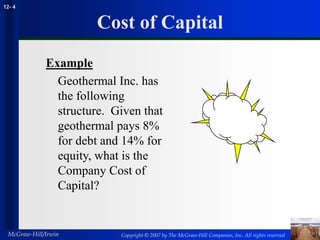
Geothermal Inc. has
the following
structure. Given that
geothermal pays 8%
for debt and 14% for
equity, what is the
Company Cost of
Capital?
Copyright © 2007 by The McGraw-Hill Companies, Inc. All rights reserved
McGraw-Hill/Irwin
12- 5
Cost of Capital
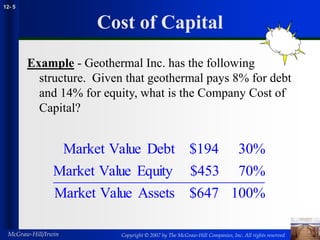
Example - Geothermal Inc. has the following
structure. Given that geothermal pays 8% for debt
and 14% for equity, what is the Company Cost of
Capital?
100%
$647
Assets
Value
Market
70%
$453
Equity
Value
Market
30%
$194
Debt
Value
Market
Copyright © 2007 by The McGraw-Hill Companies, Inc. All rights reserved
McGraw-Hill/Irwin
12- 6
Cost of Capital
Example - Geothermal Inc. has the following
structure. Given that geothermal pays 8% for debt
and 14% for equity, what is the Company Cost of
Capital?
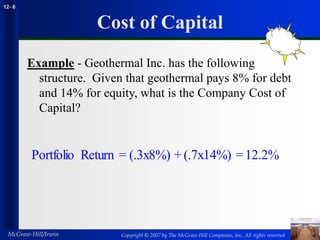
12.2%
=
(.7x14%)
+
(.3x8%)
=
Return
Portfolio
Copyright © 2007 by The McGraw-Hill Companies, Inc. All rights reserved
McGraw-Hill/Irwin
12- 7
Cost of Capital
Example - Geothermal Inc. has the following
structure. Given that geothermal pays 8% for debt
and 14% for equity, what is the Company Cost of
Capital? 12.2%
=
(.7x14%)
+
(.3x8%)
=
Return
Portfolio
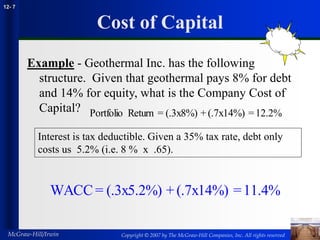
Interest is tax deductible. Given a 35% tax rate, debt only
costs us 5.2% (i.e. 8 % x .65).
11.4%
=
(.7x14%)
+
(.3x5.2%)
=
WACC
Copyright © 2007 by The McGraw-Hill Companies, Inc. All rights reserved
McGraw-Hill/Irwin
12- 8
WACC
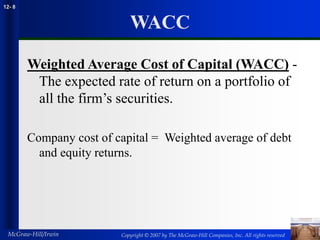
Weighted Average Cost of Capital (WACC) -
The expected rate of return on a portfolio of
all the firm’s securities.
Company cost of capital = Weighted average of debt
and equity returns.
Copyright © 2007 by The McGraw-Hill Companies, Inc. All rights reserved
McGraw-Hill/Irwin
12- 9
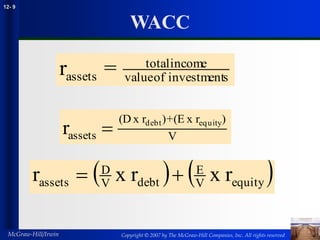
WACC
V
)
r
x
(E
+
)
r
x
(D
assets
equity
debt
r 
   
equity
V
E
debt
V
D
assets r
x
r
x
r 

s
investment
of
value
income
total
assets =
r
Copyright © 2007 by The McGraw-Hill Companies, Inc. All rights reserved
McGraw-Hill/Irwin
12- 10
WACC
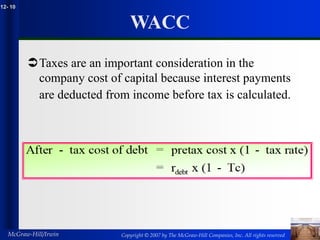
Taxes are an important consideration in the
company cost of capital because interest payments
are deducted from income before tax is calculated.
Copyright © 2007 by The McGraw-Hill Companies, Inc. All rights reserved
McGraw-Hill/Irwin
12- 11
WACC
Weighted -average cost of capital=
[ ] [ ]
WACC = x (1 - Tc)r + x r
D
V debt
E
V equity
Copyright © 2007 by The McGraw-Hill Companies, Inc. All rights reserved
McGraw-Hill/Irwin
12- 12
WACC
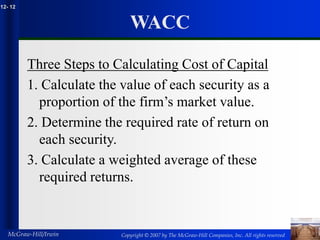
Three Steps to Calculating Cost of Capital
1. Calculate the value of each security as a
proportion of the firm’s market value.
2. Determine the required rate of return on
each security.
3. Calculate a weighted average of these
required returns.
Copyright © 2007 by The McGraw-Hill Companies, Inc. All rights reserved
McGraw-Hill/Irwin
12- 13
WACC
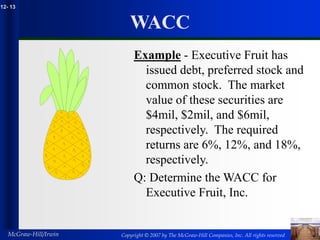
Example - Executive Fruit has
issued debt, preferred stock and
common stock. The market
value of these securities are
$4mil, $2mil, and $6mil,
respectively. The required
returns are 6%, 12%, and 18%,
respectively.
Q: Determine the WACC for
Executive Fruit, Inc.
Copyright © 2007 by The McGraw-Hill Companies, Inc. All rights reserved
McGraw-Hill/Irwin
12- 14
WACC
Example - continued
Step 1
Firm Value = 4 + 2 + 6 = $12 mil
Step 2
Required returns are given
Step 3
[ ] ( ) ( )
WACC = x(1-.35).06 + x.12 + x.18
=.123 or 12.3%
4
12
2
12
6
12
Copyright © 2007 by The McGraw-Hill Companies, Inc. All rights reserved
McGraw-Hill/Irwin
12- 15
WACC
Issues in Using WACC
Debt has two costs. 1)return on debt and 2)increased cost of
equity demanded due to the increase in risk
 Betas may change with capital structure
 Corporate taxes complicate the analysis and may change
our decision
[ ] [ ]
B = x B + x B
assets
D
V debt
E
V equity
Copyright © 2007 by The McGraw-Hill Companies, Inc. All rights reserved
McGraw-Hill/Irwin
12- 16
Measuring Capital Structure
In estimating WACC, do not use the Book
Value of securities.
In estimating WACC, use the Market Value
of the securities.
Book Values often do not represent the true
market value of a firm’s securities.
Copyright © 2007 by The McGraw-Hill Companies, Inc. All rights reserved
McGraw-Hill/Irwin
12- 17
Measuring Capital Structure
Market Value of Bonds - PV of all coupons
and par value discounted at the current
interest rate.
Copyright © 2007 by The McGraw-Hill Companies, Inc. All rights reserved
McGraw-Hill/Irwin
12- 18
Measuring Capital Structure
Market Value of Bonds - PV of all coupons
and par value discounted at the current
interest rate.
Market Value of Equity - Market price per
share multiplied by the number of
outstanding shares.
Copyright © 2007 by The McGraw-Hill Companies, Inc. All rights reserved
McGraw-Hill/Irwin
12- 19
Measuring Capital Structure
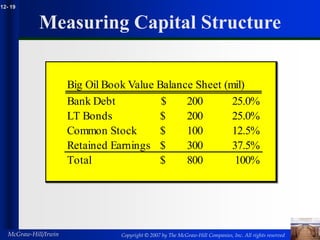
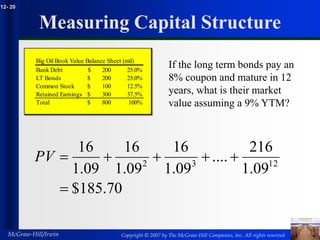
Big Oil Book Value Balance Sheet (mil)
Bank Debt 200
$ 25.0%
LT Bonds 200
$ 25.0%
Common Stock 100
$ 12.5%
Retained Earnings 300
$ 37.5%
Total 800
$ 100%
Copyright © 2007 by The McGraw-Hill Companies, Inc. All rights reserved
McGraw-Hill/Irwin
12- 20
Measuring Capital Structure
Big Oil Book Value Balance Sheet (mil)
Bank Debt 200
$ 25.0%
LT Bonds 200
$ 25.0%
Common Stock 100
$ 12.5%
Retained Earnings 300
$ 37.5%
Total 800
$ 100%
If the long term bonds pay an
8% coupon and mature in 12
years, what is their market
value assuming a 9% YTM?
70
.
185
$
09
.
1
216
....
09
.
1
16
09
.
1
16
09
.
1
16
12
3
2






PV
Copyright © 2007 by The McGraw-Hill Companies, Inc. All rights reserved
McGraw-Hill/Irwin
12- 21
Measuring Capital Structure
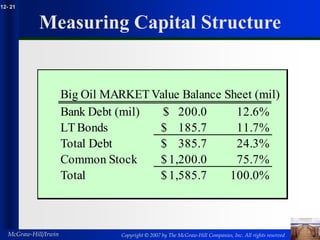
Big Oil MARKET Value Balance Sheet (mil)
Bank Debt (mil) 200.0
$ 12.6%
LT Bonds 185.7
$ 11.7%
Total Debt 385.7
$ 24.3%
Common Stock 1,200.0
$ 75.7%
Total 1,585.7
$ 100.0%
Copyright © 2007 by The McGraw-Hill Companies, Inc. All rights reserved
McGraw-Hill/Irwin
12- 22
Required Rates of Return
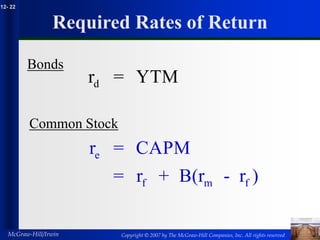
Bonds
r = YTM
d
r = CAPM
= r + B(r - r )
e
f m f
Common Stock
Copyright © 2007 by The McGraw-Hill Companies, Inc. All rights reserved
McGraw-Hill/Irwin
12- 23
Required Rates of Return
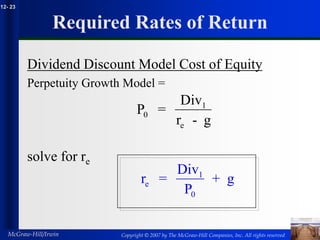
Dividend Discount Model Cost of Equity
Perpetuity Growth Model =
solve for re
P =
Div
r - g
0
1
e
r =
Div
P
+ g
e
1
0
Copyright © 2007 by The McGraw-Hill Companies, Inc. All rights reserved
McGraw-Hill/Irwin
12- 24
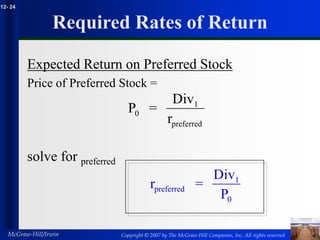
Required Rates of Return
Expected Return on Preferred Stock
Price of Preferred Stock =
solve for preferred
P =
Div
r
0
1
preferred
r =
Div
P
preferred
1
0
Copyright © 2007 by The McGraw-Hill Companies, Inc. All rights reserved
McGraw-Hill/Irwin
12- 25
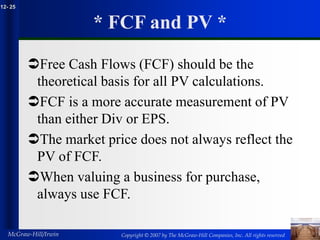
* FCF and PV *
Free Cash Flows (FCF) should be the
theoretical basis for all PV calculations.
FCF is a more accurate measurement of PV
than either Div or EPS.
The market price does not always reflect the
PV of FCF.
When valuing a business for purchase,
always use FCF.
Copyright © 2007 by The McGraw-Hill Companies, Inc. All rights reserved
McGraw-Hill/Irwin
12- 26
Capital Budgeting
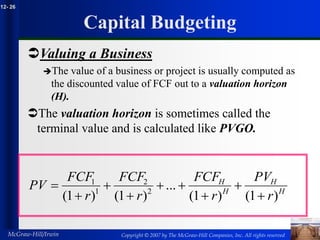
Valuing a Business
The value of a business or project is usually computed as
the discounted value of FCF out to a valuation horizon
(H).
The valuation horizon is sometimes called the
terminal value and is calculated like PVGO.
H
H
H
H
r
PV
r
FCF
r
FCF
r
FCF
PV
)
1
(
)
1
(
...
)
1
(
)
1
( 2
2
1
1









Copyright © 2007 by The McGraw-Hill Companies, Inc. All rights reserved
McGraw-Hill/Irwin
12- 27
Capital Budgeting
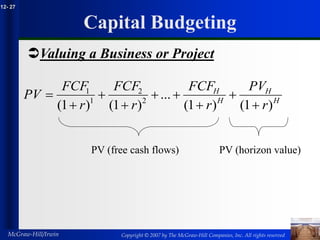
Valuing a Business or Project
H
H
H
H
r
PV
r
FCF
r
FCF
r
FCF
PV
)
1
(
)
1
(
...
)
1
(
)
1
( 2
2
1
1









PV (free cash flows) PV (horizon value)
Copyright © 2007 by The McGraw-Hill Companies, Inc. All rights reserved
McGraw-Hill/Irwin
12- 28
Capital Budgeting
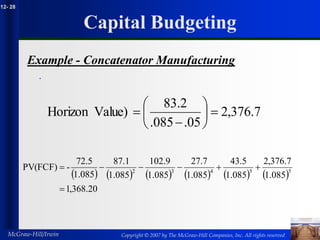
Example - Concatenator Manufacturing
.
7
.
376
,
2
05
.
085
.
2
.
83
Value)
Horizon 








           
20
.
368
,
1
085
.
1
7
.
376
,
2
085
.
1
5
.
43
085
.
1
7
.
27
085
.
1
9
.
102
085
.
1
1
.
87
085
.
1
72.5
-
PV(FCF) 5
5
4
3
2








chap012.ppt

  • 1.
    Chapter 12 Fundamentals of Corporate Finance FifthEdition Slides by Matthew Will McGraw-Hill/Irwin Copyright © 2007 by The McGraw-Hill Companies, Inc. All rights reserved The Weighted-Average Cost of Capital and Company Valuation
  • 2.
    Copyright © 2007by The McGraw-Hill Companies, Inc. All rights reserved McGraw-Hill/Irwin 12- 2 Topics Covered Geothermal’s Cost of Capital Weighted Average Cost of Capital (WACC) Measuring Capital Structure Calculating Required Rates of Return Calculating WACC Interpreting WACC Valuing Entire Businesses
  • 3.
    Copyright © 2007by The McGraw-Hill Companies, Inc. All rights reserved McGraw-Hill/Irwin 12- 3 Cost of Capital Cost of Capital - The return the firm’s investors could expect to earn if they invested in securities with comparable degrees of risk. Capital Structure - The firm’s mix of long term financing and equity financing.
  • 4.
    Copyright © 2007by The McGraw-Hill Companies, Inc. All rights reserved McGraw-Hill/Irwin 12- 4 Cost of Capital Example Geothermal Inc. has the following structure. Given that geothermal pays 8% for debt and 14% for equity, what is the Company Cost of Capital?
  • 5.
    Copyright © 2007by The McGraw-Hill Companies, Inc. All rights reserved McGraw-Hill/Irwin 12- 5 Cost of Capital Example - Geothermal Inc. has the following structure. Given that geothermal pays 8% for debt and 14% for equity, what is the Company Cost of Capital? 100% $647 Assets Value Market 70% $453 Equity Value Market 30% $194 Debt Value Market
  • 6.
    Copyright © 2007by The McGraw-Hill Companies, Inc. All rights reserved McGraw-Hill/Irwin 12- 6 Cost of Capital Example - Geothermal Inc. has the following structure. Given that geothermal pays 8% for debt and 14% for equity, what is the Company Cost of Capital? 12.2% = (.7x14%) + (.3x8%) = Return Portfolio
  • 7.
    Copyright © 2007by The McGraw-Hill Companies, Inc. All rights reserved McGraw-Hill/Irwin 12- 7 Cost of Capital Example - Geothermal Inc. has the following structure. Given that geothermal pays 8% for debt and 14% for equity, what is the Company Cost of Capital? 12.2% = (.7x14%) + (.3x8%) = Return Portfolio Interest is tax deductible. Given a 35% tax rate, debt only costs us 5.2% (i.e. 8 % x .65). 11.4% = (.7x14%) + (.3x5.2%) = WACC
  • 8.
    Copyright © 2007by The McGraw-Hill Companies, Inc. All rights reserved McGraw-Hill/Irwin 12- 8 WACC Weighted Average Cost of Capital (WACC) - The expected rate of return on a portfolio of all the firm’s securities. Company cost of capital = Weighted average of debt and equity returns.
  • 9.
    Copyright © 2007by The McGraw-Hill Companies, Inc. All rights reserved McGraw-Hill/Irwin 12- 9 WACC V ) r x (E + ) r x (D assets equity debt r      equity V E debt V D assets r x r x r   s investment of value income total assets = r
  • 10.
    Copyright © 2007by The McGraw-Hill Companies, Inc. All rights reserved McGraw-Hill/Irwin 12- 10 WACC Taxes are an important consideration in the company cost of capital because interest payments are deducted from income before tax is calculated.
  • 11.
    Copyright © 2007by The McGraw-Hill Companies, Inc. All rights reserved McGraw-Hill/Irwin 12- 11 WACC Weighted -average cost of capital= [ ] [ ] WACC = x (1 - Tc)r + x r D V debt E V equity
  • 12.
    Copyright © 2007by The McGraw-Hill Companies, Inc. All rights reserved McGraw-Hill/Irwin 12- 12 WACC Three Steps to Calculating Cost of Capital 1. Calculate the value of each security as a proportion of the firm’s market value. 2. Determine the required rate of return on each security. 3. Calculate a weighted average of these required returns.
  • 13.
    Copyright © 2007by The McGraw-Hill Companies, Inc. All rights reserved McGraw-Hill/Irwin 12- 13 WACC Example - Executive Fruit has issued debt, preferred stock and common stock. The market value of these securities are $4mil, $2mil, and $6mil, respectively. The required returns are 6%, 12%, and 18%, respectively. Q: Determine the WACC for Executive Fruit, Inc.
  • 14.
    Copyright © 2007by The McGraw-Hill Companies, Inc. All rights reserved McGraw-Hill/Irwin 12- 14 WACC Example - continued Step 1 Firm Value = 4 + 2 + 6 = $12 mil Step 2 Required returns are given Step 3 [ ] ( ) ( ) WACC = x(1-.35).06 + x.12 + x.18 =.123 or 12.3% 4 12 2 12 6 12
  • 15.
    Copyright © 2007by The McGraw-Hill Companies, Inc. All rights reserved McGraw-Hill/Irwin 12- 15 WACC Issues in Using WACC Debt has two costs. 1)return on debt and 2)increased cost of equity demanded due to the increase in risk  Betas may change with capital structure  Corporate taxes complicate the analysis and may change our decision [ ] [ ] B = x B + x B assets D V debt E V equity
  • 16.
    Copyright © 2007by The McGraw-Hill Companies, Inc. All rights reserved McGraw-Hill/Irwin 12- 16 Measuring Capital Structure In estimating WACC, do not use the Book Value of securities. In estimating WACC, use the Market Value of the securities. Book Values often do not represent the true market value of a firm’s securities.
  • 17.
    Copyright © 2007by The McGraw-Hill Companies, Inc. All rights reserved McGraw-Hill/Irwin 12- 17 Measuring Capital Structure Market Value of Bonds - PV of all coupons and par value discounted at the current interest rate.
  • 18.
    Copyright © 2007by The McGraw-Hill Companies, Inc. All rights reserved McGraw-Hill/Irwin 12- 18 Measuring Capital Structure Market Value of Bonds - PV of all coupons and par value discounted at the current interest rate. Market Value of Equity - Market price per share multiplied by the number of outstanding shares.
  • 19.
    Copyright © 2007by The McGraw-Hill Companies, Inc. All rights reserved McGraw-Hill/Irwin 12- 19 Measuring Capital Structure Big Oil Book Value Balance Sheet (mil) Bank Debt 200 $ 25.0% LT Bonds 200 $ 25.0% Common Stock 100 $ 12.5% Retained Earnings 300 $ 37.5% Total 800 $ 100%
  • 20.
    Copyright © 2007by The McGraw-Hill Companies, Inc. All rights reserved McGraw-Hill/Irwin 12- 20 Measuring Capital Structure Big Oil Book Value Balance Sheet (mil) Bank Debt 200 $ 25.0% LT Bonds 200 $ 25.0% Common Stock 100 $ 12.5% Retained Earnings 300 $ 37.5% Total 800 $ 100% If the long term bonds pay an 8% coupon and mature in 12 years, what is their market value assuming a 9% YTM? 70 . 185 $ 09 . 1 216 .... 09 . 1 16 09 . 1 16 09 . 1 16 12 3 2       PV
  • 21.
    Copyright © 2007by The McGraw-Hill Companies, Inc. All rights reserved McGraw-Hill/Irwin 12- 21 Measuring Capital Structure Big Oil MARKET Value Balance Sheet (mil) Bank Debt (mil) 200.0 $ 12.6% LT Bonds 185.7 $ 11.7% Total Debt 385.7 $ 24.3% Common Stock 1,200.0 $ 75.7% Total 1,585.7 $ 100.0%
  • 22.
    Copyright © 2007by The McGraw-Hill Companies, Inc. All rights reserved McGraw-Hill/Irwin 12- 22 Required Rates of Return Bonds r = YTM d r = CAPM = r + B(r - r ) e f m f Common Stock
  • 23.
    Copyright © 2007by The McGraw-Hill Companies, Inc. All rights reserved McGraw-Hill/Irwin 12- 23 Required Rates of Return Dividend Discount Model Cost of Equity Perpetuity Growth Model = solve for re P = Div r - g 0 1 e r = Div P + g e 1 0
  • 24.
    Copyright © 2007by The McGraw-Hill Companies, Inc. All rights reserved McGraw-Hill/Irwin 12- 24 Required Rates of Return Expected Return on Preferred Stock Price of Preferred Stock = solve for preferred P = Div r 0 1 preferred r = Div P preferred 1 0
  • 25.
    Copyright © 2007by The McGraw-Hill Companies, Inc. All rights reserved McGraw-Hill/Irwin 12- 25 * FCF and PV * Free Cash Flows (FCF) should be the theoretical basis for all PV calculations. FCF is a more accurate measurement of PV than either Div or EPS. The market price does not always reflect the PV of FCF. When valuing a business for purchase, always use FCF.
  • 26.
    Copyright © 2007by The McGraw-Hill Companies, Inc. All rights reserved McGraw-Hill/Irwin 12- 26 Capital Budgeting Valuing a Business The value of a business or project is usually computed as the discounted value of FCF out to a valuation horizon (H). The valuation horizon is sometimes called the terminal value and is calculated like PVGO. H H H H r PV r FCF r FCF r FCF PV ) 1 ( ) 1 ( ... ) 1 ( ) 1 ( 2 2 1 1         
  • 27.
    Copyright © 2007by The McGraw-Hill Companies, Inc. All rights reserved McGraw-Hill/Irwin 12- 27 Capital Budgeting Valuing a Business or Project H H H H r PV r FCF r FCF r FCF PV ) 1 ( ) 1 ( ... ) 1 ( ) 1 ( 2 2 1 1          PV (free cash flows) PV (horizon value)
  • 28.
    Copyright © 2007by The McGraw-Hill Companies, Inc. All rights reserved McGraw-Hill/Irwin 12- 28 Capital Budgeting Example - Concatenator Manufacturing . 7 . 376 , 2 05 . 085 . 2 . 83 Value) Horizon                      20 . 368 , 1 085 . 1 7 . 376 , 2 085 . 1 5 . 43 085 . 1 7 . 27 085 . 1 9 . 102 085 . 1 1 . 87 085 . 1 72.5 - PV(FCF) 5 5 4 3 2       