Segmentation

CS 537 – Introduction to Operating Systems
Segmentation
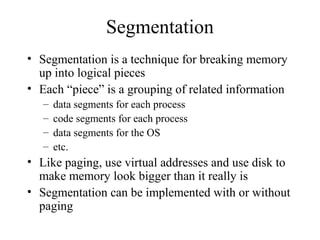
• Segmentation is a technique for breaking memory
  up into logical pieces
• Each “piece” is a grouping of related information
   –   data segments for each process
   –   code segments for each process
   –   data segments for the OS
   –   etc.
• Like paging, use virtual addresses and use disk to
  make memory look bigger than it really is
• Segmentation can be implemented with or without
  paging
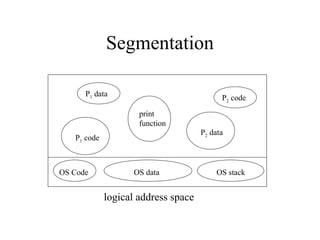
Segmentation

      P1 data                              P2 code

                     print
                     function
                                     P2 data
   P1 code


OS Code             OS data               OS stack


             logical address space
Addressing Segments
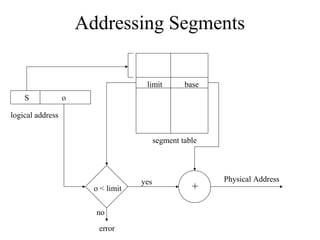
• Let’s first assume no paging in the system
• User generates logical addresses
• These addresses consist of a segment number and
  an offset into the segment
• Use segment number to index into a table
• Table contains the physical address of the start of
  the segment
   – often called the base address
• Add the offset to the base and generate the
  physical address
   – before doing this, check the offset against a limit
   – the limit is the size of the segment
Addressing Segments

                                     limit         base
    S             o

logical address


                                          segment table


                                    yes                   Physical Address
                        o < limit                    +

                        no

                         error
Segmentation Hardware
• Sounds very similar to paging
• Big difference – segments can be variable in size
• As with paging, to be effective hardware must be
  used to translate logical address
• Most systems provide segment registers
• If a reference isn’t found in one of the segment
  registers
   – trap to operating system
   – OS does lookup in segment table and loads new
     segment descriptor into the register
   – return control to the user and resume
• Again, similar to paging
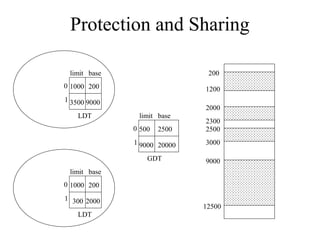
Protection and Sharing
• Like page tables, each process usually gets
  its own segment table
• Unlike page tables, there usually exists a
  global segment table for everyone
  – this, however, is usually used by OS
• Access rights for segment are usually
  included in table entry
• Multiple processes can share a segment
Protection and Sharing

 limit base                   200
0 1000 200                   1200
1 3500 9000
                             2000
    LDT        limit base
                             2300
              0 500   2500   2500
              1 9000 20000   3000

                  GDT        9000
 limit base
0 1000 200
1 300 2000
                             12500
    LDT
Segmentation Issues
• Entire segment is either in memory or on
  disk
• Variable sized segments leads to external
  fragmentation in memory
• Must find a space big enough to place
  segment into
• May need to swap out some segments to
  bring a new segment in
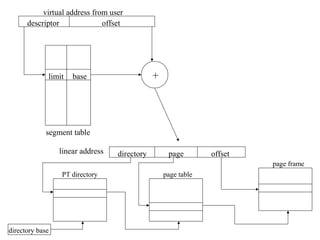
Segmentation with Paging
• Most architectures support segmentation and
  paging
• Basic idea,
   – segments exist in virtual address space
   – base address in segment descriptor table is a virtual
     address
   – use paging mechanism to translate this virtual address
     into a physical address
• Now an entire segment does not have to be in
  memory at one time
   – only the part of the segment that we need will be in
     memory
Linear Address
• The base address gotten from the segment
  descriptor table is concatenated with the
  offset
• This new address is often referred to as a
  linear address
• This is the address that is translated by the
  paging hardware
virtual address from user
      descriptor              offset


             limit   base                     +


             segment table

                 linear address   directory        page        offset
                                                                        page frame
                 PT directory                     page table


directory base

Segmentation geekssay.com

  • 1.
    Segmentation CS 537 –Introduction to Operating Systems
  • 2.
    Segmentation • Segmentation isa technique for breaking memory up into logical pieces • Each “piece” is a grouping of related information – data segments for each process – code segments for each process – data segments for the OS – etc. • Like paging, use virtual addresses and use disk to make memory look bigger than it really is • Segmentation can be implemented with or without paging
  • 3.
    Segmentation P1 data P2 code print function P2 data P1 code OS Code OS data OS stack logical address space
  • 4.
    Addressing Segments • Let’sfirst assume no paging in the system • User generates logical addresses • These addresses consist of a segment number and an offset into the segment • Use segment number to index into a table • Table contains the physical address of the start of the segment – often called the base address • Add the offset to the base and generate the physical address – before doing this, check the offset against a limit – the limit is the size of the segment
  • 5.
    Addressing Segments limit base S o logical address segment table yes Physical Address o < limit + no error
  • 6.
    Segmentation Hardware • Soundsvery similar to paging • Big difference – segments can be variable in size • As with paging, to be effective hardware must be used to translate logical address • Most systems provide segment registers • If a reference isn’t found in one of the segment registers – trap to operating system – OS does lookup in segment table and loads new segment descriptor into the register – return control to the user and resume • Again, similar to paging
  • 7.
    Protection and Sharing •Like page tables, each process usually gets its own segment table • Unlike page tables, there usually exists a global segment table for everyone – this, however, is usually used by OS • Access rights for segment are usually included in table entry • Multiple processes can share a segment
  • 8.
    Protection and Sharing limit base 200 0 1000 200 1200 1 3500 9000 2000 LDT limit base 2300 0 500 2500 2500 1 9000 20000 3000 GDT 9000 limit base 0 1000 200 1 300 2000 12500 LDT
  • 9.
    Segmentation Issues • Entiresegment is either in memory or on disk • Variable sized segments leads to external fragmentation in memory • Must find a space big enough to place segment into • May need to swap out some segments to bring a new segment in
  • 10.
    Segmentation with Paging •Most architectures support segmentation and paging • Basic idea, – segments exist in virtual address space – base address in segment descriptor table is a virtual address – use paging mechanism to translate this virtual address into a physical address • Now an entire segment does not have to be in memory at one time – only the part of the segment that we need will be in memory
  • 11.
    Linear Address • Thebase address gotten from the segment descriptor table is concatenated with the offset • This new address is often referred to as a linear address • This is the address that is translated by the paging hardware
  • 12.
    virtual address fromuser descriptor offset limit base + segment table linear address directory page offset page frame PT directory page table directory base