8.4 paging 
 Paging is a memory-management scheme 
that permits the physical address space of a 
process to be non-contiguous. 
 The basic method for implementation involves 
breaking physical memory into fixed-sized 
blocks called FRAMES and break logical 
memory into blocks of the same size called 
PAGES
Paging 
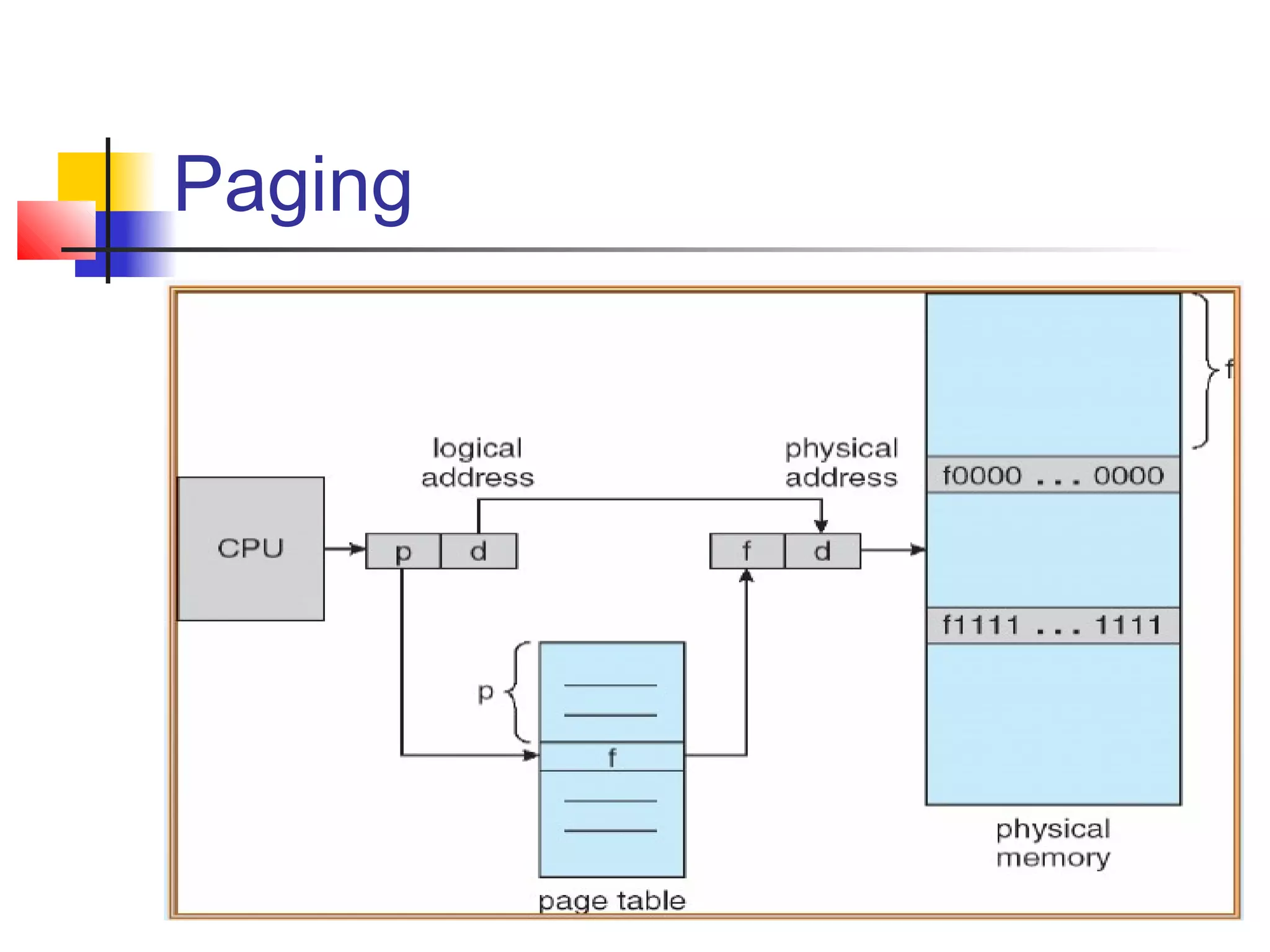
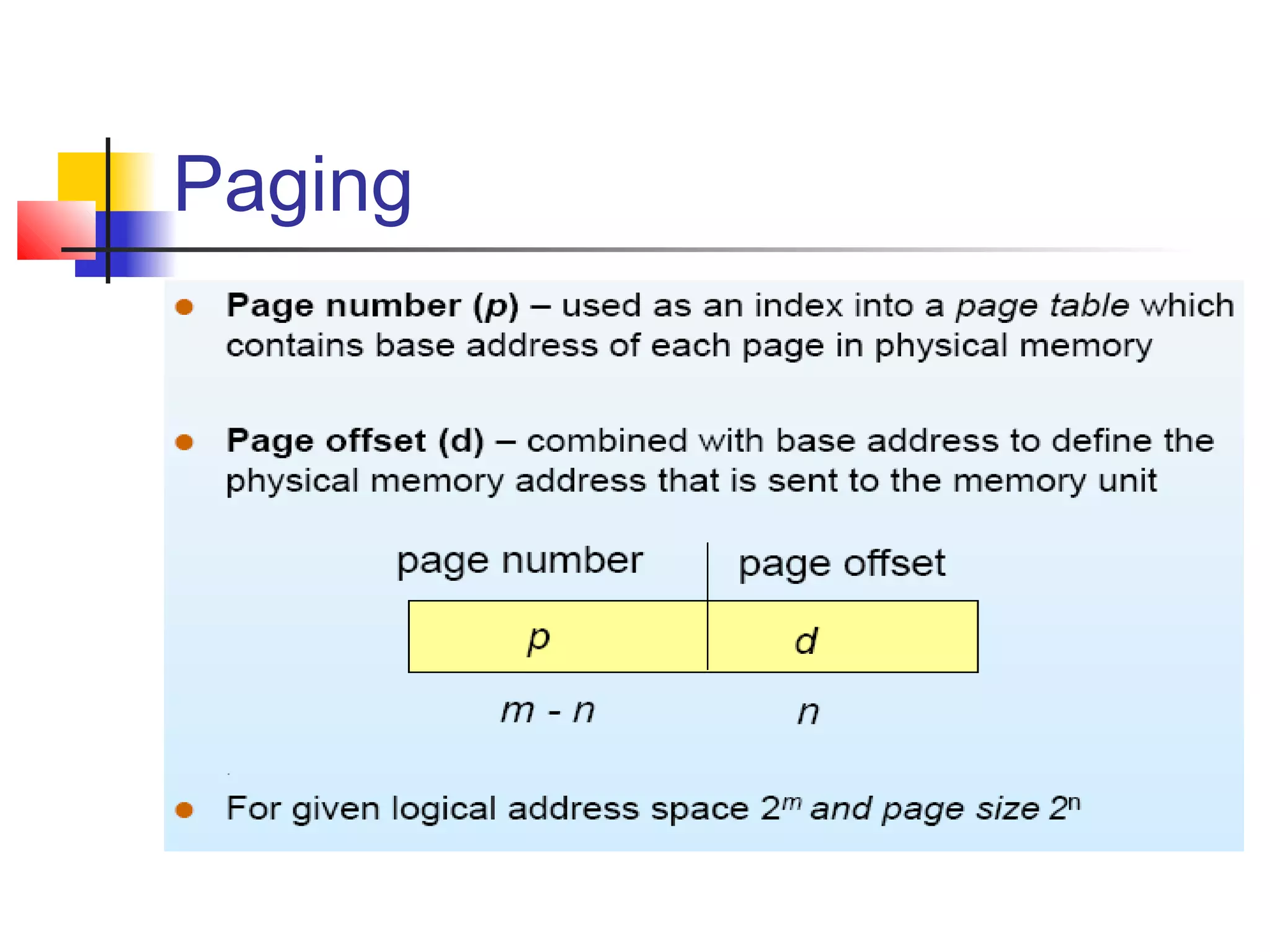
 Every address generated by the CPU is 
divided into two parts: Page number 
(p) and Page offset (d) 
 The page number is used as an index 
into a Page Table
Paging
Paging
Paging 
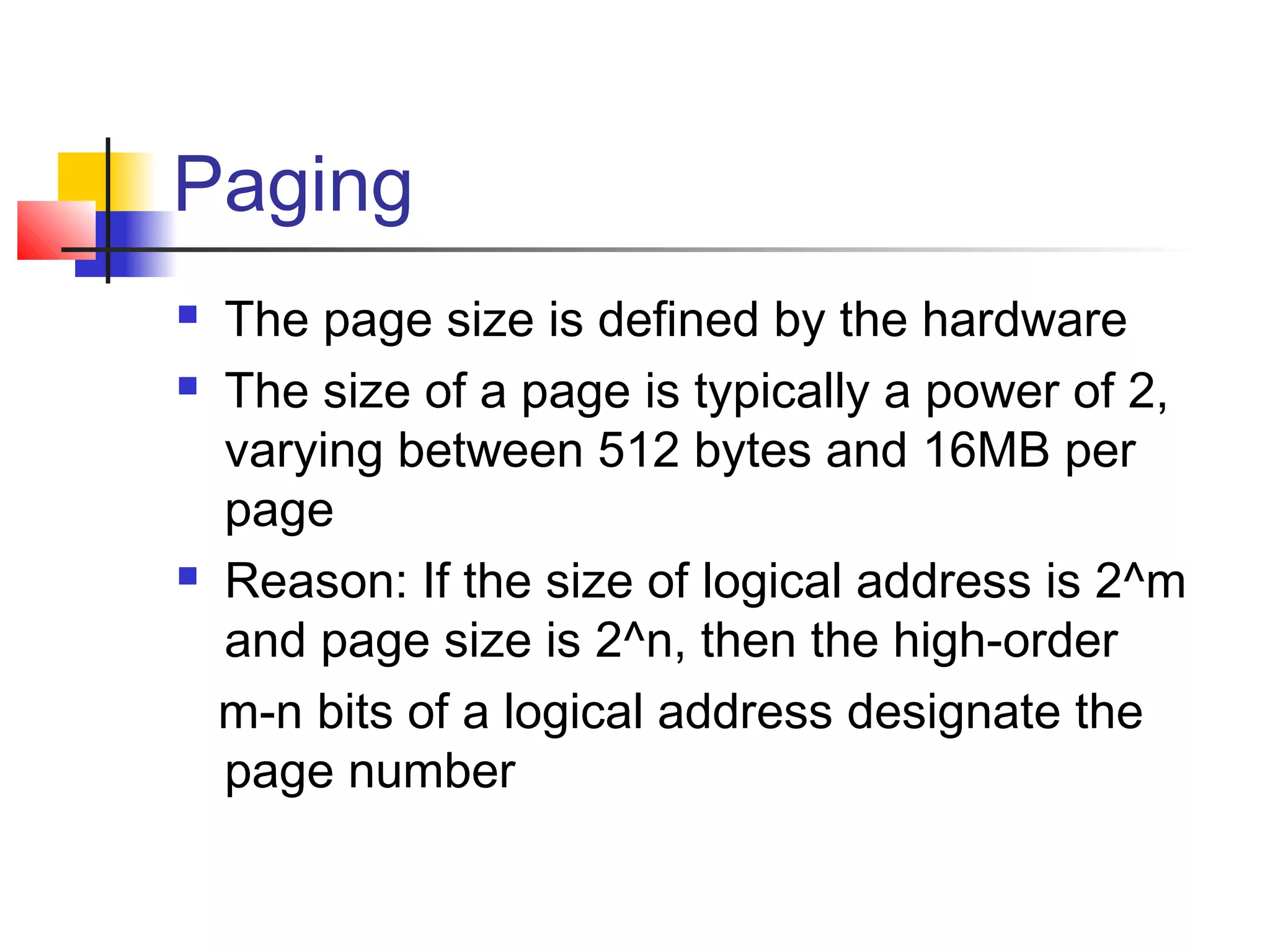
 The page size is defined by the hardware 
 The size of a page is typically a power of 2, 
varying between 512 bytes and 16MB per 
page 
 Reason: If the size of logical address is 2^m 
and page size is 2^n, then the high-order 
m-n bits of a logical address designate the 
page number
Paging
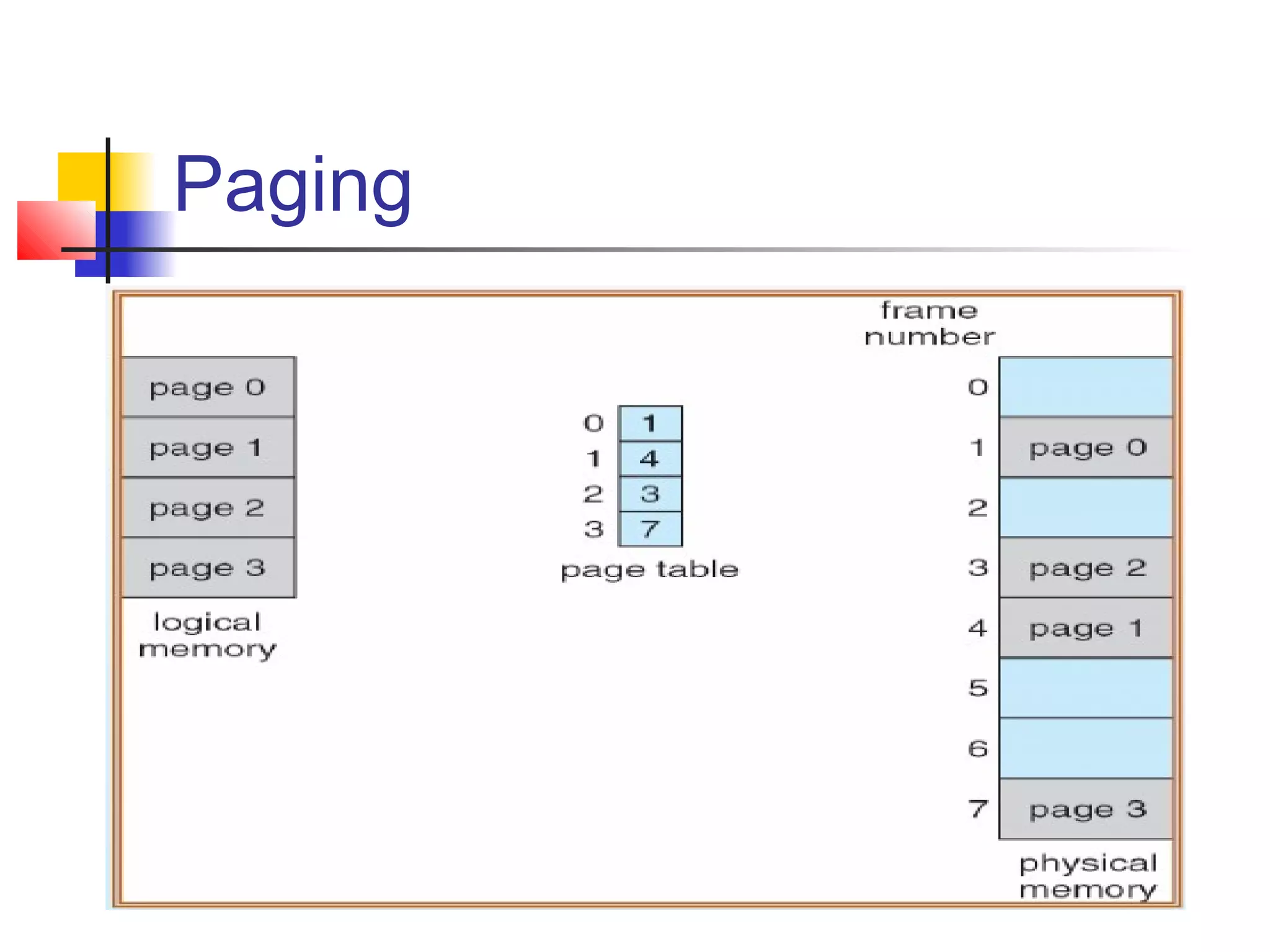
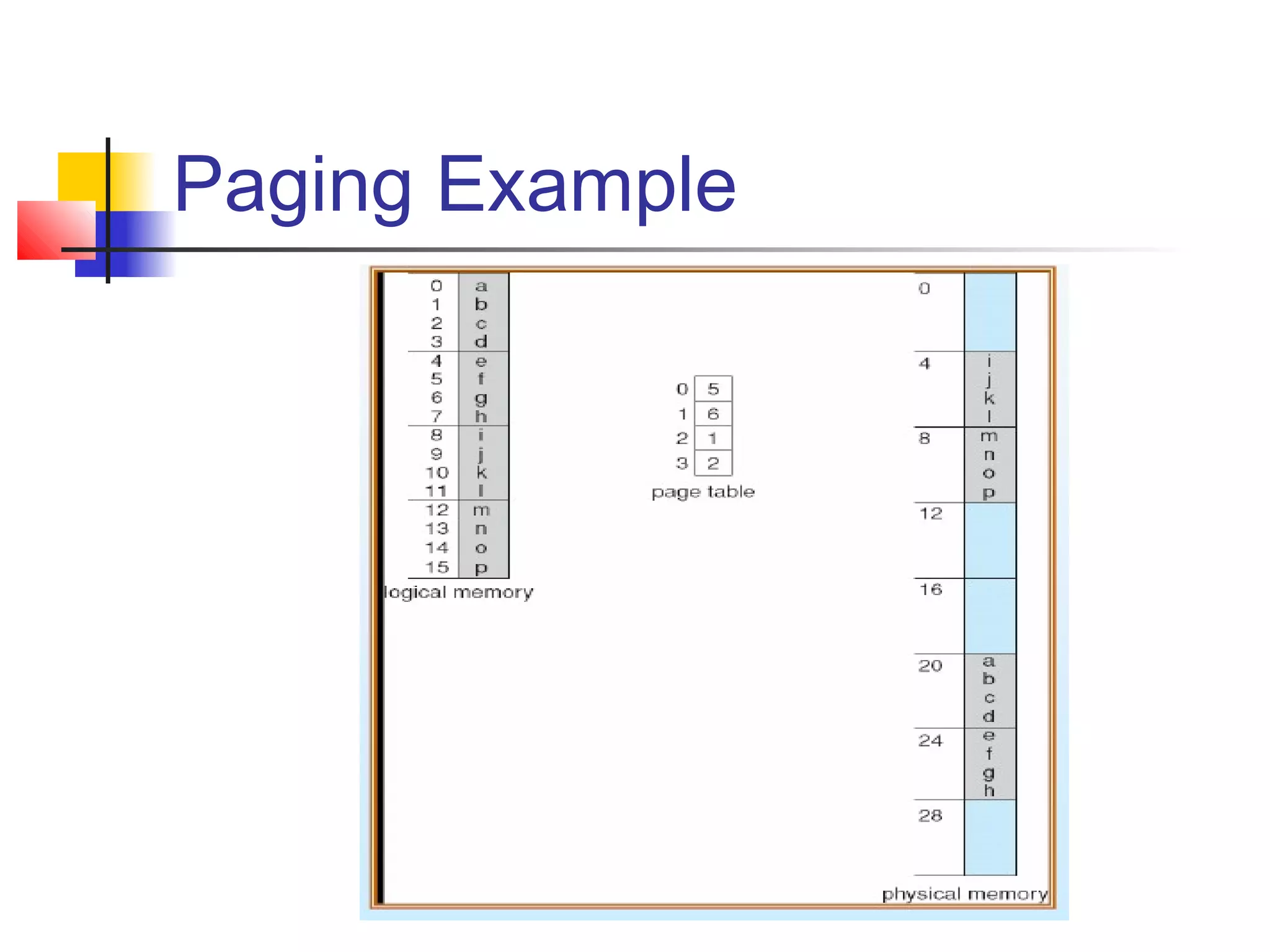
Paging Example
Paging 
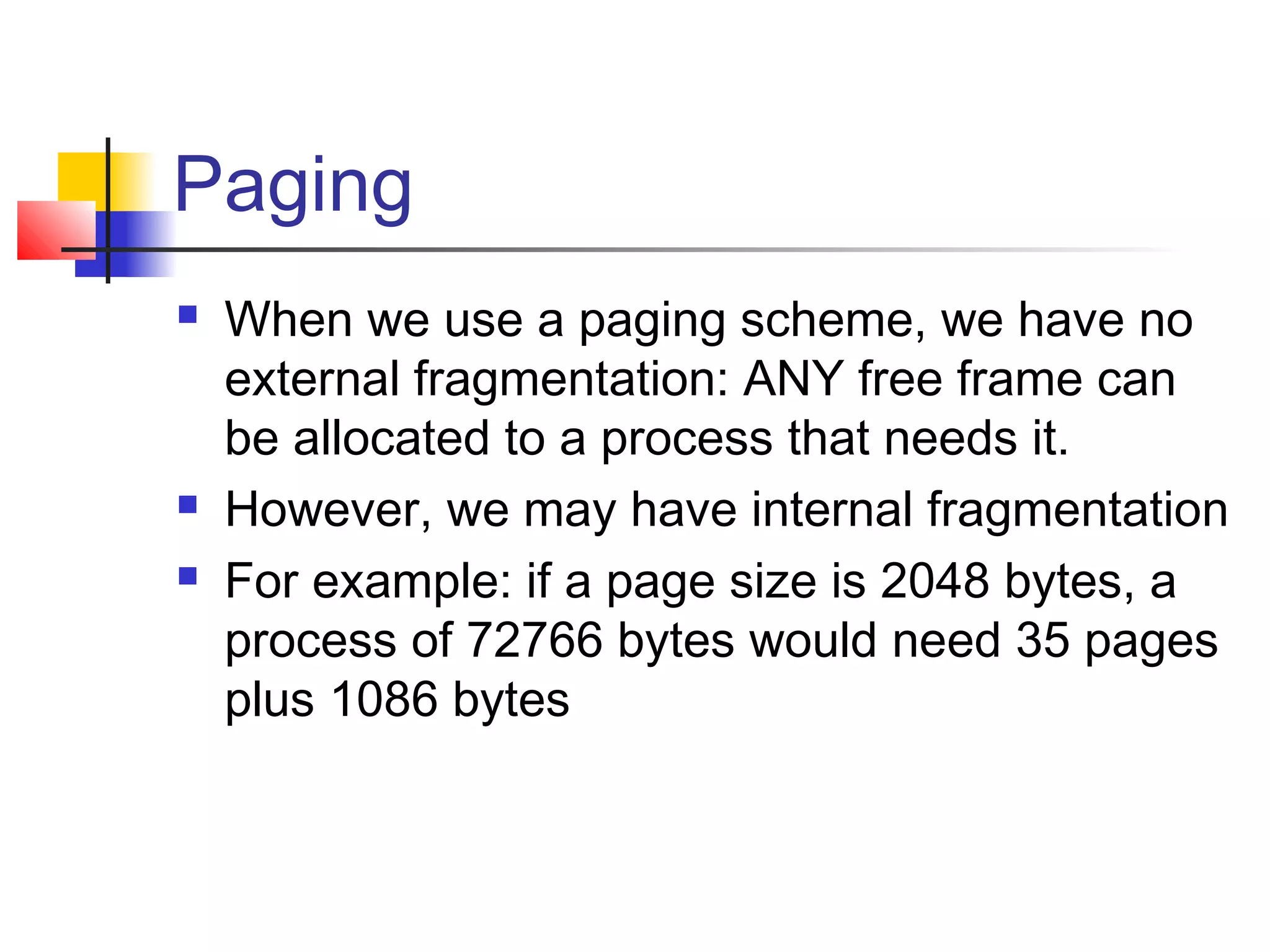
 When we use a paging scheme, we have no 
external fragmentation: ANY free frame can 
be allocated to a process that needs it. 
 However, we may have internal fragmentation 
 For example: if a page size is 2048 bytes, a 
process of 72766 bytes would need 35 pages 
plus 1086 bytes
Paging 
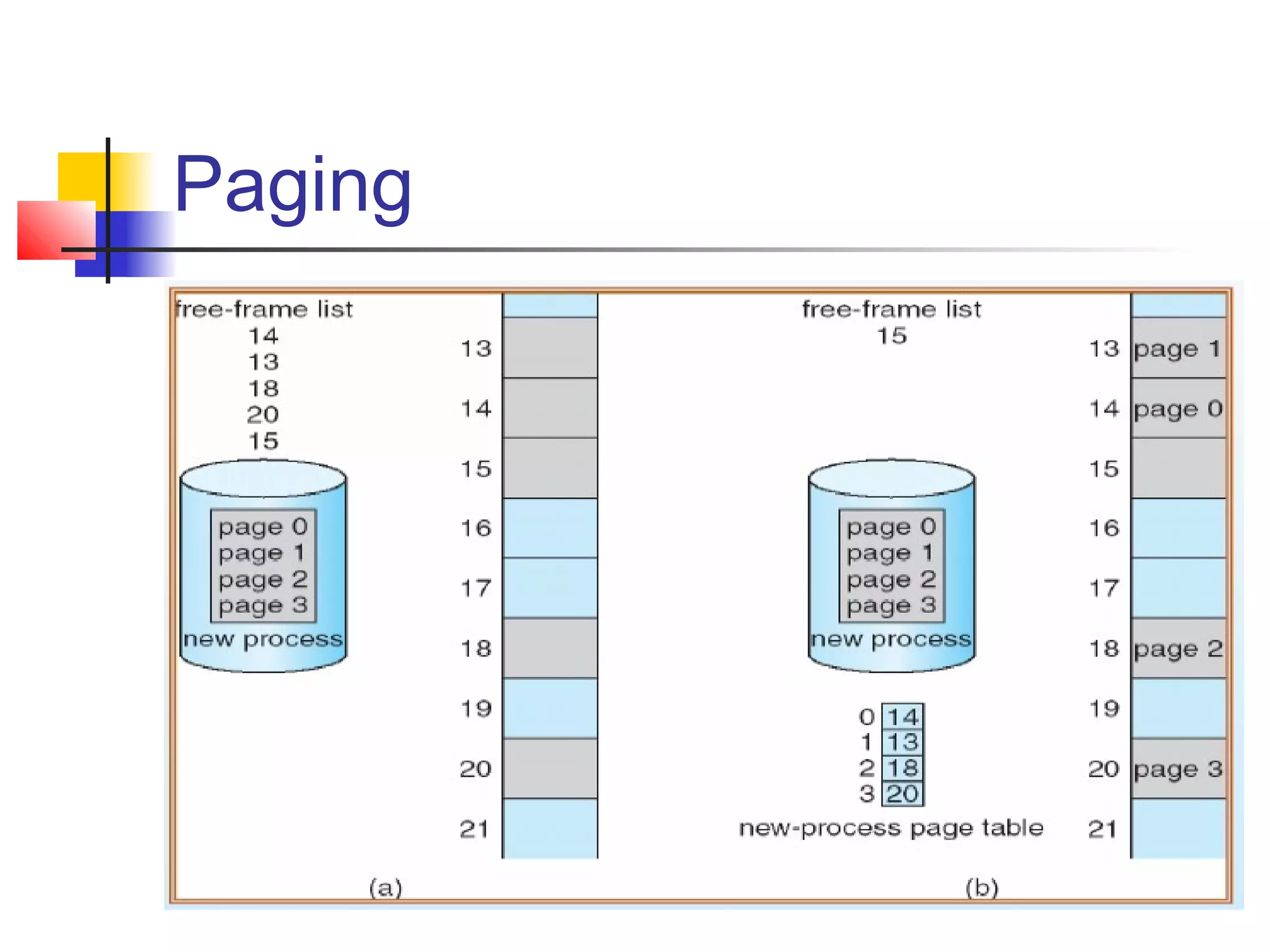
 If the process requires n pages, at least 
n frames are required 
 The first page of the process is loaded 
into the first frame listed on free-frame 
list, and the frame number is put into 
page table
Paging
Hardware Support on Paging 
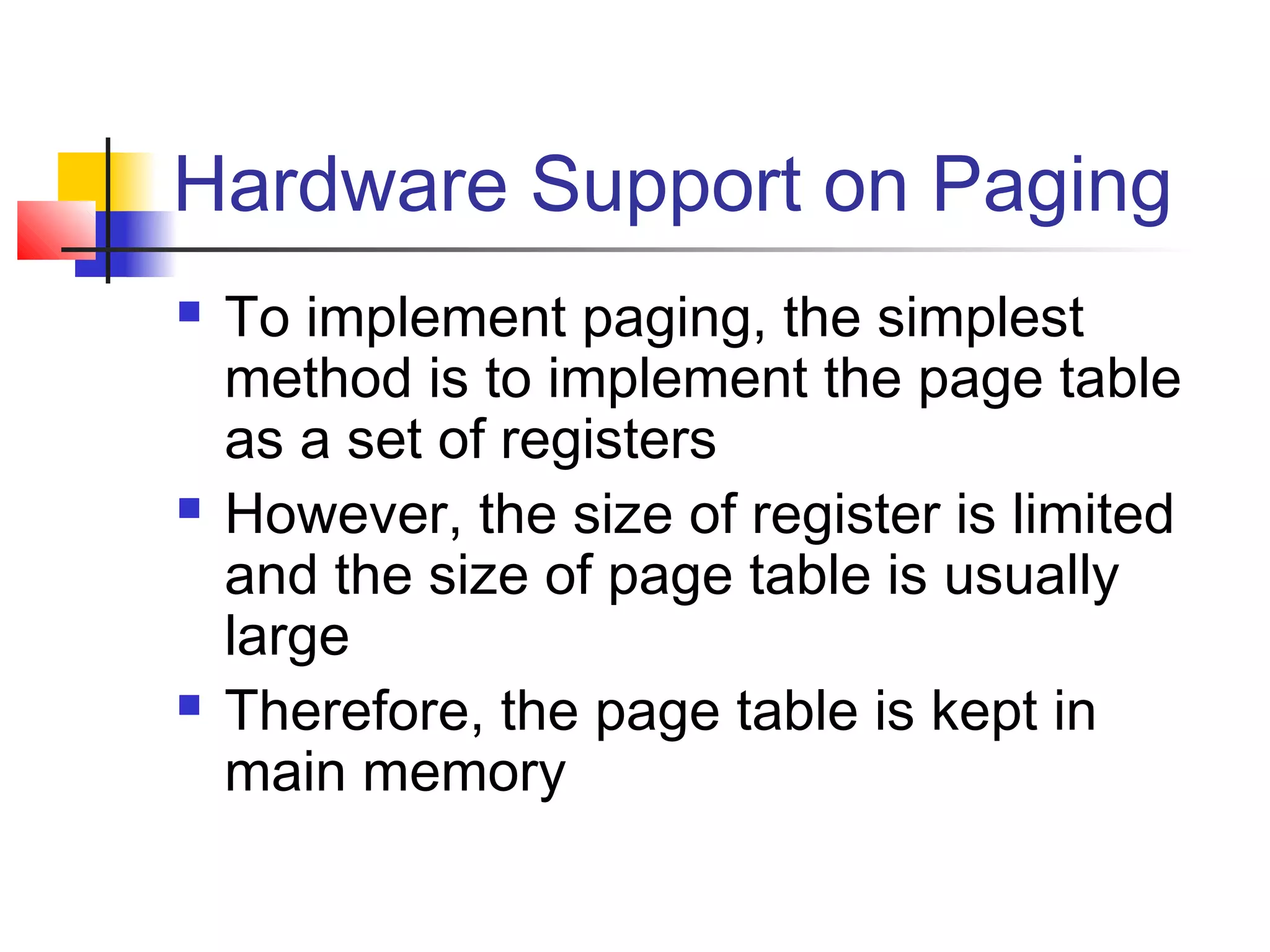
 To implement paging, the simplest 
method is to implement the page table 
as a set of registers 
 However, the size of register is limited 
and the size of page table is usually 
large 
 Therefore, the page table is kept in 
main memory
Hardware Support on Paging 
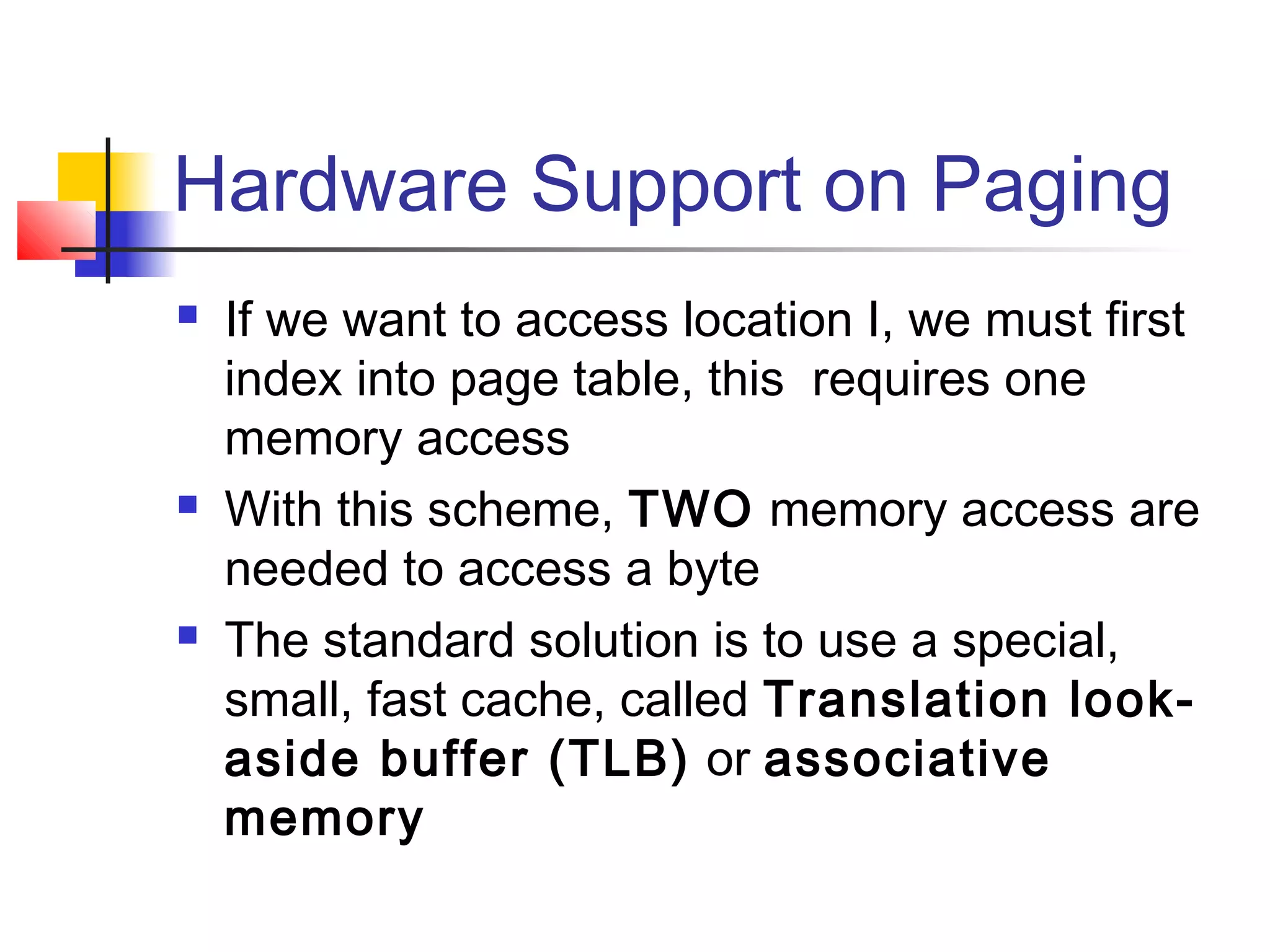
 If we want to access location I, we must first 
index into page table, this requires one 
memory access 
 With this scheme, TWO memory access are 
needed to access a byte 
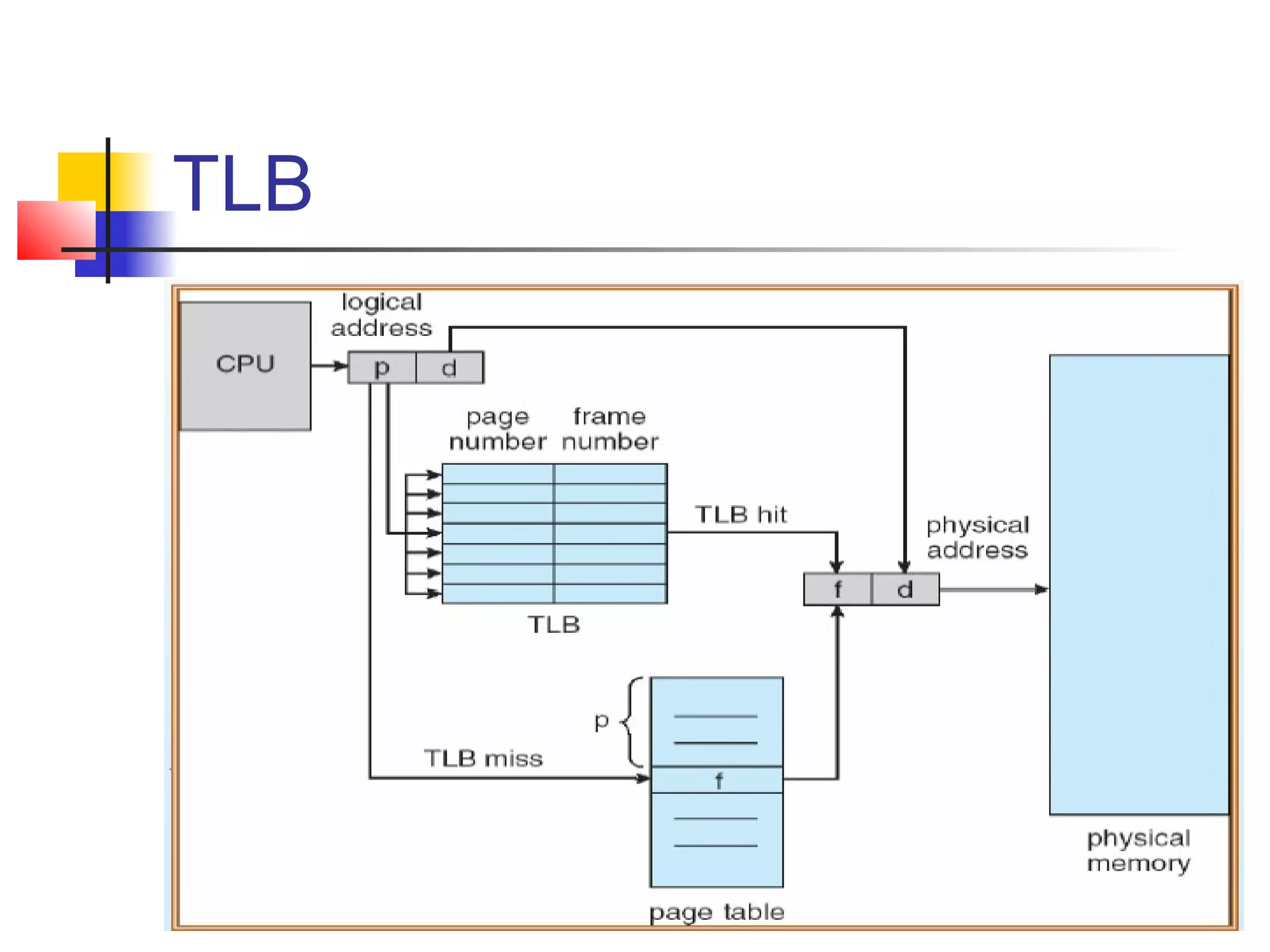
 The standard solution is to use a special, 
small, fast cache, called Translation look-aside 
buffer (TLB) or associative 
memory
TLB
TLB 
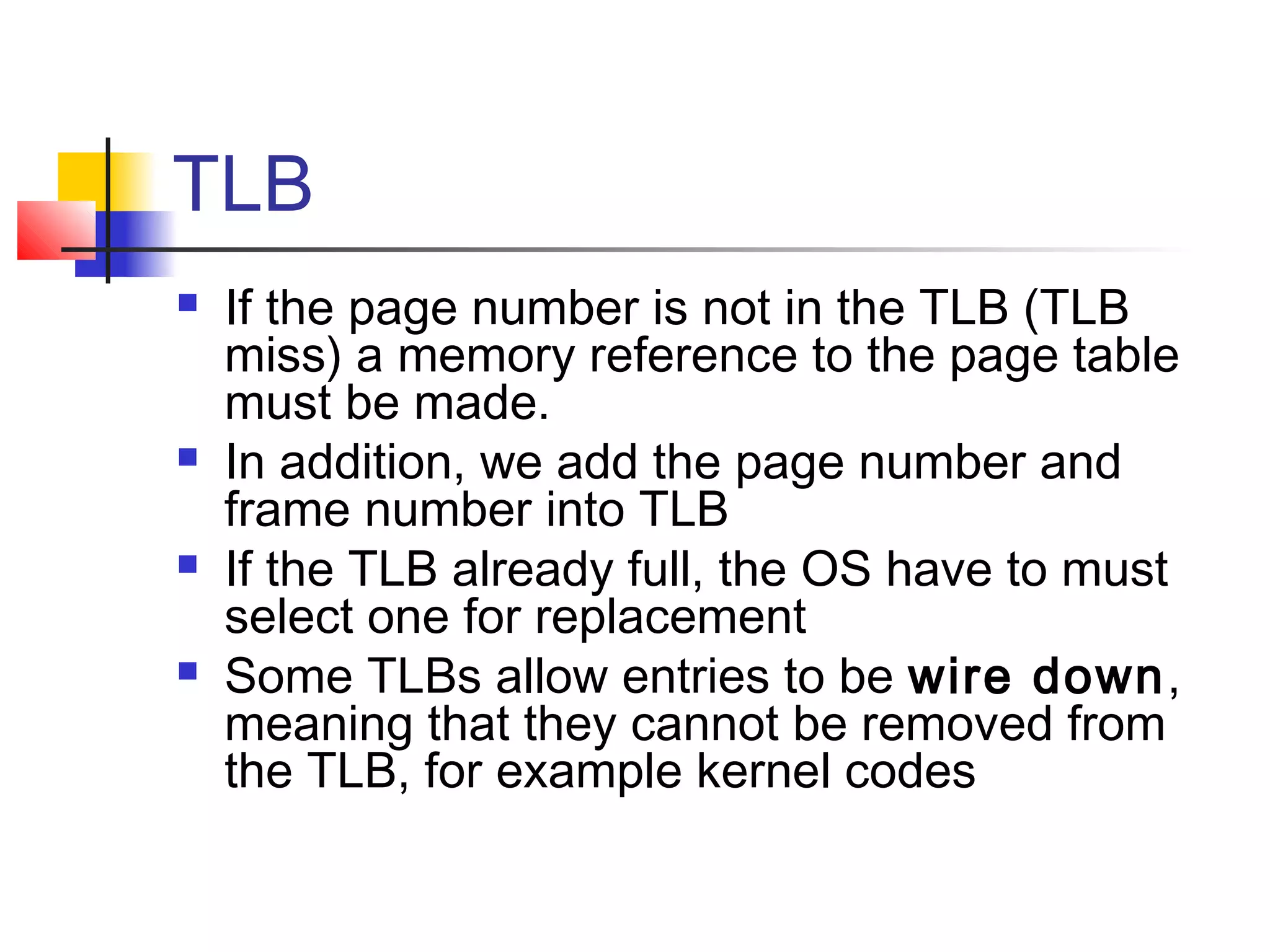
 If the page number is not in the TLB (TLB 
miss) a memory reference to the page table 
must be made. 
 In addition, we add the page number and 
frame number into TLB 
 If the TLB already full, the OS have to must 
select one for replacement 
 Some TLBs allow entries to be wire down, 
meaning that they cannot be removed from 
the TLB, for example kernel codes
TLB 
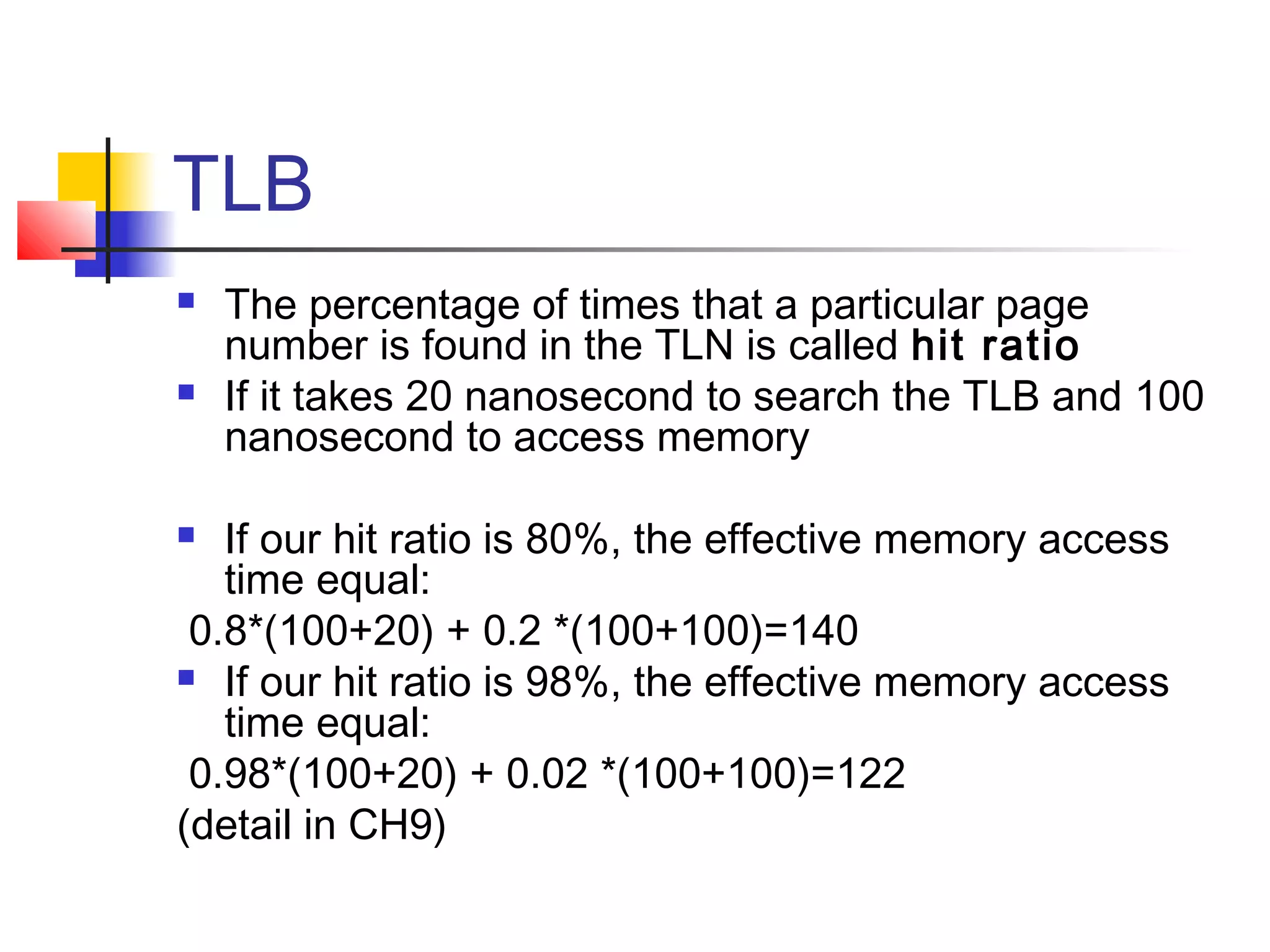
 The percentage of times that a particular page 
number is found in the TLN is called hit ratio 
 If it takes 20 nanosecond to search the TLB and 100 
nanosecond to access memory 
 If our hit ratio is 80%, the effective memory access 
time equal: 
0.8*(100+20) + 0.2 *(100+100)=140 
 If our hit ratio is 98%, the effective memory access 
time equal: 
0.98*(100+20) + 0.02 *(100+100)=122 
(detail in CH9)
Memory Protection 
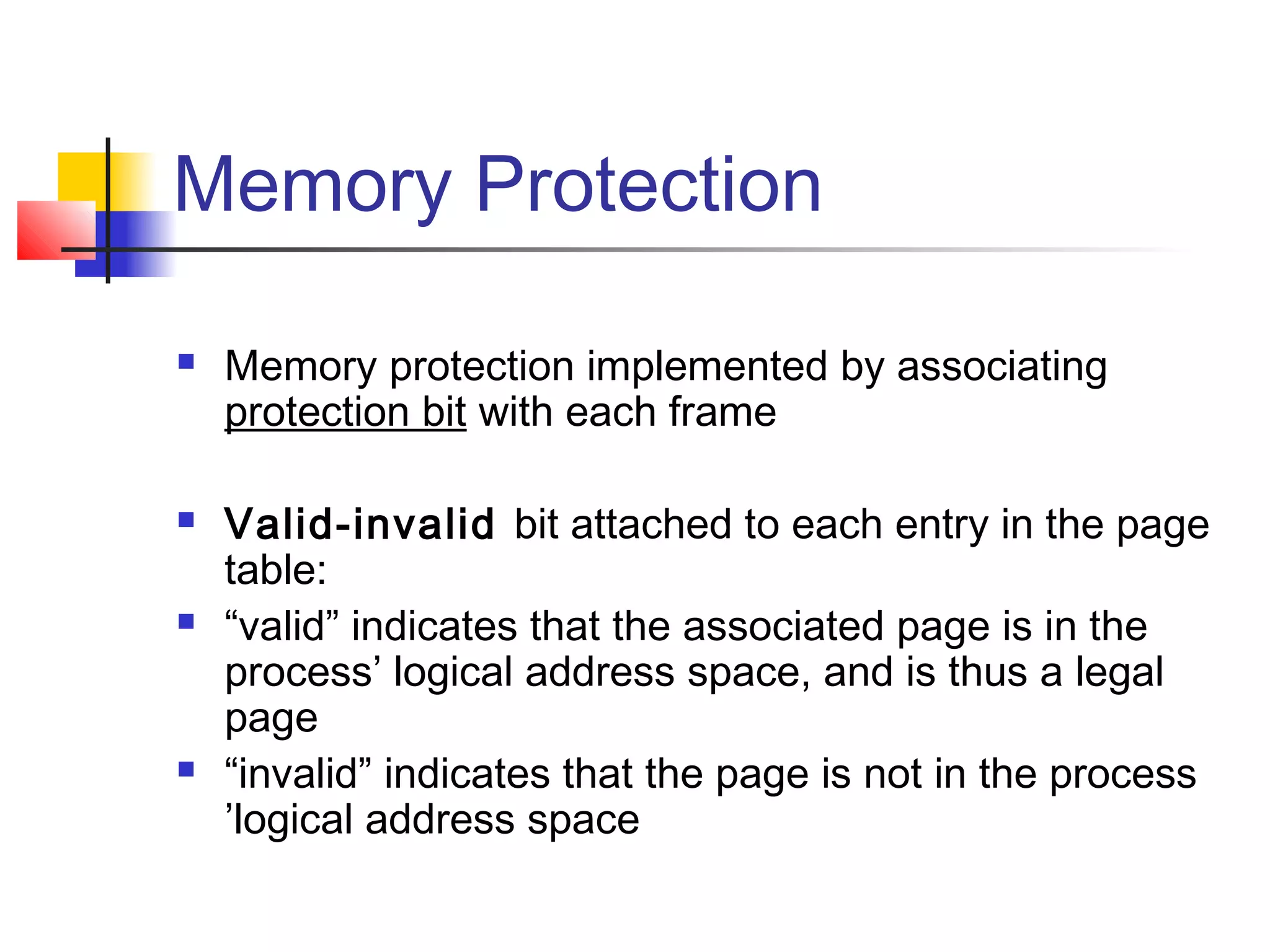
 Memory protection implemented by associating 
protection bit with each frame 
 Valid-invalid bit attached to each entry in the page 
table: 
 “valid” indicates that the associated page is in the 
process’ logical address space, and is thus a legal 
page 
 “invalid” indicates that the page is not in the process 
’logical address space
Memory Protection 
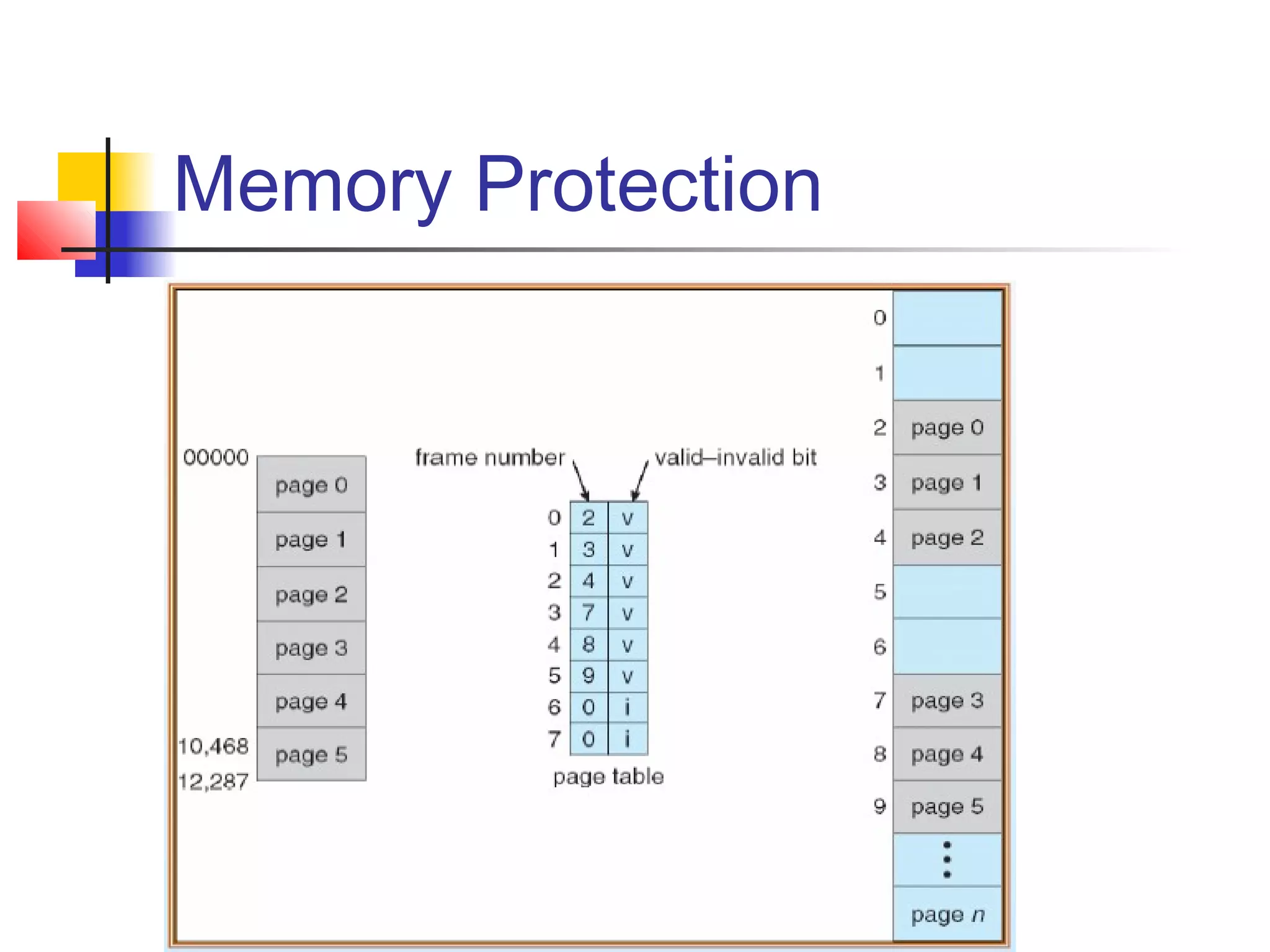
 Suppose a system with a 14bit address 
space (0 to 16383), we have a program 
that should use only address 0 to 
10468. Given a page size of 2KB, we 
may have the following figure:
Memory Protection
Memory Protection 
 Any attempt to generate an address in 
page 6 or 7 will be invalid 
 Notice that this scheme allows the 
program to access 10468 to 12287, this 
problem is result of the 2KB page size 
and reflects the internal fragmentation 
of paging
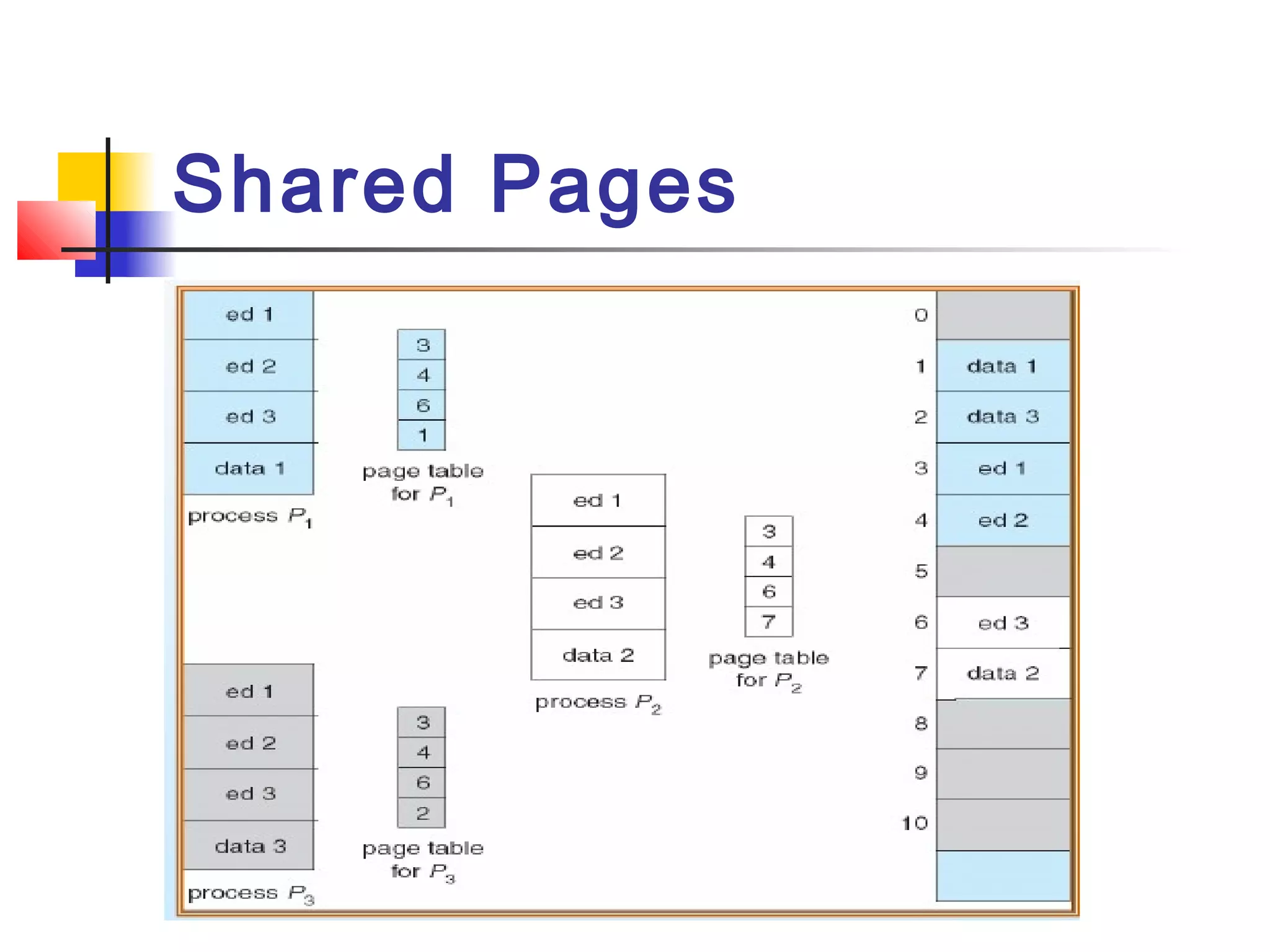
Shared Pages 
 An advantage of paging is the possible of 
sharing common code, especially time-sharing 
environment 
 For example a server with 40 user using text 
editor (with 150k reentrant code and 50k data 
space) 
 In next figure, we see three page editor with 
50k each. Each process has its own data 
page
Shared Pages
Shared Pages 
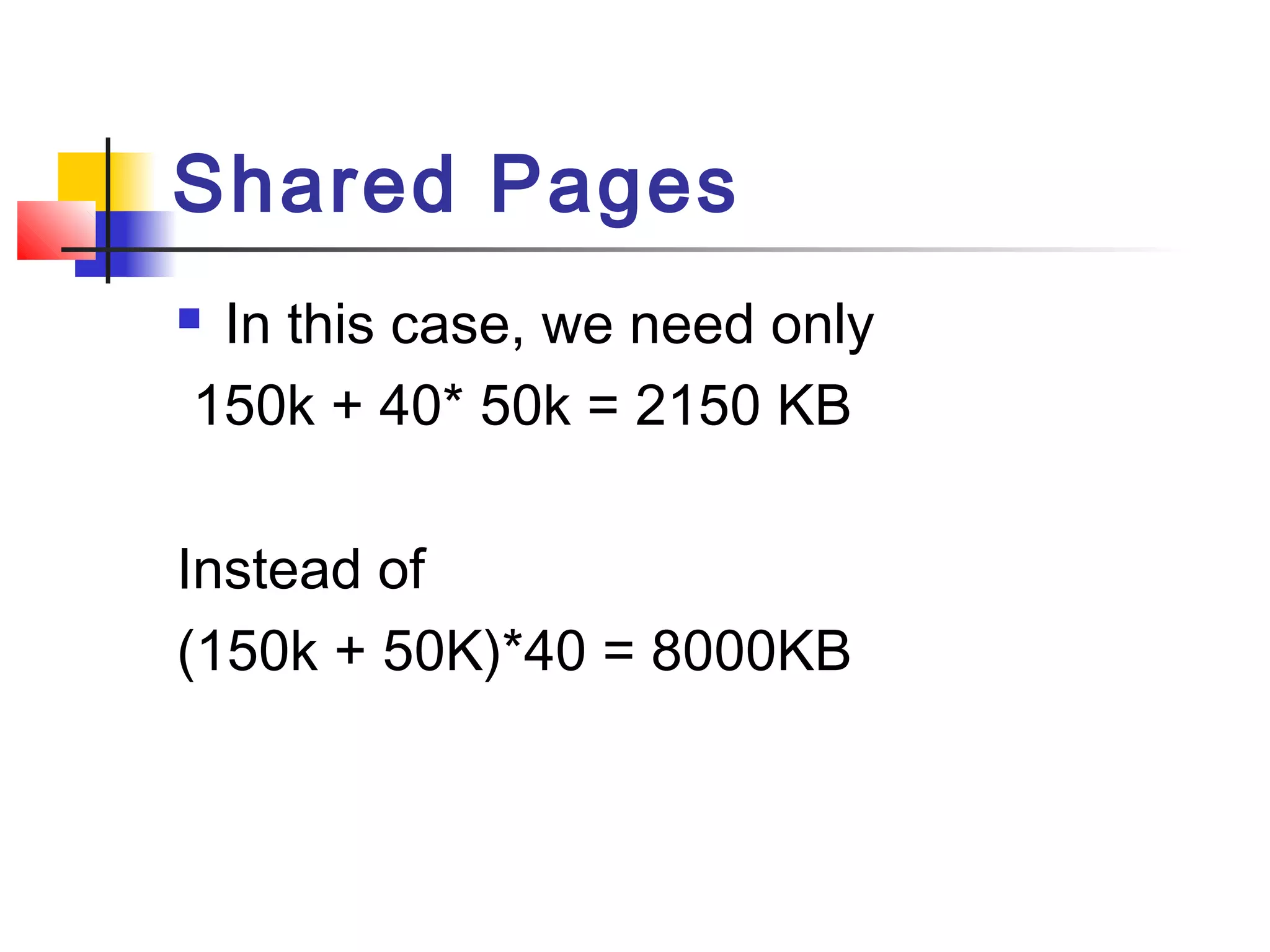
 In this case, we need only 
150k + 40* 50k = 2150 KB 
Instead of 
(150k + 50K)*40 = 8000KB
8.5 Structure of Page Table 
 Consider a system with 32-bit logical 
address space. 
 If the page size is 4 KB (2^12), then the 
page table may consist of up to 1 million 
entries (2^32/2^12=2^20) 
 Clearly, we would not want to allocate 
the page table contiguously in main 
memory
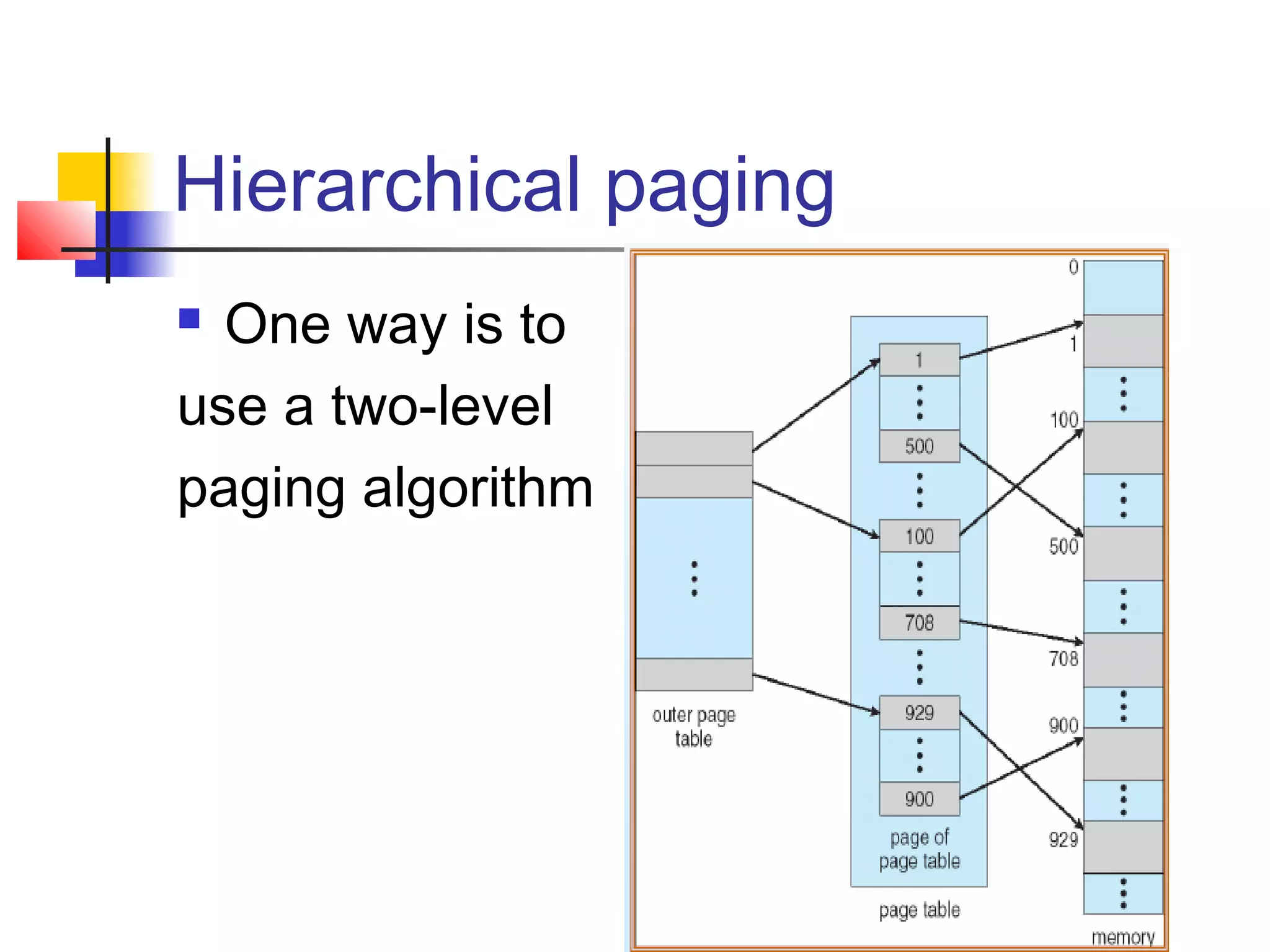
Hierarchical paging 
 One way is to 
use a two-level 
paging algorithm
Hierarchical paging 
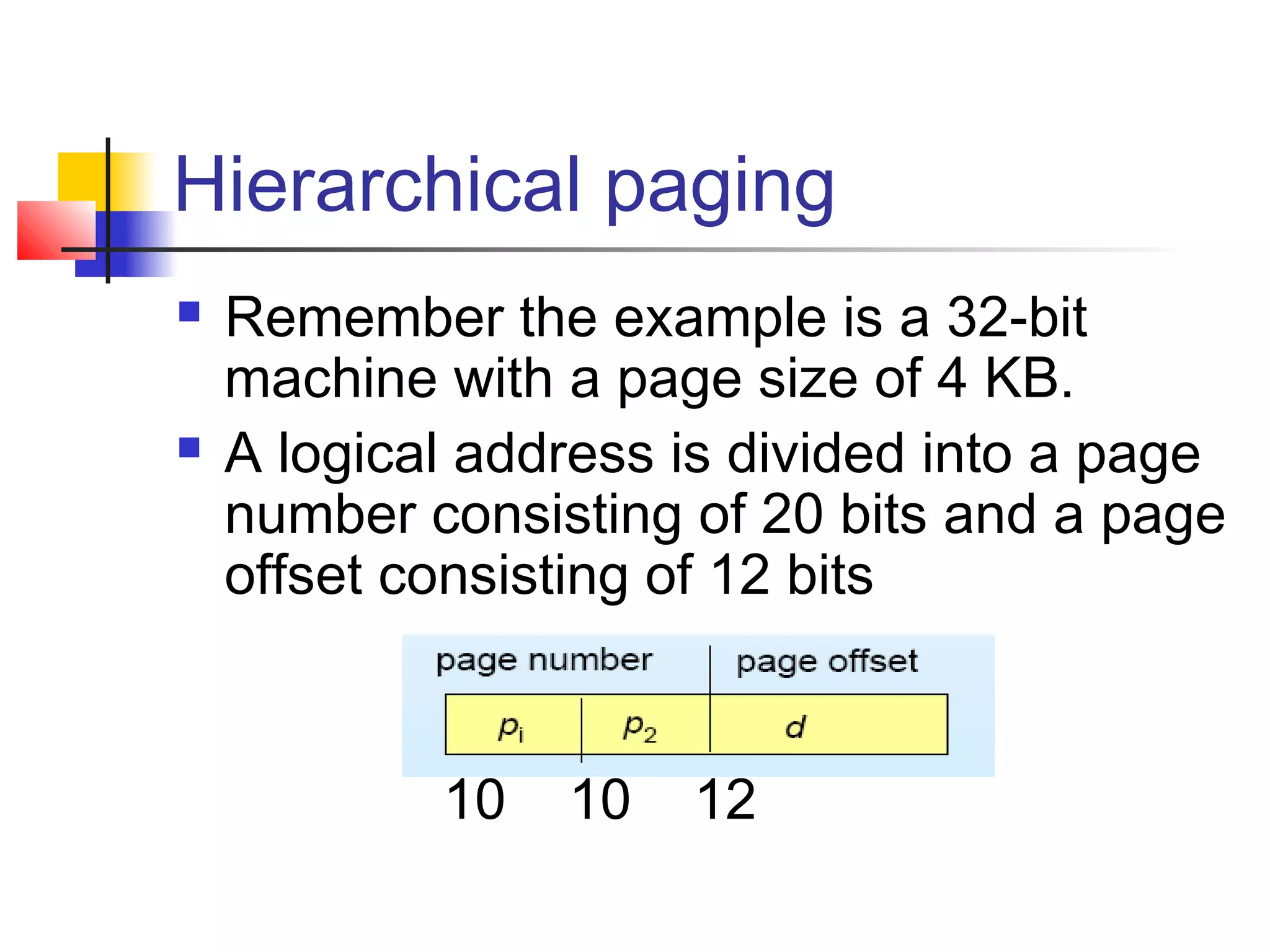
 Remember the example is a 32-bit 
machine with a page size of 4 KB. 
 A logical address is divided into a page 
number consisting of 20 bits and a page 
offset consisting of 12 bits 
10 10 12
Hierarchical paging 
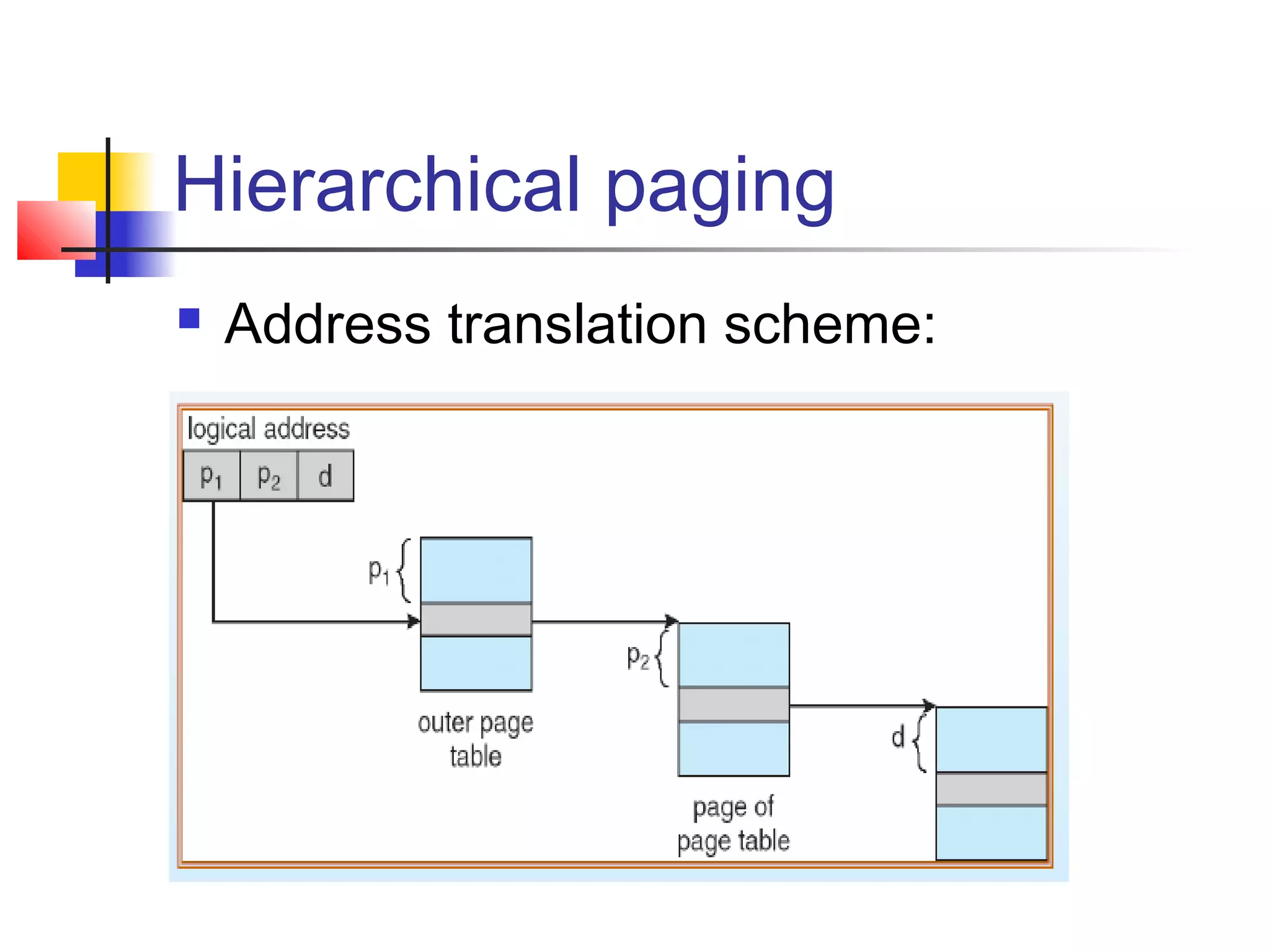
 Address translation scheme:
Hierarchical paging 
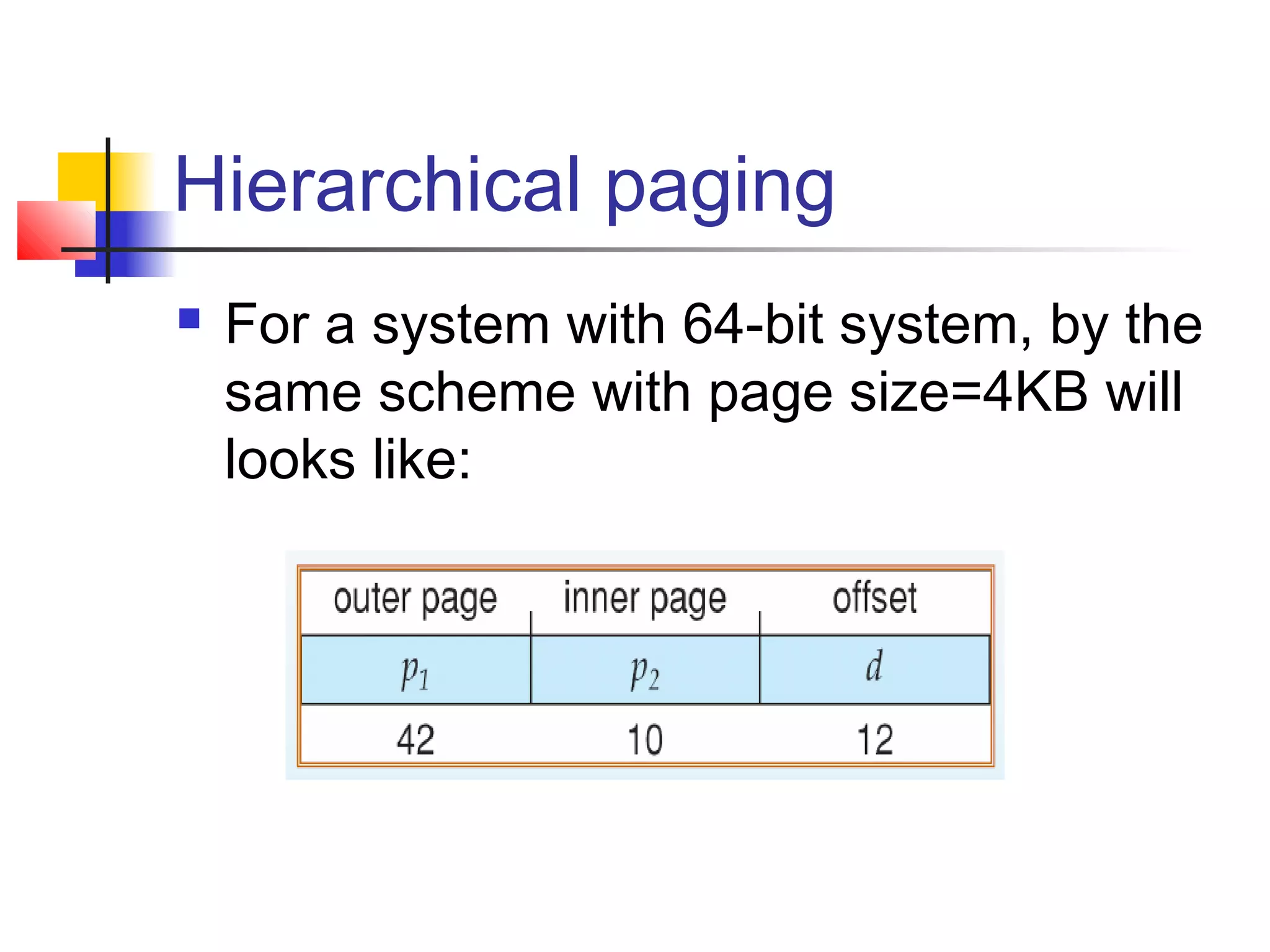
 For a system with 64-bit system, by the 
same scheme with page size=4KB will 
looks like:
Hierarchical paging 
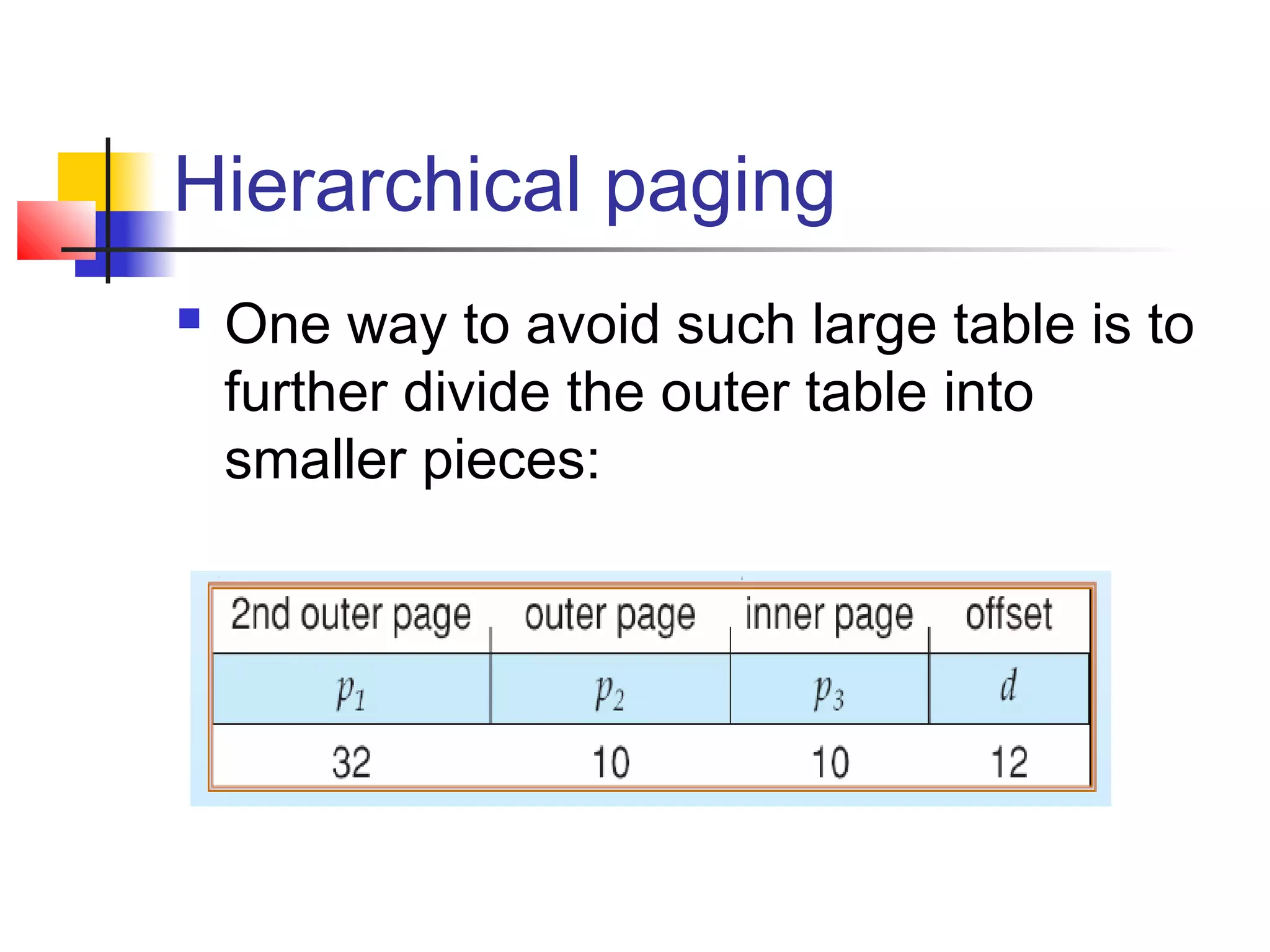
 One way to avoid such large table is to 
further divide the outer table into 
smaller pieces:
Hierarchical Paging 
 The next step would be a four-level 
paging scheme… 
 However, for 64-bit architecture, 
hierarchical page table are generally 
considered inappropriate
Hash Page Table 
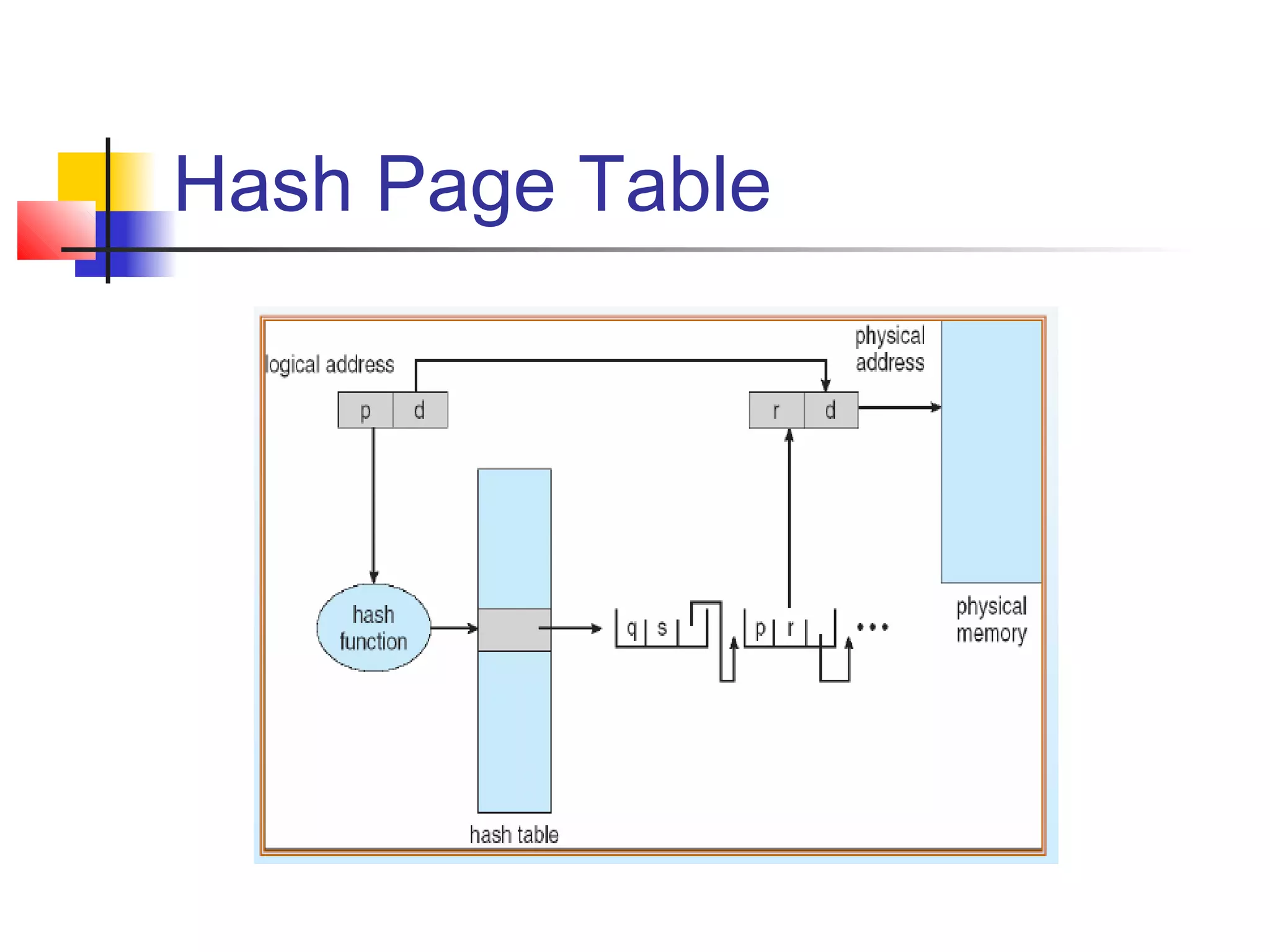
 Hash Page table is commonly used in 
systems with address spaces larger 
than 32 bit 
 So what is a hash table?
Hash Page Table 
 Each element consists of three fields: 
1. The virtual page number 
2. The value of the mapped page frame 
3. A pointer to the next element
Hash Page Table
8.6 Segmentation 
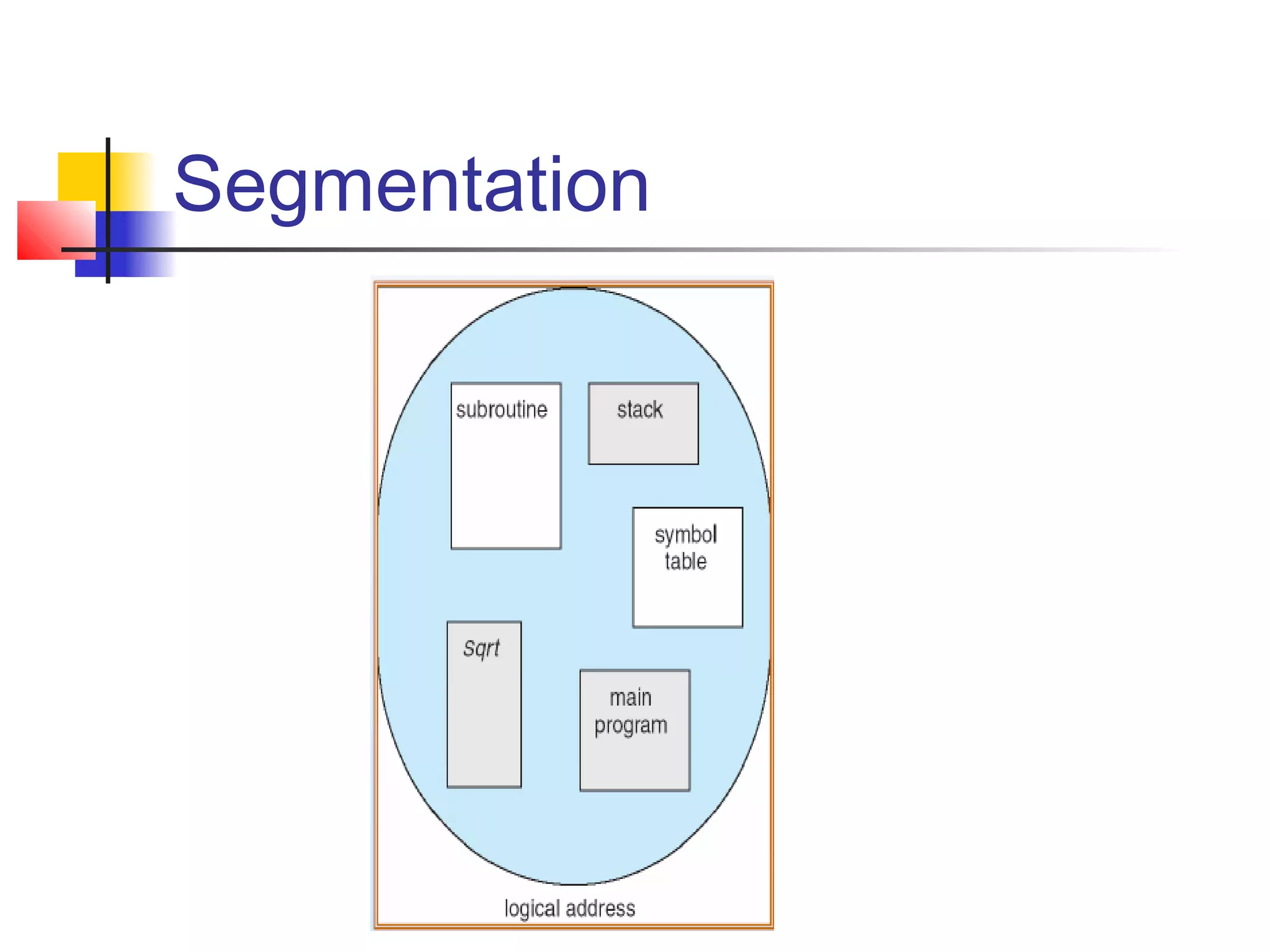
 Since the user’s view of memory is not the 
same as the actual physical memory, 
segmentation helps user to view memory as a 
collection of variable-size segment 
 Segmentation is a memory management 
scheme that supports user view of memory
Segmentation 
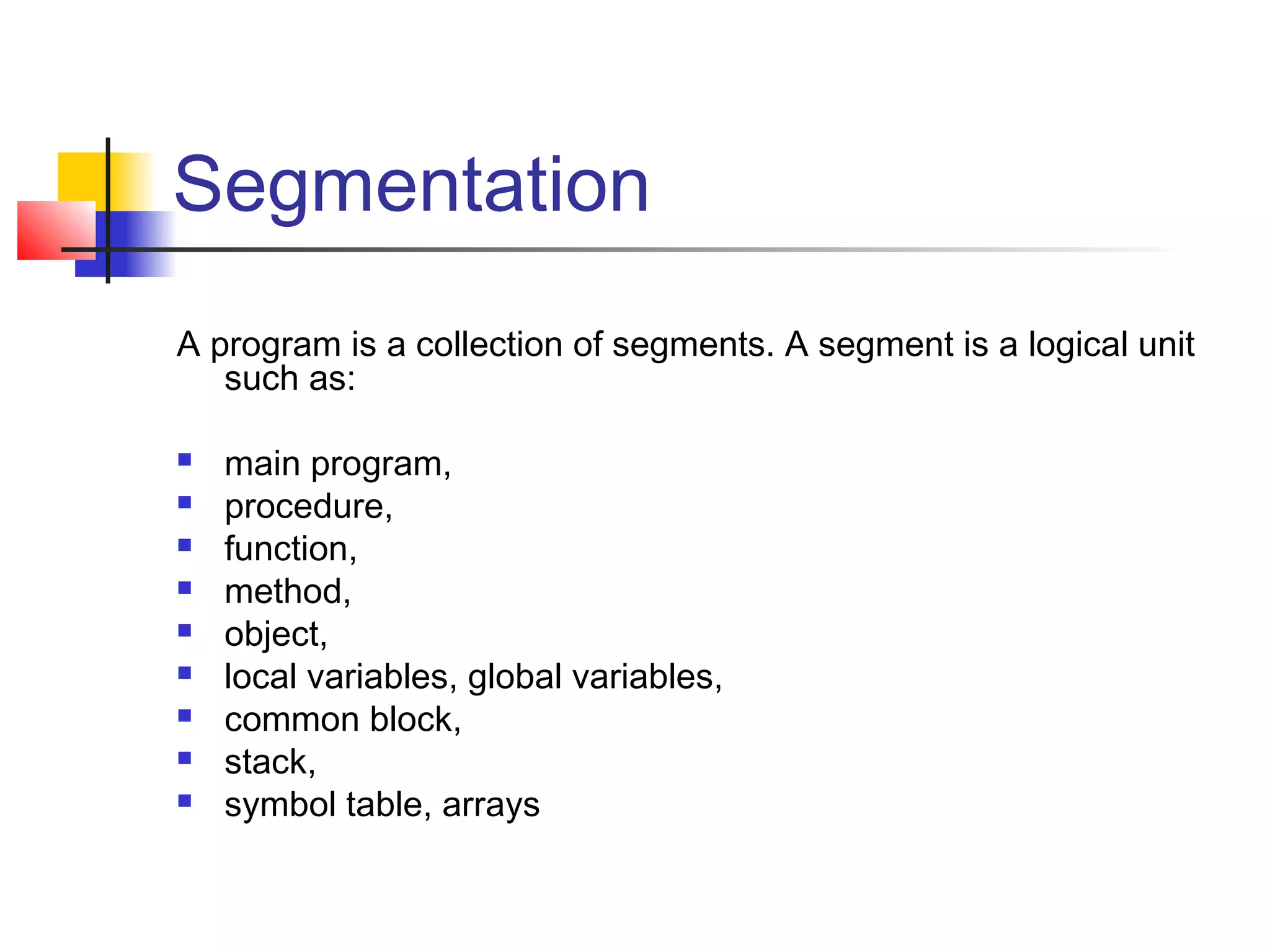
A program is a collection of segments. A segment is a logical unit 
such as: 
 main program, 
 procedure, 
 function, 
 method, 
 object, 
 local variables, global variables, 
 common block, 
 stack, 
 symbol table, arrays
Segmentation
Segmentation
Segmentation 
 The user specifies each address by two 
quantities: a segment name and an offset 
<segment-number, offset> 
 Compare with page scheme, user specifies 
only a single address, which is partitioned by 
hardware into a page number and an offset, 
all invisible to the programmer
Segmentation 
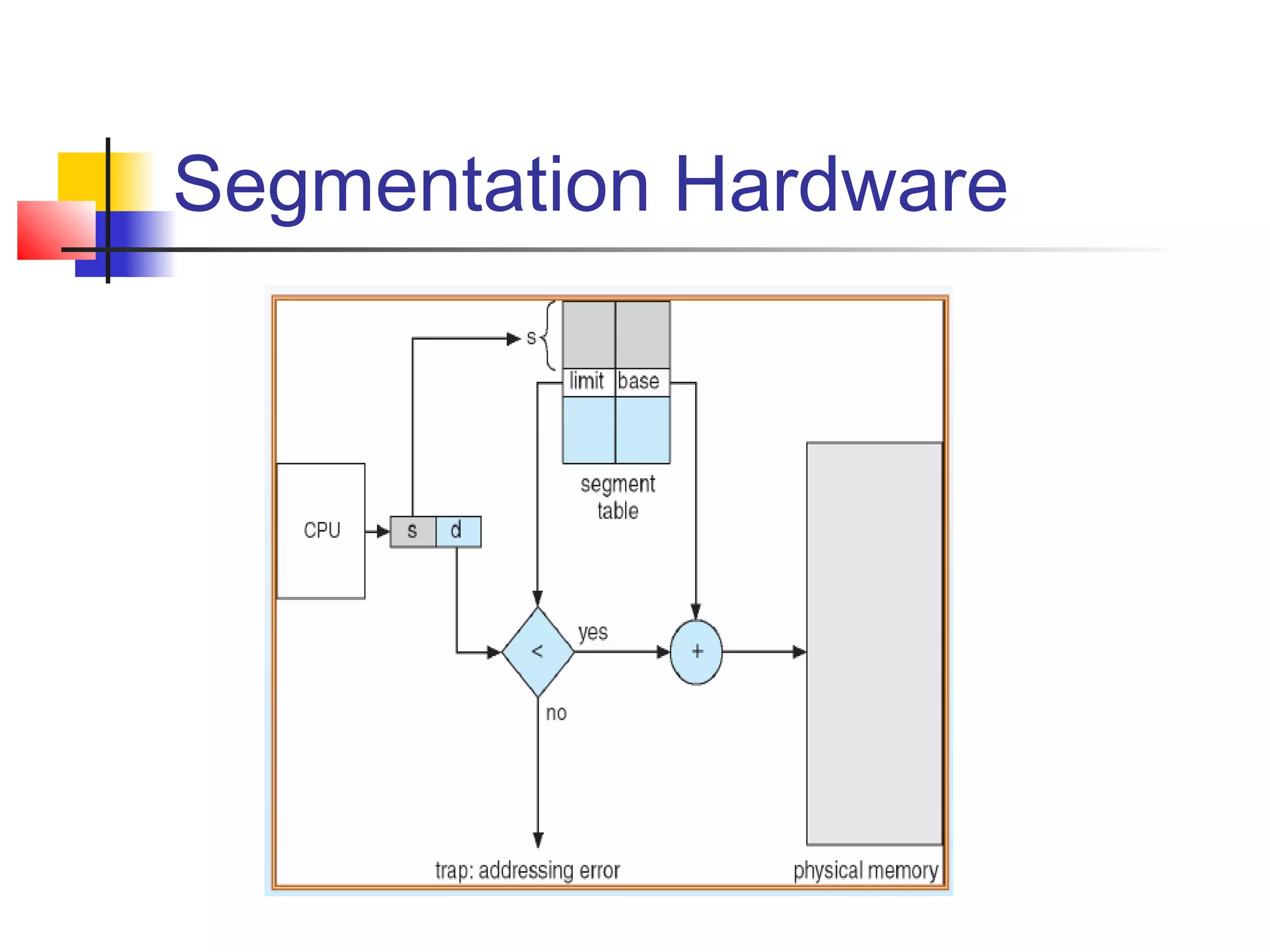
 Although the user can refer to objects in the 
program by a two-dimensional address, the 
actual physical address is still a one-dimensional 
sequence 
 Thus, we need to map the segment number 
 This mapping is effected by a segment 
table 
 In order to protect the memory space, each 
entry in segment table has a segment base 
and a segment limit
Segmentation Hardware
Example of Segmentation 
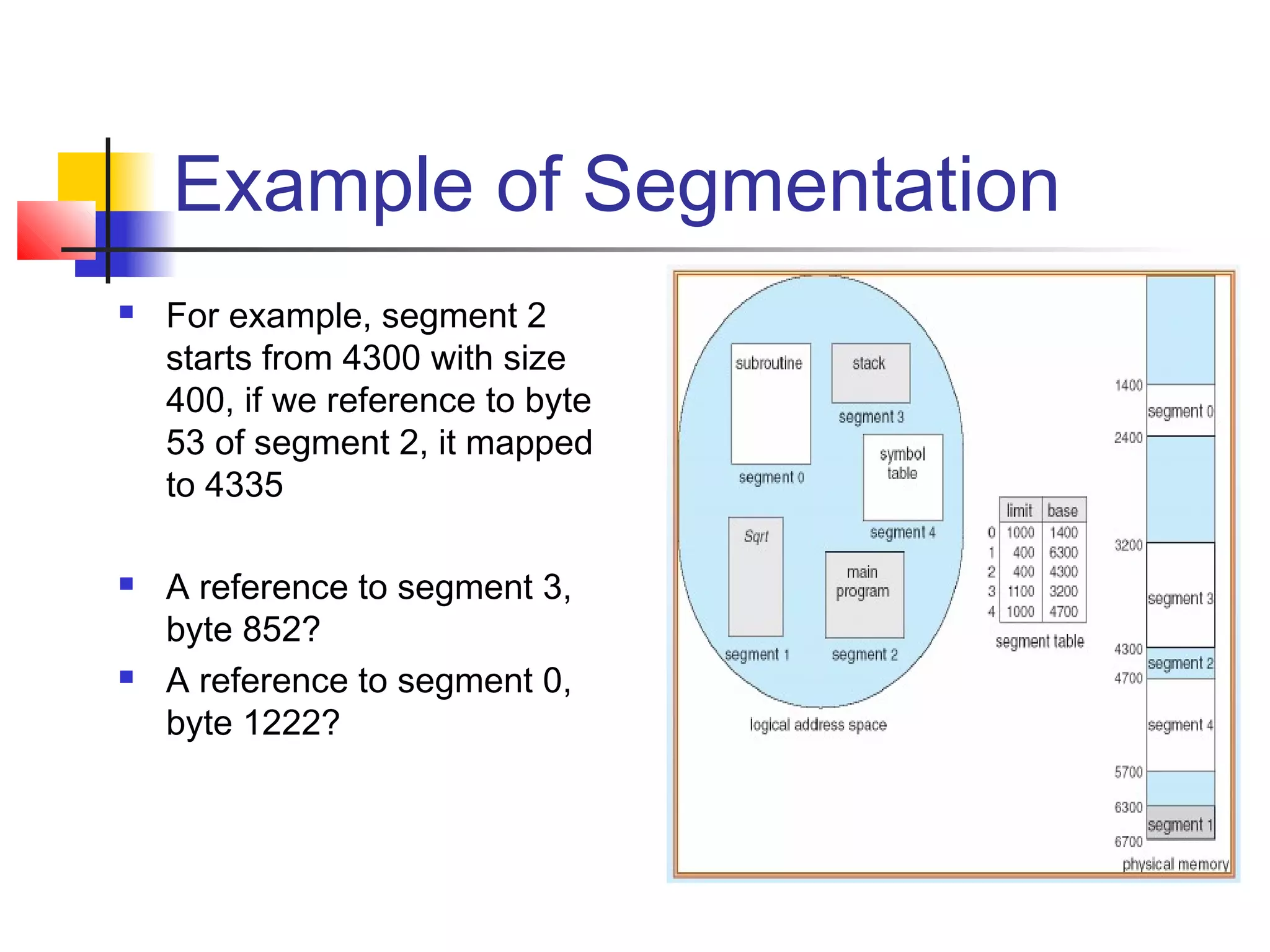
 For example, segment 2 
starts from 4300 with size 
400, if we reference to byte 
53 of segment 2, it mapped 
to 4335 
 A reference to segment 3, 
byte 852? 
 A reference to segment 0, 
byte 1222?
8.7 Example: Intel Pentium 
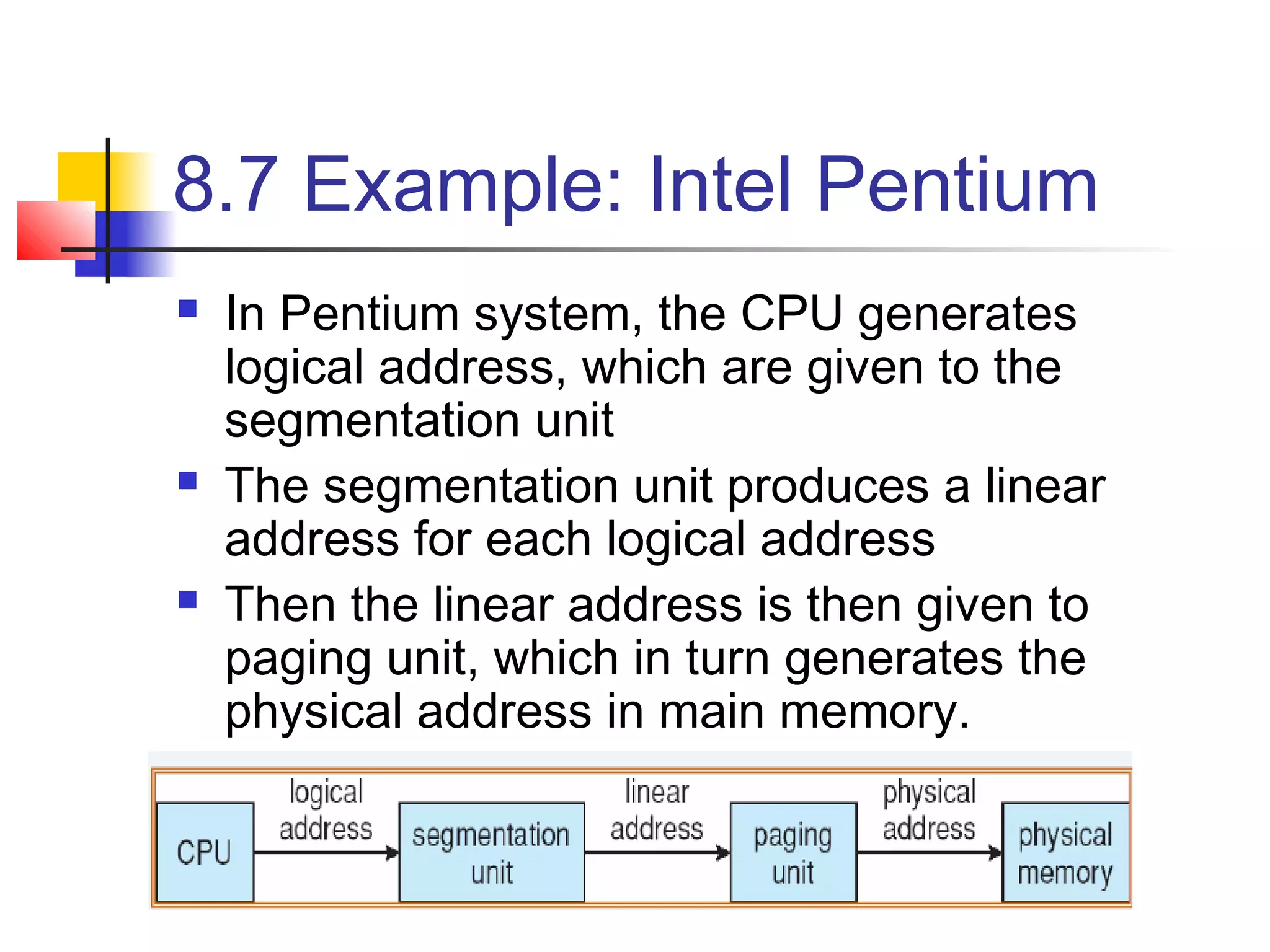
 In Pentium system, the CPU generates 
logical address, which are given to the 
segmentation unit 
 The segmentation unit produces a linear 
address for each logical address 
 Then the linear address is then given to 
paging unit, which in turn generates the 
physical address in main memory.
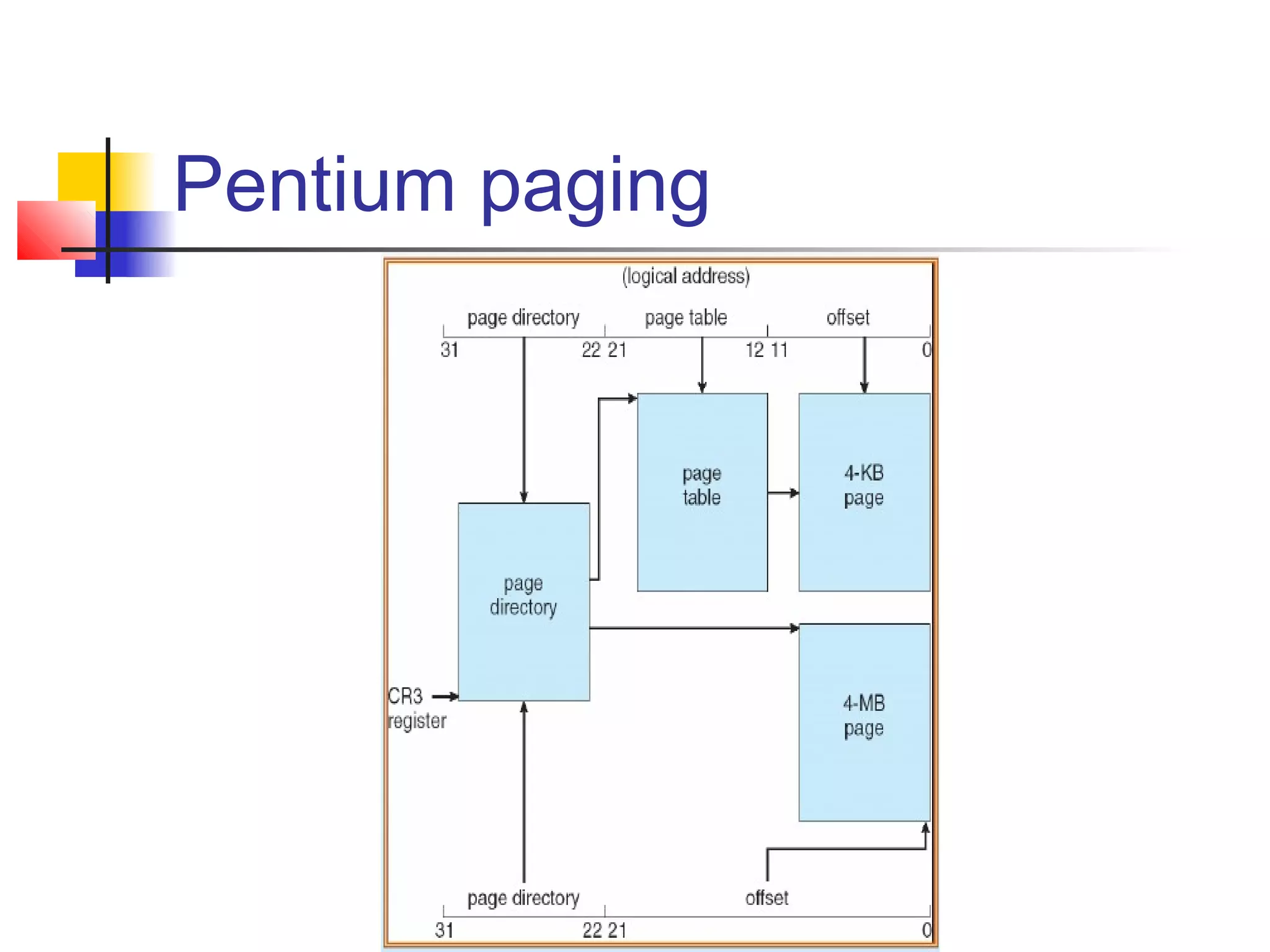
Pentium paging 
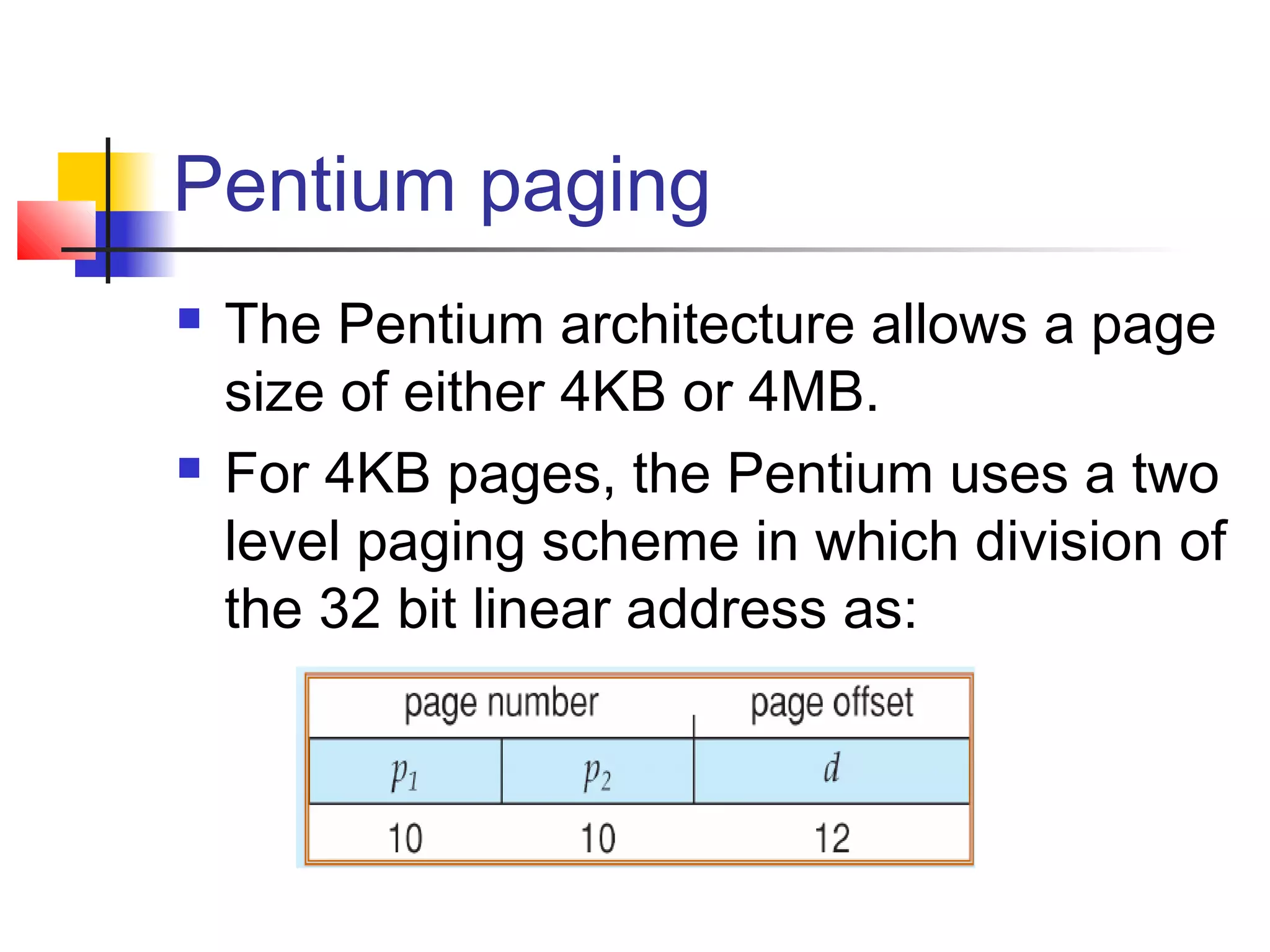
 The Pentium architecture allows a page 
size of either 4KB or 4MB. 
 For 4KB pages, the Pentium uses a two 
level paging scheme in which division of 
the 32 bit linear address as:
Pentium paging
Linux on Pentium System 
 Although the Pentium uses a two-level paging 
model, Linux is designed to run on a variety 
of hardware platform, many of which are 64- 
bit platforms 
 Therefore, two-level paging is not plausible 
 Thus, Linux has adopted a three level paging 
strategy that works well for both 32-bit and 
64-bit architectures
Linux on Pentium System 
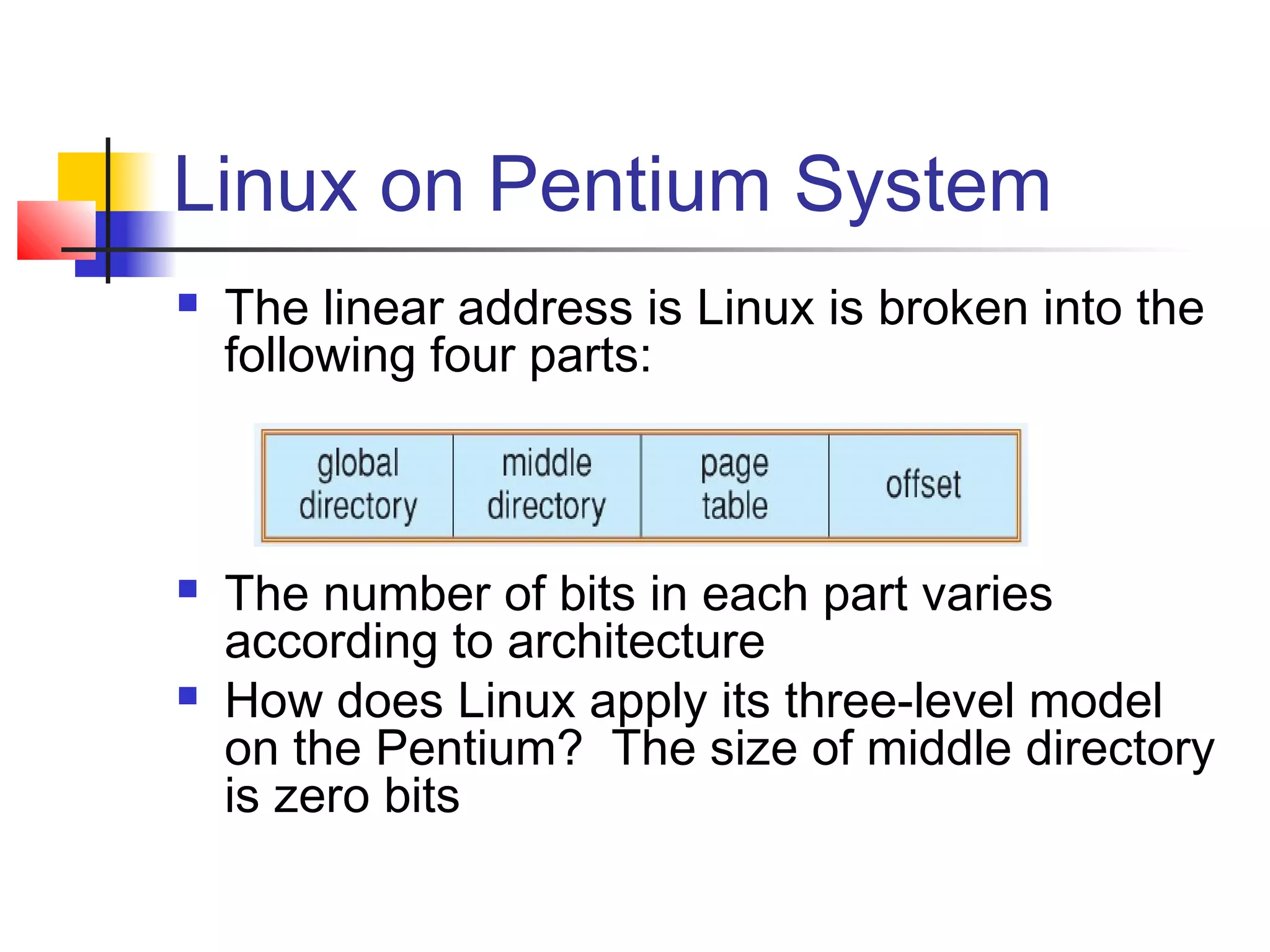
 The linear address is Linux is broken into the 
following four parts: 
 The number of bits in each part varies 
according to architecture 
 How does Linux apply its three-level model 
on the Pentium? The size of middle directory 
is zero bits

Csc4320 chapter 8 2

  • 1.
    8.4 paging Paging is a memory-management scheme that permits the physical address space of a process to be non-contiguous.  The basic method for implementation involves breaking physical memory into fixed-sized blocks called FRAMES and break logical memory into blocks of the same size called PAGES
  • 2.
    Paging  Everyaddress generated by the CPU is divided into two parts: Page number (p) and Page offset (d)  The page number is used as an index into a Page Table
  • 3.
  • 4.
  • 5.
    Paging  Thepage size is defined by the hardware  The size of a page is typically a power of 2, varying between 512 bytes and 16MB per page  Reason: If the size of logical address is 2^m and page size is 2^n, then the high-order m-n bits of a logical address designate the page number
  • 6.
  • 7.
  • 8.
    Paging  Whenwe use a paging scheme, we have no external fragmentation: ANY free frame can be allocated to a process that needs it.  However, we may have internal fragmentation  For example: if a page size is 2048 bytes, a process of 72766 bytes would need 35 pages plus 1086 bytes
  • 9.
    Paging  Ifthe process requires n pages, at least n frames are required  The first page of the process is loaded into the first frame listed on free-frame list, and the frame number is put into page table
  • 10.
  • 11.
    Hardware Support onPaging  To implement paging, the simplest method is to implement the page table as a set of registers  However, the size of register is limited and the size of page table is usually large  Therefore, the page table is kept in main memory
  • 12.
    Hardware Support onPaging  If we want to access location I, we must first index into page table, this requires one memory access  With this scheme, TWO memory access are needed to access a byte  The standard solution is to use a special, small, fast cache, called Translation look-aside buffer (TLB) or associative memory
  • 13.
  • 14.
    TLB  Ifthe page number is not in the TLB (TLB miss) a memory reference to the page table must be made.  In addition, we add the page number and frame number into TLB  If the TLB already full, the OS have to must select one for replacement  Some TLBs allow entries to be wire down, meaning that they cannot be removed from the TLB, for example kernel codes
  • 15.
    TLB  Thepercentage of times that a particular page number is found in the TLN is called hit ratio  If it takes 20 nanosecond to search the TLB and 100 nanosecond to access memory  If our hit ratio is 80%, the effective memory access time equal: 0.8*(100+20) + 0.2 *(100+100)=140  If our hit ratio is 98%, the effective memory access time equal: 0.98*(100+20) + 0.02 *(100+100)=122 (detail in CH9)
  • 16.
    Memory Protection Memory protection implemented by associating protection bit with each frame  Valid-invalid bit attached to each entry in the page table:  “valid” indicates that the associated page is in the process’ logical address space, and is thus a legal page  “invalid” indicates that the page is not in the process ’logical address space
  • 17.
    Memory Protection Suppose a system with a 14bit address space (0 to 16383), we have a program that should use only address 0 to 10468. Given a page size of 2KB, we may have the following figure:
  • 18.
  • 19.
    Memory Protection Any attempt to generate an address in page 6 or 7 will be invalid  Notice that this scheme allows the program to access 10468 to 12287, this problem is result of the 2KB page size and reflects the internal fragmentation of paging
  • 20.
    Shared Pages An advantage of paging is the possible of sharing common code, especially time-sharing environment  For example a server with 40 user using text editor (with 150k reentrant code and 50k data space)  In next figure, we see three page editor with 50k each. Each process has its own data page
  • 21.
  • 22.
    Shared Pages In this case, we need only 150k + 40* 50k = 2150 KB Instead of (150k + 50K)*40 = 8000KB
  • 23.
    8.5 Structure ofPage Table  Consider a system with 32-bit logical address space.  If the page size is 4 KB (2^12), then the page table may consist of up to 1 million entries (2^32/2^12=2^20)  Clearly, we would not want to allocate the page table contiguously in main memory
  • 24.
    Hierarchical paging One way is to use a two-level paging algorithm
  • 25.
    Hierarchical paging Remember the example is a 32-bit machine with a page size of 4 KB.  A logical address is divided into a page number consisting of 20 bits and a page offset consisting of 12 bits 10 10 12
  • 26.
    Hierarchical paging Address translation scheme:
  • 27.
    Hierarchical paging For a system with 64-bit system, by the same scheme with page size=4KB will looks like:
  • 28.
    Hierarchical paging One way to avoid such large table is to further divide the outer table into smaller pieces:
  • 29.
    Hierarchical Paging The next step would be a four-level paging scheme…  However, for 64-bit architecture, hierarchical page table are generally considered inappropriate
  • 30.
    Hash Page Table  Hash Page table is commonly used in systems with address spaces larger than 32 bit  So what is a hash table?
  • 31.
    Hash Page Table  Each element consists of three fields: 1. The virtual page number 2. The value of the mapped page frame 3. A pointer to the next element
  • 32.
  • 33.
    8.6 Segmentation Since the user’s view of memory is not the same as the actual physical memory, segmentation helps user to view memory as a collection of variable-size segment  Segmentation is a memory management scheme that supports user view of memory
  • 34.
    Segmentation A programis a collection of segments. A segment is a logical unit such as:  main program,  procedure,  function,  method,  object,  local variables, global variables,  common block,  stack,  symbol table, arrays
  • 35.
  • 36.
  • 37.
    Segmentation  Theuser specifies each address by two quantities: a segment name and an offset <segment-number, offset>  Compare with page scheme, user specifies only a single address, which is partitioned by hardware into a page number and an offset, all invisible to the programmer
  • 38.
    Segmentation  Althoughthe user can refer to objects in the program by a two-dimensional address, the actual physical address is still a one-dimensional sequence  Thus, we need to map the segment number  This mapping is effected by a segment table  In order to protect the memory space, each entry in segment table has a segment base and a segment limit
  • 39.
  • 40.
    Example of Segmentation  For example, segment 2 starts from 4300 with size 400, if we reference to byte 53 of segment 2, it mapped to 4335  A reference to segment 3, byte 852?  A reference to segment 0, byte 1222?
  • 41.
    8.7 Example: IntelPentium  In Pentium system, the CPU generates logical address, which are given to the segmentation unit  The segmentation unit produces a linear address for each logical address  Then the linear address is then given to paging unit, which in turn generates the physical address in main memory.
  • 42.
    Pentium paging The Pentium architecture allows a page size of either 4KB or 4MB.  For 4KB pages, the Pentium uses a two level paging scheme in which division of the 32 bit linear address as:
  • 43.
  • 44.
    Linux on PentiumSystem  Although the Pentium uses a two-level paging model, Linux is designed to run on a variety of hardware platform, many of which are 64- bit platforms  Therefore, two-level paging is not plausible  Thus, Linux has adopted a three level paging strategy that works well for both 32-bit and 64-bit architectures
  • 45.
    Linux on PentiumSystem  The linear address is Linux is broken into the following four parts:  The number of bits in each part varies according to architecture  How does Linux apply its three-level model on the Pentium? The size of middle directory is zero bits