12/20/12 16:27                                                     1


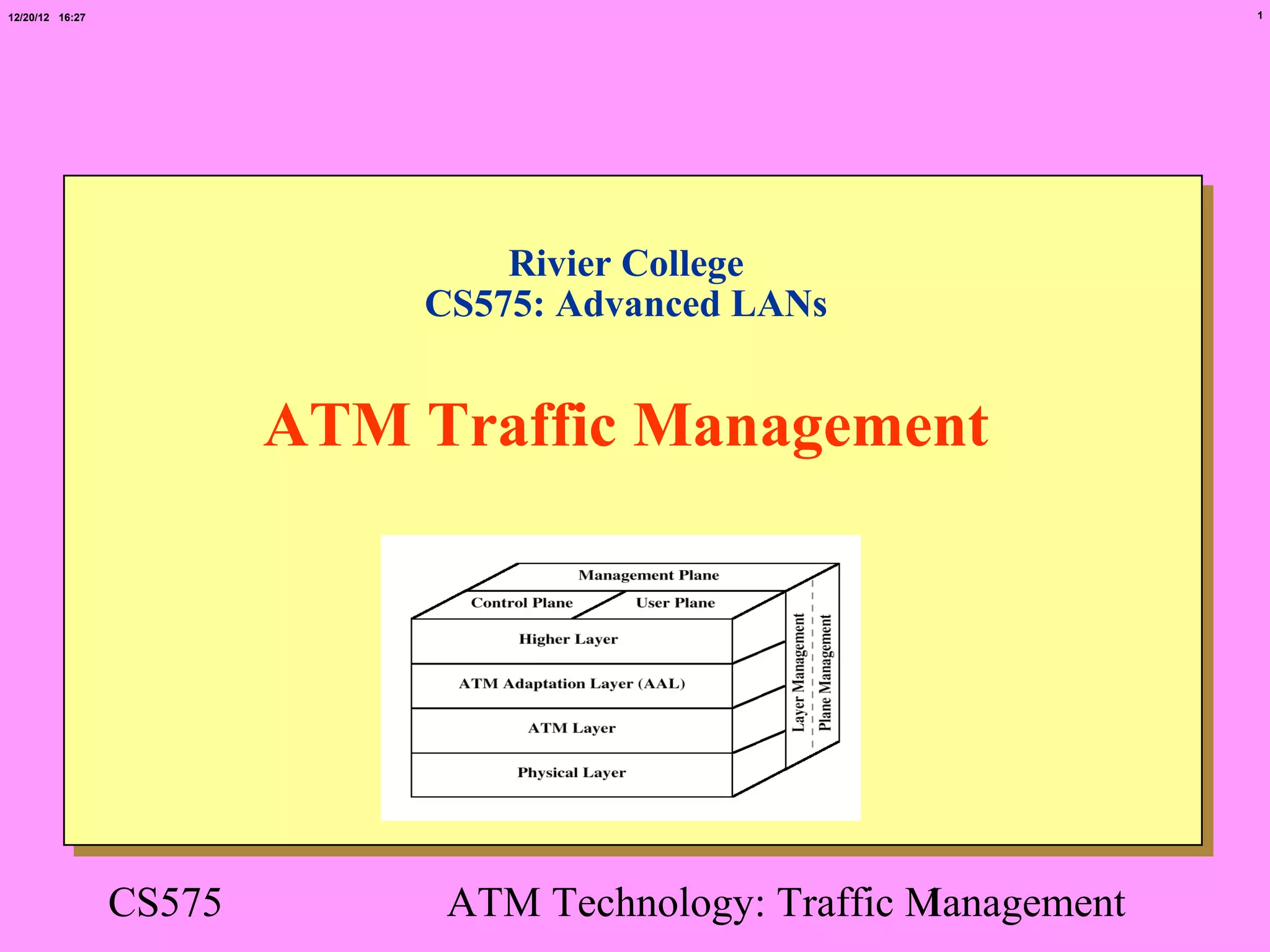
                                 Rivier College
                             CS575: Advanced LANs


                         ATM Traffic Management


                 CS575        ATM Technology: Traffic Management
                                                      1
12/20/12 16:27                                                                       2


           Overview

                 0 Why Traffic Management?
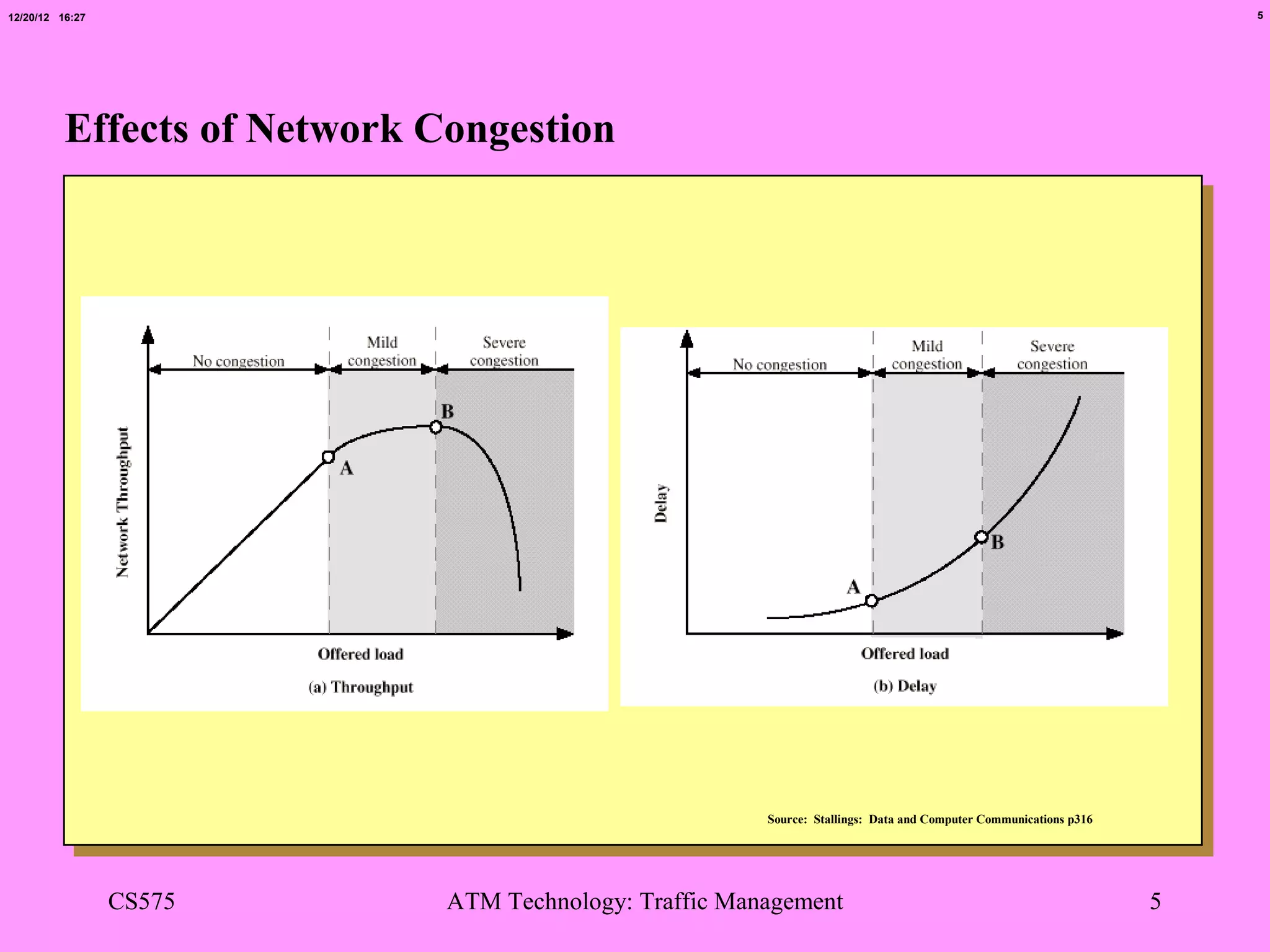
                 0 Network Congestion
                 0 Effects of Network Congestion
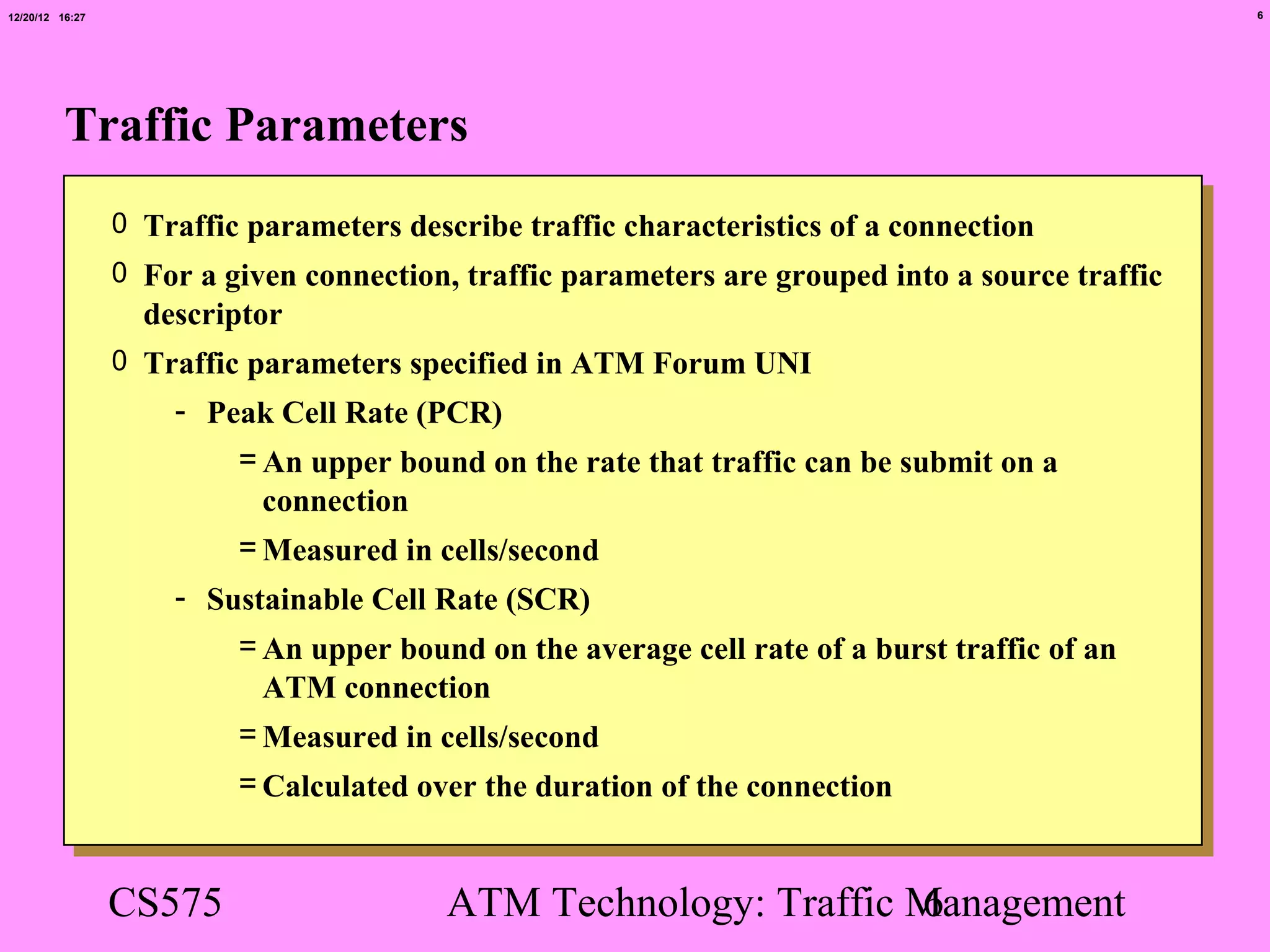
                 0 Traffic Parameters
                 0 ATM Service Categories
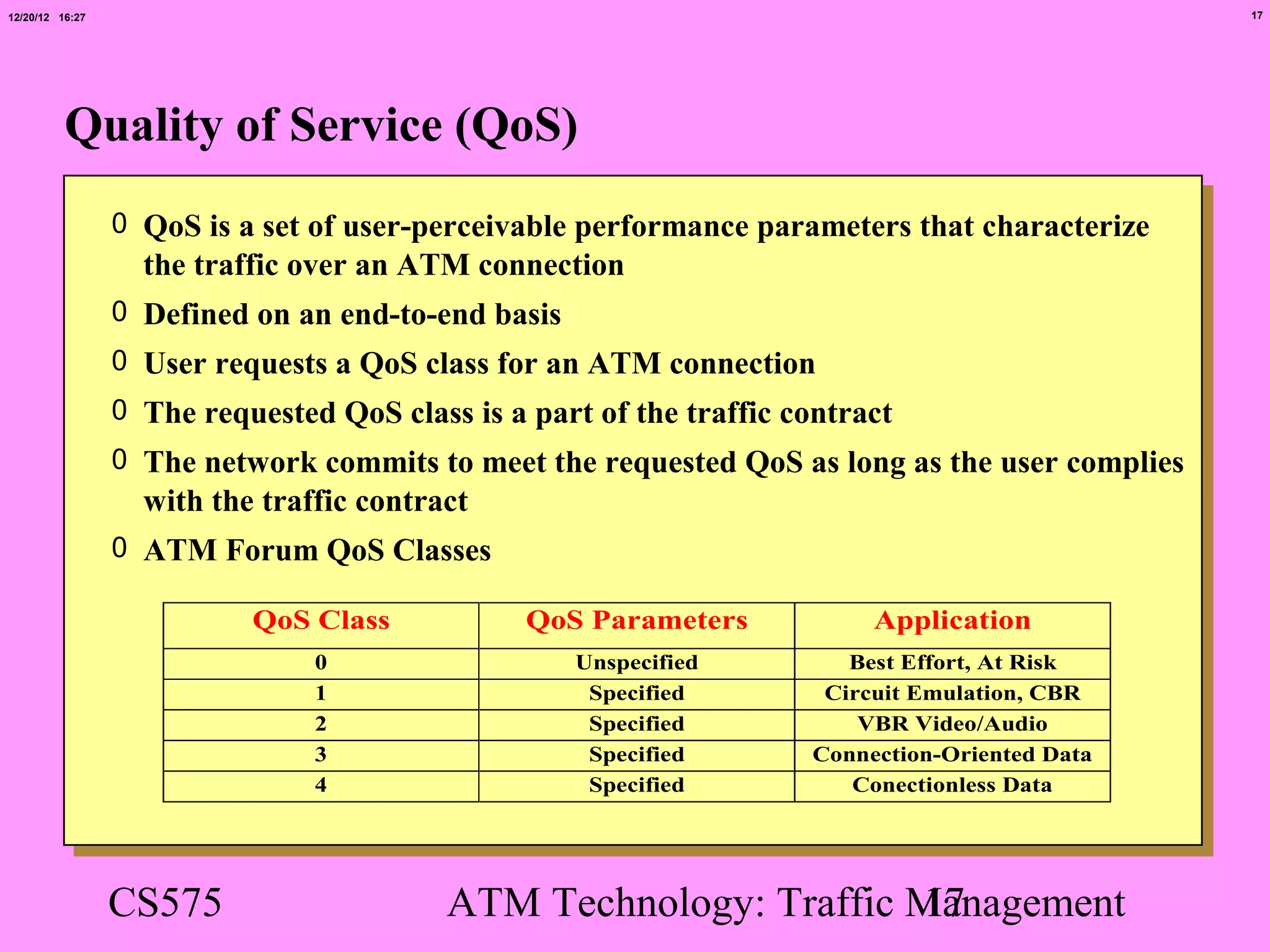
                 0 Quality of Service (QoS)
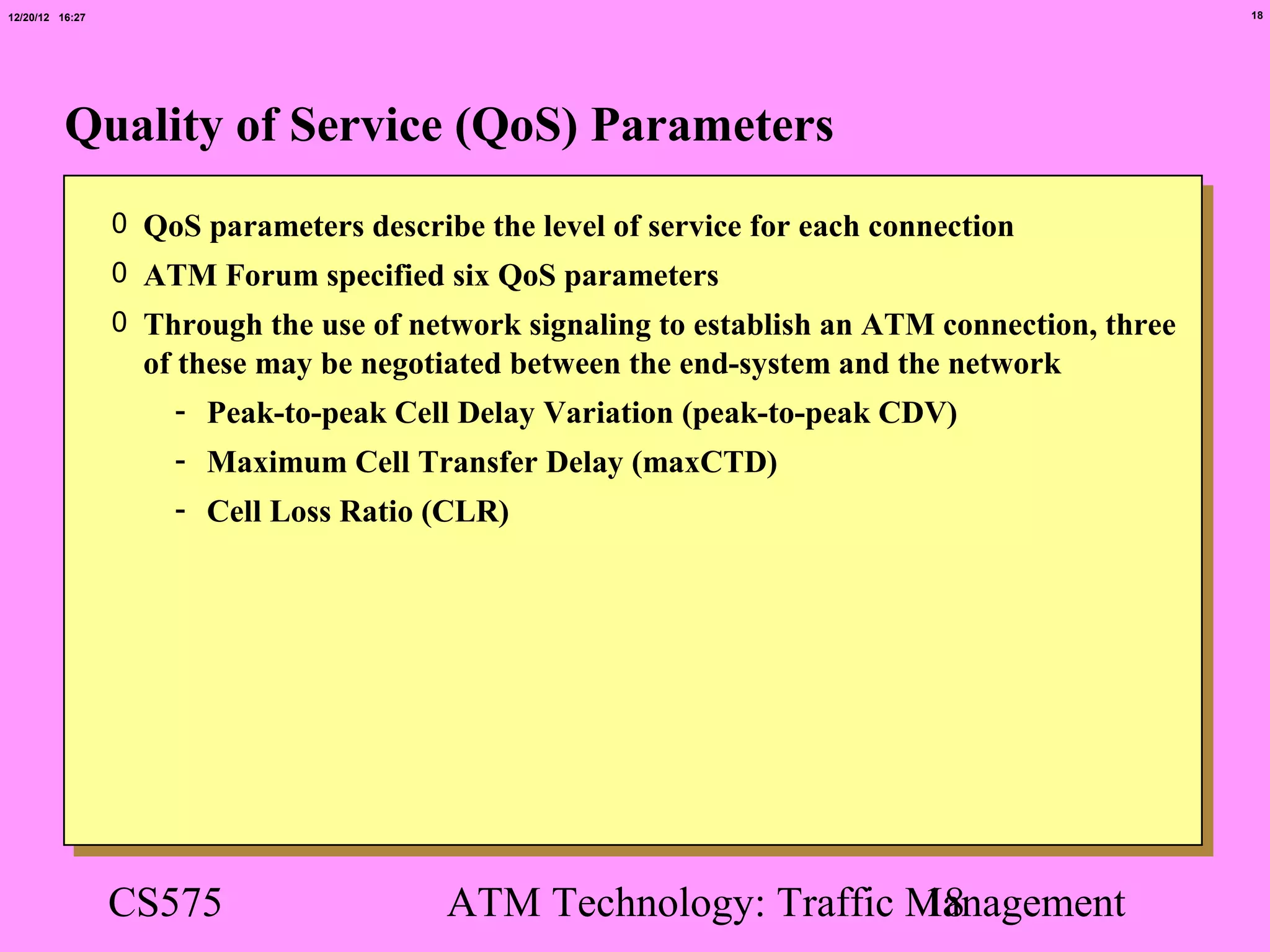
                 0 Quality of Service (QoS) Parameters
                 0 Traffic Contract
                                                                          Jain
                 0 Traffic Control Functions
                 0 Usage Parameter Control
                 0 Packet Discarding


                 CS575                    ATM Technology: Traffic Management     2
12/20/12 16:27                                                                                  3


          Why Traffic Management?
                 0 The ATM technology is intended to support a wide variety of services and
                   applications such as voice, video, and data
                 0 ATM promises to support all these different requirements with a common
                   network
                 0 Within such a network all connections may impact on each other
                 0 ATM must manage traffic fairly and provide effective allocation of network
                   resources for these different applications
                 0 It is the task of ATM traffic control to:
                     - protect the network and the end-systems from congestion in order to
                       provide specified and guaranteed levels of Quality of Service (QoS)
                     - use available network resources efficiently


                 CS575                    ATM Technology: Traffic Management
                                                                  3
12/20/12 16:27                                                                                   4


          Network Congestion
                 0 Network congestion is a state when the network cannot meet the negotiated
                   network performance objectives for established connections or for new
                   connection requests
                 0 Network congestion can be caused by:
                     - Unpredictable statistical fluctuation of traffic flows
                     - Fault conditions within the network
                 0 ATM layer traffic control is a set of actions taken by the network to avoid
                   network congestion
                 0 Traffic control takes measures to adapt to unpredictable fluctuations in
                   traffic flows and other problems within the network.
                 0 ATM layer congestion control refers to the set of actions taken by the
                   network to minimize the intensity, spread, and duration of congestion


                 CS575                    ATM Technology: Traffic Management
                                                                  4
12/20/12 16:27                                                                                                          5


          Effects of Network Congestion


                                                         Source: Stallings: Data and Computer Communications p316


                 CS575        ATM Technology: Traffic Management                                                    5
12/20/12 16:27                                                                                    6


          Traffic Parameters
                 0 Traffic parameters describe traffic characteristics of a connection
                 0 For a given connection, traffic parameters are grouped into a source traffic
                   descriptor
                 0 Traffic parameters specified in ATM Forum UNI
                     - Peak Cell Rate (PCR)
                         = An upper bound on the rate that traffic can be submit on a
                           connection
                         = Measured in cells/second
                     - Sustainable Cell Rate (SCR)
                         = An upper bound on the average cell rate of a burst traffic of an
                           ATM connection
                         = Measured in cells/second
                          = Calculated over the duration of the connection


                 CS575                    ATM Technology: Traffic Management
                                                                  6
12/20/12 16:27                                                                               7


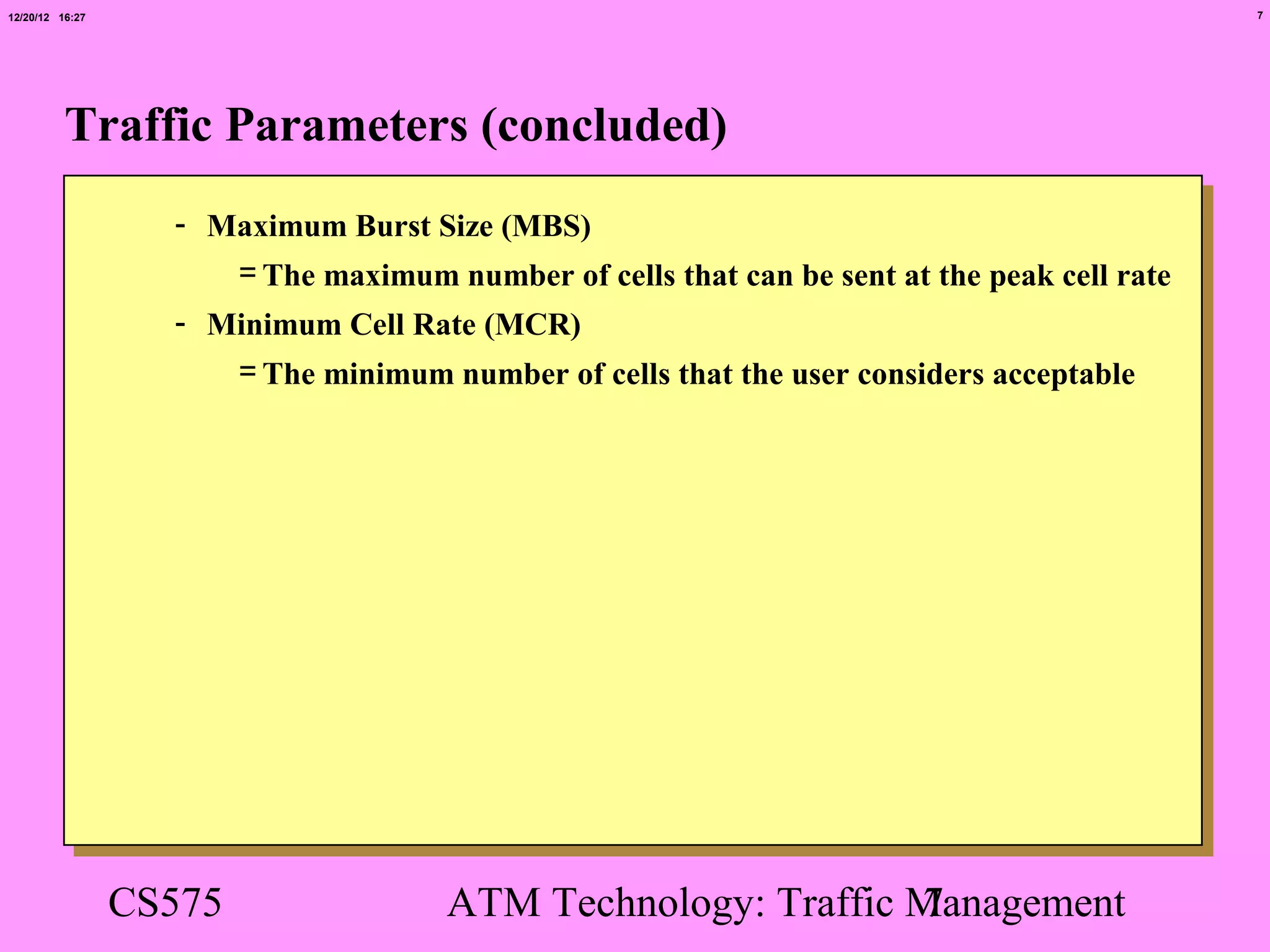
          Traffic Parameters (concluded)
                   - Maximum Burst Size (MBS)
                      = The maximum number of cells that can be sent at the peak cell rate
                   - Minimum Cell Rate (MCR)
                      = The minimum number of cells that the user considers acceptable


                 CS575                ATM Technology: Traffic Management
                                                              7
12/20/12 16:27                                                                                   8


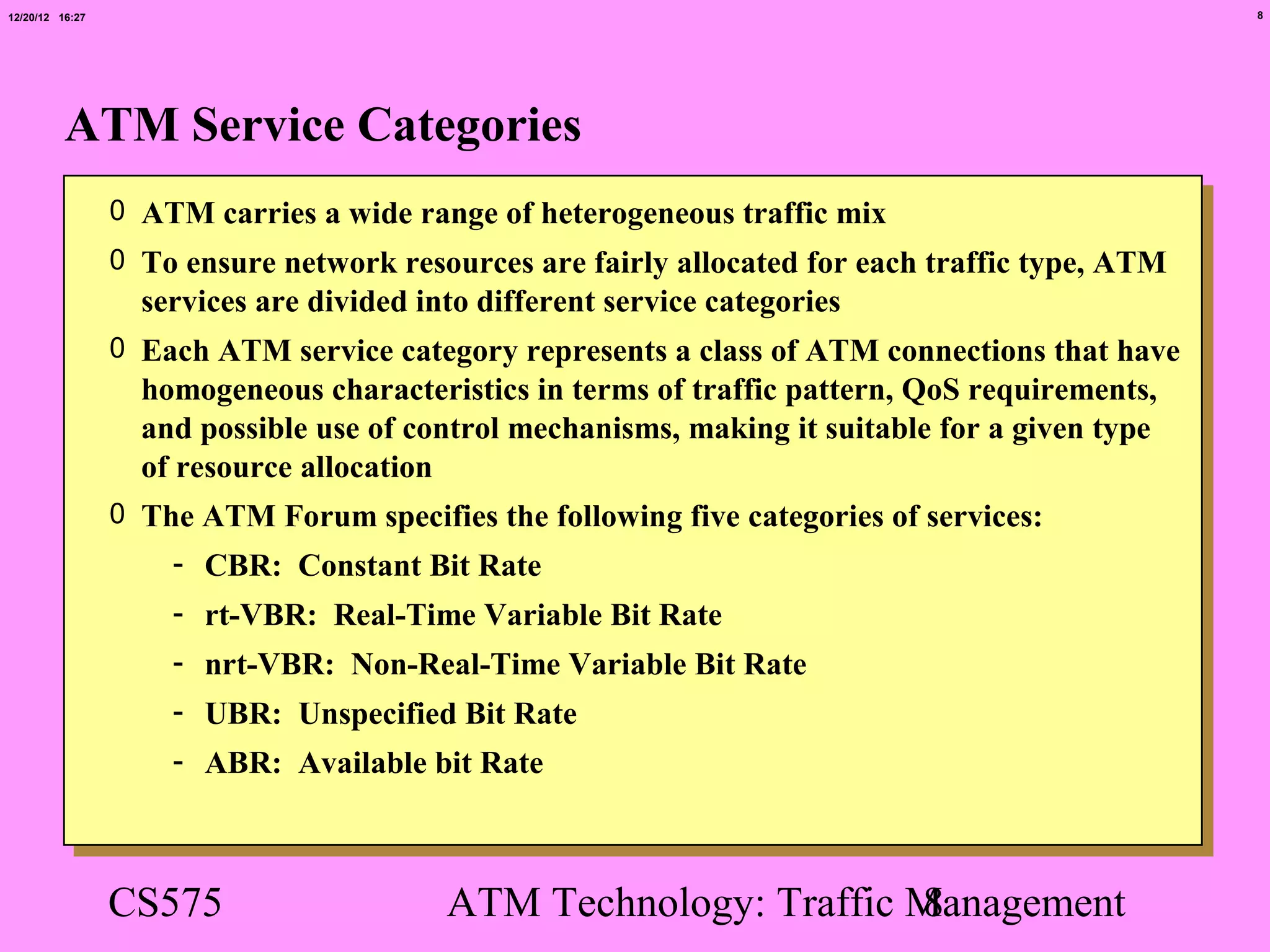
          ATM Service Categories
                 0 ATM carries a wide range of heterogeneous traffic mix
                 0 To ensure network resources are fairly allocated for each traffic type, ATM
                   services are divided into different service categories
                 0 Each ATM service category represents a class of ATM connections that have
                   homogeneous characteristics in terms of traffic pattern, QoS requirements,
                   and possible use of control mechanisms, making it suitable for a given type
                   of resource allocation
                 0 The ATM Forum specifies the following five categories of services:
                     - CBR: Constant Bit Rate
                     - rt-VBR: Real-Time Variable Bit Rate
                     - nrt-VBR: Non-Real-Time Variable Bit Rate
                     - UBR: Unspecified Bit Rate
                     - ABR: Available bit Rate


                 CS575                    ATM Technology: Traffic Management
                                                                  8
12/20/12 16:27                                                                                  9


          ATM Service Categories (continued)
                 0 All service categories apply to both VCCs and VPCs.
                 0 ATM services are characterized by the traffic parameters:
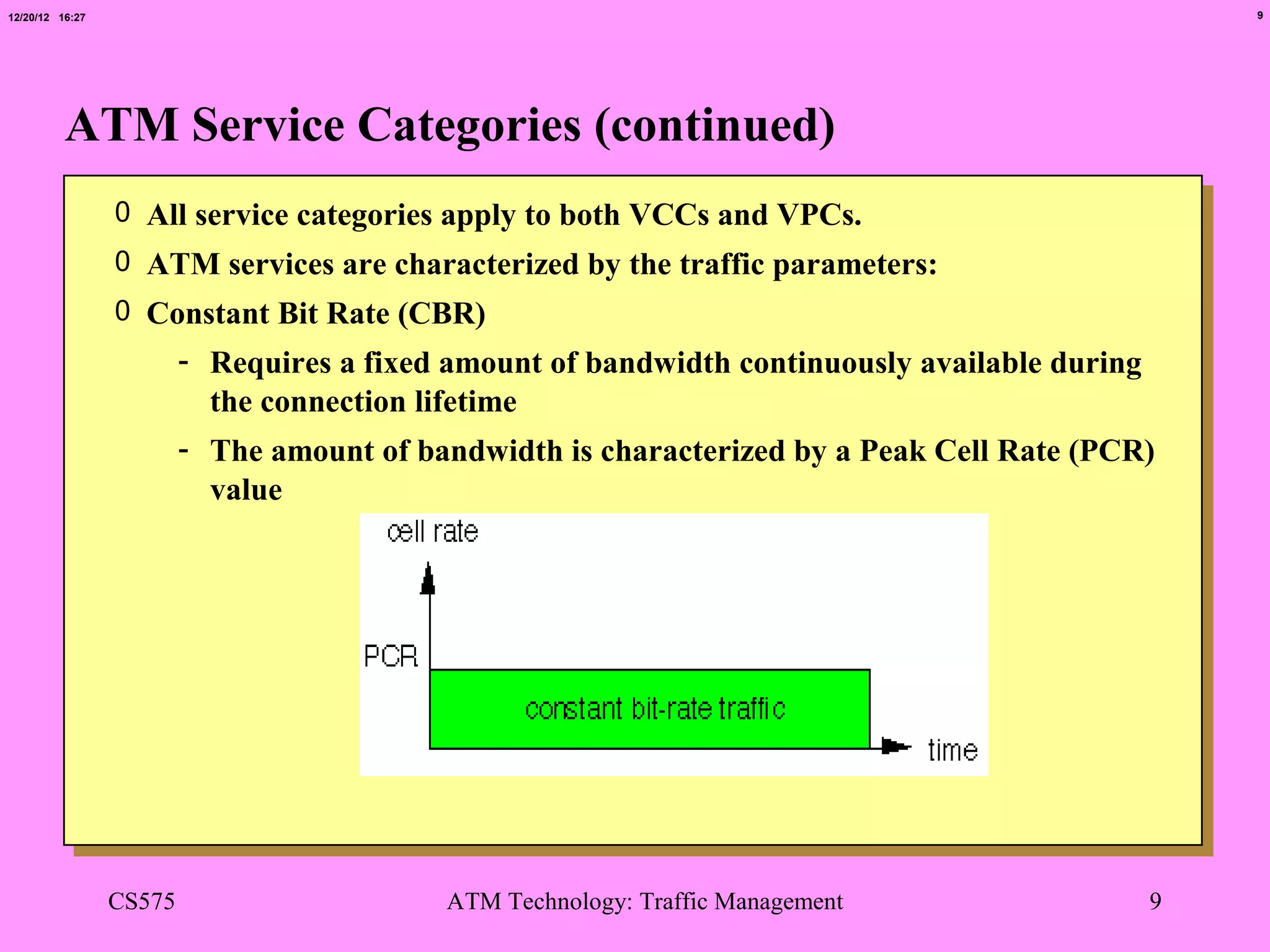
                 0 Constant Bit Rate (CBR)
                         - Requires a fixed amount of bandwidth continuously available during
                           the connection lifetime
                         - The amount of bandwidth is characterized by a Peak Cell Rate (PCR)
                           value


                 CS575                     ATM Technology: Traffic Management               9
12/20/12 16:27                                                                                   10


          ATM Service Categories (continued)
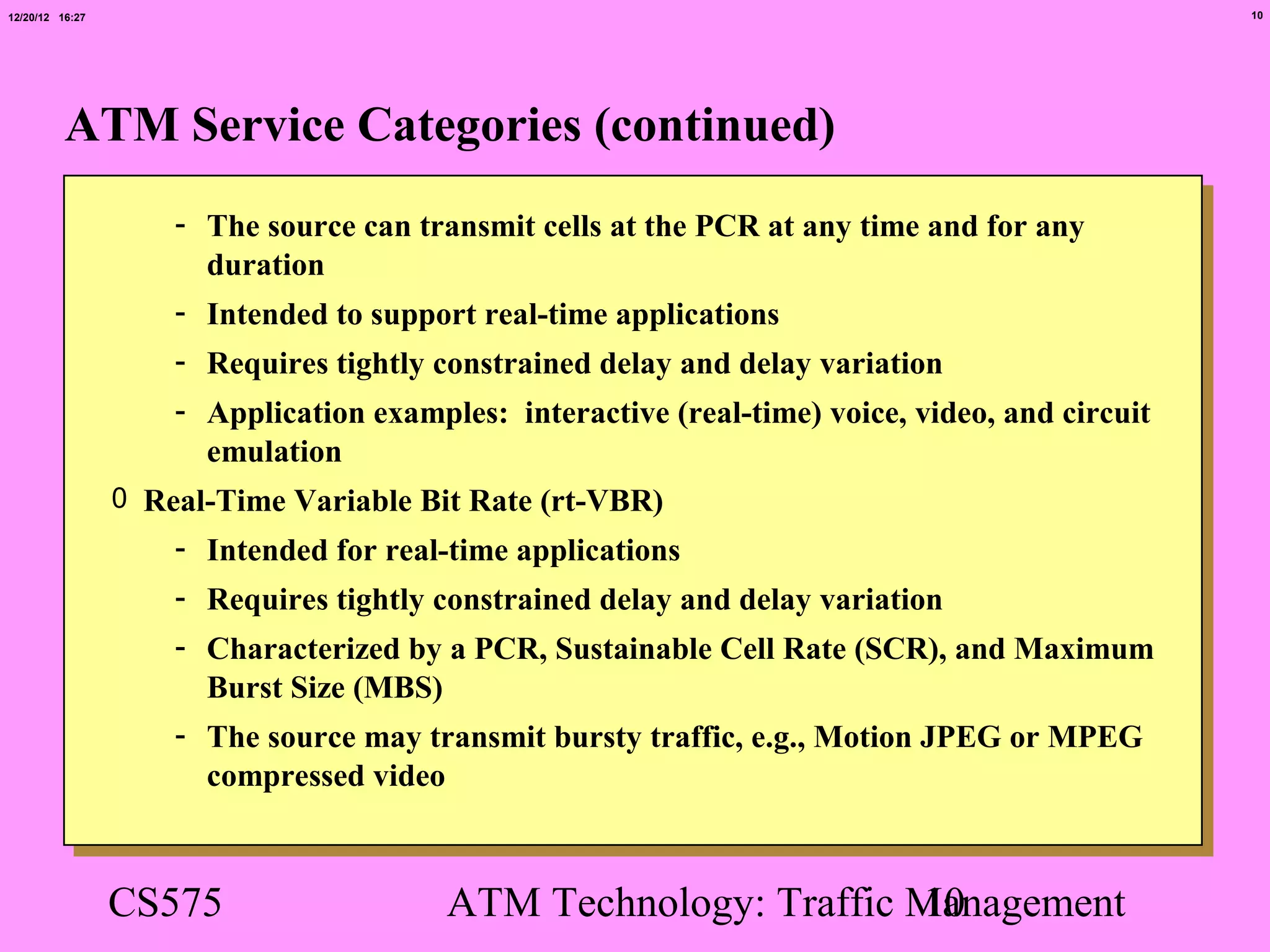
                     - The source can transmit cells at the PCR at any time and for any
                       duration
                     - Intended to support real-time applications
                     - Requires tightly constrained delay and delay variation
                     - Application examples: interactive (real-time) voice, video, and circuit
                       emulation
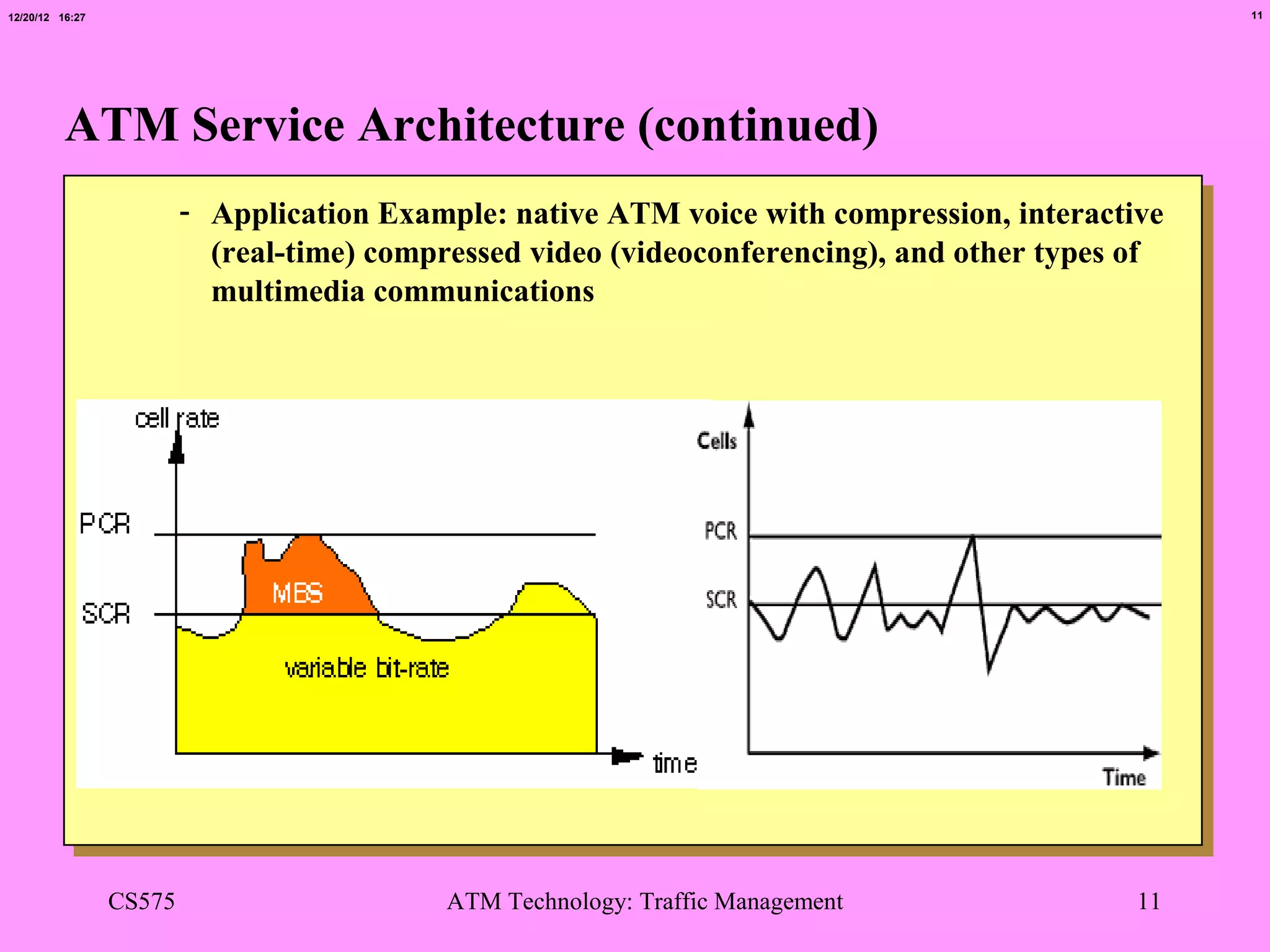
                 0 Real-Time Variable Bit Rate (rt-VBR)
                     - Intended for real-time applications
                     - Requires tightly constrained delay and delay variation
                     - Characterized by a PCR, Sustainable Cell Rate (SCR), and Maximum
                       Burst Size (MBS)
                     - The source may transmit bursty traffic, e.g., Motion JPEG or MPEG
                       compressed video


                 CS575                   ATM Technology: Traffic Management
                                                                 10
12/20/12 16:27                                                                                    11


          ATM Service Architecture (continued)
                         - Application Example: native ATM voice with compression, interactive
                           (real-time) compressed video (videoconferencing), and other types of
                           multimedia communications


                 CS575                      ATM Technology: Traffic Management               11
12/20/12 16:27                                                                                   12


          ATM Service Categories (continued)
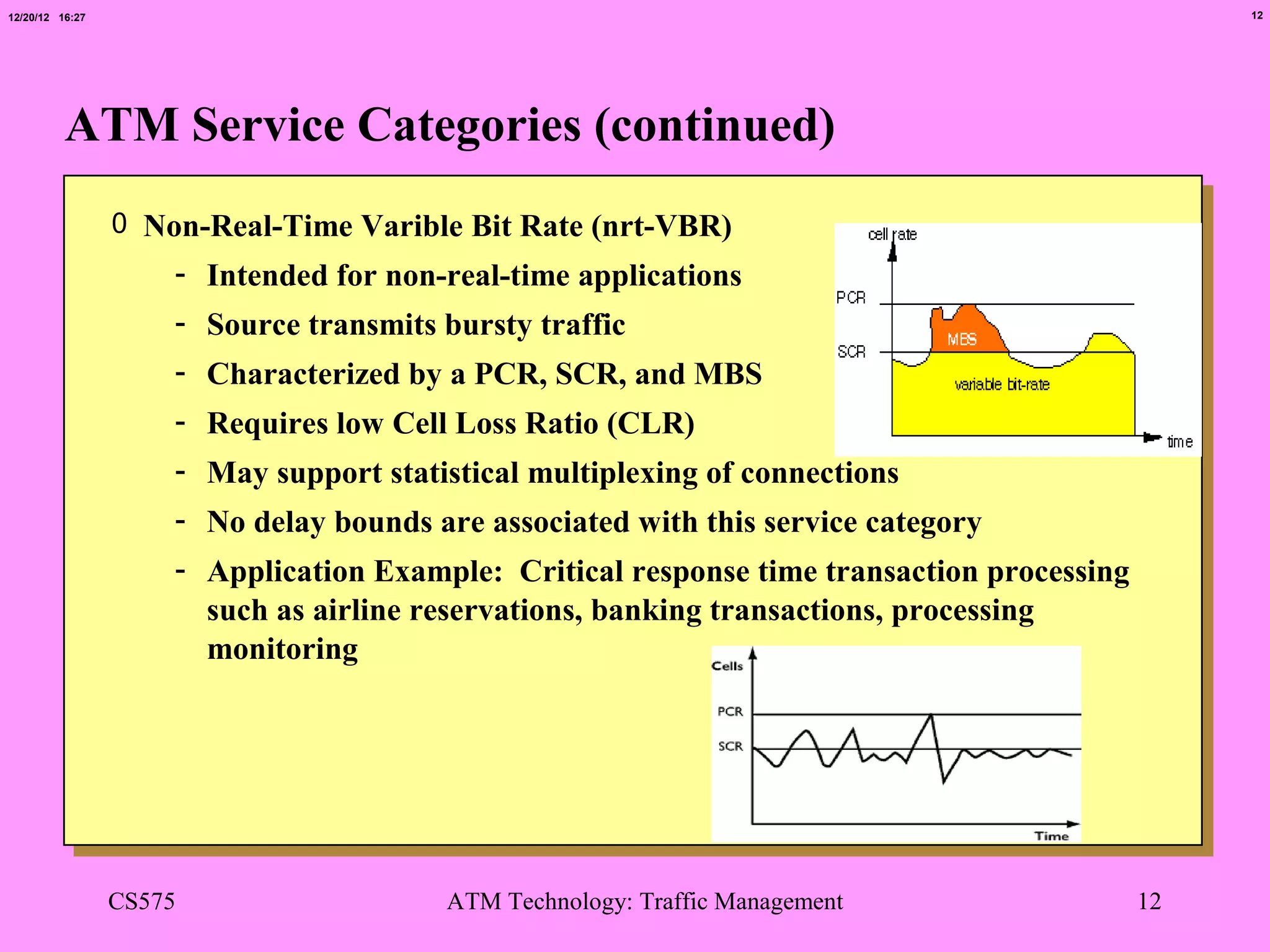
                 0 Non-Real-Time Varible Bit Rate (nrt-VBR)
                     - Intended for non-real-time applications
                     - Source transmits bursty traffic
                     - Characterized by a PCR, SCR, and MBS
                     - Requires low Cell Loss Ratio (CLR)
                     - May support statistical multiplexing of connections
                     - No delay bounds are associated with this service category
                     - Application Example: Critical response time transaction processing
                       such as airline reservations, banking transactions, processing
                       monitoring


                 CS575                  ATM Technology: Traffic Management                  12
12/20/12 16:27                                                                                   13


          ATM Service Categories (continued)
                 0 Unspecified Bit Rate (UBR)
                     - Intended for non-real-time, bursty applications
                     - Does not specify traffic related service guarantees
                     - No commitment is made about cell transfer delay
                     - No commitment is made as to cell loss ratio experienced by cells on the
                       connection
                     - Best effort service
                     - Application example: E-mail, LAN traffic, and TCP/IP traffic
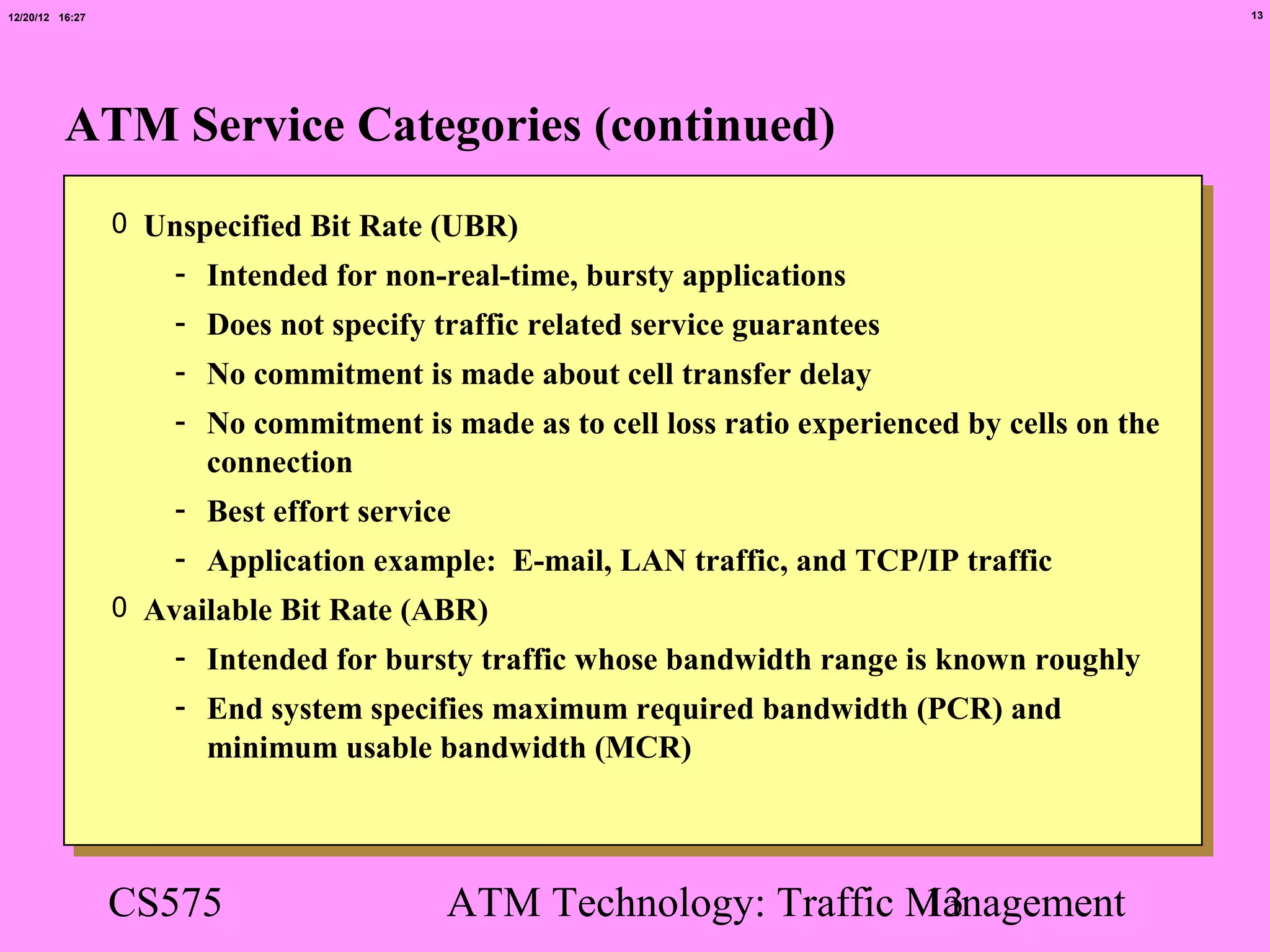
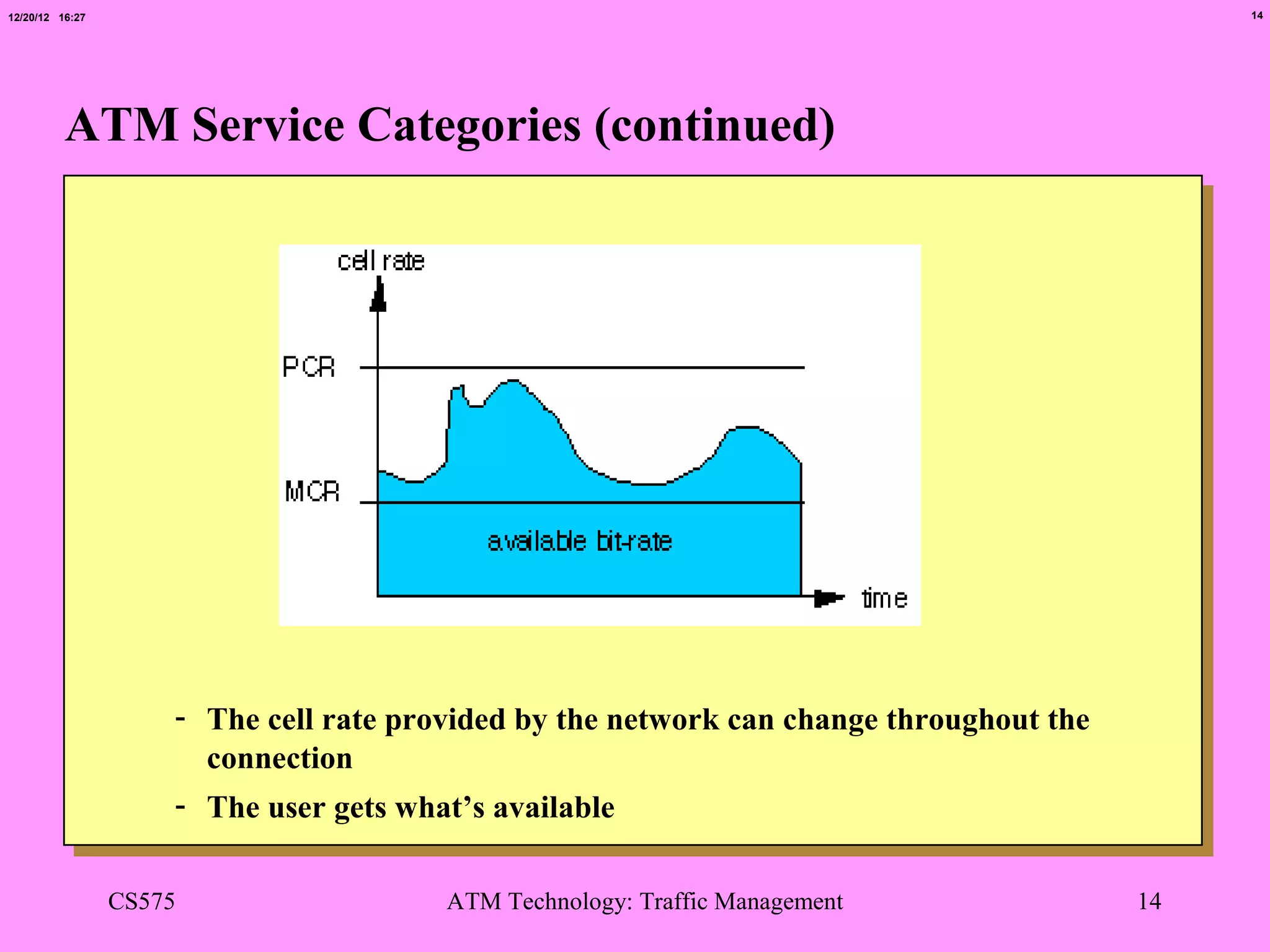
                 0 Available Bit Rate (ABR)
                     - Intended for bursty traffic whose bandwidth range is known roughly
                     - End system specifies maximum required bandwidth (PCR) and
                       minimum usable bandwidth (MCR)


                 CS575                   ATM Technology: Traffic Management
                                                                 13
12/20/12 16:27                                                                                14


          ATM Service Categories (continued)


                     - The cell rate provided by the network can change throughout the
                       connection
                     - The user gets what’s available

                 CS575                  ATM Technology: Traffic Management               14
12/20/12 16:27                                                                                            15


          ATM Service Categories (continued)
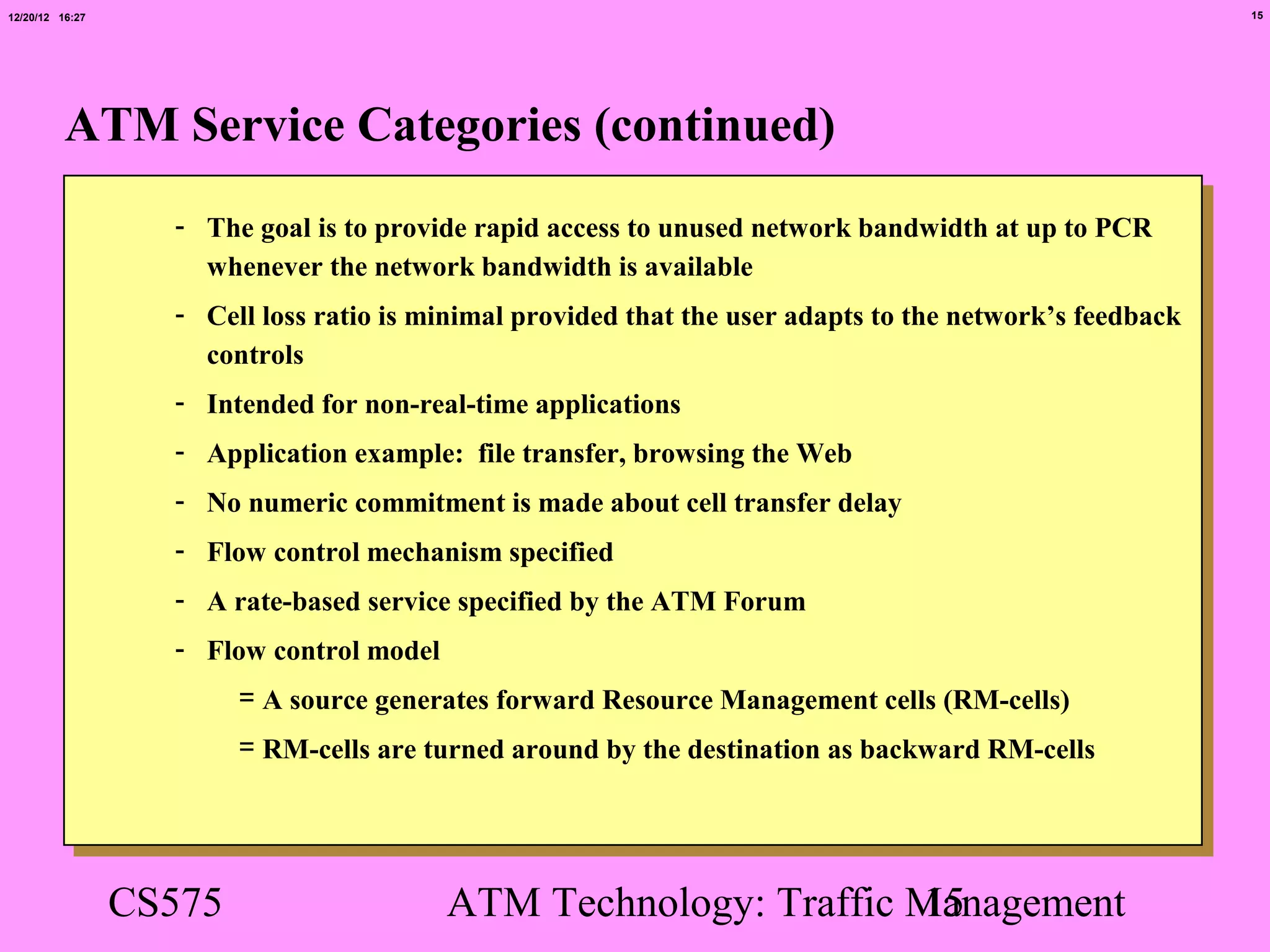
                   - The goal is to provide rapid access to unused network bandwidth at up to PCR
                     whenever the network bandwidth is available
                   - Cell loss ratio is minimal provided that the user adapts to the network’s feedback
                     controls
                   - Intended for non-real-time applications
                   - Application example: file transfer, browsing the Web
                   - No numeric commitment is made about cell transfer delay
                   - Flow control mechanism specified
                   - A rate-based service specified by the ATM Forum
                   - Flow control model
                         = A source generates forward Resource Management cells (RM-cells)
                         = RM-cells are turned around by the destination as backward RM-cells


                 CS575                    ATM Technology: Traffic Management
                                                                  15
12/20/12 16:27                                                                                 16


          ATM Service Categories (concluded)
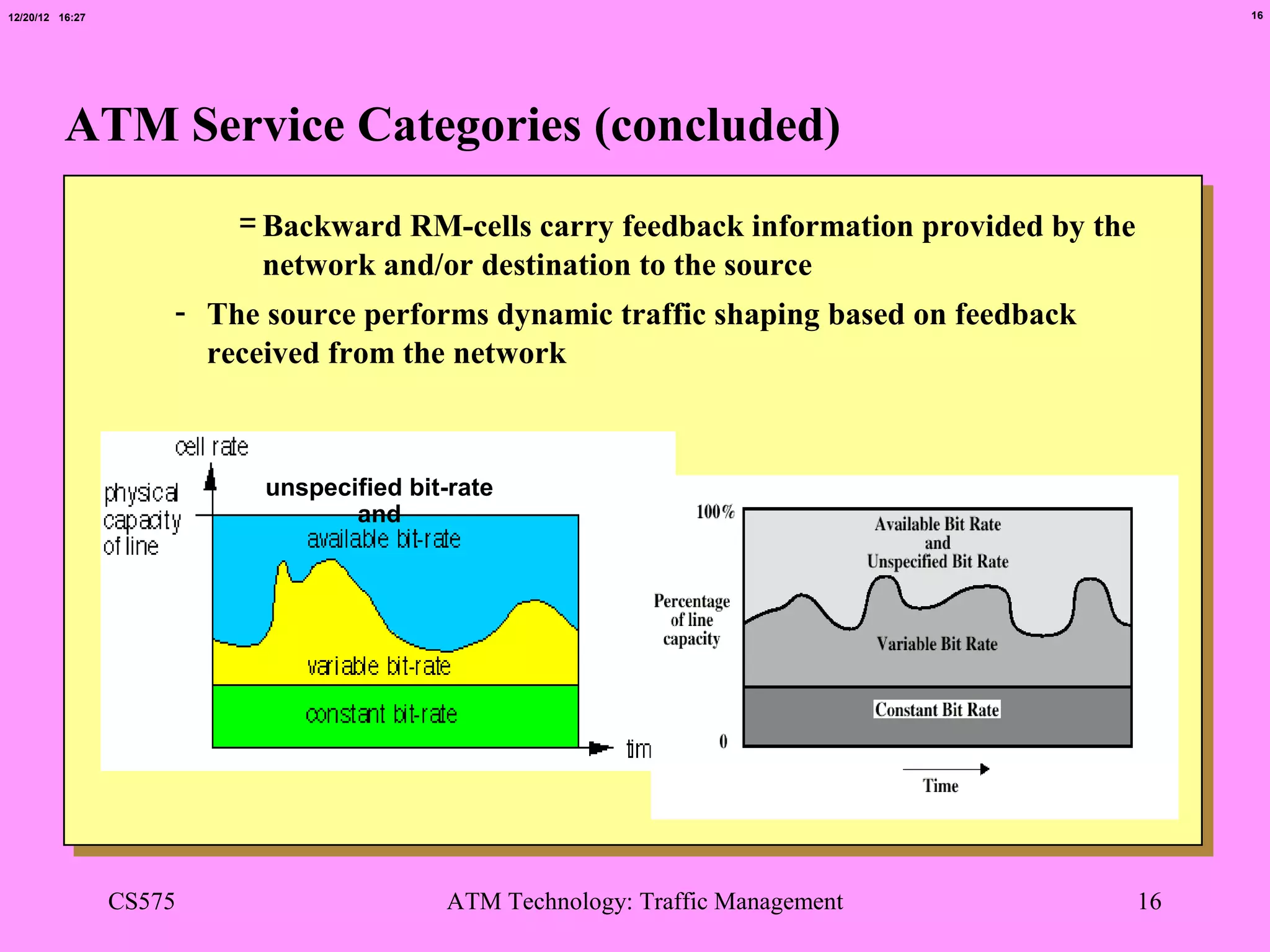
                         = Backward RM-cells carry feedback information provided by the
                           network and/or destination to the source
                     - The source performs dynamic traffic shaping based on feedback
                       received from the network


                           unspecified bit-rate
                                  and


                 CS575                    ATM Technology: Traffic Management              16
12/20/12 16:27                                                                                  17


          Quality of Service (QoS)
                 0 QoS is a set of user-perceivable performance parameters that characterize
                   the traffic over an ATM connection
                 0 Defined on an end-to-end basis
                 0 User requests a QoS class for an ATM connection
                 0 The requested QoS class is a part of the traffic contract
                 0 The network commits to meet the requested QoS as long as the user complies
                   with the traffic contract
                 0 ATM Forum QoS Classes

                           QoS Class            QoS Parameters            Application
                                0                   Unspecified         Best Effort, At Risk
                                1                    Specified        Circuit Emulation, CBR
                                2                    Specified           VBR Video/Audio
                                3                    Specified       Connection-Oriented Data
                                4                    Specified          Conectionless Data


                 CS575                    ATM Technology: Traffic Management
                                                                  17
12/20/12 16:27                                                                                  18


          Quality of Service (QoS) Parameters
                 0 QoS parameters describe the level of service for each connection
                 0 ATM Forum specified six QoS parameters
                 0 Through the use of network signaling to establish an ATM connection, three
                   of these may be negotiated between the end-system and the network
                      - Peak-to-peak Cell Delay Variation (peak-to-peak CDV)
                     - Maximum Cell Transfer Delay (maxCTD)
                     - Cell Loss Ratio (CLR)


                 CS575                   ATM Technology: Traffic Management
                                                                 18
12/20/12 16:27                                                                                                                      19


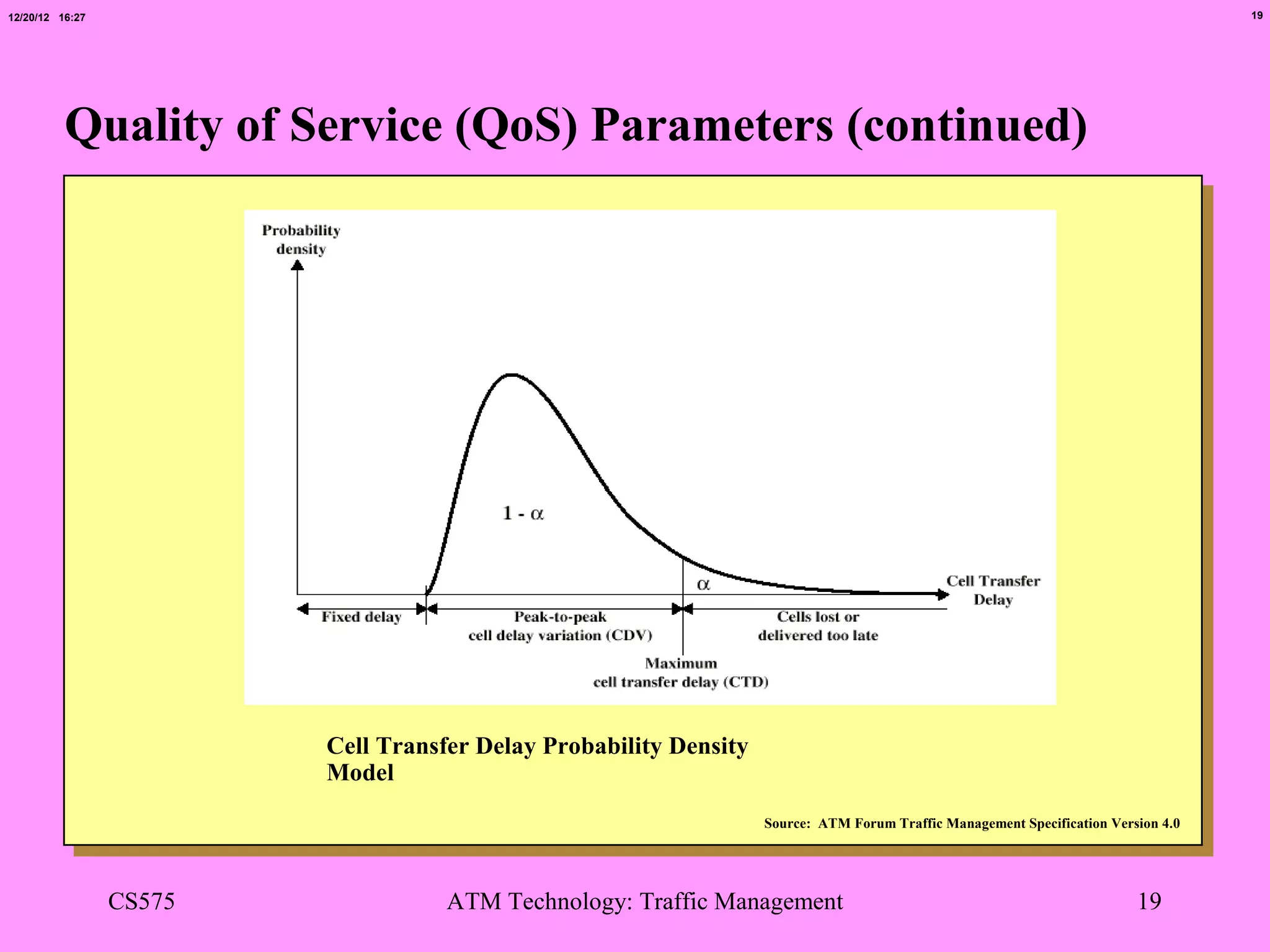
          Quality of Service (QoS) Parameters (continued)


                         Cell Transfer Delay Probability Density
                         Model
                                                                   Source: ATM Forum Traffic Management Specification Version 4.0


                 CS575              ATM Technology: Traffic Management                                                    19
12/20/12 16:27                                                                                  20


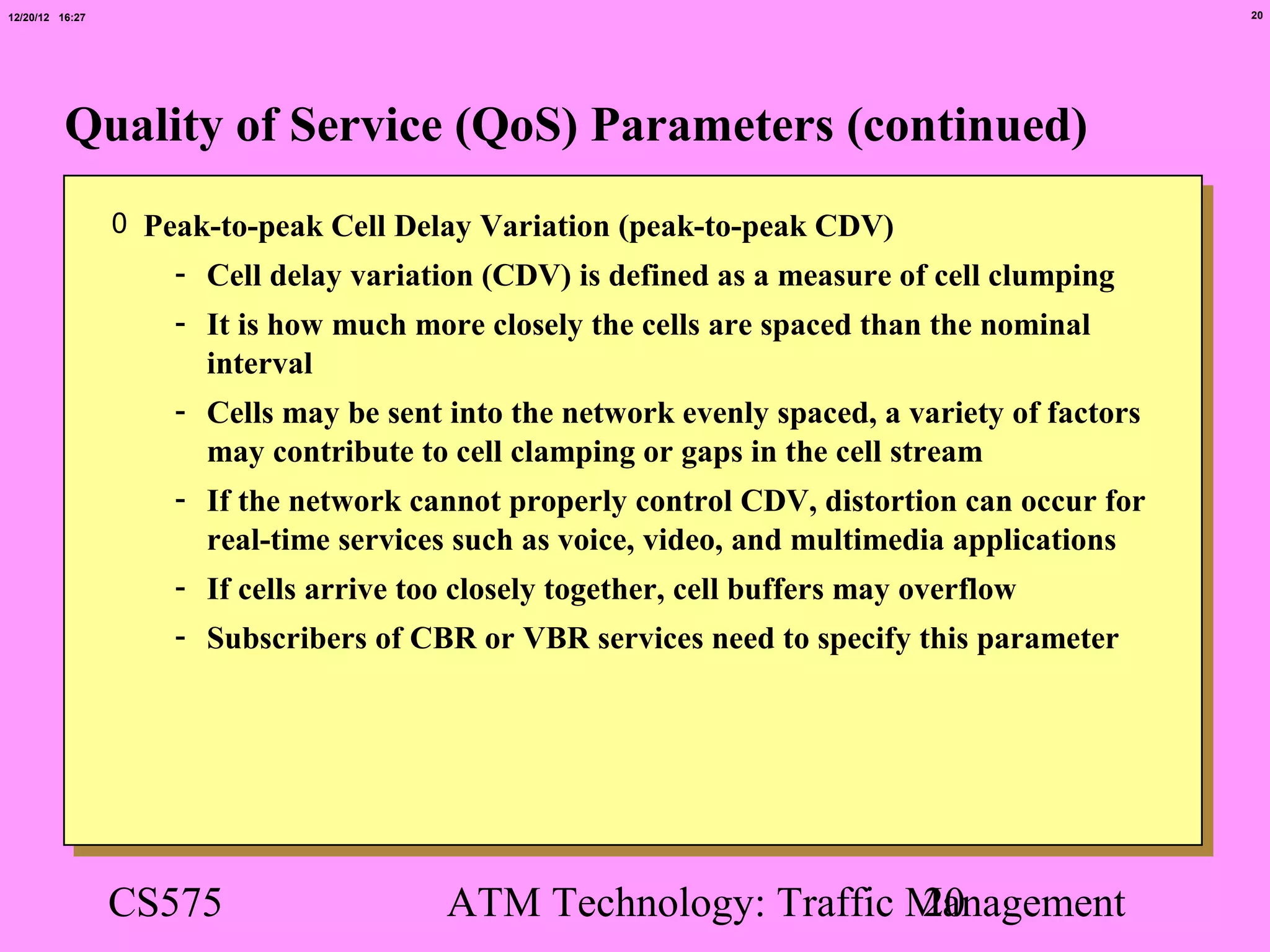
          Quality of Service (QoS) Parameters (continued)
                 0 Peak-to-peak Cell Delay Variation (peak-to-peak CDV)
                     - Cell delay variation (CDV) is defined as a measure of cell clumping
                     - It is how much more closely the cells are spaced than the nominal
                       interval
                     - Cells may be sent into the network evenly spaced, a variety of factors
                       may contribute to cell clamping or gaps in the cell stream
                     - If the network cannot properly control CDV, distortion can occur for
                       real-time services such as voice, video, and multimedia applications
                     - If cells arrive too closely together, cell buffers may overflow
                     - Subscribers of CBR or VBR services need to specify this parameter


                 CS575                   ATM Technology: Traffic Management
                                                                 20
12/20/12 16:27                                                                                     21


          Quality of Service (QoS) Parameters (continued)
                 0 Maximum Cell Transfer Delay (maxCTD)
                     - CTD is the elapsed time between a cell’s exit at the source and its entry
                       at the destination
                     - It includes both node processing and internode transmission time
                     - Subscribers of CBR or VBR services need to specify this parameter
                 0 Cell Loss Ratio (CLR)
                     - CLR = (Lost Cells) / (Total Transmitted Cells)
                     - Cells may be lost due to
                         = network malfunction
                         = discarded for noncompliance
                         = discarded in response to network congestion


                 CS575                     ATM Technology: Traffic Management
                                                                   21
12/20/12 16:27                                                                                      22


          Quality of Service (QoS) Parameters (concluded)
                 0 Higher values of cell loss is dominated by the effects of queuing strategy and
                   buffer sizes
                 0 Delay, delay variation, and cell loss are impacted by buffer size and
                   buffering strategy
                 0 The error rate is determined by fiber transmission characteristics


                 CS575                    ATM Technology: Traffic Management
                                                                  22
12/20/12 16:27                                                                                       23


          Traffic Contract
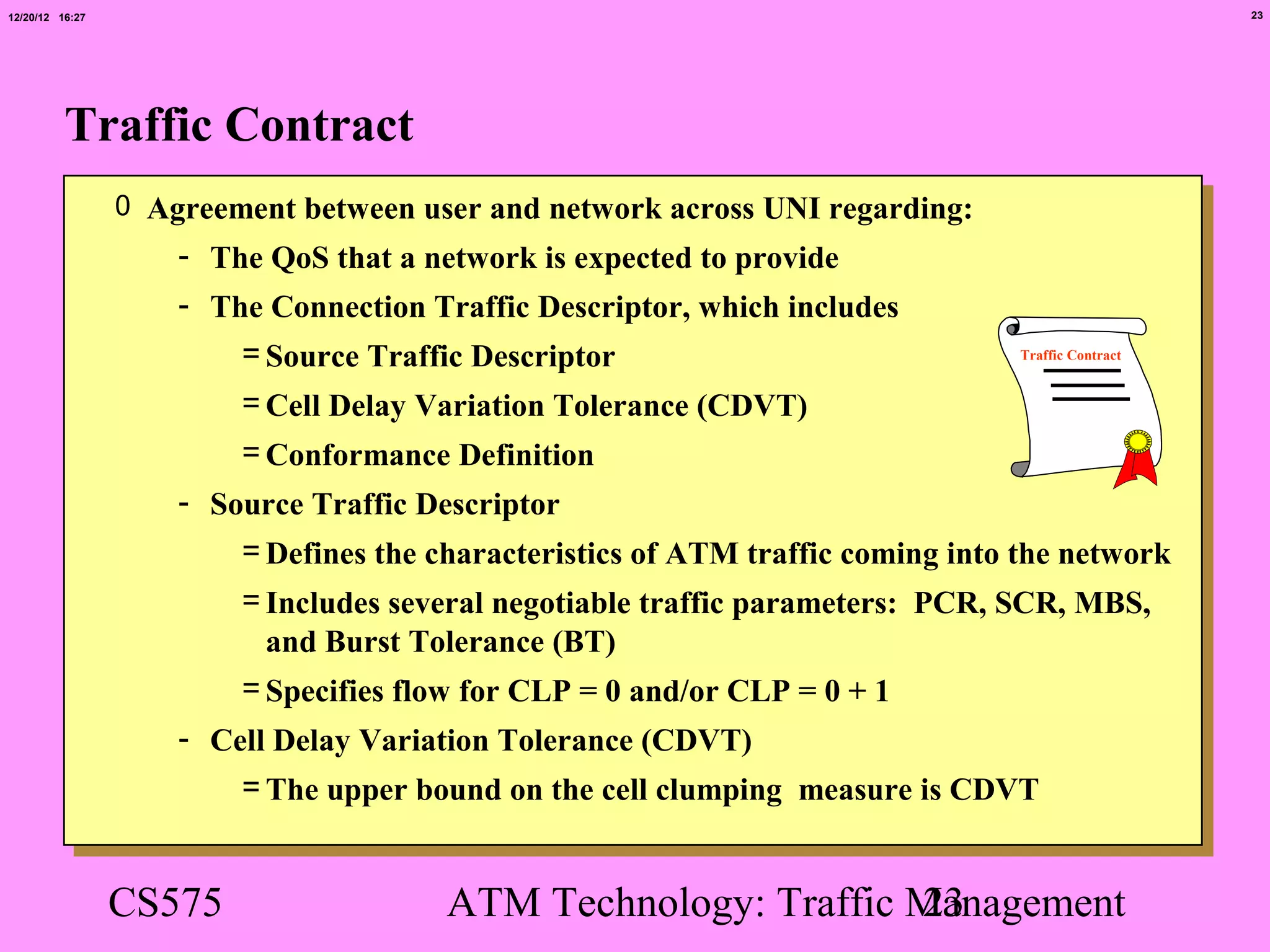
                 0 Agreement between user and network across UNI regarding:
                     - The QoS that a network is expected to provide
                     - The Connection Traffic Descriptor, which includes
                         = Source Traffic Descriptor                              Traffic Contract


                         = Cell Delay Variation Tolerance (CDVT)
                         = Conformance Definition
                     - Source Traffic Descriptor
                         = Defines the characteristics of ATM traffic coming into the network
                         = Includes several negotiable traffic parameters: PCR, SCR, MBS,
                           and Burst Tolerance (BT)
                         = Specifies flow for CLP = 0 and/or CLP = 0 + 1
                     - Cell Delay Variation Tolerance (CDVT)
                         = The upper bound on the cell clumping measure is CDVT


                 CS575                  ATM Technology: Traffic Management
                                                                23
12/20/12 16:27                                                                                   24


          Traffic Contract (continued)
                         = It is the measure of how much cell clumping is acceptable resulting
                           from network operations such as cell multiplexing or the insertion
                           of OAM cells
                         = CDVT controls the amount of variability acceptable using a leaky
                           bucket algorithm
                   - Conformance Definition
                       = Defines what cell rates and streams will be monitored
                         = Defines the checking rule used to interpret the traffic parameters
                         = Defines the network’s definition of a compliant connection, i.e.,
                           what constitutes obeying the rules
                         = Conformance is determined by the Usage Parameter control (UPC)
                           at the ingress to the network


                 CS575                  ATM Technology: Traffic Management
                                                                24
12/20/12 16:27                                                                             25


          Traffic Contract (concluded)
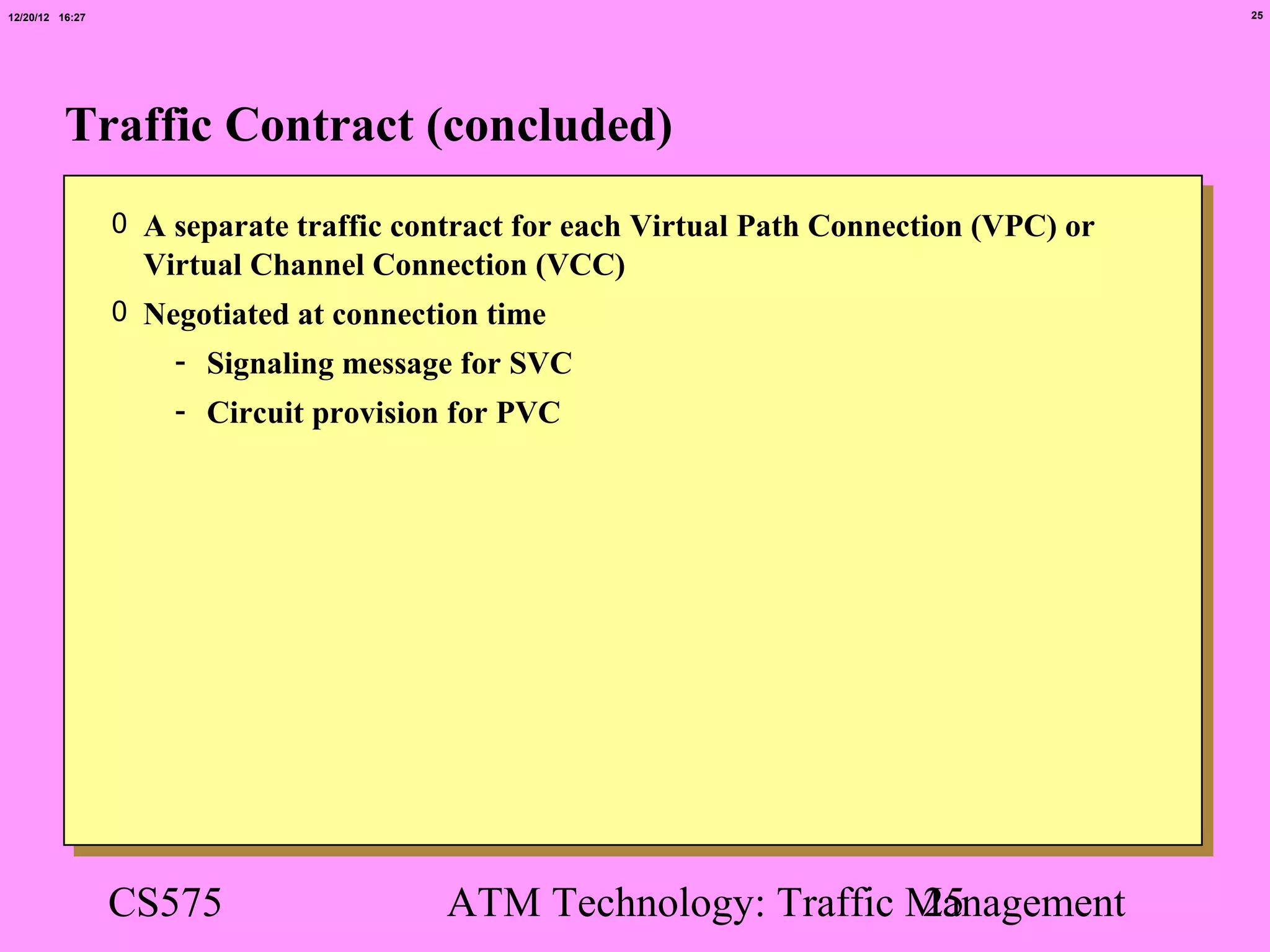
                 0 A separate traffic contract for each Virtual Path Connection (VPC) or
                   Virtual Channel Connection (VCC)
                 0 Negotiated at connection time
                     - Signaling message for SVC
                     - Circuit provision for PVC


                 CS575                   ATM Technology: Traffic Management
                                                                 25
12/20/12 16:27                                                                 26


          Traffic Control Functions
                 0 Connection Admission Control (CAC)
                 0 Usage Parameter Control (UPC)
                 0 Selective cell discarding
                 0 Traffic Shaping
                 0 Explicit Forward Congestion Indication (EFCI)
                 0 Cell Loss Priority Control
                 0 Network Resource Management (NRM)
                 0 Frame discard
                 0 ABR Flow Control
                 0 Others


                 CS575                    ATM Technology: Traffic Management
                                                                  26
12/20/12 16:27                                                                                 27


          Connection Admission Control
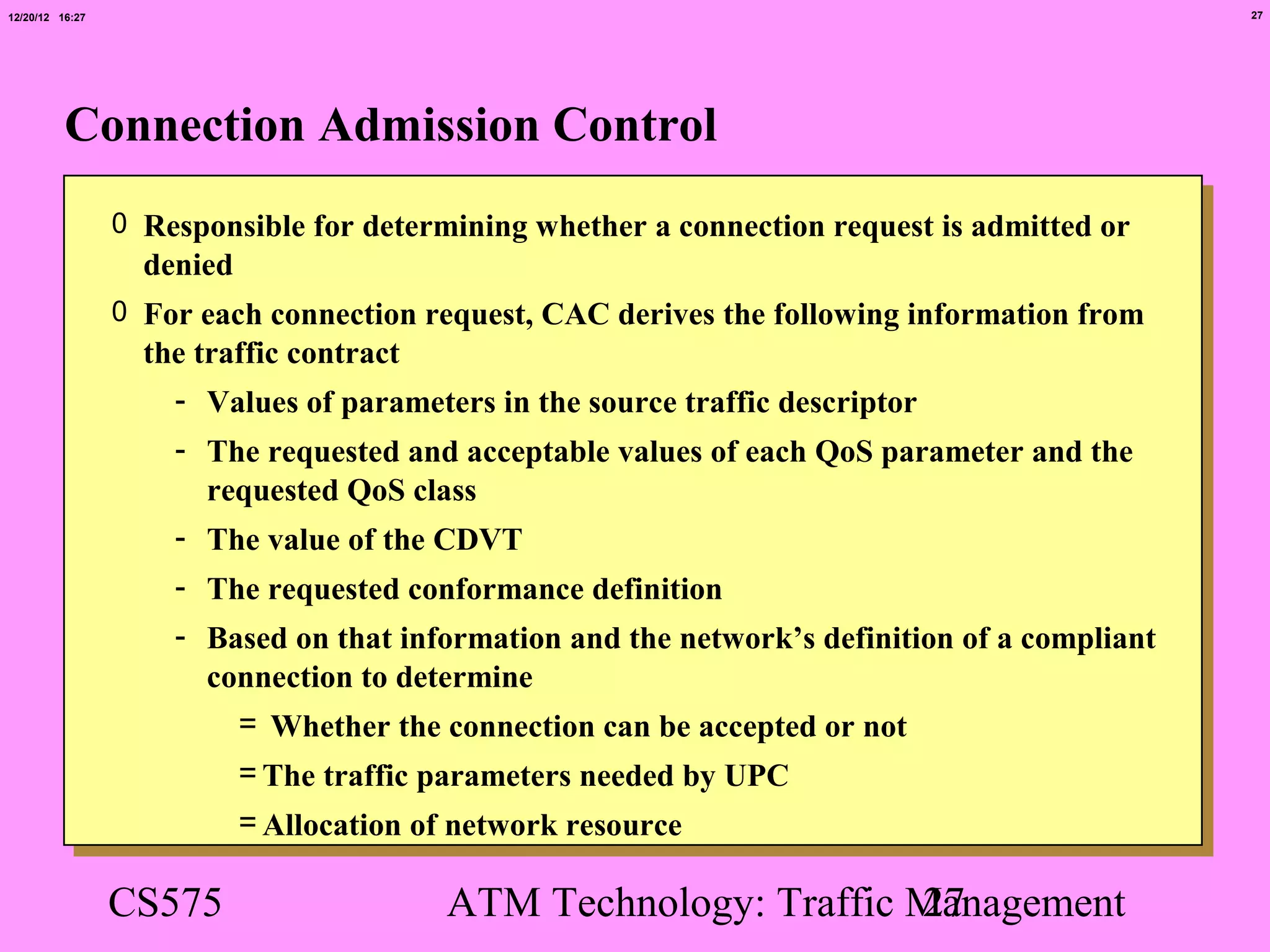
                 0 Responsible for determining whether a connection request is admitted or
                   denied
                 0 For each connection request, CAC derives the following information from
                   the traffic contract
                     - Values of parameters in the source traffic descriptor
                     - The requested and acceptable values of each QoS parameter and the
                       requested QoS class
                     - The value of the CDVT
                     - The requested conformance definition
                     - Based on that information and the network’s definition of a compliant
                       connection to determine
                         = Whether the connection can be accepted or not
                            = The traffic parameters needed by UPC
                            = Allocation of network resource

                 CS575                     ATM Technology: Traffic Management
                                                                   27
12/20/12 16:27                                                                28


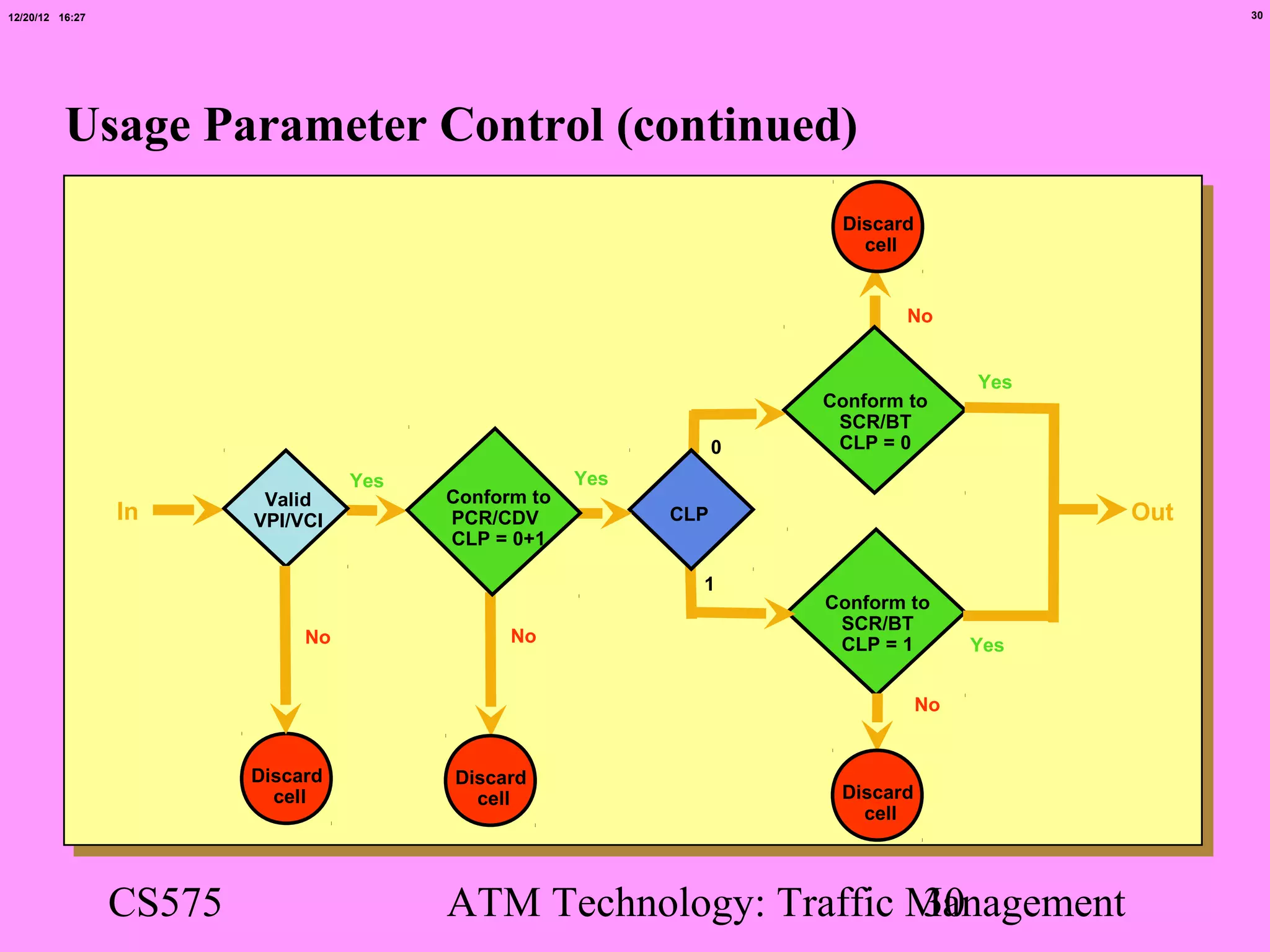
          Usage Parameter Control
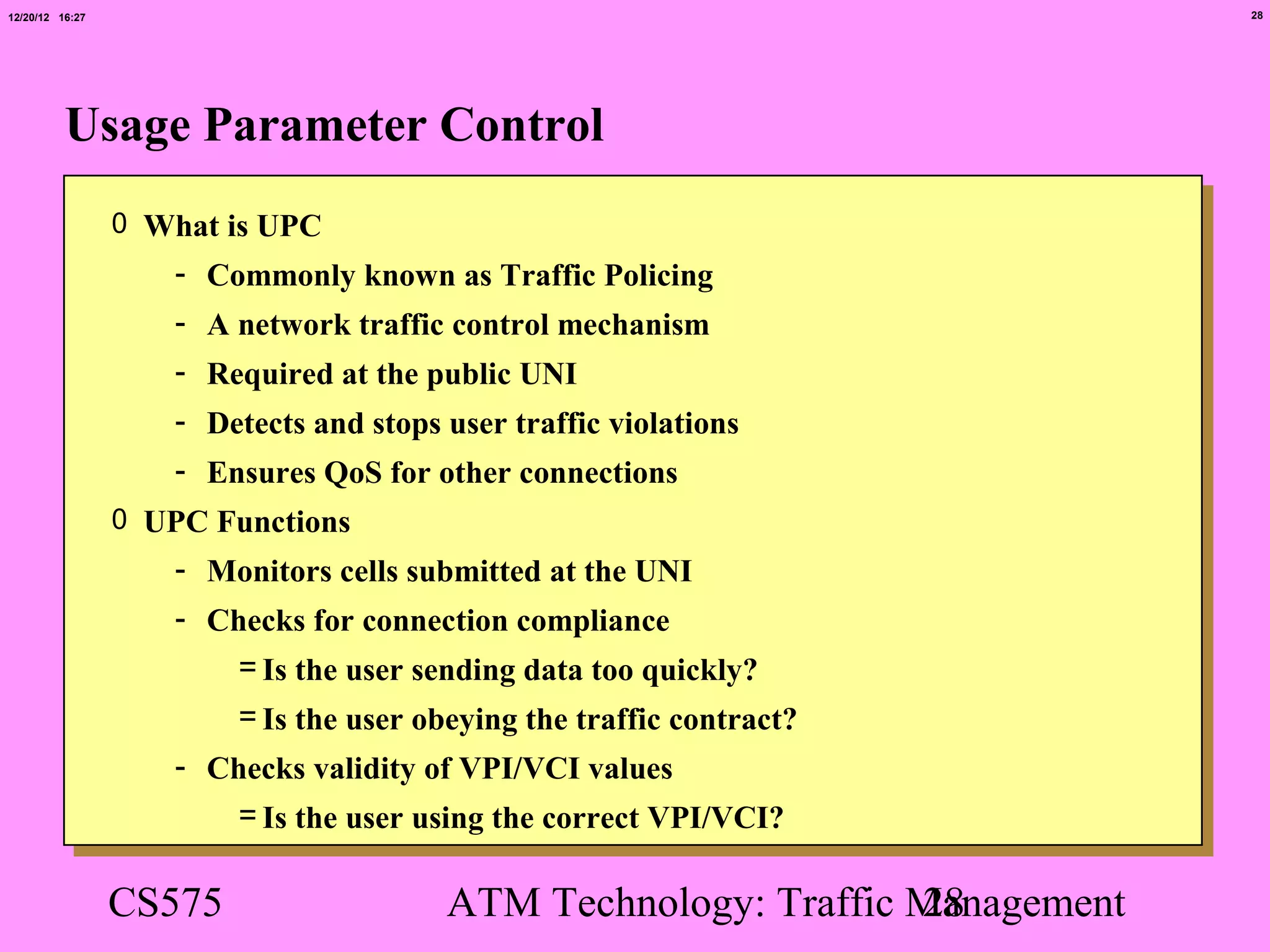
                 0 What is UPC
                    - Commonly known as Traffic Policing
                    - A network traffic control mechanism
                    - Required at the public UNI
                    - Detects and stops user traffic violations
                    - Ensures QoS for other connections
                 0 UPC Functions
                    - Monitors cells submitted at the UNI
                    - Checks for connection compliance
                         = Is the user sending data too quickly?
                         = Is the user obeying the traffic contract?
                    - Checks validity of VPI/VCI values
                       = Is the user using the correct VPI/VCI?

                 CS575                   ATM Technology: Traffic Management
                                                                 28
12/20/12 16:27                                                                  29


          Usage Parameter Control (continued)
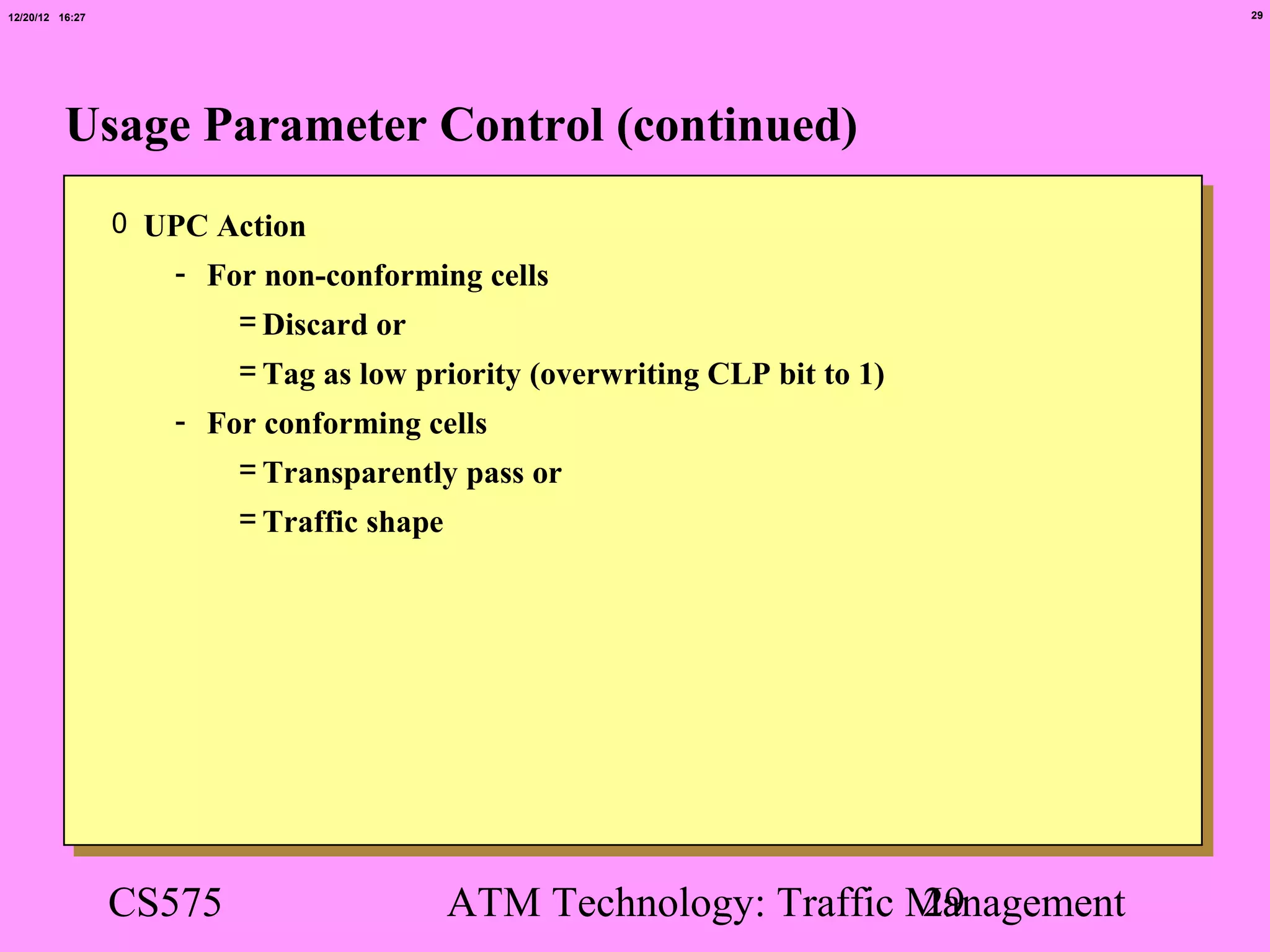
                 0 UPC Action
                    - For non-conforming cells
                        = Discard or
                         = Tag as low priority (overwriting CLP bit to 1)
                    - For conforming cells
                        = Transparently pass or
                         = Traffic shape


                 CS575                     ATM Technology: Traffic Management
                                                                   29
12/20/12 16:27                                                                                    30


          Usage Parameter Control (continued)
                                                                       Discard
                                                                         cell


                                                                              No


                                                                                      Yes
                                                                      Conform to
                                                                       SCR/BT
                                                                  0    CLP = 0
                                   Yes                Yes
                          Valid          Conform to
                 In      VPI/VCI         PCR/CDV            CLP                             Out
                                         CLP = 0+1

                                                              1
                                                                      Conform to
                                                                       SCR/BT
                              No               No                      CLP = 1        Yes


                                                                                 No


                         Discard         Discard
                           cell            cell                        Discard
                                                                         cell


                 CS575                   ATM Technology: Traffic Management
                                                                 30
12/20/12 16:27                                                                               31


          Usage Parameter Control (continued)
          Generic Cell Rate Algorithm
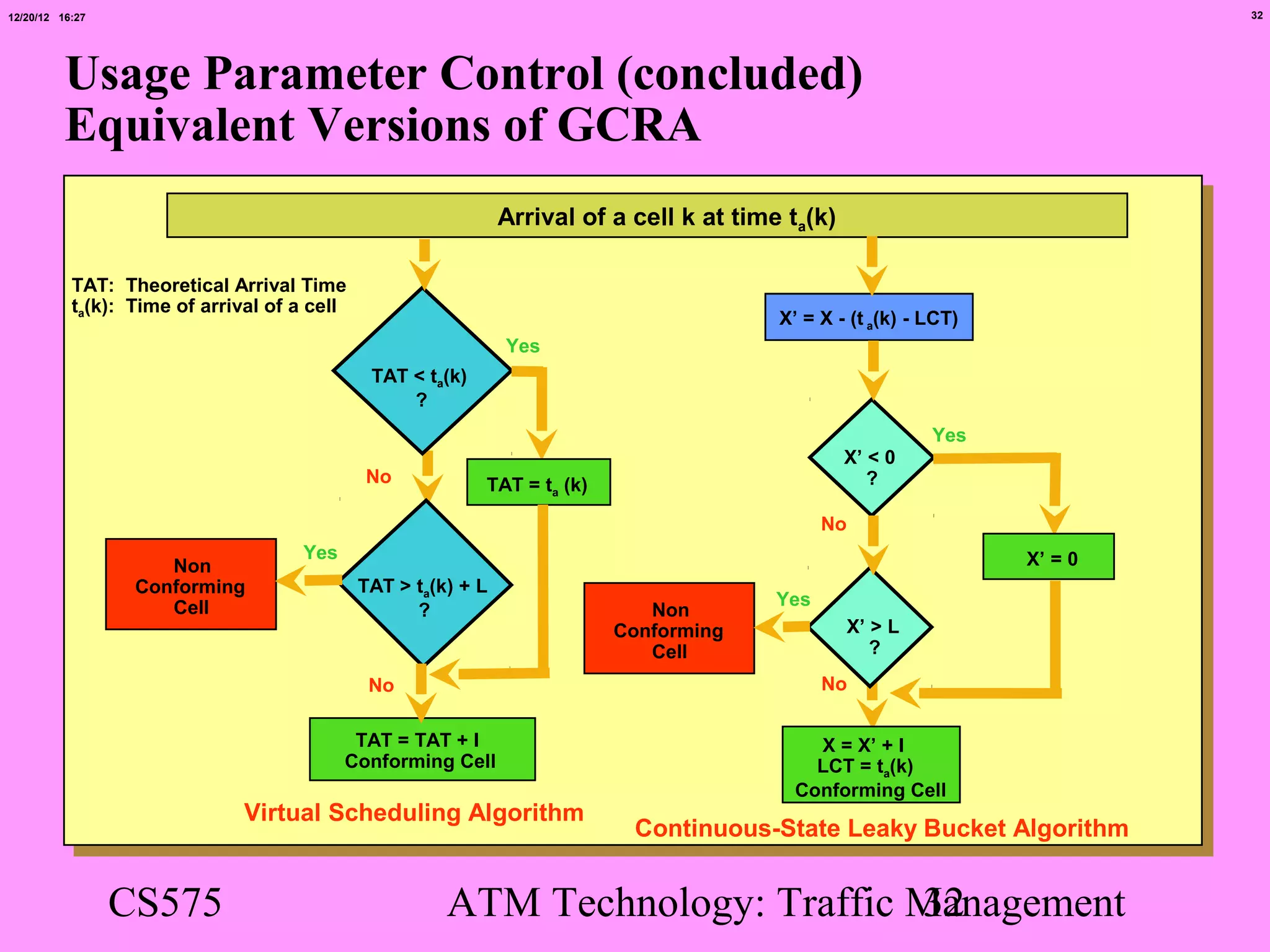
                 0 Used to define conformance with respect to the traffic contract
                 0 For each cell arrival, GCRA determines whether the cell conforms to the
                   traffic contract of the connection
                 0 The UPC function may implement GCRA to enforce conformance
                 0 Equivalent representations of the GCRA
                     - Continuous-State Leaky Bucket Algorithm
                     - Virtual Scheduling algorithm


                 CS575                    ATM Technology: Traffic Management
                                                                  31
12/20/12 16:27                                                                                                                32


          Usage Parameter Control (concluded)
          Equivalent Versions of GCRA
                                                                Arrival of a cell k at time ta(k)

           TAT: Theoretical Arrival Time
           ta(k): Time of arrival of a cell
                                                                                           X’ = X - (t a(k) - LCT)
                                                                Yes
                                               TAT < ta(k)
                                                   ?
                                                                                                              Yes
                                                                                                    X’ < 0
                                              No             TAT = ta (k)                              ?

                                                                                                 No
                                     Yes                                                                             X’ = 0
                     Non
                  Conforming                  TAT > ta(k) + L
                     Cell                                                                  Yes
                                                    ?                          Non
                                                                            Conforming              X’ > L
                                                                               Cell                    ?
                                               No                                                No

                                            TAT = TAT + I                                      X = X’ + I
                                           Conforming Cell                                     LCT = ta(k)
                                                                                             Conforming Cell
                               Virtual Scheduling Algorithm
                                                                             Continuous-State Leaky Bucket Algorithm


                 CS575                                  ATM Technology: Traffic Management
                                                                                32
12/20/12 16:27                                                                                  33


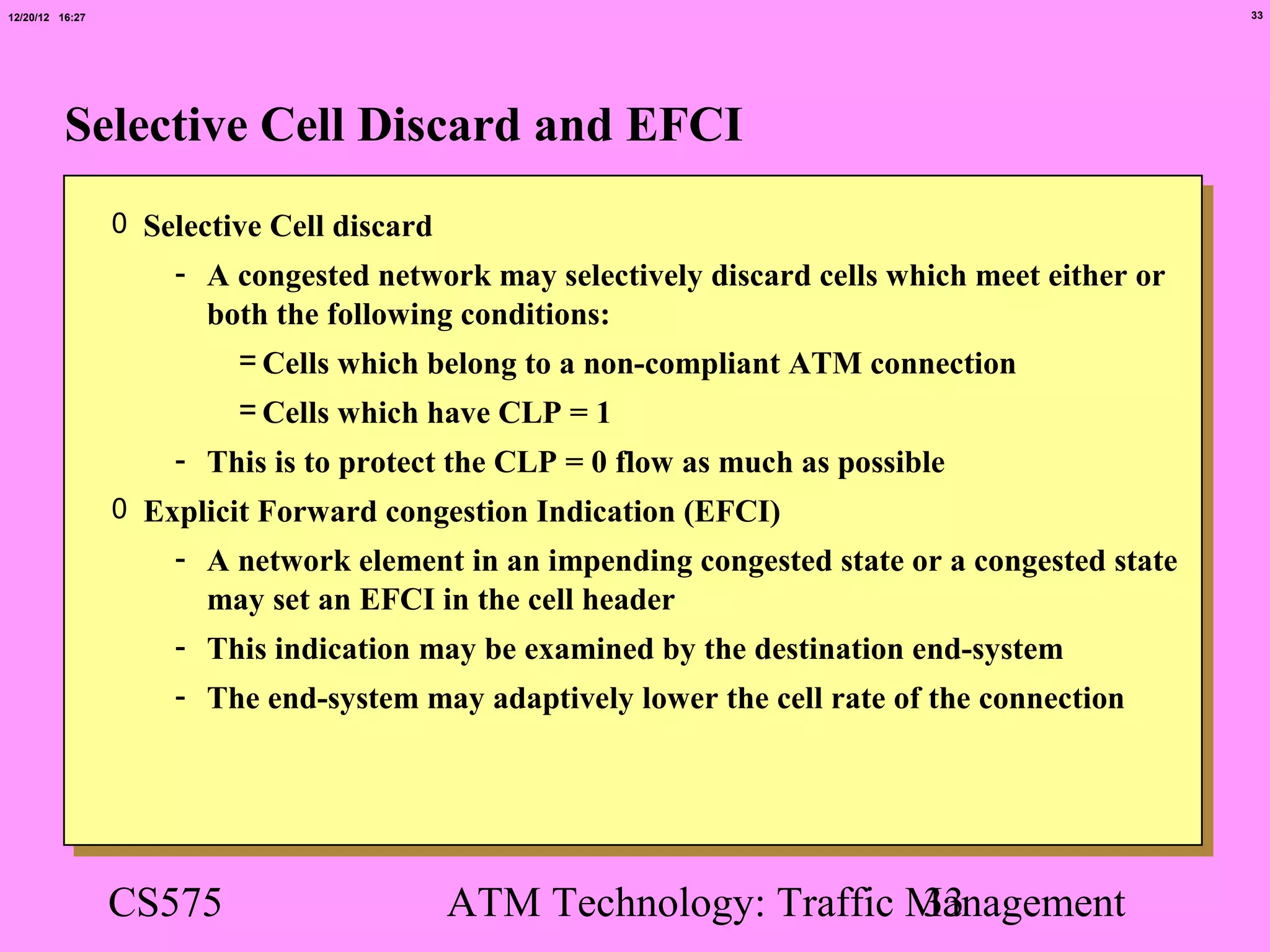
          Selective Cell Discard and EFCI
                 0 Selective Cell discard
                     - A congested network may selectively discard cells which meet either or
                       both the following conditions:
                         = Cells which belong to a non-compliant ATM connection
                          = Cells which have CLP = 1
                     - This is to protect the CLP = 0 flow as much as possible
                 0 Explicit Forward congestion Indication (EFCI)
                     - A network element in an impending congested state or a congested state
                       may set an EFCI in the cell header
                     - This indication may be examined by the destination end-system
                     - The end-system may adaptively lower the cell rate of the connection


                 CS575                      ATM Technology: Traffic Management
                                                                    33
12/20/12 16:27                                                                                   34


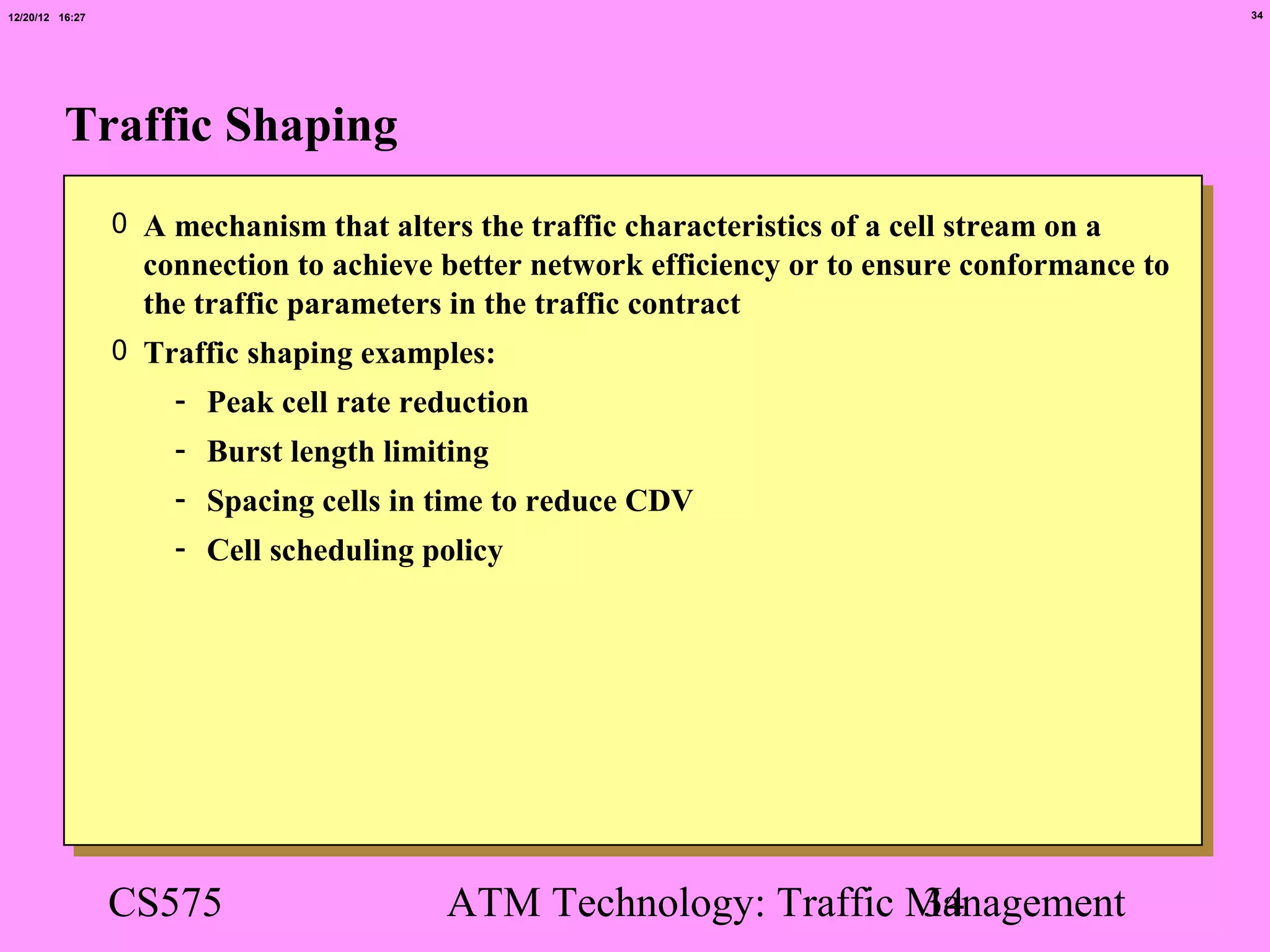
          Traffic Shaping
                 0 A mechanism that alters the traffic characteristics of a cell stream on a
                   connection to achieve better network efficiency or to ensure conformance to
                   the traffic parameters in the traffic contract
                 0 Traffic shaping examples:
                     - Peak cell rate reduction
                     - Burst length limiting
                     - Spacing cells in time to reduce CDV
                     - Cell scheduling policy


                 CS575                    ATM Technology: Traffic Management
                                                                  34
12/20/12 16:27                                                                                 35


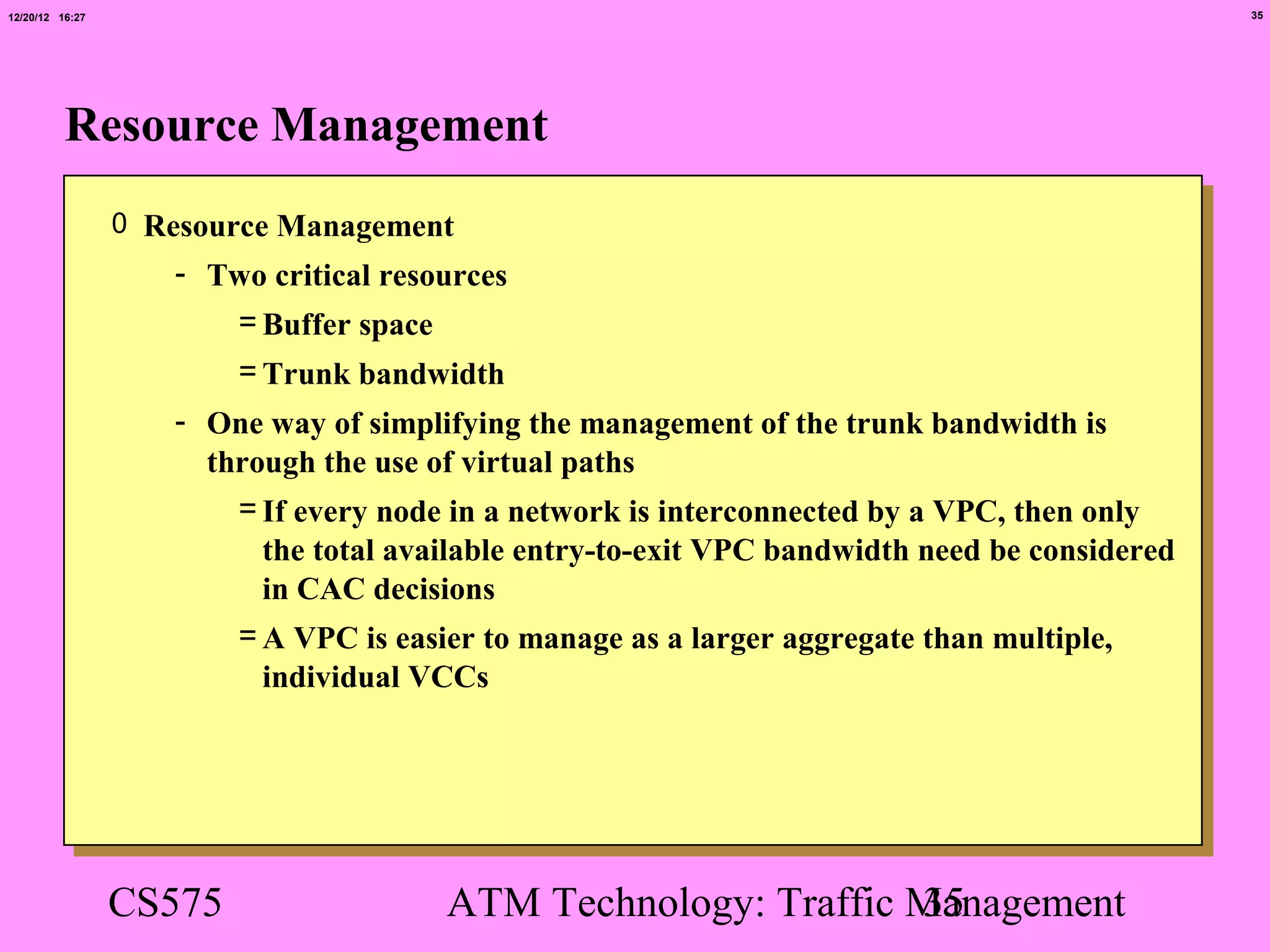
          Resource Management
                 0 Resource Management
                    - Two critical resources
                       = Buffer space
                         = Trunk bandwidth
                    - One way of simplifying the management of the trunk bandwidth is
                      through the use of virtual paths
                        = If every node in a network is interconnected by a VPC, then only
                          the total available entry-to-exit VPC bandwidth need be considered
                          in CAC decisions
                        = A VPC is easier to manage as a larger aggregate than multiple,
                          individual VCCs


                 CS575                 ATM Technology: Traffic Management
                                                               35
12/20/12 16:27                                                                                   36


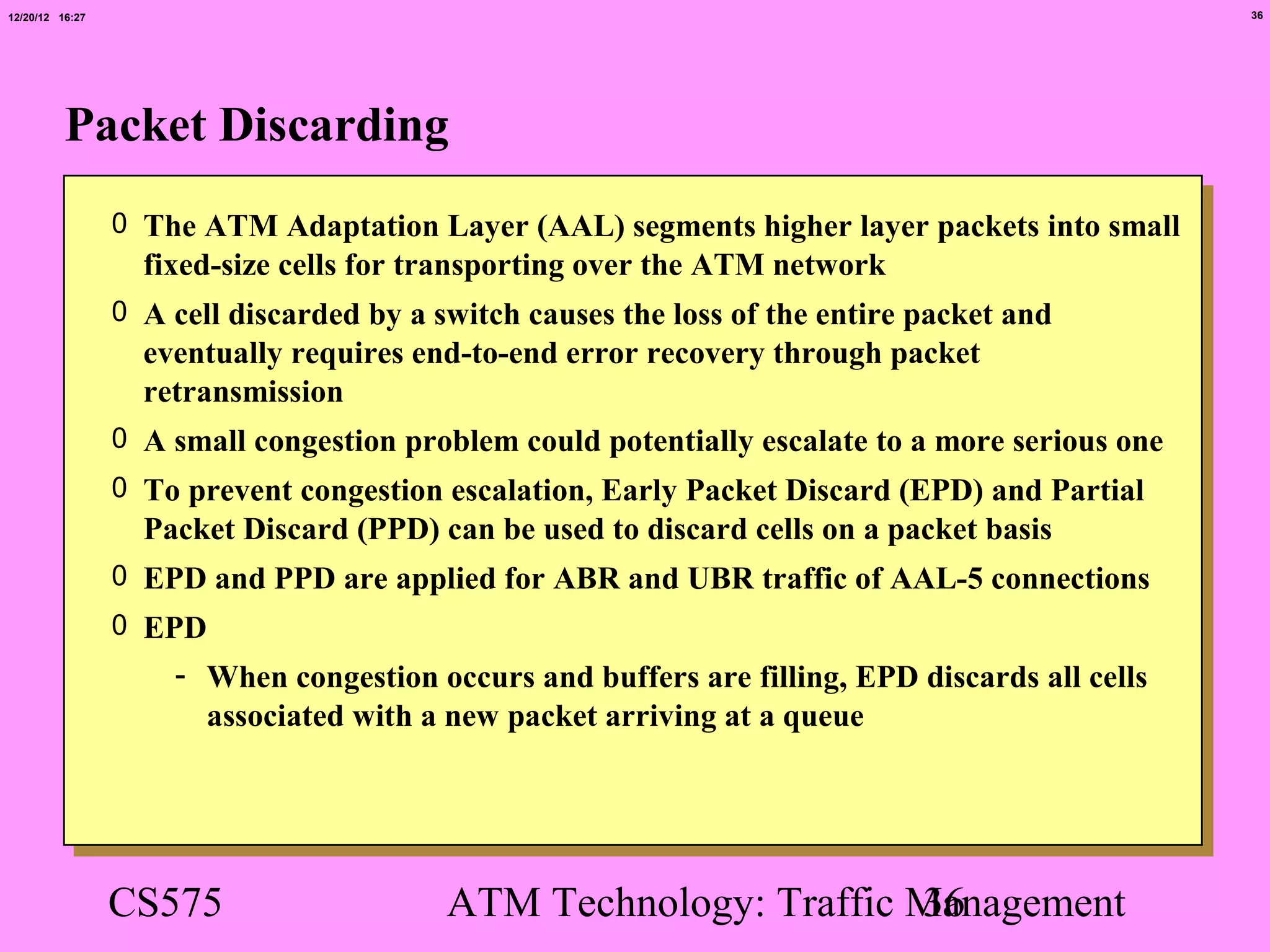
          Packet Discarding
                 0 The ATM Adaptation Layer (AAL) segments higher layer packets into small
                   fixed-size cells for transporting over the ATM network
                 0 A cell discarded by a switch causes the loss of the entire packet and
                   eventually requires end-to-end error recovery through packet
                   retransmission
                 0 A small congestion problem could potentially escalate to a more serious one
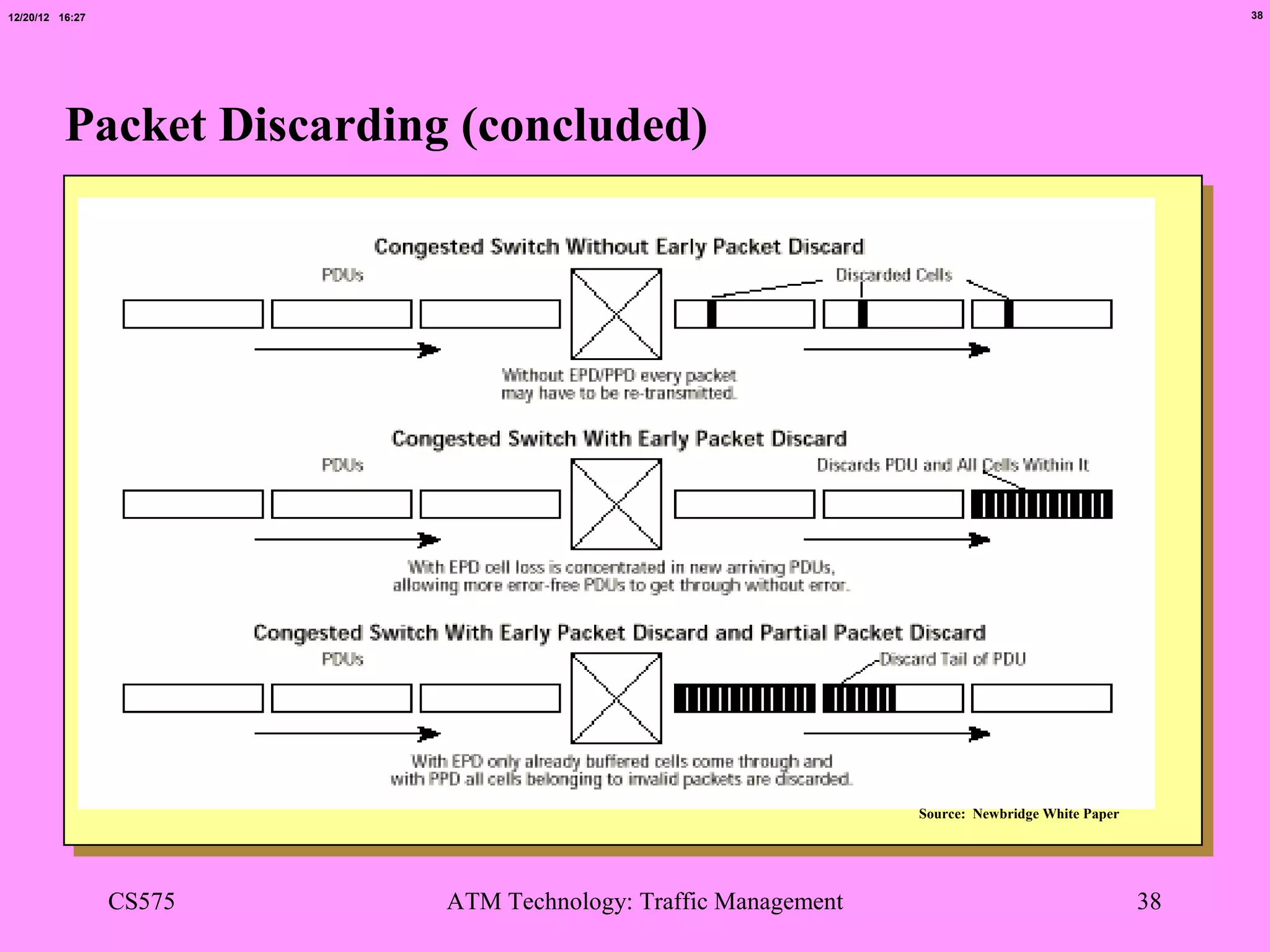
                 0 To prevent congestion escalation, Early Packet Discard (EPD) and Partial
                   Packet Discard (PPD) can be used to discard cells on a packet basis
                 0 EPD and PPD are applied for ABR and UBR traffic of AAL-5 connections
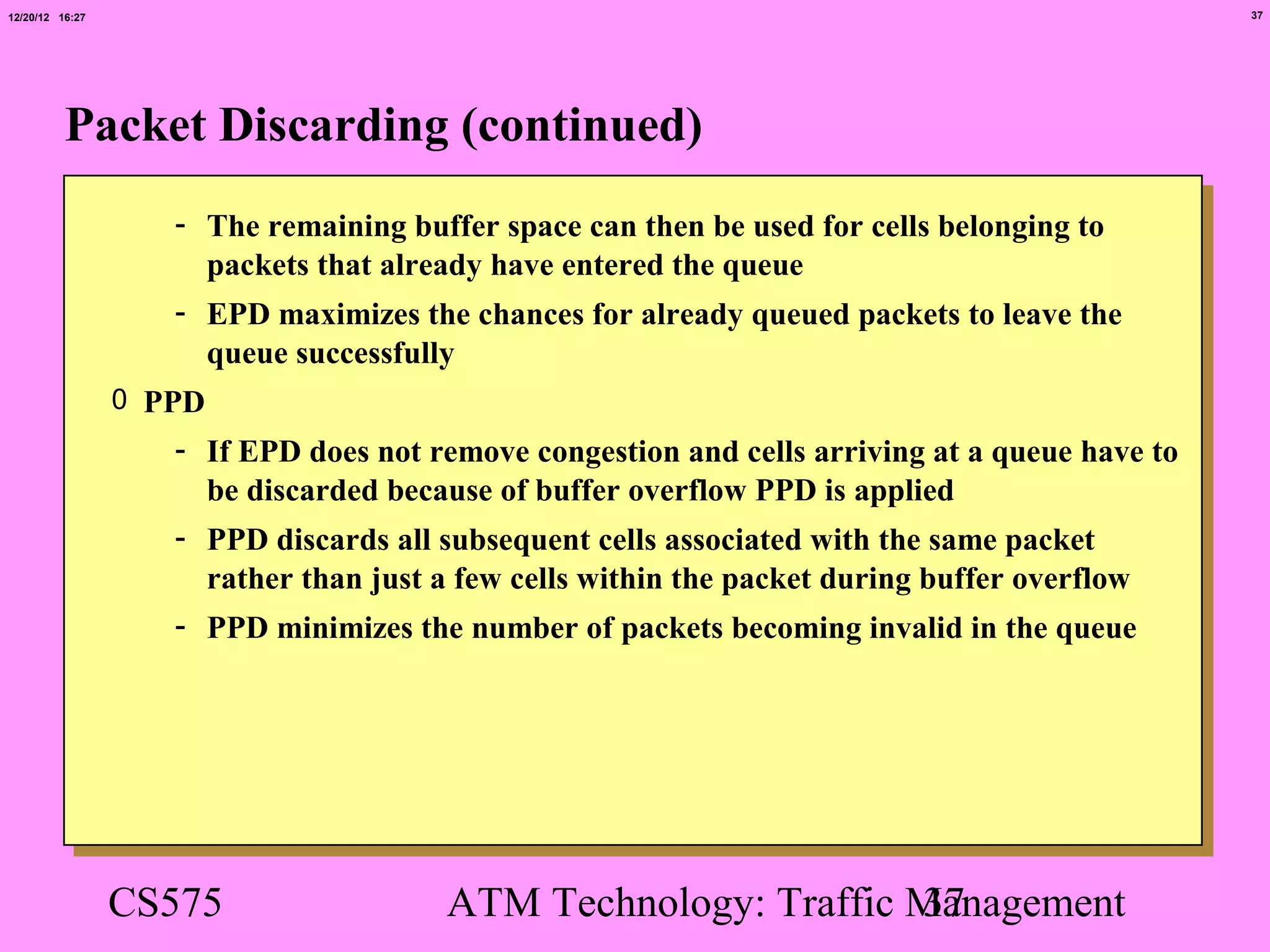
                 0 EPD
                     - When congestion occurs and buffers are filling, EPD discards all cells
                       associated with a new packet arriving at a queue


                 CS575                    ATM Technology: Traffic Management
                                                                  36
12/20/12 16:27                                                                                  37


          Packet Discarding (continued)
                    - The remaining buffer space can then be used for cells belonging to
                      packets that already have entered the queue
                    - EPD maximizes the chances for already queued packets to leave the
                      queue successfully
                 0 PPD
                    - If EPD does not remove congestion and cells arriving at a queue have to
                      be discarded because of buffer overflow PPD is applied
                    - PPD discards all subsequent cells associated with the same packet
                      rather than just a few cells within the packet during buffer overflow
                    - PPD minimizes the number of packets becoming invalid in the queue


                 CS575                 ATM Technology: Traffic Management
                                                               37
12/20/12 16:27                                                                                       38


          Packet Discarding (concluded)


                                                                Source: Newbridge White Paper


                 CS575     ATM Technology: Traffic Management                                   38
12/20/12 16:27                                                                                    39


            References


                 W. Stalling, Local and Metropolitan Area Networks, 6th edition, Prentice Hall,
                     2000, Chapter 11


                 W. Stalling, Data and Computer Communications, 6th edition, Prentice Hall,
                      2002, Chapters 11-12


                  A. Wu, Advanced Local Area Networks, Lectures & Slides, Rivier College,
                      2001.


                  CS575                    ATM Technology: Traffic Management
                                                                   39

Atm traffic management geekssay.com

  • 1.
    12/20/12 16:27 1 Rivier College CS575: Advanced LANs ATM Traffic Management CS575 ATM Technology: Traffic Management 1
  • 2.
    12/20/12 16:27 2 Overview 0 Why Traffic Management? 0 Network Congestion 0 Effects of Network Congestion 0 Traffic Parameters 0 ATM Service Categories 0 Quality of Service (QoS) 0 Quality of Service (QoS) Parameters 0 Traffic Contract Jain 0 Traffic Control Functions 0 Usage Parameter Control 0 Packet Discarding CS575 ATM Technology: Traffic Management 2
  • 3.
    12/20/12 16:27 3 Why Traffic Management? 0 The ATM technology is intended to support a wide variety of services and applications such as voice, video, and data 0 ATM promises to support all these different requirements with a common network 0 Within such a network all connections may impact on each other 0 ATM must manage traffic fairly and provide effective allocation of network resources for these different applications 0 It is the task of ATM traffic control to: - protect the network and the end-systems from congestion in order to provide specified and guaranteed levels of Quality of Service (QoS) - use available network resources efficiently CS575 ATM Technology: Traffic Management 3
  • 4.
    12/20/12 16:27 4 Network Congestion 0 Network congestion is a state when the network cannot meet the negotiated network performance objectives for established connections or for new connection requests 0 Network congestion can be caused by: - Unpredictable statistical fluctuation of traffic flows - Fault conditions within the network 0 ATM layer traffic control is a set of actions taken by the network to avoid network congestion 0 Traffic control takes measures to adapt to unpredictable fluctuations in traffic flows and other problems within the network. 0 ATM layer congestion control refers to the set of actions taken by the network to minimize the intensity, spread, and duration of congestion CS575 ATM Technology: Traffic Management 4
  • 5.
    12/20/12 16:27 5 Effects of Network Congestion Source: Stallings: Data and Computer Communications p316 CS575 ATM Technology: Traffic Management 5
  • 6.
    12/20/12 16:27 6 Traffic Parameters 0 Traffic parameters describe traffic characteristics of a connection 0 For a given connection, traffic parameters are grouped into a source traffic descriptor 0 Traffic parameters specified in ATM Forum UNI - Peak Cell Rate (PCR) = An upper bound on the rate that traffic can be submit on a connection = Measured in cells/second - Sustainable Cell Rate (SCR) = An upper bound on the average cell rate of a burst traffic of an ATM connection = Measured in cells/second = Calculated over the duration of the connection CS575 ATM Technology: Traffic Management 6
  • 7.
    12/20/12 16:27 7 Traffic Parameters (concluded) - Maximum Burst Size (MBS) = The maximum number of cells that can be sent at the peak cell rate - Minimum Cell Rate (MCR) = The minimum number of cells that the user considers acceptable CS575 ATM Technology: Traffic Management 7
  • 8.
    12/20/12 16:27 8 ATM Service Categories 0 ATM carries a wide range of heterogeneous traffic mix 0 To ensure network resources are fairly allocated for each traffic type, ATM services are divided into different service categories 0 Each ATM service category represents a class of ATM connections that have homogeneous characteristics in terms of traffic pattern, QoS requirements, and possible use of control mechanisms, making it suitable for a given type of resource allocation 0 The ATM Forum specifies the following five categories of services: - CBR: Constant Bit Rate - rt-VBR: Real-Time Variable Bit Rate - nrt-VBR: Non-Real-Time Variable Bit Rate - UBR: Unspecified Bit Rate - ABR: Available bit Rate CS575 ATM Technology: Traffic Management 8
  • 9.
    12/20/12 16:27 9 ATM Service Categories (continued) 0 All service categories apply to both VCCs and VPCs. 0 ATM services are characterized by the traffic parameters: 0 Constant Bit Rate (CBR) - Requires a fixed amount of bandwidth continuously available during the connection lifetime - The amount of bandwidth is characterized by a Peak Cell Rate (PCR) value CS575 ATM Technology: Traffic Management 9
  • 10.
    12/20/12 16:27 10 ATM Service Categories (continued) - The source can transmit cells at the PCR at any time and for any duration - Intended to support real-time applications - Requires tightly constrained delay and delay variation - Application examples: interactive (real-time) voice, video, and circuit emulation 0 Real-Time Variable Bit Rate (rt-VBR) - Intended for real-time applications - Requires tightly constrained delay and delay variation - Characterized by a PCR, Sustainable Cell Rate (SCR), and Maximum Burst Size (MBS) - The source may transmit bursty traffic, e.g., Motion JPEG or MPEG compressed video CS575 ATM Technology: Traffic Management 10
  • 11.
    12/20/12 16:27 11 ATM Service Architecture (continued) - Application Example: native ATM voice with compression, interactive (real-time) compressed video (videoconferencing), and other types of multimedia communications CS575 ATM Technology: Traffic Management 11
  • 12.
    12/20/12 16:27 12 ATM Service Categories (continued) 0 Non-Real-Time Varible Bit Rate (nrt-VBR) - Intended for non-real-time applications - Source transmits bursty traffic - Characterized by a PCR, SCR, and MBS - Requires low Cell Loss Ratio (CLR) - May support statistical multiplexing of connections - No delay bounds are associated with this service category - Application Example: Critical response time transaction processing such as airline reservations, banking transactions, processing monitoring CS575 ATM Technology: Traffic Management 12
  • 13.
    12/20/12 16:27 13 ATM Service Categories (continued) 0 Unspecified Bit Rate (UBR) - Intended for non-real-time, bursty applications - Does not specify traffic related service guarantees - No commitment is made about cell transfer delay - No commitment is made as to cell loss ratio experienced by cells on the connection - Best effort service - Application example: E-mail, LAN traffic, and TCP/IP traffic 0 Available Bit Rate (ABR) - Intended for bursty traffic whose bandwidth range is known roughly - End system specifies maximum required bandwidth (PCR) and minimum usable bandwidth (MCR) CS575 ATM Technology: Traffic Management 13
  • 14.
    12/20/12 16:27 14 ATM Service Categories (continued) - The cell rate provided by the network can change throughout the connection - The user gets what’s available CS575 ATM Technology: Traffic Management 14
  • 15.
    12/20/12 16:27 15 ATM Service Categories (continued) - The goal is to provide rapid access to unused network bandwidth at up to PCR whenever the network bandwidth is available - Cell loss ratio is minimal provided that the user adapts to the network’s feedback controls - Intended for non-real-time applications - Application example: file transfer, browsing the Web - No numeric commitment is made about cell transfer delay - Flow control mechanism specified - A rate-based service specified by the ATM Forum - Flow control model = A source generates forward Resource Management cells (RM-cells) = RM-cells are turned around by the destination as backward RM-cells CS575 ATM Technology: Traffic Management 15
  • 16.
    12/20/12 16:27 16 ATM Service Categories (concluded) = Backward RM-cells carry feedback information provided by the network and/or destination to the source - The source performs dynamic traffic shaping based on feedback received from the network unspecified bit-rate and CS575 ATM Technology: Traffic Management 16
  • 17.
    12/20/12 16:27 17 Quality of Service (QoS) 0 QoS is a set of user-perceivable performance parameters that characterize the traffic over an ATM connection 0 Defined on an end-to-end basis 0 User requests a QoS class for an ATM connection 0 The requested QoS class is a part of the traffic contract 0 The network commits to meet the requested QoS as long as the user complies with the traffic contract 0 ATM Forum QoS Classes QoS Class QoS Parameters Application 0 Unspecified Best Effort, At Risk 1 Specified Circuit Emulation, CBR 2 Specified VBR Video/Audio 3 Specified Connection-Oriented Data 4 Specified Conectionless Data CS575 ATM Technology: Traffic Management 17
  • 18.
    12/20/12 16:27 18 Quality of Service (QoS) Parameters 0 QoS parameters describe the level of service for each connection 0 ATM Forum specified six QoS parameters 0 Through the use of network signaling to establish an ATM connection, three of these may be negotiated between the end-system and the network - Peak-to-peak Cell Delay Variation (peak-to-peak CDV) - Maximum Cell Transfer Delay (maxCTD) - Cell Loss Ratio (CLR) CS575 ATM Technology: Traffic Management 18
  • 19.
    12/20/12 16:27 19 Quality of Service (QoS) Parameters (continued) Cell Transfer Delay Probability Density Model Source: ATM Forum Traffic Management Specification Version 4.0 CS575 ATM Technology: Traffic Management 19
  • 20.
    12/20/12 16:27 20 Quality of Service (QoS) Parameters (continued) 0 Peak-to-peak Cell Delay Variation (peak-to-peak CDV) - Cell delay variation (CDV) is defined as a measure of cell clumping - It is how much more closely the cells are spaced than the nominal interval - Cells may be sent into the network evenly spaced, a variety of factors may contribute to cell clamping or gaps in the cell stream - If the network cannot properly control CDV, distortion can occur for real-time services such as voice, video, and multimedia applications - If cells arrive too closely together, cell buffers may overflow - Subscribers of CBR or VBR services need to specify this parameter CS575 ATM Technology: Traffic Management 20
  • 21.
    12/20/12 16:27 21 Quality of Service (QoS) Parameters (continued) 0 Maximum Cell Transfer Delay (maxCTD) - CTD is the elapsed time between a cell’s exit at the source and its entry at the destination - It includes both node processing and internode transmission time - Subscribers of CBR or VBR services need to specify this parameter 0 Cell Loss Ratio (CLR) - CLR = (Lost Cells) / (Total Transmitted Cells) - Cells may be lost due to = network malfunction = discarded for noncompliance = discarded in response to network congestion CS575 ATM Technology: Traffic Management 21
  • 22.
    12/20/12 16:27 22 Quality of Service (QoS) Parameters (concluded) 0 Higher values of cell loss is dominated by the effects of queuing strategy and buffer sizes 0 Delay, delay variation, and cell loss are impacted by buffer size and buffering strategy 0 The error rate is determined by fiber transmission characteristics CS575 ATM Technology: Traffic Management 22
  • 23.
    12/20/12 16:27 23 Traffic Contract 0 Agreement between user and network across UNI regarding: - The QoS that a network is expected to provide - The Connection Traffic Descriptor, which includes = Source Traffic Descriptor Traffic Contract = Cell Delay Variation Tolerance (CDVT) = Conformance Definition - Source Traffic Descriptor = Defines the characteristics of ATM traffic coming into the network = Includes several negotiable traffic parameters: PCR, SCR, MBS, and Burst Tolerance (BT) = Specifies flow for CLP = 0 and/or CLP = 0 + 1 - Cell Delay Variation Tolerance (CDVT) = The upper bound on the cell clumping measure is CDVT CS575 ATM Technology: Traffic Management 23
  • 24.
    12/20/12 16:27 24 Traffic Contract (continued) = It is the measure of how much cell clumping is acceptable resulting from network operations such as cell multiplexing or the insertion of OAM cells = CDVT controls the amount of variability acceptable using a leaky bucket algorithm - Conformance Definition = Defines what cell rates and streams will be monitored = Defines the checking rule used to interpret the traffic parameters = Defines the network’s definition of a compliant connection, i.e., what constitutes obeying the rules = Conformance is determined by the Usage Parameter control (UPC) at the ingress to the network CS575 ATM Technology: Traffic Management 24
  • 25.
    12/20/12 16:27 25 Traffic Contract (concluded) 0 A separate traffic contract for each Virtual Path Connection (VPC) or Virtual Channel Connection (VCC) 0 Negotiated at connection time - Signaling message for SVC - Circuit provision for PVC CS575 ATM Technology: Traffic Management 25
  • 26.
    12/20/12 16:27 26 Traffic Control Functions 0 Connection Admission Control (CAC) 0 Usage Parameter Control (UPC) 0 Selective cell discarding 0 Traffic Shaping 0 Explicit Forward Congestion Indication (EFCI) 0 Cell Loss Priority Control 0 Network Resource Management (NRM) 0 Frame discard 0 ABR Flow Control 0 Others CS575 ATM Technology: Traffic Management 26
  • 27.
    12/20/12 16:27 27 Connection Admission Control 0 Responsible for determining whether a connection request is admitted or denied 0 For each connection request, CAC derives the following information from the traffic contract - Values of parameters in the source traffic descriptor - The requested and acceptable values of each QoS parameter and the requested QoS class - The value of the CDVT - The requested conformance definition - Based on that information and the network’s definition of a compliant connection to determine = Whether the connection can be accepted or not = The traffic parameters needed by UPC = Allocation of network resource CS575 ATM Technology: Traffic Management 27
  • 28.
    12/20/12 16:27 28 Usage Parameter Control 0 What is UPC - Commonly known as Traffic Policing - A network traffic control mechanism - Required at the public UNI - Detects and stops user traffic violations - Ensures QoS for other connections 0 UPC Functions - Monitors cells submitted at the UNI - Checks for connection compliance = Is the user sending data too quickly? = Is the user obeying the traffic contract? - Checks validity of VPI/VCI values = Is the user using the correct VPI/VCI? CS575 ATM Technology: Traffic Management 28
  • 29.
    12/20/12 16:27 29 Usage Parameter Control (continued) 0 UPC Action - For non-conforming cells = Discard or = Tag as low priority (overwriting CLP bit to 1) - For conforming cells = Transparently pass or = Traffic shape CS575 ATM Technology: Traffic Management 29
  • 30.
    12/20/12 16:27 30 Usage Parameter Control (continued) Discard cell No Yes Conform to SCR/BT 0 CLP = 0 Yes Yes Valid Conform to In VPI/VCI PCR/CDV CLP Out CLP = 0+1 1 Conform to SCR/BT No No CLP = 1 Yes No Discard Discard cell cell Discard cell CS575 ATM Technology: Traffic Management 30
  • 31.
    12/20/12 16:27 31 Usage Parameter Control (continued) Generic Cell Rate Algorithm 0 Used to define conformance with respect to the traffic contract 0 For each cell arrival, GCRA determines whether the cell conforms to the traffic contract of the connection 0 The UPC function may implement GCRA to enforce conformance 0 Equivalent representations of the GCRA - Continuous-State Leaky Bucket Algorithm - Virtual Scheduling algorithm CS575 ATM Technology: Traffic Management 31
  • 32.
    12/20/12 16:27 32 Usage Parameter Control (concluded) Equivalent Versions of GCRA Arrival of a cell k at time ta(k) TAT: Theoretical Arrival Time ta(k): Time of arrival of a cell X’ = X - (t a(k) - LCT) Yes TAT < ta(k) ? Yes X’ < 0 No TAT = ta (k) ? No Yes X’ = 0 Non Conforming TAT > ta(k) + L Cell Yes ? Non Conforming X’ > L Cell ? No No TAT = TAT + I X = X’ + I Conforming Cell LCT = ta(k) Conforming Cell Virtual Scheduling Algorithm Continuous-State Leaky Bucket Algorithm CS575 ATM Technology: Traffic Management 32
  • 33.
    12/20/12 16:27 33 Selective Cell Discard and EFCI 0 Selective Cell discard - A congested network may selectively discard cells which meet either or both the following conditions: = Cells which belong to a non-compliant ATM connection = Cells which have CLP = 1 - This is to protect the CLP = 0 flow as much as possible 0 Explicit Forward congestion Indication (EFCI) - A network element in an impending congested state or a congested state may set an EFCI in the cell header - This indication may be examined by the destination end-system - The end-system may adaptively lower the cell rate of the connection CS575 ATM Technology: Traffic Management 33
  • 34.
    12/20/12 16:27 34 Traffic Shaping 0 A mechanism that alters the traffic characteristics of a cell stream on a connection to achieve better network efficiency or to ensure conformance to the traffic parameters in the traffic contract 0 Traffic shaping examples: - Peak cell rate reduction - Burst length limiting - Spacing cells in time to reduce CDV - Cell scheduling policy CS575 ATM Technology: Traffic Management 34
  • 35.
    12/20/12 16:27 35 Resource Management 0 Resource Management - Two critical resources = Buffer space = Trunk bandwidth - One way of simplifying the management of the trunk bandwidth is through the use of virtual paths = If every node in a network is interconnected by a VPC, then only the total available entry-to-exit VPC bandwidth need be considered in CAC decisions = A VPC is easier to manage as a larger aggregate than multiple, individual VCCs CS575 ATM Technology: Traffic Management 35
  • 36.
    12/20/12 16:27 36 Packet Discarding 0 The ATM Adaptation Layer (AAL) segments higher layer packets into small fixed-size cells for transporting over the ATM network 0 A cell discarded by a switch causes the loss of the entire packet and eventually requires end-to-end error recovery through packet retransmission 0 A small congestion problem could potentially escalate to a more serious one 0 To prevent congestion escalation, Early Packet Discard (EPD) and Partial Packet Discard (PPD) can be used to discard cells on a packet basis 0 EPD and PPD are applied for ABR and UBR traffic of AAL-5 connections 0 EPD - When congestion occurs and buffers are filling, EPD discards all cells associated with a new packet arriving at a queue CS575 ATM Technology: Traffic Management 36
  • 37.
    12/20/12 16:27 37 Packet Discarding (continued) - The remaining buffer space can then be used for cells belonging to packets that already have entered the queue - EPD maximizes the chances for already queued packets to leave the queue successfully 0 PPD - If EPD does not remove congestion and cells arriving at a queue have to be discarded because of buffer overflow PPD is applied - PPD discards all subsequent cells associated with the same packet rather than just a few cells within the packet during buffer overflow - PPD minimizes the number of packets becoming invalid in the queue CS575 ATM Technology: Traffic Management 37
  • 38.
    12/20/12 16:27 38 Packet Discarding (concluded) Source: Newbridge White Paper CS575 ATM Technology: Traffic Management 38
  • 39.
    12/20/12 16:27 39 References W. Stalling, Local and Metropolitan Area Networks, 6th edition, Prentice Hall, 2000, Chapter 11 W. Stalling, Data and Computer Communications, 6th edition, Prentice Hall, 2002, Chapters 11-12 A. Wu, Advanced Local Area Networks, Lectures & Slides, Rivier College, 2001. CS575 ATM Technology: Traffic Management 39