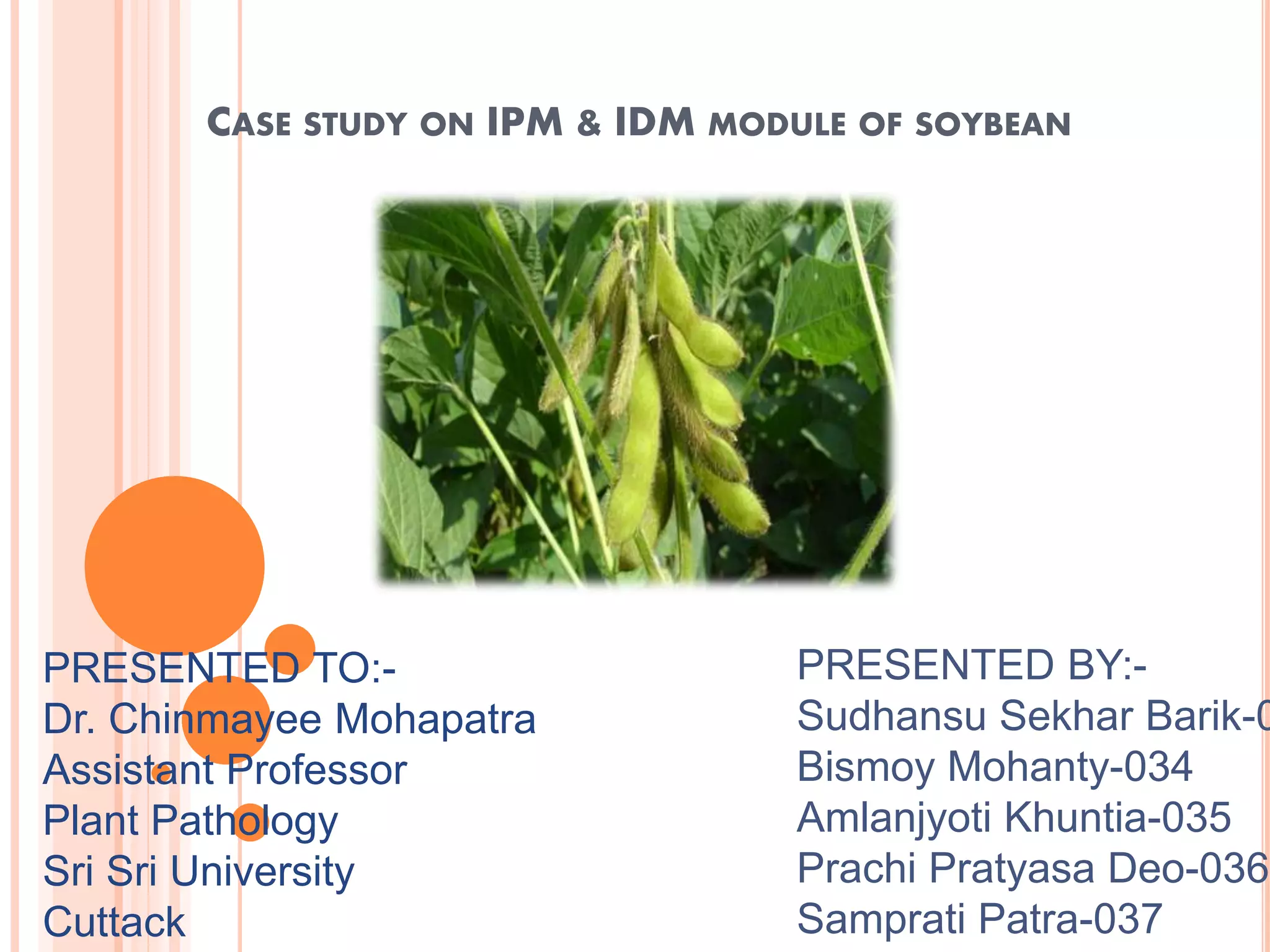


CASE STUDY ON IPM & IDM MODULE OF SOYBEAN
PRESENTED BY:-
Sudhansu Sekhar Barik-0
Bismoy Mohanty-034
Amlanjyoti Khuntia-035
Prachi Pratyasa Deo-036
Samprati Patra-037
PRESENTED TO:-
Dr. Chinmayee Mohapatra
Assistant Professor
Plant Pathology
Sri Sri University
Cuttack
 Introduction
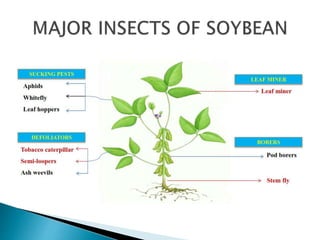
 Major Insect pests of Soybean
 Major Diseases of Soybean
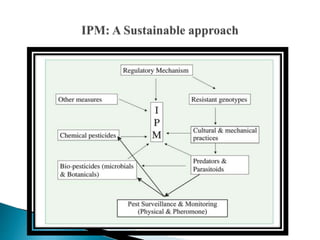
 IPM & IDM approach
 Case Study
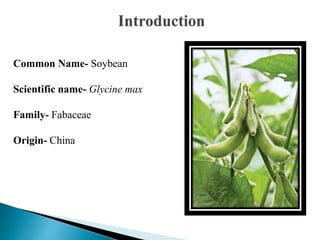
Common Name- Soybean
Scientific name- Glycine max
Family- Fabaceae
Origin- China
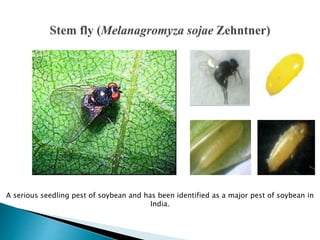
A serious seedling pest of soybean and has been identified as a major pest of soybean in
India.
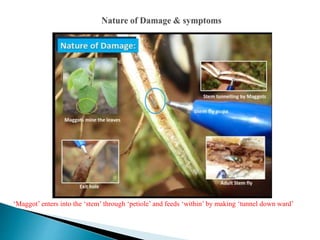
‘Maggot’ enters into the ‘stem’ through ‘petiole’ and feeds ‘within’ by making ‘tunnel down ward’
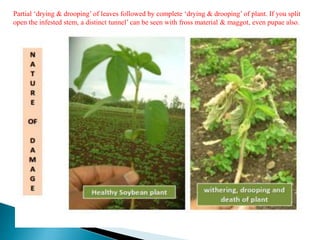
Partial ‘drying & drooping’ of leaves followed by complete ‘drying & drooping’ of plant. If you split
open the infested stem, a distinct tunnel’ can be seen with fross material & maggot, even pupae also.
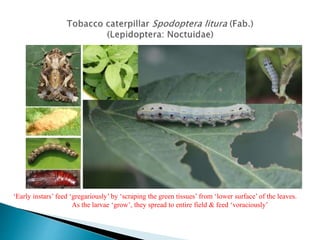
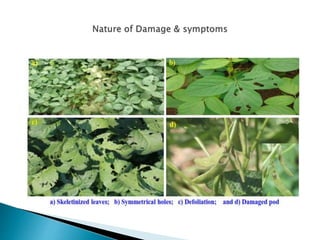
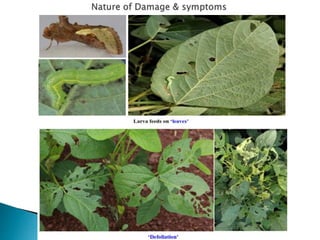
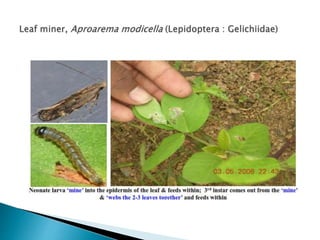
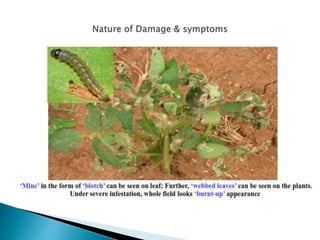
‘Early instars’ feed ‘gregariously’ by ‘scraping the green tissues’ from ‘lower surface’ of the leaves.
As the larvae ‘grow’, they spread to entire field & feed ‘voraciously’
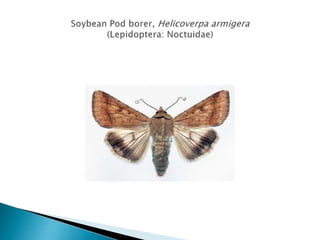
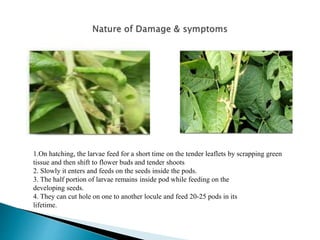
1.On hatching, the larvae feed for a short time on the tender leaflets by scrapping green
tissue and then shift to flower buds and tender shoots
2. Slowly it enters and feeds on the seeds inside the pods.
3. The half portion of larvae remains inside pod while feeding on the
developing seeds.
4. They can cut hole on one to another locule and feed 20-25 pods in its
lifetime.
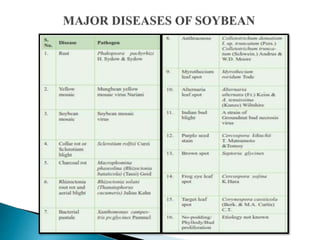
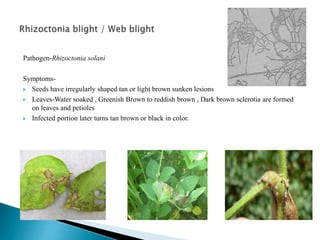
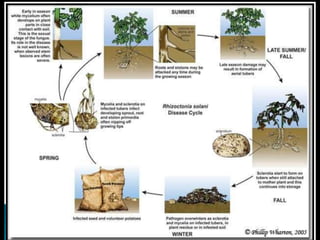
Pathogen-Rhizoctonia solani
Symptoms-
 Seeds have irregularly shaped tan or light brown sunken lesions
 Leaves-Water soaked , Greenish Brown to reddish brown , Dark brown sclerotia are formed
on leaves and petioles
 Infected portion later turns tan brown or black in color.
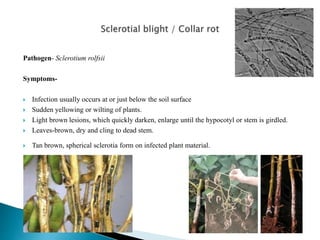
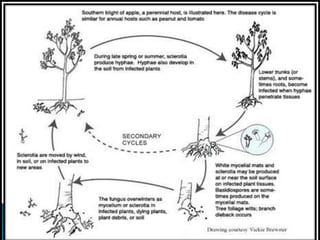
Pathogen- Sclerotium rolfsii
Symptoms-
 Infection usually occurs at or just below the soil surface
 Sudden yellowing or wilting of plants.
 Light brown lesions, which quickly darken, enlarge until the hypocotyl or stem is girdled.
 Leaves-brown, dry and cling to dead stem.
 Tan brown, spherical sclerotia form on infected plant material.
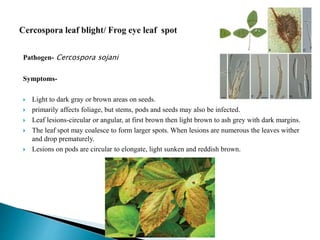
Pathogen- Cercospora sojani
Symptoms-
 Light to dark gray or brown areas on seeds.
 primarily affects foliage, but stems, pods and seeds may also be infected.
 Leaf lesions-circular or angular, at first brown then light brown to ash grey with dark margins.
 The leaf spot may coalesce to form larger spots. When lesions are numerous the leaves wither
and drop prematurely.
 Lesions on pods are circular to elongate, light sunken and reddish brown.
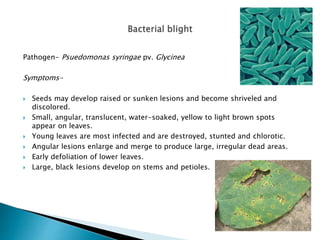
Pathogen- Psuedomonas syringae pv. Glycinea
Symptoms-
 Seeds may develop raised or sunken lesions and become shriveled and
discolored.
 Small, angular, translucent, water-soaked, yellow to light brown spots
appear on leaves.
 Young leaves are most infected and are destroyed, stunted and chlorotic.
 Angular lesions enlarge and merge to produce large, irregular dead areas.
 Early defoliation of lower leaves.
 Large, black lesions develop on stems and petioles.
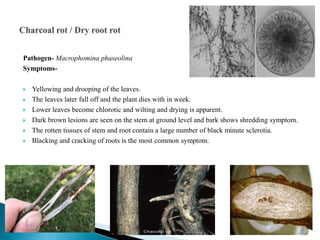
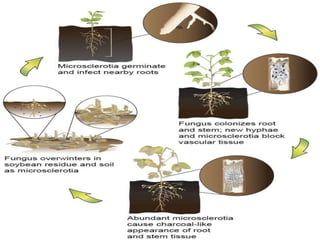
Pathogen- Macrophomina phaseolina
Symptoms-
 Yellowing and drooping of the leaves.
 The leaves later fall off and the plant dies with in week.
 Lower leaves become chlorotic and wilting and drying is apparent.
 Dark brown lesions are seen on the stem at ground level and bark shows shredding symptom.
 The rotten tissues of stem and root contain a large number of black minute sclerotia.
 Blacking and cracking of roots is the most common symptom.
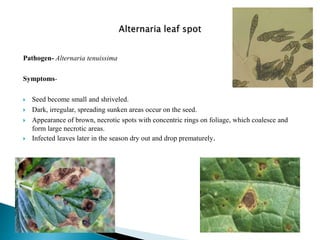
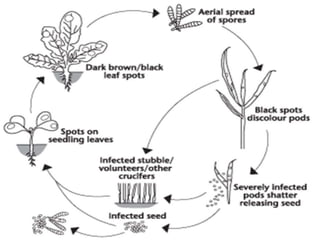
Pathogen- Alternaria tenuissima
Symptoms-
 Seed become small and shriveled.
 Dark, irregular, spreading sunken areas occur on the seed.
 Appearance of brown, necrotic spots with concentric rings on foliage, which coalesce and
form large necrotic areas.
 Infected leaves later in the season dry out and drop prematurely.
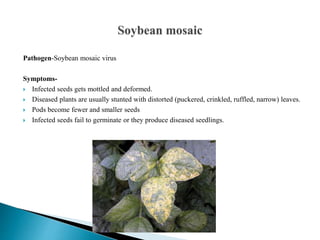
Pathogen-Soybean mosaic virus
Symptoms-
 Infected seeds gets mottled and deformed.
 Diseased plants are usually stunted with distorted (puckered, crinkled, ruffled, narrow) leaves.
 Pods become fewer and smaller seeds
 Infected seeds fail to germinate or they produce diseased seedlings.
Ecological Engineering for Pest Management – Above ground
 Raising the flowering plants such as sunflower, sesame, okra,
chrysanthemum, marigold, onion, coriander, carrot, mustard, radish, etc.
compatible cash crops along the field border by arranging shorter plants
towards main crop and taller plants towards the border to attract natural
enemies as well as to avoid immigrating pest population.
 Do not apply chemical pesticides, when the P:D is favourable. The plant
compensation ability should also be considered before applying chemical
pesticides.
Ecological Engineering for Pest Management – Below ground
 Crop rotations with cereal crops which will break the continuity of
soil borne pests as well as attract beneficial insects and predatory
birds.
 Keep soils covered year-round with living vegetation and/or crop
residue.
 Add organic matter in the form of FYM, vermicompost,
decomposed crop residue which enhance below ground biodiversity.
 Reduce tillage intensity so that hibernating natural enemies can be
saved.
 Apply balanced dose of biofertilizers and nutrients.
 Apply mychorrhiza and PGPR
 Apply Trichoderma / Pseudomonas fluorescens as seed, nursery
treatment and soil application
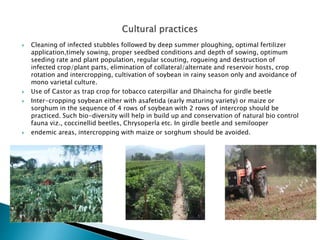
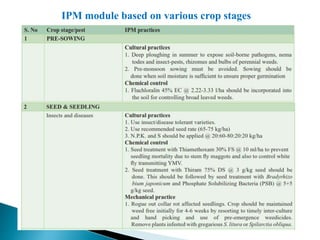
 Cleaning of infected stubbles followed by deep summer ploughing, optimal fertilizer
application,timely sowing, proper seedbed conditions and depth of sowing, optimum
seeding rate and plant population, regular scouting, rogueing and destruction of
infected crop/plant parts, elimination of collateral/alternate and reservoir hosts, crop
rotation and intercropping, cultivation of soybean in rainy season only and avoidance of
mono varietal culture.
 Use of Castor as trap crop for tobacco caterpillar and Dhaincha for girdle beetle
 Inter-cropping soybean either with asafetida (early maturing variety) or maize or
sorghum in the sequence of 4 rows of soybean with 2 rows of intercrop should be
practiced. Such bio-diversity will help in build up and conservation of natural bio control
fauna viz., coccinellid beetles, Chrysoperla etc. In girdle beetle and semilooper
 endemic areas, intercropping with maize or sorghum should be avoided.
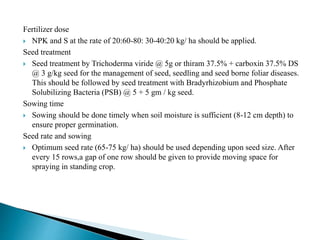
Fertilizer dose
 NPK and S at the rate of 20:60-80: 30-40:20 kg/ ha should be applied.
Seed treatment
 Seed treatment by Trichoderma viride @ 5g or thiram 37.5% + carboxin 37.5% DS
@ 3 g/kg seed for the management of seed, seedling and seed borne foliar diseases.
This should be followed by seed treatment with Bradyrhizobium and Phosphate
Solubilizing Bacteria (PSB) @ 5 + 5 gm / kg seed.
Sowing time
 Sowing should be done timely when soil moisture is sufficient (8-12 cm depth) to
ensure proper germination.
Seed rate and sowing
 Optimum seed rate (65-75 kg/ ha) should be used depending upon seed size. After
every 15 rows,a gap of one row should be given to provide moving space for
spraying in standing crop.
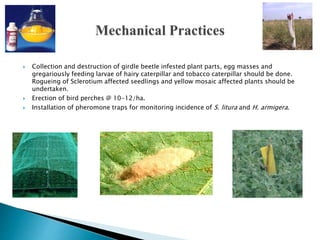
 Collection and destruction of girdle beetle infested plant parts, egg masses and
gregariously feeding larvae of hairy caterpillar and tobacco caterpillar should be done.
Rogueing of Sclerotium affected seedlings and yellow mosaic affected plants should be
undertaken.
 Erection of bird perches @ 10-12/ha.
 Installation of pheromone traps for monitoring incidence of S. litura and H. armigera.
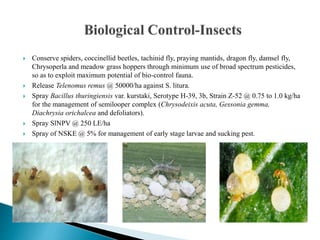
 Conserve spiders, coccinellid beetles, tachinid fly, praying mantids, dragon fly, damsel fly,
Chrysoperla and meadow grass hoppers through minimum use of broad spectrum pesticides,
so as to exploit maximum potential of bio-control fauna.
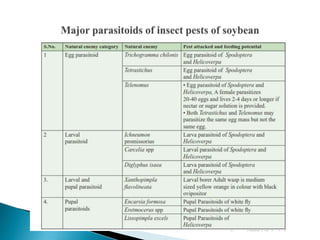
 Release Telenomus remus @ 50000/ha against S. litura.
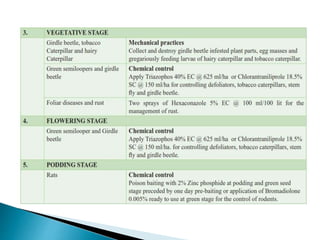
 Spray Bacillus thuringiensis var. kurstaki, Serotype H-39, 3b, Strain Z-52 @ 0.75 to 1.0 kg/ha
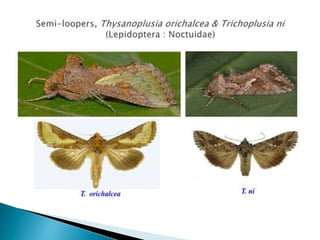
for the management of semilooper complex (Chrysodeixis acuta, Gessonia gemma,
Diachrysia orichalcea and defoliators).
 Spray SlNPV @ 250 LE/ha
 Spray of NSKE @ 5% for management of early stage larvae and sucking pest.
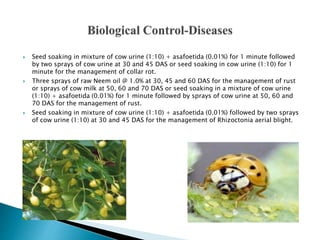
 Seed soaking in mixture of cow urine (1:10) + asafoetida (0.01%) for 1 minute followed
by two sprays of cow urine at 30 and 45 DAS or seed soaking in cow urine (1:10) for 1
minute for the management of collar rot.
 Three sprays of raw Neem oil @ 1.0% at 30, 45 and 60 DAS for the management of rust
or sprays of cow milk at 50, 60 and 70 DAS or seed soaking in a mixture of cow urine
(1:10) + asafoetida (0.01%) for 1 minute followed by sprays of cow urine at 50, 60 and
70 DAS for the management of rust.
 Seed soaking in mixture of cow urine (1:10) + asafoetida (0.01%) followed by two sprays
of cow urine (1:10) at 30 and 45 DAS for the management of Rhizoctonia aerial blight.
 Seed soaking in mixture of cow urine (1:10) + asafoetida (0.01%) for 1 minute or above
seed soaking followed by sprays of cow urine or only sprays of cow milk at 30 and 45
DAS for the management of Myrothecium leaf spot.
 Seed soaking in mixture of cow urine (1:10) + asafoetida (0.01%) or in cow urine alone
for 1minute for the management of bacterial pustule.
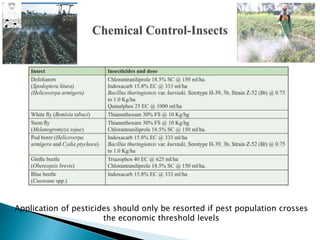
Application of pesticides should only be resorted if pest population crosses
the economic threshold levels
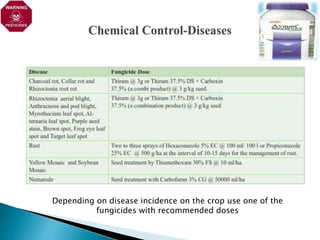
Depending on disease incidence on the crop use one of the
fungicides with recommended doses
IPM module based on various crop stages
Pathogen-Phakopsora pachyrhizi / Phakopsora meibomiae
Economic importance-
 The most destructive disease of soybean.
 Yield losses of 10-65% in U.P,30-100% in M.P
How it came into lime light and its extent of damage?
 First reported in Asiatic region in 1902 ,later became endemic.
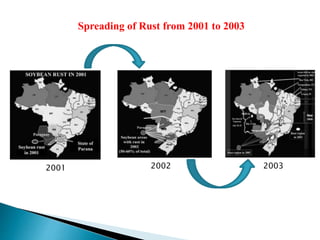
 But from 2001-03 it caused epidemics in Brazil & Paraguay.
 In 5 March 2001, a severe rust outbreak was recorded at Pitapó, Paraguay.
 Surveys showed spread throughout Paraguay and into western and northern Parana, Brazil.
 In the 2001–02 season, rust was widespread in Paraguay,in 2003 Brazil it spread to more than
90% of the soybean acreage, causing field losses estimated at 2.2 MMT.
2001 2002 2003
Spreading of Rust from 2001 to 2003
Symptoms-
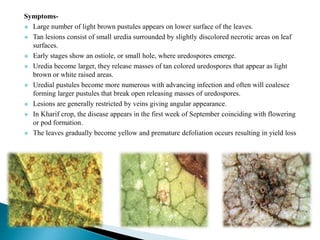
 Large number of light brown pustules appears on lower surface of the leaves.
 Tan lesions consist of small uredia surrounded by slightly discolored necrotic areas on leaf
surfaces.
 Early stages show an ostiole, or small hole, where uredospores emerge.
 Uredia become larger, they release masses of tan colored uredospores that appear as light
brown or white raised areas.
 Uredial pustules become more numerous with advancing infection and often will coalesce
forming larger pustules that break open releasing masses of uredospores.
 Lesions are generally restricted by veins giving angular appearance.
 In Kharif crop, the disease appears in the first week of September coinciding with flowering
or pod formation.
 The leaves gradually become yellow and premature defoliation occurs resulting in yield loss
Disease Cycle-
The pathogen survives as teleutospores in crop debris.
Secondary spread is through windborne uredospores.
Favourable Conditions-
Favoured by temp. of 18 to 23°C and R.H of 80%.
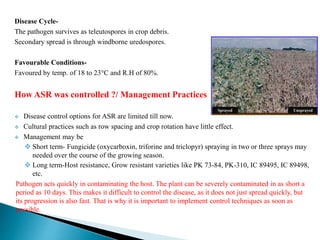
How ASR was controlled ?/ Management Practices
 Disease control options for ASR are limited till now.
 Cultural practices such as row spacing and crop rotation have little effect.
 Management may be
 Short term- Fungicide (oxycarboxin, triforine and triclopyr) spraying in two or three sprays may
needed over the course of the growing season.
 Long term-Host resistance, Grow resistant varieties like PK 73-84, PK-310, IC 89495, IC 89498,
etc.
Pathogen acts quickly in contaminating the host. The plant can be severely contaminated in as short a
period as 10 days. This makes it difficult to control the disease, as it does not just spread quickly, but
its progression is also fast. That is why it is important to implement control techniques as soon as
possible.
 https://niphm.gov.in/IPMPackages.html
 https://iisrindore.icar.gov.in/
 https://cropwatch.unl.edu/plantdisease/soybean/soybean-rust
 https://www.invasivespeciesinfo.gov/terrestrial/pathogens-and-
diseases/soybean-rust
THANK YOU FOR YOUR
ATTENTION !!!
ANY QUESTIONS

IPM & IDM - soybean-Bismoy Mohanty

  • 1.
    CASE STUDY ONIPM & IDM MODULE OF SOYBEAN PRESENTED BY:- Sudhansu Sekhar Barik-0 Bismoy Mohanty-034 Amlanjyoti Khuntia-035 Prachi Pratyasa Deo-036 Samprati Patra-037 PRESENTED TO:- Dr. Chinmayee Mohapatra Assistant Professor Plant Pathology Sri Sri University Cuttack
  • 2.
     Introduction  MajorInsect pests of Soybean  Major Diseases of Soybean  IPM & IDM approach  Case Study
  • 3.
    Common Name- Soybean Scientificname- Glycine max Family- Fabaceae Origin- China
  • 5.
    A serious seedlingpest of soybean and has been identified as a major pest of soybean in India.
  • 6.
    ‘Maggot’ enters intothe ‘stem’ through ‘petiole’ and feeds ‘within’ by making ‘tunnel down ward’
  • 7.
    Partial ‘drying &drooping’ of leaves followed by complete ‘drying & drooping’ of plant. If you split open the infested stem, a distinct tunnel’ can be seen with fross material & maggot, even pupae also.
  • 8.
    ‘Early instars’ feed‘gregariously’ by ‘scraping the green tissues’ from ‘lower surface’ of the leaves. As the larvae ‘grow’, they spread to entire field & feed ‘voraciously’
  • 13.
    1.On hatching, thelarvae feed for a short time on the tender leaflets by scrapping green tissue and then shift to flower buds and tender shoots 2. Slowly it enters and feeds on the seeds inside the pods. 3. The half portion of larvae remains inside pod while feeding on the developing seeds. 4. They can cut hole on one to another locule and feed 20-25 pods in its lifetime.
  • 17.
    Pathogen-Rhizoctonia solani Symptoms-  Seedshave irregularly shaped tan or light brown sunken lesions  Leaves-Water soaked , Greenish Brown to reddish brown , Dark brown sclerotia are formed on leaves and petioles  Infected portion later turns tan brown or black in color.
  • 19.
    Pathogen- Sclerotium rolfsii Symptoms- Infection usually occurs at or just below the soil surface  Sudden yellowing or wilting of plants.  Light brown lesions, which quickly darken, enlarge until the hypocotyl or stem is girdled.  Leaves-brown, dry and cling to dead stem.  Tan brown, spherical sclerotia form on infected plant material.
  • 21.
    Pathogen- Cercospora sojani Symptoms- Light to dark gray or brown areas on seeds.  primarily affects foliage, but stems, pods and seeds may also be infected.  Leaf lesions-circular or angular, at first brown then light brown to ash grey with dark margins.  The leaf spot may coalesce to form larger spots. When lesions are numerous the leaves wither and drop prematurely.  Lesions on pods are circular to elongate, light sunken and reddish brown.
  • 23.
    Pathogen- Psuedomonas syringaepv. Glycinea Symptoms-  Seeds may develop raised or sunken lesions and become shriveled and discolored.  Small, angular, translucent, water-soaked, yellow to light brown spots appear on leaves.  Young leaves are most infected and are destroyed, stunted and chlorotic.  Angular lesions enlarge and merge to produce large, irregular dead areas.  Early defoliation of lower leaves.  Large, black lesions develop on stems and petioles.
  • 25.
    Pathogen- Macrophomina phaseolina Symptoms- Yellowing and drooping of the leaves.  The leaves later fall off and the plant dies with in week.  Lower leaves become chlorotic and wilting and drying is apparent.  Dark brown lesions are seen on the stem at ground level and bark shows shredding symptom.  The rotten tissues of stem and root contain a large number of black minute sclerotia.  Blacking and cracking of roots is the most common symptom.
  • 27.
    Pathogen- Alternaria tenuissima Symptoms- Seed become small and shriveled.  Dark, irregular, spreading sunken areas occur on the seed.  Appearance of brown, necrotic spots with concentric rings on foliage, which coalesce and form large necrotic areas.  Infected leaves later in the season dry out and drop prematurely.
  • 29.
    Pathogen-Soybean mosaic virus Symptoms- Infected seeds gets mottled and deformed.  Diseased plants are usually stunted with distorted (puckered, crinkled, ruffled, narrow) leaves.  Pods become fewer and smaller seeds  Infected seeds fail to germinate or they produce diseased seedlings.
  • 31.
    Ecological Engineering forPest Management – Above ground  Raising the flowering plants such as sunflower, sesame, okra, chrysanthemum, marigold, onion, coriander, carrot, mustard, radish, etc. compatible cash crops along the field border by arranging shorter plants towards main crop and taller plants towards the border to attract natural enemies as well as to avoid immigrating pest population.  Do not apply chemical pesticides, when the P:D is favourable. The plant compensation ability should also be considered before applying chemical pesticides.
  • 32.
    Ecological Engineering forPest Management – Below ground  Crop rotations with cereal crops which will break the continuity of soil borne pests as well as attract beneficial insects and predatory birds.  Keep soils covered year-round with living vegetation and/or crop residue.  Add organic matter in the form of FYM, vermicompost, decomposed crop residue which enhance below ground biodiversity.  Reduce tillage intensity so that hibernating natural enemies can be saved.  Apply balanced dose of biofertilizers and nutrients.  Apply mychorrhiza and PGPR  Apply Trichoderma / Pseudomonas fluorescens as seed, nursery treatment and soil application
  • 33.
     Cleaning ofinfected stubbles followed by deep summer ploughing, optimal fertilizer application,timely sowing, proper seedbed conditions and depth of sowing, optimum seeding rate and plant population, regular scouting, rogueing and destruction of infected crop/plant parts, elimination of collateral/alternate and reservoir hosts, crop rotation and intercropping, cultivation of soybean in rainy season only and avoidance of mono varietal culture.  Use of Castor as trap crop for tobacco caterpillar and Dhaincha for girdle beetle  Inter-cropping soybean either with asafetida (early maturing variety) or maize or sorghum in the sequence of 4 rows of soybean with 2 rows of intercrop should be practiced. Such bio-diversity will help in build up and conservation of natural bio control fauna viz., coccinellid beetles, Chrysoperla etc. In girdle beetle and semilooper  endemic areas, intercropping with maize or sorghum should be avoided.
  • 34.
    Fertilizer dose  NPKand S at the rate of 20:60-80: 30-40:20 kg/ ha should be applied. Seed treatment  Seed treatment by Trichoderma viride @ 5g or thiram 37.5% + carboxin 37.5% DS @ 3 g/kg seed for the management of seed, seedling and seed borne foliar diseases. This should be followed by seed treatment with Bradyrhizobium and Phosphate Solubilizing Bacteria (PSB) @ 5 + 5 gm / kg seed. Sowing time  Sowing should be done timely when soil moisture is sufficient (8-12 cm depth) to ensure proper germination. Seed rate and sowing  Optimum seed rate (65-75 kg/ ha) should be used depending upon seed size. After every 15 rows,a gap of one row should be given to provide moving space for spraying in standing crop.
  • 36.
     Collection anddestruction of girdle beetle infested plant parts, egg masses and gregariously feeding larvae of hairy caterpillar and tobacco caterpillar should be done. Rogueing of Sclerotium affected seedlings and yellow mosaic affected plants should be undertaken.  Erection of bird perches @ 10-12/ha.  Installation of pheromone traps for monitoring incidence of S. litura and H. armigera.
  • 37.
     Conserve spiders,coccinellid beetles, tachinid fly, praying mantids, dragon fly, damsel fly, Chrysoperla and meadow grass hoppers through minimum use of broad spectrum pesticides, so as to exploit maximum potential of bio-control fauna.  Release Telenomus remus @ 50000/ha against S. litura.  Spray Bacillus thuringiensis var. kurstaki, Serotype H-39, 3b, Strain Z-52 @ 0.75 to 1.0 kg/ha for the management of semilooper complex (Chrysodeixis acuta, Gessonia gemma, Diachrysia orichalcea and defoliators).  Spray SlNPV @ 250 LE/ha  Spray of NSKE @ 5% for management of early stage larvae and sucking pest.
  • 39.
     Seed soakingin mixture of cow urine (1:10) + asafoetida (0.01%) for 1 minute followed by two sprays of cow urine at 30 and 45 DAS or seed soaking in cow urine (1:10) for 1 minute for the management of collar rot.  Three sprays of raw Neem oil @ 1.0% at 30, 45 and 60 DAS for the management of rust or sprays of cow milk at 50, 60 and 70 DAS or seed soaking in a mixture of cow urine (1:10) + asafoetida (0.01%) for 1 minute followed by sprays of cow urine at 50, 60 and 70 DAS for the management of rust.  Seed soaking in mixture of cow urine (1:10) + asafoetida (0.01%) followed by two sprays of cow urine (1:10) at 30 and 45 DAS for the management of Rhizoctonia aerial blight.
  • 40.
     Seed soakingin mixture of cow urine (1:10) + asafoetida (0.01%) for 1 minute or above seed soaking followed by sprays of cow urine or only sprays of cow milk at 30 and 45 DAS for the management of Myrothecium leaf spot.  Seed soaking in mixture of cow urine (1:10) + asafoetida (0.01%) or in cow urine alone for 1minute for the management of bacterial pustule.
  • 41.
    Application of pesticidesshould only be resorted if pest population crosses the economic threshold levels
  • 42.
    Depending on diseaseincidence on the crop use one of the fungicides with recommended doses
  • 43.
    IPM module basedon various crop stages
  • 45.
    Pathogen-Phakopsora pachyrhizi /Phakopsora meibomiae Economic importance-  The most destructive disease of soybean.  Yield losses of 10-65% in U.P,30-100% in M.P How it came into lime light and its extent of damage?  First reported in Asiatic region in 1902 ,later became endemic.  But from 2001-03 it caused epidemics in Brazil & Paraguay.  In 5 March 2001, a severe rust outbreak was recorded at Pitapó, Paraguay.  Surveys showed spread throughout Paraguay and into western and northern Parana, Brazil.  In the 2001–02 season, rust was widespread in Paraguay,in 2003 Brazil it spread to more than 90% of the soybean acreage, causing field losses estimated at 2.2 MMT.
  • 46.
    2001 2002 2003 Spreadingof Rust from 2001 to 2003
  • 47.
    Symptoms-  Large numberof light brown pustules appears on lower surface of the leaves.  Tan lesions consist of small uredia surrounded by slightly discolored necrotic areas on leaf surfaces.  Early stages show an ostiole, or small hole, where uredospores emerge.  Uredia become larger, they release masses of tan colored uredospores that appear as light brown or white raised areas.  Uredial pustules become more numerous with advancing infection and often will coalesce forming larger pustules that break open releasing masses of uredospores.  Lesions are generally restricted by veins giving angular appearance.  In Kharif crop, the disease appears in the first week of September coinciding with flowering or pod formation.  The leaves gradually become yellow and premature defoliation occurs resulting in yield loss
  • 48.
    Disease Cycle- The pathogensurvives as teleutospores in crop debris. Secondary spread is through windborne uredospores. Favourable Conditions- Favoured by temp. of 18 to 23°C and R.H of 80%. How ASR was controlled ?/ Management Practices  Disease control options for ASR are limited till now.  Cultural practices such as row spacing and crop rotation have little effect.  Management may be  Short term- Fungicide (oxycarboxin, triforine and triclopyr) spraying in two or three sprays may needed over the course of the growing season.  Long term-Host resistance, Grow resistant varieties like PK 73-84, PK-310, IC 89495, IC 89498, etc. Pathogen acts quickly in contaminating the host. The plant can be severely contaminated in as short a period as 10 days. This makes it difficult to control the disease, as it does not just spread quickly, but its progression is also fast. That is why it is important to implement control techniques as soon as possible.
  • 49.
     https://niphm.gov.in/IPMPackages.html  https://iisrindore.icar.gov.in/ https://cropwatch.unl.edu/plantdisease/soybean/soybean-rust  https://www.invasivespeciesinfo.gov/terrestrial/pathogens-and- diseases/soybean-rust
  • 50.
    THANK YOU FORYOUR ATTENTION !!! ANY QUESTIONS