B-Special 
Supplement on 
Organic Seeds 
Winter, 2011-12 
Seed Development 
and Germination by Jack Kittredge 
Sources for this information include theseedsite. 
co.uk, Ohio State University, and Oregon State 
University 
Seed Development 
Seeds develop from ovules in the female part 
of the plant after they have been fertilized, 
or pollinated, by pollen from the male parent 
plant. This is sexual reproduction and the seeds 
contain the genes of both the male and female 
parents. 
The ovules are the embryos from which the 
seed will develop. At the time of pollination, 
they are very small compared to the mature 
seed. Without being pollinated, the ovules will 
not develop into seeds. 
Pollination can be accomplished by cross-polli-nation 
or by self-pollination. 
Cross-pollination occurs when pollen is deliv-ered 
to a flower from a different plant. Plants 
adapted to outcross or cross-pollinate often 
have taller stamens (the male reproductive or-gan) 
than pistils (the female reproductive organ) 
or use other mechanisms to better ensure the 
spread of pollen to other plants’ flowers. 
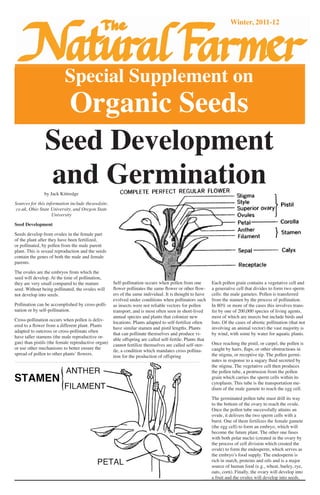
Self-pollination occurs when pollen from one 
flower pollinates the same flower or other flow-ers 
of the same individual. It is thought to have 
evolved under conditions when pollinators such 
as insects were not reliable vectors for pollen 
transport, and is most often seen in short-lived 
annual species and plants that colonize new 
locations. Plants adapted to self-fertilize often 
have similar stamen and pistil lengths. Plants 
that can pollinate themselves and produce vi-able 
offspring are called self-fertile. Plants that 
cannot fertilize themselves are called self-ster-ile, 
a condition which mandates cross pollina-tion 
for the production of offspring 
Each pollen grain contains a vegetative cell and 
a generative cell that divides to form two sperm 
cells: the male gametes. Pollen is transferred 
from the stamen by the process of pollination. 
In 80% or more of the cases this involves trans-fer 
by one of 200,000 species of living agents, 
most of which are insects but include birds and 
bats. Of the cases of abiotic pollination (that not 
involving an animal vector) the vast majority is 
by wind, with some by water for aquatic plants. 
Once reaching the pistil, or carpel, the pollen is 
caught by hairs, flaps, or other obstructions in 
the stigma, or receptive tip. The pollen germi-nates 
in response to a sugary fluid secreted by 
the stigma. The vegetative cell then produces 
the pollen tube, a protrusion from the pollen 
grain which carries the sperm cells within its 
cytoplasm. This tube is the transportation me-dium 
of the male gamete to reach the egg cell. 
The germinated pollen tube must drill its way 
to the bottom of the ovary to reach the ovule. 
Once the pollen tube successfully attains an 
ovule, it delivers the two sperm cells with a 
burst. One of them fertilizes the female gamete 
(the egg cell) to form an embryo, which will 
become the future plant. The other one fuses 
with both polar nuclei (created in the ovary by 
the process of cell division which created the 
ovule) to form the endosperm, which serves as 
the embryo’s food supply. The endosperm is 
rich in starch, proteins and oils and is a major 
source of human food (e.g., wheat, barley, rye, 
oats, corn). Finally, the ovary will develop into 
a fruit and the ovules will develop into seeds.
B- 2 T h e Na t u r a l F a rme r Wi n t e r, 2 0 1 1 - 1 2 
We can often judge how close the seeds are to being 
ripe from the size or color of the fruit or seedpod. 
Unripe seeds are soft, white or green, and enclosed 
in a hard green fleshy fruit or pod. When seeds are 
ripe and mature they change to brown or green, de-velop 
a hard covering, and the seedpod dries out and 
changes to white or brown. It eventually splits to 
release them. 
Producing seeds uses a lot of the plant’s energy. If 
the plant is dead or dying, it will not have enough 
energy to complete the process. This is one of the 
reasons you are unlikely to be able to get seeds from 
cut flowers. The plant needs to be able to gather 
food while it is developing seeds, and the seedpod 
needs to remain attached to the parent plant until the 
seeds are fully developed. 
Development of the seeds, from pollination to shed-ding 
of the ripe seeds, can take several weeks or 
even months, but seeds gathered before the process 
has been completed will not be viable. 
Seeds and Germination 
Most seeds contain less than 20% water, as opposed 
to about 80% in growing tissues. Most of the limited 
water in seeds is bound to macromolecules, so that 
little is available for metabolic reactions. Cellular 
membranes are disorganized under these conditions. 
Because the water potential of seeds is extremely 
low they are capable of drawing water from soils 
that have too little water to support normal plant 
growth. As the seed imbibes water, cell membranes 
reorganize and metabolism begins. The seed may 
not germinate at this point, however. In addition to 
water, many seeds require a period of cold exposure 
(stratification) or leaching of inhibitors by water 
before germination is possible. This applies particu-larly 
to wild species; many cultivated plants have 
been selected for ease of germination. 
Many seeds require light for germination; much of 
our understanding of this phenomenon derives from 
experiments with lettuce seeds in which germination 
is stimulated by red light and inhibited by far-red. 
These seeds, if buried in the soil, will not germinate 
unless the soil is turned over so that they are ex-posed 
to light. This is part of the theory behind “no-till” 
crop production and recent ideas that it might 
be a good idea to plow at night 
The radicle or root is usually the first part of the em-bryo 
to emerge from the seed coat. After this, differ-ent 
structures emerge, depending on the species. The 
most fimdamental structural difference is between a 
monocot and a dicot. 
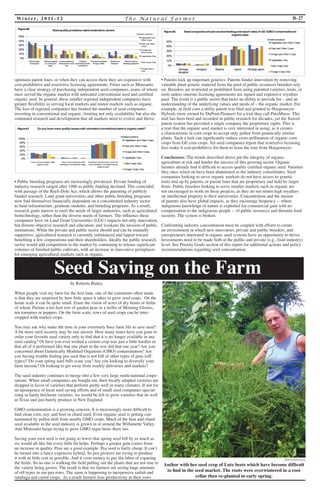
A monocot has only one seed leaf (monocot is short 
for ‘monocotyledon’. A cotyledon is a seed leaf, 
and ‘mono’ means one). This seed leaf is usually the 
same shape as the adult leaf, long and thin, and the 
leaf veins nearly always run parallel to the central 
midrib. Sometimes the adult leaves are pinnate, as 
in many palms, but the veins are parallel on each 
leaflet. There are several monocot plant families that 
are instantly recognizable. Many food plants are 
grasses, so crops like wheat, oats, barley and corn 
are all monocots. Palms, Orchids, and most bulbous 
plants are monocots. 
A dicot has two cotyledons (dicot is short for ‘di-cotyledon’, 
and ‘di’ means two). The seed leaves are 
usually rounded and fat, because they are the two 
halves of the seed. The first true leaves can be many 
different shapes, from long and thin to rounded or 
palmate. Most trees and shrubs and many garden an-nuals 
and perennials are dicots, and there are many 
more species of dicots than there are monocots. 
Seeds need a supply of food to support the embryo 
plant until it can collect its own food. This is the 
reason for the endosperm. With some exceptions, in 
monocots, this is inside the seed coat but separate 
from the cotyledon. In dicots, the cotyledons contain 
the endosperm. 
monocot (oats) dicot (beans) 
Northeast Organic Farming Association Credit Card 
www.CardLabConnect.com/nofa
Wi n t e r, 2 0 1 1 - 1 2 T h e Na t u r a l F a rme r B-3 
by Frank Morton as interviewed by Jack Kittredge 
I’m a self-trained seedsman, I grow 7-8 acres of 
organic seeds on a 50 acre organic farm in Oregon. 
I’m business partners with the people who run the 
vegetable farm. My wife and I and our workers pro-duce 
the seeds that we sell to seed companies – pret-ty 
much all the seed companies that supply organic 
farmers: Johnny’s, Fedco, High Mowing, Burpee, 
Territorial. 
Our catalog at www.wildgardenseeds.com lists 156 
varieties, plus several seed mixtures, from 28 crop 
species. We concentrate on salad greens because I 
used to be a salad green grower, I’m one of the orig-inators 
of the idea of plastic bags of salads. I started 
selling to restaurants in 1983. I shipped a lot to the 
east coast using recycled packaging and UPS deliv-ery. 
That’s how we paid for our farm. In the process 
I was also breeding varieties. That seems like a spe-cialized 
skill, but if you realize it, in the past farmers 
bred everything -- starting10,000 years ago. 
I started breeding as a fluke. I started keeping my 
own seeds – it seemed the natural thing to do. Self-sufficiency 
seemed natural. I was learning as I went 
along. Accidently I had a cross pollination between 
a red and green lettuce. It appeared spontaneously. 
It was a red oak leaf. I realized that there had been 
a cross between a red romaine and a green oak leaf. 
I realized this is where new varieties come from. It 
was a hybrid. I kept it and grew it out to seed. I got 
only 55 seeds, but I planted those seeds. In the F2 
generation (editor: F1 is the first filial generation 
after breeding diverse lines, F2 is the second, or the 
grandchildren of the original lines, so to speak) I got 
the traces of all the parents in an unbelievable level 
of genetic diversity. There were new greens and 
reds, that hadn’t been in the parents. There was new 
ruffling of the edges. When I saw all these new vari-eties 
I realized I could be a plant breeder in conjunc-tion 
with raising salad. I thought that would make 
marketing easy! 
Becoming an Organic Seedsman 
Then I realized I could even have an organic seed 
company and I wouldn’t have to change anything I 
was doing. I thought that would be a very good idea. 
After September 11. 2001 that is what happened. 
My salad business disappeared. All the restaurants 
on the east coast closed down. They couldn’t get 
shipments from the west coast. Some never opened 
again. My biggest customer sent his staff home for 3 
weeks and never reopened. 
So we were in the seed business. We had been grad-ually 
pruning down our salad work for 5 years and 
starting to sell seed to a few companies. We had ac-cumulated 
a seed collection those years and figured 
out which varieties had the best traits. You have to 
know your plants if you are going to breed seeds. 
The only way to learn what makes a cabbage is to 
grow it over years. 
For anyone doing breeding, the concept of self-pollinating 
versus cross-pollinating is crucial. Self-pollinating 
plants such as wheat, lettuce, purslane, 
and sweet peppers pollinate themselves. Heirloom 
tomatoes cross-pollinate but modern ones usually 
self-pollinate. I am growing a huge variety of let-tuce 
this year -- 35 varieties. I make them by cross-pollinating 
varieties -- growing lettuce side by side 
and holding the flowers together. Then, after 10 
generations of self-pollinating, you get 99% similar-ity 
-- essentially they are clones. Plants which self-pollinate 
in nature don’t seem to develop inbreed-ing 
depression, or loss of vigor, the way naturally 
cross-pollinating species do when you force them to 
self-pollinate. 
The reason is that cross-pollinating plants are like 
people. The population that we come from has a lot 
of deleterious, recessive genes. In normal popula-tions 
of humans or of corn most of the genes that are 
delirious are recessive. Because they are rare they 
tend to be paired up with the dominant gene. So the 
bad effect never shows up. By mating in large popu-lations 
of people or corn you try to encourage cross-ing. 
The plant makes an effort to encourage this. 
In corn, for instance, the male and female parts are 
far apart to discourage self-pollination. The tassel 
(male) is way up on the top of the plant. The silks 
are down on the ears (female). It practically guaran-tees 
that genetic mixing will occur. 
In plant breeding for agriculture you have crops that 
naturally cross-pollinate -- carrots, cabbages, squash 
-- but about 60 percent are self-pollinated. About 
30-40 percent are cross-pollinated. Then there are 
ones that are in between. 
Self-pollinating plants don’t have the deleterious 
genes. There is a lot of debate about which kind of 
pollination came first. A lot of scientists thought 
cross-pollination did. But they have shown recently 
that self-pollination is very old. 
Tomatoes and peppers are in the middle. You can 
self-pollinate a pepper for many years without that 
inbreeding depression. The same with a tomato. But 
in nature they cross readily. The tomato and pep-per, 
of course, got taken from their home in South 
America to Europe and the same pollinating insects 
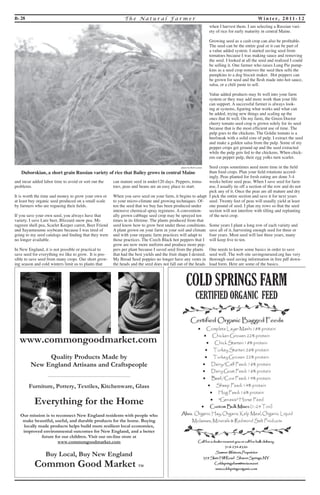
photo courtesy Frank Morton 
Frank Morton collecting lettuce seed 
*Most NCO products that are not OMRI listed are allowed for use on a certified 
organic farm. Check with your certification representative to be sure. 
Offering Natural Fertilizers, Soil Amendments, 
and Environmentally Compatible Pest Controls 
Depot Street, Bradford, VT 05033 Ph. 802.222.4277 Fax 802.222.9661 info@norganics.com 
Many NCO products are: 
Visit us on the Web: www.norganics.com or call for * 
the location of your nearest wholesale distributor
B- 4 T h e Na t u r a l F a rme r Wi n t e r, 2 0 1 1 - 1 2 
Center Square Harness Shop LLC 
J. Samuel Esh 
Christian F. Esh 
246 Forest Hill Rd. 
Leola, PA 17540 
717-656-3381 
Mfg. All Types of 
Draft Horse Harnesses 
Farm • Logging • New England D-Ring Style 
Leather and Biothane 
We Also Sell Horse Collars • 
Farm Hames • Harness Parts • 
Driving Lines, Team and Single • 
Wood Eveners • Neck Yokes 
We also Mfg. Pleasure 
Driving Harnesses for 
• CDE 
• Marathon 
• Show 
Whip Manufacturing 
Tack Shops AND Feed 
AND Farm Stores 
Call for Wholesale 
Prices 
Experiencing the Ups & Downs 
of Running a Small Business? 
Frank Crandall, with 38 years 
of experience running a successful, 
award winning landscape fi rm, 
can share proven techniques, 
forms, and resources to make 
your small business more focused, 
organized....and profi table! 
• “The Essential Horticultural 
Business Handbook” ($29.95) 
Frank Crandall, Horticultural Services 
PO Box 451, Wake eld, RI 02880 
(401) 742-7619 • FrankCrandall3@gmail.com 
at The Kettle Pond Visitor Center, 
Charlestown, RI (register via email) 
• Horticultural Business Consultations 
• GEM (Growth, Effectiveness, 
Management) Horticultural 
Business Seminars 
Two-day GEM Seminar: 
January 18 & 19, 2012 
were not there. So those plants that were more likely 
to self-pollinate were the ones to make seeds. It’s a 
survival strategy. If you don’t make seeds, you’re 
out! 
What we have seen is that if you go to the Andes, 
where peppers and tomatoes are native, they cross-pollinate. 
But if you follow drainages and go up in 
elevation, their numbers decrease until when you 
reach certain altitudes there won’t be tomatoes. 
Then there will be new ones in different valleys. 
The mountains are wonderful for breeding this di-versity. 
So selection occurs within populations that 
favor self-pollination. 
They are not necessarily using the same genes as 
the tropical tomatoes or peppers. It might be that 
in these new environments the deleterious genes 
become favorable. When plants leave where they 
originated that is when self-pollinations occurs. The 
same thing happens when you breed them across the 
world. 
A few things do not cross -- beets, Swiss chard. 
One beet plant will not produce seed. Chicory is 
the same. Whereas an endive plant is 100% self-pollinated. 
Spinach normally has male and female 
plants. But if you remove all the males, the females 
will make their own pollen. 
Breeding for Organic Plants 
Conventional farms have an environment moder-ated 
by chemical inputs. The nutrients are soluble 
in water so roots don’t have to compete. On the 
disease and insect fronts, if you are spraying fungi-cides 
plants don’t need resistance to disease. Same 
for insecticides. If those diseases aren’t part of the 
growing environment, of course, you can’t breed 
for resistance to them. Breeding should be done in 
the area of intended use using the farming practices 
expected to be used. If you are breeding for chemi-cal 
agriculture, use those chemicals on the breeding 
farm. 
Plant breeding for organics has to take place in an 
organic environment.
Wi n t e r, 2 0 1 1 - 1 2 T h e Na t u r a l F a rme r B-5 
©2011 Horizon Photo Courtesy of the Hardy Family 
Dedicated organic advocates, our 2011 
HOPE Award recipients are Henry and Teresa 
Hardy and their family, of Farmington, Maine. 
The HOPE award honors the Hardy’s for sharing 
their passion for organic farming and for ser ving 
as role models for ot her farmers in t heir community. 
To learn more about the Hardy’s, 
the HOPE Award and the HOPE program, 
visit HorizonOrganic.com. 
® 
Find us on and 
The Hardy Family, Farmington, Maine 
® 
C 
M 
Y 
CM 
MY 
CY 
CMY 
K 
15952_HO_NOFA_Winter_2011_Ad.pdf 1 10/10/11 9:44 AM 
There are traits we want in organics -- such as 
roots. Organic growers need plants with extensive 
roots because they are putting down organic fertil-ity 
which is widely distributed and you needs roots 
which are extensive and have lots of root hairs. 
Not every plant is the same in the ability to pick up 
calcium, for instance. So ask how is the fertility ap-plied. 
Another trait is tops, as in carrot tops. A lot of hy-brid 
carrots have small tops. I’ve heard farmers 
complain you can’t even bunch them! Carrot tops 
make the carrot grow. They also shade out weeds. 
Getting carrots established requires forming a good 
leafy canopy to slow weed growth. 
I breed kale so I ask people what shape of a kale 
plant do they want. How tall? There is a class of 
dwarf kale with short stems. It has less stalk and 
more leaves. In cold areas you want short dwarf kale 
because it can hide under the snow and not freeze. 
When I ask people in Oregon, they want tall kale. 
There is no snow cover here, but we do get rain and 
that makes mud and short plants get muddy. Bacte-ria 
also splash up with mud and can cause disease. 
Finally, tall plants are easier to pick. 
Organic growers tend to produce food in agricultur-ally 
marginal areas. So in Vermont or New York you 
have really different environments than around Da-vis, 
California. Breeders in Davis are thinking about 
the production centers of the crop. So to the extent 
that organic agriculture is local, you need to breed 
to know the local situation. The centers of breeding 
are not breeding for these marginal areas. They are 
breeding for the Salinas valley or for spinach grow-ers 
in Arkansas or Texas. I would like to see local 
breeders everywhere. 
To the extent that something is locally bred and the 
environment is unmoderated by chemicals, there 
is no difference between organic and conventional 
seed. But nobody is doing local breeding except the 
organic breeders. It is a skill that is accessible to 
everyone. You don’t need a degree in plant breeding 
to do it. 
Books for organic farmers on plant breeding are 
scarce. I would recommend two. One is Seed to 
Seed, published by the Seed Savers Exchange. It is 
quite outdated and needs to be revised. I understand 
that the Organic Seed Alliance is collaborating with 
them on revising it. The other is Breed Your Own 
Vegetable Varieties by Carol Deppe, published by 
Chelsea Green. It has had 2 editions. It shows you 
anybody can do it. It has a lot of breeder stories and 
is illustrative of how you can go about a breeding 
project. 
Breeding is all just practice. Cleaning is part of it. 
You winnow and screen and do that again and again. 
There are some easy exercises if you are interested 
in plant breeding. I suggest growing two radishes to 
seed side by side. Grow one long white radish and 
one red round one. Let them cross, then keep them 
separate and keep the seeds. Grow those out to be 
round and pink. They all will they look the same – 
you have created a hybrid. But save and plant that 
seed and the next generation is incredibly diverse in 
color and shape. Mendel did this a hundred and fifty 
years ago with peas! 
But it all takes time. That is what discourages 
people. That is why you need to do it in conjunction 
with regular gardening. Save a few, let them cross, if 
it catches your interest you won’t let go. 
Also, if you want to experiment in genetics without 
waiting a year, there is company in Wisconsin called 
Fast Plants. They have come to me for genetic re-sources. 
It is one guy who worked at the University 
of Wisconsin and got an idea for breeding plants 
on his desktop under lights. He bred a mustard 
genotype that grows fast and continued to select for 
fast growth. He now has seed to seed mustard in 
28 days! He then took those and crossed them with 
plants showing many colors and shapes. He sells 
them to schools, so children can learn about genet-ics 
through several generations in one school term. 
They also use them in space for experiments in 
growing in orbit under microgravity. 
WORKING IN HARMONY WITH NATURE 
EARTH CARE FARM 
Mike Merner & Jayne Merner Senecal Certified Organic Farm 
Rhode Island’s Oldest Operating Farm Composter 
Quality Made Compost is the Healthiest Way to Nourish Plants 
www.earthcarefarm.com 401.364.9930 
Compost 
Specializing in: Hardy 
fruit trees, nut trees, berry 
plants, and unusual fruits. 
East Hill Tree Farm 
Nursery 
(802) 272-5880 • 3496 East Hill Road • Plainfield, VT 05667 
Offering: Edible landscape 
design, consultation, and 
planting for Central Vermont. 
Design 
Bless up the Earth. 
www.easthilltreefarm.com narubin@gmail.com
B- 6 T h e Na t u r a l F a rme r Wi n t e r, 2 0 1 1 - 1 2 
by Bryan O’Hara 
Tobacco Road Farm is primarily a vegetable grow-ing 
operation. Over the last twenty years or so we 
have saved seed from numerous crops and worked 
to develop more beneficial varieties for our growing 
conditions here in Eastern Connecticut. These ef-forts 
have been undertaken for a number of reasons, 
including to improve productivity and to provide 
an interesting endeavor in our agricultural pursuits. 
These efforts have lead to a more harmonious re-lationship 
with our natural environment as well as 
more vegetables and also profit. 
A major benefit to our seed saving has been im-proved 
germination and vigor of the seedlings and 
crops. This vigor comes from our ability to select 
the most vigorous plants to supply the seed as well 
as freshness of the seed and our ability to interbreed 
the seed crop. In selecting specimens for seed sav-ing 
we generally will rogue out small or otherwise 
inferior plants while still maintaining a larger ge-netic 
pool of superior specimens. Size of seed can 
be selected during the cleaning process to secure the 
largest and heaviest. Seed freshness is also certain. 
As an example, seed harvested from a kale crop 
in July can be seeded in the same month of July. 
This freshness cannot be secured from commercial 
sources where age of seed is not even known by the 
purchaser. 
Beyond selection, breeding crops for vigor generally 
takes advantage of large genetic pools to provide 
hybrid vigor. Often these crops are diverse in ap-pearance 
and are referred to as “land races”. Exam-ples 
of our land races include – mizuna, tatsoi and 
maruba, all bred together with seed of the offspring 
saved for many successive years. These mizuna-like 
plants are faster growing and hardier than any of 
Plant Breeding and Seed Saving 
at Tobacco Road Farm 
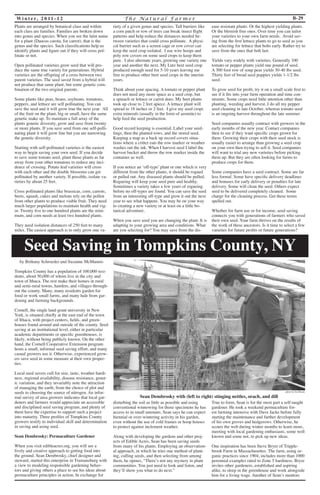
photo by Rob Durgy 
Ripe kale seed ready for harvest
Wi n t e r, 2 0 1 1 - 1 2 T h e Na t u r a l F a rme r B-7 
their original parents and have diverse leaf shapes 
and colors. It is an excellent selection for winter 
salads. Another example of a land race grown here 
is our watermelons, which originally came from a 
Polish neighbor many years ago. This melon is a 
very highly productive melon that produces melons 
of different color green rinds from green striped 
to a more solid, lighter green color. All the melons 
have excellent flavor and the markets have accepted 
these melons’ appearance. Vigor is derived from the 
genetic diversity in out crossing crops. Out crossing 
crops are those that readily breed with other plants, 
that is, are not self-pollinating. Out crossing crops 
are generally those crops that are pollinated by wind 
or insects. In the self-pollinated crops like toma-toes, 
seed is simply saved from the healthiest few 
individuals as the need for diversity is much less. 
This gives us the ability to readily maintain pinnacle 
specimens in self-pollinated crops like tomatoes or 
peppers. 
While crop vigor is certainly a major benefit of seed 
saving, the ability to select for the desired character-istics 
is also very helpful. Some of our efforts have 
been to improve cold tolerance, improve coloration 
or lengthen harvest periods. In the case of cold 
tolerance, we took a variety of arugula and over-wintered 
an October seeding. This variety had about 
a 10% survival rate. We saved the seed from this 
10% and replanted them the next fall. These plants 
survived winter at essentially 100% and were much 
less prone to damage in freezing temperatures. This 
is now our standard fall and winter arugula. 
An example of lengthening harvest times is our ef-fort 
to breed a true biennial kale. In this case it was 
noted that about 5% of Konserva kale plants will not 
flower in the spring following their over-wintering 
from a previous spring planting. These plants are 
dug up and placed together during their second 
spring in an effort to have them flower in their third 
spring. This project is ongoing and is difficult be-cause 
of its long growth period and low plant count, 
leading to low diversity. The benefit of having pro-duction 
kale, however, that does not bolt in spring 
after overwintering will be great. 
Regalia® switches on a plant’s 
Regalia is a registered trademark of Marrone Bio Innovations. 2011, Marrone Bio Innovations, Inc. 
Regalia is a powerful, proven tool for 
controlling your most troublesome fungal 
and bacterial diseases. It switches on plants’ 
natural defense mechanisms so they produce 
—and accumulate—higher levels of natural 
proteins and other compounds that inhibit 
disease development. This unique mode of 
Controls Bacterial 
and Fungal Diseases 
action gives growers an effective new option 
for bacterial spot, late blight, early blight, 
target spot, downy mildew, powdery mildew, 
gummy stem blight, and a number of other 
diseases. And adding Regalia to your rotation 
is an ideal resistance management strategy. 
The fact is, nothing else works like Regalia. 
Contact your local retailer and make new 
Regalia part of your fungicide program. 
Find out more at www.MarroneBio.com or 
call toll free 877-664-4476. 
® 
© 
for 
SMALL SCALE GROWERS 
BIG TIME VARIETIES 
Want head-turning vegetables? Your customers will love the classy appearance and top-shelf 
taste of Harris Seeds’ high-performing varieties…and you’ll appreciate the reliable production, 
high yield, and disease protection. The 2012 Harris Seeds Professional Vegetable Growers’ Catalog 
will be mailed in November, and inside you’ll fi nd a broad selection of high quality, disease 
resistant, great tasting vegetable varieties that will have customers looking your way. You’ll fi nd the 
exceptional varieties above – plus hundreds more – in untreated or organic seed. 
For an eye-catching, profi t-generating addition to your farmers’ market or roadside stand, try cheery, 
colorful cut fl owers. We have more than 160 untreated varieties, plus in-house expertise to help you 
get started. 
To receive your free catalog, call us toll-free or visit us online: 
800-544-7938 www.harrisseeds.com 
A Grower Friendly Company 
355 Paul Rd. PO Box 24966 
Rochester, NY 14624-0966 A012 
GLADIATOR 
The USA’s #1 big pumpkin 
with PM protection! 
PRIMO RED 
Start the season with unbeatable 
yield and fl avor! 
REWARD 
Classy zucchini with powdery mildew 
and virus protection! 
RENAISSANCE 
Dependable and delicious, it’s the 
new standard in the 2nd early slot! 
REVOLUTION 
You’ll see market-leading disease protection, 
consistency, and fl avor with this best-seller! 
CARNIVAL 
It’s a party on the outside and a 
taste sensation on the inside! 
MYSTIC PLUS 
PM protection and unmatched fl avor make 
this a grower-favorite pie pumpkin! 
SCARLET RED 
Firm enough to ship, tasty enough 
to gain a following!
B- 8 T h e Na t u r a l F a rme r Wi n t e r, 2 0 1 1 - 1 2 
Often we save seed simply to preserve varieties that 
are no longer commercially available, such as the 
Siegfried leek or presto cress. These varieties are 
further adapted to our farm’s environment by our 
selection of them and kept vigorous with high popu-lations 
for breeding. 
Sometimes we will re-invigorate existing commer-cial 
varieties. For example, Dwarf Scotch Kale from 
commercial sources seemed to be lacking vigor; 
perhaps the seed that was being offered was old. We 
grew out a large population and secured a vigor-ous 
fresh seed. Also, hybrid seed can be stabilized. 
Many hybrids are quite true to type if succeeding 
generations are grown. Here stabilization may re-quire 
several years of breeding to secure a consistent 
plant. High plant populations are important to main-tain 
diversity for out-crossing crops using this pro-cess. 
Or if diversity in plant type can be tolerated, a 
land race type of crop may be successfully started 
from a commercial hybrid source. 
Large volumes of seed are often produced, and most 
can be saved for many years. This allows us to pro-duce 
seed in different years that would have cross 
breeding problems if grown during the same season. 
Large volumes of seed are also useful for reducing 
seed expenses, and gives us the ability to seed very 
heavily if desired. This allows for broadcast seeding 
of salad green crops, or seeding vegetables for cover 
crops. 
Seed production has also resulted in an increase in 
beneficial insects and therefore a reduction in insect 
pests. This occurs because the production cycle 
of crops to seed often results in a food source and 
habitat for these insects. An example is the Cotesia 
Wasp, a predator of cabbage caterpillars. This wasp 
lays its eggs on the caterpillar. The larvae burrows 
into and then consume the caterpillar. The larvae 
then emerge, pupates and new wasps emerge. The 
pupal stage generally occurs on the leaf of the cab-bage 
family, and pupae are seen as small white 
cocoons, often in clusters. The wasp feeds on the 
nectar of cabbage family plants. We have overwin-tered 
the pupal cocoons in collards and seen the 
wasps emerge the day the collards started to flower 
in the spring. Now what if all the cabbage family 
residue had been tilled in the fall. Would any pupae 
that survived have anything to eat when they emerge 
as wasps? 
This relationship of the crops full growth cycle pro-viding 
both the necessary habitat and nectar source 
for the proliferation of the appropriate beneficial in-sects 
led to a new understanding of crop production. 
These crops offer us much in the way of their use-fulness. 
Therefore, in return, we should help them to 
proliferate and evolve through seed production -- a 
simple, effective relationship. 
In terms of how we produce seed, probably the most 
important factor is soil fertility. A well-balanced 
soil that can sustain healthy plant growth through to 
seed production is critical to achieve large, vigorous 
seed. Soil overly rich in nitrogen and other vegeta-tive 
growth elements will not yield high quality 
seed, nor will a soil deficient in necessary nutrients. 
A fertile soil also helps with weed control, which is 
critical in a long term crop like a seed crop. Often 
seed crops are grown with an organic mulch like 
leaves, straw or hay to assist weed control and pro-vide 
for better soil. The growing practices for the 
straw or hay need to be ascertained in order to avoid 
hazardous herbicides, herbicides known to damage 
vegetable crops. 
In terms of the growth cycle of plants, it seems best 
to grow crops for seed in their natural patterns. The 
vast majority of vegetable crops are either summer 
annuals or winter annuals. Summer annuals are 
generally frost sensitive crops which are seeded in 
spring or summer and produce seed by fall. Tomato, 
pepper, squash, melon, bean, pea, okra, basil and 
amaranth are examples of summer annuals. Winter 
photo by Rob Durgy 
Mizuna land race in flower 
around the patch applying Plantskydd, and 
the deer stayed out until after harvest. 
We have such a deer problem in the valley 
that, when I tell folks in my garden seminars 
about your product, they jump right on it. 
Hooper’s Garden Center, in Kalispell, Mon-tana, 
sent one of their customers to me, 
desperate to see if I could help them save a 
$30,000 investment in flowers that were to be 
planted for a special event on a large estate. 
I sent them to the CHS Country Store (also in 
Kalispell), where they proceeded to clean all 
the Plantskydd Granular off the shelf. The 
estate put in an order for 50 more 20 lbs bags 
this year. 
The Plantskydd Granular is my favorite re-pellent 
because: 1) it works; and 2) it is quick 
and easy to use—no mess, no fuss. 
Sincerely, 
Bill Clanton. Kalispell, Montana, April 7, 2010 
#1 Choice of Professional Growers, Foresters, and Landscapers 
Listed for 
Production 
I just wanted to say thanks for a great product 
that made my life easier, and to tell you some 
success stories that I, and others, have 
experienced using the new Plantskydd 
Granular Repellent. 
A couple of years ago I had a herd of 
30 whitetail deer crossing my land. Their game 
trail went right through a field where I was 
planning to plant corn. Rather than put up 
a fence, I decided to use your new granular 
Plantskydd product. I dumped 40 lbs in 
a drop spreader to pull behind my garden 
tractor, and put down a 3-foot border around 
my field. Next, I rubbed out the tracks on 
the game trail so I could see how effective 
Plantskydd was. The deer always crossed 
during the night. Well, the next morning there 
was not a track to be found. And none for the 
rest of my growing season! 
I have a small truck farm where I grow 
vegetables to sell at Farmer’s Markets as well 
as to supermarkets. Deer just love beet tops— 
I have had them eat a 100 foot row in one 
night! Last year, when my beets came up, I put 
some granular Plantskydd in a spreader and 
applied it around the outside row of the beets. 
The deer didn’t eat a bite. The key is to get the 
product down before the deer start nibbling. 
Later in the spring, my pickers came and told 
me the deer had been eating the zucchini. 
I took out the spreader and made one trip 
“ 30 whitetail deer crossing my vegetable farm...” 
For more testimonials or to order online, visit: 
www.plantskydd.com 
TO ORDER DIRECT, CALL TOLL FREE 
1-800-252-6051 
BULK SIZES AVAILABLE IN: 
Granular, Pre-mixed RTU Liquid, and 
Soluble Powder Concentrate
Wi n t e r, 2 0 1 1 - 1 2 T h e Na t u r a l F a rme r B-9 
annual crops generally start growth in spring or 
summer or later, and flower and produce seed the 
following spring. Lettuce, carrot, beet, the cabbage 
family, onion, leek, parsley and many others are in 
this group. Often they are mistaken for biennials, 
but this is inaccurate as their growth period is only 
one year, generally from summer to the follow-ing 
summer, an annual cycle. A true biennial like 
burdock starts its growth in one summer, forming 
a small root. This crop then spends the entire next 
year growing a larger root which spends a second 
year underground and then flowers the next summer, 
a full two year growth cycle. 
It is critically important to understand this winter 
annual cycle in order to grow high quality seed in 
our environment. Winter annuals seeded in summer 
or fall and grown through winter and allowed to 
flower in spring have consistently grown seed free 
of seed borne diseases and are vastly more prolific 
than a winter annual sown in spring which then 
flowers in summer. Lettuce has been a perfect ex-ample 
of this with prolific overwintered production 
and next to nothing of quality from spring sowings. 
This is not to say that you cannot produce seed from 
spring sown winter annuals. Some winter annu-als 
will generally not flower in their last summer 
if sown in winter or spring, such as cabbage, kale, 
carrot, beet, parsley, onion etc. Others will perform 
as summer annuals from a winter or spring sowing 
such as broccoli, lettuce, mustards, cilantro etc. and 
produce seed in their first summer. 
Often crop cycles are staggered in order to pro-duce 
pure seed from similar crops that will readily 
cross breed – for example, mizuna may be sown in 
October for an early flowering seed crop, where a 
late sowing in December of tatsoi will flower late 
enough in the spring to miss the mizuna’s flowers. 
Crops can also be separated by harvesting, which 
delays flowering, or by distance, such as another 
field entirely. 
In the case of selecting the best plants for seed col-lection, 
rogueing generally occurs. This is especially 
important in the out-crossing crops where large 
populations are maintained. In rogueing, plants are 
removed which are weak or otherwise do not meet 
our requirements. In the land races where vast di-versity 
is tolerated and even encouraged, rogueing is 
performed even less and is limited to very undesir-able 
traits, such as hairiness in a salad crop. In self-pollinated 
crops much less rogueing takes place and 
seed is simply saved from the superior specimens, 
though if we are really trying to “clean up” a variety 
we will use rogueing to give better isolation. 
The basic process for most seed crops is to cut seed 
stalks when the first basal seed pods are just start-ing 
to shatter. These basal seed pods generally have 
the best seed so it is important not to let many of 
them shatter before harvest, yet they also need to be 
at full maturity. These seed stalks are then brought 
into a shade cloth covered hoop tunnel and allowed 
to dry either hanging from the hoops in bunches or 
spread out on benches. Once dry they are stomped 
upon in a large sheet metal pan. The bulky materi-als 
are then removed from the top. The seed and 
chaff is then poured from one smaller pan to another 
through various sized screens, both too large and too 
small for the seed to pass through. This removes the 
vast majority of the chaff. 
The seed is then winnowed by pouring from one pan 
to another in front of a fan. If done carefully almost 
all chaff and small light seed can be removed in this 
manner. The seed is then left for a day or two in a 
very dry location to allow any insects to leave. The 
seed is then stored in airtight glass gallon jars in the 
dark with desiccant packs inserted into the jars. 
For summer fruits the seeds are simply removed 
from the melon, bean, pepper or squash and dried 
before storage. In the case of the tomato, the seed 
and pulp is removed and allowed to ferment for sev-eral 
days, then washed, dried and stored. 
All of these efforts have seemingly led to increased 
profit since the benefits are substantial. However, no 
cost benefit analysis has ever been done here. Seed 
production does require additional planning, labor, 
and observation and may be too much to embark 
on for many labor-strapped farms. Even small, well 
placed efforts, however, may have a dramatic effect. 
This could lead to more seed developed for our spe-cific 
region, and if distributed and shared with other 
regional farms would create greater self-reliance in 
our means of production. 
photo by Ropb Durgy 
Various screens attached to wooden frames for sifting seed by size
B- 10 T h e Na t u r a l F a rme r Wi n t e r, 2 0 1 1 - 1 2 
If you are, or would like 
to be a grower of: 
• organic broccoli 
• organic garlic 
• organic blueberries 
• organic strawberries 
• organic melons 
Come grow with us: 
In 2010, we purchased more than $15 million 
worth of flowers and produce from local farmers 
— and we’re not stopping there! 
Contact Bill McGowan for more information and a complete 
list of produce in demand: 
• 617-492-5500 
• bill.mcgowan@wholefoods.com 
…to help build our local food supply! 
wants YOU 
Supporting local farmers, producers and vendors for 30 years and counting.
Wi n t e r, 2 0 1 1 - 1 2 T h e Na t u r a l F a rme r B-11 
by CR Lawn 
Seed is an essential living component of organic 
systems. The use of organically-grown seed that is 
adapted to organic systems and free of contaminants 
is critical to overall organic integrity. 
Few in the organic movement would take issue with 
such noble sentiments. But the dream that organic 
farmers use only certified organic seeds, while salu-tary 
as an end goal, is of no help in navigating the 
way there. 
From the get-go, the Organic Seed Rule has been 
one of the most controversial features of the NOP, 
for it had no precedent in the decentralized certifi-cation 
operations that the NOP replaced. In effect, 
it called for an entire industry to develop out of a 
vacuum, a pertinent fact that puts the Organic Trade 
Association’s (OTA) impatience at the slow pace of 
industry development in perspective. In railing at a 
too-slow increase in organic seed use since imple-mentation 
of the NOP, OTA failed to appreciate 
why 11 years transition time has been insufficient 
to allow production of organic seed to catch up to 
the demand. Given that it takes a minimum of 7-10 
years using classical breeding to develop a new va-riety 
or to stabilize an hybrid, and that the organic 
method rightfully, in my opinion, forbids certain 
faster breeding techniques, organic seed develop-ment 
represents the ultimate form of slow food. 
NOP regulations 205.2 and 205.204 establish a re-quirement 
that certified operations use organic seed 
and planting stock, but allows an exemption if these 
are “not commercially available in an appropriate 
form, quality or quantity to fulfill an essential func-tion 
in organic production. Price cannot be a consid-eration.” 
While many in the organic industry lament 
the lack of clarity inherent in the ‘commercial avail- 
The Organic Seed Rule
B- 12 T h e Na t u r a l F a rme r Wi n t e r, 2 0 1 1 - 1 2 
ability’ loophole, and wish that the NOP would take 
steps to close, or at least tighten it, much of their 
position relies on two premises, both of which are, 
in my experience, demonstrably false: First, that as 
long as exemptions are permitted, organic farmers 
will shirk the organic seed requirement whenever 
they can. Second, that the organic seed industry will 
not be willing to invest in capacity absent the assur-ance 
of a stronger, more strictly enforced rule. 
My experience at Fedco Seeds gives lie to the first 
contention. I have found that reasonably priced or-ganically 
grown seed of good quality flies off the 
shelf. Not only is it purchased by certified organic 
farmers, who are required to look for it under the 
NOP rule, but it is also chosen by droves of non-cer-tified 
farmers and gardeners who are under no such 
obligation. That’s because organic is far more than 
a market niche, it is a social and ethical movement. 
Much of the demand for organic seed preceded 
the Rule. It sprang from grass roots ethical choices 
made by the pioneering generations of the move-ment 
and enthusiastically embraced by the next. To 
test this contention I conducted a small survey. I 
found that our customers chose to purchase organic 
seed 38.1% of the time, even though only 26.5% of 
our listings were certified organic, and even though 
organic seed cost 2-3 times as much. 
The second contention is harder to refute. I can 
point to numerous capacity building initiatives un-dertaken 
by entrepreneurs in the last decade, howev-er 
-- by us, by our friendly competitors, by our sup-pliers 
and by growers -- and I believe that these will 
continue to grow in the decade to come. Given the 
ever-increasing demand for quality organic seed at a 
fair price, there are tremendous investment opportu-nities 
even with the Rule as it is. To those would-be 
suppliers who might hesitate, I would advise: don’t 
wait for an iron-clad Rule. High Mowing didn’t 
wait, Family Farmers Seed Co-operative didn’t wait, 
we didn’t wait to invest. Our biggest need in the in-dustry 
is for more quality wholesalers in the States. 
Assess the market and take the risk. We’ll be knock-ing 
at your door! 
Last year the Organic Seed Alliance, as part of its 
first State of Organic Seed Report, conducted a sur-vey 
of 1,027 organic farmers in 45 states, finding 
that by far the biggest obstacles to greater use of or-ganic 
seed are the lack of availability for the specific 
varieties wanted (for 79% a moderate or significant 
factor) and the lack of sufficient quantity of avail-able 
seed (50%). 
The quality of available organic seed is quite un-even. 
The best varieties, such as those bred and 
produced by Frank Morton and Gathering Together 
Farm, those originating from Cornell University’s 
farmer-breeder collaborations, and some releases 
from Europe where organics developed much earlier 
and faster than in the States, were trialed and bred 
specifically under organic conditions. These are 
worth every penny of their price and more. Fedco’s 
seed receivers, however, can recite a litany of hor-rors 
to attest that some organic seed growers need 
additional technical assistance and seed-cleaning 
capacity to get up to snuff. In recent years we’ve 
invested tens of thousands of dollars to bolster our 
lot grow-out and trials research, and our condition-ing 
capabilities, to respond to these glaring needs. 
Unfortunately, the OSA chose to downplay seed 
quality issues in their report, dismissing the signifi-cance 
of the 21% of growers (more for vegetable 
seed) who reported significant problems, particular-ly 
of germination, emergence and trueness to type. 
The survey results showed a serious asymmetry, 
with only 3% of seed users having more problems 
with untreated conventionally-grown seeds com-pared 
to 23% having more problems with organic 
seed. Since growers are paying a premium of any-where 
from 1.5 to ten times the price for organic 
seed compared to conventional, they have a reason-able 
expectation that its quality should be at least as 
good. 
Which brings us head-to-head with perhaps the most 
problematic feature of the Rule: price. Fully 41% of 
organic farmers in the survey admitted taking price 
into consideration in their seed selection, despite the 
express prohibition of the Rule. It is from this statis-tic 
that the “shirker” argument gains traction. Let’s 
look at this from the farmers’ perspective. Farming 
is one of the highest arts. The ability to observe and 
choose varieties best suited to one’s climate, soil 
conditions and marketing needs is one of the distin-guishing 
characteristics of the skilled practitioner. 
Take away the farmer’s right to choose and she is 
little better than a serf. 
The best farmers choose whatever varieties will 
offer the highest value. What factors determine 
value? Price, satisfaction with the supplier (acces-sibility, 
prompt and accurate service), the genetics 
of the cultivar, its consistency, its quality compared 
to other strains and similar varieties, its ability to 
fill the required marketing niche. As the price for 
achieving certification, organic farmers are expected 
voluntarily to ignore price; to give up a key factor 
in determining value, which is a huge sacrifice. To 
quote the OSA report “There is a long and unfortu-nate 
history in agricultural policy of treating farmers 
unfairly...in order to benefit consumers, retailers, 
food companies, processors, financiers and suppliers 
of agricultural inputs” (read seed companies). If the 
organic movement is not to repeat this tragedy, how 
can it reconcile a Rule that asks its farmers to make 
such a sacrifice with the lofty desiderata of keeping 
organic agriculture “farmer-driven and farmer ori-ented?” 
There are no easy answers. 
The Rule as stated presents seed companies like 
mine with a dilemma as well. Aware that organic 
farmers are required to source organic seed, we take 
on an added burden whenever we consider adding 
an organic cultivar. Because organic farmers are 
forced to consider it if we offer it, we must make 
doubly sure that it is of sufficient value to justify the 
price we’d charge for it. If not, our clear duty to or-ganic 
growers is to leave it out of our catalog. 
At present, certifying agencies are inconsistent in 
applying the rule for sourcing organic seed. Some 
are much more stringent than others, but the trend 
is toward increasing strictness. Many still maintain 
a minimum requirement that farmers search at least 
three sources, a requirement that could be clearly 
inadequate depending which sources are chosen and 
REAL PICKLES 
Naturally Fermented  Raw 
Northeast grown • 100% Organic 
Our products are 
made using natural 
fermentation, which 
was e s s e n t i a l t o 
healthy human diets 
before the advent of 
i n d u s t r i a l f o o d 
processing. As raw 
products, they are rich 
sources o f active 
cultures and enzymes. 
100% vinegar free. 
Dill Pickles • Garlic Dills • Sauerkraut 
Garlic Kraut • Red Cabbage • Beets 
Kimchi • Ginger Carrots • Hot Sauce 
www.realpickles.com 
(413)774-2600 Greenfield, MA 
Sold in natural foods stores in the Northeast 
 available by mail order 
(Visit our website or call for details) 
Organic Gem - North Atlantic fresh fish higher 
in N with over 70 micro-nutrients 
Competition - Lower in natural occurring N 
Organic Gem - 100% Enzymatic cold digest 
retains nutrients 
Competition - May use fermentation, heat, 
and/or acid, thus destroying nutrients 
Organic Gem - FDA inspected plant helps insure 
quality 
Competition - ??? 
Organic Gem - Contains more available nutrients 
than competitors 
Organic Gem - Try The Best 
COMPETITION - THERE IS NONE 
Call Toll Free 
Manufactured  
Distributed in 
New England
Wi n t e r, 2 0 1 1 - 1 2 T h e Na t u r a l F a rme r B-13 
how thoroughly they are searched. Others ask for a 
pattern of continued improvement in the percentage 
usage of organic seed. Although both the Organic 
Seed Growers and Trade Association (OSGATA) 
and OTA, in their 2011 recommendations to the 
NOP, endorse the percentage usage test, it is at best 
a crude measurement of compliance, requiring cer-tifying 
agents to have a significant degree of seed 
industry knowledge to apply fairly. As a farmer, I 
could be making progress toward greater organic 
seed use even while my percentage use is dropping. 
How could that be? Let’s look at Carmen pepper. 
Johnny’s introduced Carmen pepper in 2006 when it 
won an All-America award. For the past five years it 
has been available only in conventional seed. 2012 
is the first time organic seed will be available. This 
is typical for the industry; with few exceptions, new 
cultivars usually show up first as conventional offer-ings 
and several years elapse before organic seed is 
available. Should growers who purchased Carmen 
the past five years have been penalized by certifiers? 
How about those who want to stay at the cutting 
edge by continuing to try new varieties that sound 
superior but are available only in conventional seed? 
Or let’s suppose that I have specialized in heirloom 
tomatoes. Shopping 2011 catalogs from Seeds of 
Change, High Mowing, Johnny’s and us, I found 63 
different organic listings for heirloom tomatoes. My 
certifier could have reasonably insisted on 100% or 
near 100% organic seed usage for heirloom toma-toes. 
However, now my market has changed and it 
demands shell peas and hybrid watermelons instead 
of tomatoes. For the latter I could find only three 
organic options in the four seed catalogs; for the 
peas, just seven. Unless my certifier is knowledge-able 
about the seed market, it will unfairly take me 
to task when my market changes to peas and melons 
or to hybrid summer or winter squash. In particular, 
the supply of organically grown hybrid varieties in 
the States is way underdeveloped, and the price of 
some of the imports, prohibitive. 
Because certifiers clearly need more tools to get up 
to speed on seeds, and farmers need a more con-venient 
jumping-off place to begin their organic 
search, I have, after years of holding out, recently 
come to support the organic industry’s longtime 
push for a national database of organic seed avail-ability, 
provided it is used as a tool to benefit farm-ers 
in making selections rather than as a cudgel to 
enforce the Rule high-handedly, and provided it 
observes the following caveats: 
1) Seeds are live products. Their availability is in 
constant flux, new developments are continu-ous. 
The database will be worthwhile only if it 
is carefully and knowledgeably maintained and 
kept current. 
2) For that reason it will be costly to keep up and 
farmers and seed companies should not be asked 
to bear these costs. Public funding must come 
from the NOP. 
3) Although I am in favor of requiring organic farm-ers 
to search this database as part of their organic 
sourcing, it is only a starting point. It cannot 
replace a more detailed search through seed cata-logs, 
and wise farmers searching for value will 
not use it as a short-cut. 
4) The mere mention of an available variety on this 
database is insufficient to require a farmer to pur-chase 
that variety as such a listing is no guaran-tee 
of quality or suitability of purpose. Certifiers 
may not use this listing to force farmers to pur-chase 
specific varieties or deal with seed compa-nies 
with whom they do not prefer to patronize. 
OSGATA’s recommendation to NOP places pri-mary 
responsibility on farmers, not certifiers, to 
determine varietal suitability for a given specific 
purpose and seed quality sufficiency, recognizing 
the complex nuances of seed issues. 
Well kept, wisely used and fairly applied, such a da-tabase 
can become a valuable tool, not only to farm-ers 
to source varieties, not only to certifiers to assess 
progress in organic seed use, but also to the entire 
organic industry to identify areas of insufficient sup-ply 
and develop responses. Applied unfairly, it could 
become a bureaucratic nightmare for organic farm-ers. 
Though it might be our sextant in navigating to 
a truly organic shore, it must be supplemented with 
astute observation and close collaboration between 
certifiers and farmers, as colleagues working for a 
common goal, not as cops and clients! 
In recommending any further hurdles for organic 
growers, the trends toward increased costs, bureau-cracy, 
and onerous documentation in organic certifi-cation 
give me great pause. In fact, in the fall issue 
of the Organic Broadcaster, longtime organic in-spector 
and MOSES organic specialist Harriet Behar 
warned that she is seeing organic producers leave 
the certified marketplace due to the hassle factor of 
excess paperwork. 
Along these lines, OTA’s recommendations to 
the NOP regarding varietal equivalency present a 
real can of worms. Equivalency is mentioned in 
the Rule, but its definition is sufficiently vague to 
leave open different interpretations. Represent-ing 
the goals of some of the larger players in the 
industry, OTA would like to see the NOP enforce 
equivalency. Depending on specific definitions, 
equivalency could be used to force growers to use a 
different variety if they cannot source the one they 
want. Varietal equivalency, for example, might re-quire 
growers to use Michelle lettuce if Sierra were 
unavailable, on the grounds that the varieties are 
sufficiently similar. Kind equivalency, even broader, 
could treat such varieties as Italienischer, Plato II, 
Parris Island Cos and Jericho as interchangeable tall 
green Romaine lettuces. Not only would this abro-gate 
farmers’ fundamental right to choose varieties, 
but it would also prove a bureaucratic nightmare 
both for growers and certifiers. 
In conducting and observing trials, attending con-ferences, 
and visiting farmers these past 25 plus 
years, I have learned that there is no such thing as 
an equivalent variety. Michelle is not Sierra is not 
Canasta. Farmers have definite preferences among 
varieties as among seed companies, preferences that 
should be honored. Even varieties that seem simi-lar 
may perform differently in different soil types, 
microclimates, or under different practices. The dif-ferences 
among varieties can be as subtle as the dif-ferences 
in fine wines. 
Not only are there significant differences between 
similar varieties, but there is also variation among 
• • 
We also offer lime spreading. 
Call for pricing. 
Organic Dry 
Fertilizer Programs 
• Take soil tests now to make 
applications of dry fall blends 
this fall. 
• We’ll analyze your soil and 
custom blend fertilizers for 
your fields. 
Other Organic 
Products 
• Corn  Soybean Seed 
Call for Fall Pricing Discounts. 
• Animal Health  Nutrition 
Products 
Agriculture 
Lancaster Seeds • Animal Nutrition • Soil Nutrients • Garden • Human 
60 North Ronks Road 
Ronks, PA 17572 
www.lancasterag.com 
(717) 687-9222 
L e t u s t a k e c a r e o f y o u r O R G A N I C n e e d s!
B- 14 T h e Na t u r a l F a rme r Wi n t e r, 2 0 1 1 - 1 2 
different strains of the same variety. If you don’t 
believe me, try planting arugula, Scarlet Nantes car-rots 
or Cherry Belle radishes from 6 or 8 different 
seed companies. Put them alongside each other and 
you will see variation. Varieties are alive, constantly 
evolving with their environment. Seed companies 
and their seed stocks are different, too. 
Equivalency is American Seed Trade Association 
(ASTA) sophistry at its worst. Its implementation 
would turn organic farmers into captives of the seed 
industry. It is nothing more than a scheme to enrich 
seed companies at the expense of organic farmers. I 
cannot imagine why any skilled farmer would ever 
want his/her choices to be so restricted. Wisely, 
OSGATA elected to eschew all references to equiva-lency 
in its recommendations to the NOP. Equiva-lency 
has one further fatal drawback. In a worst case 
scenario in which the organic industry abandoned 
zero tolerance of genetically engineered varieties in 
exchange for a defined acceptable threshold, equiva-lency 
could be used as a back-door means of permit-ting 
the use of GE-contaminated seeds in organics. 
Keep in mind that organic seed is still a nascent 
industry and needs more time to develop capacity 
to bring the supply of quality organic seed into line 
with the rapidly-growing demand, and don’t forget 
how the law of supply and demand works. If farm-ers 
are made captives of the Rule, the resultant spike 
in demand will sharply increase the cost of organic 
seed. While the seed industry reaps the benefits 
of this indirect government subsidy, farmers will 
pay the price -- a sad re-enactment of an old and 
familiar refrain. While I, too, look to the eventual 
day that our organic farms are 100% organic from 
seed to table, while I, too, respect those high organic 
ideals, I also remember from Economics 101 that 
setting the bar higher in the form of stiffer regula-tions 
restricts entry to the market. While all sorts of 
persuasive public policy benefits are advanced to 
justify licensing requirements, the hidden motive, to 
limit market access and keep prices high, is rarely 
acknowledged. Let us honestly assess where the or-ganic 
seed industry fits in this model before we raise 
the bar much higher. 
Sailors know that the straightest line is seldom the 
shortest distance in sailing between two points. 
Rarely in life, as in the water, is the wind right 
behind our backs. To successfully navigate to our 
goal on the other shore, often we must tack and tack 
again. 
While acknowledging that the organic Rule has pro-vided 
an important stimulus in increasing the pro-duction 
and use of organic seed, I would argue that 
now is not the time to close all loopholes and make 
it absolute, or even to greatly intensify enforcement 
efforts at the expense of our farmers. Instead let’s 
focus most of our energies on expanding capacity in 
ways that will benefit rather than hurt organic farm-ers. 
As we build infrastructure, develop and refine 
skills, we will expand our productive capabilities, 
opening up ways to increase the quantity and quality 
of good organic seed. As the supply expands over 
time to approximate the demand, we will experience 
more favorable winds, more opportunities to navi-gate 
more directly toward that shore of all-organic 
seed use, without having to jettison many members 
of our crew. The Organic Seed Alliance report and 
the OSGATA recommendations are filled with cre-ative 
ideas for such capacity building that could jus-tify 
a full-length article of their own. 
CR Lawn founded Fedco Seeds in 1978. Full dis-closure: 
CR was on the OSGATA Policy Committee 
that drafted its latest recommendations to the NOP. 
Disclaimer: The views expressed herein are neither 
those of OSGATA nor of Fedco Seeds, Inc. but rep-resent 
only those of the author. 
493–495 Main Street ~ Groton, MA 01450 ~ 978-449-9919 
www.grotonwellness.com 
Groton Wellness 
Medical • D ental • Spa • Bis tro 
s Functional Medicine 
s Holistic Dentistry 
s Pediatric Dentistry 
s Mercury Filling Removal 
s Physician Supervised Weight Loss 
s Colon Hydrotherapy 
 Vitamin C IV Therapy 
s Supplements  Nutrition 
s Detoxification 
s Massage 
s Bioidentical Hormone Balance 
s Holistic Skin Care  Facials 
s Therapeutic Baths  Sauna 
s Acupuncture 
s Organic Bistro 
493-495 Main Street Groton, MA 01450 (978)449-9919 
www.grotonwellness.com 
It’s about all of you. 
G. Robert Evans dmd 
Jean Nordin-Evans dds 
Vickty Cartsos dmd 
Terrance B. Shutts dds 
Robert Luby md abhm 
Joshua Lloyd nd 
Elisabeth Riley Horesh licac, maom 
FREE SEMINARS 
Acupuncture and Chinese Medicine 
for Fertility  Women’s Health 
august 27th 2:00pm 
What is Naturopathic Medicine? 
august 4th, september 1st 5:30pm 
Dental Secrets, A Lifetime of Health 
august 4th, september 1st 7:00pm 
Dental Anxiety Workshop 
august 18th, september 15th 6:00pm 
Don't take it so hard ! 
SoPhTec Water Conditioning Systems 
solve your hard water problems 
without salt, electricity or chemicals. 
• Controls hardness, calcium scale and corrosion. 
• Removes existing scale. • Helps control sulfur odor. 
• Saves energy costs. • No maintenance or service. 
• Use less soaps  detergents. 
• Extends equipment life (such as water heater). 
• Prevents scale buildup, clogging of pipes  equipment. 
• Safe for soil, plant life  animals. 
SoPhTec is a cost effective, environmentally friendly 
alternative to a salt based softener. 
Total system cost for the home is only $409 
- shipping  handling included (continental US). 
90 day money back guarantee  ten year warranty (residential system). 
711 W 17th St., Bldg. F-3, Costa Mesa, CA 92627 
To place your order or receive additional information call or write: 
MagneTec• 949-548-7639 • Toll Free 1-877-854-SOFT (7638) 
e-mail • magnetec@sbcglobal.net 
Conditioned water used for irrigation penetrates the soil and 
the plant cells better than unconditioned water. It significantly 
reduces water spotting on leaves and fruit. In greenhouse tests 
cuttings rooted more quickly and produced healthier plants. 
Crops such as cantaloupes and tomatoes have been shown to 
produce more and larger fruit. 
Works with city or well water. 
Other applications: Farms, Greenhouses, 
Dairies  Irrigation Systems. 
The SoPhTec water conditioning system makes 
hard water act like soft water. 
 
 
 
 
 
 
 
 
 
 
 
 

Wi n t e r, 2 0 1 1 - 1 2 T h e Na t u r a l F a rme r B-15 
by Jack Kittredge 
Eastern New York, between the Hudson River and 
the Berkshires, is Biodynamic country. Hawthorne 
Valley Farm, Roxbury Farm, and Copake’s Cam-phill 
Village are among the important institutions in 
the area that follow the biodynamic philosophy. And 
because of the unique features of Camphill Village, 
it has become home to a thriving organic seed com-pany, 
Turtle Tree Seeds. 
The company was started by Beth and Nathan Cor-ymb 
in Minnesota, at the headwaters of the Mis-sissippi. 
They chose the name based on the Native 
American belief that the North American continent 
is a turtle with a tree, which is the Mississippi, on its 
back. 
In 1998 the Corymbs came to Camphill Village in 
Copake, looking for a home for the company. They 
brought with them the roots they used for perennials 
and started putting seed crops in the ground. After 
discussion, the community decided the company 
would be a good fit. There is a lot of handwork in-volved 
in processing seeds, and Camphill Village 
has lots of hands. Plus they have a vegetable garden, 
a dairy, and an herb garden. So Nathan and Beth 
gave Turtle Tree Seeds to the Village. 
Ian Robb, who was a farmer at Camphill Village 
before becoming active in the seed company, has a 
long history of biodynamic growing. He explains 
why the company and the Village make such a good 
combination: “When you talk about Turtle Tree as 
a seed company, people could imagine that it is a 
thing unto itself. But that is oversimplified. We can 
function because we are in the center of a Biody-namic 
support group. How could we be a sustain- 
Biodynamic Seeds at 
Turtle Tree 
able seed company if we didn’t have cows to give 
us manure? To be just a seed company, I don’t know 
how it could be sustainable unless you have a farm 
organism around it. We’re extremely lucky. We have 
a dairy farm for manure, an herb garden and a veg-etable 
garden where we can trial varieties. We have 
a 250 member residential community which can 
taste our food. When we grow squash we can extract 
the seeds and still feed 200 people with the part we 
aren’t using. To take us out and plunk us somewhere 
else, I don’t think it would work.” 
Lia Babitch, another of the Turtle Tree staff, is a 
bright young woman who is fascinated with seeds. 
To order call 
800-355-5313 
or shop online at 
www.acresusa.com 
The ArT of BAlAncing 
Soil nuTrienTS 
William McKibben. A practical guide to 
interpreting soil test results for farmers 
and other stewards of the earth wanting 
to understand what nutrients are 
available to plants and learn how to more 
effectively grow crops, turfgrass and 
other plants. This book, written by an 
experienced soil consultant, gives real-world advice about how 
to decipher the jungle of numbers found on soil and water 
test reports and shows how to comprehend what the numbers 
mean for your crop. 
Softcover, 240 pages. #7115 — $25.00 
AlBrechT 
on Soil BAlAncing 
William A. Albrecht, Ph.D. A carefully 
organized and convincing explanation 
by Albrecht about the interconnection 
between soil, plants and animals — 
that everything is related to everything 
else. Albrecht reveals the importance 
of the balance equation, that it isn’t 
enough to have nutrient to soil connections, it is the ratio 
of one element to another that counts. An indispensable 
foundation for anyone interested in sustainable, 
ecologically responsible agriculture. 
Softcover, 227 pages. #7078 — $25.00 
A Complete Guide to the 
Sustainable  Profitable Biological 
System of Farming 
Biological 
the 
farmer 
the Secret to Better farming . . . 
. . . is that there is no secret — no magic product, no miracle fertilizer. 
Biological farmers work with nature, feeding soil life, balancing soil minerals 
and tilling soils with a purpose. The methods they apply involve a unique system 
of beliefs, observations and guidelines that result in increased production and 
profit. This practical how-to guide explains their methods and will help you make 
farming fun and profitable. 
A safe and sustainable system 
designed to obtain optimum 
production. Biological farming 
does not mean less production; 
it means eliminating obstacles to 
healthy, efficient production. Once 
the chemical, physical and biologi-cal 
properties of the soil are in balance, you can expect optimal outputs, even in 
bad years. Biological farming improves the environment, reduces erosion, reduces 
disease and insect problems, and 
alters weed pressure — and it 
accomplishes this by working in 
harmony with nature. 
A common-sense approach. 
Biological farming focuses on 
ways to reduce input costs and 
to increase profits while improv-ing 
soil conditions and livestock 
health. 
Taking care of the soil. 
Skilled biological farmers learn 
how to take care of soil life — 
they nurture it, feed it a bal-anced 
diet, and use tillage tools 
and methods to enhance soil life. 
Learn how to fertilize. 
Biological farmers learn proper 
fertilizer uses to correct mineral 
and nutrient imbalances and to 
feed plants and soil life. 
Agriculture/Organic Farming U.S. $25.00 
“Biological farmers work 
with nature, feeding soil life, 
balancing soil minerals, 
and tilling soils with a purpose.” 
ISBN 978-0-911311-62-4 
EAN 
the Biological farmer Zimmer Acres U.S.A. 
Acres U.S.A. / 1-800-355-5313 
www.acresusa.com 
a farmer  educator . . . 
Raised on a Wisconsin dairy farm, Gary 
Zimmer has been evaluating U.S. farming 
practices for over 35 years. In this time, he 
has established a close understanding of 
dairy, soils and successful farming methods, 
which has led to the development of a 
robust system of biological farming. 
Gary Zimmer is president of Midwestern 
Bio-Ag, a sustainable agriculture input 
supplier and biological farming consulting 
firm established in 1985, where he works 
with 75 trained consultants and thousands 
of farms across the U.S. Gary also manages 
the Bio-Ag Learning Center, a livestock 
and crop demonstration farm where he 
tests products and methods for successful 
biological farming. 
The Zimmer family’s Otter Creek Organic 
Farm has dairy, beef and crops on more than 
1,000 acres, with direct marketing of their 
farm products including specialty cheeses. 
Gary F. Zimmer 
Biological 
advancing 
farming 
Agriculture/Organic Farming U.S. $25.00 
gary f. Zimmer 
 leilani Zimmer-durand 
Anyone who’s attended a winter meeting 
featuring Gary Zimmer knows why he’s 
considered one of the nation’s leading 
authorities on biological farming. As a 
farmer, agri-businessman, educator, and 
author with four decades of experience 
under his belt, Zimmer is recognized around 
the world for his dedication to improving 
farming by restoring soils. 
Arguing in convincing detail that an 
optimally productive soil contains a perfect 
balance of inorganic minerals, organic 
materials and living organisms, he relies 
less on modern improvements than on “the 
things we’ve learned by improving fertility in 
a natural, sustainable way over many years.” 
Adjusting for different soils, a farmer can 
use the interaction of minerals, materials, 
and organisms to foster natural chemical 
reactions that feed plants perfectly. This 
book offers invaluable scientific support 
for committed organic farmers as well as 
conventional farmers who’d like to reduce 
chemical inputs and use natural processes to 
their advantage. 
Written with his daughter Leilani, it 
updates and expands upon Zimmer’s earlier 
classic, The Biological Farmer. Technically 
precise yet written in friendly language, this 
book is a horn of plenty for everyone who 
wants a future in biological farming. 
Biology, Chemistry 
 Soil Structure 
— the three “legs” of biological farming 
Raised on a Wisconsin dairy farm, Gary Zimmer has been evaluating U.S. farming practices for 
over 35 years. In this time, he has established a close understanding of dairy, soils and successful 
farming methods, which has led to the development of a robust system of biological farming. 
Gary Zimmer is president of Midwestern Bio-Ag, a sustainable agriculture input supplier 
and biological farming consulting firm established in 1985, where he works with 75 trained 
consultants and thousands of farms across the U.S. Gary also manages the Bio-Ag Learning 
Center, a livestock and crop demonstration farm where he tests products and methods for 
successful biological farming. 
The Zimmer family’s Otter Creek Organic Farm has dairy, beef and crops on more than 
1,000 acres, with direct marketing of their farm products including specialty cheeses. 
ISBN 978-1-601730-19-0 
EAN 
Practicing Mineralized, 
Balanced Agriculture 
to Improve Soils  Crops 
Acres U.S.A. / www.acresusa.com 
advancing Biological farming Zimmer Acres U.S.A. 
• klober • 
Acres U.s.A. 
Practical 
advice 
On HeirlOOm 
cHickens 
 eggs 
F selectiOn 
F Breeding 
F raising 
F marketing 
PoUltry U.s. $28.00 
everyone’s talking 
chicken! A resurgence 
of interest in heirloom 
poultry breeds has invigorated 
poultry raising on family farms and 
backyards across the country. 
The bird breeds of our grandparent’s 
day are making a comeback. These are the 
ones that can and should be producing 
for today’s marketplace — for consumers 
that have come to value locally bred and 
grown, historically significant, distinctive 
agricultural food. Heirloom birds have 
grandeur and majesty, personality and 
flavor — and they shine with vigor 
and life in the small farm environment. 
Taking back agriculture one chicken at 
a time, heirloom birds are a far cry from 
the dumbed down, weak, bland, cookie-cutter, 
inbred, confinement birds that 
frequent most of our commercial ag food 
system. There is new life in the poultry 
yard today and much is due to the great 
farm birds of yesteryear. 
The diversity and fortitude of 
yesterday’s poultry breeds make them 
ideal for meat and egg production for 
both family use or small farm commercial 
production. Often with quite modest 
space needs and rather low start-up costs, 
many heritage poultry breeds offer rapid 
turn-around on investment. Talking 
Chicken offers valuable insight into 
breed selection, chick raising, breeding 
and marketing so you can start your own 
fully sustainable heritage chicken flock 
and raise eggs or meat for your family or 
innovative small farm business. 
Kelly Klober was raised on a small, mixed-livestock farm in 
Middletown, Missouri, where he began a lifetime of experience with 
various livestock species — including heritage poultry. His grandparents, 
real country folk, raised White “English” Leghorns and sold 300 dozen 
farm fresh eggs along their weekly egg route in St. Louis County, Missouri. 
Klober has been active in poultry and livestock breed preservation for 
more than 35 years. He has written on agriculture, especially the small 
farm field, for over 20 years, and is the author of numerous articles about 
raising poultry and hogs, as well as two books on pigs including Dirt Hog: 
A Hands-On Guide to Raising Pigs Outdoors ... Naturally. 
Klober and his wife continue to farm — about 20 miles 
east from where Klober was raised — with much love and 
attention to their heritage poultry flock. 
Acres U.s.A. / www.acresusa.com 
IsBN 978-1-601730-21-3 
eAN 
• kelly klober • 
Cody Holmes 
foreword by greg judy 
Ranching 
FULL-TIME 
3Day 
real-world validation 
of holistic systems for stockmen 
Drawing from personal experience, this 
book provides real-world validation that 
holistic systems management can be used 
successfully for all aspects of your ranch. 
Learn how to make your ranch profitable 
while working just three hours a day. 
Learn about: 
• Finding stability and security 
for your ranch through diversity 
• Taking a whole-ranch approach 
to management 
• Letting cattle improve your soil 
• Recapturing time to spend with 
your family 
• Finding a better quality of life 
while ranching 
There are many hard-working men and 
women who have wanted to make a living 
in the cattle industry, but have struggled 
with very little success. Why? Shouldn’t 
hard work and more hard work be enough 
to be successful? 
Cody Holmes used to believe in this 
work philosophy for the better part of 
his 50-year life. Not anymore. No amount 
of the hard, sweating work you do on 
the ranch, if you continue to make poor 
decisions — no matter how many other 
ranchers are doing the same thing — 
can bring you to the reality of successful 
ranching. Holmes has found that to be 
really successful, the critical factors are 
your decision making and planning 
abilities. 
Learn how to plan and make good 
decisions from Holmes, a cattleman who 
struggled for decades to find this golden 
nugget. You can feed more people than 
other ranchers, have grasslands that are 
more productive and useful than they 
previously were, and enjoy raising a family 
without spending all your time working. 
Ranching Full-Time on Three Hours a 
Day can show you how to be successful at 
ranching while having a balanced life too. 
Cody Holmes left home at age 17 with his high school 4-H project of 
seven cows. That project grew into the Rockin H Ranch, a diversified ranch, 
on-farm market and agri-tourism business. The ranch has supported as 
many as 900 head on 3,400 acres. Cody, his wife, Dawnnell, and daughter 
Taylor, open up their ranch to the public and also run Real Farm Foods 
Farm Market, an on-farm store offering retail sales of beef, pork, lamb, 
chicken, eggs, milk and seasonal produce. 
Cody, by tapping the knowledge of wise mentors has connected 
the dots between soil and human life — bridging the gap to 
sustainable stockmanship on his farm. Cody speaks and writes 
frequently about his passions — cattle, soil fertility and his 
holistic, grass-based ranching system. 
AgRiCulTuRe/RAnCHing $30.00 
Acres u.S.A. / www.acresusa.com 
ranching full-time on three hours a day Holmes Acres u.S.A. 
iSBn 978-1-601730-26-8 
eAn 
P.O. Box 91299 / Austin, TX 78709 U.S.A. / 512-892-4400 
fax 512-892-4448 / email: info@acresusa.com 
*Shipping: 
U.S. $3/1St book, 
$1/book thereafter. 
The BiologicAl fArMer 
Gary F. Zimmer. Biological farming does not mean less 
production; it means eliminating obstacles to healthy, efficient 
production. It’s a safe and sustainable system designed to keep 
production up. Learn more about biological farming 
including how to take care of your soil life and how to use 
fertilizers properly to correct mineral and nutrient imbalances 
for a balanced, healthy soil that promises greater productivity 
at lower costs. Softcover, 352 pages. 
#6438 — $25.00 
AdvAncing BiologicAl 
fArMing 
Gary F. Zimmer  Leilani Zimmer-Durand. One of the leading 
authorities on biological farming, Zimmer is recognized for improv-ing 
farming by restoring soils. Arguing that an optimally productive 
soil contains a balance of inorganic minerals, organic materials and 
living organisms, he relies less on modern improvements than on 
“the things we’ve learned by improving fertility in a natural, sustain-able 
way over many years.” Advancing Biological Farming updates and 
expands upon Zimmer’s classic, The Biological Farmer. 
Softcover, 244 pages. #7066 — $25.00 
Special Both Zimmer Books Save $10! — #S-6438 — $40.00 
TAlking chicken 
Kelly Klober. A resurgence of interest in heritage poultry breeds 
has invigorated poultry raising on family farms and backyards 
across the country. These are the birds that can and should be 
producing for today’s marketplace — for consumers that have 
come to value locally bred and grown, historically significant 
agricultural food. Softcover, 416 pages. #7067 — $28.00 
rAnching full-TiMe 
on Three hourS A dAy 
Cody Holmes. No amount of the hard, sweating work you do on 
the ranch, if you continue to make poor decisions, can bring you 
to the reality of successful ranching. Holmes has found that to 
be really successful, the critical factors are your decision making 
and planning abilities. You too can have grasslands that are more 
productive and useful than they previously were, and enjoy raising 
a family without spending all your time working. 
Softcover, 200 pages. #7071 — $30.00 
Improve your crops, 
soIl  pastures 
A new perspecTive. 
A greAT deAl. 
Subscribe today for just 
$29 per year. (a 50% savings 
off the cover price) 
• N e w • 
for 40 years, acres U.S.a. has 
covered all facets of organic and 
sustainable agriculture, making the 
connection between the soil and 
human and animal health — and 
your farm’s bottom line. 
Albrecht Albrecht on Soil Balancing Acres U.S.A. 
7 William A. Albrecht Ph.D. 
edited by Charles Walters 
Albrecht 
on Soil 
Balancing 
The 
Albrecht 
Papers 
VOLUME 7 
Agriculture U.S. $25.00 
Albrecht 
on Soil 
Balancing 
William A. Albrecht, Ph.D. was undoubtedly the pre-eminent 
soil scientist of his time. During his long and 
distinguished career, Dr. Albrecht made the case for an 
agronomy based on healthy soil ecosystems rather than 
simplistic chemical inputs, even as this latter approach 
was being introduced as the “scientific” agriculture of 
future. Time has shown the destructiveness of chemi-cal 
agriculture, and more and more farmers and agrono-mists 
are turning to the genuine science of Dr. Albrecht, 
whose observations and precepts are as applicable today 
when they were first written. 
“While the increased production of food is the major objective of agronomic research, 
such an objective does not exclude concern about the role of food in better health. In simpler 
terms, better health depends on better nutrition, namely, better edibles in service for growth, 
work, and maintenance of the vital processes. Only plants have the ability to synthesize from 
water and carbon dioxide the carbohydrates — stored in the plants and also transformed into 
— as the major source of food for energy. Only the plant can combine, through various 
reactions aided by soil fertility, the carbohydrates with nitrogen, phosphorus, and sulfur to 
give amino acids . . . essential for reproduction, growth, and repair of the protoplasmic tis-sues 
of the higher forms of life.” — William A. Albrecht, Ph.D. 
This valuable collection of essays reveals the insights of a brilliant soil scientist who was 
years ahead of his time. In this volume, readers will find a convincing explanation of the 
interconnection between soil, plants and animals — that everything is related to everything 
else. In these papers Albrecht reveals the importance of the balance equation, that it isn’t 
enough to have nutrient to soil connections, it is the ratio of one element to another that 
counts. Albrecht’s insight further reveals that an ounce of prevention in the form of balanced 
plant nutrition from fertile soils is better than a pound of cure using dangerous poisons. 
Albrecht’s work provides an indispensable foundation for anyone interested in sustainable, 
ecologically responsible agriculture. 
ISBN 978-1-601730-29-9 
1-800-355-5313 • www.acresusa.com ECO-FARMING CLASSIC 
A n A c r e s U . S . A . 
• New • 
photo by Jack Kittredge 
Turtle Tree’s Ian Robb shows his inventory of seeds raised in a Biodynamic setting
B- 16 T h e Na t u r a l F a rme r Wi n t e r, 2 0 1 1 - 1 2 
She got her training in a biodynamic apprenticeship 
producing seeds for lettuce, chard, onions, leeks, 
tomatoes and cucumbers. She has continued to edu-cate 
herself during the two years she has been at 
Turtle Tree. She explains what it means to be a part 
of such a community: “I’m a volunteer – I’m not 
paid, but my needs are all met by the community. If 
you volunteer here you get room and board, gener-ally 
in a shared house with people with and without 
developmental disabilities -- sometimes with a fam-ily, 
sometimes not, sometimes with a small team. 
But part of living here is supporting people with 
developmental disabilities.” 
“There is health care covered by the community,” 
she continues. “There are vehicles if you need to 
drive somewhere. After three years they also make 
some provision toward retirement or toward your 
next step. And there is needs-based help as well. If 
I need to visit my ailing mother I could go to the 
community and ask for travel money and time off. 
They would try to figure out a way to make that pos-sible. 
We try to put something aside each year for 
that kind of need. There is a really rich cultural life. 
There is a lot of music that goes on, an ensemble 
that meets every Monday has gone down to Park 
Avenue and played there, for instance. All the prop-erty 
is owned by the community. Sometimes people 
come who just want to live in a place like this!” 
Turtle Tree staffing changes every year as different 
volunteers come to work there. Right now there are 
seven full time workers, two of whom are devel-opmentally 
disabled and two who are brand new 
apprentices, and 20 part time workers. Ian does 
the germination testing and organizes the fine seed 
cleaning. He also does the bookkeeping and bill 
paying, and coordinates the shipping. Lia is respon-sible 
for the gardens and the rough cleaning of the 
seed. Eli, who has just been hired, is going to take 
responsibility in those areas too, especially the first 
seed cleaning. Lia is also responsible for the catalog 
and public relations. The apprentices work one in 
the shop and one in the garden. 
“We get a lot of questions about seed saving,” Lia 
says, “and I try to answer them all and encourage 
people to do it. We get school groups which will 
come by and want to learn about it. They come for 
a day or even a few hours. But if you are going 
to volunteer here you have to be interested in the 
whole package and living here in the community. 
Sometimes it is hard for people to uproot their lives 
that way. Some people love it, but it’s also a lot of 
work.” 
The Village has three different growing plots, each 
of which has completely different soils. This makes 
it an excellent place to isolate and grow particular 
crops. Some plots are good for first year onions, for 
instance, but second year onions don’t do well there. 
Turtle Tree is still learning about the best places to 
grow out particular crops, and on ways to record 
and make that kind of information accessible to the 
Village growers. 
In order to provide isolation they sometimes plant 
an early variety early, and a late one late, so they 
won’t be flowering at the same time. Of course there 
are many crops and varieties that the Village can-not 
effectively grow, sometimes because of climate, 
sometimes soil, sometimes weeds or disease. 
“We can’t grow carrots, for instance,” Lia says. “We 
can grow the roots, but we would have to send them 
out the second year because of all the Queen Anne’s 
Lace here. It is botanically the same plant as the car-rot. 
Its pollen would contaminate our seed. Beth and 
Nathan are now in Nebraska, where they don’t have 
Queen Anne’s Lace, so that is a good place to grow 
carrots out the second year. This is a good place to 
select for disease resistance, however, since we have 
so many diseases here.“ 
“A number of the brassicas are really hard for us 
to get,” she continues. “They are possible to grow 
here, but don’t do really well. There are ways to get 
rid of some of the diseases, but they take a labora-tory, 
which we don’t have. The Northwest is a great 
place for them, and we have a couple of growers 
there who grow brassicas for us. There are a few 
things we still have to get from Europe – some of 
the herbs, for instance. 
Lia estimates that they grow about half of Turtle 
Tree’s varieties in Copake, getting the rest else-where. 
“We have a network of about 15 active growers,” 
she says, “of whom maybe 8 are growing for us in 
any given year. That involves growing out a crop 
and getting it to the point where they can box and 
mail it. It is usually dried seed, removed from the 
plant. You can usually dry seeds on a sheet in your 
greenhouse or just in a shady location in a dry cli-mate. 
For biennials, we buy the roots.” 
“Most of our seed growers are not just growing for 
us,” she continues. “They are also serving a CSA or 
are market gardeners. We want them to select their 
best for us, so we offer good money. They are all 
biodynamic, although not necessarily certified.” 
Demeter, which is the biodynamic certification or-ganization, 
certifies all Turtle Tree’s seed. In the last 
few years, however, for small growers Demeter has 
changed their certification system. Instead of pay-ing 
each year for certification, farmers are certified 
photo by Jack Kittredge 
Lia Babitch shows how onions 
are tested for germination
Wi n t e r, 2 0 1 1 - 1 2 T h e Na t u r a l F a rme r B-17 
every three years. In between, the program talks to 
them about their practices and makes sure they are 
still using biodynamic practices. They sign an af-fidavit 
that they are doing so. It is just too costly to 
do every year. 
For some crops, such as the cucurbits, it is some-times 
possible to use the crop and save the seeds 
both. With pumpkins, for instance, some growers 
have a pumpkin festival where they sell the pump-kin 
but they are then carved into jack-o-lanterns on 
the spot and taken home. Frugal growers can collect 
and dry the discarded seeds for sale. At the Village 
they have an annual Watermelon Seed Spit and 
Bean Stomp Festival which provides both entertain-ment 
and a wealth of discarded seeds. 
Seed companies pay by the pound for seed. Lia says 
a pound of tomato seed would command a good 
price – maybe $80 -- because it is pretty light. For 
beans or peas it would be a lot less per pound. Grain 
is also lower because it is easier to harvest and store. 
Seed usually goes for between $40 and $100 per 
pound, depending on how much work is involved. 
“Most of our growers grow one or two things really 
well,” says Ian. “They are not primarily seed pro-ducers. 
They have a market garden. So it is tricky 
getting spots which are isolated enough to keep 
seed pure. Take these 4 watermelon varieties. This 
one is from here, this is from Colorado, this is from 
Nebraska, and this is from Sacramento, California. 
This melon from Sacramento, for instance, is from 
a teaching garden which doesn’t have to support 
itself on production. So they can afford to isolate 
and raise melons for seed. I have great sympathy 
for people who are trying to make their living doing 
this, growing vegetables.” 
“If you are going to do a business in open pollinated 
seed,” adds Lia, “you have to find creative solutions. 
Southern Exposure is also in a community, for in-stance, 
like us. Then there are the seed libraries, and 
groups like the Seed Savers Exchange, where grow-ers 
participate in a lending library way.” 
Ian figures that there is probably a small percent-age 
of their customer base that save their own seed. 
He says they get calls from them, asking questions 
about details. 
Turtle Tree generally keeps a two to three year sup-ply 
of seeds. Each kind of seed has a different lifes-pan. 
Corn seed has a long life, for instance. It will 
easily last ten years. But parsnip seed is notoriously 
short-lived, as is onion seed. 
One of the reasons Turtle Tree and other organic 
or biodynamic seed companies are important for 
organic growers is that they are selecting seeds for 
organic management. Conventional seed companies 
don’t do that. 
Lia explains: “Being able to outgrow weeds may be 
important in an organic situation, where in a non-or-ganic 
system they may use herbicide so that would 
not be so important. We’re really interested in se-lecting 
for good flavor, for good storage quality, and 
for being able to grow well without a lot of inputs. 
We apply a lot of compost, but we don’t force feed 
nitrogen. So the plants have to be able to grow well 
in a natural system.” 
It is tricky to do good flavor selection on crops like 
peas and beans, she says, because once you have 
eaten them it is too late. But you can taste other 
seeds from the same plant and since peas and beans 
mostly inbreed (pollinate themselves), you can fig-ure 
one pod on the plant will be much like another 
one. Corn and cabbages, however, are the opposite. 
Corn is wind pollinated, and cabbages are self-in-fertile. 
They can’t pollinate themselves. Carrots also 
need a wide population for pollination. 
photo by Jack Kittredge 
Camphill resident Peter sorting oat seeds with tweezers 
FF-288A (0310) Protecting 
What You 
Value Most 
Agribusiness 
Insurance 
Solutions 
Enduring relationships with 
our clients have resulted in a 
mutual respect that lies at the 
heart of how we do business. 
Local Offices Throughout 
the Northeast. 
For an Agent Near You Call: 
1-800-The-Farm 
(1-800-843-3276) 
or visit 
www.FarmFamily.com 
Life insurance products offered by Farm Family Life Insurance 
Company, Glenmont, NY. Property/casualty insurance products 
offered by United Farm Family Insurance Company, Glenmont, 
NY, in MD and PA, and Farm Family Casualty Insurance Company, 
Glenmont, NY, in CT, DE, MA, ME, NH, NJ, NY, RI, VA, VT, and WV. 
1 (800) THE FARM www.farmfamily.com 
For more information on PuraMaize: 
www.blueriverorgseed.com 
800-370-7979 
PuraMaize–the best 
non-GMO insurance policy! 
• Developed through selective breeding 
• Tested side-by-side with GMO corn 
• Consistently blocks GMO contamination 
• Competitive yields 
We invest in product development to provide organic 
farmers with dependable organic hybrids and varieties, 
and innovative new products. Thank you for supporting 
product innovation with your purchase! 
Organic crops start with the seed. 
P l a n T O r G a n i C . F a r M B e T T e r . 
Corn | Soybeans | Alfalfa | Red Clover | Sudangrass 
block GMO contamination 
and color impurities 
PuraMaize 
Corn Hybrids
B- 18 T h e Na t u r a l F a rme r Wi n t e r, 2 0 1 1 - 1 2 
There are many variations in how plants are pol-linated, 
Lia continues, and you have to work with 
many of them before you grasp the details. There 
are some things you can get from charts – isolation 
distances for plants, for instance. You have to keep 
a plant certain minimum distances apart from other 
varieties of that species to prevent pollination, and 
that distance is easy to look up. But, as we are learn-ing 
with GMO crops, the only real isolation is if you 
want to grow on the moon. Otherwise you are not 
growing in isolation! 
“Isolation from relatives is important,” Lia states. 
“But there are other factors to consider when you 
are setting up a garden to raise seed. You need to 
consider the height of the surrounding plants to get 
proper airflow for drying the seeds. If you are grow-ing 
lettuce to eat it will always be low to the ground. 
But if you are growing it for seed, it will get four 
and a half feet tall. So if you have corn, then lettuce, 
then a pole bean, you might not have enough air 
flow to dry things. You need to vary the height. That 
drying also helps prevent disease. 
“For squash,” she continues, “we will do a full sec-tion, 
maybe 40 to 50 feet wide, in 50 foot rows. That 
way pollination is encouraged. And we wouldn’t 
have any relative nearby. This valley is pretty good 
because first of all it is a valley and not a lot comes 
in from outside. Also it is covered in trees and hills, 
which makes it frustrating for growing because it is 
not great soil for vegetable production. But for seed 
production it is pretty good because you don’t want 
to give the plant the easiest ride. If you do, you are 
just seeing what it will do in the best possible condi-tions. 
You want to make sure it is being put through 
its paces – it is able to grow in difficult conditions. 
It was healthy and vigorous and strong in conditions 
that were not ideal.” 
Cleaning, or separating the seed from its surround-ing 
husk or other protective membrane is, of course, 
one of the fundamental tasks in this business. Much 
of it is done mechanically, using the principle that 
the seed will be heavier than the chaff. 
One device they use a lot for this purpose is called 
a “Pelz Thresher”. You can put whole plants in the 
top and rotating rubber pads thresh the seeds out 
of the plant. Various sizes of screens enable you to 
determine what size of seed you are looking for. A 
fan creates wind so anything light will be blown off, 
and heavy things go into a bin at the bottom of the 
machine. You can adjust the speed of the threshing 
pads, the strength of the blowing air, and the size of 
the screens. 
Once the seeds are removed, they are usually sifted 
through various screens to separate them by size. 
For seeds of the same size, however, some will be 
more or less viable. The best proxy for selection in 
that case is weight. 
For this purpose, another device is handy. It is a 
small adjustable blower. Air is sucked in through 
a fine screen in the bottom of the machine, and a 
setting at the top allows more or less air to escape, 
adjusting the pressure within. Seeds are put into a 
canister at the bottom and lifted to various heights 
by the air flow. The heavier ones never travel far be-fore 
falling of their own weight. Lighter ones, how-ever, 
are lifted further and trapped in two cylinders 
at the top. 
A final process used at Turtle Tree is handwork. It 
takes a certain kind of person to enjoy sorting seeds 
with tweezers, Lia admits, but some of the commu-nity 
residents in the Camphill Village are very detail 
oriented and perfect for the work. They use magni-fiers 
and bright lights to pick out the most viable 
seed by its visual appearance. It is a learned skill, 
but some of the qualities they are sorting by are size, 
color, and proper appearance. 
“Other seed companies do most of this mechanical-ly,” 
she says. “Machines do it fairly well. But I’ve 
often noticed that when I open other seed packets it 
is not what we would call ‘packing ready’. 
“Seeds which aren’t dry-seeded,” Lia explains, “but 
have a wet fruit around them -- such as all the cu-curbits, 
tomatoes, and peppers -- present a special 
problem. With those you have to get rid of the mem-brane 
around the seed before it can dry. A lettuce 
seed dries as it matures. But a tomato seed stays 
damp as it matures until you dry it. So the processes 
are different.” 
“We scoop the seeds out of the tomatoes first,” she 
continues. We’re lucky here to have lots of hands 
and we can use the rest of the tomato for making to-mato 
paste or whatever. Then we ferment the seeds, 
as we do with cucumber seeds, (the other wet-seeded 
crops like the squashes don’t need the fer-mentation 
process). The fermentation breaks down 
the membrane around the seed, as well as kills many 
seed-borne diseases. The acidic fermentation envi-ronment 
(which is really just seeds in tomato juice 
in a jar) makes it hard for disease organisms to sur-vive. 
We stir it occasionally. The fermentation starts 
on its own, from organisms which exist on the to-mato. 
If it is a ninety-degree week it takes maybe 36 
to 48 hours. If it is more of a seventy degree week, it 
might take 72 hours. At a certain point you can tell 
it is done – the membrane is broken down and the 
seeds are ready. After that, we rinse off the bits and 
allow a water winnowing. The heavier seeds sink 
faster, and you can pour off the lighter ones. You re-photo 
by Jack Kittredge 
Lia demonstrates the blower which sepa-rates 
light from heavier seeds. 
♦ Albert Lea Seed is a MCIA certified organic processor ♦ 
Viking 40-09N 
CONVENTIONAL and ORGANIC 
Viking Corn  Soybeans 
Small Grains  Alfalfa 
Red  White Clovers 
Hay  Pasture Grasses 
Cover Crops  Annual Forages 
Garden Seed  Sweet Corn 
Regional Dealer: 
Lakeview Organic Grain 
Penn Yan, NY ♦ 315-531-1038 
Contact us for a free catalog! 
800-352-5247 or www.alseed.com 
Klaas and Peter Martens, Penn Yan, NY
Wi n t e r, 2 0 1 1 - 1 2 T h e Na t u r a l F a rme r B-19 
peat that process several times and you are left with 
the more viable seeds. You can then spread them out 
and let them dry. If it is not dry enough naturally in 
the fall, we have dehumidifiers and fans we can use. 
Some need to be rubbed because they tend to stick 
together when drying. Once dry, there might be a 
few small or discolored ones to pick out, but they 
are pretty clean and ready to pack. 
One step every seed company has to do before pack-ing 
the seeds is to run germination tests. 
“Some seeds, notably peppers and eggplants,” Lia 
explains, “have dormancies. Some plants need the 
dormancy to be broken by cold, so you need to put 
them in the refrigerator or freezer for awhile. Some 
need scarifying -- rubbing -- so that the outside 
protection is damaged and water can get in. That 
happens naturally in the earth over the winter from 
the grinding caused by freezing and thawing. Some 
have a time delay – they don’t like to germinate 
right away. In tomatoes the membrane contains 
things that prevent the seed from germinating too 
fast. Many seeds have requirements before they can 
germinate, but if we need to do a germination test in 
the fall, we use either cooling or a chemical solution 
the USDA recommends to break dormancy.” 
“The USDA puts out standards,” she continues, “for 
how you do germination tests for various plants. 
These two machines are germinators. One is set 
at 20˚ Celsius (68˚ F) and the other is set at 20˚ at 
night and 30˚ (86˚ F) during the day. They also have 
lights. The seeds are germinated on these blotter 
papers. A few plants need nutrients to germinate, 
but most don’t. Beans and peas and cucurbits are 
rolled in special paper towels. But basically you put 
out 100 seeds and count how many germinate. All 
seed companies are required to do seed testing every 
year. The USDA has a different legal percentage 
for each variety. We would never like to settle for 
the legal minimum germination rate, though. Some-times 
that is as low as 50%!” 
The germination rate for each lot of seeds (the seeds 
from a particular field grown by one person in one 
year) is printed on the package. Turtle Tree makes 
up their packages in the fall, listing the germination 
rates, and then publishes their seed list and sends it 
out to customers – mostly individuals, small CSAs 
and market gardens. 
Turtle Tree is relatively small, even in the organic 
seed world. “We started the same year as High 
Mowing,” relates Lia. “Tom Sterns and Beth and 
Nathan all knew each other. High Mowing has gone 
on to be about $3,000,000 in annual sales. We’re 
about $150,000. We’re pretty small. Southern Expo-sure 
Seed Exchange, Hudson Valley Seed Library, 
Wild Garden Seeds in Oregon – those are our col-leagues. 
“But I think we shouldn’t expand a huge amount,” 
she continues. “I wouldn’t want to be a multi-million 
dollar a year business. We would need more 
mechanization. Why we fit so well here is that at 
our scale there is lots of handwork. Not only in the 
seed handling, but also hand digging our beds in the 
spring when it is too wet to use a tractor. There was 
this crucial moment this spring when everything 
had to get in. So we said to the garden people: ‘You 
use the tractor and we’ll do the handwork this year.’ 
If we were a lot bigger, that wouldn’t be possible. 
The same with cleaning the seeds. We would have 
to mechanize to handle the load. The community is 
only a certain size and doesn’t plan to get bigger. 
We would have to have more outsiders employed. 
Right now we have Ian and another full time em-ployee, 
and one part time employee, but the rest of 
us are volunteers and live in the community.” 
Ian says sales picked up immediately once the com-pany 
began marketing on the Internet. He feels their 
prices are competitive with similar companies. They 
base their rates on the competition, rather than their 
costs, however. He says that just like a farmer at a 
market, you can’t always charge what the product is 
worth if others are selling it for less! 
Robb reflects on the changes he has seen as a grow-er, 
and why he feels seeds are so important: “I came 
to America in 1981. There was little organic and no 
biodynamic growing here then. I was even growing 
hybrids in my CSA in Amherst. I still meet many 
growers in farmers markets who do the same -- the 
idea of even open pollinated seeds is a big step. I 
was growing for 10 years in Amherst before I first 
heard of them.” 
“One of my strongest memories,” he continues, 
“was when I was at Brookfield Farm in Amherst 
many years ago. We were connected to Hampshire 
College and they were bringing over groups from 
developing countries to get ideas to take back. There 
was a group of women from Bolivia visiting, with 
their beautiful costumes and hats. They asked many 
questions and admired many things. Then one of 
the women said to me: ‘Where do you get your seed 
from?’ At that time it was Fedco and Johnny’s. That 
concept was foreign to them. They wanted to see my 
seed bank. I could see their disappointment. They 
were thinking: ‘This is a nice man, he has a won-derful 
farm, but he doesn’t know where his seed is 
from.’ That was enough to get me thinking. I wanted 
to be so self sufficient, but something as basic as 
seed I didn’t control.” 
He farmed for 28 years before getting involved in 
Turtle Tree. He thinks that farming for an extended 
period is necessary before one can grow good seed. 
“That is where it should start,” he insists. “You need 
to grow vegetables before you grow vegetables out 
to seed. I’m not saying you need 28 years of ex-perience 
to grow seed, but you need some kind of 
solid foundation. It wasn’t until 11 years ago that I 
thought I was in the next level where I could grow 
out to seed. I didn’t know much about it, but I had 
enough background to have good judgment.” 
“It’s funny,” he continues, “but probably because 
I was born in Scotland I was brought up not to be 
against something, but to be for something, to pur-sue 
what you are for. Now things may have changed 
over the years, but you can put all your energies 
against what Monsanto is doing. Or you can de-cide 
how you are going to be for something like 
this. There have to be both, of course, but we need 
people working on projects like this. I think this is 
the next big thing. I don’t think we need to explore 
CSAs or community farms anymore. They’re doing 
all right. We need to work on the next problem. All 
the young people who are interested in agriculture, 
how many are just passing through and will become 
doctors and lawyers? And how many will save and 
breed seeds as a profession?”
B- 20 T h e Na t u r a l F a rme r Wi n t e r, 2 0 1 1 - 1 2 
by Mary-Howell Martens 
The label on a bag of certified organic seed is a complex legal document, 
carefully designed to satisfy several complex sets of requirements. The New 
York Seed Law and the Federal Seed Act, as administered by New York Dept 
of Ag and Markets, specifies the information that must be on the seed quality 
portion of the label, and the USDA National Organic Program, as administered 
by certification agencies, specifies the information that must be on the organic 
portion of the label. Seed companies then use additional label information to 
describe the variety, offer valuable agronomic tips, or cover their own liability. 
This information should be clearly visible on each bag of seed. Some companies 
sew or stick the label to the bag, while others stamp or print this information on 
the bag itself. Regardless of how it is attached, the purity (% pure seed and % 
contaminants) and the germination of the seed should be clearly readable, along 
with the seed lot number (for traceability), the seed company and its address. 
Purity - New York law requires that seed companies clearly identify the 
composition of the contents of the bag - both the intended crop seed and also any 
contaminants such as weed seeds, other crop seeds and inert material (broken 
seed, chaff, or dirt) 
To obtain this information, New York Ag  Markets recommends that seed 
companies pull a composite sample of each seed lot, using a standard technique 
developed by AASCO (American Association of Seed Control Officials), to 
insure that an adequately representative sample of the seed has been evaluated. 
When a seed sample is analyzed, weed seed and other crop seeds are identified, 
and determined to be “noxious “ or not. A low percent of most weed species is 
tolerated, but some common weeds are considered so undesirable that they are 
termed “prohibited noxious weeds” and are not allowed in commercial seed. 
Other less undesirable weeds are considered “regulated noxious” and must be 
identified separately on the label. Weeds can be considered noxious because they 
are difficult to remove from small grains after harvest (vetch, wild onion and 
garlic) or because they are invasive, overly competitive, or toxic to animals (corn 
cockle). Any farmer/processor who has battled with trying to get vetch, cockle 
or garlic seed out of small grains after harvest can certainly understand why it is 
much better to avoid having them in the seed lot to begin with! 
An Organic Seed Bag Label - Demystified! 
In a seed mixture, like a pasture or lawn mix, all component species must be 
identified on the label as % of the total by weight with their separate germination 
rates. The seed label should also include the state or country of origin where the 
seed was grown, and the total weight of seed in the container. 
Germination - all bags, packets and bulk seed sold in New York must state % 
germination and a test date that is within 9 months of the date of sale. This does 
not imply that all seed sold must be fresh ‘current year’ seed, because it often is 
not. But if seed is carried over from a previous year, it must be re-tested in the 
calendar year of sale, and tagged with the current germination rate. 
This germination labeling requirement applies equally to seed you buy from a 
farmer dealer, from a seed company, or from Walmart - this is New York state 
law. New York has requirements for minimum germination for most species, 
below which the seed must be clearly labeled as being inferior quality. New 
York Ag  Markets employs seed inspectors whose job involves visiting seed 
companies, farmer dealers, and retail stores throughout the season to take random 
samples that are sent to the NY Seed Lab in Geneva. The results are matched 
to the stated information on the label and if there are discrepancies, the seed 
company is required to re-tag, or in severe cases, stop selling the seed. 
Certain species, such as clover, alfalfa and other legumes, typically produce some 
hard seed. These are live viable seed, but have a hard impermeable seed coat and 
often take longer than one year to grow. Other species, such as many grasses, 
exhibit a different type of dormancy and may also not germinate the first year. 
These types of seeds are considered live seed, but on the label, the % dormant or 
hard seed must clearly be distinguished from the germination rate. 
Seed companies are allowed to put additional information on a label such as seed 
count, seed size, planter plate recommendations, days to maturity, inoculant date, 
and agronomic suggestions. 
What is NY Certified “Blue Tag” Seed? Most newer varieties of small grains 
and other seed are ‘protected’ by the breeder/owner under the Federal Plant 
Variety Protection (PVP) laws and are legally allowed to only be sold as Certified 
Seed. In most cases, a farmer may save back enough seed grown from PVP 
protected varieties for their own re-use, but legally they are not allowed to sell 
any of the seed, not even to their neighbors. This process ensures two things 
- royalties to the breeder/owner and a higher level of genetic purity and seed 
quality for the farmer. 
The process of producing Certified Seed is rather similar to organic certification 
– a lot of paperwork, extra expense, significantly more time, and thorough 
inspections for the privilege of selling a product at a slightly higher price. 
The primary difference is that the possibility of “flunking the test” with seed 
certification is much higher! Certified Seed growers are carefully selected by NY 
Seed Improvement Project as farmers with proven ability to produce high quality 
and pay attention to details. They purchase super-pure Foundation seed each year 
as planting stock. Their fields are thoroughly walked and examined by inspectors 
who evaluate the genetic purity and plant quality of the crop, and weed species 
present. Only fields that are visually free of noxious weeds pass the inspection. 
In order to pass the inspection, most seed growers walk their fields before the 
inspector arrives to carefully rogue (remove) off-types and weeds that might 
jeopardize approval, and to be confident themselves in the crop. 
After harvest and cleaning, Certified Seed quality and germination analysis 
must be done at the state seed lab, such as the lab in Geneva, by licensed seed 
analysts (non-Blue Tag seed quality analysis can be done “in house” by the seed 
company). A much larger and more carefully drawn seed sample is required for 
Certified Seed to ensure that the analysis is representative of the seed lot, and 
the tolerances for allowed quality and germination are much more stringent. 
Germination requirements for Certified Seed are fairly high - for example, 
Certified oat seed must have a germination of no less than 85% to be eligible for 
Blue Tag status. 
If the seed passes all the requirements for Certified Seed, then the seed company 
is permitted to purchase the Blue Tags, which generate royalties to the breeder 
and income to the Seed Improvement Project. Each Blue Tag is numbered and a 
producer is only allowed to purchase an appropriate number of Blue Tags for the 
quantity of seed they certified. 
What seed tags don’t tell you - Seed Vigor is a very important factor in seed/ 
www.organicfeeds.com crop success, especially when using untreated seed, but no separate assessment 
For more than 60 years, we have been 
offering farmers across the nation feed 
that’s second to none in performance, 
quality, and consistency. Nature’s Best 
Organic Feeds™ has formulated a 
complete line of nutritionally based 
organic products with the ideal balance 
of vitamins and minerals. 
To learn how your farm can benefit 
from Nature’s Best Organic Feeds, 
call us today at 800-767-4537 or visit 
www.organicfeeds.com. 
Nature’s Best. 
It’s aWay of Life. 
NBOF-129 Ad Resize.qxd:Layout 1 4/27/10 10:21 AM Page 1
Wi n t e r, 2 0 1 1 - 1 2 T h e Na t u r a l F a rme r B-21 
of vigor is required on the seed tag. This is largely 
because vigor is difficult to measure accurately and 
quantitatively with lab techniques, especially in 
a way that is likely to estimate field performance. 
Damaged or old seed may be technically alive, 
and therefore the germination will look fine, but 
the vigor can be low, and the seed will grow more 
slowly and unevenly. This makes the seedlings 
more susceptible to disease and will make timing 
mechanical weed control operations much more 
difficult, This is why using new seed, or testing any 
carryover or “bin run” seed yourself, is especially 
important for organic farmers, either by sending 
your own sample into Geneva, or doing a casual 
kitchen counter germination test. 
Another reason seed companies are unwilling to 
provide vigor assessments is that they have no 
control over how seed is handled or stored after 
purchase. When farmers store seed, for a few 
weeks or until next year, many things can happen 
to damage seed quality. Seed that gets wet, is 
stored under damp and moldy conditions, is left 
in the back of the pickup truck overnight in the 
rain, gets excessively hot, or is damaged by pests 
will deteriorate rapidly, first losing vigor and then 
germination. Leftover seed bags, stacked on the 
gravel floor in a hot warehouse over the summer, 
are going to contain a very different quality product 
then when they were purchased in the spring! Bean 
seed (soy and dry bean) that is banged around, 
thrown from the back of a truck or dropped, can get 
physically damaged with tiny interior cracks that 
increase rot susceptibility and reduce germination 
and vigor. Rhizobium inoculant, either in bags or 
on seeds, will rapidly die if it gets hot - a barn or a 
pickup truck seat is NOT a suitable place to store 
inoculant! If you must store inoculant, even for a 
few weeks, put it in a freezer. 
Unfortunately, every year, farmers often end up with 
leftover seed than that they didn’t get planted and 
want to carry over until the next year. With some 
species, such as corn, small grains and grasses, 
this can be successful as long as the seed bags are 
stored off the ground, in a dry location, and are 
protected from rodents and other pests. Soybeans, 
and other seeds high in oil tend to deteriorate much 
more rapidly and usually have much lower quality 
the second year. It is always a good idea to test 
germination on any seed you carry over before 
planting. 
Assessing seed germination and vigor at home - 
for many crop species, this is fairly simple. Put 100 
seeds on most paper towels and cover. Keep moist 
(but not dripping) and in a warm room for 7 days 
- do not let it dry out, but do allow air exchange 
(don’t put in a plastic bag). After 7 days, count the 
number of seeds that have germinated - this will 
give you an estimate of percent germination. Then, 
look at the germinating seeds. If all are about at 
the same point of development (roots, shoots and 
leaves) the seed probably has pretty good vigor, 
but if the seedling development is variable, with 
some much farther along than others, it is likely 
that some of the seeds are weak. As you evaluate 
the seedlings, it is important to remember that 
when a seed lab tests for germination, they only 
count normal seedlings as “germinated seeds”. You 
can still use the seed, but you will probably want 
to plant a little heavier and make sure the field 
conditions are better. Seed that sprouts unevenly 
and produces non-uniform seedlings. often yields 
less and is less competitive with weeds. 
For more information about seed quality, or about 
how to submit seed samples for testing, contact 
the NY State Seed Lab at the NY Agricultural 
Experiment Station, Geneva at 315-787-2242 or 
www.nysaes.cornell.edu/hort/seedlab/main.htm. 
At the website, there is a list and pictures of weed 
species considered noxious in New York. 
The label or bag for certified organic seed must 
contain several other key pieces of information 
to meet USDA National Organic Program 
requirements. The USDA NOP seal is eye-catching 
and a good verification of the organic status, but it is 
actually not required. What is required is the name 
of the organic certification agency, which must be 
stated immediately below or next to the name of 
the seed company. A farmer must be easily able 
to identify and be able to contact that certification 
agency if desired to verify the valid current organic 
certification of the seed company for that product. 
Farmers should also request a copy of the seed 
company’s current organic certificate in addition to 
their statement on the seed tag. 
Sufficient information about any seed treatments, 
including inoculants, must be clearly stated on 
the label so organic farmers can determine before 
purchase whether the treatments are allowed for 
organic use. If the treatment is OMRI listed, often 
the OMRI seal will be on the label. Organically 
approved seed treatments are generally a 
combination of coating materials that form a 
pathogen barrier, plus protective bio-fungicides, 
bio-stimulants to energize the good soil microbes, 
and extra nutrients for strong early plant growth. 
Especially under marginal conditions, organic seed 
treatment on corn is often well worth the additional 
$10-20/bag cost. 
The results of other seed tests, such as % GMO and 
GMO testing procedures, are generally not printed 
on seed tags/bags, but may be available for certain 
species where GMO contamination is likely to be 
an issue (corn, soybeans) upon request. If you ask 
for these tests, it is important to understand that 
in the seed industry, “non GMO” does NOT mean 
“GMO-free”. It is widely accepted, both in the 
conventional and organic seed industry, that a low 
level of “adventitious transgenic presence” or ATP 
(we call this contamination) is nearly universal 
and is not necessarily cause to discard a seed lot. 
There is not, and never has been, a widely accepted 
definition for the maximum % ATP allowed 
for “non-GMO” status of seed. Organic seed 
companies do generally discard organic corn and 
soybean lots that test above a certain level of ATP 
(often 0.25%) but to conventional seed companies, 
“non-GMO” means simply “not a transgenic 
variety” – they do not routinely discard (or even test 
for) mild contamination. 
** For organic certification, always be sure to save 
at least one complete label and bag of each type of 
seed you use for your organic inspector to see. It 
also is a good idea to save a sample of the seed, 
just in case you need to refer back to it. Make 
sure you obtain the certificates/letters needed for 
seed treatments and inoculants to show they are 
organically approved. If you use any non-organic, 
conventional untreated seed, be sure to document 
your search in writing for organic seed of the same 
type and be prepared to justify your choice to use 
non-organic seed. 
Most seed bags also include some form of 
disclaimer in very small print. Essentially, this 
disclaimer states that if the seed does not perform as 
the farmer thinks it should, compensation is limited 
to the original purchase price of the seed, and that 
by buying and planting the seed, the farmer has 
already accepted these terms. The disclaimer also 
describes the process a farmer must use to place 
such a claim. Most seed companies will only accept 
seed back on trade or for credit when returned by 
a certain date (usually in June) in unopened clean 
intact bags that are in salable condition.
B- 22 T h e Na t u r a l F a rme r Wi n t e r, 2 0 1 1 - 1 2 
by Kiki Hubbard 
Organic Seed Alliance (OSA) is a national non-profit 
organization established in 2003 to advance the ethi-cal 
development and stewardship of seed. OSA grew 
out of Abundant Life Seed Foundation (founded in 
1973) after its founders realized that the agriculture 
community was losing seed knowledge – how to 
manage and improve our seed – as quickly as we 
were losing seed as a diverse resource. 
Today, through research and education, OSA works 
with farmers and other seed professionals to restore 
and develop seed varieties for current needs while 
safeguarding plant genetic resources for future gen-erations. 
We believe the best way to meet the seed 
needs of farmers is to engage them in creating region-al, 
decentralized seed systems. And we advocate for 
policies that impact the integrity of the seed systems 
we help create. OSA is sustained through public and 
private funding sources, including grants received 
from federal programs, private foundations, and indi-vidual 
contributions. 
In 2009, OSA set out to take a snapshot of the bur-geoning 
organic seed sector. We knew organic agri-culture 
continued to expand as demand for organic 
food increased, but was organic seed keeping pace? 
What were the barriers to building seed systems that 
met the diverse needs of organic farmers, and how do 
we overcome them? 
These were just some of the questions behind OSA’s 
State of Organic Seed project, an ongoing effort to 
monitor the status of organic seed systems in the U.S. 
Our report provides the first comprehensive analysis 
of organic seed usage on U.S. farms, research invest-ments 
into organic seed, risks to the integrity of or-ganic 
seed, and a roadmap for collaborative actions. 
The National Organic Program (NOP) requires the 
use of organically produced seed when commercially 
available. Yet the organic seed sector was almost 
nonexistent when the organic program began. De-spite 
continued growth in the organic industry – now 
a $29 billion industry that experiences growth each 
year – organically produced seed is still only used on 
a small percentage of organic farmland. Responses to 
our nationwide survey in 2010 indicate the organic 
sector is underserved in genetics specifically adapted 
to organic systems, regions, and market niches. For 
varieties in organic seed that are available, many 
farmers are challenged by a lack of sufficient quantity 
and scarcity of information on variety performances 
under organic conditions. 
Organic seed availability is low because there is little 
investment in these programs. This is in part due to 
consolidation in the seed industry, where few regional 
seed companies are interested in meeting the diverse 
needs of organic farmers. Market consolidation has 
also concentrated the ownership of invaluable plant 
genetic resources. For example, patents are aggres-sively 
enforced by seed firms, and inhibit farmers 
and breeders’ ability to protect and enhance genetic 
diversity. Diminished funding for public plant breed-ing 
programs has also contributed to the problem. 
As industry investments in public research increase, 
research priorities narrow to focus on proprietary and 
profitable products that benefit larger industries, like 
agricultural biotechnology, as opposed to the diverse 
needs of farmers. 
The good news is that, despite these troubling trends, 
organic seed systems are developing. Farmers report 
increased attempts to source organic seed and more 
pressure from certifiers to do so. Public research in 
organic plant breeding has increased slightly, with 
investments from both the public and private sector. 
Still, challenges and needs loom large for expanding 
organic seed systems. The lack of organically bred 
and produced seed is a barrier to the ongoing growth 
and success of organic agriculture. 
Because conventional seed production often relies on 
toxic chemicals, using conventional varieties creates 
a conflict with the principles of organic agriculture. 
But beyond the NOP organic seed requirement, there 
are many benefits to expanding organic seed sys-tems. 
For starters, seed bred under organic conditions 
provide organic farmers with the optimum genetics 
for their production systems. Seed is the critical first 
link in organic production, and provides farmers the 
genetic tools to confront day-to-day challenges in the 
field. Organically bred seed also provides food pro-cessors, 
companies and retailers with improved traits 
that organic consumers value, including nutrition, 
flavor, and other beneficial traits. 
We believe the benefits are even greater. The chal-lenges 
of resource depletion, climate change, and 
population growth require ongoing improvements in 
agriculture, including innovation in plant breeding 
to deliver beneficial traits that address these issues. 
Organic farming and organic seed systems are well 
suited to address these challenges in a socially ethi-cal 
and environmentally responsible manner. With 
further investments in organic research and breeding 
we will see exponential improvements that recognize 
local ecological systems and address food consumer 
needs, including regionally adapted seed varieties that 
are suitable to a range of growing seasons, resist im-portant 
crop diseases, and have enhanced flavor and 
nutrition. 
That’s why OSA’s research and education programs 
are helping farmers restore the skills needed for seed 
production. Our work responds to the urgent need to 
protect our genetic resources for future generations 
while ensuring farmers have adequate seed choices to 
feed their communities today. Expanding knowledge 
and skills for developing alternative seed production 
and distribution networks at the community level is 
one solution that lays the foundation for long-term, 
transformative change. 
One example of these alternative networks is the 
Northern Organic Vegetable Improvement Collabora-tion 
(NOVIC). NOVIC brings together researchers 
and organic farmers in northern states to breed new 
varieties, identify the best performing varieties for 
organic agriculture, and educate farmers on organic 
seed production and plant variety improvement. The 
collaborative includes researchers and educators from 
OSA, the U.S. Department of Agriculture, and four 
universities: Washington State University, Oregon 
State University, University of Wisconsin, and Cor-nell 
University. 
NOVIC’s regional breeding projects focus on traits 
important for season extension, flavor and horticul-tural 
traits crucial to organic agriculture. Plant breed-ing 
projects are underway in five states – Minnesota, 
New York, Oregon, Washington, Wisconsin – and 
focus on five vegetable crops. The breeding goals in-clude 
broccoli (heat tolerance, marketable uniformity 
in an open-pollinated variety); carrot (cold-tolerant, 
weed-competitive, ‘Nantes’ type); snap pea (heat-tolerant, 
disease resistant, stringless variety); sweet 
corn (good cold soil emergence in a sugar enhanced 
variety); winter squash (long term storability). 
NOVIC is committed to education and shared re-sources. 
Collaborators have hosted workshops for 
farmers to gain skills in seed production and plant 
variety improvement. Participants are also developing 
publications and a national database of organic vari-ety 
trial results through eOrganic (to be shared with 
the public on www.eXtension.org). 
In the Northeast, breeding efforts at Cornell Uni-versity 
are focused on squash and peas, and trialing 
continues for all six crops mentioned above. (NOFA 
farmers interested in participating in on-farm tri-als 
should contact Michael Glos at mag22@cornell. 
edu to learn more.) Eventually farmers across the 
U.S. will have access to new varieties to better meet 
compliance with organic regulations and through new 
resources that help identify which organic varieties 
perform well in their region. The collaborative is an 
example of a working model that the organic com-munity 
can embrace and replicate to collaboratively 
build infrastructure for developing and distributing 
organic seed. 
We employ traditional breeding techniques, including 
population improvement, controlled pollination, and 
family selection. We use many of the same techniques 
that conventional breeders use in public breeding pro-grams 
and in the seed industry. However, our breed-ing 
program is based on principles not generally seen 
in conventional breeding programs. We use partici-patory 
plant breeding to produce genetically diverse 
varieties adapted to organic agriculture. 
In our participatory breeding work, there is a true 
and equal partnership between a farmer and a plant 
breeder. The farmer understands how the crop re-sponds 
to the challenges of their environment and 
the agronomic traits needed to excel under those 
conditions. They also know what horticultural traits 
are essential for their markets. The classical plant 
breeder knows how to isolate those traits and how 
to test the new crosses in the field, relying on the 
farmer’s expertise to select the best material as the 
farmer gets to intimately know the material over the 
course of the season. 
We strive to produce varieties that have the broad 
genetic elasticity necessary for continual adapta-tion 
to shifting climatic, environmental, and energy 
constraints. This diversity allows them to be se-lected 
for local environments. They will stand up 
over time, thrive under organic conditions, and be 
worked with and handed down by farmers and gar-deners 
for many generations to come as “heirlooms 
of tomorrow”. 
Due to the lack of plant varieties that have been de-veloped 
or screened in organic (or other low-input) 
systems, most organic producers rely on conven-tionally 
bred varieties that have been selected to 
perform well under high-input chemical systems. 
Fundamental to the success of organic agriculture 
is the use of plant varieties that are most suitable to 
organic production challenges and methods. OSA’s 
breeding objectives support sustainable and organic 
agriculture, recognize local ecological systems and 
address food consumer needs. 
As an organic community, we need to keep chal-lenging 
threats to the integrity and expansion of or-ganic 
agriculture, especially consolidation of market 
power and genetically engineered organisms. But 
we also need to devote attention to real solutions, 
including organic seed systems that restore farmers’ 
role and rights, ensure new varieties are available 
and shared for breeding purposes, and provide a di-versity 
of healthy food now and into the future. We 
hope you’ll join us in this important work. 
Organic Seed Alliance Studies State of Organic Seed 
$15 for a US address, or 
$20 for a foreign address
Wi n t e r, 2 0 1 1 - 1 2 T h e Na t u r a l F a rme r B-23 
These are excerpts (selected by Jack Kittredge) from the Executive Summary and 
sections on history of seed in the organic movement, and concentration in the 
seed industry. For a copy of the full report, visit www.seedalliance.org 
State of Organic Seed (SOS) is an ongoing project to monitor the status of 
organic seed systems in the United States. The project aims to develop diverse 
stakeholder involvement in implementing policy, research, education, and 
market-driven activities that result in the improved quality, integrity, and use of 
organic seed. Organic Seed Alliance (OSA), a national non-profit organization 
committed to the ethical development and stewardship of the genetic resources 
of agricultural seed, facilitates the project with the belief that developing and 
protecting organic seed systems is a top priority for organic food and farming. 
This report is the first comprehensive analysis of the challenges and 
opportunities in building the organic seed sector. A planning team of farmers, 
non-governmental organizations (NGOs), certifiers, and food industry and seed 
industry representatives directed project activities. To collect information from 
a broad and diverse group of stakeholders, OSA and its partners conducted a 
series of surveys with farmers in 45 states, and gathered questionnaires from 
researchers, certifiers, food and seed industry representatives, and farm and food 
policy experts. OSA also hosted a full-day SOS Symposium to discuss data and 
prioritize next steps. 
Why is the State of Organic Seed project important? 
The USDA’s National Organic Program (NOP) standards require the use of 
organically produced seed. Yet, even with the organic industry’s impressive 
growth, the organic seed sector has not caught up to meet this demand. There 
is a limited availability of appropriate organically produced seed for a variety 
of reasons, including cutbacks in public plant breeding programs, lack of 
investments from the private sector, seed industry consolidation, and ongoing 
disagreement regarding implementing NOP requirements pertaining to organic 
seed, among others. 
The lack of organically bred and produced seed is a barrier to the growth and 
ongoing success of organic farming. Seed is the critical first link in organic 
production, and provides farmers with the genetic tools to confront day-to- 
day challenges in the field. Organic systems have different challenges 
than conventional counterparts and have fewer spray-on solutions. Further 
investments in organic plant breeding will yield adapted genetics suitable to a 
range of pest and disease pressures, growing seasons, and flavor and nutrition 
needs. Organic seed that is appropriate for regional agronomic challenges, 
market needs, regulations, and the social and ecological values of organic 
agriculture is therefore fundamental to the success of organic farmers and the 
food system they supply. 
State Of Organic Seed 2011 (excerpts) 
As we work to build organic seed systems, other challenges must 
simultaneously be addressed. In crops for which there are genetically 
engineered (GE) counterparts (i.e., alfalfa, canola, corn, cotton, soybeans, 
and sugar beets), organic seed increasingly contains detectable levels of GE 
material, a technology that is explicitly excluded in NOP regulations and 
rejected by the organic industry and consumers alike. The lack of federal 
protection for organic markets from GE contamination poses a serious risk to 
the credibility, viability, and success of organic farmers and the NOP. 
Concentration in the seed industry is another challenge. The seed industry 
has consolidated quickly, concentrating the ownership of seed resources 
through corporate acquisitions and mergers and the restrictive use of utility 
patents. In addition to placing constraints on germplasm, this consolidation has 
decreased the number of regional seed and genetics firms with the potential to 
serve organic markets. Alternative intellectual property models that enhance 
innovation while protecting investments must be explored. 
Key findings: Organic seed systems are improving but require increased 
attention and resources 
SOS data shows that organic seed systems are developing. Farmers report 
increased attempts to source organic seed and more pressure from certifiers 
to do so. Research in organic plant breeding has increased slightly, with 
investments from both the public and private sector. 
Still, challenges and needs loom large for expanding organic seed systems. 
While this project captured an array of priorities that varied by crop, region, and 
perspective of different professional sectors, overarching priorities are clear, 
including the need to: 
• Develop seed systems that are responsive to the diverse needs of organic 
farmers through increased public-private collaboration. 
• Refine understanding of organic plant breeding principles and practices. 
• Engage the National Organic Program in policy initiatives that move organic 
seed forward. 
• Reinvigorate public plant breeding with an emphasis on the development of 
cultivars that fit the social, agronomic, environmental, and market needs of 
organics. 
• Protect organic seed systems from threats of concentrated ownership of plant 
genetics. 
• Protect organic seed systems from threats of contamination from genetically 
engineered traits. 
• Improve sharing of information in the areas of organic seed availability, lack 
of availability for specific varieties and/or traits, and field trial data. 
• Create opportunities for organic farmers to work with professional breeders 
through trialing networks and on-farm plant breeding to speed the development 
of regionally adapted organic cultivars.
B- 24 T h e Na t u r a l F a rme r Wi n t e r, 2 0 1 1 - 1 2 
History of Seed in Organic Movement 
In any history of seed we have to first recognize the 12,000 years of farmer 
and plant breeder innovation that existed before the advent of 21st century 
agriculture. We have been bequeathed an incredible living resource that is 
beyond economic valuation. We have no modern food crops, only modern 
variations on crops from the centuries before. From the diversity of grains, to 
the broad array of brassicas, we have been the beneficiaries of more than we can 
ever give back. That said, it is our responsibility to leave this seed inheritance 
better than when we received it. The authors want to recognize the diversity 
of cultures, individuals, breeders clubs, and early scientists who observed, 
recorded, studied, and selected. They have left us with much to appreciate, 
protect, and improve. 
Organic seed has developed slowly, at a pace behind many other innovations 
in the organic movement. Modern U.S. organic farming can be traced back to 
the early work of the Rodale Institute in the 1940s. Organic farming gained 
proponents and practitioners throughout the next two decades, but it was not 
until the early 1970s that formal organizations developed, including California 
Certified Organic Farmers, Maine Organic Famers and Gardeners Association, 
Tilth Association, and many other regional groups. In the early years these 
organizations focused attention on farmer education, certification standards, and 
research (e.g., field trials), but have left no public record of specific programs 
focused on seed system development. 
In fact there is little formal historical documentation of the development of 
US organic seed systems prior to the 1990s. Certainly organic farmers from 
the 1940s through the 1970s were engaged in seed saving and basic breeding, 
but we have no record of commercial organic seed development in this period. 
We know that the early back to the land movement, which valued a “do it 
yourself” approach, supported the seed saving movement. Backing up this idea, 
Rob Johnston, founder of Johnny’s Selected Seeds, said that his motivation in 
starting the company and publishing a seed saving guide was to promote the 
“hand crafted aspect of seed work.” 
The first Johnny’s Selected Seeds catalog was published in 1974. Johnny’s 
became a mainstay for organic gardeners and farmers, and was very likely the 
first seed company with its own certified organic research farm (1979). In 1975, 
two organizations with missions of conserving and distributing heirloom seed 
launched: Abundant Life Seed Foundation published its first seed catalog, and 
Seed Savers Exchange (originally “True Seed Exchange”) published its first 
yearbook annual newsletter (which became the yearbook). These organizations, 
along with companies such as Peace Seeds (1975), Fedco (1978), and Territorial 
(1979) were suppliers to many organic farms, and indeed worked with organic 
farmers to produce some of their seed. 
While no studies from this period indicate farmer preferences or behavior 
in purchasing seed, it is likely that organic farmers in the 1970s and 1980s 
used heirloom varieties much more than their conventional counterparts. This 
preference was likely tied to a philosophical response to the conventional 
agricultural industry, as organic farmers were opposed to the negative 
environmental, economic, and social justice impacts of industrial conventional 
agriculture, while valuing diversity, local systems, and the sovereignty that 
comes with a “do it yourself” approach to life. Along with concerns about 
genetic diversity, early organic advocates were also concerned about the taste 
and nutritional value of their crops and expressed concerns that conventional 
breeding systems favored the development of crops with heavy chemical inputs. 
The focus in the organic movement on open-pollinated (OP) and heirloom 
varieties is apparent in that many of the first seed companies serving the organic 
vegetable market primarily sold heirloom seed. Seeds of Change (1989) is 
considered by many to be the first seed company that only offered 100% 
certified organic seed, and it was nearly twenty years before the company 
offered hybrid varieties. A scan of commercial organic vegetable seed catalogs 
in 2010 continues to show more OP and heirloom varieties than hybrid varieties. 
In conventional seed catalogs, the majority of options are hybrids, with few if 
any OPs available (for crops in which hybrids are available.) Interest in using 
hybrid vegetable varieties has increased among organic farmers, yet the market 
offers very little in hybrid options. The corn seed market is an exception to the 
OP-Hybrid ratio, with major organic corn seed dealers offering primarily hybrid 
seed. These dealers are even breeding new parent lines specifically for organic 
systems. There is talk of U.S. vegetable seed companies developing organic 
parent lines and experimenting with hybrid production, but the small U.S. 
market at present comes primarily from European firms. 
The majority of organic breeding projects funded through USDA programs are 
also focused on OP development (see Public Initiatives section). This may in 
part speak to a “do it yourself” value that remains among organic farmers, as 
well as a desire to decentralize seed systems and increase farmer involvement. 
However, organic farming is diverse, and requires varied approaches to seed. 
Not all farmers want to or could save seed, and not all favor OPs. The seed 
saving movement has pointed out that the shift toward hybrid varieties resulted 
in a reduction in crop and genetic diversity, and was a by-product of the 
monoculture approach to agriculture. We do not contest this, or that the seed 
industry dropped OP varieties in favor of hybrids to have customers who had to 
return for the next generation of seed. However, hybridization in and of itself is 
only a tool, one used often in creating OP populations. Many organic farmers 
rely on and are strong proponents of hybrid varieties. If organic seed systems 
are to move forward and provide high quality organic seed to meet the needs of 
diverse organic farmers, then we will need diverse varietal offerings, including 
both OP and hybrid seed. 
While the appreciation of seed saving and heirloom varieties by early organic 
vegetable farmers may have been a factor in the slow development of certified 
organic hybrid varietals, the factors that continue to slow development today in 
organic hybrids likely has more to do with investment and access to germplasm. 
The development of breeding lines for organic systems requires time and 
significant resources, and seed industry professionals who gave input for this 
report have stated that they have been slow to make such investment due to 
concerns that they will not be able to recoup costs. These financial risks are 
real not only for hybrid development but for improvements or breeding of new 
OP varieties, which also require large amounts of time and resources to deliver 
a finished product. One factor that has slowed investment in organic breeding 
is uncertainty regarding the implementation of the National Organic Program 
(NOP) rule as it pertains to seed. In particular, there is concern that allowing 
organic farmers to use conventional untreated seed has been, and will continue 
to be, a loophole without sufficient auditing, oversight, and metrics to determine 
if or when allowances should be denied, or the allowance itself removed from 
the rule. 
The lack of investment from the private seed sector in organic seed is directly 
related to this regulatory quagmire around seed. It is not the only reason for 
inadequate investment, but one that must be addressed for the seed sector to gain 
confidence in delivering varieties appropriate for organic agriculture. The seed 
sector fears the cost of unsold organic seed due to farmers claiming a lack of 
equivalent variety and requesting allowances for conventional untreated seed. 
In this scenario, seed companies stand to lose huge investments in breeding, 
production, and marketing expenses. 
Farmers also fear they will be forced to purchase organic seed that is not 
equivalent or does not meet quality standards. The NOSB attempted to give 
guidance in addressing these concerns and others, but initially it gained no 
traction at the administrative level of the NOP. Fortunately there are signs that 
the new NOP leadership will provide more clarity. Still, the lack of clarity has 
damaged organic seed systems as well as organic stakeholders’ confidence in 
the public process. These are difficult but important issues, and at stake is not 
simply a regulatory rule or the development of a niche seed industry. 
Regulatory History of Organic Seed in National Organic Program: 
Prior to the NOP in 2002, farmers who purchased organic seed did so based 
on philosophical or agronomic reasons, as there was no federal regulatory 
requirement to do so. A brief review of the development of organic standards 
shows that, from the start of the federal program, there was recognition that seed
Wi n t e r, 2 0 1 1 - 1 2 T h e Na t u r a l F a rme r B-25 
systems needed investment and action if organic producers were ever going to 
use 100% organic seed. 
The first federal codification of organic occurred in the 1990 Farm Bill with the 
passage of the Organic Food Production Act (OFPA), which gave the federal 
government authorization to create national organic standards and initiate 
a National Organic Standards Board. From the outset of the discussions on 
national standards, there was recognition of the importance of requiring the use 
of organic seed, but also the lack of availability – pointing to a need for allowing 
conventional seed to be used. OFPA recognized the importance of organic seed 
in stating, “For a farm to be certified under this title, producers on such farm 
shall not apply materials to, or engage in practices on, seeds or seedlings that are 
contrary to, or inconsistent with the applicable organic certification program.” 
In a 1994 interview, NOSB founding Chair Michael Sligh said, “We recognize 
currently there is not enough of untreated organic seed of every variety 
necessary to say this is required tomorrow. At the same time, we don’t want to 
discourage companies from making this type of progress.” 
When the NOP rule was published in December of 2000 it included the seed 
section as it exists today, requiring the usage of organic seed except that 
“Nonorganically produced, untreated seeds and planting stock may be used to 
produce an organic crop when an equivalent organically produced variety is not 
commercially available.” 
In the public response to the published rule, the federal register noted that the 
“seed and planting stock practice standard in the proposed rule generated a very 
diverse array of responses that, while largely favorable, highlighted a potentially 
disruptive impact on organic producers.” 
The NOP responded that while some comments identified the seed and planting 
stock requirement as unreasonable, they had chosen not to change the standard, 
stating: “The objectives of spurring production of organically grown seed and 
promoting research in natural seed treatments are compatible with the OFPA’s 
purpose of facilitating commerce in organically produced and processed food. 
We designed the practice standard to pursue these objectives while preventing 
the disruption that an ironclad requirement for organically produced seed and 
planting stock may have caused.” 
The NOP rule became effective in October of 2002. There was an immediate 
backlash from farmers on certain aspects of the rule, including the price of 
organic seed. Some farmers protested that their seed bills would triple, and 
that the certifying fee was not as expensive as the extra cost of organic seed. 
Within the first few years of the seed requirement farmers also began to voice 
concerns about the quality of organic seed, with complaints in the media and at 
conference discussions about germination rates and varietal off-types. 
Complaints from the seed industry also emerged almost immediately. The 
American Seed Trade Association’s Organic Seed Committee noted these issues 
fourteen months after the rule became law. The following are direct quotes of 
their concerns: 
• Organic growers are reluctant to use organically produced seed because of the 
higher cost over conventional seed. 
• While some certifiers are imposing the organic seed requirement on their 
clients when there are equivalent varieties available, other certifiers hesitate to 
do so. Some of these certifiers have said they would not force growers to use 
organic seed if the price difference was over a certain amount—even though the 
NOP has confirmed in a letter that price is not a factor in determining whether 
an organic seed is “commercially available.” 
• Most organic certifiers are not well informed on the varieties of organic seed 
that are currently commercially available. Many certifiers are calling for a 
central database to tell them what varieties are available in organic form. 
• When a grower claims to a certifier that he needs a particular variety for which 
there is no equivalent organic seed, most organic certifiers are not well equipped 
to evaluate the grower’s position. Thus there is a danger of haphazard decisions 
by certifiers, and no third party oversight of these decisions. 
American Seed Trade Association (ASTA) members also issued a statement 
to the NOSB on the equivalency issue with a deadline for the usage of organic 
seed: “ASTA believes equivalence should be measured by ‘species’ when the 
transition period is over and organic producers will be required to select the 
most suitable variety [within the same species] for their production location and 
time. ASTA’s proposed transitional deadline for variety and species certification 
and equivalence is October 2004.” 
NOSB did not recommend this deadline to the NOP, and if they would have it 
is likely that many organic farmers would have protested given the wide range 
of diversity within a species, versus the more localized adaptation of varietals. 
But the NOSB was hearing from enough stakeholders for them to create a joint 
committee to address the varying concerns over how the seed rule was being 
interpreted, implemented, and enforced. 
NOSB Recommendation on the Commercial Availability of Organic Seed: 
In August of 2005 the NOSB presented the NOP with their “Recommendation 
on the Commercial Availability of Organic Seed.” This statement received so 
much public feedback that in 2006 the Crops Committee of the NOSB began 
a new round of discussions and public comment periods to further develop a 
guidance statement on organic seed. 
The final document – “Further Guidance on Commercial Availability of Organic 
Seed” – was approved in November of 2008 with the intent of having an 
“increased level of compliance with Title 7 Part 205 National Organic Program 
(§205.204)” (the seed section of the rule). The introduction states: “This Joint 
Committee acknowledges that only a small proportion of the seed currently 
used by organic farmers is certified organically grown seed. Also that, many 
certifying agents do not believe they have been given viable guidelines for their 
role in verification procedures concerning organically grown seed availability. 
The Committee now offers adjusted guidance that we hope will bring clarity to 
the issue and accelerate the utilization of organic seed in all sectors of organic 
crop production.” 
The document goes on to give specific guidance to the NOP, Accredited 
Certifying Association (ACA) and to certified growers for their specific “role in 
increasing organic seed usage.” 
The development of the guidance statements received mostly favorable 
comments from the seed industry, mixed comments from accredited certifying 
agencies (with some very opposed and others supportive), and no comments 
directly from farmers. 
Particularly polarizing was the following recommendation to the NOP: 
“Emphasize to ACA’s that organic seed usage by clients must be monitored 
and improvement in percentage usage is expected and must also be monitored. 
Documentation of the levels of organic seed usage and evidence of improvement 
in the percentage vs. total seed usage by the ACA’s clientele should be audited 
as part of the NOP accreditation reviews.” 
Also controversial was this recommendation to ACAs: “Maintain and submit 
upon request to the National Organic Program documentation of the organic 
seed usage status (current percent levels as compared to historical levels of 
usage by acreage) of each certified operator.” 
Comments made by the National Association of State Organic Programs 
(NASOP) were emblematic of those ACAs who responded negatively to the 
guidelines. Miles McEvoy, NASOP President at the time (now director of 
NOP) wrote in his comment letter, “The suggestion that organic growers and 
certifiers maintain records on the percentage of organic seed usage by acreage 
is unworkable. The additional recordkeeping requirements will not increase the 
availability of organic seeds.” 
The letter points out a burden in both record keeping and increased cost in 
certification. Going into further detail in a breakdown of the guidance document 
by sections, McEvoy writes: “There are problems with determining compliance 
with the commercial availability of organic seed requirement by the percentage 
of organic seed used. The standards require the use of organic seeds if they 
are commercially available. The percentage of organic seed usage could 
decrease from one year to the next because the producer is planting different 
seed varieties that are not available organically. On the other hand if organic 
seeds are available then the producer should be using 100% organic seeds. A 
producer may be increasing the percentage of organic seed used but still be 
in violation of the organic seed requirement if they do not use organic seeds 
that are commercially available. Another complicating factor is that many 
diversified direct marketing operations do not calculate the acreage planted to 
their various crops. Calculating the percentage of organic seed used could be a 
recordkeeping nightmare and not lead to any greater adoption of organic seed 
usage. Organic seeds can only be used if they are commercially available.” 
These NOSB recommendations – with hundreds of volunteer hours in research 
and writing, review, revisions, and further review and input from stakeholders 
over a three-year period – were approved and presented to the NOP in 
November of 2008. And yet, two years later, there has been no formal response 
from the NOP. 
Current Situation with National Organic Program: Many of the certifiers we 
spoke with during the course of this project expressed a positive opinion that 
the NOP, under new leadership as of 2009, is taking actions to strengthen the 
integrity of the organic label, including encouraging greater enforcement of the
B- 26 T h e Na t u r a l F a rme r Wi n t e r, 2 0 1 1 - 1 2 
use of organic seed and that they expect additional input on seed from the NOP 
in 2011. Several ACAs report that they are strengthening their own policies and 
procedures regarding commercial availability of seed. 
Oregon Tilth is one example of a certifying organization that has changed its 
approach to the seed issue. If a new farming operation applies for certification 
and has not performed a commercial availability search (contacting or searching 
through a minimum of three seed company lists/catalogs), Oregon Tilth’s 
previous practice was to give the producer “a reminder of the requirements for 
using organic seed and demonstrating commercial availability.” Beginning in 
2010, Tilth started to issue a notification of noncompliance, asking the operator 
to demonstrate that the seed was not available in organic form. If the operator 
fails to demonstrate this, Tilth now denies certification of that specific crop. 
Kristy Korb, Certification Director of Oregon Tilth, states that “If it happened 
the next inspection there would most likely be denial of [certification for that 
particular] crop or suspension [of certification] if it was all crops or a pervasive 
problem. In a renewing client situation if it moves to suspension there would 
have to be ongoing issues from year to year, as otherwise we would simply deny 
that specific crop.” 
NOP staff recently said they were in a “new age of enforcement.” The USDA 
Agricultural Marketing Service reports of “adverse actions” taken on organic 
producers and handlers provide examples of this commitment. In August of 
2010, suspension of organic certification was issued to producers in Georgia and 
Oregon for “failure to use organic seeds or demonstrate absence of commercial 
availability.” In July, a New York producer was issued a suspension for using 
“seeds treated with a prohibited substance.” 
While some may be encouraged by signs that ACAs are tightening procedures, 
we caution that regulatory enforcement will only be as good and fair as the 
information that all stakeholders have regarding commercial availability of seed. 
The goal from the perspective of SOS is not to move as quickly as possible 
to 100% usage of organic seed, but to move as quickly as possible to 100% 
usage of high quality organic seed that is optimal for organic farming 
systems. Certifiers, farmers, seed companies, researchers and the NOP itself 
all need more information. The development of a pubic database that allows 
all parties to search for seed availability, track allowances of conventional seed 
(including variety name or characteristics, volume of seed, and crop type), verify 
certifiers, and provide seed suppliers with information to promote and market 
their varieties was one of the highest priority actions requested by multiple 
stakeholders involved in this project (see “Priority Actions, Information- 
Perception” in section seven). Developing this public database is also in line with 
NOSB recommendations. Good regulation requires good information, and we do 
not have that at present. 
Concentration in the Seed Industry: Implications for Organic Agriculture 
Seed is not only an input for crop production, it is a natural resource that 
demands management in a manner that is ethical, sustainable, profitable, and 
effective in delivering agronomic adaptations for the diverse agricultural systems 
and markets within the U.S. Plant genetic resources were once managed and 
maintained as a public commons with intellectual property rights in the form of 
Plant Variety Protection Act certificates that were adequate to compensate private 
innovators, while allowing both farmers and other researchers to save seed, sell 
seed and further adaptation and the development of new characteristics within 
the crop. Diversity and competition thrived through most of the twentieth century 
with public and private breeding programs delivering improved genetics to a 
broad array of farming systems. This changed dramatically when the Supreme 
Court upheld the use of utility patents on living organisms. Large corporations 
that had little to no previous investments in seed and genetic traits rushed into the 
market to take advantage of this powerful intellectual property tool. This trend 
led to the highly concentrated seed industry that we face today. 
Concentration in the seed industry has a negative impact on organic farming. 
It has resulted in decreased public and private research and development of 
varieties and breeding populations for minor markets, such as organic. As the 
industry consolidates, farmers have seen varieties sold in smaller volumes, often 
those that serve organic farming systems. In 2000, the world’s largest vegetable 
seed company, Seminis (prior to being bought by Monsanto), acquired several 
smaller international seed companies. The mergers resulted in a decision by 
Seminis to drop over 2,000 varieties from production in a single season, a trend 
that continues. The result has been fewer options for organic farmers, and for 
the researchers and seed companies trying to serve them. 
Seed Industry Concentration: The seed industry stands out as one of the 
most concentrated in agriculture. Once comprised of mostly small, family-owned 
companies, the industry is now dominated by a handful of transnational 
biotechnology/chemical firms. The top three firms, for example, account for 
more than 75% of U.S. corn seed sales. One firm’s patented genetic traits are in 
nearly all corn, soybean, and cotton acreage planted in the U.S. Vegetable seed 
is following a similar consolidation trajectory and is dominated by a single 
player – Seminis (Monsanto) – that dwarfs any competitor. 
Rapid and extensive consolidation is a consequence of the following factors: 
• Weak antitrust law enforcement allowed large firms to acquire and merge 
with a significant number of competitors; 
• Supreme Court decisions paved the way for firms to patent plant parts, 
including seeds, traits, and described plant characteristics (and Congress has 
not acted to clarify the intent of the Plant Variety Protection Act); 
• Federal legislation (1980 Bayh-Dole Act) encouraged the privatization and 
patenting of public research; and 
• Funding for public plant breeding and cultivar development has dramatically 
reduced. 
These factors have led not only to fewer choices in the seed marketplace, but 
also concentrated control over important plant genetics needed for research and 
development for all agricultural systems. This level of concentration has severe 
consequences for the organic community. 
Impacts to Organic: Organic farmers are underserved in genetics specifically 
adapted to their cropping systems, regions, and market niches, and experience 
a basic lack of availability of organic seed, with an even greater gap in varieties 
specifically bred under certified organic conditions. As private concentration 
and intellectual property control of plant genetics expand, the public sector 
weakens, innovation stagnates, and minor markets such as organic do not 
receive needed investments in seed system development. 
Other consequences of seed industry concentration on organic agriculture are 
clear: 
• Dominant firms do not serve organic interests: This is because the organic 
community embraces ecological alternatives to biotechnology and has deemed 
genetic engineering an excluded method in the National Organic Program 
(NOP). The organic and biotechnology sectors are generally in conflict with 
each other’s goals, objectives, practices, and values. 
• Loss of regional independent seed companies: Companies that for decades 
served the regional needs of farmers by breeding varieties with agronomic 
traits adapted to very specific environments – including some that were serving 
or preparing to serve the organic market – have been lost with seed industry 
consolidation. What regional companies exist often struggle to get access to
Wi n t e r, 2 0 1 1 - 1 2 T h e Na t u r a l F a rme r B-27 
optimum parent lines, or when they can access them they are expensive with 
cost-prohibitive and restrictive licensing agreements. Firms such as Monsanto 
have a clear strategy of purchasing independent seed companies, many of whom 
once served the organic market with untreated conventional seed and certified 
organic seed. In general, these smaller regional independent companies have 
greater flexibility in serving local markets and minor markets such as organic. 
The loss of regional companies has limited the number of seed companies 
investing in conventional and organic, limiting not only availability but also the 
continued research and development that all markets need to evolve and thrive. 
• Public breeding programs are increasingly privatized: Private funding of 
industry research surged after 1980 as public funding declined. This coincided 
with passage of the Bayh-Dole Act, which allows the patenting of publicly 
funded research. Land grant universities and other public breeding programs 
now find themselves financially dependent on a concentrated industry sector 
to fund infrastructure, graduate students, and breeding programs. As a result, 
research goals narrow to meet the needs of larger industries, such as agricultural 
biotechnology, rather than the diverse needs of farmers. The influence these 
companies have on Land Grant Universities (LGU) impacts not only innovation, 
but distorts objective research and education, and weakens the mission of public 
institutions. While the private and public sector should and can be mutually 
supportive, agricultural research is currently imbalanced and tipped toward 
benefiting a few corporations and their shareholders. Ideally the public research 
sector would add competition to the market by continuing to release significant 
volumes of finished public cultivars, with an increase in innovative germplasm 
for emerging agricultural markets such as organic. 
• Patents lock up important genetics: Patents hinder innovation by removing 
valuable plant genetic material from the pool of public resources breeders rely 
on. Breeders are restricted or prohibited from using patented varieties, traits, or 
tools unless onerous licensing agreements are signed and expensive royalties 
paid. The result is a public sector that lacks an ability to provide for – and an 
understanding of the underlying values and needs of – the organic market. For 
example, in field corn a utility patent was filed and granted to Hoegemeyer 
Hybrids (now owned by DuPont-Pioneer) for a trait they call PuraMaize. This 
trait has been bred and recorded in public research for decades, yet the flawed 
patent system has provided a single company the proprietary rights. This is 
a trait that the organic seed market is very interested in using, as it creates 
a characteristic in corn crops to accept only pollen from genetically similar 
plants. Such a trait can significantly reduce cross-pollination of organic corn 
crops from GE corn crops. Yet seed companies report that restrictive licensing 
fees make it cost-prohibitive for them to lease the trait from Hoegemeyer. 
Conclusions: The trends described above put the integrity of organic 
agriculture at risk and hinder the success of this growing sector. Organic 
farmers already find it difficult to access quality certified organic seed. Varieties 
they once relied on have been abandoned as the industry consolidates. Seed 
companies looking to serve organic markets do not have access to genetic 
traits tied up by patents, or parent lines that are proprietary and held by larger 
firms. Public breeders looking to serve smaller markets such as organic are 
not encouraged to work on these projects, as they do not return high royalties 
on intellectual property to their universities. Concentration and the misuse 
of patents also have global impacts, as they encourage biopiracy -- where 
indigenous knowledge of nature is exploited for commercial gain with no 
compensation to the indigenous people -- of public resources and threaten food 
security. The system is broken. 
Confronting industry concentration must be coupled with efforts to create 
an environment in which new innovators, private and public breeders, and 
entrepreneurs interested in organic seed systems have an opportunity to thrive. 
Investments need to be made both at the public and private (e.g., food industry) 
level. See Priority Goals section of this report for additional actions and policy 
recommendations regarding seed concentration. 
by Roberta Bailey 
When people visit my farm for the first time, one of the comments often made 
is that they are surprised by how little space it takes to grow seed crops. On the 
home scale it can be quite small. Erase the vision of acres of dry beans or fields 
of wheat. Picture a ten foot row of garden peas or a trellis of Morning Glories, 
ten tomatoes or peppers. On the farm scale, rows of seed crops can be inter-cropped 
with market crops. 
You may ask why make the time in your extremely busy farm life to save seed? 
A bit more seed security may be one answer. How many times have you gone to 
order your favorite seed variety only to find that it is no longer available in any 
seed catalog? Or have you ever wished a certain crop was just a little hardier or 
that all of it performed like that one plant in the row did that one year? Are you 
concerned about Genetically Modified Organism (GMO) contamination? Are 
you having trouble finding pea seed that is not full of other types of peas (off-types)? 
Do your spring seed bills scare you? Are you looking to diversify your 
farm income? Or looking to get away from weekly deliveries and markets? 
The seed industry continues to merge into a few very large multi-national corpo-rations. 
When small companies are bought out, their locally adapted varieties are 
dropped in favor of varieties that perform pretty well in many climates. If not for 
an upsurgence of local seed saving efforts and of small seed companies special-izing 
in hardy heirloom varieties, we would be left to grow varieties that do well 
in Texas and just barely produce in New England. 
GMO contamination is a growing concern. It is increasingly more difficult to 
find clean corn, soy, and beet or chard seed. Even organic seed is getting con-taminated 
by pollen drift from nearby GMO crops. Much of the beet and chard 
seed available in the seed industry is grown in or around the Willamette Valley. 
And Monsanto keeps trying to grow GMO sugar beets there too. 
Saving your own seed is not going to lower that spring seed bill by as much as 
we would all like but every little bit helps. Perhaps a greater gain comes from 
an increase in quality. Peas are a good example. Pea seed is fairly cheap. It can’t 
be turned into a fancy expensive hybrid. So pea growers are trying to produce 
it with as little cost as possible. And it costs money to pay the labor of rogueing 
the fields. So no one is walking the field pulling out the plants that are not true to 
the variety being grown. The result is that we farmers are seeing huge amounts 
of off-types in our pea rows. The same is happening to inexpensive radish and 
rutabaga and carrot crops. As a result farmers lose productivity in their rows 
Seed Saving on the Farm 
photo by Rob Lemire 
Author with her seed crop of Lutz beets which have become difficult 
to find in the seed market. The roots were overwintered in a root 
cellar then re-planted in early spring.
B- 28 T h e Na t u r a l F a rme r Wi n t e r, 2 0 1 1 - 1 2 
and incur added labor time to avoid or sort out the 
problems. 
It is worth the time and money to grow your own or 
at least buy organic seed produced on a small scale 
by farmers who are rogueing their fields. 
If you save your own seed, you always have that 
variety. I save Lutz beet, Blizzard snow pea. Mi-ragreen 
shell pea, Scarlet Keeper carrot, Beer Friend 
and Sayamusume soybeans because I was tired of 
going to my seed catalogs and finding that they were 
no longer available. 
In New England, it is not possible or practical to 
save seed for everything we like to grow. It is pos-sible 
to save seed from many crops. Our short grow-ing 
season and cold winters limit us to plants that 
can mature seed in under120 days. Peppers, toma-toes, 
peas and beans are an easy place to start. 
When you save seed on your farm, it begins to adapt 
to your micro-climate and growing techniques. Of-ten 
the seed that we buy has been produced under 
intensive chemical spray regimens. A convention-ally 
grown cabbage seed crop may be sprayed ten 
times in its lifetime. The plants produced from that 
seed know how to grow best under those conditions. 
A plant grown on your farm in your soil and climate 
and with your organic farm practices will adapt to 
those practices. The Czech Black hot peppers that I 
grow are now more uniform and produce more pep-pers 
per plant because I saved seed from the plants 
that had the best yields and the fruit shape I desired. 
My Bread Seed poppies no longer have any vents in 
the heads and the seed does not fall out of the heads 
when I harvest them. I am selecting a Russian vari-ety 
of rice for early maturity in central Maine. 
Growing seed as a cash crop can also be profitable. 
The seed can be the entire goal or it can be part of 
a value added system. I started saving seed from 
tomatoes because I was making sauce and removing 
the seed. I looked at all the seed and realized I could 
be selling it. One farmer who raises Long Pie pump-kins 
as a seed crop removes the seed then sells the 
pumpkins to a dog biscuit maker. Hot peppers can 
be grown for seed and the flesh made into hot sauce, 
salsa, or a chili paste to sell. 
Value added products may fit well into your farm 
system or they may add more work than your life 
can support. A successful farmer is always look-ing 
at systems, figuring what works and what can 
be added, trying new things and scaling up the 
ones that fit well. On my farm, the Green Doctor 
cherry tomato seed crop is grown solely for its seed 
because that is the most efficient use of time. The 
pulp goes to the chickens. The Goldie tomato is a 
beefsteak with a solid core of pulp. I extract the seed 
and make a golden salsa from the pulp. Some of my 
pepper crops get ground up and the seed extracted 
while the pulp gets fed to the chickens. When chick-ens 
eat pepper pulp, their egg yolks turn scarlet. 
Seed crops sometimes need more time in the field 
than food crops. Plan your field rotations accord-ingly. 
Peas planted for fresh eating are done 3-4 
weeks before seed peas. When I save seed for farm 
use, I usually tie off a section of the row and do not 
pick any of it. Once the peas are all mature and dry 
I pick the entire section and save it for next years 
seed. Twenty feet of peas will usually yield at least 
one pound of seed. I plan my rows so that the seed 
section will not interfere with tilling and replanting 
of the next crop. 
Some years I plant a long row of each variety and 
save all of it, harvesting enough seed for three or 
four years. Most seed will last three years, many 
will keep five to ten. 
One needs to know some basics in order to save 
seed well. The web site savingourseed.org has very 
thorough seed saving information in free pdf down-load 
form. Here are some of the basics. 
www.commongoodmarket.com 
Quality Products Made by 
New England Artisans and Craftspeople 
________________________________________________ 
Furniture, Pottery, Textiles, Kitchenware, Glass 
Everything for the Home 
Our mission is to reconnect New England residents with people who 
make beautiful, useful, and durable products for the home. Buying 
locally made products helps build more resilient local economies, 
improved environmental outcomes for New England, and a better 
future for our children. Visit our on-line store at 
www.commongoodmarket.com 
Buy Local, Buy New England 
Common Good Market TM 
photo by Rob Lemire 
Duborskian, a short grain Russian variety of rice that Bailey grows in central Maine
Wi n t e r, 2 0 1 1 - 1 2 T h e Na t u r a l F a rme r B-29 
Plants are arranged by botanical class and within 
each class are families. Families are broken down 
into genus and species. When you see the latin name 
for a plant (Daucus carota, for carrot), that is the 
genus and the species. Such classifications help us 
identify plants and figure out if they will cross pol-linate 
or not. 
Open pollinated varieties grow seed that will pro-duce 
the same true variety for generations. Hybrid 
varieties are the offspring of a cross between two 
parent varieties. The seed saved from a hybrid will 
not produce that same plant, but some genetic com-bination 
of the two original parents. 
Some plants like peas, beans, soybeans. tomatoes, 
peppers, and lettuce are self pollinating. You can 
save the seed and it will grow true the next year. All 
of the fruit on the plant, big or small, have the same 
genetic make up. To maintain a full array of the 
plants genetic diversity, grow and save from twenty 
or more plants. If you save seed from one self-polli-nating 
plant it will grow fine but you are narrowing 
the genetic diversity. 
Starting with self-pollinated varieties is the easiest 
way to begin saving your own seed. If you decide 
to save some tomato seed, plant those plants as far 
away from your other tomatoes to reduce any inci-dence 
of crossing. Potato leaf varieties will cross 
with each other and the double blossoms can get 
pollinated by another variety. If possible, isolate va-rieties 
by about 25 feet. 
Cross pollinated plants like brassicas, corn, carrots, 
beets, squash, cukes and melons rely on the pollen 
from other plants to produce viable fruit. They need 
much larger populations to maintain health and vig-or. 
Twenty five to one hundred plants are the mini-mum, 
and corn needs at least two hundred plants. 
They need isolation distances of 250 feet to many 
miles. The easiest approach is to only grow one va-riety 
of a given genus and species. Tall barriers like 
a corn patch or row of trees can break insect flight 
patterns and help reduce the distances needed be-tween 
varieties that could cross pollinate. A physi-cal 
barrier such as a screen cage or row cover can 
keep the seed crop isolated. I use wire hoops and 
poly row covers on some seed crops to keep them 
pure. I also alternate years, growing one variety one 
year and another the next. My Lutz beet seed crop 
produced enough seed for 5-10 years leaving me 
free to produce other beet seed crops in the interim 
years. 
Think about your spacing. A tomato or pepper plant 
does not need any more space as a seed crop, but 
a spinach or lettuce or carrot does. My beet plants 
took up close to 2 feet apiece. A lettuce plant will 
spread to 18 inches or 2 feet. I give my seed crops 
extra minerals (usually in the form of azomite) to 
help feed the seed production. 
Good record keeping is essential. Label your seed-lings, 
then the planted rows, and the stored seed. 
Keeping a map as a back up record covers situa-tions 
where a critter eats the row marker or weather 
washes out the ink. When I harvest seed I label the 
harvest bucket and throw the row marker inside the 
container as well. 
If you notice an ‘off-type’ plant or one which is very 
different from the other plants, it should be rogued 
or pulled out. Any diseased plants should be pulled. 
Rogueing will keep your seed pure and healthy. 
Sometimes a variety takes a few years of rogueing 
before no off-types are found. You can save the seed 
from an interesting off-type and grow it out the next 
year to see what happens. You may be on your way 
to creating a new variety or at least on a little bo-tanical 
adventure. 
When you save seed you are changing the plant. It is 
adapting to your growing area and conditions. What 
are you selecting for? You may save from the dis-ease 
resistant plants. Or the highest yielding plants. 
Or the blemish free ones. Over time you can tailor 
your varieties to your own farm needs. Avoid sav-ing 
from the first lettuce plants to go to seed as you 
are selecting for lettuce that bolts early. Rather try to 
save from the ones that bolt last. 
Yields vary widely with varieties. Generally 100 
tomato or pepper plants yield one pound of seed. 
A 300 foot row of soup peas yields 30-40 lbs seed. 
Thirty feet of bread seed poppies yields 1-1/2 lbs 
seed. 
To grow seed for profit, try it on a small scale first to 
see if it fits into your farm operation and time con-straints. 
Some crops need little attention other than 
planting, weeding and harvest. I do all my pepper 
seed cleaning in late October, whereas tomato seed 
is an ongoing harvest throughout the late summer. 
Seed companies usually contract with growers in the 
early months of the new year. Contact companies 
then to see if they want specific crops grown for 
them. Growing their crops with their seed stock is 
usually easier to arrange than growing a seed crop 
on your own then trying to sell it. Seed companies 
will want to trial any new varieties before picking 
them up. But they are often looking for farms to 
produce crops for them. 
Some companies have a seed contract. Some are far 
less formal. Some have specific delivery deadlines 
and bonuses for early delivery or penalties for late 
delivery. Some will clean the seed. Others expect 
seed to be delivered completely cleaned. Some 
charge for the cleaning process. Get these terms 
spelled out. 
Whether for farm use or for income, seed saving 
connects you with generations of farmers who saved 
their own seed. Your farm thrives on the results of 
the work of these ancestors. Is it time to select a few 
varieties for future profits or future generations? 
by Bethany Schroeder and Suzanne McMannis 
Tompkins County has a population of 100,000 resi-dents, 
about 50,000 of whom live in the city and 
town of Ithaca. The rest make their homes in rural 
and semi-rural towns, hamlets, and villages through-out 
the county. Many, many residents garden for 
food or work small farms, and many hale from gar-dening 
and farming backgrounds. 
Cornell, the single land-grant university in New 
York, is situated chiefly at the east end of the town 
of Ithaca, with project centers, fields, and green-houses 
found around and outside of the county. Seed 
saving at an institutional level, either in particular 
academic departments or specific greenhouses, is 
likely, without being publicly known. On the other 
hand, the Cornell Cooperative Extension program 
hosts a small, informal seed saving effort, and many 
casual growers use it. Otherwise, experienced grow-ers 
save seed in some measure at their own proper-ties. 
Local seed savers cull for size, taste, weather hardi-ness, 
regional availability, disease resistance, genet-ic 
variation, and they invariably note the attraction 
of managing the earth, from the choice of plot and 
seeds to choosing the source of nitrogen. An infor-mal 
survey of area growers indicates that local gar-deners 
and farmers would appreciate an accessible 
and disciplined seed saving program, and plenty of 
them have the expertise to support such a project 
into maturity. Three profiles of Tompkins County 
growers testify to individual skill and determination 
in saving and using seed. 
Sean Dembrosky: Permaculture Gardener 
When you visit edibleacres.org, you will see a 
lively and creative approach to getting food into 
the ground. Sean Dembrosky, chief designer and 
steward, started this enterprise in Trumansburg with 
a view to modeling responsible gardening behav-iors 
and giving others a place to see his ideas about 
permaculture principles in action. In exchange for 
Seed Saving in Tompkins County, NY 
disturbing the soil as little as possible and using 
conventional winnowing for those specimens he has 
access to in small amounts, Sean says he can expect 
biennial or over-wintering activity in his garden, 
even without the use of cold frames or hoop houses 
to protect against inclement weather. 
Along with developing the gardens and other proj-ects 
of Edible Acres, Sean has been saving seeds 
from many of his plants. Employing an observation-al 
approach, in which he tries one method of plant-ing, 
culling seeds, and then selecting from among 
them, he opines, “There’s not any mystery in plant 
communities. You just need to look and listen, and 
they’ll show you what to do next.” 
True to form, Sean is for the most part a self-taught 
gardener. He took a weekend permaculture for-est 
farming intensive with Dave Jacke before fully 
starting the maintenance and further development 
of his own groves and hedgerows. Otherwise, he 
scours the web during winter months to learn more, 
meeting with local gardening enthusiasts, some well 
known and some not, to pick up new ideas. 
One inspiration has been Steve Bryer of Tripple-brook 
Farm in Massachusettes. The farm, using or-ganic 
practices since 1904, includes more than 1000 
perennial examples rated to Zone 5 hardiness. Bryer 
invites other gardeners, established and aspiring 
alike, to sleep in the greenhouse and work alongside 
him for a living wage. Another of Sean’s mentors 
photo by Jon Bosak 
Sean Dembrosky with (left to right) stinging nettles, orach, and dill
B- 30 T h e Na t u r a l F a rme r Wi n t e r, 2 0 1 1 - 1 2 
has been Erik Toensmeier, author of Perennial Veg-etables. 
Toensmeier’s website includes growing tips 
and lists beyond the author’s original 100 edibles, as 
well as choices by climate and useful links for gar-deners 
across the U.S. and elsewhere. 
Sean says he primarily selects seeds from plants with 
the best yield and the greatest number of seeds. For 
example, in choosing kale seeds, he considers the 
plants in his garden with the largest leaves among 
plants that have demonstrated both hardiness to ex-tremes 
in weather and resistance to predation. Along 
with the methods he has found to be easiest and most 
useful for seed saving, Sean is not averse to acquiring 
seed through the area’s seed bank housed at Cornell 
Cooperative Extension. “Germination rates might 
sometimes be low and I might not always have a lot 
of variety to choose from, but it’s a good way to use 
what’s locally available,” says Sean. 
With a decidedly low-tech approach, Sean tethers 
and hangs ideal plants upside down in his airy equip-ment 
shed before broadcasting the thoroughly dried 
specimens onto raised beds. Called the “magic wand” 
approach, Sean shakes seeds onto the ground, loosely 
covers them with surface dirt, and then sticks the 
stems into the center of the planted area. “That way I 
am reminded of what I put into each bed,” he says. 
An inveterate contributor of time and energy, Sean 
shares his techniques with the community through 
work on his property; education at the Veteran’s 
Sanctuary in Trumansburg; and, this autumn, through 
Freeskool programming, which will include sustain-able 
farming practices. 
Sean’s favorite vegetable seeds over the past several 
years have included orach, a lovely spinach-like leaf 
with great color; kales of all varieties, especially 
“krepe,” a combination of red Russian kale and rape; 
collard greens; spinach; dill; fennel; cilantro; parsley; 
calendula; borage; leeks; and heirloom tomatoes. 
For more information go to: edibleacres.org, 
http://veteranssanctuary.blogspot.com/ and 
http://ithacafreeskool.wordpress.com/class-descrip-tions/ 
Teresa Vanek and Brent Welch: Market Farmers 
Red Tail Farm, in Jacksonville, is a four-acre organ-ic 
farm and the home of Teresa Vanek, Brent Welch, 
and their young son, Milan. Teresa and Brent have 
owned the land since 2004 and are close to finish-ing 
work on their straw bale house. The couple sells 
produce at two Ithaca Farmers Markets, as well as to 
a home delivery service and some area restaurants. 
They also produce and sell raw honey. 
Traveling abroad in their formidable years, particu-larly 
in South America, fostered in Teresa and Brent 
a fascination for seeds. They agree that whereas no 
single farmer mentored them, farmers in the area 
have always been generous with time and advice. 
Michael Glos gave them how-to information on 
seed saving strategies, and they have returned to 
this local well-known resource for more help when 
needed. 
They currently save seed for garlic, tomatillos, hot 
peppers, and several heirloom tomatoes. They select 
for flavor, yield, and disease resistance, but beyond 
these obvious traits, Teresa and Brent are drawn to 
characteristics perhaps less easily defined. For in-stance, 
they have had good luck saving seed from 
a hot pepper that came to them from the Bolivian 
Andes. About three inches long, this Red Aji pepper 
is hot and spicy as one would expect but also very 
sweet. A “wonderful flavor,” says Brent, adding that 
you can just about completely abandon it in the gar-den 
and it will still do well. 
The Red Aji dries nicely, too, another key feature 
that recommends it to Teresa and Brent. They use 
it mostly for cooking at home, but they have given 
thought to committing it to seed production, so en-amored 
are they of this pepper. They have not found 
its match in seed catalogues over the years; hence, 
their seed saving efforts with this variety have been 
worthwhile. 
They also save seed from an heirloom tomato 
named Opalka, a luscious sauce tomato with very 
little seed and almost no water. Brent notes that 
Opalka is still available through the Seed Savers 
catalogue. Having been stung by the disappearance 
of a San Marzano tomato they really enjoyed, how-ever, 
Teresa and Brent are careful with their Opalka 
seed, despite its availability elsewhere. 
The seed garlic at Red Tail Farm includes German 
Red, German White, and what the farmers call Red 
Tail Farm Mix, a favorite with customers. Brent ex-plains 
that one year their seed garlic got a bit mixed 
up, but they decided to market it cleverly and have 
found that customers love the variety in it. (Note to 
seed savers everywhere: never underestimate seren-dipity.) 
Clements Law Office, LLC 
9 Damonmill Square, 
Concord, MA 01742 
978.287.4901 
www.clementsllc.com 
Appeals and Litigation • Advice and Advocacy 
“Agriculture. . . is our wisest pursuit, 
because it will in the end contribute most to 
real wealth, good morals and happiness.” 
Thomas Jefferson to George Washington, 1787 
Clements_4.875x7.5.indd 1 1/10/10 12:07 PM 
photo by Jon Bosak 
Brent Welch of Red Tail Farm with 
tomatillo, garlic, and red peppers
Wi n t e r, 2 0 1 1 - 1 2 T h e Na t u r a l F a rme r B-31 
Red Tail Farm also produces a favorite tomatillo 
with huge fruit but rather low yields. It makes a 
marvelous salsa verde, and Teresa and Brent share 
the fruit with some of their farmer friends. They 
hope other growers in the area will commit to grow-ing 
it in the future, so that the “seed bank” for this 
variety can be preserved for this bio-region. 
For more information go to: 
redgooseberry@yahoo.com 
Thor Oechsner: Grain Farmer 
The equipment at the Oechsner Farm in Newfield is 
the most obvious aspect of the operation. As owner 
Thor Oechsner points out, “Grain farming is equip-ment 
farming, and you have to know how to manage 
the machines if you’re going to succeed.” 
Schooled in agriculture at Cornell in the early 1980s 
and auto mechanics at his own auto shop between 
1989 and 1997, Thor sounds a grateful note at hav-ing 
learned the skills that make him the rare certified 
organic wheat farmer in this southern tier commu-nity. 
Although he demurs at the notion of formal 
sources, Thor does cite mentors such as Tony Poten-za 
of Trumansburg, John Meyers of Ovid, and Klaas 
Martins of Penn Yan. As Thor sees it, “They taught 
me farming and the principles of organic farm man-agement. 
They encouraged me to think about farm-ing 
on my own terms.” 
In addition to every manner of tractor and truck on 
this farm, the air screen cleaner in the main barn 
is a sight to behold. Standing almost 15 feet high, 
the massive wooden contraption, built in 1910, had 
been useful for many decades by the time Thor 
bought it in 2009. As the primary machine used 
both to sift seeds for saving and to prepare wheat 
and other grains for milling, this cleaner has three 
screens of varying gauges, down to a 64th of an 
inch, and a strong fan to blow out light materials. 
After Thor’s preparations, he sends the wheat on for 
milling at partner Greg Mol’s Farmer Ground Flour 
in Trumansburg. The flour is used to bake bread 
and pastries at Wide Awake Bakery in Mecklenburg 
(in which Thor has also invested) and at Ithaca’s 
food co-op, GreenStar. The flour is sold at increas-ing 
numbers of stores across the state and in New 
York City. Harkening back to more than a century 
ago when New York was called the nation’s bread 
basket, the entire Oechsner enterprise is focused on 
grain. 
Along with growing and threshing, Thor has been 
saving seed for many years. For example, he saves 
and selects from among the most nutritional oats for 
animal feed. He also selects for disease resistance, 
agronomic traits and, at the same time, looks for 
good baking characteristics in the field products, 
all of which he learns through trial and error. Thor 
continues to search out different varieties of grain, 
including heirloom varieties, by researching a new 
seed each year and analyzing the results at the end 
of the growing season. He maintains files on seed 
types, both for inspection by the state and in order 
to compare his observations and experiences over 
time. He sets aside specific fields for seed saving, 
depending on the size of the grain and its overall 
health. Thor notes that it often takes a couple of 
years to be confident about a grain. “You can lose a 
lot of your investment, either due to bad weather or 
just by making the wrong bet on seed.” 
One grain that Thor likes is a dark rye from Po-land, 
which he says is good for milling. Varieties of 
wheat seed that have produced well include Glenn, 
AC Morley, Steele, and Warthog, the latter of which 
has both wonderful baking qualities as well as hav-ing 
proven to be an excellent source of wheat grass 
seed, ultimately used for juicing. 
Most of his seed saving is for the benefit of his own 
farm, but other area farmers have come to depend 
on Thor’s seed saving work, too. Estimating his 
seed saving activities to be ten percent or less of 
his operation, he nonetheless carefully records his 
findings from year to year in order to protect the 
product. 
For moore information go to: 
http://www.smallworldfood.com/about/farms/oech-sner- 
farm/ 
A Seed Bank from the Ground Up 
The seed saving impulse is strong in people who work 
to wrest a living from the soil. Despite frantic sched-ules 
and a heavy workload, the interest in seed saving 
thrives across the seasons. As growers come to under-stand 
both the power and vulnerability of seeds in the 
current climate of consolidation, their thoughts might 
naturally turn to a community-based seed bank. Noth-ing 
seems to compare to the piles of glorious seed cata-logues 
that show up in the winter months to encourage 
a grower’s appetite, but the work of creating a commu-nity 
seed bank could well bring its own inimitable joy. 
What would such an effort entail? First, growers would 
have to know each other well and trust one another’s 
abilities—not only regarding the growing of plants for 
seed but also in terms of record keeping. Ideally, they 
would then need to make an extensive effort to docu-ment 
soil types in order to optimize the seed production 
of different plants on each farm. They would need to 
analyze current research on the influence of soil, cli-mate, 
and other environmental factors. Keeping track 
of quantities and varieties of seed and insuring proper 
storage and viability records would demand a consis-tency 
of purpose, and the group or collective would 
necessarily have to be clear about expectations from 
season to season, as more varieties of seed were in-cluded 
in the bank. 
Reflecting on an initiative this seemingly complex, 
we might do well to consider that throughout the 
Third World, local seed saving has been the basis of 
survival for centuries. Although not widely so, the 
knowledge is available. Perhaps we just need to be-lieve 
that the future of our food is safest when it is in 
our own roughened and soil-stained hands. 
Bethany Schroeder is a founding member of TCLocal 
(tclocal.org), a long-time writer for hire, and a newly 
committed food grower in Ithaca, New York. She can 
be reached at nidus@pinax.com. With her husband, 
Lynn, Suzanne McMannis owns Earth Walk Farm in 
Dryden, New York. She can be reached at earthwalk-farm@ 
gmail.com. The authors thank Kristina Strain 
for advice in developing this article. 
photo by Jon Bosak 
Thor Oechsner with a “new” air cleaner 
“The main bene t of Udder 
Comfort™ is the milk 
quality,” says  fth generation 
dairy farmer Leon Corse. 
He and his wife Linda and 
their daughter Abbie milk 50 to 60 cows at Corse 
Farm Dairy in southern Vermont, which was certi ed 
organic in 2008. “Since we’ve been organic, we get 
pretty terri c quality premiums, and that made SCC 
an even greater focus than it was before. 
“Historically, our SCC was up in the 150 to 200,000 
range. Our numbers for the last 12 months show 
averages of 95,000 and as low as 75,000 in the 
 rst few months of 2010. It’s been a gradual 
decline since we’ve been using Udder Comfort 
consistently. 
“We use Udder Comfort on any cow with a known 
high SCC, unusual swelling or any  akes. We apply 
it after both milkings for a few days. We monitor 
bulk tanks and cell counts from the milk company, 
and we test suspicious quarters and also all fresh 
cows for SCC levels. If high, we put Udder Comfort 
on for 2 to 4 days to take care of it. 
“ I was asked to give a quality milk presentation at 
the NOFA Vermont Winter Conference in 2010. 
Part of my preparation was to  gure out our quality 
results for 2009. The interesting number I came 
up with was: On 956,000 total pounds shipped, 
we received $26,187 in quality premiums for all 4 
measures-SCC is a very signi cant portion of that. 
“ Initially, I was somewhat skeptical about what to 
expect from using Udder Comfort, but I’m glad I was 
willing to give it a try because we are totally happy 
with it. The best way to see what it does, is to pick 
out a couple cows that have got a cell count problem 
and try Udder Comfort on them, and see what you 
get for results.” 
“… glad we tried it because we are totally happy with it.” 
Quality Udders Make Quality Milk 
For external application to the udder only, after milking, as an essential component 
of udder management. Always wash and dry teats thoroughly before milking. 
Call to locate a 
distributor near you. 
Keep the milk in 
the system 
1.888.773.7153 
1.613.543.3263 
uddercomfort.com 
— Leon Corse 
CORSE FARM DAIRY, LLC, Whitingham, VT 
LEON AND LINDA CORSE  daughter ABBIE 
Milking 60 cows – Certi ed Organic 
RHA: 16,600 lbs. (2x) - SCC: 75,000
Winter 2011-12 Non-Profit Organization 
U. S. Postage Paid 
Barre, MA 01005 
NOFA Education Fund Permit No. 28 
411 Sheldon Rd. 
Barre, MA 01005 
$5.00 
photo by Jack Kittredge 
The seed bank of India’s Green Foundation Biodiversity Conservation Center in Thally, Karna-taka. 
Note the seeds saved in jars and those still drying in bunches hanging from the rafters. 
This issue contains news, features, and articles about organic growing in the Northeast 
plus a special supplement on Organic Seeds

Organic Seeds - Seed Development and Germination

  • 1.
    B-Special Supplement on Organic Seeds Winter, 2011-12 Seed Development and Germination by Jack Kittredge Sources for this information include theseedsite. co.uk, Ohio State University, and Oregon State University Seed Development Seeds develop from ovules in the female part of the plant after they have been fertilized, or pollinated, by pollen from the male parent plant. This is sexual reproduction and the seeds contain the genes of both the male and female parents. The ovules are the embryos from which the seed will develop. At the time of pollination, they are very small compared to the mature seed. Without being pollinated, the ovules will not develop into seeds. Pollination can be accomplished by cross-polli-nation or by self-pollination. Cross-pollination occurs when pollen is deliv-ered to a flower from a different plant. Plants adapted to outcross or cross-pollinate often have taller stamens (the male reproductive or-gan) than pistils (the female reproductive organ) or use other mechanisms to better ensure the spread of pollen to other plants’ flowers. Self-pollination occurs when pollen from one flower pollinates the same flower or other flow-ers of the same individual. It is thought to have evolved under conditions when pollinators such as insects were not reliable vectors for pollen transport, and is most often seen in short-lived annual species and plants that colonize new locations. Plants adapted to self-fertilize often have similar stamen and pistil lengths. Plants that can pollinate themselves and produce vi-able offspring are called self-fertile. Plants that cannot fertilize themselves are called self-ster-ile, a condition which mandates cross pollina-tion for the production of offspring Each pollen grain contains a vegetative cell and a generative cell that divides to form two sperm cells: the male gametes. Pollen is transferred from the stamen by the process of pollination. In 80% or more of the cases this involves trans-fer by one of 200,000 species of living agents, most of which are insects but include birds and bats. Of the cases of abiotic pollination (that not involving an animal vector) the vast majority is by wind, with some by water for aquatic plants. Once reaching the pistil, or carpel, the pollen is caught by hairs, flaps, or other obstructions in the stigma, or receptive tip. The pollen germi-nates in response to a sugary fluid secreted by the stigma. The vegetative cell then produces the pollen tube, a protrusion from the pollen grain which carries the sperm cells within its cytoplasm. This tube is the transportation me-dium of the male gamete to reach the egg cell. The germinated pollen tube must drill its way to the bottom of the ovary to reach the ovule. Once the pollen tube successfully attains an ovule, it delivers the two sperm cells with a burst. One of them fertilizes the female gamete (the egg cell) to form an embryo, which will become the future plant. The other one fuses with both polar nuclei (created in the ovary by the process of cell division which created the ovule) to form the endosperm, which serves as the embryo’s food supply. The endosperm is rich in starch, proteins and oils and is a major source of human food (e.g., wheat, barley, rye, oats, corn). Finally, the ovary will develop into a fruit and the ovules will develop into seeds.
  • 2.
    B- 2 Th e Na t u r a l F a rme r Wi n t e r, 2 0 1 1 - 1 2 We can often judge how close the seeds are to being ripe from the size or color of the fruit or seedpod. Unripe seeds are soft, white or green, and enclosed in a hard green fleshy fruit or pod. When seeds are ripe and mature they change to brown or green, de-velop a hard covering, and the seedpod dries out and changes to white or brown. It eventually splits to release them. Producing seeds uses a lot of the plant’s energy. If the plant is dead or dying, it will not have enough energy to complete the process. This is one of the reasons you are unlikely to be able to get seeds from cut flowers. The plant needs to be able to gather food while it is developing seeds, and the seedpod needs to remain attached to the parent plant until the seeds are fully developed. Development of the seeds, from pollination to shed-ding of the ripe seeds, can take several weeks or even months, but seeds gathered before the process has been completed will not be viable. Seeds and Germination Most seeds contain less than 20% water, as opposed to about 80% in growing tissues. Most of the limited water in seeds is bound to macromolecules, so that little is available for metabolic reactions. Cellular membranes are disorganized under these conditions. Because the water potential of seeds is extremely low they are capable of drawing water from soils that have too little water to support normal plant growth. As the seed imbibes water, cell membranes reorganize and metabolism begins. The seed may not germinate at this point, however. In addition to water, many seeds require a period of cold exposure (stratification) or leaching of inhibitors by water before germination is possible. This applies particu-larly to wild species; many cultivated plants have been selected for ease of germination. Many seeds require light for germination; much of our understanding of this phenomenon derives from experiments with lettuce seeds in which germination is stimulated by red light and inhibited by far-red. These seeds, if buried in the soil, will not germinate unless the soil is turned over so that they are ex-posed to light. This is part of the theory behind “no-till” crop production and recent ideas that it might be a good idea to plow at night The radicle or root is usually the first part of the em-bryo to emerge from the seed coat. After this, differ-ent structures emerge, depending on the species. The most fimdamental structural difference is between a monocot and a dicot. A monocot has only one seed leaf (monocot is short for ‘monocotyledon’. A cotyledon is a seed leaf, and ‘mono’ means one). This seed leaf is usually the same shape as the adult leaf, long and thin, and the leaf veins nearly always run parallel to the central midrib. Sometimes the adult leaves are pinnate, as in many palms, but the veins are parallel on each leaflet. There are several monocot plant families that are instantly recognizable. Many food plants are grasses, so crops like wheat, oats, barley and corn are all monocots. Palms, Orchids, and most bulbous plants are monocots. A dicot has two cotyledons (dicot is short for ‘di-cotyledon’, and ‘di’ means two). The seed leaves are usually rounded and fat, because they are the two halves of the seed. The first true leaves can be many different shapes, from long and thin to rounded or palmate. Most trees and shrubs and many garden an-nuals and perennials are dicots, and there are many more species of dicots than there are monocots. Seeds need a supply of food to support the embryo plant until it can collect its own food. This is the reason for the endosperm. With some exceptions, in monocots, this is inside the seed coat but separate from the cotyledon. In dicots, the cotyledons contain the endosperm. monocot (oats) dicot (beans) Northeast Organic Farming Association Credit Card www.CardLabConnect.com/nofa
  • 3.
    Wi n te r, 2 0 1 1 - 1 2 T h e Na t u r a l F a rme r B-3 by Frank Morton as interviewed by Jack Kittredge I’m a self-trained seedsman, I grow 7-8 acres of organic seeds on a 50 acre organic farm in Oregon. I’m business partners with the people who run the vegetable farm. My wife and I and our workers pro-duce the seeds that we sell to seed companies – pret-ty much all the seed companies that supply organic farmers: Johnny’s, Fedco, High Mowing, Burpee, Territorial. Our catalog at www.wildgardenseeds.com lists 156 varieties, plus several seed mixtures, from 28 crop species. We concentrate on salad greens because I used to be a salad green grower, I’m one of the orig-inators of the idea of plastic bags of salads. I started selling to restaurants in 1983. I shipped a lot to the east coast using recycled packaging and UPS deliv-ery. That’s how we paid for our farm. In the process I was also breeding varieties. That seems like a spe-cialized skill, but if you realize it, in the past farmers bred everything -- starting10,000 years ago. I started breeding as a fluke. I started keeping my own seeds – it seemed the natural thing to do. Self-sufficiency seemed natural. I was learning as I went along. Accidently I had a cross pollination between a red and green lettuce. It appeared spontaneously. It was a red oak leaf. I realized that there had been a cross between a red romaine and a green oak leaf. I realized this is where new varieties come from. It was a hybrid. I kept it and grew it out to seed. I got only 55 seeds, but I planted those seeds. In the F2 generation (editor: F1 is the first filial generation after breeding diverse lines, F2 is the second, or the grandchildren of the original lines, so to speak) I got the traces of all the parents in an unbelievable level of genetic diversity. There were new greens and reds, that hadn’t been in the parents. There was new ruffling of the edges. When I saw all these new vari-eties I realized I could be a plant breeder in conjunc-tion with raising salad. I thought that would make marketing easy! Becoming an Organic Seedsman Then I realized I could even have an organic seed company and I wouldn’t have to change anything I was doing. I thought that would be a very good idea. After September 11. 2001 that is what happened. My salad business disappeared. All the restaurants on the east coast closed down. They couldn’t get shipments from the west coast. Some never opened again. My biggest customer sent his staff home for 3 weeks and never reopened. So we were in the seed business. We had been grad-ually pruning down our salad work for 5 years and starting to sell seed to a few companies. We had ac-cumulated a seed collection those years and figured out which varieties had the best traits. You have to know your plants if you are going to breed seeds. The only way to learn what makes a cabbage is to grow it over years. For anyone doing breeding, the concept of self-pollinating versus cross-pollinating is crucial. Self-pollinating plants such as wheat, lettuce, purslane, and sweet peppers pollinate themselves. Heirloom tomatoes cross-pollinate but modern ones usually self-pollinate. I am growing a huge variety of let-tuce this year -- 35 varieties. I make them by cross-pollinating varieties -- growing lettuce side by side and holding the flowers together. Then, after 10 generations of self-pollinating, you get 99% similar-ity -- essentially they are clones. Plants which self-pollinate in nature don’t seem to develop inbreed-ing depression, or loss of vigor, the way naturally cross-pollinating species do when you force them to self-pollinate. The reason is that cross-pollinating plants are like people. The population that we come from has a lot of deleterious, recessive genes. In normal popula-tions of humans or of corn most of the genes that are delirious are recessive. Because they are rare they tend to be paired up with the dominant gene. So the bad effect never shows up. By mating in large popu-lations of people or corn you try to encourage cross-ing. The plant makes an effort to encourage this. In corn, for instance, the male and female parts are far apart to discourage self-pollination. The tassel (male) is way up on the top of the plant. The silks are down on the ears (female). It practically guaran-tees that genetic mixing will occur. In plant breeding for agriculture you have crops that naturally cross-pollinate -- carrots, cabbages, squash -- but about 60 percent are self-pollinated. About 30-40 percent are cross-pollinated. Then there are ones that are in between. Self-pollinating plants don’t have the deleterious genes. There is a lot of debate about which kind of pollination came first. A lot of scientists thought cross-pollination did. But they have shown recently that self-pollination is very old. Tomatoes and peppers are in the middle. You can self-pollinate a pepper for many years without that inbreeding depression. The same with a tomato. But in nature they cross readily. The tomato and pep-per, of course, got taken from their home in South America to Europe and the same pollinating insects photo courtesy Frank Morton Frank Morton collecting lettuce seed *Most NCO products that are not OMRI listed are allowed for use on a certified organic farm. Check with your certification representative to be sure. Offering Natural Fertilizers, Soil Amendments, and Environmentally Compatible Pest Controls Depot Street, Bradford, VT 05033 Ph. 802.222.4277 Fax 802.222.9661 info@norganics.com Many NCO products are: Visit us on the Web: www.norganics.com or call for * the location of your nearest wholesale distributor
  • 4.
    B- 4 Th e Na t u r a l F a rme r Wi n t e r, 2 0 1 1 - 1 2 Center Square Harness Shop LLC J. Samuel Esh Christian F. Esh 246 Forest Hill Rd. Leola, PA 17540 717-656-3381 Mfg. All Types of Draft Horse Harnesses Farm • Logging • New England D-Ring Style Leather and Biothane We Also Sell Horse Collars • Farm Hames • Harness Parts • Driving Lines, Team and Single • Wood Eveners • Neck Yokes We also Mfg. Pleasure Driving Harnesses for • CDE • Marathon • Show Whip Manufacturing Tack Shops AND Feed AND Farm Stores Call for Wholesale Prices Experiencing the Ups & Downs of Running a Small Business? Frank Crandall, with 38 years of experience running a successful, award winning landscape fi rm, can share proven techniques, forms, and resources to make your small business more focused, organized....and profi table! • “The Essential Horticultural Business Handbook” ($29.95) Frank Crandall, Horticultural Services PO Box 451, Wake eld, RI 02880 (401) 742-7619 • FrankCrandall3@gmail.com at The Kettle Pond Visitor Center, Charlestown, RI (register via email) • Horticultural Business Consultations • GEM (Growth, Effectiveness, Management) Horticultural Business Seminars Two-day GEM Seminar: January 18 & 19, 2012 were not there. So those plants that were more likely to self-pollinate were the ones to make seeds. It’s a survival strategy. If you don’t make seeds, you’re out! What we have seen is that if you go to the Andes, where peppers and tomatoes are native, they cross-pollinate. But if you follow drainages and go up in elevation, their numbers decrease until when you reach certain altitudes there won’t be tomatoes. Then there will be new ones in different valleys. The mountains are wonderful for breeding this di-versity. So selection occurs within populations that favor self-pollination. They are not necessarily using the same genes as the tropical tomatoes or peppers. It might be that in these new environments the deleterious genes become favorable. When plants leave where they originated that is when self-pollinations occurs. The same thing happens when you breed them across the world. A few things do not cross -- beets, Swiss chard. One beet plant will not produce seed. Chicory is the same. Whereas an endive plant is 100% self-pollinated. Spinach normally has male and female plants. But if you remove all the males, the females will make their own pollen. Breeding for Organic Plants Conventional farms have an environment moder-ated by chemical inputs. The nutrients are soluble in water so roots don’t have to compete. On the disease and insect fronts, if you are spraying fungi-cides plants don’t need resistance to disease. Same for insecticides. If those diseases aren’t part of the growing environment, of course, you can’t breed for resistance to them. Breeding should be done in the area of intended use using the farming practices expected to be used. If you are breeding for chemi-cal agriculture, use those chemicals on the breeding farm. Plant breeding for organics has to take place in an organic environment.
  • 5.
    Wi n te r, 2 0 1 1 - 1 2 T h e Na t u r a l F a rme r B-5 ©2011 Horizon Photo Courtesy of the Hardy Family Dedicated organic advocates, our 2011 HOPE Award recipients are Henry and Teresa Hardy and their family, of Farmington, Maine. The HOPE award honors the Hardy’s for sharing their passion for organic farming and for ser ving as role models for ot her farmers in t heir community. To learn more about the Hardy’s, the HOPE Award and the HOPE program, visit HorizonOrganic.com. ® Find us on and The Hardy Family, Farmington, Maine ® C M Y CM MY CY CMY K 15952_HO_NOFA_Winter_2011_Ad.pdf 1 10/10/11 9:44 AM There are traits we want in organics -- such as roots. Organic growers need plants with extensive roots because they are putting down organic fertil-ity which is widely distributed and you needs roots which are extensive and have lots of root hairs. Not every plant is the same in the ability to pick up calcium, for instance. So ask how is the fertility ap-plied. Another trait is tops, as in carrot tops. A lot of hy-brid carrots have small tops. I’ve heard farmers complain you can’t even bunch them! Carrot tops make the carrot grow. They also shade out weeds. Getting carrots established requires forming a good leafy canopy to slow weed growth. I breed kale so I ask people what shape of a kale plant do they want. How tall? There is a class of dwarf kale with short stems. It has less stalk and more leaves. In cold areas you want short dwarf kale because it can hide under the snow and not freeze. When I ask people in Oregon, they want tall kale. There is no snow cover here, but we do get rain and that makes mud and short plants get muddy. Bacte-ria also splash up with mud and can cause disease. Finally, tall plants are easier to pick. Organic growers tend to produce food in agricultur-ally marginal areas. So in Vermont or New York you have really different environments than around Da-vis, California. Breeders in Davis are thinking about the production centers of the crop. So to the extent that organic agriculture is local, you need to breed to know the local situation. The centers of breeding are not breeding for these marginal areas. They are breeding for the Salinas valley or for spinach grow-ers in Arkansas or Texas. I would like to see local breeders everywhere. To the extent that something is locally bred and the environment is unmoderated by chemicals, there is no difference between organic and conventional seed. But nobody is doing local breeding except the organic breeders. It is a skill that is accessible to everyone. You don’t need a degree in plant breeding to do it. Books for organic farmers on plant breeding are scarce. I would recommend two. One is Seed to Seed, published by the Seed Savers Exchange. It is quite outdated and needs to be revised. I understand that the Organic Seed Alliance is collaborating with them on revising it. The other is Breed Your Own Vegetable Varieties by Carol Deppe, published by Chelsea Green. It has had 2 editions. It shows you anybody can do it. It has a lot of breeder stories and is illustrative of how you can go about a breeding project. Breeding is all just practice. Cleaning is part of it. You winnow and screen and do that again and again. There are some easy exercises if you are interested in plant breeding. I suggest growing two radishes to seed side by side. Grow one long white radish and one red round one. Let them cross, then keep them separate and keep the seeds. Grow those out to be round and pink. They all will they look the same – you have created a hybrid. But save and plant that seed and the next generation is incredibly diverse in color and shape. Mendel did this a hundred and fifty years ago with peas! But it all takes time. That is what discourages people. That is why you need to do it in conjunction with regular gardening. Save a few, let them cross, if it catches your interest you won’t let go. Also, if you want to experiment in genetics without waiting a year, there is company in Wisconsin called Fast Plants. They have come to me for genetic re-sources. It is one guy who worked at the University of Wisconsin and got an idea for breeding plants on his desktop under lights. He bred a mustard genotype that grows fast and continued to select for fast growth. He now has seed to seed mustard in 28 days! He then took those and crossed them with plants showing many colors and shapes. He sells them to schools, so children can learn about genet-ics through several generations in one school term. They also use them in space for experiments in growing in orbit under microgravity. WORKING IN HARMONY WITH NATURE EARTH CARE FARM Mike Merner & Jayne Merner Senecal Certified Organic Farm Rhode Island’s Oldest Operating Farm Composter Quality Made Compost is the Healthiest Way to Nourish Plants www.earthcarefarm.com 401.364.9930 Compost Specializing in: Hardy fruit trees, nut trees, berry plants, and unusual fruits. East Hill Tree Farm Nursery (802) 272-5880 • 3496 East Hill Road • Plainfield, VT 05667 Offering: Edible landscape design, consultation, and planting for Central Vermont. Design Bless up the Earth. www.easthilltreefarm.com narubin@gmail.com
  • 6.
    B- 6 Th e Na t u r a l F a rme r Wi n t e r, 2 0 1 1 - 1 2 by Bryan O’Hara Tobacco Road Farm is primarily a vegetable grow-ing operation. Over the last twenty years or so we have saved seed from numerous crops and worked to develop more beneficial varieties for our growing conditions here in Eastern Connecticut. These ef-forts have been undertaken for a number of reasons, including to improve productivity and to provide an interesting endeavor in our agricultural pursuits. These efforts have lead to a more harmonious re-lationship with our natural environment as well as more vegetables and also profit. A major benefit to our seed saving has been im-proved germination and vigor of the seedlings and crops. This vigor comes from our ability to select the most vigorous plants to supply the seed as well as freshness of the seed and our ability to interbreed the seed crop. In selecting specimens for seed sav-ing we generally will rogue out small or otherwise inferior plants while still maintaining a larger ge-netic pool of superior specimens. Size of seed can be selected during the cleaning process to secure the largest and heaviest. Seed freshness is also certain. As an example, seed harvested from a kale crop in July can be seeded in the same month of July. This freshness cannot be secured from commercial sources where age of seed is not even known by the purchaser. Beyond selection, breeding crops for vigor generally takes advantage of large genetic pools to provide hybrid vigor. Often these crops are diverse in ap-pearance and are referred to as “land races”. Exam-ples of our land races include – mizuna, tatsoi and maruba, all bred together with seed of the offspring saved for many successive years. These mizuna-like plants are faster growing and hardier than any of Plant Breeding and Seed Saving at Tobacco Road Farm photo by Rob Durgy Ripe kale seed ready for harvest
  • 7.
    Wi n te r, 2 0 1 1 - 1 2 T h e Na t u r a l F a rme r B-7 their original parents and have diverse leaf shapes and colors. It is an excellent selection for winter salads. Another example of a land race grown here is our watermelons, which originally came from a Polish neighbor many years ago. This melon is a very highly productive melon that produces melons of different color green rinds from green striped to a more solid, lighter green color. All the melons have excellent flavor and the markets have accepted these melons’ appearance. Vigor is derived from the genetic diversity in out crossing crops. Out crossing crops are those that readily breed with other plants, that is, are not self-pollinating. Out crossing crops are generally those crops that are pollinated by wind or insects. In the self-pollinated crops like toma-toes, seed is simply saved from the healthiest few individuals as the need for diversity is much less. This gives us the ability to readily maintain pinnacle specimens in self-pollinated crops like tomatoes or peppers. While crop vigor is certainly a major benefit of seed saving, the ability to select for the desired character-istics is also very helpful. Some of our efforts have been to improve cold tolerance, improve coloration or lengthen harvest periods. In the case of cold tolerance, we took a variety of arugula and over-wintered an October seeding. This variety had about a 10% survival rate. We saved the seed from this 10% and replanted them the next fall. These plants survived winter at essentially 100% and were much less prone to damage in freezing temperatures. This is now our standard fall and winter arugula. An example of lengthening harvest times is our ef-fort to breed a true biennial kale. In this case it was noted that about 5% of Konserva kale plants will not flower in the spring following their over-wintering from a previous spring planting. These plants are dug up and placed together during their second spring in an effort to have them flower in their third spring. This project is ongoing and is difficult be-cause of its long growth period and low plant count, leading to low diversity. The benefit of having pro-duction kale, however, that does not bolt in spring after overwintering will be great. Regalia® switches on a plant’s Regalia is a registered trademark of Marrone Bio Innovations. 2011, Marrone Bio Innovations, Inc. Regalia is a powerful, proven tool for controlling your most troublesome fungal and bacterial diseases. It switches on plants’ natural defense mechanisms so they produce —and accumulate—higher levels of natural proteins and other compounds that inhibit disease development. This unique mode of Controls Bacterial and Fungal Diseases action gives growers an effective new option for bacterial spot, late blight, early blight, target spot, downy mildew, powdery mildew, gummy stem blight, and a number of other diseases. And adding Regalia to your rotation is an ideal resistance management strategy. The fact is, nothing else works like Regalia. Contact your local retailer and make new Regalia part of your fungicide program. Find out more at www.MarroneBio.com or call toll free 877-664-4476. ® © for SMALL SCALE GROWERS BIG TIME VARIETIES Want head-turning vegetables? Your customers will love the classy appearance and top-shelf taste of Harris Seeds’ high-performing varieties…and you’ll appreciate the reliable production, high yield, and disease protection. The 2012 Harris Seeds Professional Vegetable Growers’ Catalog will be mailed in November, and inside you’ll fi nd a broad selection of high quality, disease resistant, great tasting vegetable varieties that will have customers looking your way. You’ll fi nd the exceptional varieties above – plus hundreds more – in untreated or organic seed. For an eye-catching, profi t-generating addition to your farmers’ market or roadside stand, try cheery, colorful cut fl owers. We have more than 160 untreated varieties, plus in-house expertise to help you get started. To receive your free catalog, call us toll-free or visit us online: 800-544-7938 www.harrisseeds.com A Grower Friendly Company 355 Paul Rd. PO Box 24966 Rochester, NY 14624-0966 A012 GLADIATOR The USA’s #1 big pumpkin with PM protection! PRIMO RED Start the season with unbeatable yield and fl avor! REWARD Classy zucchini with powdery mildew and virus protection! RENAISSANCE Dependable and delicious, it’s the new standard in the 2nd early slot! REVOLUTION You’ll see market-leading disease protection, consistency, and fl avor with this best-seller! CARNIVAL It’s a party on the outside and a taste sensation on the inside! MYSTIC PLUS PM protection and unmatched fl avor make this a grower-favorite pie pumpkin! SCARLET RED Firm enough to ship, tasty enough to gain a following!
  • 8.
    B- 8 Th e Na t u r a l F a rme r Wi n t e r, 2 0 1 1 - 1 2 Often we save seed simply to preserve varieties that are no longer commercially available, such as the Siegfried leek or presto cress. These varieties are further adapted to our farm’s environment by our selection of them and kept vigorous with high popu-lations for breeding. Sometimes we will re-invigorate existing commer-cial varieties. For example, Dwarf Scotch Kale from commercial sources seemed to be lacking vigor; perhaps the seed that was being offered was old. We grew out a large population and secured a vigor-ous fresh seed. Also, hybrid seed can be stabilized. Many hybrids are quite true to type if succeeding generations are grown. Here stabilization may re-quire several years of breeding to secure a consistent plant. High plant populations are important to main-tain diversity for out-crossing crops using this pro-cess. Or if diversity in plant type can be tolerated, a land race type of crop may be successfully started from a commercial hybrid source. Large volumes of seed are often produced, and most can be saved for many years. This allows us to pro-duce seed in different years that would have cross breeding problems if grown during the same season. Large volumes of seed are also useful for reducing seed expenses, and gives us the ability to seed very heavily if desired. This allows for broadcast seeding of salad green crops, or seeding vegetables for cover crops. Seed production has also resulted in an increase in beneficial insects and therefore a reduction in insect pests. This occurs because the production cycle of crops to seed often results in a food source and habitat for these insects. An example is the Cotesia Wasp, a predator of cabbage caterpillars. This wasp lays its eggs on the caterpillar. The larvae burrows into and then consume the caterpillar. The larvae then emerge, pupates and new wasps emerge. The pupal stage generally occurs on the leaf of the cab-bage family, and pupae are seen as small white cocoons, often in clusters. The wasp feeds on the nectar of cabbage family plants. We have overwin-tered the pupal cocoons in collards and seen the wasps emerge the day the collards started to flower in the spring. Now what if all the cabbage family residue had been tilled in the fall. Would any pupae that survived have anything to eat when they emerge as wasps? This relationship of the crops full growth cycle pro-viding both the necessary habitat and nectar source for the proliferation of the appropriate beneficial in-sects led to a new understanding of crop production. These crops offer us much in the way of their use-fulness. Therefore, in return, we should help them to proliferate and evolve through seed production -- a simple, effective relationship. In terms of how we produce seed, probably the most important factor is soil fertility. A well-balanced soil that can sustain healthy plant growth through to seed production is critical to achieve large, vigorous seed. Soil overly rich in nitrogen and other vegeta-tive growth elements will not yield high quality seed, nor will a soil deficient in necessary nutrients. A fertile soil also helps with weed control, which is critical in a long term crop like a seed crop. Often seed crops are grown with an organic mulch like leaves, straw or hay to assist weed control and pro-vide for better soil. The growing practices for the straw or hay need to be ascertained in order to avoid hazardous herbicides, herbicides known to damage vegetable crops. In terms of the growth cycle of plants, it seems best to grow crops for seed in their natural patterns. The vast majority of vegetable crops are either summer annuals or winter annuals. Summer annuals are generally frost sensitive crops which are seeded in spring or summer and produce seed by fall. Tomato, pepper, squash, melon, bean, pea, okra, basil and amaranth are examples of summer annuals. Winter photo by Rob Durgy Mizuna land race in flower around the patch applying Plantskydd, and the deer stayed out until after harvest. We have such a deer problem in the valley that, when I tell folks in my garden seminars about your product, they jump right on it. Hooper’s Garden Center, in Kalispell, Mon-tana, sent one of their customers to me, desperate to see if I could help them save a $30,000 investment in flowers that were to be planted for a special event on a large estate. I sent them to the CHS Country Store (also in Kalispell), where they proceeded to clean all the Plantskydd Granular off the shelf. The estate put in an order for 50 more 20 lbs bags this year. The Plantskydd Granular is my favorite re-pellent because: 1) it works; and 2) it is quick and easy to use—no mess, no fuss. Sincerely, Bill Clanton. Kalispell, Montana, April 7, 2010 #1 Choice of Professional Growers, Foresters, and Landscapers Listed for Production I just wanted to say thanks for a great product that made my life easier, and to tell you some success stories that I, and others, have experienced using the new Plantskydd Granular Repellent. A couple of years ago I had a herd of 30 whitetail deer crossing my land. Their game trail went right through a field where I was planning to plant corn. Rather than put up a fence, I decided to use your new granular Plantskydd product. I dumped 40 lbs in a drop spreader to pull behind my garden tractor, and put down a 3-foot border around my field. Next, I rubbed out the tracks on the game trail so I could see how effective Plantskydd was. The deer always crossed during the night. Well, the next morning there was not a track to be found. And none for the rest of my growing season! I have a small truck farm where I grow vegetables to sell at Farmer’s Markets as well as to supermarkets. Deer just love beet tops— I have had them eat a 100 foot row in one night! Last year, when my beets came up, I put some granular Plantskydd in a spreader and applied it around the outside row of the beets. The deer didn’t eat a bite. The key is to get the product down before the deer start nibbling. Later in the spring, my pickers came and told me the deer had been eating the zucchini. I took out the spreader and made one trip “ 30 whitetail deer crossing my vegetable farm...” For more testimonials or to order online, visit: www.plantskydd.com TO ORDER DIRECT, CALL TOLL FREE 1-800-252-6051 BULK SIZES AVAILABLE IN: Granular, Pre-mixed RTU Liquid, and Soluble Powder Concentrate
  • 9.
    Wi n te r, 2 0 1 1 - 1 2 T h e Na t u r a l F a rme r B-9 annual crops generally start growth in spring or summer or later, and flower and produce seed the following spring. Lettuce, carrot, beet, the cabbage family, onion, leek, parsley and many others are in this group. Often they are mistaken for biennials, but this is inaccurate as their growth period is only one year, generally from summer to the follow-ing summer, an annual cycle. A true biennial like burdock starts its growth in one summer, forming a small root. This crop then spends the entire next year growing a larger root which spends a second year underground and then flowers the next summer, a full two year growth cycle. It is critically important to understand this winter annual cycle in order to grow high quality seed in our environment. Winter annuals seeded in summer or fall and grown through winter and allowed to flower in spring have consistently grown seed free of seed borne diseases and are vastly more prolific than a winter annual sown in spring which then flowers in summer. Lettuce has been a perfect ex-ample of this with prolific overwintered production and next to nothing of quality from spring sowings. This is not to say that you cannot produce seed from spring sown winter annuals. Some winter annu-als will generally not flower in their last summer if sown in winter or spring, such as cabbage, kale, carrot, beet, parsley, onion etc. Others will perform as summer annuals from a winter or spring sowing such as broccoli, lettuce, mustards, cilantro etc. and produce seed in their first summer. Often crop cycles are staggered in order to pro-duce pure seed from similar crops that will readily cross breed – for example, mizuna may be sown in October for an early flowering seed crop, where a late sowing in December of tatsoi will flower late enough in the spring to miss the mizuna’s flowers. Crops can also be separated by harvesting, which delays flowering, or by distance, such as another field entirely. In the case of selecting the best plants for seed col-lection, rogueing generally occurs. This is especially important in the out-crossing crops where large populations are maintained. In rogueing, plants are removed which are weak or otherwise do not meet our requirements. In the land races where vast di-versity is tolerated and even encouraged, rogueing is performed even less and is limited to very undesir-able traits, such as hairiness in a salad crop. In self-pollinated crops much less rogueing takes place and seed is simply saved from the superior specimens, though if we are really trying to “clean up” a variety we will use rogueing to give better isolation. The basic process for most seed crops is to cut seed stalks when the first basal seed pods are just start-ing to shatter. These basal seed pods generally have the best seed so it is important not to let many of them shatter before harvest, yet they also need to be at full maturity. These seed stalks are then brought into a shade cloth covered hoop tunnel and allowed to dry either hanging from the hoops in bunches or spread out on benches. Once dry they are stomped upon in a large sheet metal pan. The bulky materi-als are then removed from the top. The seed and chaff is then poured from one smaller pan to another through various sized screens, both too large and too small for the seed to pass through. This removes the vast majority of the chaff. The seed is then winnowed by pouring from one pan to another in front of a fan. If done carefully almost all chaff and small light seed can be removed in this manner. The seed is then left for a day or two in a very dry location to allow any insects to leave. The seed is then stored in airtight glass gallon jars in the dark with desiccant packs inserted into the jars. For summer fruits the seeds are simply removed from the melon, bean, pepper or squash and dried before storage. In the case of the tomato, the seed and pulp is removed and allowed to ferment for sev-eral days, then washed, dried and stored. All of these efforts have seemingly led to increased profit since the benefits are substantial. However, no cost benefit analysis has ever been done here. Seed production does require additional planning, labor, and observation and may be too much to embark on for many labor-strapped farms. Even small, well placed efforts, however, may have a dramatic effect. This could lead to more seed developed for our spe-cific region, and if distributed and shared with other regional farms would create greater self-reliance in our means of production. photo by Ropb Durgy Various screens attached to wooden frames for sifting seed by size
  • 10.
    B- 10 Th e Na t u r a l F a rme r Wi n t e r, 2 0 1 1 - 1 2 If you are, or would like to be a grower of: • organic broccoli • organic garlic • organic blueberries • organic strawberries • organic melons Come grow with us: In 2010, we purchased more than $15 million worth of flowers and produce from local farmers — and we’re not stopping there! Contact Bill McGowan for more information and a complete list of produce in demand: • 617-492-5500 • bill.mcgowan@wholefoods.com …to help build our local food supply! wants YOU Supporting local farmers, producers and vendors for 30 years and counting.
  • 11.
    Wi n te r, 2 0 1 1 - 1 2 T h e Na t u r a l F a rme r B-11 by CR Lawn Seed is an essential living component of organic systems. The use of organically-grown seed that is adapted to organic systems and free of contaminants is critical to overall organic integrity. Few in the organic movement would take issue with such noble sentiments. But the dream that organic farmers use only certified organic seeds, while salu-tary as an end goal, is of no help in navigating the way there. From the get-go, the Organic Seed Rule has been one of the most controversial features of the NOP, for it had no precedent in the decentralized certifi-cation operations that the NOP replaced. In effect, it called for an entire industry to develop out of a vacuum, a pertinent fact that puts the Organic Trade Association’s (OTA) impatience at the slow pace of industry development in perspective. In railing at a too-slow increase in organic seed use since imple-mentation of the NOP, OTA failed to appreciate why 11 years transition time has been insufficient to allow production of organic seed to catch up to the demand. Given that it takes a minimum of 7-10 years using classical breeding to develop a new va-riety or to stabilize an hybrid, and that the organic method rightfully, in my opinion, forbids certain faster breeding techniques, organic seed develop-ment represents the ultimate form of slow food. NOP regulations 205.2 and 205.204 establish a re-quirement that certified operations use organic seed and planting stock, but allows an exemption if these are “not commercially available in an appropriate form, quality or quantity to fulfill an essential func-tion in organic production. Price cannot be a consid-eration.” While many in the organic industry lament the lack of clarity inherent in the ‘commercial avail- The Organic Seed Rule
  • 12.
    B- 12 Th e Na t u r a l F a rme r Wi n t e r, 2 0 1 1 - 1 2 ability’ loophole, and wish that the NOP would take steps to close, or at least tighten it, much of their position relies on two premises, both of which are, in my experience, demonstrably false: First, that as long as exemptions are permitted, organic farmers will shirk the organic seed requirement whenever they can. Second, that the organic seed industry will not be willing to invest in capacity absent the assur-ance of a stronger, more strictly enforced rule. My experience at Fedco Seeds gives lie to the first contention. I have found that reasonably priced or-ganically grown seed of good quality flies off the shelf. Not only is it purchased by certified organic farmers, who are required to look for it under the NOP rule, but it is also chosen by droves of non-cer-tified farmers and gardeners who are under no such obligation. That’s because organic is far more than a market niche, it is a social and ethical movement. Much of the demand for organic seed preceded the Rule. It sprang from grass roots ethical choices made by the pioneering generations of the move-ment and enthusiastically embraced by the next. To test this contention I conducted a small survey. I found that our customers chose to purchase organic seed 38.1% of the time, even though only 26.5% of our listings were certified organic, and even though organic seed cost 2-3 times as much. The second contention is harder to refute. I can point to numerous capacity building initiatives un-dertaken by entrepreneurs in the last decade, howev-er -- by us, by our friendly competitors, by our sup-pliers and by growers -- and I believe that these will continue to grow in the decade to come. Given the ever-increasing demand for quality organic seed at a fair price, there are tremendous investment opportu-nities even with the Rule as it is. To those would-be suppliers who might hesitate, I would advise: don’t wait for an iron-clad Rule. High Mowing didn’t wait, Family Farmers Seed Co-operative didn’t wait, we didn’t wait to invest. Our biggest need in the in-dustry is for more quality wholesalers in the States. Assess the market and take the risk. We’ll be knock-ing at your door! Last year the Organic Seed Alliance, as part of its first State of Organic Seed Report, conducted a sur-vey of 1,027 organic farmers in 45 states, finding that by far the biggest obstacles to greater use of or-ganic seed are the lack of availability for the specific varieties wanted (for 79% a moderate or significant factor) and the lack of sufficient quantity of avail-able seed (50%). The quality of available organic seed is quite un-even. The best varieties, such as those bred and produced by Frank Morton and Gathering Together Farm, those originating from Cornell University’s farmer-breeder collaborations, and some releases from Europe where organics developed much earlier and faster than in the States, were trialed and bred specifically under organic conditions. These are worth every penny of their price and more. Fedco’s seed receivers, however, can recite a litany of hor-rors to attest that some organic seed growers need additional technical assistance and seed-cleaning capacity to get up to snuff. In recent years we’ve invested tens of thousands of dollars to bolster our lot grow-out and trials research, and our condition-ing capabilities, to respond to these glaring needs. Unfortunately, the OSA chose to downplay seed quality issues in their report, dismissing the signifi-cance of the 21% of growers (more for vegetable seed) who reported significant problems, particular-ly of germination, emergence and trueness to type. The survey results showed a serious asymmetry, with only 3% of seed users having more problems with untreated conventionally-grown seeds com-pared to 23% having more problems with organic seed. Since growers are paying a premium of any-where from 1.5 to ten times the price for organic seed compared to conventional, they have a reason-able expectation that its quality should be at least as good. Which brings us head-to-head with perhaps the most problematic feature of the Rule: price. Fully 41% of organic farmers in the survey admitted taking price into consideration in their seed selection, despite the express prohibition of the Rule. It is from this statis-tic that the “shirker” argument gains traction. Let’s look at this from the farmers’ perspective. Farming is one of the highest arts. The ability to observe and choose varieties best suited to one’s climate, soil conditions and marketing needs is one of the distin-guishing characteristics of the skilled practitioner. Take away the farmer’s right to choose and she is little better than a serf. The best farmers choose whatever varieties will offer the highest value. What factors determine value? Price, satisfaction with the supplier (acces-sibility, prompt and accurate service), the genetics of the cultivar, its consistency, its quality compared to other strains and similar varieties, its ability to fill the required marketing niche. As the price for achieving certification, organic farmers are expected voluntarily to ignore price; to give up a key factor in determining value, which is a huge sacrifice. To quote the OSA report “There is a long and unfortu-nate history in agricultural policy of treating farmers unfairly...in order to benefit consumers, retailers, food companies, processors, financiers and suppliers of agricultural inputs” (read seed companies). If the organic movement is not to repeat this tragedy, how can it reconcile a Rule that asks its farmers to make such a sacrifice with the lofty desiderata of keeping organic agriculture “farmer-driven and farmer ori-ented?” There are no easy answers. The Rule as stated presents seed companies like mine with a dilemma as well. Aware that organic farmers are required to source organic seed, we take on an added burden whenever we consider adding an organic cultivar. Because organic farmers are forced to consider it if we offer it, we must make doubly sure that it is of sufficient value to justify the price we’d charge for it. If not, our clear duty to or-ganic growers is to leave it out of our catalog. At present, certifying agencies are inconsistent in applying the rule for sourcing organic seed. Some are much more stringent than others, but the trend is toward increasing strictness. Many still maintain a minimum requirement that farmers search at least three sources, a requirement that could be clearly inadequate depending which sources are chosen and REAL PICKLES Naturally Fermented Raw Northeast grown • 100% Organic Our products are made using natural fermentation, which was e s s e n t i a l t o healthy human diets before the advent of i n d u s t r i a l f o o d processing. As raw products, they are rich sources o f active cultures and enzymes. 100% vinegar free. Dill Pickles • Garlic Dills • Sauerkraut Garlic Kraut • Red Cabbage • Beets Kimchi • Ginger Carrots • Hot Sauce www.realpickles.com (413)774-2600 Greenfield, MA Sold in natural foods stores in the Northeast available by mail order (Visit our website or call for details) Organic Gem - North Atlantic fresh fish higher in N with over 70 micro-nutrients Competition - Lower in natural occurring N Organic Gem - 100% Enzymatic cold digest retains nutrients Competition - May use fermentation, heat, and/or acid, thus destroying nutrients Organic Gem - FDA inspected plant helps insure quality Competition - ??? Organic Gem - Contains more available nutrients than competitors Organic Gem - Try The Best COMPETITION - THERE IS NONE Call Toll Free Manufactured Distributed in New England
  • 13.
    Wi n te r, 2 0 1 1 - 1 2 T h e Na t u r a l F a rme r B-13 how thoroughly they are searched. Others ask for a pattern of continued improvement in the percentage usage of organic seed. Although both the Organic Seed Growers and Trade Association (OSGATA) and OTA, in their 2011 recommendations to the NOP, endorse the percentage usage test, it is at best a crude measurement of compliance, requiring cer-tifying agents to have a significant degree of seed industry knowledge to apply fairly. As a farmer, I could be making progress toward greater organic seed use even while my percentage use is dropping. How could that be? Let’s look at Carmen pepper. Johnny’s introduced Carmen pepper in 2006 when it won an All-America award. For the past five years it has been available only in conventional seed. 2012 is the first time organic seed will be available. This is typical for the industry; with few exceptions, new cultivars usually show up first as conventional offer-ings and several years elapse before organic seed is available. Should growers who purchased Carmen the past five years have been penalized by certifiers? How about those who want to stay at the cutting edge by continuing to try new varieties that sound superior but are available only in conventional seed? Or let’s suppose that I have specialized in heirloom tomatoes. Shopping 2011 catalogs from Seeds of Change, High Mowing, Johnny’s and us, I found 63 different organic listings for heirloom tomatoes. My certifier could have reasonably insisted on 100% or near 100% organic seed usage for heirloom toma-toes. However, now my market has changed and it demands shell peas and hybrid watermelons instead of tomatoes. For the latter I could find only three organic options in the four seed catalogs; for the peas, just seven. Unless my certifier is knowledge-able about the seed market, it will unfairly take me to task when my market changes to peas and melons or to hybrid summer or winter squash. In particular, the supply of organically grown hybrid varieties in the States is way underdeveloped, and the price of some of the imports, prohibitive. Because certifiers clearly need more tools to get up to speed on seeds, and farmers need a more con-venient jumping-off place to begin their organic search, I have, after years of holding out, recently come to support the organic industry’s longtime push for a national database of organic seed avail-ability, provided it is used as a tool to benefit farm-ers in making selections rather than as a cudgel to enforce the Rule high-handedly, and provided it observes the following caveats: 1) Seeds are live products. Their availability is in constant flux, new developments are continu-ous. The database will be worthwhile only if it is carefully and knowledgeably maintained and kept current. 2) For that reason it will be costly to keep up and farmers and seed companies should not be asked to bear these costs. Public funding must come from the NOP. 3) Although I am in favor of requiring organic farm-ers to search this database as part of their organic sourcing, it is only a starting point. It cannot replace a more detailed search through seed cata-logs, and wise farmers searching for value will not use it as a short-cut. 4) The mere mention of an available variety on this database is insufficient to require a farmer to pur-chase that variety as such a listing is no guaran-tee of quality or suitability of purpose. Certifiers may not use this listing to force farmers to pur-chase specific varieties or deal with seed compa-nies with whom they do not prefer to patronize. OSGATA’s recommendation to NOP places pri-mary responsibility on farmers, not certifiers, to determine varietal suitability for a given specific purpose and seed quality sufficiency, recognizing the complex nuances of seed issues. Well kept, wisely used and fairly applied, such a da-tabase can become a valuable tool, not only to farm-ers to source varieties, not only to certifiers to assess progress in organic seed use, but also to the entire organic industry to identify areas of insufficient sup-ply and develop responses. Applied unfairly, it could become a bureaucratic nightmare for organic farm-ers. Though it might be our sextant in navigating to a truly organic shore, it must be supplemented with astute observation and close collaboration between certifiers and farmers, as colleagues working for a common goal, not as cops and clients! In recommending any further hurdles for organic growers, the trends toward increased costs, bureau-cracy, and onerous documentation in organic certifi-cation give me great pause. In fact, in the fall issue of the Organic Broadcaster, longtime organic in-spector and MOSES organic specialist Harriet Behar warned that she is seeing organic producers leave the certified marketplace due to the hassle factor of excess paperwork. Along these lines, OTA’s recommendations to the NOP regarding varietal equivalency present a real can of worms. Equivalency is mentioned in the Rule, but its definition is sufficiently vague to leave open different interpretations. Represent-ing the goals of some of the larger players in the industry, OTA would like to see the NOP enforce equivalency. Depending on specific definitions, equivalency could be used to force growers to use a different variety if they cannot source the one they want. Varietal equivalency, for example, might re-quire growers to use Michelle lettuce if Sierra were unavailable, on the grounds that the varieties are sufficiently similar. Kind equivalency, even broader, could treat such varieties as Italienischer, Plato II, Parris Island Cos and Jericho as interchangeable tall green Romaine lettuces. Not only would this abro-gate farmers’ fundamental right to choose varieties, but it would also prove a bureaucratic nightmare both for growers and certifiers. In conducting and observing trials, attending con-ferences, and visiting farmers these past 25 plus years, I have learned that there is no such thing as an equivalent variety. Michelle is not Sierra is not Canasta. Farmers have definite preferences among varieties as among seed companies, preferences that should be honored. Even varieties that seem simi-lar may perform differently in different soil types, microclimates, or under different practices. The dif-ferences among varieties can be as subtle as the dif-ferences in fine wines. Not only are there significant differences between similar varieties, but there is also variation among • • We also offer lime spreading. Call for pricing. Organic Dry Fertilizer Programs • Take soil tests now to make applications of dry fall blends this fall. • We’ll analyze your soil and custom blend fertilizers for your fields. Other Organic Products • Corn Soybean Seed Call for Fall Pricing Discounts. • Animal Health Nutrition Products Agriculture Lancaster Seeds • Animal Nutrition • Soil Nutrients • Garden • Human 60 North Ronks Road Ronks, PA 17572 www.lancasterag.com (717) 687-9222 L e t u s t a k e c a r e o f y o u r O R G A N I C n e e d s!
  • 14.
    B- 14 Th e Na t u r a l F a rme r Wi n t e r, 2 0 1 1 - 1 2 different strains of the same variety. If you don’t believe me, try planting arugula, Scarlet Nantes car-rots or Cherry Belle radishes from 6 or 8 different seed companies. Put them alongside each other and you will see variation. Varieties are alive, constantly evolving with their environment. Seed companies and their seed stocks are different, too. Equivalency is American Seed Trade Association (ASTA) sophistry at its worst. Its implementation would turn organic farmers into captives of the seed industry. It is nothing more than a scheme to enrich seed companies at the expense of organic farmers. I cannot imagine why any skilled farmer would ever want his/her choices to be so restricted. Wisely, OSGATA elected to eschew all references to equiva-lency in its recommendations to the NOP. Equiva-lency has one further fatal drawback. In a worst case scenario in which the organic industry abandoned zero tolerance of genetically engineered varieties in exchange for a defined acceptable threshold, equiva-lency could be used as a back-door means of permit-ting the use of GE-contaminated seeds in organics. Keep in mind that organic seed is still a nascent industry and needs more time to develop capacity to bring the supply of quality organic seed into line with the rapidly-growing demand, and don’t forget how the law of supply and demand works. If farm-ers are made captives of the Rule, the resultant spike in demand will sharply increase the cost of organic seed. While the seed industry reaps the benefits of this indirect government subsidy, farmers will pay the price -- a sad re-enactment of an old and familiar refrain. While I, too, look to the eventual day that our organic farms are 100% organic from seed to table, while I, too, respect those high organic ideals, I also remember from Economics 101 that setting the bar higher in the form of stiffer regula-tions restricts entry to the market. While all sorts of persuasive public policy benefits are advanced to justify licensing requirements, the hidden motive, to limit market access and keep prices high, is rarely acknowledged. Let us honestly assess where the or-ganic seed industry fits in this model before we raise the bar much higher. Sailors know that the straightest line is seldom the shortest distance in sailing between two points. Rarely in life, as in the water, is the wind right behind our backs. To successfully navigate to our goal on the other shore, often we must tack and tack again. While acknowledging that the organic Rule has pro-vided an important stimulus in increasing the pro-duction and use of organic seed, I would argue that now is not the time to close all loopholes and make it absolute, or even to greatly intensify enforcement efforts at the expense of our farmers. Instead let’s focus most of our energies on expanding capacity in ways that will benefit rather than hurt organic farm-ers. As we build infrastructure, develop and refine skills, we will expand our productive capabilities, opening up ways to increase the quantity and quality of good organic seed. As the supply expands over time to approximate the demand, we will experience more favorable winds, more opportunities to navi-gate more directly toward that shore of all-organic seed use, without having to jettison many members of our crew. The Organic Seed Alliance report and the OSGATA recommendations are filled with cre-ative ideas for such capacity building that could jus-tify a full-length article of their own. CR Lawn founded Fedco Seeds in 1978. Full dis-closure: CR was on the OSGATA Policy Committee that drafted its latest recommendations to the NOP. Disclaimer: The views expressed herein are neither those of OSGATA nor of Fedco Seeds, Inc. but rep-resent only those of the author. 493–495 Main Street ~ Groton, MA 01450 ~ 978-449-9919 www.grotonwellness.com Groton Wellness Medical • D ental • Spa • Bis tro s Functional Medicine s Holistic Dentistry s Pediatric Dentistry s Mercury Filling Removal s Physician Supervised Weight Loss s Colon Hydrotherapy  Vitamin C IV Therapy s Supplements Nutrition s Detoxification s Massage s Bioidentical Hormone Balance s Holistic Skin Care Facials s Therapeutic Baths Sauna s Acupuncture s Organic Bistro 493-495 Main Street Groton, MA 01450 (978)449-9919 www.grotonwellness.com It’s about all of you. G. Robert Evans dmd Jean Nordin-Evans dds Vickty Cartsos dmd Terrance B. Shutts dds Robert Luby md abhm Joshua Lloyd nd Elisabeth Riley Horesh licac, maom FREE SEMINARS Acupuncture and Chinese Medicine for Fertility Women’s Health august 27th 2:00pm What is Naturopathic Medicine? august 4th, september 1st 5:30pm Dental Secrets, A Lifetime of Health august 4th, september 1st 7:00pm Dental Anxiety Workshop august 18th, september 15th 6:00pm Don't take it so hard ! SoPhTec Water Conditioning Systems solve your hard water problems without salt, electricity or chemicals. • Controls hardness, calcium scale and corrosion. • Removes existing scale. • Helps control sulfur odor. • Saves energy costs. • No maintenance or service. • Use less soaps detergents. • Extends equipment life (such as water heater). • Prevents scale buildup, clogging of pipes equipment. • Safe for soil, plant life animals. SoPhTec is a cost effective, environmentally friendly alternative to a salt based softener. Total system cost for the home is only $409 - shipping handling included (continental US). 90 day money back guarantee ten year warranty (residential system). 711 W 17th St., Bldg. F-3, Costa Mesa, CA 92627 To place your order or receive additional information call or write: MagneTec• 949-548-7639 • Toll Free 1-877-854-SOFT (7638) e-mail • magnetec@sbcglobal.net Conditioned water used for irrigation penetrates the soil and the plant cells better than unconditioned water. It significantly reduces water spotting on leaves and fruit. In greenhouse tests cuttings rooted more quickly and produced healthier plants. Crops such as cantaloupes and tomatoes have been shown to produce more and larger fruit. Works with city or well water. Other applications: Farms, Greenhouses, Dairies Irrigation Systems. The SoPhTec water conditioning system makes hard water act like soft water.             
  • 15.
    Wi n te r, 2 0 1 1 - 1 2 T h e Na t u r a l F a rme r B-15 by Jack Kittredge Eastern New York, between the Hudson River and the Berkshires, is Biodynamic country. Hawthorne Valley Farm, Roxbury Farm, and Copake’s Cam-phill Village are among the important institutions in the area that follow the biodynamic philosophy. And because of the unique features of Camphill Village, it has become home to a thriving organic seed com-pany, Turtle Tree Seeds. The company was started by Beth and Nathan Cor-ymb in Minnesota, at the headwaters of the Mis-sissippi. They chose the name based on the Native American belief that the North American continent is a turtle with a tree, which is the Mississippi, on its back. In 1998 the Corymbs came to Camphill Village in Copake, looking for a home for the company. They brought with them the roots they used for perennials and started putting seed crops in the ground. After discussion, the community decided the company would be a good fit. There is a lot of handwork in-volved in processing seeds, and Camphill Village has lots of hands. Plus they have a vegetable garden, a dairy, and an herb garden. So Nathan and Beth gave Turtle Tree Seeds to the Village. Ian Robb, who was a farmer at Camphill Village before becoming active in the seed company, has a long history of biodynamic growing. He explains why the company and the Village make such a good combination: “When you talk about Turtle Tree as a seed company, people could imagine that it is a thing unto itself. But that is oversimplified. We can function because we are in the center of a Biody-namic support group. How could we be a sustain- Biodynamic Seeds at Turtle Tree able seed company if we didn’t have cows to give us manure? To be just a seed company, I don’t know how it could be sustainable unless you have a farm organism around it. We’re extremely lucky. We have a dairy farm for manure, an herb garden and a veg-etable garden where we can trial varieties. We have a 250 member residential community which can taste our food. When we grow squash we can extract the seeds and still feed 200 people with the part we aren’t using. To take us out and plunk us somewhere else, I don’t think it would work.” Lia Babitch, another of the Turtle Tree staff, is a bright young woman who is fascinated with seeds. To order call 800-355-5313 or shop online at www.acresusa.com The ArT of BAlAncing Soil nuTrienTS William McKibben. A practical guide to interpreting soil test results for farmers and other stewards of the earth wanting to understand what nutrients are available to plants and learn how to more effectively grow crops, turfgrass and other plants. This book, written by an experienced soil consultant, gives real-world advice about how to decipher the jungle of numbers found on soil and water test reports and shows how to comprehend what the numbers mean for your crop. Softcover, 240 pages. #7115 — $25.00 AlBrechT on Soil BAlAncing William A. Albrecht, Ph.D. A carefully organized and convincing explanation by Albrecht about the interconnection between soil, plants and animals — that everything is related to everything else. Albrecht reveals the importance of the balance equation, that it isn’t enough to have nutrient to soil connections, it is the ratio of one element to another that counts. An indispensable foundation for anyone interested in sustainable, ecologically responsible agriculture. Softcover, 227 pages. #7078 — $25.00 A Complete Guide to the Sustainable Profitable Biological System of Farming Biological the farmer the Secret to Better farming . . . . . . is that there is no secret — no magic product, no miracle fertilizer. Biological farmers work with nature, feeding soil life, balancing soil minerals and tilling soils with a purpose. The methods they apply involve a unique system of beliefs, observations and guidelines that result in increased production and profit. This practical how-to guide explains their methods and will help you make farming fun and profitable. A safe and sustainable system designed to obtain optimum production. Biological farming does not mean less production; it means eliminating obstacles to healthy, efficient production. Once the chemical, physical and biologi-cal properties of the soil are in balance, you can expect optimal outputs, even in bad years. Biological farming improves the environment, reduces erosion, reduces disease and insect problems, and alters weed pressure — and it accomplishes this by working in harmony with nature. A common-sense approach. Biological farming focuses on ways to reduce input costs and to increase profits while improv-ing soil conditions and livestock health. Taking care of the soil. Skilled biological farmers learn how to take care of soil life — they nurture it, feed it a bal-anced diet, and use tillage tools and methods to enhance soil life. Learn how to fertilize. Biological farmers learn proper fertilizer uses to correct mineral and nutrient imbalances and to feed plants and soil life. Agriculture/Organic Farming U.S. $25.00 “Biological farmers work with nature, feeding soil life, balancing soil minerals, and tilling soils with a purpose.” ISBN 978-0-911311-62-4 EAN the Biological farmer Zimmer Acres U.S.A. Acres U.S.A. / 1-800-355-5313 www.acresusa.com a farmer educator . . . Raised on a Wisconsin dairy farm, Gary Zimmer has been evaluating U.S. farming practices for over 35 years. In this time, he has established a close understanding of dairy, soils and successful farming methods, which has led to the development of a robust system of biological farming. Gary Zimmer is president of Midwestern Bio-Ag, a sustainable agriculture input supplier and biological farming consulting firm established in 1985, where he works with 75 trained consultants and thousands of farms across the U.S. Gary also manages the Bio-Ag Learning Center, a livestock and crop demonstration farm where he tests products and methods for successful biological farming. The Zimmer family’s Otter Creek Organic Farm has dairy, beef and crops on more than 1,000 acres, with direct marketing of their farm products including specialty cheeses. Gary F. Zimmer Biological advancing farming Agriculture/Organic Farming U.S. $25.00 gary f. Zimmer leilani Zimmer-durand Anyone who’s attended a winter meeting featuring Gary Zimmer knows why he’s considered one of the nation’s leading authorities on biological farming. As a farmer, agri-businessman, educator, and author with four decades of experience under his belt, Zimmer is recognized around the world for his dedication to improving farming by restoring soils. Arguing in convincing detail that an optimally productive soil contains a perfect balance of inorganic minerals, organic materials and living organisms, he relies less on modern improvements than on “the things we’ve learned by improving fertility in a natural, sustainable way over many years.” Adjusting for different soils, a farmer can use the interaction of minerals, materials, and organisms to foster natural chemical reactions that feed plants perfectly. This book offers invaluable scientific support for committed organic farmers as well as conventional farmers who’d like to reduce chemical inputs and use natural processes to their advantage. Written with his daughter Leilani, it updates and expands upon Zimmer’s earlier classic, The Biological Farmer. Technically precise yet written in friendly language, this book is a horn of plenty for everyone who wants a future in biological farming. Biology, Chemistry Soil Structure — the three “legs” of biological farming Raised on a Wisconsin dairy farm, Gary Zimmer has been evaluating U.S. farming practices for over 35 years. In this time, he has established a close understanding of dairy, soils and successful farming methods, which has led to the development of a robust system of biological farming. Gary Zimmer is president of Midwestern Bio-Ag, a sustainable agriculture input supplier and biological farming consulting firm established in 1985, where he works with 75 trained consultants and thousands of farms across the U.S. Gary also manages the Bio-Ag Learning Center, a livestock and crop demonstration farm where he tests products and methods for successful biological farming. The Zimmer family’s Otter Creek Organic Farm has dairy, beef and crops on more than 1,000 acres, with direct marketing of their farm products including specialty cheeses. ISBN 978-1-601730-19-0 EAN Practicing Mineralized, Balanced Agriculture to Improve Soils Crops Acres U.S.A. / www.acresusa.com advancing Biological farming Zimmer Acres U.S.A. • klober • Acres U.s.A. Practical advice On HeirlOOm cHickens eggs F selectiOn F Breeding F raising F marketing PoUltry U.s. $28.00 everyone’s talking chicken! A resurgence of interest in heirloom poultry breeds has invigorated poultry raising on family farms and backyards across the country. The bird breeds of our grandparent’s day are making a comeback. These are the ones that can and should be producing for today’s marketplace — for consumers that have come to value locally bred and grown, historically significant, distinctive agricultural food. Heirloom birds have grandeur and majesty, personality and flavor — and they shine with vigor and life in the small farm environment. Taking back agriculture one chicken at a time, heirloom birds are a far cry from the dumbed down, weak, bland, cookie-cutter, inbred, confinement birds that frequent most of our commercial ag food system. There is new life in the poultry yard today and much is due to the great farm birds of yesteryear. The diversity and fortitude of yesterday’s poultry breeds make them ideal for meat and egg production for both family use or small farm commercial production. Often with quite modest space needs and rather low start-up costs, many heritage poultry breeds offer rapid turn-around on investment. Talking Chicken offers valuable insight into breed selection, chick raising, breeding and marketing so you can start your own fully sustainable heritage chicken flock and raise eggs or meat for your family or innovative small farm business. Kelly Klober was raised on a small, mixed-livestock farm in Middletown, Missouri, where he began a lifetime of experience with various livestock species — including heritage poultry. His grandparents, real country folk, raised White “English” Leghorns and sold 300 dozen farm fresh eggs along their weekly egg route in St. Louis County, Missouri. Klober has been active in poultry and livestock breed preservation for more than 35 years. He has written on agriculture, especially the small farm field, for over 20 years, and is the author of numerous articles about raising poultry and hogs, as well as two books on pigs including Dirt Hog: A Hands-On Guide to Raising Pigs Outdoors ... Naturally. Klober and his wife continue to farm — about 20 miles east from where Klober was raised — with much love and attention to their heritage poultry flock. Acres U.s.A. / www.acresusa.com IsBN 978-1-601730-21-3 eAN • kelly klober • Cody Holmes foreword by greg judy Ranching FULL-TIME 3Day real-world validation of holistic systems for stockmen Drawing from personal experience, this book provides real-world validation that holistic systems management can be used successfully for all aspects of your ranch. Learn how to make your ranch profitable while working just three hours a day. Learn about: • Finding stability and security for your ranch through diversity • Taking a whole-ranch approach to management • Letting cattle improve your soil • Recapturing time to spend with your family • Finding a better quality of life while ranching There are many hard-working men and women who have wanted to make a living in the cattle industry, but have struggled with very little success. Why? Shouldn’t hard work and more hard work be enough to be successful? Cody Holmes used to believe in this work philosophy for the better part of his 50-year life. Not anymore. No amount of the hard, sweating work you do on the ranch, if you continue to make poor decisions — no matter how many other ranchers are doing the same thing — can bring you to the reality of successful ranching. Holmes has found that to be really successful, the critical factors are your decision making and planning abilities. Learn how to plan and make good decisions from Holmes, a cattleman who struggled for decades to find this golden nugget. You can feed more people than other ranchers, have grasslands that are more productive and useful than they previously were, and enjoy raising a family without spending all your time working. Ranching Full-Time on Three Hours a Day can show you how to be successful at ranching while having a balanced life too. Cody Holmes left home at age 17 with his high school 4-H project of seven cows. That project grew into the Rockin H Ranch, a diversified ranch, on-farm market and agri-tourism business. The ranch has supported as many as 900 head on 3,400 acres. Cody, his wife, Dawnnell, and daughter Taylor, open up their ranch to the public and also run Real Farm Foods Farm Market, an on-farm store offering retail sales of beef, pork, lamb, chicken, eggs, milk and seasonal produce. Cody, by tapping the knowledge of wise mentors has connected the dots between soil and human life — bridging the gap to sustainable stockmanship on his farm. Cody speaks and writes frequently about his passions — cattle, soil fertility and his holistic, grass-based ranching system. AgRiCulTuRe/RAnCHing $30.00 Acres u.S.A. / www.acresusa.com ranching full-time on three hours a day Holmes Acres u.S.A. iSBn 978-1-601730-26-8 eAn P.O. Box 91299 / Austin, TX 78709 U.S.A. / 512-892-4400 fax 512-892-4448 / email: info@acresusa.com *Shipping: U.S. $3/1St book, $1/book thereafter. The BiologicAl fArMer Gary F. Zimmer. Biological farming does not mean less production; it means eliminating obstacles to healthy, efficient production. It’s a safe and sustainable system designed to keep production up. Learn more about biological farming including how to take care of your soil life and how to use fertilizers properly to correct mineral and nutrient imbalances for a balanced, healthy soil that promises greater productivity at lower costs. Softcover, 352 pages. #6438 — $25.00 AdvAncing BiologicAl fArMing Gary F. Zimmer Leilani Zimmer-Durand. One of the leading authorities on biological farming, Zimmer is recognized for improv-ing farming by restoring soils. Arguing that an optimally productive soil contains a balance of inorganic minerals, organic materials and living organisms, he relies less on modern improvements than on “the things we’ve learned by improving fertility in a natural, sustain-able way over many years.” Advancing Biological Farming updates and expands upon Zimmer’s classic, The Biological Farmer. Softcover, 244 pages. #7066 — $25.00 Special Both Zimmer Books Save $10! — #S-6438 — $40.00 TAlking chicken Kelly Klober. A resurgence of interest in heritage poultry breeds has invigorated poultry raising on family farms and backyards across the country. These are the birds that can and should be producing for today’s marketplace — for consumers that have come to value locally bred and grown, historically significant agricultural food. Softcover, 416 pages. #7067 — $28.00 rAnching full-TiMe on Three hourS A dAy Cody Holmes. No amount of the hard, sweating work you do on the ranch, if you continue to make poor decisions, can bring you to the reality of successful ranching. Holmes has found that to be really successful, the critical factors are your decision making and planning abilities. You too can have grasslands that are more productive and useful than they previously were, and enjoy raising a family without spending all your time working. Softcover, 200 pages. #7071 — $30.00 Improve your crops, soIl pastures A new perspecTive. A greAT deAl. Subscribe today for just $29 per year. (a 50% savings off the cover price) • N e w • for 40 years, acres U.S.a. has covered all facets of organic and sustainable agriculture, making the connection between the soil and human and animal health — and your farm’s bottom line. Albrecht Albrecht on Soil Balancing Acres U.S.A. 7 William A. Albrecht Ph.D. edited by Charles Walters Albrecht on Soil Balancing The Albrecht Papers VOLUME 7 Agriculture U.S. $25.00 Albrecht on Soil Balancing William A. Albrecht, Ph.D. was undoubtedly the pre-eminent soil scientist of his time. During his long and distinguished career, Dr. Albrecht made the case for an agronomy based on healthy soil ecosystems rather than simplistic chemical inputs, even as this latter approach was being introduced as the “scientific” agriculture of future. Time has shown the destructiveness of chemi-cal agriculture, and more and more farmers and agrono-mists are turning to the genuine science of Dr. Albrecht, whose observations and precepts are as applicable today when they were first written. “While the increased production of food is the major objective of agronomic research, such an objective does not exclude concern about the role of food in better health. In simpler terms, better health depends on better nutrition, namely, better edibles in service for growth, work, and maintenance of the vital processes. Only plants have the ability to synthesize from water and carbon dioxide the carbohydrates — stored in the plants and also transformed into — as the major source of food for energy. Only the plant can combine, through various reactions aided by soil fertility, the carbohydrates with nitrogen, phosphorus, and sulfur to give amino acids . . . essential for reproduction, growth, and repair of the protoplasmic tis-sues of the higher forms of life.” — William A. Albrecht, Ph.D. This valuable collection of essays reveals the insights of a brilliant soil scientist who was years ahead of his time. In this volume, readers will find a convincing explanation of the interconnection between soil, plants and animals — that everything is related to everything else. In these papers Albrecht reveals the importance of the balance equation, that it isn’t enough to have nutrient to soil connections, it is the ratio of one element to another that counts. Albrecht’s insight further reveals that an ounce of prevention in the form of balanced plant nutrition from fertile soils is better than a pound of cure using dangerous poisons. Albrecht’s work provides an indispensable foundation for anyone interested in sustainable, ecologically responsible agriculture. ISBN 978-1-601730-29-9 1-800-355-5313 • www.acresusa.com ECO-FARMING CLASSIC A n A c r e s U . S . A . • New • photo by Jack Kittredge Turtle Tree’s Ian Robb shows his inventory of seeds raised in a Biodynamic setting
  • 16.
    B- 16 Th e Na t u r a l F a rme r Wi n t e r, 2 0 1 1 - 1 2 She got her training in a biodynamic apprenticeship producing seeds for lettuce, chard, onions, leeks, tomatoes and cucumbers. She has continued to edu-cate herself during the two years she has been at Turtle Tree. She explains what it means to be a part of such a community: “I’m a volunteer – I’m not paid, but my needs are all met by the community. If you volunteer here you get room and board, gener-ally in a shared house with people with and without developmental disabilities -- sometimes with a fam-ily, sometimes not, sometimes with a small team. But part of living here is supporting people with developmental disabilities.” “There is health care covered by the community,” she continues. “There are vehicles if you need to drive somewhere. After three years they also make some provision toward retirement or toward your next step. And there is needs-based help as well. If I need to visit my ailing mother I could go to the community and ask for travel money and time off. They would try to figure out a way to make that pos-sible. We try to put something aside each year for that kind of need. There is a really rich cultural life. There is a lot of music that goes on, an ensemble that meets every Monday has gone down to Park Avenue and played there, for instance. All the prop-erty is owned by the community. Sometimes people come who just want to live in a place like this!” Turtle Tree staffing changes every year as different volunteers come to work there. Right now there are seven full time workers, two of whom are devel-opmentally disabled and two who are brand new apprentices, and 20 part time workers. Ian does the germination testing and organizes the fine seed cleaning. He also does the bookkeeping and bill paying, and coordinates the shipping. Lia is respon-sible for the gardens and the rough cleaning of the seed. Eli, who has just been hired, is going to take responsibility in those areas too, especially the first seed cleaning. Lia is also responsible for the catalog and public relations. The apprentices work one in the shop and one in the garden. “We get a lot of questions about seed saving,” Lia says, “and I try to answer them all and encourage people to do it. We get school groups which will come by and want to learn about it. They come for a day or even a few hours. But if you are going to volunteer here you have to be interested in the whole package and living here in the community. Sometimes it is hard for people to uproot their lives that way. Some people love it, but it’s also a lot of work.” The Village has three different growing plots, each of which has completely different soils. This makes it an excellent place to isolate and grow particular crops. Some plots are good for first year onions, for instance, but second year onions don’t do well there. Turtle Tree is still learning about the best places to grow out particular crops, and on ways to record and make that kind of information accessible to the Village growers. In order to provide isolation they sometimes plant an early variety early, and a late one late, so they won’t be flowering at the same time. Of course there are many crops and varieties that the Village can-not effectively grow, sometimes because of climate, sometimes soil, sometimes weeds or disease. “We can’t grow carrots, for instance,” Lia says. “We can grow the roots, but we would have to send them out the second year because of all the Queen Anne’s Lace here. It is botanically the same plant as the car-rot. Its pollen would contaminate our seed. Beth and Nathan are now in Nebraska, where they don’t have Queen Anne’s Lace, so that is a good place to grow carrots out the second year. This is a good place to select for disease resistance, however, since we have so many diseases here.“ “A number of the brassicas are really hard for us to get,” she continues. “They are possible to grow here, but don’t do really well. There are ways to get rid of some of the diseases, but they take a labora-tory, which we don’t have. The Northwest is a great place for them, and we have a couple of growers there who grow brassicas for us. There are a few things we still have to get from Europe – some of the herbs, for instance. Lia estimates that they grow about half of Turtle Tree’s varieties in Copake, getting the rest else-where. “We have a network of about 15 active growers,” she says, “of whom maybe 8 are growing for us in any given year. That involves growing out a crop and getting it to the point where they can box and mail it. It is usually dried seed, removed from the plant. You can usually dry seeds on a sheet in your greenhouse or just in a shady location in a dry cli-mate. For biennials, we buy the roots.” “Most of our seed growers are not just growing for us,” she continues. “They are also serving a CSA or are market gardeners. We want them to select their best for us, so we offer good money. They are all biodynamic, although not necessarily certified.” Demeter, which is the biodynamic certification or-ganization, certifies all Turtle Tree’s seed. In the last few years, however, for small growers Demeter has changed their certification system. Instead of pay-ing each year for certification, farmers are certified photo by Jack Kittredge Lia Babitch shows how onions are tested for germination
  • 17.
    Wi n te r, 2 0 1 1 - 1 2 T h e Na t u r a l F a rme r B-17 every three years. In between, the program talks to them about their practices and makes sure they are still using biodynamic practices. They sign an af-fidavit that they are doing so. It is just too costly to do every year. For some crops, such as the cucurbits, it is some-times possible to use the crop and save the seeds both. With pumpkins, for instance, some growers have a pumpkin festival where they sell the pump-kin but they are then carved into jack-o-lanterns on the spot and taken home. Frugal growers can collect and dry the discarded seeds for sale. At the Village they have an annual Watermelon Seed Spit and Bean Stomp Festival which provides both entertain-ment and a wealth of discarded seeds. Seed companies pay by the pound for seed. Lia says a pound of tomato seed would command a good price – maybe $80 -- because it is pretty light. For beans or peas it would be a lot less per pound. Grain is also lower because it is easier to harvest and store. Seed usually goes for between $40 and $100 per pound, depending on how much work is involved. “Most of our growers grow one or two things really well,” says Ian. “They are not primarily seed pro-ducers. They have a market garden. So it is tricky getting spots which are isolated enough to keep seed pure. Take these 4 watermelon varieties. This one is from here, this is from Colorado, this is from Nebraska, and this is from Sacramento, California. This melon from Sacramento, for instance, is from a teaching garden which doesn’t have to support itself on production. So they can afford to isolate and raise melons for seed. I have great sympathy for people who are trying to make their living doing this, growing vegetables.” “If you are going to do a business in open pollinated seed,” adds Lia, “you have to find creative solutions. Southern Exposure is also in a community, for in-stance, like us. Then there are the seed libraries, and groups like the Seed Savers Exchange, where grow-ers participate in a lending library way.” Ian figures that there is probably a small percent-age of their customer base that save their own seed. He says they get calls from them, asking questions about details. Turtle Tree generally keeps a two to three year sup-ply of seeds. Each kind of seed has a different lifes-pan. Corn seed has a long life, for instance. It will easily last ten years. But parsnip seed is notoriously short-lived, as is onion seed. One of the reasons Turtle Tree and other organic or biodynamic seed companies are important for organic growers is that they are selecting seeds for organic management. Conventional seed companies don’t do that. Lia explains: “Being able to outgrow weeds may be important in an organic situation, where in a non-or-ganic system they may use herbicide so that would not be so important. We’re really interested in se-lecting for good flavor, for good storage quality, and for being able to grow well without a lot of inputs. We apply a lot of compost, but we don’t force feed nitrogen. So the plants have to be able to grow well in a natural system.” It is tricky to do good flavor selection on crops like peas and beans, she says, because once you have eaten them it is too late. But you can taste other seeds from the same plant and since peas and beans mostly inbreed (pollinate themselves), you can fig-ure one pod on the plant will be much like another one. Corn and cabbages, however, are the opposite. Corn is wind pollinated, and cabbages are self-in-fertile. They can’t pollinate themselves. Carrots also need a wide population for pollination. photo by Jack Kittredge Camphill resident Peter sorting oat seeds with tweezers FF-288A (0310) Protecting What You Value Most Agribusiness Insurance Solutions Enduring relationships with our clients have resulted in a mutual respect that lies at the heart of how we do business. Local Offices Throughout the Northeast. For an Agent Near You Call: 1-800-The-Farm (1-800-843-3276) or visit www.FarmFamily.com Life insurance products offered by Farm Family Life Insurance Company, Glenmont, NY. Property/casualty insurance products offered by United Farm Family Insurance Company, Glenmont, NY, in MD and PA, and Farm Family Casualty Insurance Company, Glenmont, NY, in CT, DE, MA, ME, NH, NJ, NY, RI, VA, VT, and WV. 1 (800) THE FARM www.farmfamily.com For more information on PuraMaize: www.blueriverorgseed.com 800-370-7979 PuraMaize–the best non-GMO insurance policy! • Developed through selective breeding • Tested side-by-side with GMO corn • Consistently blocks GMO contamination • Competitive yields We invest in product development to provide organic farmers with dependable organic hybrids and varieties, and innovative new products. Thank you for supporting product innovation with your purchase! Organic crops start with the seed. P l a n T O r G a n i C . F a r M B e T T e r . Corn | Soybeans | Alfalfa | Red Clover | Sudangrass block GMO contamination and color impurities PuraMaize Corn Hybrids
  • 18.
    B- 18 Th e Na t u r a l F a rme r Wi n t e r, 2 0 1 1 - 1 2 There are many variations in how plants are pol-linated, Lia continues, and you have to work with many of them before you grasp the details. There are some things you can get from charts – isolation distances for plants, for instance. You have to keep a plant certain minimum distances apart from other varieties of that species to prevent pollination, and that distance is easy to look up. But, as we are learn-ing with GMO crops, the only real isolation is if you want to grow on the moon. Otherwise you are not growing in isolation! “Isolation from relatives is important,” Lia states. “But there are other factors to consider when you are setting up a garden to raise seed. You need to consider the height of the surrounding plants to get proper airflow for drying the seeds. If you are grow-ing lettuce to eat it will always be low to the ground. But if you are growing it for seed, it will get four and a half feet tall. So if you have corn, then lettuce, then a pole bean, you might not have enough air flow to dry things. You need to vary the height. That drying also helps prevent disease. “For squash,” she continues, “we will do a full sec-tion, maybe 40 to 50 feet wide, in 50 foot rows. That way pollination is encouraged. And we wouldn’t have any relative nearby. This valley is pretty good because first of all it is a valley and not a lot comes in from outside. Also it is covered in trees and hills, which makes it frustrating for growing because it is not great soil for vegetable production. But for seed production it is pretty good because you don’t want to give the plant the easiest ride. If you do, you are just seeing what it will do in the best possible condi-tions. You want to make sure it is being put through its paces – it is able to grow in difficult conditions. It was healthy and vigorous and strong in conditions that were not ideal.” Cleaning, or separating the seed from its surround-ing husk or other protective membrane is, of course, one of the fundamental tasks in this business. Much of it is done mechanically, using the principle that the seed will be heavier than the chaff. One device they use a lot for this purpose is called a “Pelz Thresher”. You can put whole plants in the top and rotating rubber pads thresh the seeds out of the plant. Various sizes of screens enable you to determine what size of seed you are looking for. A fan creates wind so anything light will be blown off, and heavy things go into a bin at the bottom of the machine. You can adjust the speed of the threshing pads, the strength of the blowing air, and the size of the screens. Once the seeds are removed, they are usually sifted through various screens to separate them by size. For seeds of the same size, however, some will be more or less viable. The best proxy for selection in that case is weight. For this purpose, another device is handy. It is a small adjustable blower. Air is sucked in through a fine screen in the bottom of the machine, and a setting at the top allows more or less air to escape, adjusting the pressure within. Seeds are put into a canister at the bottom and lifted to various heights by the air flow. The heavier ones never travel far be-fore falling of their own weight. Lighter ones, how-ever, are lifted further and trapped in two cylinders at the top. A final process used at Turtle Tree is handwork. It takes a certain kind of person to enjoy sorting seeds with tweezers, Lia admits, but some of the commu-nity residents in the Camphill Village are very detail oriented and perfect for the work. They use magni-fiers and bright lights to pick out the most viable seed by its visual appearance. It is a learned skill, but some of the qualities they are sorting by are size, color, and proper appearance. “Other seed companies do most of this mechanical-ly,” she says. “Machines do it fairly well. But I’ve often noticed that when I open other seed packets it is not what we would call ‘packing ready’. “Seeds which aren’t dry-seeded,” Lia explains, “but have a wet fruit around them -- such as all the cu-curbits, tomatoes, and peppers -- present a special problem. With those you have to get rid of the mem-brane around the seed before it can dry. A lettuce seed dries as it matures. But a tomato seed stays damp as it matures until you dry it. So the processes are different.” “We scoop the seeds out of the tomatoes first,” she continues. We’re lucky here to have lots of hands and we can use the rest of the tomato for making to-mato paste or whatever. Then we ferment the seeds, as we do with cucumber seeds, (the other wet-seeded crops like the squashes don’t need the fer-mentation process). The fermentation breaks down the membrane around the seed, as well as kills many seed-borne diseases. The acidic fermentation envi-ronment (which is really just seeds in tomato juice in a jar) makes it hard for disease organisms to sur-vive. We stir it occasionally. The fermentation starts on its own, from organisms which exist on the to-mato. If it is a ninety-degree week it takes maybe 36 to 48 hours. If it is more of a seventy degree week, it might take 72 hours. At a certain point you can tell it is done – the membrane is broken down and the seeds are ready. After that, we rinse off the bits and allow a water winnowing. The heavier seeds sink faster, and you can pour off the lighter ones. You re-photo by Jack Kittredge Lia demonstrates the blower which sepa-rates light from heavier seeds. ♦ Albert Lea Seed is a MCIA certified organic processor ♦ Viking 40-09N CONVENTIONAL and ORGANIC Viking Corn Soybeans Small Grains Alfalfa Red White Clovers Hay Pasture Grasses Cover Crops Annual Forages Garden Seed Sweet Corn Regional Dealer: Lakeview Organic Grain Penn Yan, NY ♦ 315-531-1038 Contact us for a free catalog! 800-352-5247 or www.alseed.com Klaas and Peter Martens, Penn Yan, NY
  • 19.
    Wi n te r, 2 0 1 1 - 1 2 T h e Na t u r a l F a rme r B-19 peat that process several times and you are left with the more viable seeds. You can then spread them out and let them dry. If it is not dry enough naturally in the fall, we have dehumidifiers and fans we can use. Some need to be rubbed because they tend to stick together when drying. Once dry, there might be a few small or discolored ones to pick out, but they are pretty clean and ready to pack. One step every seed company has to do before pack-ing the seeds is to run germination tests. “Some seeds, notably peppers and eggplants,” Lia explains, “have dormancies. Some plants need the dormancy to be broken by cold, so you need to put them in the refrigerator or freezer for awhile. Some need scarifying -- rubbing -- so that the outside protection is damaged and water can get in. That happens naturally in the earth over the winter from the grinding caused by freezing and thawing. Some have a time delay – they don’t like to germinate right away. In tomatoes the membrane contains things that prevent the seed from germinating too fast. Many seeds have requirements before they can germinate, but if we need to do a germination test in the fall, we use either cooling or a chemical solution the USDA recommends to break dormancy.” “The USDA puts out standards,” she continues, “for how you do germination tests for various plants. These two machines are germinators. One is set at 20˚ Celsius (68˚ F) and the other is set at 20˚ at night and 30˚ (86˚ F) during the day. They also have lights. The seeds are germinated on these blotter papers. A few plants need nutrients to germinate, but most don’t. Beans and peas and cucurbits are rolled in special paper towels. But basically you put out 100 seeds and count how many germinate. All seed companies are required to do seed testing every year. The USDA has a different legal percentage for each variety. We would never like to settle for the legal minimum germination rate, though. Some-times that is as low as 50%!” The germination rate for each lot of seeds (the seeds from a particular field grown by one person in one year) is printed on the package. Turtle Tree makes up their packages in the fall, listing the germination rates, and then publishes their seed list and sends it out to customers – mostly individuals, small CSAs and market gardens. Turtle Tree is relatively small, even in the organic seed world. “We started the same year as High Mowing,” relates Lia. “Tom Sterns and Beth and Nathan all knew each other. High Mowing has gone on to be about $3,000,000 in annual sales. We’re about $150,000. We’re pretty small. Southern Expo-sure Seed Exchange, Hudson Valley Seed Library, Wild Garden Seeds in Oregon – those are our col-leagues. “But I think we shouldn’t expand a huge amount,” she continues. “I wouldn’t want to be a multi-million dollar a year business. We would need more mechanization. Why we fit so well here is that at our scale there is lots of handwork. Not only in the seed handling, but also hand digging our beds in the spring when it is too wet to use a tractor. There was this crucial moment this spring when everything had to get in. So we said to the garden people: ‘You use the tractor and we’ll do the handwork this year.’ If we were a lot bigger, that wouldn’t be possible. The same with cleaning the seeds. We would have to mechanize to handle the load. The community is only a certain size and doesn’t plan to get bigger. We would have to have more outsiders employed. Right now we have Ian and another full time em-ployee, and one part time employee, but the rest of us are volunteers and live in the community.” Ian says sales picked up immediately once the com-pany began marketing on the Internet. He feels their prices are competitive with similar companies. They base their rates on the competition, rather than their costs, however. He says that just like a farmer at a market, you can’t always charge what the product is worth if others are selling it for less! Robb reflects on the changes he has seen as a grow-er, and why he feels seeds are so important: “I came to America in 1981. There was little organic and no biodynamic growing here then. I was even growing hybrids in my CSA in Amherst. I still meet many growers in farmers markets who do the same -- the idea of even open pollinated seeds is a big step. I was growing for 10 years in Amherst before I first heard of them.” “One of my strongest memories,” he continues, “was when I was at Brookfield Farm in Amherst many years ago. We were connected to Hampshire College and they were bringing over groups from developing countries to get ideas to take back. There was a group of women from Bolivia visiting, with their beautiful costumes and hats. They asked many questions and admired many things. Then one of the women said to me: ‘Where do you get your seed from?’ At that time it was Fedco and Johnny’s. That concept was foreign to them. They wanted to see my seed bank. I could see their disappointment. They were thinking: ‘This is a nice man, he has a won-derful farm, but he doesn’t know where his seed is from.’ That was enough to get me thinking. I wanted to be so self sufficient, but something as basic as seed I didn’t control.” He farmed for 28 years before getting involved in Turtle Tree. He thinks that farming for an extended period is necessary before one can grow good seed. “That is where it should start,” he insists. “You need to grow vegetables before you grow vegetables out to seed. I’m not saying you need 28 years of ex-perience to grow seed, but you need some kind of solid foundation. It wasn’t until 11 years ago that I thought I was in the next level where I could grow out to seed. I didn’t know much about it, but I had enough background to have good judgment.” “It’s funny,” he continues, “but probably because I was born in Scotland I was brought up not to be against something, but to be for something, to pur-sue what you are for. Now things may have changed over the years, but you can put all your energies against what Monsanto is doing. Or you can de-cide how you are going to be for something like this. There have to be both, of course, but we need people working on projects like this. I think this is the next big thing. I don’t think we need to explore CSAs or community farms anymore. They’re doing all right. We need to work on the next problem. All the young people who are interested in agriculture, how many are just passing through and will become doctors and lawyers? And how many will save and breed seeds as a profession?”
  • 20.
    B- 20 Th e Na t u r a l F a rme r Wi n t e r, 2 0 1 1 - 1 2 by Mary-Howell Martens The label on a bag of certified organic seed is a complex legal document, carefully designed to satisfy several complex sets of requirements. The New York Seed Law and the Federal Seed Act, as administered by New York Dept of Ag and Markets, specifies the information that must be on the seed quality portion of the label, and the USDA National Organic Program, as administered by certification agencies, specifies the information that must be on the organic portion of the label. Seed companies then use additional label information to describe the variety, offer valuable agronomic tips, or cover their own liability. This information should be clearly visible on each bag of seed. Some companies sew or stick the label to the bag, while others stamp or print this information on the bag itself. Regardless of how it is attached, the purity (% pure seed and % contaminants) and the germination of the seed should be clearly readable, along with the seed lot number (for traceability), the seed company and its address. Purity - New York law requires that seed companies clearly identify the composition of the contents of the bag - both the intended crop seed and also any contaminants such as weed seeds, other crop seeds and inert material (broken seed, chaff, or dirt) To obtain this information, New York Ag Markets recommends that seed companies pull a composite sample of each seed lot, using a standard technique developed by AASCO (American Association of Seed Control Officials), to insure that an adequately representative sample of the seed has been evaluated. When a seed sample is analyzed, weed seed and other crop seeds are identified, and determined to be “noxious “ or not. A low percent of most weed species is tolerated, but some common weeds are considered so undesirable that they are termed “prohibited noxious weeds” and are not allowed in commercial seed. Other less undesirable weeds are considered “regulated noxious” and must be identified separately on the label. Weeds can be considered noxious because they are difficult to remove from small grains after harvest (vetch, wild onion and garlic) or because they are invasive, overly competitive, or toxic to animals (corn cockle). Any farmer/processor who has battled with trying to get vetch, cockle or garlic seed out of small grains after harvest can certainly understand why it is much better to avoid having them in the seed lot to begin with! An Organic Seed Bag Label - Demystified! In a seed mixture, like a pasture or lawn mix, all component species must be identified on the label as % of the total by weight with their separate germination rates. The seed label should also include the state or country of origin where the seed was grown, and the total weight of seed in the container. Germination - all bags, packets and bulk seed sold in New York must state % germination and a test date that is within 9 months of the date of sale. This does not imply that all seed sold must be fresh ‘current year’ seed, because it often is not. But if seed is carried over from a previous year, it must be re-tested in the calendar year of sale, and tagged with the current germination rate. This germination labeling requirement applies equally to seed you buy from a farmer dealer, from a seed company, or from Walmart - this is New York state law. New York has requirements for minimum germination for most species, below which the seed must be clearly labeled as being inferior quality. New York Ag Markets employs seed inspectors whose job involves visiting seed companies, farmer dealers, and retail stores throughout the season to take random samples that are sent to the NY Seed Lab in Geneva. The results are matched to the stated information on the label and if there are discrepancies, the seed company is required to re-tag, or in severe cases, stop selling the seed. Certain species, such as clover, alfalfa and other legumes, typically produce some hard seed. These are live viable seed, but have a hard impermeable seed coat and often take longer than one year to grow. Other species, such as many grasses, exhibit a different type of dormancy and may also not germinate the first year. These types of seeds are considered live seed, but on the label, the % dormant or hard seed must clearly be distinguished from the germination rate. Seed companies are allowed to put additional information on a label such as seed count, seed size, planter plate recommendations, days to maturity, inoculant date, and agronomic suggestions. What is NY Certified “Blue Tag” Seed? Most newer varieties of small grains and other seed are ‘protected’ by the breeder/owner under the Federal Plant Variety Protection (PVP) laws and are legally allowed to only be sold as Certified Seed. In most cases, a farmer may save back enough seed grown from PVP protected varieties for their own re-use, but legally they are not allowed to sell any of the seed, not even to their neighbors. This process ensures two things - royalties to the breeder/owner and a higher level of genetic purity and seed quality for the farmer. The process of producing Certified Seed is rather similar to organic certification – a lot of paperwork, extra expense, significantly more time, and thorough inspections for the privilege of selling a product at a slightly higher price. The primary difference is that the possibility of “flunking the test” with seed certification is much higher! Certified Seed growers are carefully selected by NY Seed Improvement Project as farmers with proven ability to produce high quality and pay attention to details. They purchase super-pure Foundation seed each year as planting stock. Their fields are thoroughly walked and examined by inspectors who evaluate the genetic purity and plant quality of the crop, and weed species present. Only fields that are visually free of noxious weeds pass the inspection. In order to pass the inspection, most seed growers walk their fields before the inspector arrives to carefully rogue (remove) off-types and weeds that might jeopardize approval, and to be confident themselves in the crop. After harvest and cleaning, Certified Seed quality and germination analysis must be done at the state seed lab, such as the lab in Geneva, by licensed seed analysts (non-Blue Tag seed quality analysis can be done “in house” by the seed company). A much larger and more carefully drawn seed sample is required for Certified Seed to ensure that the analysis is representative of the seed lot, and the tolerances for allowed quality and germination are much more stringent. Germination requirements for Certified Seed are fairly high - for example, Certified oat seed must have a germination of no less than 85% to be eligible for Blue Tag status. If the seed passes all the requirements for Certified Seed, then the seed company is permitted to purchase the Blue Tags, which generate royalties to the breeder and income to the Seed Improvement Project. Each Blue Tag is numbered and a producer is only allowed to purchase an appropriate number of Blue Tags for the quantity of seed they certified. What seed tags don’t tell you - Seed Vigor is a very important factor in seed/ www.organicfeeds.com crop success, especially when using untreated seed, but no separate assessment For more than 60 years, we have been offering farmers across the nation feed that’s second to none in performance, quality, and consistency. Nature’s Best Organic Feeds™ has formulated a complete line of nutritionally based organic products with the ideal balance of vitamins and minerals. To learn how your farm can benefit from Nature’s Best Organic Feeds, call us today at 800-767-4537 or visit www.organicfeeds.com. Nature’s Best. It’s aWay of Life. NBOF-129 Ad Resize.qxd:Layout 1 4/27/10 10:21 AM Page 1
  • 21.
    Wi n te r, 2 0 1 1 - 1 2 T h e Na t u r a l F a rme r B-21 of vigor is required on the seed tag. This is largely because vigor is difficult to measure accurately and quantitatively with lab techniques, especially in a way that is likely to estimate field performance. Damaged or old seed may be technically alive, and therefore the germination will look fine, but the vigor can be low, and the seed will grow more slowly and unevenly. This makes the seedlings more susceptible to disease and will make timing mechanical weed control operations much more difficult, This is why using new seed, or testing any carryover or “bin run” seed yourself, is especially important for organic farmers, either by sending your own sample into Geneva, or doing a casual kitchen counter germination test. Another reason seed companies are unwilling to provide vigor assessments is that they have no control over how seed is handled or stored after purchase. When farmers store seed, for a few weeks or until next year, many things can happen to damage seed quality. Seed that gets wet, is stored under damp and moldy conditions, is left in the back of the pickup truck overnight in the rain, gets excessively hot, or is damaged by pests will deteriorate rapidly, first losing vigor and then germination. Leftover seed bags, stacked on the gravel floor in a hot warehouse over the summer, are going to contain a very different quality product then when they were purchased in the spring! Bean seed (soy and dry bean) that is banged around, thrown from the back of a truck or dropped, can get physically damaged with tiny interior cracks that increase rot susceptibility and reduce germination and vigor. Rhizobium inoculant, either in bags or on seeds, will rapidly die if it gets hot - a barn or a pickup truck seat is NOT a suitable place to store inoculant! If you must store inoculant, even for a few weeks, put it in a freezer. Unfortunately, every year, farmers often end up with leftover seed than that they didn’t get planted and want to carry over until the next year. With some species, such as corn, small grains and grasses, this can be successful as long as the seed bags are stored off the ground, in a dry location, and are protected from rodents and other pests. Soybeans, and other seeds high in oil tend to deteriorate much more rapidly and usually have much lower quality the second year. It is always a good idea to test germination on any seed you carry over before planting. Assessing seed germination and vigor at home - for many crop species, this is fairly simple. Put 100 seeds on most paper towels and cover. Keep moist (but not dripping) and in a warm room for 7 days - do not let it dry out, but do allow air exchange (don’t put in a plastic bag). After 7 days, count the number of seeds that have germinated - this will give you an estimate of percent germination. Then, look at the germinating seeds. If all are about at the same point of development (roots, shoots and leaves) the seed probably has pretty good vigor, but if the seedling development is variable, with some much farther along than others, it is likely that some of the seeds are weak. As you evaluate the seedlings, it is important to remember that when a seed lab tests for germination, they only count normal seedlings as “germinated seeds”. You can still use the seed, but you will probably want to plant a little heavier and make sure the field conditions are better. Seed that sprouts unevenly and produces non-uniform seedlings. often yields less and is less competitive with weeds. For more information about seed quality, or about how to submit seed samples for testing, contact the NY State Seed Lab at the NY Agricultural Experiment Station, Geneva at 315-787-2242 or www.nysaes.cornell.edu/hort/seedlab/main.htm. At the website, there is a list and pictures of weed species considered noxious in New York. The label or bag for certified organic seed must contain several other key pieces of information to meet USDA National Organic Program requirements. The USDA NOP seal is eye-catching and a good verification of the organic status, but it is actually not required. What is required is the name of the organic certification agency, which must be stated immediately below or next to the name of the seed company. A farmer must be easily able to identify and be able to contact that certification agency if desired to verify the valid current organic certification of the seed company for that product. Farmers should also request a copy of the seed company’s current organic certificate in addition to their statement on the seed tag. Sufficient information about any seed treatments, including inoculants, must be clearly stated on the label so organic farmers can determine before purchase whether the treatments are allowed for organic use. If the treatment is OMRI listed, often the OMRI seal will be on the label. Organically approved seed treatments are generally a combination of coating materials that form a pathogen barrier, plus protective bio-fungicides, bio-stimulants to energize the good soil microbes, and extra nutrients for strong early plant growth. Especially under marginal conditions, organic seed treatment on corn is often well worth the additional $10-20/bag cost. The results of other seed tests, such as % GMO and GMO testing procedures, are generally not printed on seed tags/bags, but may be available for certain species where GMO contamination is likely to be an issue (corn, soybeans) upon request. If you ask for these tests, it is important to understand that in the seed industry, “non GMO” does NOT mean “GMO-free”. It is widely accepted, both in the conventional and organic seed industry, that a low level of “adventitious transgenic presence” or ATP (we call this contamination) is nearly universal and is not necessarily cause to discard a seed lot. There is not, and never has been, a widely accepted definition for the maximum % ATP allowed for “non-GMO” status of seed. Organic seed companies do generally discard organic corn and soybean lots that test above a certain level of ATP (often 0.25%) but to conventional seed companies, “non-GMO” means simply “not a transgenic variety” – they do not routinely discard (or even test for) mild contamination. ** For organic certification, always be sure to save at least one complete label and bag of each type of seed you use for your organic inspector to see. It also is a good idea to save a sample of the seed, just in case you need to refer back to it. Make sure you obtain the certificates/letters needed for seed treatments and inoculants to show they are organically approved. If you use any non-organic, conventional untreated seed, be sure to document your search in writing for organic seed of the same type and be prepared to justify your choice to use non-organic seed. Most seed bags also include some form of disclaimer in very small print. Essentially, this disclaimer states that if the seed does not perform as the farmer thinks it should, compensation is limited to the original purchase price of the seed, and that by buying and planting the seed, the farmer has already accepted these terms. The disclaimer also describes the process a farmer must use to place such a claim. Most seed companies will only accept seed back on trade or for credit when returned by a certain date (usually in June) in unopened clean intact bags that are in salable condition.
  • 22.
    B- 22 Th e Na t u r a l F a rme r Wi n t e r, 2 0 1 1 - 1 2 by Kiki Hubbard Organic Seed Alliance (OSA) is a national non-profit organization established in 2003 to advance the ethi-cal development and stewardship of seed. OSA grew out of Abundant Life Seed Foundation (founded in 1973) after its founders realized that the agriculture community was losing seed knowledge – how to manage and improve our seed – as quickly as we were losing seed as a diverse resource. Today, through research and education, OSA works with farmers and other seed professionals to restore and develop seed varieties for current needs while safeguarding plant genetic resources for future gen-erations. We believe the best way to meet the seed needs of farmers is to engage them in creating region-al, decentralized seed systems. And we advocate for policies that impact the integrity of the seed systems we help create. OSA is sustained through public and private funding sources, including grants received from federal programs, private foundations, and indi-vidual contributions. In 2009, OSA set out to take a snapshot of the bur-geoning organic seed sector. We knew organic agri-culture continued to expand as demand for organic food increased, but was organic seed keeping pace? What were the barriers to building seed systems that met the diverse needs of organic farmers, and how do we overcome them? These were just some of the questions behind OSA’s State of Organic Seed project, an ongoing effort to monitor the status of organic seed systems in the U.S. Our report provides the first comprehensive analysis of organic seed usage on U.S. farms, research invest-ments into organic seed, risks to the integrity of or-ganic seed, and a roadmap for collaborative actions. The National Organic Program (NOP) requires the use of organically produced seed when commercially available. Yet the organic seed sector was almost nonexistent when the organic program began. De-spite continued growth in the organic industry – now a $29 billion industry that experiences growth each year – organically produced seed is still only used on a small percentage of organic farmland. Responses to our nationwide survey in 2010 indicate the organic sector is underserved in genetics specifically adapted to organic systems, regions, and market niches. For varieties in organic seed that are available, many farmers are challenged by a lack of sufficient quantity and scarcity of information on variety performances under organic conditions. Organic seed availability is low because there is little investment in these programs. This is in part due to consolidation in the seed industry, where few regional seed companies are interested in meeting the diverse needs of organic farmers. Market consolidation has also concentrated the ownership of invaluable plant genetic resources. For example, patents are aggres-sively enforced by seed firms, and inhibit farmers and breeders’ ability to protect and enhance genetic diversity. Diminished funding for public plant breed-ing programs has also contributed to the problem. As industry investments in public research increase, research priorities narrow to focus on proprietary and profitable products that benefit larger industries, like agricultural biotechnology, as opposed to the diverse needs of farmers. The good news is that, despite these troubling trends, organic seed systems are developing. Farmers report increased attempts to source organic seed and more pressure from certifiers to do so. Public research in organic plant breeding has increased slightly, with investments from both the public and private sector. Still, challenges and needs loom large for expanding organic seed systems. The lack of organically bred and produced seed is a barrier to the ongoing growth and success of organic agriculture. Because conventional seed production often relies on toxic chemicals, using conventional varieties creates a conflict with the principles of organic agriculture. But beyond the NOP organic seed requirement, there are many benefits to expanding organic seed sys-tems. For starters, seed bred under organic conditions provide organic farmers with the optimum genetics for their production systems. Seed is the critical first link in organic production, and provides farmers the genetic tools to confront day-to-day challenges in the field. Organically bred seed also provides food pro-cessors, companies and retailers with improved traits that organic consumers value, including nutrition, flavor, and other beneficial traits. We believe the benefits are even greater. The chal-lenges of resource depletion, climate change, and population growth require ongoing improvements in agriculture, including innovation in plant breeding to deliver beneficial traits that address these issues. Organic farming and organic seed systems are well suited to address these challenges in a socially ethi-cal and environmentally responsible manner. With further investments in organic research and breeding we will see exponential improvements that recognize local ecological systems and address food consumer needs, including regionally adapted seed varieties that are suitable to a range of growing seasons, resist im-portant crop diseases, and have enhanced flavor and nutrition. That’s why OSA’s research and education programs are helping farmers restore the skills needed for seed production. Our work responds to the urgent need to protect our genetic resources for future generations while ensuring farmers have adequate seed choices to feed their communities today. Expanding knowledge and skills for developing alternative seed production and distribution networks at the community level is one solution that lays the foundation for long-term, transformative change. One example of these alternative networks is the Northern Organic Vegetable Improvement Collabora-tion (NOVIC). NOVIC brings together researchers and organic farmers in northern states to breed new varieties, identify the best performing varieties for organic agriculture, and educate farmers on organic seed production and plant variety improvement. The collaborative includes researchers and educators from OSA, the U.S. Department of Agriculture, and four universities: Washington State University, Oregon State University, University of Wisconsin, and Cor-nell University. NOVIC’s regional breeding projects focus on traits important for season extension, flavor and horticul-tural traits crucial to organic agriculture. Plant breed-ing projects are underway in five states – Minnesota, New York, Oregon, Washington, Wisconsin – and focus on five vegetable crops. The breeding goals in-clude broccoli (heat tolerance, marketable uniformity in an open-pollinated variety); carrot (cold-tolerant, weed-competitive, ‘Nantes’ type); snap pea (heat-tolerant, disease resistant, stringless variety); sweet corn (good cold soil emergence in a sugar enhanced variety); winter squash (long term storability). NOVIC is committed to education and shared re-sources. Collaborators have hosted workshops for farmers to gain skills in seed production and plant variety improvement. Participants are also developing publications and a national database of organic vari-ety trial results through eOrganic (to be shared with the public on www.eXtension.org). In the Northeast, breeding efforts at Cornell Uni-versity are focused on squash and peas, and trialing continues for all six crops mentioned above. (NOFA farmers interested in participating in on-farm tri-als should contact Michael Glos at mag22@cornell. edu to learn more.) Eventually farmers across the U.S. will have access to new varieties to better meet compliance with organic regulations and through new resources that help identify which organic varieties perform well in their region. The collaborative is an example of a working model that the organic com-munity can embrace and replicate to collaboratively build infrastructure for developing and distributing organic seed. We employ traditional breeding techniques, including population improvement, controlled pollination, and family selection. We use many of the same techniques that conventional breeders use in public breeding pro-grams and in the seed industry. However, our breed-ing program is based on principles not generally seen in conventional breeding programs. We use partici-patory plant breeding to produce genetically diverse varieties adapted to organic agriculture. In our participatory breeding work, there is a true and equal partnership between a farmer and a plant breeder. The farmer understands how the crop re-sponds to the challenges of their environment and the agronomic traits needed to excel under those conditions. They also know what horticultural traits are essential for their markets. The classical plant breeder knows how to isolate those traits and how to test the new crosses in the field, relying on the farmer’s expertise to select the best material as the farmer gets to intimately know the material over the course of the season. We strive to produce varieties that have the broad genetic elasticity necessary for continual adapta-tion to shifting climatic, environmental, and energy constraints. This diversity allows them to be se-lected for local environments. They will stand up over time, thrive under organic conditions, and be worked with and handed down by farmers and gar-deners for many generations to come as “heirlooms of tomorrow”. Due to the lack of plant varieties that have been de-veloped or screened in organic (or other low-input) systems, most organic producers rely on conven-tionally bred varieties that have been selected to perform well under high-input chemical systems. Fundamental to the success of organic agriculture is the use of plant varieties that are most suitable to organic production challenges and methods. OSA’s breeding objectives support sustainable and organic agriculture, recognize local ecological systems and address food consumer needs. As an organic community, we need to keep chal-lenging threats to the integrity and expansion of or-ganic agriculture, especially consolidation of market power and genetically engineered organisms. But we also need to devote attention to real solutions, including organic seed systems that restore farmers’ role and rights, ensure new varieties are available and shared for breeding purposes, and provide a di-versity of healthy food now and into the future. We hope you’ll join us in this important work. Organic Seed Alliance Studies State of Organic Seed $15 for a US address, or $20 for a foreign address
  • 23.
    Wi n te r, 2 0 1 1 - 1 2 T h e Na t u r a l F a rme r B-23 These are excerpts (selected by Jack Kittredge) from the Executive Summary and sections on history of seed in the organic movement, and concentration in the seed industry. For a copy of the full report, visit www.seedalliance.org State of Organic Seed (SOS) is an ongoing project to monitor the status of organic seed systems in the United States. The project aims to develop diverse stakeholder involvement in implementing policy, research, education, and market-driven activities that result in the improved quality, integrity, and use of organic seed. Organic Seed Alliance (OSA), a national non-profit organization committed to the ethical development and stewardship of the genetic resources of agricultural seed, facilitates the project with the belief that developing and protecting organic seed systems is a top priority for organic food and farming. This report is the first comprehensive analysis of the challenges and opportunities in building the organic seed sector. A planning team of farmers, non-governmental organizations (NGOs), certifiers, and food industry and seed industry representatives directed project activities. To collect information from a broad and diverse group of stakeholders, OSA and its partners conducted a series of surveys with farmers in 45 states, and gathered questionnaires from researchers, certifiers, food and seed industry representatives, and farm and food policy experts. OSA also hosted a full-day SOS Symposium to discuss data and prioritize next steps. Why is the State of Organic Seed project important? The USDA’s National Organic Program (NOP) standards require the use of organically produced seed. Yet, even with the organic industry’s impressive growth, the organic seed sector has not caught up to meet this demand. There is a limited availability of appropriate organically produced seed for a variety of reasons, including cutbacks in public plant breeding programs, lack of investments from the private sector, seed industry consolidation, and ongoing disagreement regarding implementing NOP requirements pertaining to organic seed, among others. The lack of organically bred and produced seed is a barrier to the growth and ongoing success of organic farming. Seed is the critical first link in organic production, and provides farmers with the genetic tools to confront day-to- day challenges in the field. Organic systems have different challenges than conventional counterparts and have fewer spray-on solutions. Further investments in organic plant breeding will yield adapted genetics suitable to a range of pest and disease pressures, growing seasons, and flavor and nutrition needs. Organic seed that is appropriate for regional agronomic challenges, market needs, regulations, and the social and ecological values of organic agriculture is therefore fundamental to the success of organic farmers and the food system they supply. State Of Organic Seed 2011 (excerpts) As we work to build organic seed systems, other challenges must simultaneously be addressed. In crops for which there are genetically engineered (GE) counterparts (i.e., alfalfa, canola, corn, cotton, soybeans, and sugar beets), organic seed increasingly contains detectable levels of GE material, a technology that is explicitly excluded in NOP regulations and rejected by the organic industry and consumers alike. The lack of federal protection for organic markets from GE contamination poses a serious risk to the credibility, viability, and success of organic farmers and the NOP. Concentration in the seed industry is another challenge. The seed industry has consolidated quickly, concentrating the ownership of seed resources through corporate acquisitions and mergers and the restrictive use of utility patents. In addition to placing constraints on germplasm, this consolidation has decreased the number of regional seed and genetics firms with the potential to serve organic markets. Alternative intellectual property models that enhance innovation while protecting investments must be explored. Key findings: Organic seed systems are improving but require increased attention and resources SOS data shows that organic seed systems are developing. Farmers report increased attempts to source organic seed and more pressure from certifiers to do so. Research in organic plant breeding has increased slightly, with investments from both the public and private sector. Still, challenges and needs loom large for expanding organic seed systems. While this project captured an array of priorities that varied by crop, region, and perspective of different professional sectors, overarching priorities are clear, including the need to: • Develop seed systems that are responsive to the diverse needs of organic farmers through increased public-private collaboration. • Refine understanding of organic plant breeding principles and practices. • Engage the National Organic Program in policy initiatives that move organic seed forward. • Reinvigorate public plant breeding with an emphasis on the development of cultivars that fit the social, agronomic, environmental, and market needs of organics. • Protect organic seed systems from threats of concentrated ownership of plant genetics. • Protect organic seed systems from threats of contamination from genetically engineered traits. • Improve sharing of information in the areas of organic seed availability, lack of availability for specific varieties and/or traits, and field trial data. • Create opportunities for organic farmers to work with professional breeders through trialing networks and on-farm plant breeding to speed the development of regionally adapted organic cultivars.
  • 24.
    B- 24 Th e Na t u r a l F a rme r Wi n t e r, 2 0 1 1 - 1 2 History of Seed in Organic Movement In any history of seed we have to first recognize the 12,000 years of farmer and plant breeder innovation that existed before the advent of 21st century agriculture. We have been bequeathed an incredible living resource that is beyond economic valuation. We have no modern food crops, only modern variations on crops from the centuries before. From the diversity of grains, to the broad array of brassicas, we have been the beneficiaries of more than we can ever give back. That said, it is our responsibility to leave this seed inheritance better than when we received it. The authors want to recognize the diversity of cultures, individuals, breeders clubs, and early scientists who observed, recorded, studied, and selected. They have left us with much to appreciate, protect, and improve. Organic seed has developed slowly, at a pace behind many other innovations in the organic movement. Modern U.S. organic farming can be traced back to the early work of the Rodale Institute in the 1940s. Organic farming gained proponents and practitioners throughout the next two decades, but it was not until the early 1970s that formal organizations developed, including California Certified Organic Farmers, Maine Organic Famers and Gardeners Association, Tilth Association, and many other regional groups. In the early years these organizations focused attention on farmer education, certification standards, and research (e.g., field trials), but have left no public record of specific programs focused on seed system development. In fact there is little formal historical documentation of the development of US organic seed systems prior to the 1990s. Certainly organic farmers from the 1940s through the 1970s were engaged in seed saving and basic breeding, but we have no record of commercial organic seed development in this period. We know that the early back to the land movement, which valued a “do it yourself” approach, supported the seed saving movement. Backing up this idea, Rob Johnston, founder of Johnny’s Selected Seeds, said that his motivation in starting the company and publishing a seed saving guide was to promote the “hand crafted aspect of seed work.” The first Johnny’s Selected Seeds catalog was published in 1974. Johnny’s became a mainstay for organic gardeners and farmers, and was very likely the first seed company with its own certified organic research farm (1979). In 1975, two organizations with missions of conserving and distributing heirloom seed launched: Abundant Life Seed Foundation published its first seed catalog, and Seed Savers Exchange (originally “True Seed Exchange”) published its first yearbook annual newsletter (which became the yearbook). These organizations, along with companies such as Peace Seeds (1975), Fedco (1978), and Territorial (1979) were suppliers to many organic farms, and indeed worked with organic farmers to produce some of their seed. While no studies from this period indicate farmer preferences or behavior in purchasing seed, it is likely that organic farmers in the 1970s and 1980s used heirloom varieties much more than their conventional counterparts. This preference was likely tied to a philosophical response to the conventional agricultural industry, as organic farmers were opposed to the negative environmental, economic, and social justice impacts of industrial conventional agriculture, while valuing diversity, local systems, and the sovereignty that comes with a “do it yourself” approach to life. Along with concerns about genetic diversity, early organic advocates were also concerned about the taste and nutritional value of their crops and expressed concerns that conventional breeding systems favored the development of crops with heavy chemical inputs. The focus in the organic movement on open-pollinated (OP) and heirloom varieties is apparent in that many of the first seed companies serving the organic vegetable market primarily sold heirloom seed. Seeds of Change (1989) is considered by many to be the first seed company that only offered 100% certified organic seed, and it was nearly twenty years before the company offered hybrid varieties. A scan of commercial organic vegetable seed catalogs in 2010 continues to show more OP and heirloom varieties than hybrid varieties. In conventional seed catalogs, the majority of options are hybrids, with few if any OPs available (for crops in which hybrids are available.) Interest in using hybrid vegetable varieties has increased among organic farmers, yet the market offers very little in hybrid options. The corn seed market is an exception to the OP-Hybrid ratio, with major organic corn seed dealers offering primarily hybrid seed. These dealers are even breeding new parent lines specifically for organic systems. There is talk of U.S. vegetable seed companies developing organic parent lines and experimenting with hybrid production, but the small U.S. market at present comes primarily from European firms. The majority of organic breeding projects funded through USDA programs are also focused on OP development (see Public Initiatives section). This may in part speak to a “do it yourself” value that remains among organic farmers, as well as a desire to decentralize seed systems and increase farmer involvement. However, organic farming is diverse, and requires varied approaches to seed. Not all farmers want to or could save seed, and not all favor OPs. The seed saving movement has pointed out that the shift toward hybrid varieties resulted in a reduction in crop and genetic diversity, and was a by-product of the monoculture approach to agriculture. We do not contest this, or that the seed industry dropped OP varieties in favor of hybrids to have customers who had to return for the next generation of seed. However, hybridization in and of itself is only a tool, one used often in creating OP populations. Many organic farmers rely on and are strong proponents of hybrid varieties. If organic seed systems are to move forward and provide high quality organic seed to meet the needs of diverse organic farmers, then we will need diverse varietal offerings, including both OP and hybrid seed. While the appreciation of seed saving and heirloom varieties by early organic vegetable farmers may have been a factor in the slow development of certified organic hybrid varietals, the factors that continue to slow development today in organic hybrids likely has more to do with investment and access to germplasm. The development of breeding lines for organic systems requires time and significant resources, and seed industry professionals who gave input for this report have stated that they have been slow to make such investment due to concerns that they will not be able to recoup costs. These financial risks are real not only for hybrid development but for improvements or breeding of new OP varieties, which also require large amounts of time and resources to deliver a finished product. One factor that has slowed investment in organic breeding is uncertainty regarding the implementation of the National Organic Program (NOP) rule as it pertains to seed. In particular, there is concern that allowing organic farmers to use conventional untreated seed has been, and will continue to be, a loophole without sufficient auditing, oversight, and metrics to determine if or when allowances should be denied, or the allowance itself removed from the rule. The lack of investment from the private seed sector in organic seed is directly related to this regulatory quagmire around seed. It is not the only reason for inadequate investment, but one that must be addressed for the seed sector to gain confidence in delivering varieties appropriate for organic agriculture. The seed sector fears the cost of unsold organic seed due to farmers claiming a lack of equivalent variety and requesting allowances for conventional untreated seed. In this scenario, seed companies stand to lose huge investments in breeding, production, and marketing expenses. Farmers also fear they will be forced to purchase organic seed that is not equivalent or does not meet quality standards. The NOSB attempted to give guidance in addressing these concerns and others, but initially it gained no traction at the administrative level of the NOP. Fortunately there are signs that the new NOP leadership will provide more clarity. Still, the lack of clarity has damaged organic seed systems as well as organic stakeholders’ confidence in the public process. These are difficult but important issues, and at stake is not simply a regulatory rule or the development of a niche seed industry. Regulatory History of Organic Seed in National Organic Program: Prior to the NOP in 2002, farmers who purchased organic seed did so based on philosophical or agronomic reasons, as there was no federal regulatory requirement to do so. A brief review of the development of organic standards shows that, from the start of the federal program, there was recognition that seed
  • 25.
    Wi n te r, 2 0 1 1 - 1 2 T h e Na t u r a l F a rme r B-25 systems needed investment and action if organic producers were ever going to use 100% organic seed. The first federal codification of organic occurred in the 1990 Farm Bill with the passage of the Organic Food Production Act (OFPA), which gave the federal government authorization to create national organic standards and initiate a National Organic Standards Board. From the outset of the discussions on national standards, there was recognition of the importance of requiring the use of organic seed, but also the lack of availability – pointing to a need for allowing conventional seed to be used. OFPA recognized the importance of organic seed in stating, “For a farm to be certified under this title, producers on such farm shall not apply materials to, or engage in practices on, seeds or seedlings that are contrary to, or inconsistent with the applicable organic certification program.” In a 1994 interview, NOSB founding Chair Michael Sligh said, “We recognize currently there is not enough of untreated organic seed of every variety necessary to say this is required tomorrow. At the same time, we don’t want to discourage companies from making this type of progress.” When the NOP rule was published in December of 2000 it included the seed section as it exists today, requiring the usage of organic seed except that “Nonorganically produced, untreated seeds and planting stock may be used to produce an organic crop when an equivalent organically produced variety is not commercially available.” In the public response to the published rule, the federal register noted that the “seed and planting stock practice standard in the proposed rule generated a very diverse array of responses that, while largely favorable, highlighted a potentially disruptive impact on organic producers.” The NOP responded that while some comments identified the seed and planting stock requirement as unreasonable, they had chosen not to change the standard, stating: “The objectives of spurring production of organically grown seed and promoting research in natural seed treatments are compatible with the OFPA’s purpose of facilitating commerce in organically produced and processed food. We designed the practice standard to pursue these objectives while preventing the disruption that an ironclad requirement for organically produced seed and planting stock may have caused.” The NOP rule became effective in October of 2002. There was an immediate backlash from farmers on certain aspects of the rule, including the price of organic seed. Some farmers protested that their seed bills would triple, and that the certifying fee was not as expensive as the extra cost of organic seed. Within the first few years of the seed requirement farmers also began to voice concerns about the quality of organic seed, with complaints in the media and at conference discussions about germination rates and varietal off-types. Complaints from the seed industry also emerged almost immediately. The American Seed Trade Association’s Organic Seed Committee noted these issues fourteen months after the rule became law. The following are direct quotes of their concerns: • Organic growers are reluctant to use organically produced seed because of the higher cost over conventional seed. • While some certifiers are imposing the organic seed requirement on their clients when there are equivalent varieties available, other certifiers hesitate to do so. Some of these certifiers have said they would not force growers to use organic seed if the price difference was over a certain amount—even though the NOP has confirmed in a letter that price is not a factor in determining whether an organic seed is “commercially available.” • Most organic certifiers are not well informed on the varieties of organic seed that are currently commercially available. Many certifiers are calling for a central database to tell them what varieties are available in organic form. • When a grower claims to a certifier that he needs a particular variety for which there is no equivalent organic seed, most organic certifiers are not well equipped to evaluate the grower’s position. Thus there is a danger of haphazard decisions by certifiers, and no third party oversight of these decisions. American Seed Trade Association (ASTA) members also issued a statement to the NOSB on the equivalency issue with a deadline for the usage of organic seed: “ASTA believes equivalence should be measured by ‘species’ when the transition period is over and organic producers will be required to select the most suitable variety [within the same species] for their production location and time. ASTA’s proposed transitional deadline for variety and species certification and equivalence is October 2004.” NOSB did not recommend this deadline to the NOP, and if they would have it is likely that many organic farmers would have protested given the wide range of diversity within a species, versus the more localized adaptation of varietals. But the NOSB was hearing from enough stakeholders for them to create a joint committee to address the varying concerns over how the seed rule was being interpreted, implemented, and enforced. NOSB Recommendation on the Commercial Availability of Organic Seed: In August of 2005 the NOSB presented the NOP with their “Recommendation on the Commercial Availability of Organic Seed.” This statement received so much public feedback that in 2006 the Crops Committee of the NOSB began a new round of discussions and public comment periods to further develop a guidance statement on organic seed. The final document – “Further Guidance on Commercial Availability of Organic Seed” – was approved in November of 2008 with the intent of having an “increased level of compliance with Title 7 Part 205 National Organic Program (§205.204)” (the seed section of the rule). The introduction states: “This Joint Committee acknowledges that only a small proportion of the seed currently used by organic farmers is certified organically grown seed. Also that, many certifying agents do not believe they have been given viable guidelines for their role in verification procedures concerning organically grown seed availability. The Committee now offers adjusted guidance that we hope will bring clarity to the issue and accelerate the utilization of organic seed in all sectors of organic crop production.” The document goes on to give specific guidance to the NOP, Accredited Certifying Association (ACA) and to certified growers for their specific “role in increasing organic seed usage.” The development of the guidance statements received mostly favorable comments from the seed industry, mixed comments from accredited certifying agencies (with some very opposed and others supportive), and no comments directly from farmers. Particularly polarizing was the following recommendation to the NOP: “Emphasize to ACA’s that organic seed usage by clients must be monitored and improvement in percentage usage is expected and must also be monitored. Documentation of the levels of organic seed usage and evidence of improvement in the percentage vs. total seed usage by the ACA’s clientele should be audited as part of the NOP accreditation reviews.” Also controversial was this recommendation to ACAs: “Maintain and submit upon request to the National Organic Program documentation of the organic seed usage status (current percent levels as compared to historical levels of usage by acreage) of each certified operator.” Comments made by the National Association of State Organic Programs (NASOP) were emblematic of those ACAs who responded negatively to the guidelines. Miles McEvoy, NASOP President at the time (now director of NOP) wrote in his comment letter, “The suggestion that organic growers and certifiers maintain records on the percentage of organic seed usage by acreage is unworkable. The additional recordkeeping requirements will not increase the availability of organic seeds.” The letter points out a burden in both record keeping and increased cost in certification. Going into further detail in a breakdown of the guidance document by sections, McEvoy writes: “There are problems with determining compliance with the commercial availability of organic seed requirement by the percentage of organic seed used. The standards require the use of organic seeds if they are commercially available. The percentage of organic seed usage could decrease from one year to the next because the producer is planting different seed varieties that are not available organically. On the other hand if organic seeds are available then the producer should be using 100% organic seeds. A producer may be increasing the percentage of organic seed used but still be in violation of the organic seed requirement if they do not use organic seeds that are commercially available. Another complicating factor is that many diversified direct marketing operations do not calculate the acreage planted to their various crops. Calculating the percentage of organic seed used could be a recordkeeping nightmare and not lead to any greater adoption of organic seed usage. Organic seeds can only be used if they are commercially available.” These NOSB recommendations – with hundreds of volunteer hours in research and writing, review, revisions, and further review and input from stakeholders over a three-year period – were approved and presented to the NOP in November of 2008. And yet, two years later, there has been no formal response from the NOP. Current Situation with National Organic Program: Many of the certifiers we spoke with during the course of this project expressed a positive opinion that the NOP, under new leadership as of 2009, is taking actions to strengthen the integrity of the organic label, including encouraging greater enforcement of the
  • 26.
    B- 26 Th e Na t u r a l F a rme r Wi n t e r, 2 0 1 1 - 1 2 use of organic seed and that they expect additional input on seed from the NOP in 2011. Several ACAs report that they are strengthening their own policies and procedures regarding commercial availability of seed. Oregon Tilth is one example of a certifying organization that has changed its approach to the seed issue. If a new farming operation applies for certification and has not performed a commercial availability search (contacting or searching through a minimum of three seed company lists/catalogs), Oregon Tilth’s previous practice was to give the producer “a reminder of the requirements for using organic seed and demonstrating commercial availability.” Beginning in 2010, Tilth started to issue a notification of noncompliance, asking the operator to demonstrate that the seed was not available in organic form. If the operator fails to demonstrate this, Tilth now denies certification of that specific crop. Kristy Korb, Certification Director of Oregon Tilth, states that “If it happened the next inspection there would most likely be denial of [certification for that particular] crop or suspension [of certification] if it was all crops or a pervasive problem. In a renewing client situation if it moves to suspension there would have to be ongoing issues from year to year, as otherwise we would simply deny that specific crop.” NOP staff recently said they were in a “new age of enforcement.” The USDA Agricultural Marketing Service reports of “adverse actions” taken on organic producers and handlers provide examples of this commitment. In August of 2010, suspension of organic certification was issued to producers in Georgia and Oregon for “failure to use organic seeds or demonstrate absence of commercial availability.” In July, a New York producer was issued a suspension for using “seeds treated with a prohibited substance.” While some may be encouraged by signs that ACAs are tightening procedures, we caution that regulatory enforcement will only be as good and fair as the information that all stakeholders have regarding commercial availability of seed. The goal from the perspective of SOS is not to move as quickly as possible to 100% usage of organic seed, but to move as quickly as possible to 100% usage of high quality organic seed that is optimal for organic farming systems. Certifiers, farmers, seed companies, researchers and the NOP itself all need more information. The development of a pubic database that allows all parties to search for seed availability, track allowances of conventional seed (including variety name or characteristics, volume of seed, and crop type), verify certifiers, and provide seed suppliers with information to promote and market their varieties was one of the highest priority actions requested by multiple stakeholders involved in this project (see “Priority Actions, Information- Perception” in section seven). Developing this public database is also in line with NOSB recommendations. Good regulation requires good information, and we do not have that at present. Concentration in the Seed Industry: Implications for Organic Agriculture Seed is not only an input for crop production, it is a natural resource that demands management in a manner that is ethical, sustainable, profitable, and effective in delivering agronomic adaptations for the diverse agricultural systems and markets within the U.S. Plant genetic resources were once managed and maintained as a public commons with intellectual property rights in the form of Plant Variety Protection Act certificates that were adequate to compensate private innovators, while allowing both farmers and other researchers to save seed, sell seed and further adaptation and the development of new characteristics within the crop. Diversity and competition thrived through most of the twentieth century with public and private breeding programs delivering improved genetics to a broad array of farming systems. This changed dramatically when the Supreme Court upheld the use of utility patents on living organisms. Large corporations that had little to no previous investments in seed and genetic traits rushed into the market to take advantage of this powerful intellectual property tool. This trend led to the highly concentrated seed industry that we face today. Concentration in the seed industry has a negative impact on organic farming. It has resulted in decreased public and private research and development of varieties and breeding populations for minor markets, such as organic. As the industry consolidates, farmers have seen varieties sold in smaller volumes, often those that serve organic farming systems. In 2000, the world’s largest vegetable seed company, Seminis (prior to being bought by Monsanto), acquired several smaller international seed companies. The mergers resulted in a decision by Seminis to drop over 2,000 varieties from production in a single season, a trend that continues. The result has been fewer options for organic farmers, and for the researchers and seed companies trying to serve them. Seed Industry Concentration: The seed industry stands out as one of the most concentrated in agriculture. Once comprised of mostly small, family-owned companies, the industry is now dominated by a handful of transnational biotechnology/chemical firms. The top three firms, for example, account for more than 75% of U.S. corn seed sales. One firm’s patented genetic traits are in nearly all corn, soybean, and cotton acreage planted in the U.S. Vegetable seed is following a similar consolidation trajectory and is dominated by a single player – Seminis (Monsanto) – that dwarfs any competitor. Rapid and extensive consolidation is a consequence of the following factors: • Weak antitrust law enforcement allowed large firms to acquire and merge with a significant number of competitors; • Supreme Court decisions paved the way for firms to patent plant parts, including seeds, traits, and described plant characteristics (and Congress has not acted to clarify the intent of the Plant Variety Protection Act); • Federal legislation (1980 Bayh-Dole Act) encouraged the privatization and patenting of public research; and • Funding for public plant breeding and cultivar development has dramatically reduced. These factors have led not only to fewer choices in the seed marketplace, but also concentrated control over important plant genetics needed for research and development for all agricultural systems. This level of concentration has severe consequences for the organic community. Impacts to Organic: Organic farmers are underserved in genetics specifically adapted to their cropping systems, regions, and market niches, and experience a basic lack of availability of organic seed, with an even greater gap in varieties specifically bred under certified organic conditions. As private concentration and intellectual property control of plant genetics expand, the public sector weakens, innovation stagnates, and minor markets such as organic do not receive needed investments in seed system development. Other consequences of seed industry concentration on organic agriculture are clear: • Dominant firms do not serve organic interests: This is because the organic community embraces ecological alternatives to biotechnology and has deemed genetic engineering an excluded method in the National Organic Program (NOP). The organic and biotechnology sectors are generally in conflict with each other’s goals, objectives, practices, and values. • Loss of regional independent seed companies: Companies that for decades served the regional needs of farmers by breeding varieties with agronomic traits adapted to very specific environments – including some that were serving or preparing to serve the organic market – have been lost with seed industry consolidation. What regional companies exist often struggle to get access to
  • 27.
    Wi n te r, 2 0 1 1 - 1 2 T h e Na t u r a l F a rme r B-27 optimum parent lines, or when they can access them they are expensive with cost-prohibitive and restrictive licensing agreements. Firms such as Monsanto have a clear strategy of purchasing independent seed companies, many of whom once served the organic market with untreated conventional seed and certified organic seed. In general, these smaller regional independent companies have greater flexibility in serving local markets and minor markets such as organic. The loss of regional companies has limited the number of seed companies investing in conventional and organic, limiting not only availability but also the continued research and development that all markets need to evolve and thrive. • Public breeding programs are increasingly privatized: Private funding of industry research surged after 1980 as public funding declined. This coincided with passage of the Bayh-Dole Act, which allows the patenting of publicly funded research. Land grant universities and other public breeding programs now find themselves financially dependent on a concentrated industry sector to fund infrastructure, graduate students, and breeding programs. As a result, research goals narrow to meet the needs of larger industries, such as agricultural biotechnology, rather than the diverse needs of farmers. The influence these companies have on Land Grant Universities (LGU) impacts not only innovation, but distorts objective research and education, and weakens the mission of public institutions. While the private and public sector should and can be mutually supportive, agricultural research is currently imbalanced and tipped toward benefiting a few corporations and their shareholders. Ideally the public research sector would add competition to the market by continuing to release significant volumes of finished public cultivars, with an increase in innovative germplasm for emerging agricultural markets such as organic. • Patents lock up important genetics: Patents hinder innovation by removing valuable plant genetic material from the pool of public resources breeders rely on. Breeders are restricted or prohibited from using patented varieties, traits, or tools unless onerous licensing agreements are signed and expensive royalties paid. The result is a public sector that lacks an ability to provide for – and an understanding of the underlying values and needs of – the organic market. For example, in field corn a utility patent was filed and granted to Hoegemeyer Hybrids (now owned by DuPont-Pioneer) for a trait they call PuraMaize. This trait has been bred and recorded in public research for decades, yet the flawed patent system has provided a single company the proprietary rights. This is a trait that the organic seed market is very interested in using, as it creates a characteristic in corn crops to accept only pollen from genetically similar plants. Such a trait can significantly reduce cross-pollination of organic corn crops from GE corn crops. Yet seed companies report that restrictive licensing fees make it cost-prohibitive for them to lease the trait from Hoegemeyer. Conclusions: The trends described above put the integrity of organic agriculture at risk and hinder the success of this growing sector. Organic farmers already find it difficult to access quality certified organic seed. Varieties they once relied on have been abandoned as the industry consolidates. Seed companies looking to serve organic markets do not have access to genetic traits tied up by patents, or parent lines that are proprietary and held by larger firms. Public breeders looking to serve smaller markets such as organic are not encouraged to work on these projects, as they do not return high royalties on intellectual property to their universities. Concentration and the misuse of patents also have global impacts, as they encourage biopiracy -- where indigenous knowledge of nature is exploited for commercial gain with no compensation to the indigenous people -- of public resources and threaten food security. The system is broken. Confronting industry concentration must be coupled with efforts to create an environment in which new innovators, private and public breeders, and entrepreneurs interested in organic seed systems have an opportunity to thrive. Investments need to be made both at the public and private (e.g., food industry) level. See Priority Goals section of this report for additional actions and policy recommendations regarding seed concentration. by Roberta Bailey When people visit my farm for the first time, one of the comments often made is that they are surprised by how little space it takes to grow seed crops. On the home scale it can be quite small. Erase the vision of acres of dry beans or fields of wheat. Picture a ten foot row of garden peas or a trellis of Morning Glories, ten tomatoes or peppers. On the farm scale, rows of seed crops can be inter-cropped with market crops. You may ask why make the time in your extremely busy farm life to save seed? A bit more seed security may be one answer. How many times have you gone to order your favorite seed variety only to find that it is no longer available in any seed catalog? Or have you ever wished a certain crop was just a little hardier or that all of it performed like that one plant in the row did that one year? Are you concerned about Genetically Modified Organism (GMO) contamination? Are you having trouble finding pea seed that is not full of other types of peas (off-types)? Do your spring seed bills scare you? Are you looking to diversify your farm income? Or looking to get away from weekly deliveries and markets? The seed industry continues to merge into a few very large multi-national corpo-rations. When small companies are bought out, their locally adapted varieties are dropped in favor of varieties that perform pretty well in many climates. If not for an upsurgence of local seed saving efforts and of small seed companies special-izing in hardy heirloom varieties, we would be left to grow varieties that do well in Texas and just barely produce in New England. GMO contamination is a growing concern. It is increasingly more difficult to find clean corn, soy, and beet or chard seed. Even organic seed is getting con-taminated by pollen drift from nearby GMO crops. Much of the beet and chard seed available in the seed industry is grown in or around the Willamette Valley. And Monsanto keeps trying to grow GMO sugar beets there too. Saving your own seed is not going to lower that spring seed bill by as much as we would all like but every little bit helps. Perhaps a greater gain comes from an increase in quality. Peas are a good example. Pea seed is fairly cheap. It can’t be turned into a fancy expensive hybrid. So pea growers are trying to produce it with as little cost as possible. And it costs money to pay the labor of rogueing the fields. So no one is walking the field pulling out the plants that are not true to the variety being grown. The result is that we farmers are seeing huge amounts of off-types in our pea rows. The same is happening to inexpensive radish and rutabaga and carrot crops. As a result farmers lose productivity in their rows Seed Saving on the Farm photo by Rob Lemire Author with her seed crop of Lutz beets which have become difficult to find in the seed market. The roots were overwintered in a root cellar then re-planted in early spring.
  • 28.
    B- 28 Th e Na t u r a l F a rme r Wi n t e r, 2 0 1 1 - 1 2 and incur added labor time to avoid or sort out the problems. It is worth the time and money to grow your own or at least buy organic seed produced on a small scale by farmers who are rogueing their fields. If you save your own seed, you always have that variety. I save Lutz beet, Blizzard snow pea. Mi-ragreen shell pea, Scarlet Keeper carrot, Beer Friend and Sayamusume soybeans because I was tired of going to my seed catalogs and finding that they were no longer available. In New England, it is not possible or practical to save seed for everything we like to grow. It is pos-sible to save seed from many crops. Our short grow-ing season and cold winters limit us to plants that can mature seed in under120 days. Peppers, toma-toes, peas and beans are an easy place to start. When you save seed on your farm, it begins to adapt to your micro-climate and growing techniques. Of-ten the seed that we buy has been produced under intensive chemical spray regimens. A convention-ally grown cabbage seed crop may be sprayed ten times in its lifetime. The plants produced from that seed know how to grow best under those conditions. A plant grown on your farm in your soil and climate and with your organic farm practices will adapt to those practices. The Czech Black hot peppers that I grow are now more uniform and produce more pep-pers per plant because I saved seed from the plants that had the best yields and the fruit shape I desired. My Bread Seed poppies no longer have any vents in the heads and the seed does not fall out of the heads when I harvest them. I am selecting a Russian vari-ety of rice for early maturity in central Maine. Growing seed as a cash crop can also be profitable. The seed can be the entire goal or it can be part of a value added system. I started saving seed from tomatoes because I was making sauce and removing the seed. I looked at all the seed and realized I could be selling it. One farmer who raises Long Pie pump-kins as a seed crop removes the seed then sells the pumpkins to a dog biscuit maker. Hot peppers can be grown for seed and the flesh made into hot sauce, salsa, or a chili paste to sell. Value added products may fit well into your farm system or they may add more work than your life can support. A successful farmer is always look-ing at systems, figuring what works and what can be added, trying new things and scaling up the ones that fit well. On my farm, the Green Doctor cherry tomato seed crop is grown solely for its seed because that is the most efficient use of time. The pulp goes to the chickens. The Goldie tomato is a beefsteak with a solid core of pulp. I extract the seed and make a golden salsa from the pulp. Some of my pepper crops get ground up and the seed extracted while the pulp gets fed to the chickens. When chick-ens eat pepper pulp, their egg yolks turn scarlet. Seed crops sometimes need more time in the field than food crops. Plan your field rotations accord-ingly. Peas planted for fresh eating are done 3-4 weeks before seed peas. When I save seed for farm use, I usually tie off a section of the row and do not pick any of it. Once the peas are all mature and dry I pick the entire section and save it for next years seed. Twenty feet of peas will usually yield at least one pound of seed. I plan my rows so that the seed section will not interfere with tilling and replanting of the next crop. Some years I plant a long row of each variety and save all of it, harvesting enough seed for three or four years. Most seed will last three years, many will keep five to ten. One needs to know some basics in order to save seed well. The web site savingourseed.org has very thorough seed saving information in free pdf down-load form. Here are some of the basics. www.commongoodmarket.com Quality Products Made by New England Artisans and Craftspeople ________________________________________________ Furniture, Pottery, Textiles, Kitchenware, Glass Everything for the Home Our mission is to reconnect New England residents with people who make beautiful, useful, and durable products for the home. Buying locally made products helps build more resilient local economies, improved environmental outcomes for New England, and a better future for our children. Visit our on-line store at www.commongoodmarket.com Buy Local, Buy New England Common Good Market TM photo by Rob Lemire Duborskian, a short grain Russian variety of rice that Bailey grows in central Maine
  • 29.
    Wi n te r, 2 0 1 1 - 1 2 T h e Na t u r a l F a rme r B-29 Plants are arranged by botanical class and within each class are families. Families are broken down into genus and species. When you see the latin name for a plant (Daucus carota, for carrot), that is the genus and the species. Such classifications help us identify plants and figure out if they will cross pol-linate or not. Open pollinated varieties grow seed that will pro-duce the same true variety for generations. Hybrid varieties are the offspring of a cross between two parent varieties. The seed saved from a hybrid will not produce that same plant, but some genetic com-bination of the two original parents. Some plants like peas, beans, soybeans. tomatoes, peppers, and lettuce are self pollinating. You can save the seed and it will grow true the next year. All of the fruit on the plant, big or small, have the same genetic make up. To maintain a full array of the plants genetic diversity, grow and save from twenty or more plants. If you save seed from one self-polli-nating plant it will grow fine but you are narrowing the genetic diversity. Starting with self-pollinated varieties is the easiest way to begin saving your own seed. If you decide to save some tomato seed, plant those plants as far away from your other tomatoes to reduce any inci-dence of crossing. Potato leaf varieties will cross with each other and the double blossoms can get pollinated by another variety. If possible, isolate va-rieties by about 25 feet. Cross pollinated plants like brassicas, corn, carrots, beets, squash, cukes and melons rely on the pollen from other plants to produce viable fruit. They need much larger populations to maintain health and vig-or. Twenty five to one hundred plants are the mini-mum, and corn needs at least two hundred plants. They need isolation distances of 250 feet to many miles. The easiest approach is to only grow one va-riety of a given genus and species. Tall barriers like a corn patch or row of trees can break insect flight patterns and help reduce the distances needed be-tween varieties that could cross pollinate. A physi-cal barrier such as a screen cage or row cover can keep the seed crop isolated. I use wire hoops and poly row covers on some seed crops to keep them pure. I also alternate years, growing one variety one year and another the next. My Lutz beet seed crop produced enough seed for 5-10 years leaving me free to produce other beet seed crops in the interim years. Think about your spacing. A tomato or pepper plant does not need any more space as a seed crop, but a spinach or lettuce or carrot does. My beet plants took up close to 2 feet apiece. A lettuce plant will spread to 18 inches or 2 feet. I give my seed crops extra minerals (usually in the form of azomite) to help feed the seed production. Good record keeping is essential. Label your seed-lings, then the planted rows, and the stored seed. Keeping a map as a back up record covers situa-tions where a critter eats the row marker or weather washes out the ink. When I harvest seed I label the harvest bucket and throw the row marker inside the container as well. If you notice an ‘off-type’ plant or one which is very different from the other plants, it should be rogued or pulled out. Any diseased plants should be pulled. Rogueing will keep your seed pure and healthy. Sometimes a variety takes a few years of rogueing before no off-types are found. You can save the seed from an interesting off-type and grow it out the next year to see what happens. You may be on your way to creating a new variety or at least on a little bo-tanical adventure. When you save seed you are changing the plant. It is adapting to your growing area and conditions. What are you selecting for? You may save from the dis-ease resistant plants. Or the highest yielding plants. Or the blemish free ones. Over time you can tailor your varieties to your own farm needs. Avoid sav-ing from the first lettuce plants to go to seed as you are selecting for lettuce that bolts early. Rather try to save from the ones that bolt last. Yields vary widely with varieties. Generally 100 tomato or pepper plants yield one pound of seed. A 300 foot row of soup peas yields 30-40 lbs seed. Thirty feet of bread seed poppies yields 1-1/2 lbs seed. To grow seed for profit, try it on a small scale first to see if it fits into your farm operation and time con-straints. Some crops need little attention other than planting, weeding and harvest. I do all my pepper seed cleaning in late October, whereas tomato seed is an ongoing harvest throughout the late summer. Seed companies usually contract with growers in the early months of the new year. Contact companies then to see if they want specific crops grown for them. Growing their crops with their seed stock is usually easier to arrange than growing a seed crop on your own then trying to sell it. Seed companies will want to trial any new varieties before picking them up. But they are often looking for farms to produce crops for them. Some companies have a seed contract. Some are far less formal. Some have specific delivery deadlines and bonuses for early delivery or penalties for late delivery. Some will clean the seed. Others expect seed to be delivered completely cleaned. Some charge for the cleaning process. Get these terms spelled out. Whether for farm use or for income, seed saving connects you with generations of farmers who saved their own seed. Your farm thrives on the results of the work of these ancestors. Is it time to select a few varieties for future profits or future generations? by Bethany Schroeder and Suzanne McMannis Tompkins County has a population of 100,000 resi-dents, about 50,000 of whom live in the city and town of Ithaca. The rest make their homes in rural and semi-rural towns, hamlets, and villages through-out the county. Many, many residents garden for food or work small farms, and many hale from gar-dening and farming backgrounds. Cornell, the single land-grant university in New York, is situated chiefly at the east end of the town of Ithaca, with project centers, fields, and green-houses found around and outside of the county. Seed saving at an institutional level, either in particular academic departments or specific greenhouses, is likely, without being publicly known. On the other hand, the Cornell Cooperative Extension program hosts a small, informal seed saving effort, and many casual growers use it. Otherwise, experienced grow-ers save seed in some measure at their own proper-ties. Local seed savers cull for size, taste, weather hardi-ness, regional availability, disease resistance, genet-ic variation, and they invariably note the attraction of managing the earth, from the choice of plot and seeds to choosing the source of nitrogen. An infor-mal survey of area growers indicates that local gar-deners and farmers would appreciate an accessible and disciplined seed saving program, and plenty of them have the expertise to support such a project into maturity. Three profiles of Tompkins County growers testify to individual skill and determination in saving and using seed. Sean Dembrosky: Permaculture Gardener When you visit edibleacres.org, you will see a lively and creative approach to getting food into the ground. Sean Dembrosky, chief designer and steward, started this enterprise in Trumansburg with a view to modeling responsible gardening behav-iors and giving others a place to see his ideas about permaculture principles in action. In exchange for Seed Saving in Tompkins County, NY disturbing the soil as little as possible and using conventional winnowing for those specimens he has access to in small amounts, Sean says he can expect biennial or over-wintering activity in his garden, even without the use of cold frames or hoop houses to protect against inclement weather. Along with developing the gardens and other proj-ects of Edible Acres, Sean has been saving seeds from many of his plants. Employing an observation-al approach, in which he tries one method of plant-ing, culling seeds, and then selecting from among them, he opines, “There’s not any mystery in plant communities. You just need to look and listen, and they’ll show you what to do next.” True to form, Sean is for the most part a self-taught gardener. He took a weekend permaculture for-est farming intensive with Dave Jacke before fully starting the maintenance and further development of his own groves and hedgerows. Otherwise, he scours the web during winter months to learn more, meeting with local gardening enthusiasts, some well known and some not, to pick up new ideas. One inspiration has been Steve Bryer of Tripple-brook Farm in Massachusettes. The farm, using or-ganic practices since 1904, includes more than 1000 perennial examples rated to Zone 5 hardiness. Bryer invites other gardeners, established and aspiring alike, to sleep in the greenhouse and work alongside him for a living wage. Another of Sean’s mentors photo by Jon Bosak Sean Dembrosky with (left to right) stinging nettles, orach, and dill
  • 30.
    B- 30 Th e Na t u r a l F a rme r Wi n t e r, 2 0 1 1 - 1 2 has been Erik Toensmeier, author of Perennial Veg-etables. Toensmeier’s website includes growing tips and lists beyond the author’s original 100 edibles, as well as choices by climate and useful links for gar-deners across the U.S. and elsewhere. Sean says he primarily selects seeds from plants with the best yield and the greatest number of seeds. For example, in choosing kale seeds, he considers the plants in his garden with the largest leaves among plants that have demonstrated both hardiness to ex-tremes in weather and resistance to predation. Along with the methods he has found to be easiest and most useful for seed saving, Sean is not averse to acquiring seed through the area’s seed bank housed at Cornell Cooperative Extension. “Germination rates might sometimes be low and I might not always have a lot of variety to choose from, but it’s a good way to use what’s locally available,” says Sean. With a decidedly low-tech approach, Sean tethers and hangs ideal plants upside down in his airy equip-ment shed before broadcasting the thoroughly dried specimens onto raised beds. Called the “magic wand” approach, Sean shakes seeds onto the ground, loosely covers them with surface dirt, and then sticks the stems into the center of the planted area. “That way I am reminded of what I put into each bed,” he says. An inveterate contributor of time and energy, Sean shares his techniques with the community through work on his property; education at the Veteran’s Sanctuary in Trumansburg; and, this autumn, through Freeskool programming, which will include sustain-able farming practices. Sean’s favorite vegetable seeds over the past several years have included orach, a lovely spinach-like leaf with great color; kales of all varieties, especially “krepe,” a combination of red Russian kale and rape; collard greens; spinach; dill; fennel; cilantro; parsley; calendula; borage; leeks; and heirloom tomatoes. For more information go to: edibleacres.org, http://veteranssanctuary.blogspot.com/ and http://ithacafreeskool.wordpress.com/class-descrip-tions/ Teresa Vanek and Brent Welch: Market Farmers Red Tail Farm, in Jacksonville, is a four-acre organ-ic farm and the home of Teresa Vanek, Brent Welch, and their young son, Milan. Teresa and Brent have owned the land since 2004 and are close to finish-ing work on their straw bale house. The couple sells produce at two Ithaca Farmers Markets, as well as to a home delivery service and some area restaurants. They also produce and sell raw honey. Traveling abroad in their formidable years, particu-larly in South America, fostered in Teresa and Brent a fascination for seeds. They agree that whereas no single farmer mentored them, farmers in the area have always been generous with time and advice. Michael Glos gave them how-to information on seed saving strategies, and they have returned to this local well-known resource for more help when needed. They currently save seed for garlic, tomatillos, hot peppers, and several heirloom tomatoes. They select for flavor, yield, and disease resistance, but beyond these obvious traits, Teresa and Brent are drawn to characteristics perhaps less easily defined. For in-stance, they have had good luck saving seed from a hot pepper that came to them from the Bolivian Andes. About three inches long, this Red Aji pepper is hot and spicy as one would expect but also very sweet. A “wonderful flavor,” says Brent, adding that you can just about completely abandon it in the gar-den and it will still do well. The Red Aji dries nicely, too, another key feature that recommends it to Teresa and Brent. They use it mostly for cooking at home, but they have given thought to committing it to seed production, so en-amored are they of this pepper. They have not found its match in seed catalogues over the years; hence, their seed saving efforts with this variety have been worthwhile. They also save seed from an heirloom tomato named Opalka, a luscious sauce tomato with very little seed and almost no water. Brent notes that Opalka is still available through the Seed Savers catalogue. Having been stung by the disappearance of a San Marzano tomato they really enjoyed, how-ever, Teresa and Brent are careful with their Opalka seed, despite its availability elsewhere. The seed garlic at Red Tail Farm includes German Red, German White, and what the farmers call Red Tail Farm Mix, a favorite with customers. Brent ex-plains that one year their seed garlic got a bit mixed up, but they decided to market it cleverly and have found that customers love the variety in it. (Note to seed savers everywhere: never underestimate seren-dipity.) Clements Law Office, LLC 9 Damonmill Square, Concord, MA 01742 978.287.4901 www.clementsllc.com Appeals and Litigation • Advice and Advocacy “Agriculture. . . is our wisest pursuit, because it will in the end contribute most to real wealth, good morals and happiness.” Thomas Jefferson to George Washington, 1787 Clements_4.875x7.5.indd 1 1/10/10 12:07 PM photo by Jon Bosak Brent Welch of Red Tail Farm with tomatillo, garlic, and red peppers
  • 31.
    Wi n te r, 2 0 1 1 - 1 2 T h e Na t u r a l F a rme r B-31 Red Tail Farm also produces a favorite tomatillo with huge fruit but rather low yields. It makes a marvelous salsa verde, and Teresa and Brent share the fruit with some of their farmer friends. They hope other growers in the area will commit to grow-ing it in the future, so that the “seed bank” for this variety can be preserved for this bio-region. For more information go to: redgooseberry@yahoo.com Thor Oechsner: Grain Farmer The equipment at the Oechsner Farm in Newfield is the most obvious aspect of the operation. As owner Thor Oechsner points out, “Grain farming is equip-ment farming, and you have to know how to manage the machines if you’re going to succeed.” Schooled in agriculture at Cornell in the early 1980s and auto mechanics at his own auto shop between 1989 and 1997, Thor sounds a grateful note at hav-ing learned the skills that make him the rare certified organic wheat farmer in this southern tier commu-nity. Although he demurs at the notion of formal sources, Thor does cite mentors such as Tony Poten-za of Trumansburg, John Meyers of Ovid, and Klaas Martins of Penn Yan. As Thor sees it, “They taught me farming and the principles of organic farm man-agement. They encouraged me to think about farm-ing on my own terms.” In addition to every manner of tractor and truck on this farm, the air screen cleaner in the main barn is a sight to behold. Standing almost 15 feet high, the massive wooden contraption, built in 1910, had been useful for many decades by the time Thor bought it in 2009. As the primary machine used both to sift seeds for saving and to prepare wheat and other grains for milling, this cleaner has three screens of varying gauges, down to a 64th of an inch, and a strong fan to blow out light materials. After Thor’s preparations, he sends the wheat on for milling at partner Greg Mol’s Farmer Ground Flour in Trumansburg. The flour is used to bake bread and pastries at Wide Awake Bakery in Mecklenburg (in which Thor has also invested) and at Ithaca’s food co-op, GreenStar. The flour is sold at increas-ing numbers of stores across the state and in New York City. Harkening back to more than a century ago when New York was called the nation’s bread basket, the entire Oechsner enterprise is focused on grain. Along with growing and threshing, Thor has been saving seed for many years. For example, he saves and selects from among the most nutritional oats for animal feed. He also selects for disease resistance, agronomic traits and, at the same time, looks for good baking characteristics in the field products, all of which he learns through trial and error. Thor continues to search out different varieties of grain, including heirloom varieties, by researching a new seed each year and analyzing the results at the end of the growing season. He maintains files on seed types, both for inspection by the state and in order to compare his observations and experiences over time. He sets aside specific fields for seed saving, depending on the size of the grain and its overall health. Thor notes that it often takes a couple of years to be confident about a grain. “You can lose a lot of your investment, either due to bad weather or just by making the wrong bet on seed.” One grain that Thor likes is a dark rye from Po-land, which he says is good for milling. Varieties of wheat seed that have produced well include Glenn, AC Morley, Steele, and Warthog, the latter of which has both wonderful baking qualities as well as hav-ing proven to be an excellent source of wheat grass seed, ultimately used for juicing. Most of his seed saving is for the benefit of his own farm, but other area farmers have come to depend on Thor’s seed saving work, too. Estimating his seed saving activities to be ten percent or less of his operation, he nonetheless carefully records his findings from year to year in order to protect the product. For moore information go to: http://www.smallworldfood.com/about/farms/oech-sner- farm/ A Seed Bank from the Ground Up The seed saving impulse is strong in people who work to wrest a living from the soil. Despite frantic sched-ules and a heavy workload, the interest in seed saving thrives across the seasons. As growers come to under-stand both the power and vulnerability of seeds in the current climate of consolidation, their thoughts might naturally turn to a community-based seed bank. Noth-ing seems to compare to the piles of glorious seed cata-logues that show up in the winter months to encourage a grower’s appetite, but the work of creating a commu-nity seed bank could well bring its own inimitable joy. What would such an effort entail? First, growers would have to know each other well and trust one another’s abilities—not only regarding the growing of plants for seed but also in terms of record keeping. Ideally, they would then need to make an extensive effort to docu-ment soil types in order to optimize the seed production of different plants on each farm. They would need to analyze current research on the influence of soil, cli-mate, and other environmental factors. Keeping track of quantities and varieties of seed and insuring proper storage and viability records would demand a consis-tency of purpose, and the group or collective would necessarily have to be clear about expectations from season to season, as more varieties of seed were in-cluded in the bank. Reflecting on an initiative this seemingly complex, we might do well to consider that throughout the Third World, local seed saving has been the basis of survival for centuries. Although not widely so, the knowledge is available. Perhaps we just need to be-lieve that the future of our food is safest when it is in our own roughened and soil-stained hands. Bethany Schroeder is a founding member of TCLocal (tclocal.org), a long-time writer for hire, and a newly committed food grower in Ithaca, New York. She can be reached at nidus@pinax.com. With her husband, Lynn, Suzanne McMannis owns Earth Walk Farm in Dryden, New York. She can be reached at earthwalk-farm@ gmail.com. The authors thank Kristina Strain for advice in developing this article. photo by Jon Bosak Thor Oechsner with a “new” air cleaner “The main bene t of Udder Comfort™ is the milk quality,” says fth generation dairy farmer Leon Corse. He and his wife Linda and their daughter Abbie milk 50 to 60 cows at Corse Farm Dairy in southern Vermont, which was certi ed organic in 2008. “Since we’ve been organic, we get pretty terri c quality premiums, and that made SCC an even greater focus than it was before. “Historically, our SCC was up in the 150 to 200,000 range. Our numbers for the last 12 months show averages of 95,000 and as low as 75,000 in the rst few months of 2010. It’s been a gradual decline since we’ve been using Udder Comfort consistently. “We use Udder Comfort on any cow with a known high SCC, unusual swelling or any akes. We apply it after both milkings for a few days. We monitor bulk tanks and cell counts from the milk company, and we test suspicious quarters and also all fresh cows for SCC levels. If high, we put Udder Comfort on for 2 to 4 days to take care of it. “ I was asked to give a quality milk presentation at the NOFA Vermont Winter Conference in 2010. Part of my preparation was to gure out our quality results for 2009. The interesting number I came up with was: On 956,000 total pounds shipped, we received $26,187 in quality premiums for all 4 measures-SCC is a very signi cant portion of that. “ Initially, I was somewhat skeptical about what to expect from using Udder Comfort, but I’m glad I was willing to give it a try because we are totally happy with it. The best way to see what it does, is to pick out a couple cows that have got a cell count problem and try Udder Comfort on them, and see what you get for results.” “… glad we tried it because we are totally happy with it.” Quality Udders Make Quality Milk For external application to the udder only, after milking, as an essential component of udder management. Always wash and dry teats thoroughly before milking. Call to locate a distributor near you. Keep the milk in the system 1.888.773.7153 1.613.543.3263 uddercomfort.com — Leon Corse CORSE FARM DAIRY, LLC, Whitingham, VT LEON AND LINDA CORSE daughter ABBIE Milking 60 cows – Certi ed Organic RHA: 16,600 lbs. (2x) - SCC: 75,000
  • 32.
    Winter 2011-12 Non-ProfitOrganization U. S. Postage Paid Barre, MA 01005 NOFA Education Fund Permit No. 28 411 Sheldon Rd. Barre, MA 01005 $5.00 photo by Jack Kittredge The seed bank of India’s Green Foundation Biodiversity Conservation Center in Thally, Karna-taka. Note the seeds saved in jars and those still drying in bunches hanging from the rafters. This issue contains news, features, and articles about organic growing in the Northeast plus a special supplement on Organic Seeds