SNJB’s SSDJ College of Pharmacy,
Chandwad, Nasik.
SEDATIVE - HYPNOTICS
25-04-2021
1
Presented By-
Satpute Manoj Yadavrao
M.Pharmacy 1st Year
Department of Pharmacology
Guided By-
Dr.A.B.Upaganlawar
Associate Professor
Department of Pharmacology
CONTENTS :
 DEFINITION
 HISTORY
 CLASSIFICATION
 MECHANISM OF ACTION
 PHARMACOLOGICAL ACTIONS
 SIDE EFFECTS
 ADVANTAGES OF BZD OVER BRT
25-04-2021
2
DEFINITION
 SEDATIVES- Sedatives are CNS depressant agents that
reduce excitement & tension. produce calmness and
relaxation.
 HYPNOTICS-Drugs or chemical that produce sleep
similar to that natural sleep.
 Sleep inducing agents used in Insomnia.
(melatonin hormone responsible for sedation)
25-04-2021
3
HISTORY
25-04-2021
4
INSOMNIA
25-04-2021
5
INSOMNIA TYPES:
 Type1
 Type2
Classification of sleep:
 NREM (Non rapid eye moment sleep)
 REM (Rapid eye moment)
Stages of NREM-
Stage 0- from lying down to falling a sleep.
Stage 1- eye movement .body muscle relax.
(5to10% Total sleep)
25-04-2021
6
 Stage 2- More eye movement. Person may
arousable.(50%Total sleep).
 Stage 3- Deeper sleep with less Eye movement. Person
not easily arousable.
 Stage 4- Deepest level of sleep. Low metabolism rate.
Growth hormone secretion higher. No eye movement.
If awaken –Disorientation.
REM -Dreaming
-HR
-Voluntary muscle relax
-Dream recalled
25-04-2021
7
CLASSIFICATION
 BENZODIAZEPINES-
a) Hypnotics-
e.g. Diazepam, Alprazolam, Flurazepam
b) Anti-anxiety-
e.g. Diazepam, Lorazepam, Oxazepam
C) Anticonvulsant -
e.g. Diazepam, Clonazepam.
 BARBITURATES-
a) Long acting-
e.g. Phenobarbitone, Mephobarbitone
25-04-2021
8
b) Short acting-
e.g. Pentobarbitone, Secobarbitone
c) Ultra short acting-
e.g. Methohexitone, Thiopentone
 NEWER NON-BENZODIZEPINE
e.g. Zolpidem, Zolpiclone, Zaleplon
25-04-2021
9
BENZODIAZEPINES
25-04-2021
10
 Benzene ring
 Halogen and Nitro group at
7th position confers sedative
hypnotics activity.
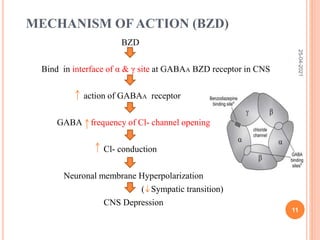
MECHANISM OF ACTION (BZD)
BZD
Bind in interface of α & γ site at GABAA BZD receptor in CNS
action of GABAA receptor
GABA frequency of Cl- channel opening
Cl- conduction
Neuronal membrane Hyperpolarization
( Sympatic transition)
CNS Depression
25-04-2021
11
25-04-2021
12
PHARMACOGICALACTION
 Reduction of Anxiety.
 Sedation and Hypnotics.
 Muscle Relaxation.
 Anti convalsant.
SIDE EFFECT-
 CNS Depression
BZD ANTAGONIST-
 Flumazenil (BDZ overdosing)
25-04-2021
13
BARBITURATES
 Derivatives of barbituric acid
 Alkyl or Aryl groups at
No 5th position confers sedative-hypnotics activity
25-04-2021
14
 MOA- BRT bind 0n α & β site of GABA
duration of opening of Cl ion channels act as CNS
depression agent
 P’cological Action
Dose dependent action :
 CNS- a) Sedative & Hypnosis
b) Anxiety
c) Produce Euphoria
d) Hyperalgesia
e) Anesthesia (high dose)
f) Anticonvulsant
25-04-2021
15
 Respiratory system-
. a) Respiratory depression (small dose)
b) Respiratory paralysis (high dose)
 Cardiovascular System-
Fall in B.P And H.R
 Kidney-
IV administered urinary output result in G.R
25-04-2021
16
 Adverse Effects-
-Hangover
Mental Confusion
Drowsiness, Constipation
-Prolong administration cause Anemia
-In pregnant women leads to fetal respiratory depression
-Tolerance
 Therapeutic uses-
-sedative hypnotics
-antiepileptic agent
-preanesthetic agent
-general anesthetic agents
-psychiatric disorder like anxiety
25-04-2021
17
BARBITURATE POISONING
o Cause- a) Respiratory paralysis
b) B.P (Hypotension)
o Treatment-
a) Activated charcoal (universal antidote)
b) Gastric cleavage
c) Artificial ventilation
d) Haemodialysis
25-04-2021
18
DOSE-RESPONSE CURVES
25-04-2021
19
ADVANTAGES OF BND OVER BRT
a) Less hangover
b) No respiratory depression
c) No enzyme induction
d) Wide margin of safety
f) Specific antagonist (Flumazenil)
e) Flat/Shallow dose response curve
25-04-2021
20
25-04-2021
21
Marketed Preparations
REFERENCES
 The Pharmacological Basis of Therapeutics, Goodman
and Gillman,12th edition.pg no-457.
 K.D.Thripathi essentials of medical Pharmacology 8th
edition.
 Sedative hypnotics by Dr.D.K.Brahna.
 Lippincott illustrated Reviews-Pharmacology 6th edition
2014.
25-04-2021
22
25-04-2021
23

Sedative hypnotics

  • 1.
    SNJB’s SSDJ Collegeof Pharmacy, Chandwad, Nasik. SEDATIVE - HYPNOTICS 25-04-2021 1 Presented By- Satpute Manoj Yadavrao M.Pharmacy 1st Year Department of Pharmacology Guided By- Dr.A.B.Upaganlawar Associate Professor Department of Pharmacology
  • 2.
    CONTENTS :  DEFINITION HISTORY  CLASSIFICATION  MECHANISM OF ACTION  PHARMACOLOGICAL ACTIONS  SIDE EFFECTS  ADVANTAGES OF BZD OVER BRT 25-04-2021 2
  • 3.
    DEFINITION  SEDATIVES- Sedativesare CNS depressant agents that reduce excitement & tension. produce calmness and relaxation.  HYPNOTICS-Drugs or chemical that produce sleep similar to that natural sleep.  Sleep inducing agents used in Insomnia. (melatonin hormone responsible for sedation) 25-04-2021 3
  • 4.
  • 5.
  • 6.
    INSOMNIA TYPES:  Type1 Type2 Classification of sleep:  NREM (Non rapid eye moment sleep)  REM (Rapid eye moment) Stages of NREM- Stage 0- from lying down to falling a sleep. Stage 1- eye movement .body muscle relax. (5to10% Total sleep) 25-04-2021 6
  • 7.
     Stage 2-More eye movement. Person may arousable.(50%Total sleep).  Stage 3- Deeper sleep with less Eye movement. Person not easily arousable.  Stage 4- Deepest level of sleep. Low metabolism rate. Growth hormone secretion higher. No eye movement. If awaken –Disorientation. REM -Dreaming -HR -Voluntary muscle relax -Dream recalled 25-04-2021 7
  • 8.
    CLASSIFICATION  BENZODIAZEPINES- a) Hypnotics- e.g.Diazepam, Alprazolam, Flurazepam b) Anti-anxiety- e.g. Diazepam, Lorazepam, Oxazepam C) Anticonvulsant - e.g. Diazepam, Clonazepam.  BARBITURATES- a) Long acting- e.g. Phenobarbitone, Mephobarbitone 25-04-2021 8
  • 9.
    b) Short acting- e.g.Pentobarbitone, Secobarbitone c) Ultra short acting- e.g. Methohexitone, Thiopentone  NEWER NON-BENZODIZEPINE e.g. Zolpidem, Zolpiclone, Zaleplon 25-04-2021 9
  • 10.
    BENZODIAZEPINES 25-04-2021 10  Benzene ring Halogen and Nitro group at 7th position confers sedative hypnotics activity.
  • 11.
    MECHANISM OF ACTION(BZD) BZD Bind in interface of α & γ site at GABAA BZD receptor in CNS action of GABAA receptor GABA frequency of Cl- channel opening Cl- conduction Neuronal membrane Hyperpolarization ( Sympatic transition) CNS Depression 25-04-2021 11
  • 12.
  • 13.
    PHARMACOGICALACTION  Reduction ofAnxiety.  Sedation and Hypnotics.  Muscle Relaxation.  Anti convalsant. SIDE EFFECT-  CNS Depression BZD ANTAGONIST-  Flumazenil (BDZ overdosing) 25-04-2021 13
  • 14.
    BARBITURATES  Derivatives ofbarbituric acid  Alkyl or Aryl groups at No 5th position confers sedative-hypnotics activity 25-04-2021 14
  • 15.
     MOA- BRTbind 0n α & β site of GABA duration of opening of Cl ion channels act as CNS depression agent  P’cological Action Dose dependent action :  CNS- a) Sedative & Hypnosis b) Anxiety c) Produce Euphoria d) Hyperalgesia e) Anesthesia (high dose) f) Anticonvulsant 25-04-2021 15
  • 16.
     Respiratory system- .a) Respiratory depression (small dose) b) Respiratory paralysis (high dose)  Cardiovascular System- Fall in B.P And H.R  Kidney- IV administered urinary output result in G.R 25-04-2021 16
  • 17.
     Adverse Effects- -Hangover MentalConfusion Drowsiness, Constipation -Prolong administration cause Anemia -In pregnant women leads to fetal respiratory depression -Tolerance  Therapeutic uses- -sedative hypnotics -antiepileptic agent -preanesthetic agent -general anesthetic agents -psychiatric disorder like anxiety 25-04-2021 17
  • 18.
    BARBITURATE POISONING o Cause-a) Respiratory paralysis b) B.P (Hypotension) o Treatment- a) Activated charcoal (universal antidote) b) Gastric cleavage c) Artificial ventilation d) Haemodialysis 25-04-2021 18
  • 19.
  • 20.
    ADVANTAGES OF BNDOVER BRT a) Less hangover b) No respiratory depression c) No enzyme induction d) Wide margin of safety f) Specific antagonist (Flumazenil) e) Flat/Shallow dose response curve 25-04-2021 20
  • 21.
  • 22.
    REFERENCES  The PharmacologicalBasis of Therapeutics, Goodman and Gillman,12th edition.pg no-457.  K.D.Thripathi essentials of medical Pharmacology 8th edition.  Sedative hypnotics by Dr.D.K.Brahna.  Lippincott illustrated Reviews-Pharmacology 6th edition 2014. 25-04-2021 22
  • 23.