1
IoT Security Overview
Steve Orrin
Chief Technologist, Intel Federal
INTEL PROPRIETARY Intel Federal
Agenda
• Overview of Security Challenges in IoT
• The Vision for IoT Security
• Fundamental Capabilities
• Example Solutions / Use Cases
• Summary
INTEL PROPRIETARY Intel Federal
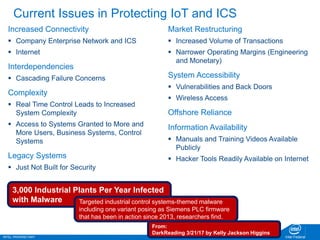
Current Issues in Protecting IoT and ICS
Increased Connectivity
 Company Enterprise Network and ICS
 Internet
Interdependencies
 Cascading Failure Concerns
Complexity
 Real Time Control Leads to Increased
System Complexity
 Access to Systems Granted to More and
More Users, Business Systems, Control
Systems
Legacy Systems
 Just Not Built for Security
Market Restructuring
 Increased Volume of Transactions
 Narrower Operating Margins (Engineering
and Monetary)
System Accessibility
 Vulnerabilities and Back Doors
 Wireless Access
Offshore Reliance
Information Availability
 Manuals and Training Videos Available
Publicly
 Hacker Tools Readily Available on Internet
3,000 Industrial Plants Per Year Infected
with Malware Targeted industrial control systems-themed malware
including one variant posing as Siemens PLC firmware
that has been in action since 2013, researchers find.
From:
DarkReading 3/21/17 by Kelly Jackson Higgins
INTEL PROPRIETARY Intel Federal
Threats to IoT and ICS
• Disrupt operation of ICS by delaying or blocking the flow of information through
control networks, thereby denying network availability to control system operators
• Send false information to control system operators, either to disguise unauthorized
changes or to initiate inappropriate actions by system operators.
• Modify the system software – producing unpredictable results
• Interfere with the operation of a safety system(s)
• Make unauthorized changes to programmed instructions in PLCs, RTUs, or DCS
controllers
• Change alarm thresholds and settings
• Order premature shutdown of processes
• Disable control equipment
INTEL PROPRIETARY Intel Federal
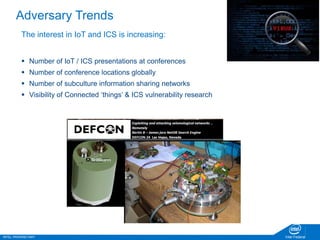
Adversary Trends
The interest in IoT and ICS is increasing:
 Number of IoT / ICS presentations at conferences
 Number of conference locations globally
 Number of subculture information sharing networks
 Visibility of Connected ‘things’ & ICS vulnerability research
INTEL PROPRIETARY Intel Federal
Attacks on IoT and ICS
Pipeline Communication Infrastructure
Compromise
Devices used in an attack against a third party.
Device configuration contributed to compromise
Large volume of network traffic generated
Compromised not detected by traditional means
Nuclear Power Plant cyber infection
Recovery time:
SPDS – 4 hours 50 minutes
PPC – 6 hours 9 minutes
Event: Slammer worm infects plant.
Impact: Complete shutdown of digital portion of Safety Parameter
Display System (SPDS) and Plan Process Computer (PPC).
Specifics: Worm started at contractors site. Worm jumped from
corporate to plant network and found an unpatched server. Patch
had been available for
6 months.
Lessons learned:
 Verify device configuration
 Ensure Defense-in-depth strategies are in
place
 Isolate critical systems from the internet.
Lessons learned:
 Secure remote (trusted) access channels
 Ensure Defense-in-depth strategies with
appropriate procurement requirements
 Critical patches need to be applied
Automobile Manufacturing Impact
Event: Internet worms shuts down major US automobile
manufacturer’s industrial control systems
Impact: Production lines were idle as infected systems were patched
Specifics: The malware infected 13 automobile manufacturing
plants. Revenue impact was approximately $1M USD/HR
Lessons learned:
 Critical patches need to be applied
 Provide adequate network segmentation
between control and business networks
 Place controls between segments to
limit congestion and cascading effects
Automobile computer systems hacked
Event(s): Researchers take away driver control of a moving vehicle by
remotely hacking into relatively insecure computer systems
Impact: Computerized systems in modern cars control many critical
components and safety devices
Specifics: Several Team managed to break into key vehicle systems to
kill the engine, apply or disable the brakes and even send various
taunting messages to radio or dashboard displays
Lessons learned:
 Automobile control systems are
vulnerable to the same kind of attacks
which are launched against Internet-
connected computers
INTEL PROPRIETARY Intel Federal
Attacks on IoT and ICS
Oil Platform Cyber Incident
Event: Insider computer attack on an energy company’s process
control system.
Impact: By disrupting one of the process control computer
systems, the leak detection system was periodically disabled.
Specifics: Disgruntled IT contractor damaged company
computer systems by impairing the integrity and availability of
critical operational data.
Water Utility Loses Control
Event: Residents of a rural town experienced loss of water
pressure
Impact: Approximately 10,000 residents without water
Specifics: Utility operator updated its HMI OS (Windows) with a
direct connection to the Internet and evidence points to a virus
infecting the SCADA system; causing it to crash.
The ICS was outdated, not supported by the vendor, and not
patched to current updates.
Lacked a firewall between the business and control networks
Water facility accessed via Internet
Event: Cyber researcher used new search engine “SHODAN” to
identify an online link to a utility company’s SCADA system. The
system was then accessed using the default user name and
passwords
Impact: The researcher gained administrative control over the
regional water treatment system
Specifics: After connecting to the water control and management
system via the internet the researcher as able to access all
control systems for water pumping and waste water treatment
Lessons learned:
 Do not underestimate the insider threat
 Ensure access controls
 Policies and Procedure, with regards to
contract personnel, background checks
Lessons learned:
 Utilize DMZ to ensure isolation from
business side and Internet
 Keep systems patched
 Establish and enforce sound security
policies
Lessons learned:
 Change system default user names and
passwords
 Avoid posting system details to public
facing devices
 Not all public facing system details are
obviously visible
INTEL PROPRIETARY Intel Federal
8
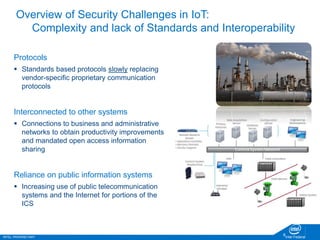
Overview of Security Challenges in IoT:
Complexity and lack of Standards and Interoperability
Protocols
 Standards based protocols slowly replacing
vendor-specific proprietary communication
protocols
Interconnected to other systems
 Connections to business and administrative
networks to obtain productivity improvements
and mandated open access information
sharing
Reliance on public information systems
 Increasing use of public telecommunication
systems and the Internet for portions of the
ICS
INTEL PROPRIETARY Intel Federal
9
Overview of Security Challenges in IoT:
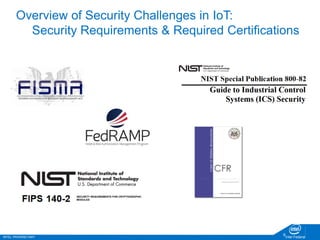
Security Requirements & Required Certifications
INTEL PROPRIETARY Intel Federal
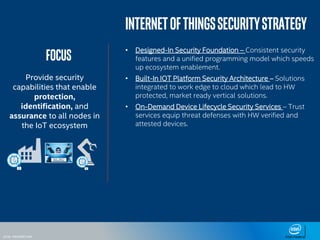
focus
Provide security
capabilities that enable
protection,
identification, and
assurance to all nodes in
the IoT ecosystem
InternetofthingssecurityStrategy
• Designed-In Security Foundation – Consistent security
features and a unified programming model which speeds
up ecosystem enablement.
• Built-In IOT Platform Security Architecture – Solutions
integrated to work edge to cloud which lead to HW
protected, market ready vertical solutions.
• On-Demand Device Lifecycle Security Services – Trust
services equip threat defenses with HW verified and
attested devices.
INTEL PROPRIETARY Intel Federal
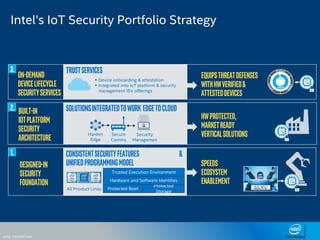
Intel’s IoT Security Portfolio Strategy
 Device onboarding & attestation
 Integrated into IoT platform & security
management ISV offerings
On-Demand
DeviceLifecycle
SecurityServices
Equipsthreatdefenses
withHWVerified&
attestedDevices
TrustServices3.
BuilT-In
IoTPlatform
Security
Architecture
SolutionsIntegratedtowork EdgetoCloud
HWProtected,
MarketReady
VerticalSolutionsHarden
Edge
Secure
Comms
Security
Managemen
t
2.
Protected
Storage
Protected Boot
Trusted Execution Environment
Hardware and Software Identities
Speeds
Ecosystem
Enablement
ConsistentSecurityFeatures &
UnifiedProgrammingModelDesigned-in
Security
Foundation
All Product Lines
1.
INTEL PROPRIETARY Intel Federal
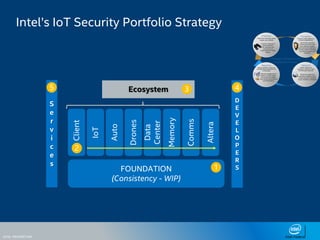
Intel’s IoT Security Portfolio Strategy
FOUNDATION
(Consistency - WIP)
Ecosystem
1
Client
IoT
Auto
Drones
Data
Center
3
Memory
Comms
Altera
D
E
V
E
L
O
P
E
R
S
2
4
S
e
r
v
i
c
e
s
5
INTEL PROPRIETARY Intel Federal
13
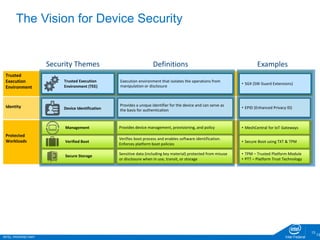
The Vision for Device Security
13
Protected
Workloads
Trusted
Execution
Environment
Identity
Verifies boot process and enables software identification.
Enforces platform boot policies
• Secure Boot using TXT & TPMVerified Boot
Execution environment that isolates the operations from
manipulation or disclosure
• SGX (SW Guard Extensions)
Trusted Execution
Environment (TEE)
Provides a unique identifier for the device and can serve as
the basis for authentication
• EPID (Enhanced Privacy ID)Device Identification
Sensitive data (including key material) protected from misuse
or disclosure when in use, transit, or storage
• TPM – Trusted Platform Module
• PTT – Platform Trust Technology
Secure Storage
ExamplesDefinitionsSecurity Themes
Provides device management, provisioning, and policy • MeshCentral for IoT GatewaysManagement
INTEL PROPRIETARY Intel Federal
14
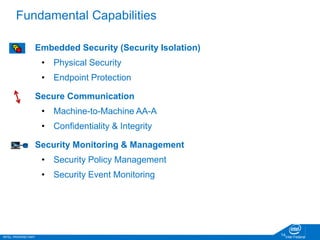
Fundamental Capabilities
Embedded Security (Security Isolation)
• Physical Security
• Endpoint Protection
Secure Communication
• Machine-to-Machine AA-A
• Confidentiality & Integrity
Security Monitoring & Management
• Security Policy Management
• Security Event Monitoring
INTEL PROPRIETARY Intel Federal
15
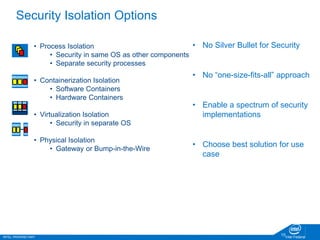
Security Isolation Options
• No Silver Bullet for Security
• No “one-size-fits-all” approach
• Enable a spectrum of security
implementations
• Choose best solution for use
case
• Process Isolation
• Security in same OS as other components
• Separate security processes
• Containerization Isolation
• Software Containers
• Hardware Containers
• Virtualization Isolation
• Security in separate OS
• Physical Isolation
• Gateway or Bump-in-the-Wire
INTEL PROPRIETARY Intel Federal
16
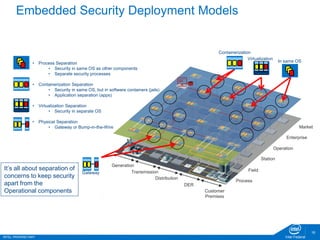
Embedded Security Deployment Models
16
• Process Separation
• Security in same OS as other components
• Separate security processes
• Containerization Separation
• Security in same OS, but in software containers (jails)
• Application separation (apps)
• Virtualization Separation
• Security in separate OS
• Physical Separation
• Gateway or Bump-in-the-Wire
Gateway
Virtualization
In same OS
Containerization
It’s all about separation of
concerns to keep security
apart from the
Operational components
INTEL PROPRIETARY Intel Federal
17
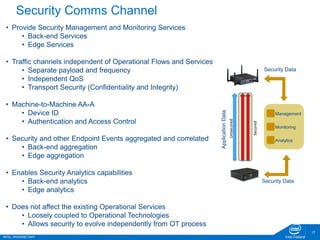
Security Comms Channel
• Provide Security Management and Monitoring Services
• Back-end Services
• Edge Services
• Traffic channels independent of Operational Flows and Services
• Separate payload and frequency
• Independent QoS
• Transport Security (Confidentiality and Integrity)
• Machine-to-Machine AA-A
• Device ID
• Authentication and Access Control
• Security and other Endpoint Events aggregated and correlated
• Back-end aggregation
• Edge aggregation
• Enables Security Analytics capabilities
• Back-end analytics
• Edge analytics
• Does not affect the existing Operational Services
• Loosely coupled to Operational Technologies
• Allows security to evolve independently from OT process
Management
Monitoring
Analytics
Secured
Unsecured
ApplicationData
Security Data
Security Data
INTEL PROPRIETARY Intel Federal
18
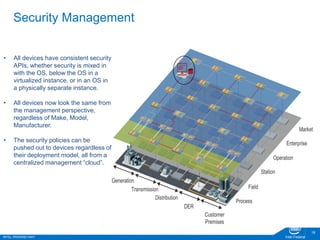
Security Management
• All devices have consistent security
APIs, whether security is mixed in
with the OS, below the OS in a
virtualized instance, or in an OS in
a physically separate instance.
• All devices now look the same from
the management perspective,
regardless of Make, Model,
Manufacturer.
• The security policies can be
pushed out to devices regardless of
their deployment model, all from a
centralized management “cloud”.
INTEL PROPRIETARY Intel Federal
19
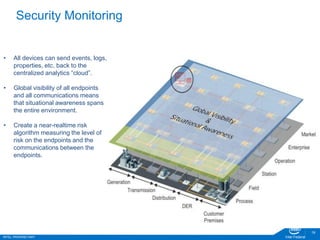
Security Monitoring
• All devices can send events, logs,
properties, etc. back to the
centralized analytics “cloud”.
• Global visibility of all endpoints
and all communications means
that situational awareness spans
the entire environment.
• Create a near-realtime risk
algorithm measuring the level of
risk on the endpoints and the
communications between the
endpoints.
INTEL PROPRIETARY Intel Federal
20
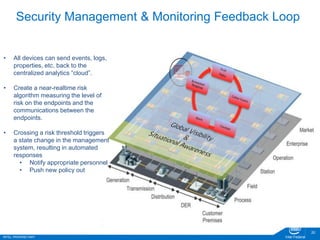
Security Management & Monitoring Feedback Loop
• All devices can send events, logs,
properties, etc. back to the
centralized analytics “cloud”.
• Create a near-realtime risk
algorithm measuring the level of
risk on the endpoints and the
communications between the
endpoints.
• Crossing a risk threshold triggers
a state change in the management
system, resulting in automated
responses
• Notify appropriate personnel
• Push new policy out
INTEL PROPRIETARY Intel Federal
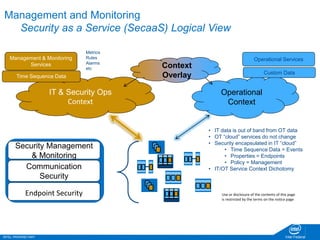
Management and Monitoring
Security as a Service (SecaaS) Logical View
21
IT & Security Ops
Context
Operational
Context
Security Management
& Monitoring
Communication
Security
Endpoint Security
Management & Monitoring
Services
Time Sequence Data
Custom Data
Operational Services
Context
Overlay
• IT data is out of band from OT data
• OT “cloud” services do not change
• Security encapsulated in IT “cloud”
• Time Sequence Data = Events
• Properties = Endpoints
• Policy = Management
• IT/OT Service Context Dichotomy
Metrics
Rules
Alarms
etc
Use or disclosure of the contents of this page
is restricted by the terms on the notice page
INTEL PROPRIETARY Intel Federal
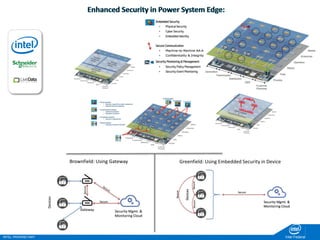
Brownfield: Using Gateway Greenfield: Using Embedded Security in Device
INTEL PROPRIETARY Intel Federal
23
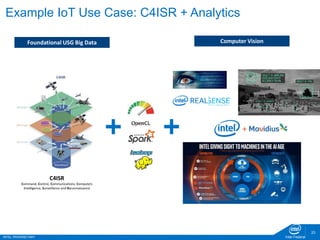
Example IoT Use Case: C4ISR + Analytics
C4ISR
Command, Control, Communications, Computers
Intelligence, Surveillance and Reconnaissance
Foundational USG Big Data Computer Vision
INTEL PROPRIETARY Intel Federal
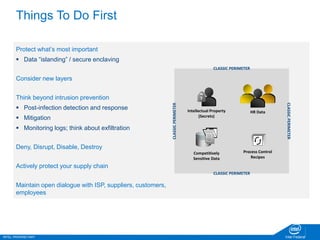
Things To Do First
Protect what’s most important
 Data “islanding” / secure enclaving
Consider new layers
Think beyond intrusion prevention
 Post-infection detection and response
 Mitigation
 Monitoring logs; think about exfiltration
Deny, Disrupt, Disable, Destroy
Actively protect your supply chain
Maintain open dialogue with ISP, suppliers, customers,
employees
CLASSIC PERIMETER
Intellectual Property
(Secrets)
HR Data
Process Control
Recipes
Competitively
Sensitive Data
CLASSIC PERIMETERCLASSICPERIMETER
CLASSICPERIMETER
INTEL PROPRIETARY Intel Federal
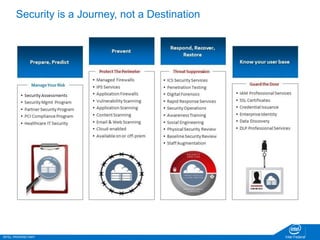
Security is a Journey, not a Destination
INTEL PROPRIETARY Intel Federal
26
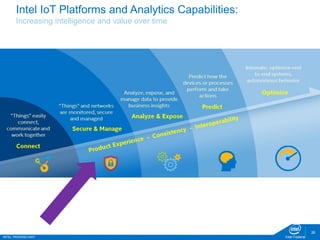
Intel IoT Platforms and Analytics Capabilities:
Increasing intelligence and value over time
INTEL PROPRIETARY Intel Federal
27
Thank you
Steve Orrin
Chief Technologist, Intel Federal
steve.orrin@intel.com

IoT Security Challenges and Solutions

  • 1.
    1 IoT Security Overview SteveOrrin Chief Technologist, Intel Federal
  • 2.
    INTEL PROPRIETARY IntelFederal Agenda • Overview of Security Challenges in IoT • The Vision for IoT Security • Fundamental Capabilities • Example Solutions / Use Cases • Summary
  • 3.
    INTEL PROPRIETARY IntelFederal Current Issues in Protecting IoT and ICS Increased Connectivity  Company Enterprise Network and ICS  Internet Interdependencies  Cascading Failure Concerns Complexity  Real Time Control Leads to Increased System Complexity  Access to Systems Granted to More and More Users, Business Systems, Control Systems Legacy Systems  Just Not Built for Security Market Restructuring  Increased Volume of Transactions  Narrower Operating Margins (Engineering and Monetary) System Accessibility  Vulnerabilities and Back Doors  Wireless Access Offshore Reliance Information Availability  Manuals and Training Videos Available Publicly  Hacker Tools Readily Available on Internet 3,000 Industrial Plants Per Year Infected with Malware Targeted industrial control systems-themed malware including one variant posing as Siemens PLC firmware that has been in action since 2013, researchers find. From: DarkReading 3/21/17 by Kelly Jackson Higgins
  • 4.
    INTEL PROPRIETARY IntelFederal Threats to IoT and ICS • Disrupt operation of ICS by delaying or blocking the flow of information through control networks, thereby denying network availability to control system operators • Send false information to control system operators, either to disguise unauthorized changes or to initiate inappropriate actions by system operators. • Modify the system software – producing unpredictable results • Interfere with the operation of a safety system(s) • Make unauthorized changes to programmed instructions in PLCs, RTUs, or DCS controllers • Change alarm thresholds and settings • Order premature shutdown of processes • Disable control equipment
  • 5.
    INTEL PROPRIETARY IntelFederal Adversary Trends The interest in IoT and ICS is increasing:  Number of IoT / ICS presentations at conferences  Number of conference locations globally  Number of subculture information sharing networks  Visibility of Connected ‘things’ & ICS vulnerability research
  • 6.
    INTEL PROPRIETARY IntelFederal Attacks on IoT and ICS Pipeline Communication Infrastructure Compromise Devices used in an attack against a third party. Device configuration contributed to compromise Large volume of network traffic generated Compromised not detected by traditional means Nuclear Power Plant cyber infection Recovery time: SPDS – 4 hours 50 minutes PPC – 6 hours 9 minutes Event: Slammer worm infects plant. Impact: Complete shutdown of digital portion of Safety Parameter Display System (SPDS) and Plan Process Computer (PPC). Specifics: Worm started at contractors site. Worm jumped from corporate to plant network and found an unpatched server. Patch had been available for 6 months. Lessons learned:  Verify device configuration  Ensure Defense-in-depth strategies are in place  Isolate critical systems from the internet. Lessons learned:  Secure remote (trusted) access channels  Ensure Defense-in-depth strategies with appropriate procurement requirements  Critical patches need to be applied Automobile Manufacturing Impact Event: Internet worms shuts down major US automobile manufacturer’s industrial control systems Impact: Production lines were idle as infected systems were patched Specifics: The malware infected 13 automobile manufacturing plants. Revenue impact was approximately $1M USD/HR Lessons learned:  Critical patches need to be applied  Provide adequate network segmentation between control and business networks  Place controls between segments to limit congestion and cascading effects Automobile computer systems hacked Event(s): Researchers take away driver control of a moving vehicle by remotely hacking into relatively insecure computer systems Impact: Computerized systems in modern cars control many critical components and safety devices Specifics: Several Team managed to break into key vehicle systems to kill the engine, apply or disable the brakes and even send various taunting messages to radio or dashboard displays Lessons learned:  Automobile control systems are vulnerable to the same kind of attacks which are launched against Internet- connected computers
  • 7.
    INTEL PROPRIETARY IntelFederal Attacks on IoT and ICS Oil Platform Cyber Incident Event: Insider computer attack on an energy company’s process control system. Impact: By disrupting one of the process control computer systems, the leak detection system was periodically disabled. Specifics: Disgruntled IT contractor damaged company computer systems by impairing the integrity and availability of critical operational data. Water Utility Loses Control Event: Residents of a rural town experienced loss of water pressure Impact: Approximately 10,000 residents without water Specifics: Utility operator updated its HMI OS (Windows) with a direct connection to the Internet and evidence points to a virus infecting the SCADA system; causing it to crash. The ICS was outdated, not supported by the vendor, and not patched to current updates. Lacked a firewall between the business and control networks Water facility accessed via Internet Event: Cyber researcher used new search engine “SHODAN” to identify an online link to a utility company’s SCADA system. The system was then accessed using the default user name and passwords Impact: The researcher gained administrative control over the regional water treatment system Specifics: After connecting to the water control and management system via the internet the researcher as able to access all control systems for water pumping and waste water treatment Lessons learned:  Do not underestimate the insider threat  Ensure access controls  Policies and Procedure, with regards to contract personnel, background checks Lessons learned:  Utilize DMZ to ensure isolation from business side and Internet  Keep systems patched  Establish and enforce sound security policies Lessons learned:  Change system default user names and passwords  Avoid posting system details to public facing devices  Not all public facing system details are obviously visible
  • 8.
    INTEL PROPRIETARY IntelFederal 8 Overview of Security Challenges in IoT: Complexity and lack of Standards and Interoperability Protocols  Standards based protocols slowly replacing vendor-specific proprietary communication protocols Interconnected to other systems  Connections to business and administrative networks to obtain productivity improvements and mandated open access information sharing Reliance on public information systems  Increasing use of public telecommunication systems and the Internet for portions of the ICS
  • 9.
    INTEL PROPRIETARY IntelFederal 9 Overview of Security Challenges in IoT: Security Requirements & Required Certifications
  • 10.
    INTEL PROPRIETARY IntelFederal focus Provide security capabilities that enable protection, identification, and assurance to all nodes in the IoT ecosystem InternetofthingssecurityStrategy • Designed-In Security Foundation – Consistent security features and a unified programming model which speeds up ecosystem enablement. • Built-In IOT Platform Security Architecture – Solutions integrated to work edge to cloud which lead to HW protected, market ready vertical solutions. • On-Demand Device Lifecycle Security Services – Trust services equip threat defenses with HW verified and attested devices.
  • 11.
    INTEL PROPRIETARY IntelFederal Intel’s IoT Security Portfolio Strategy  Device onboarding & attestation  Integrated into IoT platform & security management ISV offerings On-Demand DeviceLifecycle SecurityServices Equipsthreatdefenses withHWVerified& attestedDevices TrustServices3. BuilT-In IoTPlatform Security Architecture SolutionsIntegratedtowork EdgetoCloud HWProtected, MarketReady VerticalSolutionsHarden Edge Secure Comms Security Managemen t 2. Protected Storage Protected Boot Trusted Execution Environment Hardware and Software Identities Speeds Ecosystem Enablement ConsistentSecurityFeatures & UnifiedProgrammingModelDesigned-in Security Foundation All Product Lines 1.
  • 12.
    INTEL PROPRIETARY IntelFederal Intel’s IoT Security Portfolio Strategy FOUNDATION (Consistency - WIP) Ecosystem 1 Client IoT Auto Drones Data Center 3 Memory Comms Altera D E V E L O P E R S 2 4 S e r v i c e s 5
  • 13.
    INTEL PROPRIETARY IntelFederal 13 The Vision for Device Security 13 Protected Workloads Trusted Execution Environment Identity Verifies boot process and enables software identification. Enforces platform boot policies • Secure Boot using TXT & TPMVerified Boot Execution environment that isolates the operations from manipulation or disclosure • SGX (SW Guard Extensions) Trusted Execution Environment (TEE) Provides a unique identifier for the device and can serve as the basis for authentication • EPID (Enhanced Privacy ID)Device Identification Sensitive data (including key material) protected from misuse or disclosure when in use, transit, or storage • TPM – Trusted Platform Module • PTT – Platform Trust Technology Secure Storage ExamplesDefinitionsSecurity Themes Provides device management, provisioning, and policy • MeshCentral for IoT GatewaysManagement
  • 14.
    INTEL PROPRIETARY IntelFederal 14 Fundamental Capabilities Embedded Security (Security Isolation) • Physical Security • Endpoint Protection Secure Communication • Machine-to-Machine AA-A • Confidentiality & Integrity Security Monitoring & Management • Security Policy Management • Security Event Monitoring
  • 15.
    INTEL PROPRIETARY IntelFederal 15 Security Isolation Options • No Silver Bullet for Security • No “one-size-fits-all” approach • Enable a spectrum of security implementations • Choose best solution for use case • Process Isolation • Security in same OS as other components • Separate security processes • Containerization Isolation • Software Containers • Hardware Containers • Virtualization Isolation • Security in separate OS • Physical Isolation • Gateway or Bump-in-the-Wire
  • 16.
    INTEL PROPRIETARY IntelFederal 16 Embedded Security Deployment Models 16 • Process Separation • Security in same OS as other components • Separate security processes • Containerization Separation • Security in same OS, but in software containers (jails) • Application separation (apps) • Virtualization Separation • Security in separate OS • Physical Separation • Gateway or Bump-in-the-Wire Gateway Virtualization In same OS Containerization It’s all about separation of concerns to keep security apart from the Operational components
  • 17.
    INTEL PROPRIETARY IntelFederal 17 Security Comms Channel • Provide Security Management and Monitoring Services • Back-end Services • Edge Services • Traffic channels independent of Operational Flows and Services • Separate payload and frequency • Independent QoS • Transport Security (Confidentiality and Integrity) • Machine-to-Machine AA-A • Device ID • Authentication and Access Control • Security and other Endpoint Events aggregated and correlated • Back-end aggregation • Edge aggregation • Enables Security Analytics capabilities • Back-end analytics • Edge analytics • Does not affect the existing Operational Services • Loosely coupled to Operational Technologies • Allows security to evolve independently from OT process Management Monitoring Analytics Secured Unsecured ApplicationData Security Data Security Data
  • 18.
    INTEL PROPRIETARY IntelFederal 18 Security Management • All devices have consistent security APIs, whether security is mixed in with the OS, below the OS in a virtualized instance, or in an OS in a physically separate instance. • All devices now look the same from the management perspective, regardless of Make, Model, Manufacturer. • The security policies can be pushed out to devices regardless of their deployment model, all from a centralized management “cloud”.
  • 19.
    INTEL PROPRIETARY IntelFederal 19 Security Monitoring • All devices can send events, logs, properties, etc. back to the centralized analytics “cloud”. • Global visibility of all endpoints and all communications means that situational awareness spans the entire environment. • Create a near-realtime risk algorithm measuring the level of risk on the endpoints and the communications between the endpoints.
  • 20.
    INTEL PROPRIETARY IntelFederal 20 Security Management & Monitoring Feedback Loop • All devices can send events, logs, properties, etc. back to the centralized analytics “cloud”. • Create a near-realtime risk algorithm measuring the level of risk on the endpoints and the communications between the endpoints. • Crossing a risk threshold triggers a state change in the management system, resulting in automated responses • Notify appropriate personnel • Push new policy out
  • 21.
    INTEL PROPRIETARY IntelFederal Management and Monitoring Security as a Service (SecaaS) Logical View 21 IT & Security Ops Context Operational Context Security Management & Monitoring Communication Security Endpoint Security Management & Monitoring Services Time Sequence Data Custom Data Operational Services Context Overlay • IT data is out of band from OT data • OT “cloud” services do not change • Security encapsulated in IT “cloud” • Time Sequence Data = Events • Properties = Endpoints • Policy = Management • IT/OT Service Context Dichotomy Metrics Rules Alarms etc Use or disclosure of the contents of this page is restricted by the terms on the notice page
  • 22.
    INTEL PROPRIETARY IntelFederal Brownfield: Using Gateway Greenfield: Using Embedded Security in Device
  • 23.
    INTEL PROPRIETARY IntelFederal 23 Example IoT Use Case: C4ISR + Analytics C4ISR Command, Control, Communications, Computers Intelligence, Surveillance and Reconnaissance Foundational USG Big Data Computer Vision
  • 24.
    INTEL PROPRIETARY IntelFederal Things To Do First Protect what’s most important  Data “islanding” / secure enclaving Consider new layers Think beyond intrusion prevention  Post-infection detection and response  Mitigation  Monitoring logs; think about exfiltration Deny, Disrupt, Disable, Destroy Actively protect your supply chain Maintain open dialogue with ISP, suppliers, customers, employees CLASSIC PERIMETER Intellectual Property (Secrets) HR Data Process Control Recipes Competitively Sensitive Data CLASSIC PERIMETERCLASSICPERIMETER CLASSICPERIMETER
  • 25.
    INTEL PROPRIETARY IntelFederal Security is a Journey, not a Destination
  • 26.
    INTEL PROPRIETARY IntelFederal 26 Intel IoT Platforms and Analytics Capabilities: Increasing intelligence and value over time
  • 27.
    INTEL PROPRIETARY IntelFederal 27 Thank you Steve Orrin Chief Technologist, Intel Federal steve.orrin@intel.com