1
TRIZ is acronym of Russian phrase
"Teorija Rezbenija Izobretatelskib Zadach".
It's meaning is: Theory of inventive
problem solving(TIPS).
What is TRIZ?
2
 Genrich Altshuller invented TRIZ
 TRIZ is an evolving, open-ended system for
enhancing human inventiveness through:
• Systematic identification of problems and ideal
solutions
• Concentrating on all the resources available, to get
more out of less
• Overcoming various blocks through approaches
that have worked in other disciplines
TRIZ Principles
3
 Don't accept compromises. Eliminate them.
 Somebody, someplace, has already solved your
problem or one similar to it. Creativity means
finding that solution and adapting it to the current
problem.
 Pharmaceutical industry needed a way to deal with excess
foam from a pharmaceutical process, solution came from the
beer industry
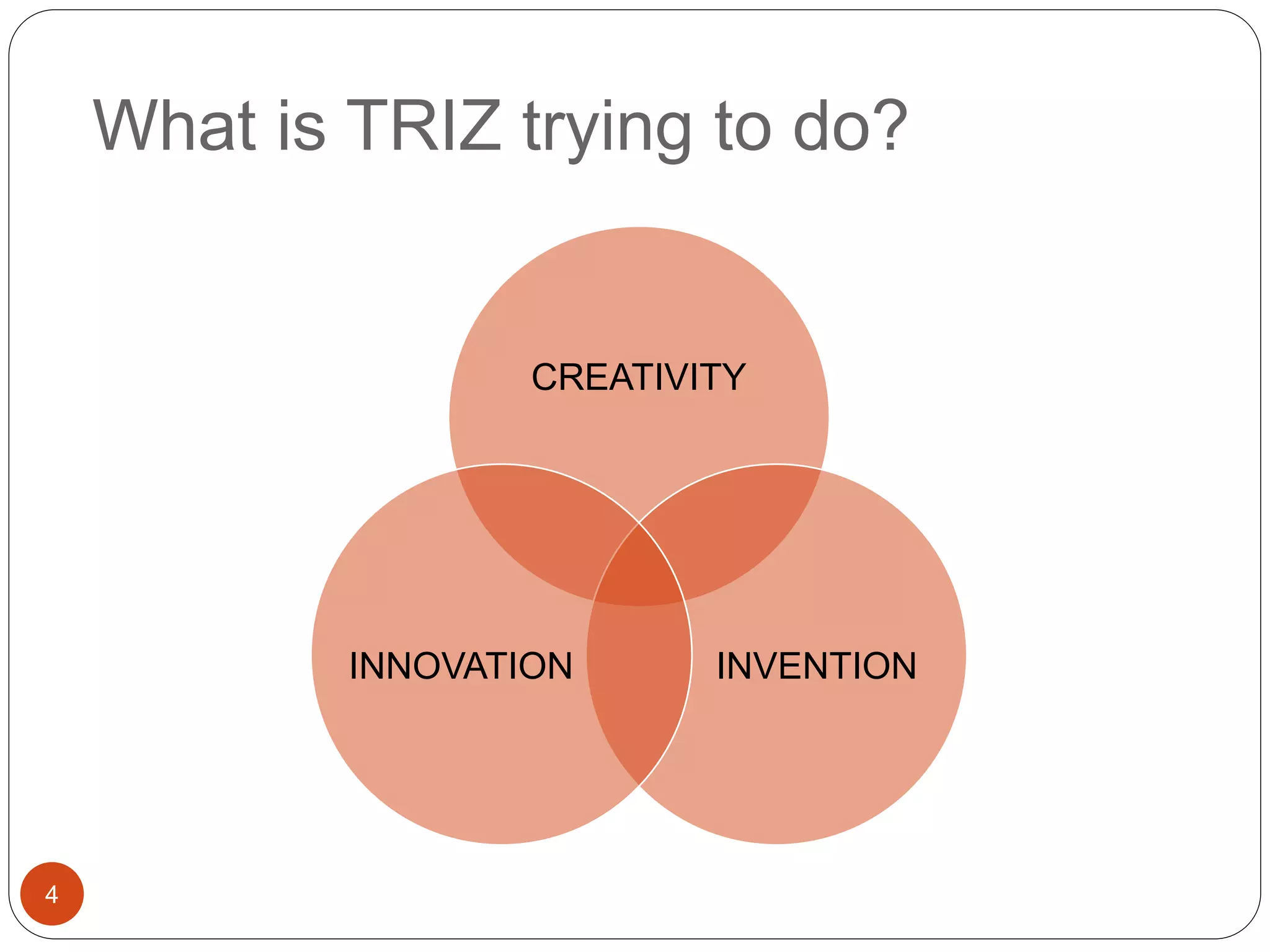
What is TRIZ trying to do?
4
CREATIVITY
INVENTIONINNOVATION
Three premises of TRIZ
5
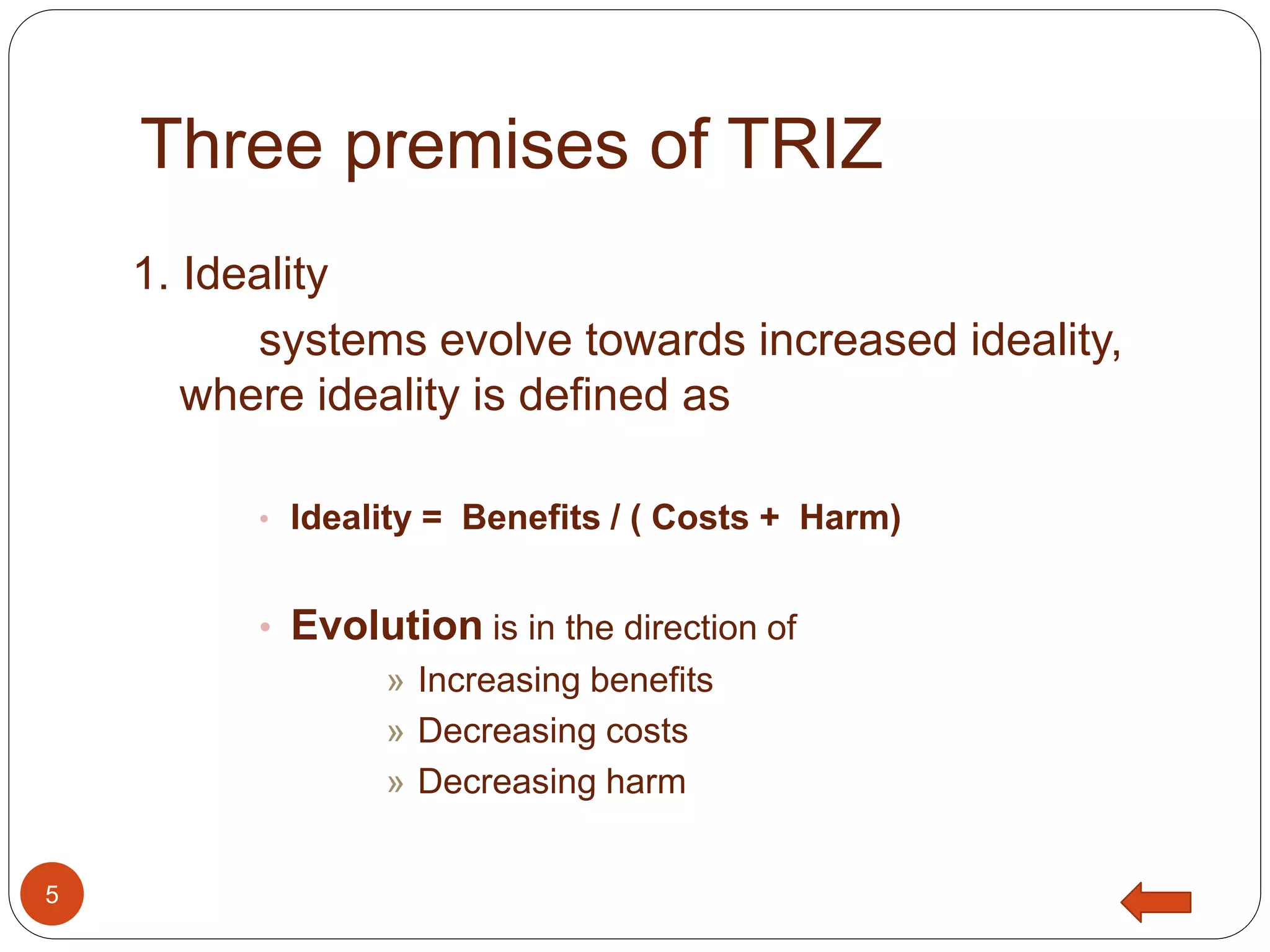
1. Ideality
systems evolve towards increased ideality,
where ideality is defined as
• Ideality = Benefits / ( Costs + Harm)
• Evolution is in the direction of
» Increasing benefits
» Decreasing costs
» Decreasing harm
6
 Solutions with higher degrees of ideality are more
successful in the market
• The ideal system performs a required function
without actually existing.
• Start by focussing on solutions not problems, then
ask how can we use the resources to achieve this?
Ideality (cont’d)
2. Contradiction
An inventive
solution involves
wholly or partially
eliminating a
contradiction.
Contradiction is a
situation when the
known solution
meets some
requirements, but
generates harmful
or undesirable
effects.7
Three premises of TRIZ(cont’d)
Contradiction(cont’d)
8
 Technical Contradictions: something gets better,
something else gets worse
 Stronger at cost of additional weight
 Greater bandwidth requires more power
 Faster airbag deployment requires greater force
 Physical Contradictions: one object has
contradictory requirements
 Coffee hot enough to enjoy but not so hot as to burn
 Software powerful features but easy to use
 A pen tip should be sharp to draw fine lines, but blunt to avoid
tearing paper
Three premises of TRIZ(cont’d)
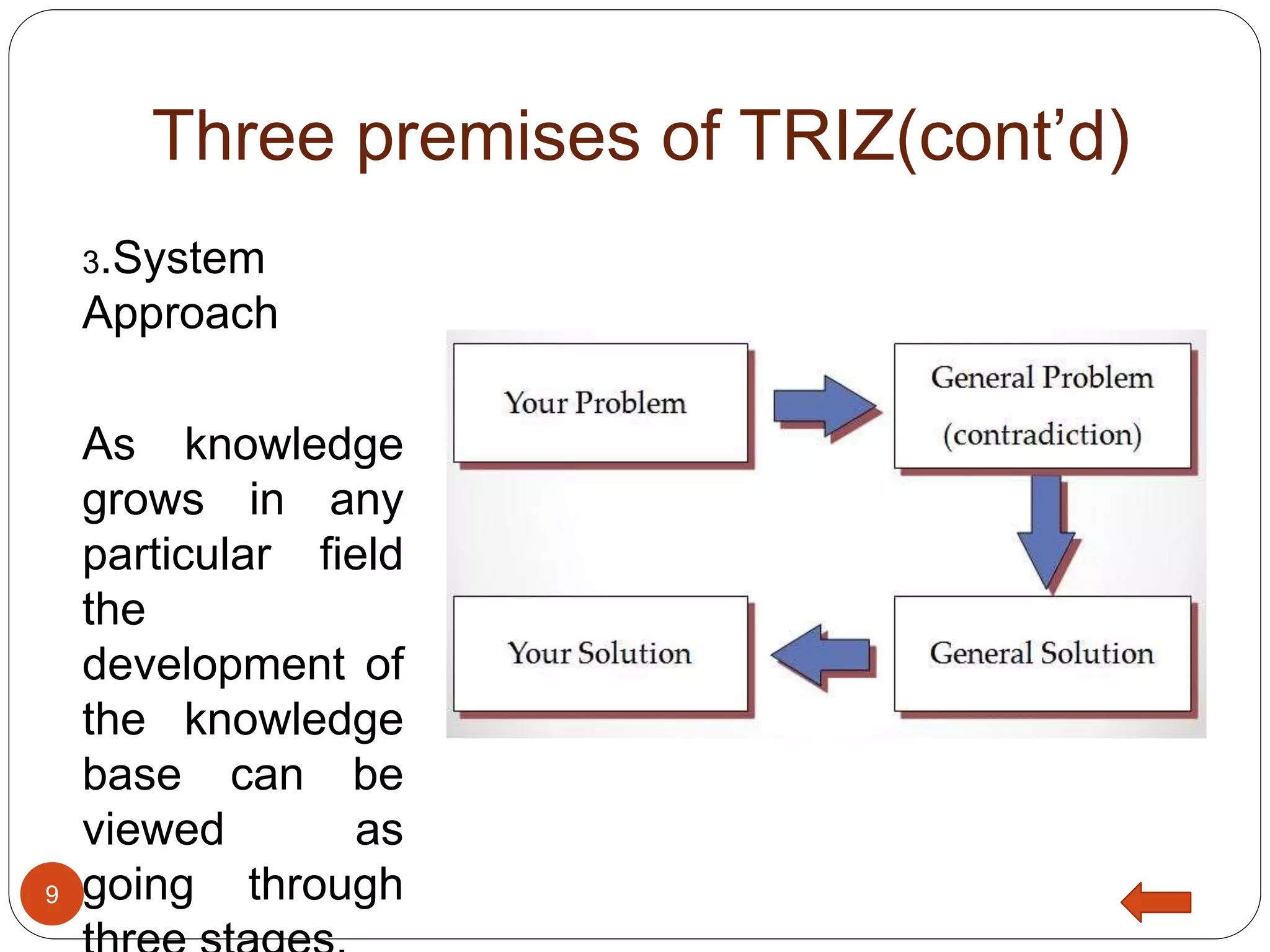
3.System
Approach
As knowledge
grows in any
particular field
the
development of
the knowledge
base can be
viewed as
going through9
Why TRIZ?
10
 TRIZ uses the world’s knowledge;
 TRIZ is systematic and repeatable;
 TRIZ is based on proven successful patents;
 You can build your own toolkit from the TRIZ
tools;
 It’s quick;
 It can be used in groups;
 It’s not just for engineers;
5 Levels of Inventiveness
11
TRIZ Trends help you:
12
• Predict future technologies, new products and
improvement of current systems
• Define what you want – Ideality
• Understand where you are - using S-Curves and seeing
the next steps and future possibilities
• See the most promising directions of your products and
those of your competitors
• Choose / evaluate the most promising ideas being
developed and help you develop those products
Principles of Invention
13
 Familiarity with all 40 Principles is essential for future
effective problem solving. The 40 Principles are
accessed for problem solutions by defining Physical
and Technical Contradictions, using:
• The Separation principles to solve Physical
Contradictions (you have opposite requirements for
the same thing e.g. I want an umbrella big enough to
protect me from the rain, but small to carry around).
• The TRIZ Contradiction Matrix to solve Technical
Contradictions (something improves but something
different gets worse e.g. as I make something
stronger, it gets heavier.[2]
40 Principles of Invention (cont’d)
14
Contradiction Matrix: The 39
15
1. Weight of moving object
2. Weight of stationary object
3. Length of moving object
4. Length of stationary object
5. Area of moving object
6. Area of stationary object
7. Volume of moving object
8. Volume of stationary object
9. Speed
10. Force (Intensity)
11. Stress or Pressure
12. Shape
13. Stability of the object’s composition
14. Strength
15. Duration of action of moving object
16. Duration of action of stationary object
17. Temperature
18. Illumination intensity
19. Use of energy by moving object
20. Use of energy by stationary object
21. Power
22. Loss of Energy
23. Loss of substance
24. Loss of Information
25. Loss of Time
26. Quantity of substance
27. Reliability
28. Measurement accuracy
29. Manufacturing precision
30. Object-affected harmful factors
31. Object-generated harmful factors
32. Ease of manufacture
33. Ease of operation
34. Ease of repair
35. Adaptability of versatility
36. Device complexity
37. Difficulty of detecting and measuring
38. Extent of automation
39. Productivity
Air bag problem
16
 Airbags need to inflate before contacting
occupants to prevent forward motion. We would
like to inflate the air bags faster while decreasing
the adverse effects
• Principle 16: Partial or Excessive Action
 Use a lower powered air bag. By using less power the
acceleration of the bag is less, and injuries will be reduced.
 Use smaller air bags with higher power. These bags will reach
full inflation sooner.
Air bag problem(cont’d)
17
 Principle 21: Rushing Through
 Inflate the air bag faster than current practice.
 Principle 40: Composite materials
 Airbag material that can’t grab skin as it is deployed
We usually accept a compromise, but this is often
not necessary. Powerful solutions are the ones
that don’t accept the trade-offs. Compromise
when necessary.
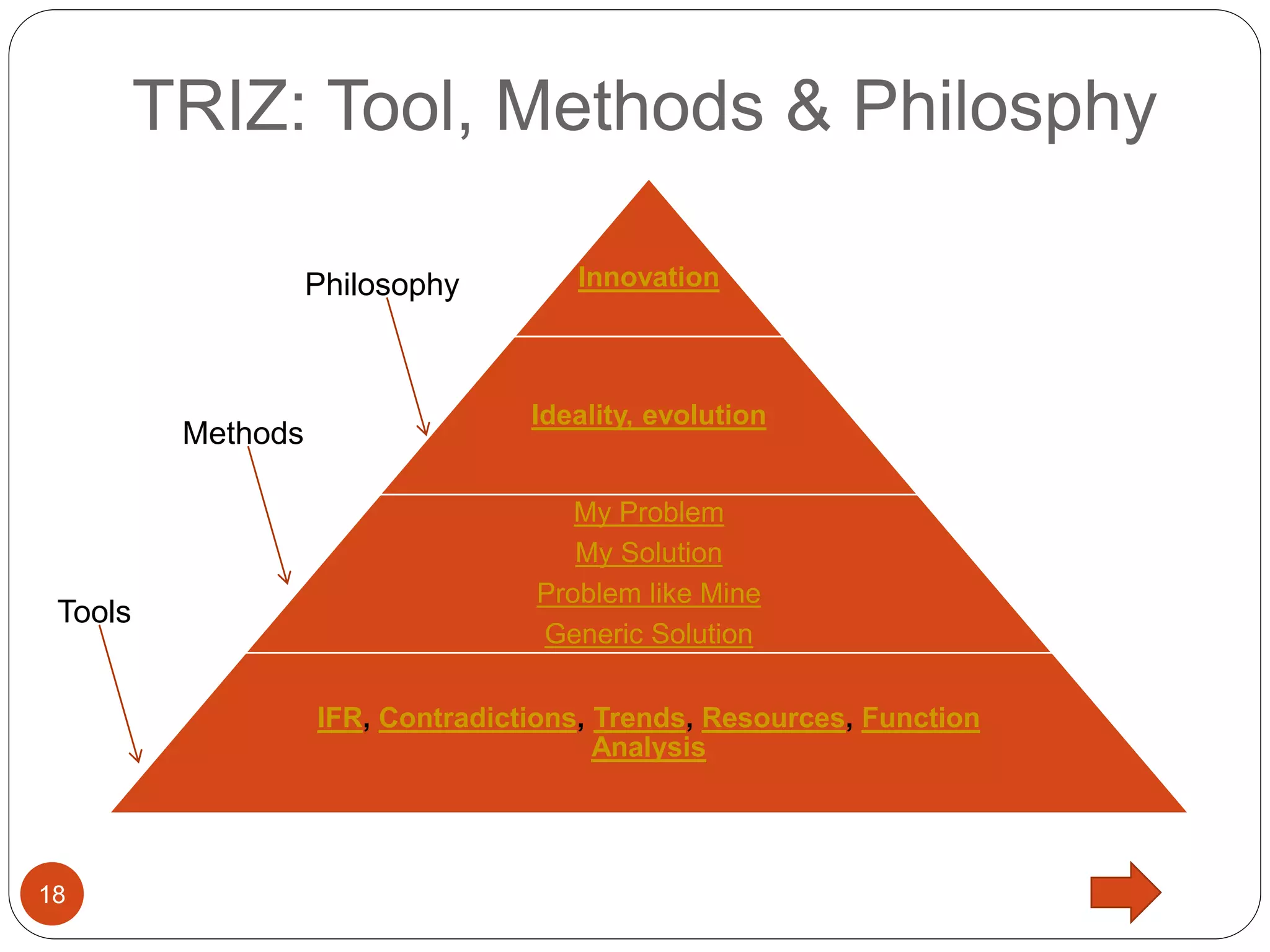
TRIZ: Tool, Methods & Philosphy
18
Philosophy
Methods
Tools
Innovation
Ideality, evolution
My Problem
My Solution
Problem like Mine
Generic Solution
IFR, Contradictions, Trends, Resources, Function
Analysis
Inventing the wheel
19
IFR (Ideal Final Result )
20
 A description of the best possible solution for the
problem situation regardless of the resources or
constraints of the original problem
1
• Eliminates the deficiencies of the original
system
2
• Preserves the advantages of the original
system
3
• Does not make the system more complicated
(uses free or available resources.)
4
• Does not introduce new disadvantages
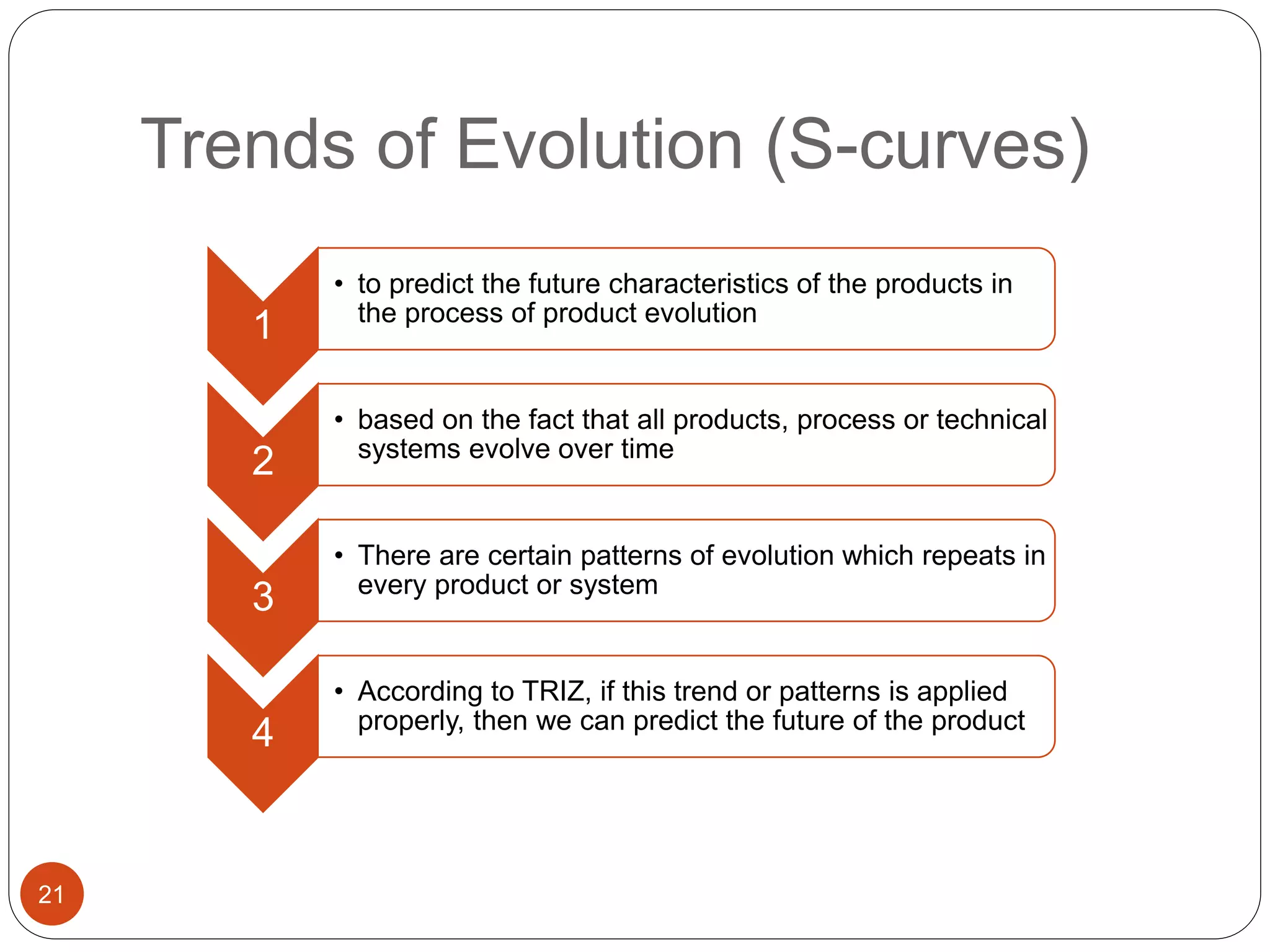
Trends of Evolution (S-curves)
21
1
• to predict the future characteristics of the products in
the process of product evolution
2
• based on the fact that all products, process or technical
systems evolve over time
3
• There are certain patterns of evolution which repeats in
every product or system
4
• According to TRIZ, if this trend or patterns is applied
properly, then we can predict the future of the product
S-curves
22
Resources'
23
• Formulate a list of resources
• prioritize them in their order, internal and free at the top,
external and paid at the bottom.
• Define what kind of resources are needed for solving the
problem
• Evaluate and estimate each of the existing resources
• Prioritize in the order of their effects/ usefulness to the
given problem
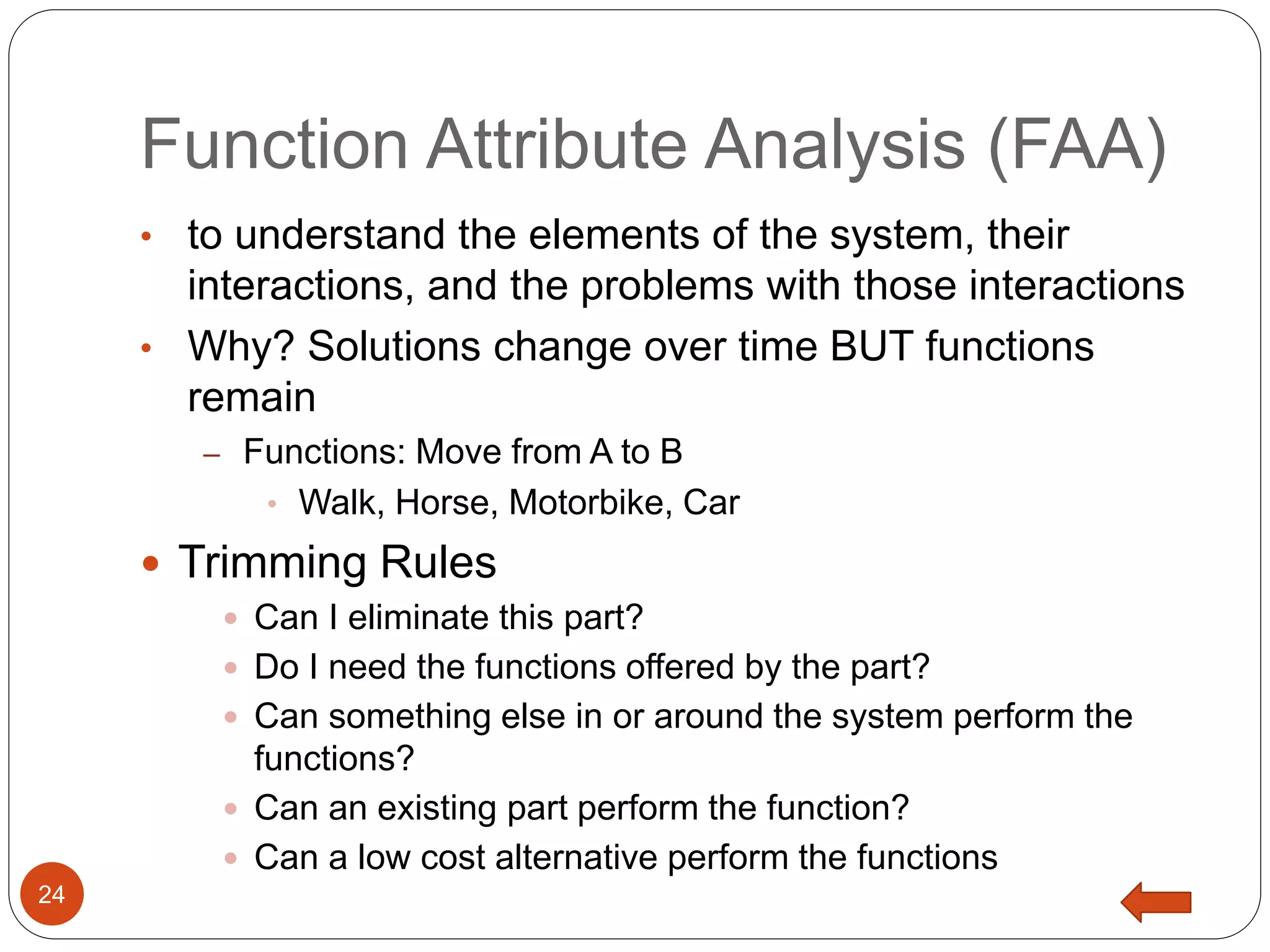
Function Attribute Analysis (FAA)
24
• to understand the elements of the system, their
interactions, and the problems with those interactions
• Why? Solutions change over time BUT functions
remain
– Functions: Move from A to B
• Walk, Horse, Motorbike, Car
 Trimming Rules
 Can I eliminate this part?
 Do I need the functions offered by the part?
 Can something else in or around the system perform the
functions?
 Can an existing part perform the function?
 Can a low cost alternative perform the functions
Conclusion
25
• TRIZ is NOT a SOLUTION to a problem BUT a
tool to generate better and useable idea to solve
the problem.
• TRIZ is not to find root cause of a problem BUT a
tool to solve founded root cause of a problem
• Main ideas behind TRIZ become a powerful tool
for managing knowledge and solving problems
that contain contradictions in many areas
26

Introduction to Triz (TIPS)

  • 1.
    1 TRIZ is acronymof Russian phrase "Teorija Rezbenija Izobretatelskib Zadach". It's meaning is: Theory of inventive problem solving(TIPS).
  • 2.
    What is TRIZ? 2 Genrich Altshuller invented TRIZ  TRIZ is an evolving, open-ended system for enhancing human inventiveness through: • Systematic identification of problems and ideal solutions • Concentrating on all the resources available, to get more out of less • Overcoming various blocks through approaches that have worked in other disciplines
  • 3.
    TRIZ Principles 3  Don'taccept compromises. Eliminate them.  Somebody, someplace, has already solved your problem or one similar to it. Creativity means finding that solution and adapting it to the current problem.  Pharmaceutical industry needed a way to deal with excess foam from a pharmaceutical process, solution came from the beer industry
  • 4.
    What is TRIZtrying to do? 4 CREATIVITY INVENTIONINNOVATION
  • 5.
    Three premises ofTRIZ 5 1. Ideality systems evolve towards increased ideality, where ideality is defined as • Ideality = Benefits / ( Costs + Harm) • Evolution is in the direction of » Increasing benefits » Decreasing costs » Decreasing harm
  • 6.
    6  Solutions withhigher degrees of ideality are more successful in the market • The ideal system performs a required function without actually existing. • Start by focussing on solutions not problems, then ask how can we use the resources to achieve this? Ideality (cont’d)
  • 7.
    2. Contradiction An inventive solutioninvolves wholly or partially eliminating a contradiction. Contradiction is a situation when the known solution meets some requirements, but generates harmful or undesirable effects.7 Three premises of TRIZ(cont’d)
  • 8.
    Contradiction(cont’d) 8  Technical Contradictions:something gets better, something else gets worse  Stronger at cost of additional weight  Greater bandwidth requires more power  Faster airbag deployment requires greater force  Physical Contradictions: one object has contradictory requirements  Coffee hot enough to enjoy but not so hot as to burn  Software powerful features but easy to use  A pen tip should be sharp to draw fine lines, but blunt to avoid tearing paper
  • 9.
    Three premises ofTRIZ(cont’d) 3.System Approach As knowledge grows in any particular field the development of the knowledge base can be viewed as going through9
  • 10.
    Why TRIZ? 10  TRIZuses the world’s knowledge;  TRIZ is systematic and repeatable;  TRIZ is based on proven successful patents;  You can build your own toolkit from the TRIZ tools;  It’s quick;  It can be used in groups;  It’s not just for engineers;
  • 11.
    5 Levels ofInventiveness 11
  • 12.
    TRIZ Trends helpyou: 12 • Predict future technologies, new products and improvement of current systems • Define what you want – Ideality • Understand where you are - using S-Curves and seeing the next steps and future possibilities • See the most promising directions of your products and those of your competitors • Choose / evaluate the most promising ideas being developed and help you develop those products
  • 13.
    Principles of Invention 13 Familiarity with all 40 Principles is essential for future effective problem solving. The 40 Principles are accessed for problem solutions by defining Physical and Technical Contradictions, using: • The Separation principles to solve Physical Contradictions (you have opposite requirements for the same thing e.g. I want an umbrella big enough to protect me from the rain, but small to carry around). • The TRIZ Contradiction Matrix to solve Technical Contradictions (something improves but something different gets worse e.g. as I make something stronger, it gets heavier.[2]
  • 14.
    40 Principles ofInvention (cont’d) 14
  • 15.
    Contradiction Matrix: The39 15 1. Weight of moving object 2. Weight of stationary object 3. Length of moving object 4. Length of stationary object 5. Area of moving object 6. Area of stationary object 7. Volume of moving object 8. Volume of stationary object 9. Speed 10. Force (Intensity) 11. Stress or Pressure 12. Shape 13. Stability of the object’s composition 14. Strength 15. Duration of action of moving object 16. Duration of action of stationary object 17. Temperature 18. Illumination intensity 19. Use of energy by moving object 20. Use of energy by stationary object 21. Power 22. Loss of Energy 23. Loss of substance 24. Loss of Information 25. Loss of Time 26. Quantity of substance 27. Reliability 28. Measurement accuracy 29. Manufacturing precision 30. Object-affected harmful factors 31. Object-generated harmful factors 32. Ease of manufacture 33. Ease of operation 34. Ease of repair 35. Adaptability of versatility 36. Device complexity 37. Difficulty of detecting and measuring 38. Extent of automation 39. Productivity
  • 16.
    Air bag problem 16 Airbags need to inflate before contacting occupants to prevent forward motion. We would like to inflate the air bags faster while decreasing the adverse effects • Principle 16: Partial or Excessive Action  Use a lower powered air bag. By using less power the acceleration of the bag is less, and injuries will be reduced.  Use smaller air bags with higher power. These bags will reach full inflation sooner.
  • 17.
    Air bag problem(cont’d) 17 Principle 21: Rushing Through  Inflate the air bag faster than current practice.  Principle 40: Composite materials  Airbag material that can’t grab skin as it is deployed We usually accept a compromise, but this is often not necessary. Powerful solutions are the ones that don’t accept the trade-offs. Compromise when necessary.
  • 18.
    TRIZ: Tool, Methods& Philosphy 18 Philosophy Methods Tools Innovation Ideality, evolution My Problem My Solution Problem like Mine Generic Solution IFR, Contradictions, Trends, Resources, Function Analysis
  • 19.
  • 20.
    IFR (Ideal FinalResult ) 20  A description of the best possible solution for the problem situation regardless of the resources or constraints of the original problem 1 • Eliminates the deficiencies of the original system 2 • Preserves the advantages of the original system 3 • Does not make the system more complicated (uses free or available resources.) 4 • Does not introduce new disadvantages
  • 21.
    Trends of Evolution(S-curves) 21 1 • to predict the future characteristics of the products in the process of product evolution 2 • based on the fact that all products, process or technical systems evolve over time 3 • There are certain patterns of evolution which repeats in every product or system 4 • According to TRIZ, if this trend or patterns is applied properly, then we can predict the future of the product
  • 22.
  • 23.
    Resources' 23 • Formulate alist of resources • prioritize them in their order, internal and free at the top, external and paid at the bottom. • Define what kind of resources are needed for solving the problem • Evaluate and estimate each of the existing resources • Prioritize in the order of their effects/ usefulness to the given problem
  • 24.
    Function Attribute Analysis(FAA) 24 • to understand the elements of the system, their interactions, and the problems with those interactions • Why? Solutions change over time BUT functions remain – Functions: Move from A to B • Walk, Horse, Motorbike, Car  Trimming Rules  Can I eliminate this part?  Do I need the functions offered by the part?  Can something else in or around the system perform the functions?  Can an existing part perform the function?  Can a low cost alternative perform the functions
  • 25.
    Conclusion 25 • TRIZ isNOT a SOLUTION to a problem BUT a tool to generate better and useable idea to solve the problem. • TRIZ is not to find root cause of a problem BUT a tool to solve founded root cause of a problem • Main ideas behind TRIZ become a powerful tool for managing knowledge and solving problems that contain contradictions in many areas
  • 26.