VISHNURAJ C R
T-5 MBA
RBS
UNIT – 1
Security analysis
Security analysis comprises of an examination and evaluation of the various factors affecting the value of a
security. Security analysis is about valuing the assets, debt, warrants, and equity of companies from the
perspective of outside investors using publicly available information. The security analyst must have a through
understanding of financing statements, which are an important source of this information. As such, the ability
to value equity securities requires cross-disciplinary knowledge in both finance and financial accounting.
While there is much overlap between the analytical tools used in security analysis and those used in corporate
finance, security analysis tends to take the perspective of potential investors, whereas corporate finance tends
to take an inside perspective such as that of a corporate financial manager.
Portfolio: group of securities put together by the investor
Portfolio management: it refers to creation and maintenance of an investment portfolio.
Phases of portfolio management
1. Security analysis
2. Portfolio management
3. Portfolio selection
4. Portfolio revision
5. Portfolio evaluation
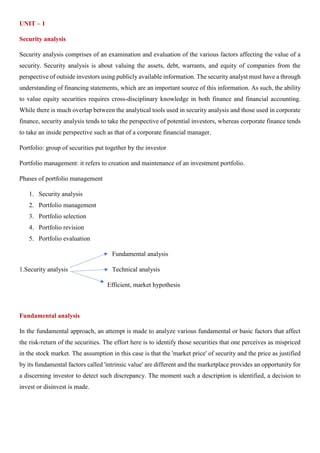
Fundamental analysis
1.Security analysis Technical analysis
Efficient, market hypothesis
Fundamental analysis
In the fundamental approach, an attempt is made to analyze various fundamental or basic factors that affect
the risk-return of the securities. The effort here is to identify those securities that one perceives as mispriced
in the stock market. The assumption in this case is that the 'market price' of security and the price as justified
by its fundamental factors called 'intrinsic value' are different and the marketplace provides an opportunity for
a discerning investor to detect such discrepancy. The moment such a description is identified, a decision to
invest or disinvest is made.
1. Economy Analysis
In actual practice, you must have noticed that investment decisions of individuals and the institutions made in
the economic set-up of a particular country. It becomes essential, therefore, to understand the star economy of
that country at the macro level. The analysis of the state of the economy at the macro level incorporates the
performance of the economy in the past, how it is performing in the present and how it is expected to perform
in future. Also relevant in this context is to know how various sectors of the economy are going to grow in the
future.
Economic variables are taken into consideration. Such as:
o Growth of national income (GNP, NNP, GDP)
o Business cycle (boom, depression, recession, recovery)
o Inflation
o Interest rate
o Exchange rate
o Infrastructure
o Political stability
• Economic forecasting-economic variables helps to forecast the economic growth
Eg: survey method, opinion method, barometric
2. Industry Analysis
Industry Analysis After conducting an analysis of the economy and identifying the direction it is likely to take
in the short, interim and long-term, the analyst must look into various sectors of the economy in terms of
various industries. An industry is a homogenous group of companies.
Intro – maturity – growth - decline
It involves:
• Industrial lifecycle [pioneering/growth stage, expansion, stagnation, decay]
• Industry characteristics:
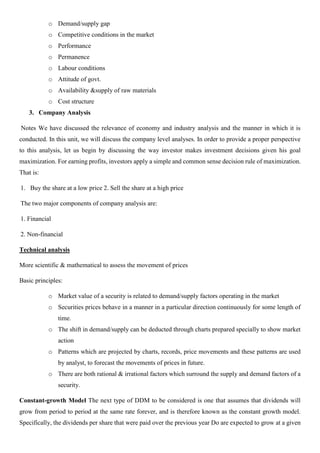
Industry
output
Company
Analysis
Industry Analysis
Economy Analysis
o Demand/supply gap
o Competitive conditions in the market
o Performance
o Permanence
o Labour conditions
o Attitude of govt.
o Availability &supply of raw materials
o Cost structure
3. Company Analysis
Notes We have discussed the relevance of economy and industry analysis and the manner in which it is
conducted. In this unit, we will discuss the company level analyses. In order to provide a proper perspective
to this analysis, let us begin by discussing the way investor makes investment decisions given his goal
maximization. For earning profits, investors apply a simple and common sense decision rule of maximization.
That is:
1. Buy the share at a low price 2. Sell the share at a high price
The two major components of company analysis are:
1. Financial
2. Non-financial
Technical analysis
More scientific & mathematical to assess the movement of prices
Basic principles:
o Market value of a security is related to demand/supply factors operating in the market
o Securities prices behave in a manner in a particular direction continuously for some length of
time.
o The shift in demand/supply can be deducted through charts prepared specially to show market
action
o Patterns which are projected by charts, records, price movements and these patterns are used
by analyst, to forecast the movements of prices in future.
o There are both rational & irrational factors which surround the supply and demand factors of a
security.
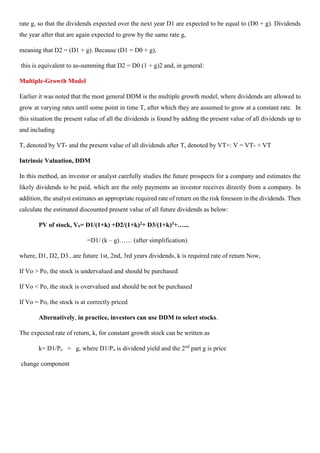
Constant-growth Model The next type of DDM to be considered is one that assumes that dividends will
grow from period to period at the same rate forever, and is therefore known as the constant growth model.
Specifically, the dividends per share that were paid over the previous year Do are expected to grow at a given
rate g, so that the dividends expected over the next year D1 are expected to be equal to (D0 + g). Dividends
the year after that are again expected to grow by the same rate g,
meaning that D2 = (D1 + g). Because (D1 = D0 + g),
this is equivalent to as-summing that D2 = D0 (1 + g)2 and, in general:
Multiple-Growth Model
Earlier it was noted that the most general DDM is the multiple growth model, where dividends are allowed to
grow at varying rates until some point in time T, after which they are assumed to grow at a constant rate. In
this situation the present value of all the dividends is found by adding the present value of all dividends up to
and including
T, denoted by VT- and the present value of all dividends after T, denoted by VT+: V = VT- + VT
Intrinsic Valuation, DDM
In this method, an investor or analyst carefully studies the future prospects for a company and estimates the
likely dividends to be paid, which are the only payments an investor receives directly from a company. In
addition, the analyst estimates an appropriate required rate of return on the risk foreseen in the dividends. Then
calculate the estimated discounted present value of all future dividends as below:
PV of stock, Vo= D1/(1+k) +D2/(1+k)2+ D3/(1+k)3+…...
=D1/ (k – g)…… (after simplification)
where, D1, D2, D3...are future 1st, 2nd, 3rd years dividends, k is required rate of return Now,
If Vo > Po, the stock is undervalued and should be purchased
If Vo < Po, the stock is overvalued and should be not be purchased
If Vo = Po, the stock is at correctly priced
Alternatively, in practice, investors can use DDM to select stocks.
The expected rate of return, k, for constant growth stock can be written as
k= D1/Po + g, where D1/Po is dividend yield and the 2nd
part g is price
change component
UNIT – 2
Technical analysis
Dow Theory
The Dow Theory is one of the oldest and most famous technical tools. It was originated by Charles Dow, who
founded the Dow Jones company and was the editor of The Wall Street Journal. Charles Dow passed away in
1902.
The Theory: According to Dow, "The market is always considered as having three movements, all going at
the same time. The first is the narrow movement from day-to-day. The second is the short swing running from
two weeks to a month or more, the third is the main movement covering at least four years in duration".
These movements are called:
1. Daily fluctuations (minor trends)
2. Secondary movements (trends), and
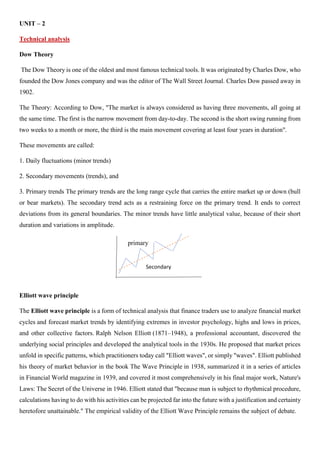
3. Primary trends The primary trends are the long range cycle that carries the entire market up or down (bull
or bear markets). The secondary trend acts as a restraining force on the primary trend. It ends to correct
deviations from its general boundaries. The minor trends have little analytical value, because of their short
duration and variations in amplitude.
Elliott wave principle
The Elliott wave principle is a form of technical analysis that finance traders use to analyze financial market
cycles and forecast market trends by identifying extremes in investor psychology, highs and lows in prices,
and other collective factors. Ralph Nelson Elliott (1871–1948), a professional accountant, discovered the
underlying social principles and developed the analytical tools in the 1930s. He proposed that market prices
unfold in specific patterns, which practitioners today call "Elliott waves", or simply "waves". Elliott published
his theory of market behavior in the book The Wave Principle in 1938, summarized it in a series of articles
in Financial World magazine in 1939, and covered it most comprehensively in his final major work, Nature's
Laws: The Secret of the Universe in 1946. Elliott stated that "because man is subject to rhythmical procedure,
calculations having to do with his activities can be projected far into the future with a justification and certainty
heretofore unattainable." The empirical validity of the Elliott Wave Principle remains the subject of debate.
primary
Secondary
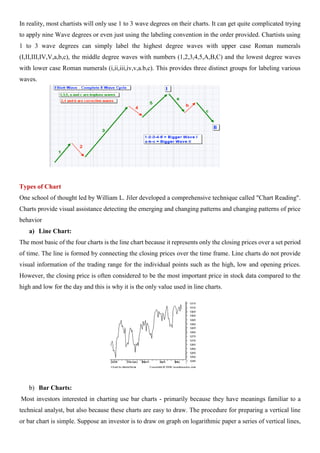
In reality, most chartists will only use 1 to 3 wave degrees on their charts. It can get quite complicated trying
to apply nine Wave degrees or even just using the labeling convention in the order provided. Chartists using
1 to 3 wave degrees can simply label the highest degree waves with upper case Roman numerals
(I,II,III,IV,V,a,b,c), the middle degree waves with numbers (1,2,3,4,5,A,B,C) and the lowest degree waves
with lower case Roman numerals (i,ii,iii,iv,v,a.b,c). This provides three distinct groups for labeling various
waves.
Types of Chart
One school of thought led by William L. Jiler developed a comprehensive technique called "Chart Reading".
Charts provide visual assistance detecting the emerging and changing patterns and changing patterns of price
behavior
a) Line Chart:
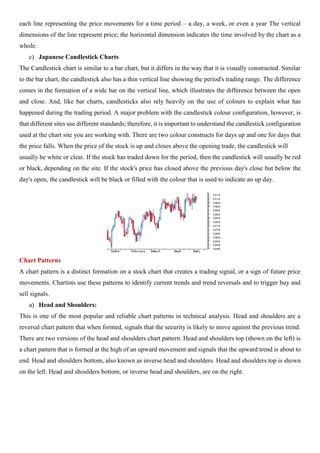
The most basic of the four charts is the line chart because it represents only the closing prices over a set period
of time. The line is formed by connecting the closing prices over the time frame. Line charts do not provide
visual information of the trading range for the individual points such as the high, low and opening prices.
However, the closing price is often considered to be the most important price in stock data compared to the
high and low for the day and this is why it is the only value used in line charts.
b) Bar Charts:
Most investors interested in charting use bar charts - primarily because they have meanings familiar to a
technical analyst, but also because these charts are easy to draw. The procedure for preparing a vertical line
or bar chart is simple. Suppose an investor is to draw on graph on logarithmic paper a series of vertical lines,
each line representing the price movements for a time period – a day, a week, or even a year The vertical
dimensions of the line represent price; the horizontal dimension indicates the time involved by the chart as a
whole.
c) Japanese Candlestick Charts
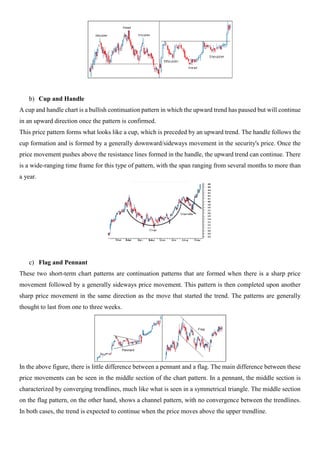
The Candlestick chart is similar to a bar chart, but it differs in the way that it is visually constructed. Similar
to the bar chart, the candlestick also has a thin vertical line showing the period's trading range. The difference
comes in the formation of a wide bar on the vertical line, which illustrates the difference between the open
and close. And, like bar charts, candlesticks also rely heavily on the use of colours to explain what has
happened during the trading period. A major problem with the candlestick colour configuration, however, is
that different sites use different standards; therefore, it is important to understand the candlestick configuration
used at the chart site you are working with. There are two colour constructs for days up and one for days that
the price falls. When the price of the stock is up and closes above the opening trade, the candlestick will
usually be white or clear. If the stock has traded down for the period, then the candlestick will usually be red
or black, depending on the site. If the stock's price has closed above the previous day's close but below the
day's open, the candlestick will be black or filled with the colour that is used to indicate an up day.
Chart Patterns
A chart pattern is a distinct formation on a stock chart that creates a trading signal, or a sign of future price
movements. Chartists use these patterns to identify current trends and trend reversals and to trigger buy and
sell signals.
a) Head and Shoulders:
This is one of the most popular and reliable chart patterns in technical analysis. Head and shoulders are a
reversal chart pattern that when formed, signals that the security is likely to move against the previous trend.
There are two versions of the head and shoulders chart pattern. Head and shoulders top (shown on the left) is
a chart pattern that is formed at the high of an upward movement and signals that the upward trend is about to
end. Head and shoulders bottom, also known as inverse head and shoulders. Head and shoulders top is shown
on the left. Head and shoulders bottom, or inverse head and shoulders, are on the right.
b) Cup and Handle
A cup and handle chart is a bullish continuation pattern in which the upward trend has paused but will continue
in an upward direction once the pattern is confirmed.
This price pattern forms what looks like a cup, which is preceded by an upward trend. The handle follows the
cup formation and is formed by a generally downward/sideways movement in the security's price. Once the
price movement pushes above the resistance lines formed in the handle, the upward trend can continue. There
is a wide-ranging time frame for this type of pattern, with the span ranging from several months to more than
a year.
c) Flag and Pennant
These two short-term chart patterns are continuation patterns that are formed when there is a sharp price
movement followed by a generally sideways price movement. This pattern is then completed upon another
sharp price movement in the same direction as the move that started the trend. The patterns are generally
thought to last from one to three weeks.
In the above figure, there is little difference between a pennant and a flag. The main difference between these
price movements can be seen in the middle section of the chart pattern. In a pennant, the middle section is
characterized by converging trendlines, much like what is seen in a symmetrical triangle. The middle section
on the flag pattern, on the other hand, shows a channel pattern, with no convergence between the trendlines.
In both cases, the trend is expected to continue when the price moves above the upper trendline.
d) Triangles
Triangles are some of the most well-known chart patterns used in technical analysis. The three types of
triangles, which vary in construct and implication, are the symmetrical triangle, ascending and descending
triangle. These chart patterns are considered to last anywhere from a couple of weeks to several months.
Moving Averages
Most chart patterns show a lot of variation in price movement. This can make it difficult for traders to get an
idea of a security's overall trend. One simple method traders use to combat this is to apply moving averages.
A moving average is the average price of a security over a set amount of time. By plotting a security's average
price, the price movement is smoothed out. Once the day-to-day fluctuations are removed, traders are better
able to identify the true trend and increase the probability that it will work in their favour.
Types of Moving Averages
Moving Averages may be of following types
1. Simple Moving Average (SMA):
This is the most common method used to calculate the moving average of prices. It simply takes the sum of
all of the past closing prices over the time period and divides the result by the number of prices used in the
calculation.
2. Exponential Moving Average (EMA):
This moving average calculation uses a smoothing factor to place a higher weight on recent data points and is
regarded as much more efficient than the linear weighted average. The most important thing to remember
about the exponential moving average is that it is more responsive to new information relative to the simple
moving average.
a) Linear Weighted Average:
This moving average indicator is the least common out of the three and is used to address the problem of the
equal weighting. The linear weighted moving average is calculated by taking the sum of all the closing prices
over a certain time period and multiplying them by the position of the data point and then dividing by the sum
of the number of periods.
b) Moving Average Convergence & Divergence (MACD):
The moving average convergence divergence (MACD) is one of the most well-known and used indicators in
technical analysis. This indicator is comprised of two exponential moving averages, which help to measure
momentum in the security. The MACD is simply the difference between these two moving averages plotted
against a centerline. The centerline is the point at which the two moving averages are equal. Along with the
MACD and the centerline, an exponential moving average of the MACD itself is plotted on the chart. The
idea behind this momentum indicator is to measure short-term momentum compared to the longer-term
momentum to help signal the current direction of momentum.
MACD = shorter-term moving average – longer-term moving average
UNIT-3
Efficient Market Theory
An efficient capital market is one in which security prices adjust rapidly to the arrival of new information and,
therefore, the current prices of securities reflect all information about the security.
• Proponents of the efficient market theory believe that a stock's current price accurately reflects what i
nvestors know aboutthe stock.
• They also maintain that you can't predict a stock's future price based on its past performance. Their c
onclusion, which iscontested by other experts, is that it's not possible for an individual or institutional
investor to outperform the market as awhole.
• Index funds, which are designed to match, rather than beat, the performance of a particular market se
gment, are in part anoutgrowth of efficient market theory.
Efficient Market Hypotheses
Most of the early works related to efficient capital markets were based on the random walk hypothesis, which
contended that changes in stock prices occurred randomly. This early academic work contained extensive
empirical analysis without much theory behind it. An article by Fama attempted to formalize the theory and
organize the growing empirical evidence. Fama presented the efficient market theory in terms of a fair game
model, contending that investors can be confident that a current market price fully reflects all available
information about a security and the expected return based upon this price is consistent with its risk. In his
original article, Fama divided the overall efficient market hypothesis (EMH) and the empirical tests of the
hypothesis into three sub-hypotheses depending on the information set involved:
1. weak-form EMH,
2. semi-strong-form EMH, and
3. (3) strong-form EMH.
In a subsequent review article, Fama again divided the empirical results into three groups but shifted empirical
results between the prior categories. Therefore, the following discussion uses the original categories but
organizes the presentation of results using the new categories.
The weak-form EMH assumes that current stock prices fully reflect all security market information,
including the historical sequence of prices, rates of return, trading volume data, and other market-generated
information, such as odd-lot transactions, block trades, and transactions by exchange specialists. Because it
assumes that current market prices already reflect all past returns and any other security market information,
this hypothesis implies that past rates of return and other historical market data should have no relationship
with future rates of return (that is, rates of return should be independent). Therefore, this hypothesis contends
that you should gain little from using any trading rule that decides whether to buy or sell a security based on
past rates of return or any other past market data.
The semi strong-form EMH asserts that security prices adjust rapidly to the release of all public information;
that is, current security prices fully reflect all public information. The semi-strong hypothesis encompasses
the weak-form hypothesis, because all the market information considered by the weak-form hypothesis, such
as stock prices, rates of return, and trading. volume, is public information. Public information also includes
all non-market information, such as earnings and dividend announcements, price-to-earnings (P/E) ratios,
dividend-yield (D/P) ratios, price book value (P/BV) ratios, stock splits, news about the economy, and political
news. This hypothesis implies that investors who base their decisions on any important new information after
it is public should not derive above-average risk-adjusted profits from their transactions, considering the cost
of trading because the security price already reflects all such new public information.
The strong-form EMH contends that stock prices fully reflect all information from public and private
sources. This means that no group of investors has monopolistic access to information relevant to the
formation of prices. Therefore, this hypothesis contends that no group of investors should be able to
consistently derive above-average risk-adjusted rates of return. The strong form EMH encompasses both the
weak form and the semi-strong form EMH. Further, the strong form EMH extends the assumption of efficient
markets, in which prices adjust rapidly to the release of new public information, to assume perfect markets, in
which all information is cost-free and available to everyone at the same time.
UNIT- 4
A portfolio is a grouping of financial assets such as stocks, bonds and cash equivalents, as well as their funds
counterparts, including mutual, exchange-traded and closed funds. Portfolios are held directly by investors
and/or managed by financial professionals.
Portfolio Diversification
In an efficient capital market, the important principle to consider is that, investors should not hold all their
eggs in one basket; investor should hold a well-diversified portfolio. In order to understand portfolio
diversification, one must understand correlation. Correlation is a statistical measure that indicates the
relationship, if any, between series of numbers representing anything from cash flows to test data. If the two
series move together, they are positively correlated; if the series move in opposite directions, they are
negatively correlated. The existence of perfectly correlated especially negatively correlated-projects is quite
rare. In order to diversify project risk and thereby reduce the firm's overall risk, the projects that are best
combined or added to the existing portfolio of projects are those that have a negative (or low positive)
correlation with existing projects. By combining negatively correlated projects, the overall variability of
returns or risk can be reduced.
Modern Portfolio Theory represents the mathematical formulation of risk diversification in investing, that
aims at selecting a group of investment assets which have collectively lower risk than any single asset on its
own. This becomes possible, since various asset types frequently change in value in opposite directions.
Actually investing, being a tradeoff between risk and return, presupposes that risky assets have the highest
expected returns.
Thus, MPT shows how to choose a portfolio with the maximum possible expected return for the given amount
of risk. It also describes how to choose a portfolio with the minimum possible risk for the given expected
return. Therefore, Modern Portfolio Theory is viewed as a form of diversification which explains the way of
finding the best possible diversification strategy.
Harry Markowitz model (HM model), also known as Mean-Variance Model because it is based on the
expected returns (mean) and the standard deviation (variance) of different portfolios, helps to make the most
efficient selection by analyzing various portfolios of the given assets. It shows investors how to reduce their
risk in case they have chosen assets not “moving” together.
MPT Assumptions
Modern Portfolio Theory relies on the following assumptions and fundamentals that are the key concepts upon
which it has been constructed:
• For buying and selling securities there are no transaction costs. There is no spread between bidding and
asking prices. No tax is paid, its only risk that plays a part in determining which securities an investor will
buy.
• An investor has a chance to take any position of any size and in any security. The market liquidity is infinite
and no one can move the market. So that nothing can stop the investor from taking positions of any size
in any security.
• While making investment decisions the investor does not consider taxes and is indifferent towards receiving
dividends or capital gains.
• The risk-return relationships are viewed over the same time horizon. Both long term speculator and short-
term speculator share the same motivations, profit target and time horizon.
• Investors seek to control risk only by the diversification of their holdings.
• In the market all assets can be bought and sold including human capital.
• Politics and investor psychology have no influence on market.
• The risk of portfolio depends directly on the instability of returns from the given portfolio.
• An investor gives preference to the increase of utilization.
• An investor either maximizes his return for the minimum risk or maximizes his portfolio return for a given
level of risk.
• Analysis is based on a single period model of investment.
Sharp’s Single Index Model
Sharpe assumed that, for the sake of simplicity, the return on a security could be regarded as being linearly
related to a single index like the market index. Theoretically, the market index should consist of all the
securities trading on the market. However, a popular average can be treated as a surrogate for the market
index. The acceptance of the idea of a market between individual securities is because any movements in
securities could be attributed to movements in the single underlying factor being measured by the market
index. The simplification of the Markowitz Model has come to be known as the Market Model or Single Index
Model (SIM).
In an attempt to capture the relative contribution of each stock towards portfolio risk, William Sharpe has
developed a simple but elegant model called as ‘Market Model’. His argument is like this. We appreciate that
the portfolio risk declines as the number of stocks increases but to an extent. That part of the risk which cannot
be further reduced even when we add few more stocks into a portfolio is called systematic risk. That
undiversifiable risk is attributed to the influence of systematic factors principally operated at a given market.
If one includes all traded securities in a market in his portfolio, that portfolio reduces the risk to the extent of
the market influences. In such a case, one can easily capture every individual stock’s contribution to portfolio
risk by simply relating its returns with that of the market index. Such a relationship is expected to give us the
market sensitivity of the given scrip. This is exactly the relationship that William Sharpe has estimated with a
simple regression equation considering the returns or Market Index, such as SENSEX, ET Index, NSE Index
or RBI Index as independent variable and returns on individual stocks as dependent.
Capital Asset Pricing Model (CAPM)
William F. Sharpe and John Linter developed the Capital Asset Pricing Model (CAPM). The model is based
on the portfolio theory developed by Harry Markowitz. The model emphasizes the risk factor in portfolio
theory is a combination of two risks, systematic risk and unsystematic risk. The model suggests that a
security’s return is directly related to its systematic risk, which cannot be neutralized through diversification.
The combination of both types of risks stated above provides the total risk. The total variance of returns is
equal to market related variance plus company’s specific variance. CAPM explains the behaviour of security
prices and provides a mechanism whereby investors could assess the impact of a proposed security investment
on the overall portfolio risk and return. CAPM suggests that the prices of securities are determined in such a
way that the risk premium or excess returns are proportional to systematic risk, which is indicated by the beta
coefficient. The model is used for analyzing the risk-return implications of holding securities. CAPM refers
to the manner in which securities are valued in line with their anticipated risks and returns. A risk-averse
investor prefers to invest in risk-free securities. For a small investor having few securities in his portfolio, the
risk is greater. To reduce the unsystematic risk, he must build up well-diversified securities in his portfolio.
Multi Factor Model
A Multi Factor Model can be defined as a financial model that employs multiple factors in its computations
to explain market phenomena and/or equilibrium asset prices. The multi-factor model can be used to explain
either an individual security or a portfolio of securities. It will do this by comparing two or more factors to
analyze relationships between variables and the security’s resulting performance.
Multi-factor models can be divided into three categories: macroeconomic, fundamental and statistical models.
Macroeconomic models compare a security’s return to such factors as employment, inflation and interest.
Fundamental models analyze the relationship between a security’s return and its underlying financials (such
as earnings). Statistical models are used to compare the returns of different securities based on the statistical
performance of each security in and of itself.
The Arbitrage Pricing Model (APM)
The Arbitrage Pricing Model (APM) looks very similar to the CAPM, but its origins are significantly different.
Whereas the CAPM is a single-factor model, the APM is a multi-factor model instead of just a single beta
value; there is a whole set of beta values – one for each factor. Arbitrage Pricing Theory, out of which the
APM arises, states that the expected return on an investment is dependent upon how that investment reacts to
a set of individual macro-economic factors (the degree of reaction being measured by the betas) and the risk
premium associated with each of those macro-economic factors. The APM, which was developed by Ross
(1976), holds that there are four factors, which explain the risk/risk premium relationship of a particular
security.
UNIT – 5
Portfolio Revision
In the entire process of portfolio management, portfolio revision is as important as portfolios analysis and
selection. Keeping in mind the risk-return objectives, an investor selects a mix of securities from the given
investment universe. In a dynamic world of investment, it is only natural that the portfolio may not perform
as desired or opportunities might arise turning the desired into less that desired. In every such situation, a
portfolio revision is warranted. Portfolio revision involves changing the existing mix of securities. The
objective of portfolio revision is similar to the objective of portfolio selection i.e. maximizing the return for a
given level of risk or minimizing the risk for a given level of return. The process of portfolio revision may
also be similar to the process of portfolio selection. This is particularly true where active portfolio revision
strategy is followed. Where passive portfolio revision strategy is followed, use of mechanical formula plans
may be made. What are these formula plans? We shall discuss these and other aspects of portfolio revision in
this unit. Let us begin by highlighting the need for portfolio revision.
Need for Portfolio Revision
No plan can be perfect to the extent that it would not need revision sooner or later. Investment plans are
certainly not. In the context of portfolio management, the need for revision is ever more because the financial
markets are continually changing. Thus the need for portfolio revision might simply arise because the market
witnessed some significant changes since the creation of the portfolio. Further, the need for portfolio revision
may arise because of some investor related factors such as
• Availability of additional wealth,
• Change in the risk attitude and the utility function of the investor,
• Change in the investment goals of the investors and
• The need to liquidate a part of the portfolio to provide funds for some alternative uses.
The other valid reasons for portfolio revision such as short-term price fluctuations in the market do also exist.
There are, thus, numerous factors, which may be broadly called market related and investor-related, which
spell need for portfolio revision.
Portfolio Revision Strategies
As are there numerous factors motivating revision of portfolio, so are there numerous strategies of portfolio
revision. Broadly speaking, investors may, depending on their investment objectives, skill and resources,
follow active or passive strategies for portfolio revision. Active strategy of portfolio revision involves a
process similar to portfolio analysis and selection, which is based on an analysis of fundamental factors
covering economy, industries and companies as well as technical factors.
An active revision strategy seeks “beating the market by anticipating” or reacting to the perceived events or
information. Passive revision strategy, on the other hand, seeks ‘performing as the market.’ The followers of
active revision strategy are found among believers in the ‘market inefficiency’, whereas passive revision
strategy is the choice of believers in ‘market efficiency.’ The frequency of trading transaction, as is obvious,
will be more under active revision strategy than under passive revision strategy and so will be the time, money
and resources required for implementing active revision strategy than for passive revision strategy. In other
words, active and passive revision strategies differ in terms of purpose, process and cost involved. The choice
between the two strategies is certainly not very straightforward. One has to compare relevant costs and
benefits. On the face of it, active revision strategy might appear quite appealing but in actual practice, there
exist a number of constraints in undertaking portfolio revision itself.
1) Portfolio Revision Practices
There are two type strategies active and passive portfolio revision strategies. Studies about portfolio revision
strategies followed by investors show that the efficient market hypothesis is slowly but continuously gaining
believers and these converts revise their portfolio much less often than they were doing previously because of
their rising faith in market efficiency. Institutional investors in the countries, on the other hand, have shown a
definite tendency in the recent past for active revision of their portfolios. This is reportedly motivated by their
desire to achieve superior performance by frequent trading to take advantage of their supposedly superior
investment skills.
2) Constraints in Portfolio Revision:
A look into the portfolio revision practices as discussed above highlight that there are a number of constraints
in portfolio revision, in general and active portfolio revision, in particular. Let us indicate some common
constraints in portfolio revision as follows:
a) Transaction cost:
As you know, buying and selling of securities involve transaction costs, including brokers’ fee. Frequent
buying and selling for portfolio revision may push up transaction costs beyond gainful limits.
b) Taxes:
In most countries, capital gains are taxed at concessional rates. But for any income to qualify as capital gains,
it should be earned after the lapse of a certain period. In many cases, the period is 36 months. Frequently
selling portfolio revision may mean foregoing capital gains tax concessions. Higher the tax differential
(between rates of tax for income and capital gains), the higher the constraints rise.
c) Statutory Stipulation:
In many countries like India, statutory stipulations have been made as to the percentage of investible funds
that can be invested by investment companies/mutual funds in the shares/debentures of a company or industry.
In such a situation, the initiative to revise the portfolio is most likely to get stifled under the burden of various
stipulations. Government-owned investment companies and mutual funds are quite often called upon to
support sagging markets (albeit counters) or to cool down heated markets, which put limits on the active
portfolio revision by these companies.
d) No Single Formula:
Portfolio revision is not an exact science. Even today, there does not exist a clear-cut answer to the overall
question of whether, when and how to revise a portfolio. The entire process is fairly cumbersome and time-
consuming. Investment literature does provide some formula plans, which we shall discuss in the following
section, but they have their own assumptions and limitations.
Formula Plans
1. Formula Investing:
Investment technique is based on a predetermined timing or asset allocation model that eliminates emotional
decisions. One type of formula investing, called dollar cost averaging, involves putting the same amount of
money into a stock or mutual fund at regular intervals, so that more shares will be bought when the price is
low and less when the price is high. Another formula investing method calls for shifting funds from stocks to
bonds or vice versa as the stock market reaches particular price levels. If stocks rise to a particular point, a
certain amount of the stock portfolio is sold and put in bonds. On the other hand, if stocks fall to a particular
low price, money is brought out of bonds into stocks.
2. Basic Assumptions and Ground Rules of Formula Plan
The formula plans are based on the following assumption.
(a) The stock prices move up and down in cycle.
(b) The stock prices and the high-grade bond prices move in the opposite directions.
(c) The investors cannot or are not inclined to forecast direction of the next fluctuations in stock prices, which
may be due to lack of skill and resources or their belief in market efficiency or both.
The use of formula plans call for the investor to divide his investment funds into two portfolios, one aggressive
and the other conservative or defensive. The aggressive portfolio usually consists of stocks while conservative
portfolio consists of bonds. The formula plans specify predesignated rules for the transfer of funds from that
aggressive into the conservative and vice-versa such that it automatically causes the investors to sell stocks
when their prices are rising and buy stocks when their prices are falling.
3. Dollar-Value Plan
securities, typically mutual funds, are purchased in fixed dollar amounts at regular intervals, regardless of
what direction the market is moving. Thus, as prices of securities rise, fewer units are bought, and as prices
fall, more units are bought also called constant dollar plan, also called dollar cost averaging.
4. Constant-ratio Plan:
This is an investment strategy in which the portfolio’s composition by asset class is maintained at a certain
level through periodic adjustments. When the balance is upset, it is periodically restored by moving money
from over-performing assets to underperforming ones. The constant-ratio plan specifies that the value of the
aggressive portfolio to the value of the conservative portfolio will be held constant at the predetermined ratio.
This plan automatically forces the investor to sell stocks as their prices rise, in order to keep the ratio of the
value of their aggressive portfolio to the value of the conservative portfolio constant.
5. Variable-ratio Plan:
Variable-ratio plan is a more flexible variation of constant ratio plan. Under the variable ratio plan, it is
provided that if the value of aggressive portfolio changes by certain percentage or more, the initial ratio
between the aggressive portfolio and conservative portfolio will be allowed to change as per the pre-
determined schedule. Some variations of this plan provide for the ratios to vary according to economic or
market indices rather than the value of the aggressive portfolio. Still others use moving averages of indicators.
Portfolio Evaluation:
Portfolio evaluation is the last step in the process of portfolio management. It is the stage when we examine
to what extent the objective has been achieved. It is basically the study of the impact of investment decisions.
Without portfolio evaluation, portfolio management would be incomplete. It has evolved as an important
aspect of portfolio management over the last two decades.
Need for evaluation:
Investment may be carried out by individuals on their own. The funds available with individual investors may
not be large enough to create a well-diversified portfolio of securities. Moreover, the time, skill and other
resources at the disposal of individual investors may not be sufficient to manage the portfolio professionally.
Institutional investors such as mutual funds and investment companies are better equipped to create and
manage well diversified portfolios in a professional fashion. Hence, small investors may prefer to entrust their
funds with mutual funds or investment companies to avail the benefits of their professional services and
thereby achieve maximum return with minimum risk and effort.
Evaluation is an appraisal of performance. Whether the investment activity is carried out by individual
investors themselves or through mutual funds and investment companies, different situations arise where
evaluation of performance becomes imperative. These situations are discussed below:
• Self Evaluation:
Where individual investors undertake the investment activity on their own, the investment decisions are taken
by them. They construct and manage their own portfolio of securities. In such a situation, an investor would
like to evaluate the performance of his portfolio in order to identify the mistakes committed by him. This self-
evaluation will enable him to improve his skills and achieve better performance in future.
• Evaluation of portfolio managers:
A mutual fund or investment company usually creates different portfolios with different objectives aimed at
different sets of investors. Each such portfolio may be entrusted to different professional portfolio managers
who are responsible for the investment decisions regarding the portfolio entrusted to each of them. In such a
situation, the organization would like to evaluate the performance of each portfolio so as to compare the
performance of different portfolio managers.
• Evaluation Perspective:
A portfolio comprises several individual securities. In the building up of the portfolio several transactions of
purchase and sale of securities take place. Thus, several transactions in several securities are needed to create
and revise a portfolio of securities. Hence, the evaluation may be carried out from different perspectives or
viewpoints such a transactions view, security view or portfolio view.
• Transaction view:
An investor may attempt to evaluate every transaction of purchase and sale of securities. Whenever a security
is bought or sold, the transaction is evaluated as regards its correctness and profitability.
• Security view:
Each security included in the portfolio has been purchased at a particular price. At the end of the holding
period, the market price of the security may be higher or lower than its cost price or purchase price. Further,
during the holding period, interest or dividend might have been received in respect of the security. Thus, it
may be possible to evaluate the profitability of holding each security separately. This is evaluation from the
security viewpoint.
Sharpe Ratio:
The performance measure developed by William Sharpe is referred to as the Sharpe ratio or the reward to
variability ratio. It is the ratio of the reward or risk premium to the variability of return or risk as measured by
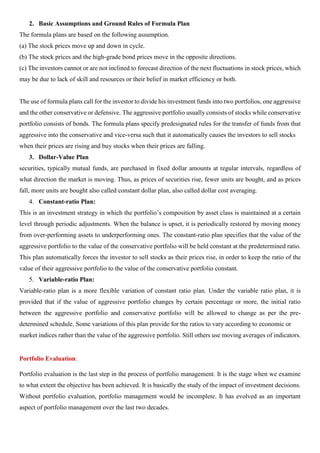
the standard deviation of return. The formula for calculating Sharpe ratio may be stated as:
Where: rp = realized return of portfolio
rf = risk free rate of return
sdp= sd of portfolio return
Treynor Ratio:
The performance measure developed by Jack Treynor is referred to as Treynor ratio or reward to volatility
ratio. It is the ratio of the reward or risk premium to the volatility of return as measured by the portfolio beta.
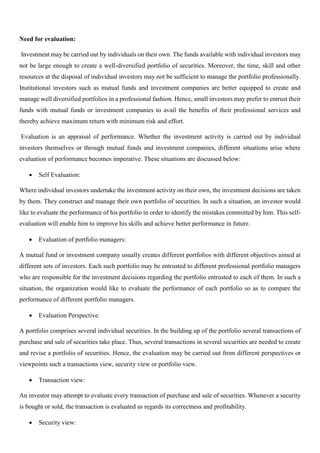
The formula for calculating Treynor ratio may be stated as:
Where: rp = realized return of portfolio
rf = risk free rate of return
beta p= portfolio beta
Jensen's measure is a statistical measurement of the portion of a security's or portfolio's return that is not
explained by the market or the security's relationship to the market but rather by the skill of the investor
or portfolio manager. It is also called alpha.
Mathematically, Jensen's measure (which was developed in 1968 by Michael Jensen) is the rate of return that
exceeds what was expected or predicted by models like the capital asset pricing model (CAPM). To
understand how it works, consider the CAPM formula:
r = Rf + beta x (Rm - Rf ) + Jensen's measure (alpha)
where:
r = the security's or portfolio's return
Rf = the risk-free rate of return
beta = the security's or portfolio's price volatility relative to the overall market
Rm = the market return

Security Analysis and Portfolio Management

  • 1.
  • 2.
    UNIT – 1 Securityanalysis Security analysis comprises of an examination and evaluation of the various factors affecting the value of a security. Security analysis is about valuing the assets, debt, warrants, and equity of companies from the perspective of outside investors using publicly available information. The security analyst must have a through understanding of financing statements, which are an important source of this information. As such, the ability to value equity securities requires cross-disciplinary knowledge in both finance and financial accounting. While there is much overlap between the analytical tools used in security analysis and those used in corporate finance, security analysis tends to take the perspective of potential investors, whereas corporate finance tends to take an inside perspective such as that of a corporate financial manager. Portfolio: group of securities put together by the investor Portfolio management: it refers to creation and maintenance of an investment portfolio. Phases of portfolio management 1. Security analysis 2. Portfolio management 3. Portfolio selection 4. Portfolio revision 5. Portfolio evaluation Fundamental analysis 1.Security analysis Technical analysis Efficient, market hypothesis Fundamental analysis In the fundamental approach, an attempt is made to analyze various fundamental or basic factors that affect the risk-return of the securities. The effort here is to identify those securities that one perceives as mispriced in the stock market. The assumption in this case is that the 'market price' of security and the price as justified by its fundamental factors called 'intrinsic value' are different and the marketplace provides an opportunity for a discerning investor to detect such discrepancy. The moment such a description is identified, a decision to invest or disinvest is made.
  • 3.
    1. Economy Analysis Inactual practice, you must have noticed that investment decisions of individuals and the institutions made in the economic set-up of a particular country. It becomes essential, therefore, to understand the star economy of that country at the macro level. The analysis of the state of the economy at the macro level incorporates the performance of the economy in the past, how it is performing in the present and how it is expected to perform in future. Also relevant in this context is to know how various sectors of the economy are going to grow in the future. Economic variables are taken into consideration. Such as: o Growth of national income (GNP, NNP, GDP) o Business cycle (boom, depression, recession, recovery) o Inflation o Interest rate o Exchange rate o Infrastructure o Political stability • Economic forecasting-economic variables helps to forecast the economic growth Eg: survey method, opinion method, barometric 2. Industry Analysis Industry Analysis After conducting an analysis of the economy and identifying the direction it is likely to take in the short, interim and long-term, the analyst must look into various sectors of the economy in terms of various industries. An industry is a homogenous group of companies. Intro – maturity – growth - decline It involves: • Industrial lifecycle [pioneering/growth stage, expansion, stagnation, decay] • Industry characteristics: Industry output Company Analysis Industry Analysis Economy Analysis
  • 4.
    o Demand/supply gap oCompetitive conditions in the market o Performance o Permanence o Labour conditions o Attitude of govt. o Availability &supply of raw materials o Cost structure 3. Company Analysis Notes We have discussed the relevance of economy and industry analysis and the manner in which it is conducted. In this unit, we will discuss the company level analyses. In order to provide a proper perspective to this analysis, let us begin by discussing the way investor makes investment decisions given his goal maximization. For earning profits, investors apply a simple and common sense decision rule of maximization. That is: 1. Buy the share at a low price 2. Sell the share at a high price The two major components of company analysis are: 1. Financial 2. Non-financial Technical analysis More scientific & mathematical to assess the movement of prices Basic principles: o Market value of a security is related to demand/supply factors operating in the market o Securities prices behave in a manner in a particular direction continuously for some length of time. o The shift in demand/supply can be deducted through charts prepared specially to show market action o Patterns which are projected by charts, records, price movements and these patterns are used by analyst, to forecast the movements of prices in future. o There are both rational & irrational factors which surround the supply and demand factors of a security. Constant-growth Model The next type of DDM to be considered is one that assumes that dividends will grow from period to period at the same rate forever, and is therefore known as the constant growth model. Specifically, the dividends per share that were paid over the previous year Do are expected to grow at a given
  • 5.
    rate g, sothat the dividends expected over the next year D1 are expected to be equal to (D0 + g). Dividends the year after that are again expected to grow by the same rate g, meaning that D2 = (D1 + g). Because (D1 = D0 + g), this is equivalent to as-summing that D2 = D0 (1 + g)2 and, in general: Multiple-Growth Model Earlier it was noted that the most general DDM is the multiple growth model, where dividends are allowed to grow at varying rates until some point in time T, after which they are assumed to grow at a constant rate. In this situation the present value of all the dividends is found by adding the present value of all dividends up to and including T, denoted by VT- and the present value of all dividends after T, denoted by VT+: V = VT- + VT Intrinsic Valuation, DDM In this method, an investor or analyst carefully studies the future prospects for a company and estimates the likely dividends to be paid, which are the only payments an investor receives directly from a company. In addition, the analyst estimates an appropriate required rate of return on the risk foreseen in the dividends. Then calculate the estimated discounted present value of all future dividends as below: PV of stock, Vo= D1/(1+k) +D2/(1+k)2+ D3/(1+k)3+…... =D1/ (k – g)…… (after simplification) where, D1, D2, D3...are future 1st, 2nd, 3rd years dividends, k is required rate of return Now, If Vo > Po, the stock is undervalued and should be purchased If Vo < Po, the stock is overvalued and should be not be purchased If Vo = Po, the stock is at correctly priced Alternatively, in practice, investors can use DDM to select stocks. The expected rate of return, k, for constant growth stock can be written as k= D1/Po + g, where D1/Po is dividend yield and the 2nd part g is price change component
  • 6.
    UNIT – 2 Technicalanalysis Dow Theory The Dow Theory is one of the oldest and most famous technical tools. It was originated by Charles Dow, who founded the Dow Jones company and was the editor of The Wall Street Journal. Charles Dow passed away in 1902. The Theory: According to Dow, "The market is always considered as having three movements, all going at the same time. The first is the narrow movement from day-to-day. The second is the short swing running from two weeks to a month or more, the third is the main movement covering at least four years in duration". These movements are called: 1. Daily fluctuations (minor trends) 2. Secondary movements (trends), and 3. Primary trends The primary trends are the long range cycle that carries the entire market up or down (bull or bear markets). The secondary trend acts as a restraining force on the primary trend. It ends to correct deviations from its general boundaries. The minor trends have little analytical value, because of their short duration and variations in amplitude. Elliott wave principle The Elliott wave principle is a form of technical analysis that finance traders use to analyze financial market cycles and forecast market trends by identifying extremes in investor psychology, highs and lows in prices, and other collective factors. Ralph Nelson Elliott (1871–1948), a professional accountant, discovered the underlying social principles and developed the analytical tools in the 1930s. He proposed that market prices unfold in specific patterns, which practitioners today call "Elliott waves", or simply "waves". Elliott published his theory of market behavior in the book The Wave Principle in 1938, summarized it in a series of articles in Financial World magazine in 1939, and covered it most comprehensively in his final major work, Nature's Laws: The Secret of the Universe in 1946. Elliott stated that "because man is subject to rhythmical procedure, calculations having to do with his activities can be projected far into the future with a justification and certainty heretofore unattainable." The empirical validity of the Elliott Wave Principle remains the subject of debate. primary Secondary
  • 7.
    In reality, mostchartists will only use 1 to 3 wave degrees on their charts. It can get quite complicated trying to apply nine Wave degrees or even just using the labeling convention in the order provided. Chartists using 1 to 3 wave degrees can simply label the highest degree waves with upper case Roman numerals (I,II,III,IV,V,a,b,c), the middle degree waves with numbers (1,2,3,4,5,A,B,C) and the lowest degree waves with lower case Roman numerals (i,ii,iii,iv,v,a.b,c). This provides three distinct groups for labeling various waves. Types of Chart One school of thought led by William L. Jiler developed a comprehensive technique called "Chart Reading". Charts provide visual assistance detecting the emerging and changing patterns and changing patterns of price behavior a) Line Chart: The most basic of the four charts is the line chart because it represents only the closing prices over a set period of time. The line is formed by connecting the closing prices over the time frame. Line charts do not provide visual information of the trading range for the individual points such as the high, low and opening prices. However, the closing price is often considered to be the most important price in stock data compared to the high and low for the day and this is why it is the only value used in line charts. b) Bar Charts: Most investors interested in charting use bar charts - primarily because they have meanings familiar to a technical analyst, but also because these charts are easy to draw. The procedure for preparing a vertical line or bar chart is simple. Suppose an investor is to draw on graph on logarithmic paper a series of vertical lines,
  • 8.
    each line representingthe price movements for a time period – a day, a week, or even a year The vertical dimensions of the line represent price; the horizontal dimension indicates the time involved by the chart as a whole. c) Japanese Candlestick Charts The Candlestick chart is similar to a bar chart, but it differs in the way that it is visually constructed. Similar to the bar chart, the candlestick also has a thin vertical line showing the period's trading range. The difference comes in the formation of a wide bar on the vertical line, which illustrates the difference between the open and close. And, like bar charts, candlesticks also rely heavily on the use of colours to explain what has happened during the trading period. A major problem with the candlestick colour configuration, however, is that different sites use different standards; therefore, it is important to understand the candlestick configuration used at the chart site you are working with. There are two colour constructs for days up and one for days that the price falls. When the price of the stock is up and closes above the opening trade, the candlestick will usually be white or clear. If the stock has traded down for the period, then the candlestick will usually be red or black, depending on the site. If the stock's price has closed above the previous day's close but below the day's open, the candlestick will be black or filled with the colour that is used to indicate an up day. Chart Patterns A chart pattern is a distinct formation on a stock chart that creates a trading signal, or a sign of future price movements. Chartists use these patterns to identify current trends and trend reversals and to trigger buy and sell signals. a) Head and Shoulders: This is one of the most popular and reliable chart patterns in technical analysis. Head and shoulders are a reversal chart pattern that when formed, signals that the security is likely to move against the previous trend. There are two versions of the head and shoulders chart pattern. Head and shoulders top (shown on the left) is a chart pattern that is formed at the high of an upward movement and signals that the upward trend is about to end. Head and shoulders bottom, also known as inverse head and shoulders. Head and shoulders top is shown on the left. Head and shoulders bottom, or inverse head and shoulders, are on the right.
  • 9.
    b) Cup andHandle A cup and handle chart is a bullish continuation pattern in which the upward trend has paused but will continue in an upward direction once the pattern is confirmed. This price pattern forms what looks like a cup, which is preceded by an upward trend. The handle follows the cup formation and is formed by a generally downward/sideways movement in the security's price. Once the price movement pushes above the resistance lines formed in the handle, the upward trend can continue. There is a wide-ranging time frame for this type of pattern, with the span ranging from several months to more than a year. c) Flag and Pennant These two short-term chart patterns are continuation patterns that are formed when there is a sharp price movement followed by a generally sideways price movement. This pattern is then completed upon another sharp price movement in the same direction as the move that started the trend. The patterns are generally thought to last from one to three weeks. In the above figure, there is little difference between a pennant and a flag. The main difference between these price movements can be seen in the middle section of the chart pattern. In a pennant, the middle section is characterized by converging trendlines, much like what is seen in a symmetrical triangle. The middle section on the flag pattern, on the other hand, shows a channel pattern, with no convergence between the trendlines. In both cases, the trend is expected to continue when the price moves above the upper trendline.
  • 10.
    d) Triangles Triangles aresome of the most well-known chart patterns used in technical analysis. The three types of triangles, which vary in construct and implication, are the symmetrical triangle, ascending and descending triangle. These chart patterns are considered to last anywhere from a couple of weeks to several months. Moving Averages Most chart patterns show a lot of variation in price movement. This can make it difficult for traders to get an idea of a security's overall trend. One simple method traders use to combat this is to apply moving averages. A moving average is the average price of a security over a set amount of time. By plotting a security's average price, the price movement is smoothed out. Once the day-to-day fluctuations are removed, traders are better able to identify the true trend and increase the probability that it will work in their favour. Types of Moving Averages Moving Averages may be of following types 1. Simple Moving Average (SMA): This is the most common method used to calculate the moving average of prices. It simply takes the sum of all of the past closing prices over the time period and divides the result by the number of prices used in the calculation. 2. Exponential Moving Average (EMA): This moving average calculation uses a smoothing factor to place a higher weight on recent data points and is regarded as much more efficient than the linear weighted average. The most important thing to remember about the exponential moving average is that it is more responsive to new information relative to the simple moving average. a) Linear Weighted Average: This moving average indicator is the least common out of the three and is used to address the problem of the equal weighting. The linear weighted moving average is calculated by taking the sum of all the closing prices over a certain time period and multiplying them by the position of the data point and then dividing by the sum of the number of periods. b) Moving Average Convergence & Divergence (MACD): The moving average convergence divergence (MACD) is one of the most well-known and used indicators in technical analysis. This indicator is comprised of two exponential moving averages, which help to measure momentum in the security. The MACD is simply the difference between these two moving averages plotted against a centerline. The centerline is the point at which the two moving averages are equal. Along with the MACD and the centerline, an exponential moving average of the MACD itself is plotted on the chart. The idea behind this momentum indicator is to measure short-term momentum compared to the longer-term momentum to help signal the current direction of momentum. MACD = shorter-term moving average – longer-term moving average
  • 11.
    UNIT-3 Efficient Market Theory Anefficient capital market is one in which security prices adjust rapidly to the arrival of new information and, therefore, the current prices of securities reflect all information about the security. • Proponents of the efficient market theory believe that a stock's current price accurately reflects what i nvestors know aboutthe stock. • They also maintain that you can't predict a stock's future price based on its past performance. Their c onclusion, which iscontested by other experts, is that it's not possible for an individual or institutional investor to outperform the market as awhole. • Index funds, which are designed to match, rather than beat, the performance of a particular market se gment, are in part anoutgrowth of efficient market theory. Efficient Market Hypotheses Most of the early works related to efficient capital markets were based on the random walk hypothesis, which contended that changes in stock prices occurred randomly. This early academic work contained extensive empirical analysis without much theory behind it. An article by Fama attempted to formalize the theory and organize the growing empirical evidence. Fama presented the efficient market theory in terms of a fair game model, contending that investors can be confident that a current market price fully reflects all available information about a security and the expected return based upon this price is consistent with its risk. In his original article, Fama divided the overall efficient market hypothesis (EMH) and the empirical tests of the hypothesis into three sub-hypotheses depending on the information set involved: 1. weak-form EMH, 2. semi-strong-form EMH, and 3. (3) strong-form EMH. In a subsequent review article, Fama again divided the empirical results into three groups but shifted empirical results between the prior categories. Therefore, the following discussion uses the original categories but organizes the presentation of results using the new categories. The weak-form EMH assumes that current stock prices fully reflect all security market information, including the historical sequence of prices, rates of return, trading volume data, and other market-generated information, such as odd-lot transactions, block trades, and transactions by exchange specialists. Because it assumes that current market prices already reflect all past returns and any other security market information, this hypothesis implies that past rates of return and other historical market data should have no relationship with future rates of return (that is, rates of return should be independent). Therefore, this hypothesis contends
  • 12.
    that you shouldgain little from using any trading rule that decides whether to buy or sell a security based on past rates of return or any other past market data. The semi strong-form EMH asserts that security prices adjust rapidly to the release of all public information; that is, current security prices fully reflect all public information. The semi-strong hypothesis encompasses the weak-form hypothesis, because all the market information considered by the weak-form hypothesis, such as stock prices, rates of return, and trading. volume, is public information. Public information also includes all non-market information, such as earnings and dividend announcements, price-to-earnings (P/E) ratios, dividend-yield (D/P) ratios, price book value (P/BV) ratios, stock splits, news about the economy, and political news. This hypothesis implies that investors who base their decisions on any important new information after it is public should not derive above-average risk-adjusted profits from their transactions, considering the cost of trading because the security price already reflects all such new public information. The strong-form EMH contends that stock prices fully reflect all information from public and private sources. This means that no group of investors has monopolistic access to information relevant to the formation of prices. Therefore, this hypothesis contends that no group of investors should be able to consistently derive above-average risk-adjusted rates of return. The strong form EMH encompasses both the weak form and the semi-strong form EMH. Further, the strong form EMH extends the assumption of efficient markets, in which prices adjust rapidly to the release of new public information, to assume perfect markets, in which all information is cost-free and available to everyone at the same time. UNIT- 4 A portfolio is a grouping of financial assets such as stocks, bonds and cash equivalents, as well as their funds counterparts, including mutual, exchange-traded and closed funds. Portfolios are held directly by investors and/or managed by financial professionals. Portfolio Diversification In an efficient capital market, the important principle to consider is that, investors should not hold all their eggs in one basket; investor should hold a well-diversified portfolio. In order to understand portfolio diversification, one must understand correlation. Correlation is a statistical measure that indicates the relationship, if any, between series of numbers representing anything from cash flows to test data. If the two series move together, they are positively correlated; if the series move in opposite directions, they are negatively correlated. The existence of perfectly correlated especially negatively correlated-projects is quite rare. In order to diversify project risk and thereby reduce the firm's overall risk, the projects that are best combined or added to the existing portfolio of projects are those that have a negative (or low positive) correlation with existing projects. By combining negatively correlated projects, the overall variability of returns or risk can be reduced.
  • 13.
    Modern Portfolio Theoryrepresents the mathematical formulation of risk diversification in investing, that aims at selecting a group of investment assets which have collectively lower risk than any single asset on its own. This becomes possible, since various asset types frequently change in value in opposite directions. Actually investing, being a tradeoff between risk and return, presupposes that risky assets have the highest expected returns. Thus, MPT shows how to choose a portfolio with the maximum possible expected return for the given amount of risk. It also describes how to choose a portfolio with the minimum possible risk for the given expected return. Therefore, Modern Portfolio Theory is viewed as a form of diversification which explains the way of finding the best possible diversification strategy. Harry Markowitz model (HM model), also known as Mean-Variance Model because it is based on the expected returns (mean) and the standard deviation (variance) of different portfolios, helps to make the most efficient selection by analyzing various portfolios of the given assets. It shows investors how to reduce their risk in case they have chosen assets not “moving” together. MPT Assumptions Modern Portfolio Theory relies on the following assumptions and fundamentals that are the key concepts upon which it has been constructed: • For buying and selling securities there are no transaction costs. There is no spread between bidding and asking prices. No tax is paid, its only risk that plays a part in determining which securities an investor will buy. • An investor has a chance to take any position of any size and in any security. The market liquidity is infinite and no one can move the market. So that nothing can stop the investor from taking positions of any size in any security. • While making investment decisions the investor does not consider taxes and is indifferent towards receiving dividends or capital gains. • The risk-return relationships are viewed over the same time horizon. Both long term speculator and short- term speculator share the same motivations, profit target and time horizon. • Investors seek to control risk only by the diversification of their holdings. • In the market all assets can be bought and sold including human capital. • Politics and investor psychology have no influence on market. • The risk of portfolio depends directly on the instability of returns from the given portfolio. • An investor gives preference to the increase of utilization. • An investor either maximizes his return for the minimum risk or maximizes his portfolio return for a given level of risk.
  • 14.
    • Analysis isbased on a single period model of investment. Sharp’s Single Index Model Sharpe assumed that, for the sake of simplicity, the return on a security could be regarded as being linearly related to a single index like the market index. Theoretically, the market index should consist of all the securities trading on the market. However, a popular average can be treated as a surrogate for the market index. The acceptance of the idea of a market between individual securities is because any movements in securities could be attributed to movements in the single underlying factor being measured by the market index. The simplification of the Markowitz Model has come to be known as the Market Model or Single Index Model (SIM). In an attempt to capture the relative contribution of each stock towards portfolio risk, William Sharpe has developed a simple but elegant model called as ‘Market Model’. His argument is like this. We appreciate that the portfolio risk declines as the number of stocks increases but to an extent. That part of the risk which cannot be further reduced even when we add few more stocks into a portfolio is called systematic risk. That undiversifiable risk is attributed to the influence of systematic factors principally operated at a given market. If one includes all traded securities in a market in his portfolio, that portfolio reduces the risk to the extent of the market influences. In such a case, one can easily capture every individual stock’s contribution to portfolio risk by simply relating its returns with that of the market index. Such a relationship is expected to give us the market sensitivity of the given scrip. This is exactly the relationship that William Sharpe has estimated with a simple regression equation considering the returns or Market Index, such as SENSEX, ET Index, NSE Index or RBI Index as independent variable and returns on individual stocks as dependent. Capital Asset Pricing Model (CAPM) William F. Sharpe and John Linter developed the Capital Asset Pricing Model (CAPM). The model is based on the portfolio theory developed by Harry Markowitz. The model emphasizes the risk factor in portfolio theory is a combination of two risks, systematic risk and unsystematic risk. The model suggests that a security’s return is directly related to its systematic risk, which cannot be neutralized through diversification. The combination of both types of risks stated above provides the total risk. The total variance of returns is equal to market related variance plus company’s specific variance. CAPM explains the behaviour of security prices and provides a mechanism whereby investors could assess the impact of a proposed security investment on the overall portfolio risk and return. CAPM suggests that the prices of securities are determined in such a way that the risk premium or excess returns are proportional to systematic risk, which is indicated by the beta coefficient. The model is used for analyzing the risk-return implications of holding securities. CAPM refers to the manner in which securities are valued in line with their anticipated risks and returns. A risk-averse investor prefers to invest in risk-free securities. For a small investor having few securities in his portfolio, the risk is greater. To reduce the unsystematic risk, he must build up well-diversified securities in his portfolio.
  • 15.
    Multi Factor Model AMulti Factor Model can be defined as a financial model that employs multiple factors in its computations to explain market phenomena and/or equilibrium asset prices. The multi-factor model can be used to explain either an individual security or a portfolio of securities. It will do this by comparing two or more factors to analyze relationships between variables and the security’s resulting performance. Multi-factor models can be divided into three categories: macroeconomic, fundamental and statistical models. Macroeconomic models compare a security’s return to such factors as employment, inflation and interest. Fundamental models analyze the relationship between a security’s return and its underlying financials (such as earnings). Statistical models are used to compare the returns of different securities based on the statistical performance of each security in and of itself. The Arbitrage Pricing Model (APM) The Arbitrage Pricing Model (APM) looks very similar to the CAPM, but its origins are significantly different. Whereas the CAPM is a single-factor model, the APM is a multi-factor model instead of just a single beta value; there is a whole set of beta values – one for each factor. Arbitrage Pricing Theory, out of which the APM arises, states that the expected return on an investment is dependent upon how that investment reacts to a set of individual macro-economic factors (the degree of reaction being measured by the betas) and the risk premium associated with each of those macro-economic factors. The APM, which was developed by Ross (1976), holds that there are four factors, which explain the risk/risk premium relationship of a particular security. UNIT – 5 Portfolio Revision In the entire process of portfolio management, portfolio revision is as important as portfolios analysis and selection. Keeping in mind the risk-return objectives, an investor selects a mix of securities from the given investment universe. In a dynamic world of investment, it is only natural that the portfolio may not perform as desired or opportunities might arise turning the desired into less that desired. In every such situation, a portfolio revision is warranted. Portfolio revision involves changing the existing mix of securities. The objective of portfolio revision is similar to the objective of portfolio selection i.e. maximizing the return for a given level of risk or minimizing the risk for a given level of return. The process of portfolio revision may also be similar to the process of portfolio selection. This is particularly true where active portfolio revision strategy is followed. Where passive portfolio revision strategy is followed, use of mechanical formula plans may be made. What are these formula plans? We shall discuss these and other aspects of portfolio revision in this unit. Let us begin by highlighting the need for portfolio revision.
  • 16.
    Need for PortfolioRevision No plan can be perfect to the extent that it would not need revision sooner or later. Investment plans are certainly not. In the context of portfolio management, the need for revision is ever more because the financial markets are continually changing. Thus the need for portfolio revision might simply arise because the market witnessed some significant changes since the creation of the portfolio. Further, the need for portfolio revision may arise because of some investor related factors such as • Availability of additional wealth, • Change in the risk attitude and the utility function of the investor, • Change in the investment goals of the investors and • The need to liquidate a part of the portfolio to provide funds for some alternative uses. The other valid reasons for portfolio revision such as short-term price fluctuations in the market do also exist. There are, thus, numerous factors, which may be broadly called market related and investor-related, which spell need for portfolio revision. Portfolio Revision Strategies As are there numerous factors motivating revision of portfolio, so are there numerous strategies of portfolio revision. Broadly speaking, investors may, depending on their investment objectives, skill and resources, follow active or passive strategies for portfolio revision. Active strategy of portfolio revision involves a process similar to portfolio analysis and selection, which is based on an analysis of fundamental factors covering economy, industries and companies as well as technical factors. An active revision strategy seeks “beating the market by anticipating” or reacting to the perceived events or information. Passive revision strategy, on the other hand, seeks ‘performing as the market.’ The followers of active revision strategy are found among believers in the ‘market inefficiency’, whereas passive revision strategy is the choice of believers in ‘market efficiency.’ The frequency of trading transaction, as is obvious, will be more under active revision strategy than under passive revision strategy and so will be the time, money and resources required for implementing active revision strategy than for passive revision strategy. In other words, active and passive revision strategies differ in terms of purpose, process and cost involved. The choice between the two strategies is certainly not very straightforward. One has to compare relevant costs and benefits. On the face of it, active revision strategy might appear quite appealing but in actual practice, there exist a number of constraints in undertaking portfolio revision itself. 1) Portfolio Revision Practices There are two type strategies active and passive portfolio revision strategies. Studies about portfolio revision strategies followed by investors show that the efficient market hypothesis is slowly but continuously gaining believers and these converts revise their portfolio much less often than they were doing previously because of their rising faith in market efficiency. Institutional investors in the countries, on the other hand, have shown a
  • 17.
    definite tendency inthe recent past for active revision of their portfolios. This is reportedly motivated by their desire to achieve superior performance by frequent trading to take advantage of their supposedly superior investment skills. 2) Constraints in Portfolio Revision: A look into the portfolio revision practices as discussed above highlight that there are a number of constraints in portfolio revision, in general and active portfolio revision, in particular. Let us indicate some common constraints in portfolio revision as follows: a) Transaction cost: As you know, buying and selling of securities involve transaction costs, including brokers’ fee. Frequent buying and selling for portfolio revision may push up transaction costs beyond gainful limits. b) Taxes: In most countries, capital gains are taxed at concessional rates. But for any income to qualify as capital gains, it should be earned after the lapse of a certain period. In many cases, the period is 36 months. Frequently selling portfolio revision may mean foregoing capital gains tax concessions. Higher the tax differential (between rates of tax for income and capital gains), the higher the constraints rise. c) Statutory Stipulation: In many countries like India, statutory stipulations have been made as to the percentage of investible funds that can be invested by investment companies/mutual funds in the shares/debentures of a company or industry. In such a situation, the initiative to revise the portfolio is most likely to get stifled under the burden of various stipulations. Government-owned investment companies and mutual funds are quite often called upon to support sagging markets (albeit counters) or to cool down heated markets, which put limits on the active portfolio revision by these companies. d) No Single Formula: Portfolio revision is not an exact science. Even today, there does not exist a clear-cut answer to the overall question of whether, when and how to revise a portfolio. The entire process is fairly cumbersome and time- consuming. Investment literature does provide some formula plans, which we shall discuss in the following section, but they have their own assumptions and limitations. Formula Plans 1. Formula Investing: Investment technique is based on a predetermined timing or asset allocation model that eliminates emotional decisions. One type of formula investing, called dollar cost averaging, involves putting the same amount of money into a stock or mutual fund at regular intervals, so that more shares will be bought when the price is low and less when the price is high. Another formula investing method calls for shifting funds from stocks to bonds or vice versa as the stock market reaches particular price levels. If stocks rise to a particular point, a certain amount of the stock portfolio is sold and put in bonds. On the other hand, if stocks fall to a particular low price, money is brought out of bonds into stocks.
  • 18.
    2. Basic Assumptionsand Ground Rules of Formula Plan The formula plans are based on the following assumption. (a) The stock prices move up and down in cycle. (b) The stock prices and the high-grade bond prices move in the opposite directions. (c) The investors cannot or are not inclined to forecast direction of the next fluctuations in stock prices, which may be due to lack of skill and resources or their belief in market efficiency or both. The use of formula plans call for the investor to divide his investment funds into two portfolios, one aggressive and the other conservative or defensive. The aggressive portfolio usually consists of stocks while conservative portfolio consists of bonds. The formula plans specify predesignated rules for the transfer of funds from that aggressive into the conservative and vice-versa such that it automatically causes the investors to sell stocks when their prices are rising and buy stocks when their prices are falling. 3. Dollar-Value Plan securities, typically mutual funds, are purchased in fixed dollar amounts at regular intervals, regardless of what direction the market is moving. Thus, as prices of securities rise, fewer units are bought, and as prices fall, more units are bought also called constant dollar plan, also called dollar cost averaging. 4. Constant-ratio Plan: This is an investment strategy in which the portfolio’s composition by asset class is maintained at a certain level through periodic adjustments. When the balance is upset, it is periodically restored by moving money from over-performing assets to underperforming ones. The constant-ratio plan specifies that the value of the aggressive portfolio to the value of the conservative portfolio will be held constant at the predetermined ratio. This plan automatically forces the investor to sell stocks as their prices rise, in order to keep the ratio of the value of their aggressive portfolio to the value of the conservative portfolio constant. 5. Variable-ratio Plan: Variable-ratio plan is a more flexible variation of constant ratio plan. Under the variable ratio plan, it is provided that if the value of aggressive portfolio changes by certain percentage or more, the initial ratio between the aggressive portfolio and conservative portfolio will be allowed to change as per the pre- determined schedule. Some variations of this plan provide for the ratios to vary according to economic or market indices rather than the value of the aggressive portfolio. Still others use moving averages of indicators. Portfolio Evaluation: Portfolio evaluation is the last step in the process of portfolio management. It is the stage when we examine to what extent the objective has been achieved. It is basically the study of the impact of investment decisions. Without portfolio evaluation, portfolio management would be incomplete. It has evolved as an important aspect of portfolio management over the last two decades.
  • 19.
    Need for evaluation: Investmentmay be carried out by individuals on their own. The funds available with individual investors may not be large enough to create a well-diversified portfolio of securities. Moreover, the time, skill and other resources at the disposal of individual investors may not be sufficient to manage the portfolio professionally. Institutional investors such as mutual funds and investment companies are better equipped to create and manage well diversified portfolios in a professional fashion. Hence, small investors may prefer to entrust their funds with mutual funds or investment companies to avail the benefits of their professional services and thereby achieve maximum return with minimum risk and effort. Evaluation is an appraisal of performance. Whether the investment activity is carried out by individual investors themselves or through mutual funds and investment companies, different situations arise where evaluation of performance becomes imperative. These situations are discussed below: • Self Evaluation: Where individual investors undertake the investment activity on their own, the investment decisions are taken by them. They construct and manage their own portfolio of securities. In such a situation, an investor would like to evaluate the performance of his portfolio in order to identify the mistakes committed by him. This self- evaluation will enable him to improve his skills and achieve better performance in future. • Evaluation of portfolio managers: A mutual fund or investment company usually creates different portfolios with different objectives aimed at different sets of investors. Each such portfolio may be entrusted to different professional portfolio managers who are responsible for the investment decisions regarding the portfolio entrusted to each of them. In such a situation, the organization would like to evaluate the performance of each portfolio so as to compare the performance of different portfolio managers. • Evaluation Perspective: A portfolio comprises several individual securities. In the building up of the portfolio several transactions of purchase and sale of securities take place. Thus, several transactions in several securities are needed to create and revise a portfolio of securities. Hence, the evaluation may be carried out from different perspectives or viewpoints such a transactions view, security view or portfolio view. • Transaction view: An investor may attempt to evaluate every transaction of purchase and sale of securities. Whenever a security is bought or sold, the transaction is evaluated as regards its correctness and profitability. • Security view:
  • 20.
    Each security includedin the portfolio has been purchased at a particular price. At the end of the holding period, the market price of the security may be higher or lower than its cost price or purchase price. Further, during the holding period, interest or dividend might have been received in respect of the security. Thus, it may be possible to evaluate the profitability of holding each security separately. This is evaluation from the security viewpoint. Sharpe Ratio: The performance measure developed by William Sharpe is referred to as the Sharpe ratio or the reward to variability ratio. It is the ratio of the reward or risk premium to the variability of return or risk as measured by the standard deviation of return. The formula for calculating Sharpe ratio may be stated as: Where: rp = realized return of portfolio rf = risk free rate of return sdp= sd of portfolio return Treynor Ratio: The performance measure developed by Jack Treynor is referred to as Treynor ratio or reward to volatility ratio. It is the ratio of the reward or risk premium to the volatility of return as measured by the portfolio beta. The formula for calculating Treynor ratio may be stated as: Where: rp = realized return of portfolio rf = risk free rate of return beta p= portfolio beta Jensen's measure is a statistical measurement of the portion of a security's or portfolio's return that is not explained by the market or the security's relationship to the market but rather by the skill of the investor or portfolio manager. It is also called alpha. Mathematically, Jensen's measure (which was developed in 1968 by Michael Jensen) is the rate of return that exceeds what was expected or predicted by models like the capital asset pricing model (CAPM). To understand how it works, consider the CAPM formula: r = Rf + beta x (Rm - Rf ) + Jensen's measure (alpha)
  • 21.
    where: r = thesecurity's or portfolio's return Rf = the risk-free rate of return beta = the security's or portfolio's price volatility relative to the overall market Rm = the market return