VISHNURAJ CR
ANJANA KS
ANJALY GOKUL
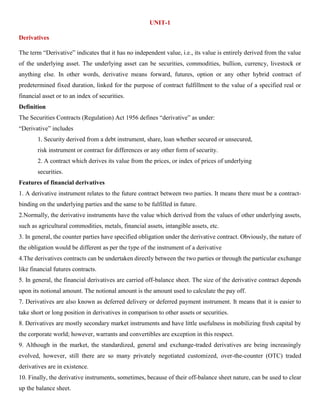
UNIT-1
Derivatives
The term “Derivative” indicates that it has no independent value, i.e., its value is entirely derived from the value
of the underlying asset. The underlying asset can be securities, commodities, bullion, currency, livestock or
anything else. In other words, derivative means forward, futures, option or any other hybrid contract of
predetermined fixed duration, linked for the purpose of contract fulfillment to the value of a specified real or
financial asset or to an index of securities.
Definition
The Securities Contracts (Regulation) Act 1956 defines “derivative” as under:
“Derivative” includes
1. Security derived from a debt instrument, share, loan whether secured or unsecured,
risk instrument or contract for differences or any other form of security.
2. A contract which derives its value from the prices, or index of prices of underlying
securities.
Features of financial derivatives
1. A derivative instrument relates to the future contract between two parties. It means there must be a contract-
binding on the underlying parties and the same to be fulfilled in future.
2.Normally, the derivative instruments have the value which derived from the values of other underlying assets,
such as agricultural commodities, metals, financial assets, intangible assets, etc.
3. In general, the counter parties have specified obligation under the derivative contract. Obviously, the nature of
the obligation would be different as per the type of the instrument of a derivative
4.The derivatives contracts can be undertaken directly between the two parties or through the particular exchange
like financial futures contracts.
5. In general, the financial derivatives are carried off-balance sheet. The size of the derivative contract depends
upon its notional amount. The notional amount is the amount used to calculate the pay off.
7. Derivatives are also known as deferred delivery or deferred payment instrument. It means that it is easier to
take short or long position in derivatives in comparison to other assets or securities.
8. Derivatives are mostly secondary market instruments and have little usefulness in mobilizing fresh capital by
the corporate world; however, warrants and convertibles are exception in this respect.
9. Although in the market, the standardized, general and exchange-traded derivatives are being increasingly
evolved, however, still there are so many privately negotiated customized, over-the-counter (OTC) traded
derivatives are in existence.
10. Finally, the derivative instruments, sometimes, because of their off-balance sheet nature, can be used to clear
up the balance sheet.
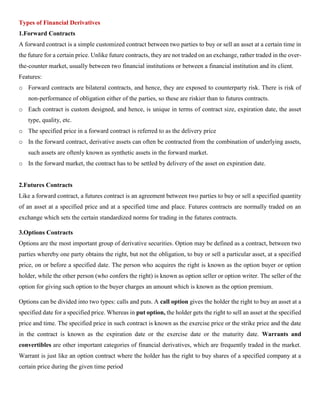
Types of Financial Derivatives
1.Forward Contracts
A forward contract is a simple customized contract between two parties to buy or sell an asset at a certain time in
the future for a certain price. Unlike future contracts, they are not traded on an exchange, rather traded in the over-
the-counter market, usually between two financial institutions or between a financial institution and its client.
Features:
o Forward contracts are bilateral contracts, and hence, they are exposed to counterparty risk. There is risk of
non-performance of obligation either of the parties, so these are riskier than to futures contracts.
o Each contract is custom designed, and hence, is unique in terms of contract size, expiration date, the asset
type, quality, etc.
o The specified price in a forward contract is referred to as the delivery price
o In the forward contract, derivative assets can often be contracted from the combination of underlying assets,
such assets are oftenly known as synthetic assets in the forward market.
o In the forward market, the contract has to be settled by delivery of the asset on expiration date.
2.Futures Contracts
Like a forward contract, a futures contract is an agreement between two parties to buy or sell a specified quantity
of an asset at a specified price and at a specified time and place. Futures contracts are normally traded on an
exchange which sets the certain standardized norms for trading in the futures contracts.
3.Options Contracts
Options are the most important group of derivative securities. Option may be defined as a contract, between two
parties whereby one party obtains the right, but not the obligation, to buy or sell a particular asset, at a specified
price, on or before a specified date. The person who acquires the right is known as the option buyer or option
holder, while the other person (who confers the right) is known as option seller or option writer. The seller of the
option for giving such option to the buyer charges an amount which is known as the option premium.
Options can be divided into two types: calls and puts. A call option gives the holder the right to buy an asset at a
specified date for a specified price. Whereas in put option, the holder gets the right to sell an asset at the specified
price and time. The specified price in such contract is known as the exercise price or the strike price and the date
in the contract is known as the expiration date or the exercise date or the maturity date. Warrants and
convertibles are other important categories of financial derivatives, which are frequently traded in the market.
Warrant is just like an option contract where the holder has the right to buy shares of a specified company at a
certain price during the given time period
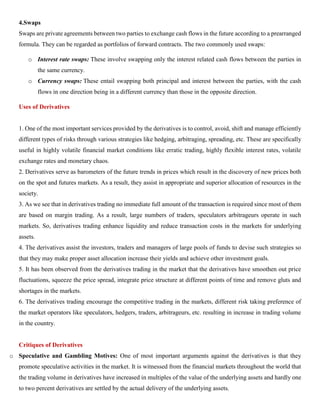
4.Swaps
Swaps are private agreements between two parties to exchange cash flows in the future according to a prearranged
formula. They can be regarded as portfolios of forward contracts. The two commonly used swaps:
o Interest rate swaps: These involve swapping only the interest related cash flows between the parties in
the same currency.
o Currency swaps: These entail swapping both principal and interest between the parties, with the cash
flows in one direction being in a different currency than those in the opposite direction.
Uses of Derivatives
1. One of the most important services provided by the derivatives is to control, avoid, shift and manage efficiently
different types of risks through various strategies like hedging, arbitraging, spreading, etc. These are specifically
useful in highly volatile financial market conditions like erratic trading, highly flexible interest rates, volatile
exchange rates and monetary chaos.
2. Derivatives serve as barometers of the future trends in prices which result in the discovery of new prices both
on the spot and futures markets. As a result, they assist in appropriate and superior allocation of resources in the
society.
3. As we see that in derivatives trading no immediate full amount of the transaction is required since most of them
are based on margin trading. As a result, large numbers of traders, speculators arbitrageurs operate in such
markets. So, derivatives trading enhance liquidity and reduce transaction costs in the markets for underlying
assets.
4. The derivatives assist the investors, traders and managers of large pools of funds to devise such strategies so
that they may make proper asset allocation increase their yields and achieve other investment goals.
5. It has been observed from the derivatives trading in the market that the derivatives have smoothen out price
fluctuations, squeeze the price spread, integrate price structure at different points of time and remove gluts and
shortages in the markets.
6. The derivatives trading encourage the competitive trading in the markets, different risk taking preference of
the market operators like speculators, hedgers, traders, arbitrageurs, etc. resulting in increase in trading volume
in the country.
Critiques of Derivatives
o Speculative and Gambling Motives: One of most important arguments against the derivatives is that they
promote speculative activities in the market. It is witnessed from the financial markets throughout the world that
the trading volume in derivatives have increased in multiples of the value of the underlying assets and hardly one
to two percent derivatives are settled by the actual delivery of the underlying assets.
o Increase in Risk: The derivatives are supposed to be efficient tool of risk management in the market. In fact, this
is also one-sided argument. It has been observed that the derivatives market—especially OTC markets, as
particularly customized, privately managed and negotiated, and thus, they are highly risky.
o Instability of the Financial System: It is argued that derivatives have increased risk not only for their users but
also for the whole financial system. The fears of micro and macro financial crisis have caused to the unchecked
growth of derivatives which have turned many market players into big losers. The malpractices, desperate
behaviour and fraud by the users of derivatives have threatened the stability of the financial markets and the
financial system.
o Price Instability: Derivatives have caused wild fluctuations in asset prices, and moreover, they have widened the
range of such fluctuations in the prices. The derivatives may be helpful in price stabilization only if there exist a
properly organized, competitive and well-regulated market.
o Displacement Effect: There is another doubt about the growth of the derivatives that they will reduce the volume
of the business in the primary or new issue market specifically for the new and small corporate units. It is
apprehension that most of investors will divert to the derivatives markets, raising fresh capital by such units will
be difficult, and hence, this will create displacement effect in the financial market.
o Increased Regulatory Burden: Derivatives create instability in the financial system as a result, there will be
more burden on the government or regulatory authorities to control the activities of the traders in financial
derivatives. As we see various financial crises and scams in the market from time to time, most of time and energy
of the regulatory authorities just spent on to find out new regulatory, supervisory and monitoring tools so that the
derivatives do not lead to the fall of the financial system.
Major Recommendations of Dr. L.C. Gupta Committee
Before discussing the emerging structure of derivatives markets in India, let us have a brief view of the important
recommendations made by the Dr. L.C. Gupta Committee on the introduction of derivatives markets in India.
These are as under:
1. The Committee is strongly of the view that there is urgent need of introducing of financial derivatives to
facilitate market development and hedging in a most cost-efficient way against market risk by the participants
such as mutual funds and other investment institutions.
2. There is need for equity derivatives, interest rate derivatives and currency derivatives.
3. Futures trading through derivatives should be introduced in phased manner starting with stock index futures,
which will be followed by options on index and later options on stocks. It will enhance the efficiency and liquidity
of cash markets in equities through arbitrage process.
4. There should be two-level regulation (regulatory framework for derivatives trading), i.e., exchange level and
SEBI level. Further, there must be considerable emphasis on self-regulatory competence of derivative exchanges
under the overall supervision and guidance of SEBI.
5. The derivative trading should be initiated on a separate segment of existing stock exchanges having an
independent governing council. The number of the trading members will be limited to 40 percent of the total
number. The Chairman of the governing council will not be permitted to trade on any of the stock exchanges.
6. The settlement of derivatives will be through an independent clearing Corporation/Clearing house, which will
become counter-party for all trades or alternatively guarantees the settlement of all trades. The clearing
corporation will have adequate risk containment measures and will collect margins through EFT.
7. The derivatives exchange will have on-line-trading and adequate surveillance systems. It will disseminate trade
and price information on real time basis through two information vending networks. It should inspect 100 percent
of members every year.
8. There will be complete segregation of client money at the level of trading/clearing member and even at the
level of clearing corporation.
9. The trading and clearing member will have stringent eligibility conditions. At least two persons should have
passed the certification programme approved by the SEBI.
10. The clearing members should deposit minimum ` 50 lakh with clearing corporation and should have a net
worth of ` 3 crore.
11. Removal of the regulatory prohibition on the use of derivatives by mutual funds while making the trustees
responsible to restrict the use of derivatives by mutual funds only to hedging and portfolio balancing and not for
specification.
12. The operations of the cash market on which the derivatives market will be based, needed improvement in
many respects.
13. Creation of a Derivation Cell, a Derivative Advisory Committee, and Economic Research Wing by SEBI.
14. Declaration of derivatives as ‘securities’ under Section 2 (h) of the SCRA and suitable amendments in the
notification issued by the Central Government in June, 1969 under Section 16 of the SCRA.
Benefits of Derivatives
1. India’s financial market system will strongly benefit from smoothly functioning index derivatives markets.
2. Internationally, the launch of derivatives has been associated with substantial improvements in market quality
on the underlying equity market. Liquidity and market efficiency on India’s equity market will improve once the
derivatives commence trading.
3. Many risks in the financial markets can be eliminated by diversification. Index derivatives are special in so far
as they can be used by the investors to protect themselves from the one risk in the equity market that cannot be
diversified away,
4. Foreign investors coming into India would be more comfortable if the hedging vehicles routinely used by them
worldwide are available to them.
5. The launch of derivatives is a logical next step in the development of human capital in India. Skills in the
financial sector have grown tremendously in the last few years.
Categories of Derivatives Traded in India
1. Commodities futures for coffee, oil seeds, and oil, gold, silver, pepper, cotton, jute and jute goods are traded in
the commodities futures. Forward Markets Commission regulates the trading of commodities futures.
2. Index futures based on Sensex and NIFTY index are also traded under the supervision of Securities and
Exchange Board of India (SEBI).
3. The RBI has permitted banks, Financial Institutions (F1’s) and Primary Dealers (PD’s) to enter into forward
rate agreement (FRAs)/interest rate stvaps in order to facilitate hedging of interest rate risk and ensuring orderly
development of the derivatives market.
4. The National Stock Exchange (NSE) became the first exchange to launch trading in options on individual
securities. Trading in options on individual securities commenced from July, 2001.
5. Options contracts are American style and cash settled and are available in about 40 securities Stipulated by the
Securities and Exchange Board of India.
6. The NSE commenced trading in futures on individual securities on November 9,2001. The futures contracts
are available in about 31 securities stipulated by SEBI.The BSE also started trading in stock options and futures
(both Index and Stocks) around at the same time as the NSE.
7. The National Stock Exchange commenced trading in interest rate future on June 2003. Interest rate futures
contracts are available on 91-day 1-bills, 10-year bonds and 10-year zero coupon bonds as specified by the SEBI.
Derivatives Trading at NSE/BSE
The National Stock Exchange of India Limited (NSE) commenced trading in derivatives with the launch of index
futures on June 12, 2000. The futures contracts are based on the popular benchmark Nifty 50 Index.
The Exchange introduced trading in Index Options (also based on Nifty 50) on June 4, 2001. NSE also became
the first exchange to launch trading in options on individual securities from July 2, 2001. Futures on individual
securities were introduced on November 9, 2001. Futures and Options on individual securities are available on
175 securities stipulated by SEBI.
The Exchange has also introduced trading in Futures and Options contracts based on Nifty IT, Nifty Bank, and
Nifty Midcap 50, Nifty Infrastructure, Nifty PSE, Nifty CPSE indices.
This section provides you with an insight into the derivatives segment of NSE. Real-time quotes and information
regarding derivative products, trading systems & processes, clearing and settlement, risk management, statistics
etc. are available here.
Products available in NSE:
Since the launch of the Index Derivatives on the popular benchmark Nifty 50 Index in 2000, the National Stock
Exchange of India Limited (NSE) today have moved ahead with a varied product offering in equity derivatives.
The Exchange currently provides trading in Futures and Options contracts on 9 major indices and more than 100
securities.
Derivatives on the following Products
• Nifty 50 Index
• Nifty IT Index
• Nifty Bank Index
• Nifty Midcap 50 Index
• Nifty Infrastructure Index
• Nifty PSE Index
• Individual Securities
• Nifty CPS
Participants of Derivatives Markets
Derivatives are those financial instruments which derive their value from the value of other assets. In other words,
they have no value on their own rather their value depends on the value of the underlying asset There are 3
important participants in the derivatives market which include the following :
1. Hedgers – They are those who buy or sell in derivatives market in order to reduce their risk of their portfolio.
For example, if the portfolio of hedger is long then he will protect or hedge this position by buying put options in
derivatives market.
2. Speculators – Speculators are those who enter into the market purely for making profit by buying or selling
the derivatives, they do not have any intention of hedging their portfolio or such thing their only aim is to make
profit based on their judgment about the stock or market.
3. Arbitrageurs – Arbitrage refers to obtaining risk free profits by simultaneously buying and selling similar
instruments in different markets. Arbitrageurs enter into derivative market in order to take advantage of any such
opportunity and profit from it
Regulation of Financial Derivatives in India
With the amendment in the definition of ''securities'' under SC(R)A (to include derivative contracts in the
definition of securities), derivatives trading takes place under the provisions of the Securities Contracts
(Regulation) Act, 1956 and the Securities and Exchange Board of India Act, 1992.
Dr. L.C Gupta Committee constituted by SEBI had laid down the regulatory framework for derivative trading in
India. SEBI has also framed suggestive bye-law for Derivative Exchanges/Segments and their Clearing
Corporation/House which lays down the provisions for trading and settlement of derivative contracts. The Rules,
Bye-laws & Regulations of the Derivative Segment of the Exchanges and their Clearing Corporation/House have
to be framed in line with the suggestive Bye-laws. SEBI has also laid the eligibility conditions for Derivative
Exchange/Segment and its Clearing Corporation/House. The eligibility conditions have been framed to ensure
that Derivative Exchange/Segment & Clearing Corporation/House provide a transparent trading environment,
safety & integrity and provide facilities for redressal of investor grievances. Some of the important eligibility
conditions are –
1.Derivative trading to take place through an online screen based Trading System.
2.The Derivatives Exchange/Segment shall have online surveillance capability to monitor positions, prices, and
volumes on a real time basis to deter market manipulation.
3.The Derivatives Exchange/ Segment should have arrangements for dissemination of information about trades,
quantities and quotes on a real time basis through at least two information vending networks, which are easily
accessible to investors across the country.
4.The Derivatives Exchange/Segment should have arbitration and investor grievances redressal mechanism
operative from all the four areas / regions of the country.
5.The Derivatives Exchange/Segment should have satisfactory system of monitoring investor complaints and
preventing irregularities in trading.
6.The Derivative Segment of the Exchange would have a separate Investor Protection Fund.
7.The Clearing Corporation/House shall perform full novation, i.e. the Clearing Corporation/House shall
interpose itself between both legs of every trade, becoming the legal counterparty to both or alternatively should
provide an unconditional guarantee for settlement of all trades.
8.The Clearing Corporation/House shall have the capacity to monitor the overall position of Members across
both derivatives market and the underlying securities market for those Members who are participating in both.
9.The level of initial margin on Index Futures Contracts shall be related to the risk of loss on the position. The
concept of value-at-risk shall be used in calculating required level of initial margins. The initial margins should
be large enough to cover the one-day loss that can be encountered on the position on 99% of the days.
10.The Clearing Corporation/House shall establish facilities for electronic funds transfer (EFT) for swift
movement of margin payments.
11.In the event of a Member defaulting in meeting its liabilities, the Clearing Corporation/House shall transfer
client positions and assets to another solvent Member or close-out all open positions.
12.The Clearing Corporation/House should have capabilities to segregate initial margins deposited by Clearing
Members for trades on their own account and on account of his client. The Clearing Corporation/House shall
hold the clients' margin money in trust for the client purposes only and should not allow its diversion for any
other purpose.
13.The Clearing Corporation/House shall have a separate Trade Guarantee Fund for the trades executed on
Derivative Exchange / Segment.
Presently, SEBI has permitted Derivative Trading on the Derivative Segment of BSE and the F&O Segment of
NSE.
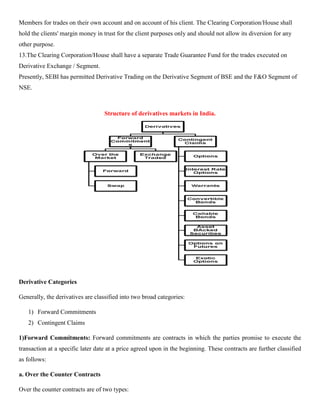
Structure of derivatives markets in India.
Derivative Categories
Generally, the derivatives are classified into two broad categories:
1) Forward Commitments
2) Contingent Claims
1)Forward Commitments: Forward commitments are contracts in which the parties promise to execute the
transaction at a specific later date at a price agreed upon in the beginning. These contracts are further classified
as follows:
a. Over the Counter Contracts
Over the counter contracts are of two types:
Forward: In this type of contract, one party commits to buy and the other commits to sell an underlying asset at
a certain price on a certain future date. The underlying can either be a physical asset or a stock. The loss or gain
of a particular party is determined by the price movement of the asset. If the price increases, the buyer incurs a
gain as he still gets to buy the asset at the older and lower price. On the other hand, the seller incurs a loss in the
same scenario.
Swap: Swap can be defined as a series of forward derivatives. It is essentially a contract between two parties
where they exchange a series of cash flows in the future. One party will consent to pay the floating interest rate
on a principal amount while the other party will pay a fixed interest rate on the same amount in return. Currency
and equity returns swaps are the most commonly used swaps in the markets.
b. Exchange Traded Contracts
Exchange traded forward commitments are called futures. A future contract is another version of a forward
contract, which is exchange-traded and standardized. Unlike forward contracts, future contracts are actively traded
in the secondary market, have the backing of the clearinghouse, follow regulations and involve a daily settlement
cycle of gains and losses.
2.Contingent Claims:
Contingent claims are contracts in which the payoff depends on the occurrence of a certain event. Unlike forward
commitments where the contract is bound to be settled on or before the termination date, contingent claims are
legally obliged to settle the contract only when a specific event occurs. Contingent claims are also categorized
into OTC and exchange-traded contracts, depending on the type of contract. The contingent claims are further
sub-divided into the following types of derivatives:
o Options: Options are the type of contingent claims that are dependent on the price of the stock at a future date.
Unlike the forward commitments derivatives where payoffs are calculated keeping the movement of the price in
mind, the options have payoffs only if the price of the stock crosses a certain threshold. Options are of two types:
Call and Put. A call option gives the option to buy the underlying asset at a specific price. A put option is the
option to sell the underlying at a certain price.
o Interest Rate Options: Options where the underlying is not a physical asset or a stock, but the interest rates.
o Warrants: Warrants are the options which have a maturity period of more than one year and hence, are called
long-dated options. These are mostly OTC derivatives.
o Convertible Bonds: Convertible bonds are the type of contingent claims that gives the bondholder an option to
participate in the capital gains caused by the upward movement in the stock price of the company, without any
obligation to share the losses.
o Callable Bonds: Callable bonds provide an option to the issuer to completely pay off the bonds before their
maturity.
o Asset-Backed Securities: Asset-backed securities are also a type of contingent claim as they contain an optional
feature, which is the prepayment option available to the asset owners.
o Options on Futures: A type of options that are based on the futures contracts.
o Exotic Options: These are the advanced versions of the standard options, having more complex features. In
addition to the categorization of derivatives on the basis of payoffs, they are also sub-divided on the basis of their
underlying asset. Since a derivative will always have an underlying asset, it is common to categorize derivatives
on the basis of the asset. Equity derivatives, weather derivatives, interest rate derivatives, commodity derivatives,
exchange derivatives, etc are the most popular ones
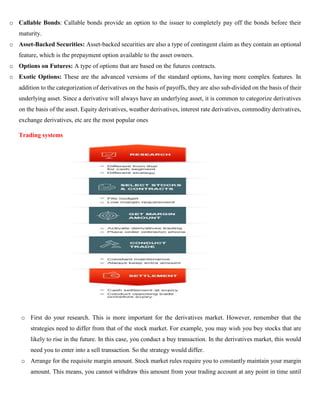
Trading systems
o First do your research. This is more important for the derivatives market. However, remember that the
strategies need to differ from that of the stock market. For example, you may wish you buy stocks that are
likely to rise in the future. In this case, you conduct a buy transaction. In the derivatives market, this would
need you to enter into a sell transaction. So the strategy would differ.
o Arrange for the requisite margin amount. Stock market rules require you to constantly maintain your margin
amount. This means, you cannot withdraw this amount from your trading account at any point in time until
the trade is settled. Also remember that the margin amount changes as the price of the underlying stock rises
or falls. So, always keep extra money in your account.
o Conduct the transaction through your trading account. You will have to first make sure that your account
allows you to trade in derivatives. If not, consult your brokerage or stock broker and get the required services
activated. Once you do this, you can place an order online or on phone with your broker.
o Select your stocks and their contracts on the basis of the amount you have in hand, the margin requirements,
the price of the underlying shares, as well as the price of the contracts. Yes, you do have to pay a small
amount to buy the contract. Ensure all this fits your budget.
o You can wait until the contract is scheduled to expiry to settle the trade.
UNIT-2
Forward Contracts:
Forward contracts are contracts that initiated at one time but performance occurs at a subsequent time. The term
of contract such as price, delivery date, quantity, and quality of the assets are specified at the time of initiating
the contract but actual performance takes place at a later date. It is a type of contract which is settled at a maturity.
It is there for a contract for forward delivery and not for immediate, spot or cash delivery.
Pricing and Trading Mechanism of Forward Contracts:
Delivery price or Forward Price:
A forward price is the predetermined delivery price for an underlying commodity, currency or financial
asset decided upon by the long (the buyer) and the short (the seller) to be paid at predetermined date in the future.
At the inception of a forward contract, the forward price makes the value of the contract at that time, zero.
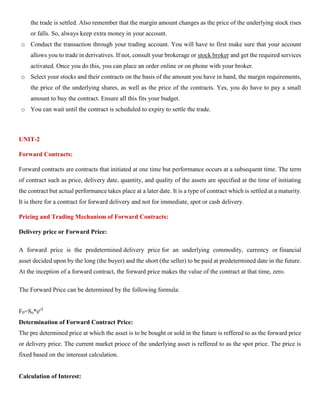
The Forward Price can be determined by the following formula:
F0=So*erT
Determination of Forward Contract Price:
The pre determined price at which the asset is to be bought or sold in the future is reffered to as the forward price
or delivery price. The current market prioce of the underlying asset is reffered to as the spot price. The price is
fixed based on the intereast calculation.
Calculation of Interest:
Interest is calculated based on simple interest or compound interest. An interest may be calculated periodically
based on annually, semi annually, or quarterly. The compounding method of interest is preferred. The formula
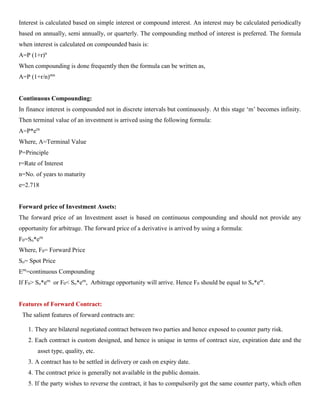
when interest is calculated on compounded basis is:
A=P (1+r)n
When compounding is done frequently then the formula can be written as,
A=P (1+r/n)mn
Continuous Compounding:
In finance interest is compounded not in discrete intervals but continuously. At this stage ‘m’ becomes infinity.
Then terminal value of an investment is arrived using the following formula:
A=P*ern
Where, A=Terminal Value
P=Principle
r=Rate of Interest
n=No. of years to maturity
e=2.718
Forward price of Investment Assets:
The forward price of an Investment asset is based on continuous compounding and should not provide any
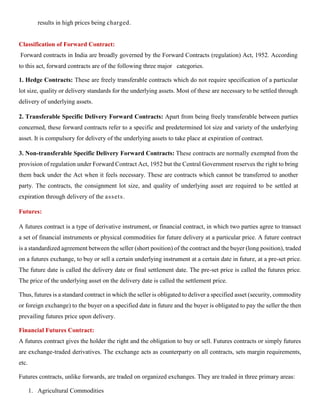
opportunity for arbitrage. The forward price of a derivative is arrived by using a formula:
F0=So*ern
Where, F0= Forward Price
So= Spot Price
Ern
=continuous Compounding
If F0> So*ern
or F0< So*ern
, Arbitrage opportunity will arrive. Hence F0 should be equal to So*ern
.
Features of Forward Contract:
The salient features of forward contracts are:
1. They are bilateral negotiated contract between two parties and hence exposed to counter party risk.
2. Each contract is custom designed, and hence is unique in terms of contract size, expiration date and the
asset type, quality, etc.
3. A contract has to be settled in delivery or cash on expiry date.
4. The contract price is generally not available in the public domain.
5. If the party wishes to reverse the contract, it has to compulsorily got the same counter party, which often
results in high prices being charged.
Classification of Forward Contract:
Forward contracts in India are broadly governed by the Forward Contracts (regulation) Act, 1952. According
to this act, forward contracts are of the following three major categories.
1. Hedge Contracts: These are freely transferable contracts which do not require specification of a particular
lot size, quality or delivery standards for the underlying assets. Most of these are necessary to be settled through
delivery of underlying assets.
2. Transferable Specific Delivery Forward Contracts: Apart from being freely transferable between parties
concerned, these forward contracts refer to a specific and predetermined lot size and variety of the underlying
asset. It is compulsory for delivery of the underlying assets to take place at expiration of contract.
3. Non-transferable Specific Delivery Forward Contracts: These contracts are normally exempted from the
provision of regulation under Forward Contract Act, 1952 but the Central Government reserves the right to bring
them back under the Act when it feels necessary. These are contracts which cannot be transferred to another
party. The contracts, the consignment lot size, and quality of underlying asset are required to be settled at
expiration through delivery of the assets.
Futures:
A futures contract is a type of derivative instrument, or financial contract, in which two parties agree to transact
a set of financial instruments or physical commodities for future delivery at a particular price. A future contract
is a standardized agreement between the seller (short position) of the contract and the buyer (long position), traded
on a futures exchange, to buy or sell a certain underlying instrument at a certain date in future, at a pre-set price.
The future date is called the delivery date or final settlement date. The pre-set price is called the futures price.
The price of the underlying asset on the delivery date is called the settlement price.
Thus, futures is a standard contract in which the seller is obligated to deliver a specified asset (security, commodity
or foreign exchange) to the buyer on a specified date in future and the buyer is obligated to pay the seller the then
prevailing futures price upon delivery.
Financial Futures Contract:
A futures contract gives the holder the right and the obligation to buy or sell. Futures contracts or simply futures
are exchange-traded derivatives. The exchange acts as counterparty on all contracts, sets margin requirements,
etc.
Futures contracts, unlike forwards, are traded on organized exchanges. They are traded in three primary areas:
1. Agricultural Commodities
2. Metals and Petroleum, and
3. Financial Assets (individual stocks, indices, interest rate, currency)
Types of Futures Contract:
Futures contracts are of the following categories:
Stock Index Futures
These futures contract without actual delivery were introduced only in 1982 and are the most recent major futures
contract to emerge. In the United States, these contracts trade on several market indices like Standard and Poor's
500, a major market index, the NYSE Index and the Value Line Index. Numerous contracts on industry indices
are now trading as well.
A stock index futures contract is a contract to buy or sell the face value of the underlying stock index where the
face value is defined as being the value of index multiplied by the specified monetary amount.
Commodity Futures
The commodity futures include:
Agricultural futures contracts: These contracts are traded in grains, oil and meal, livestock, forest products,
textiles and foodstuff.
Metallurgical futures contract: This category includes genuine metal and petroleum contracts. Among the
metals, contracts are traded on gold, silver, platinum and copper. Of the petroleum products, only heating oil,
crude oil and gasoline are traded.
Currency Futures
Currency future is the price of a particular currency for settlement at a specified future date. Currency futures
are traded on future exchanges and the exchanges where the contracts are fungible (or transferable freely) are
very popular. The two most popular future exchanges are the Singapore International Monetary Exchange
(SIMEX) and the International Money Market, Chicago (IMM). Other exchanges are in London, Sydney,
Frankfurt, New York, Philadelphia, etc.
The first exchange-traded foreign currency futures contracts were launched on the International Monetary
Market (IMM) – now part of the Chicago Mercantile Exchange (CME)
The CME remains the most active market in these contracts to this day, though a number of other exchanges have
launched their own contracts.
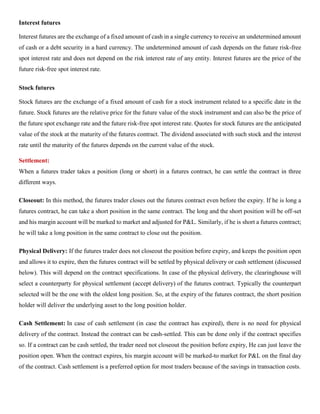
Interest futures
Interest futures are the exchange of a fixed amount of cash in a single currency to receive an undetermined amount
of cash or a debt security in a hard currency. The undetermined amount of cash depends on the future risk-free
spot interest rate and does not depend on the risk interest rate of any entity. Interest futures are the price of the
future risk-free spot interest rate.
Stock futures
Stock futures are the exchange of a fixed amount of cash for a stock instrument related to a specific date in the
future. Stock futures are the relative price for the future value of the stock instrument and can also be the price of
the future spot exchange rate and the future risk-free spot interest rate. Quotes for stock futures are the anticipated
value of the stock at the maturity of the futures contract. The dividend associated with such stock and the interest
rate until the maturity of the futures depends on the current value of the stock.
Settlement:
When a futures trader takes a position (long or short) in a futures contract, he can settle the contract in three
different ways.
Closeout: In this method, the futures trader closes out the futures contract even before the expiry. If he is long a
futures contract, he can take a short position in the same contract. The long and the short position will be off-set
and his margin account will be marked to market and adjusted for P&L. Similarly, if he is short a futures contract;
he will take a long position in the same contract to close out the position.
Physical Delivery: If the futures trader does not closeout the position before expiry, and keeps the position open
and allows it to expire, then the futures contract will be settled by physical delivery or cash settlement (discussed
below). This will depend on the contract specifications. In case of the physical delivery, the clearinghouse will
select a counterparty for physical settlement (accept delivery) of the futures contract. Typically the counterpart
selected will be the one with the oldest long position. So, at the expiry of the futures contract, the short position
holder will deliver the underlying asset to the long position holder.
Cash Settlement: In case of cash settlement (in case the contract has expired), there is no need for physical
delivery of the contract. Instead the contract can be cash-settled. This can be done only if the contract specifies
so. If a contract can be cash settled, the trader need not closeout the position before expiry, He can just leave the
position open. When the contract expires, his margin account will be marked-to market for P&L on the final day
of the contract. Cash settlement is a preferred option for most traders because of the savings in transaction costs.
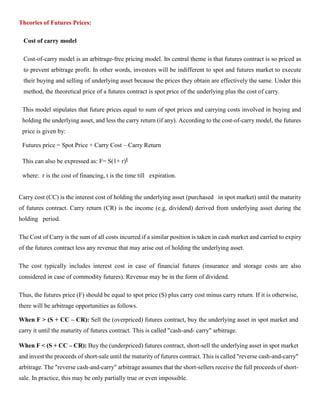
Theories of Futures Prices:
Cost of carry model
Cost-of-carry model is an arbitrage-free pricing model. Its central theme is that futures contract is so priced as
to prevent arbitrage profit. In other words, investors will be indifferent to spot and futures market to execute
their buying and selling of underlying asset because the prices they obtain are effectively the same. Under this
method, the theoretical price of a futures contract is spot price of the underlying plus the cost of carry.
This model stipulates that future prices equal to sum of spot prices and carrying costs involved in buying and
holding the underlying asset, and less the carry return (if any). According to the cost-of-carry model, the futures
price is given by:
Futures price = Spot Price + Carry Cost – Carry Return
This can also be expressed as: F= S(1+ r)t
where: r is the cost of financing, t is the time till expiration.
Carry cost (CC) is the interest cost of holding the underlying asset (purchased in spot market) until the maturity
of futures contract. Carry return (CR) is the income (e.g, dividend) derived from underlying asset during the
holding period.
The Cost of Carry is the sum of all costs incurred if a similar position is taken in cash market and carried to expiry
of the futures contract less any revenue that may arise out of holding the underlying asset.
The cost typically includes interest cost in case of financial futures (insurance and storage costs are also
considered in case of commodity futures). Revenue may be in the form of dividend.
Thus, the futures price (F) should be equal to spot price (S) plus carry cost minus carry return. If it is otherwise,
there will be arbitrage opportunities as follows.
When F > (S + CC – CR): Sell the (overpriced) futures contract, buy the underlying asset in spot market and
carry it until the maturity of futures contract. This is called "cash-and- carry" arbitrage.
When F < (S + CC – CR): Buy the (underpriced) futures contract, short-sell the underlying asset in spot market
and invest the proceeds of short-sale until the maturity of futures contract. This is called "reverse cash-and-carry"
arbitrage. The "reverse cash-and-carry" arbitrage assumes that the short-sellers receive the full proceeds of short-
sale. In practice, this may be only partially true or even impossible.
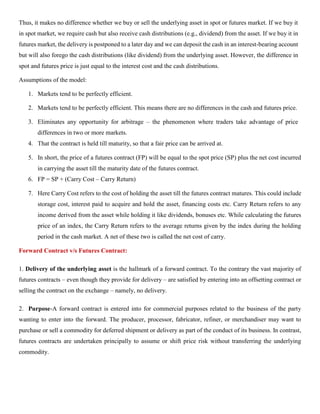
Thus, it makes no difference whether we buy or sell the underlying asset in spot or futures market. If we buy it
in spot market, we require cash but also receive cash distributions (e.g., dividend) from the asset. If we buy it in
futures market, the delivery is postponed to a later day and we can deposit the cash in an interest-bearing account
but will also forego the cash distributions (like dividend) from the underlying asset. However, the difference in
spot and futures price is just equal to the interest cost and the cash distributions.
Assumptions of the model:
1. Markets tend to be perfectly efficient.
2. Markets tend to be perfectly efficient. This means there are no differences in the cash and futures price.
3. Eliminates any opportunity for arbitrage – the phenomenon where traders take advantage of price
differences in two or more markets.
4. That the contract is held till maturity, so that a fair price can be arrived at.
5. In short, the price of a futures contract (FP) will be equal to the spot price (SP) plus the net cost incurred
in carrying the asset till the maturity date of the futures contract.
6. FP = SP + (Carry Cost – Carry Return)
7. Here Carry Cost refers to the cost of holding the asset till the futures contract matures. This could include
storage cost, interest paid to acquire and hold the asset, financing costs etc. Carry Return refers to any
income derived from the asset while holding it like dividends, bonuses etc. While calculating the futures
price of an index, the Carry Return refers to the average returns given by the index during the holding
period in the cash market. A net of these two is called the net cost of carry.
Forward Contract v/s Futures Contract:
1. Delivery of the underlying asset is the hallmark of a forward contract. To the contrary the vast majority of
futures contracts – even though they provide for delivery – are satisfied by entering into an offsetting contract or
selling the contract on the exchange – namely, no delivery.
2. Purpose-A forward contract is entered into for commercial purposes related to the business of the party
wanting to enter into the forward. The producer, processor, fabricator, refiner, or merchandiser may want to
purchase or sell a commodity for deferred shipment or delivery as part of the conduct of its business. In contrast,
futures contracts are undertaken principally to assume or shift price risk without transferring the underlying
commodity.
3. Format -A forward contract is privately and individually negotiated between two principals. A futures
contract is an exchange-traded contract, with standardized provisions related to commodity units; margin
requirements related to price movements; clearing organizations.
Futurescontractsarestandardizedcontractsthataretradedonorganizedfuturesmarkets.Forward contracts, on the
other hand, are private deals between two individuals who can sign any type of contract they agree on.
The organization of futures trading with a clearing house reduces the default risks of trading. The exchange
members, in effect, guarantee both sides of a contract. In contrast, a forward contract is a private deal between
two parties and is subject to the risk that either side may default on the terms of the agreement.
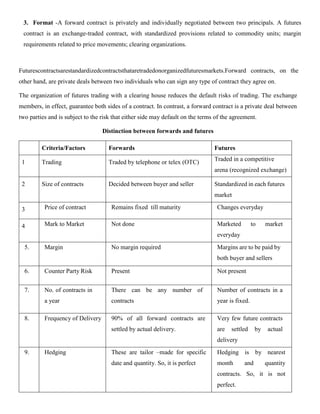
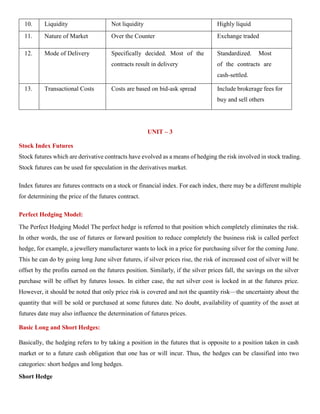
Distinction between forwards and futures
Criteria/Factors Forwards Futures
1 Trading Traded by telephone or telex (OTC)
Traded in a competitive
arena (recognized exchange)
2 Size of contracts Decided between buyer and seller Standardized in each futures
market
3 Price of contract Remains fixed till maturity Changes everyday
4 Mark to Market Not done Marketed to market
everyday
5. Margin No margin required Margins are to be paid by
both buyer and sellers
6. Counter Party Risk Present Not present
7. No. of contracts in
a year
There can be any number of
contracts
Number of contracts in a
year is fixed.
8. Frequency of Delivery 90% of all forward contracts are
settled by actual delivery.
Very few future contracts
are settled by actual
delivery
9. Hedging These are tailor –made for specific
date and quantity. So, it is perfect
Hedging is by nearest
month and quantity
contracts. So, it is not
perfect.
UNIT – 3
Stock Index Futures
Stock futures which are derivative contracts have evolved as a means of hedging the risk involved in stock trading.
Stock futures can be used for speculation in the derivatives market.
Index futures are futures contracts on a stock or financial index. For each index, there may be a different multiple
for determining the price of the futures contract.
Perfect Hedging Model:
The Perfect Hedging Model The perfect hedge is referred to that position which completely eliminates the risk.
In other words, the use of futures or forward position to reduce completely the business risk is called perfect
hedge, for example, a jewellery manufacturer wants to lock in a price for purchasing silver for the coming June.
This he can do by going long June silver futures, if silver prices rise, the risk of increased cost of silver will be
offset by the profits earned on the futures position. Similarly, if the silver prices fall, the savings on the silver
purchase will be offset by futures losses. In either case, the net silver cost is locked in at the futures price.
However, it should be noted that only price risk is covered and not the quantity risk—the uncertainty about the
quantity that will be sold or purchased at some futures date. No doubt, availability of quantity of the asset at
futures date may also influence the determination of futures prices.
Basic Long and Short Hedges:
Basically, the hedging refers to by taking a position in the futures that is opposite to a position taken in cash
market or to a future cash obligation that one has or will incur. Thus, the hedges can be classified into two
categories: short hedges and long hedges.
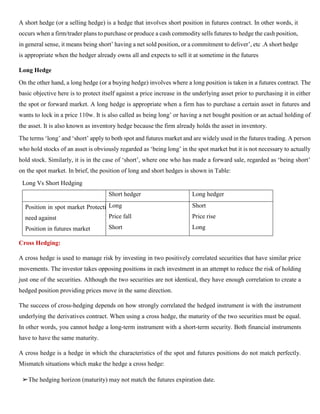
Short Hedge
10. Liquidity Not liquidity Highly liquid
11. Nature of Market Over the Counter Exchange traded
12. Mode of Delivery Specifically decided. Most of the
contracts result in delivery
Standardized. Most
of the contracts are
cash-settled.
13. Transactional Costs Costs are based on bid-ask spread Include brokerage fees for
buy and sell others
A short hedge (or a selling hedge) is a hedge that involves short position in futures contract. In other words, it
occurs when a firm/trader plans to purchase or produce a cash commodity sells futures to hedge the cash position,
in general sense, it means being short’ having a net sold position, or a commitment to deliver’, etc .A short hedge
is appropriate when the hedger already owns all and expects to sell it at sometime in the futures
Long Hedge
On the other hand, a long hedge (or a buying hedge) involves where a long position is taken in a futures contract. The
basic objective here is to protect itself against a price increase in the underlying asset prior to purchasing it in either
the spot or forward market. A long hedge is appropriate when a firm has to purchase a certain asset in futures and
wants to lock in a price 110w. It is also called as being long’ or having a net bought position or an actual holding of
the asset. It is also known as inventory hedge because the firm already holds the asset in inventory.
The terms ‘long’ and ‘short’ apply to both spot and futures market and are widely used in the futures trading. A person
who hold stocks of an asset is obviously regarded as ‘being long’ in the spot market but it is not necessary to actually
hold stock. Similarly, it is in the case of ‘short’, where one who has made a forward sale, regarded as ‘being short’
on the spot market. In brief, the position of long and short hedges is shown in Table:
Long Vs Short Hedging
Short hedger Long hedger
Position in spot market Protection
need against
Position in futures market
Long
Price fall
Short
Short
Price rise
Long
Cross Hedging:
A cross hedge is used to manage risk by investing in two positively correlated securities that have similar price
movements. The investor takes opposing positions in each investment in an attempt to reduce the risk of holding
just one of the securities. Although the two securities are not identical, they have enough correlation to create a
hedged position providing prices move in the same direction.
The success of cross-hedging depends on how strongly correlated the hedged instrument is with the instrument
underlying the derivatives contract. When using a cross hedge, the maturity of the two securities must be equal.
In other words, you cannot hedge a long-term instrument with a short-term security. Both financial instruments
have to have the same maturity.
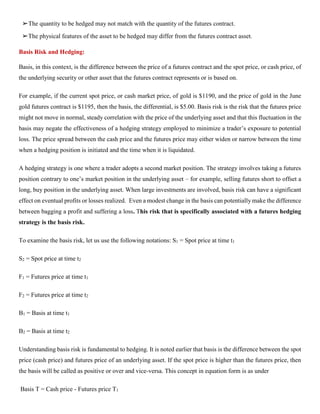
A cross hedge is a hedge in which the characteristics of the spot and futures positions do not match perfectly.
Mismatch situations which make the hedge a cross hedge:
➢The hedging horizon (maturity) may not match the futures expiration date.
➢The quantity to be hedged may not match with the quantity of the futures contract.
➢The physical features of the asset to be hedged may differ from the futures contract asset.
Basis Risk and Hedging:
Basis, in this context, is the difference between the price of a futures contract and the spot price, or cash price, of
the underlying security or other asset that the futures contract represents or is based on.
For example, if the current spot price, or cash market price, of gold is $1190, and the price of gold in the June
gold futures contract is $1195, then the basis, the differential, is $5.00. Basis risk is the risk that the futures price
might not move in normal, steady correlation with the price of the underlying asset and that this fluctuation in the
basis may negate the effectiveness of a hedging strategy employed to minimize a trader’s exposure to potential
loss. The price spread between the cash price and the futures price may either widen or narrow between the time
when a hedging position is initiated and the time when it is liquidated.
A hedging strategy is one where a trader adopts a second market position. The strategy involves taking a futures
position contrary to one’s market position in the underlying asset – for example, selling futures short to offset a
long, buy position in the underlying asset. When large investments are involved, basis risk can have a significant
effect on eventual profits or losses realized. Even a modest change in the basis can potentially make the difference
between bagging a profit and suffering a loss. This risk that is specifically associated with a futures hedging
strategy is the basis risk.
To examine the basis risk, let us use the following notations: S1 = Spot price at time t1
S2 = Spot price at time t2
F1 = Futures price at time t1
F2 = Futures price at time t2
B1 = Basis at time t1
B2 = Basis at time t2
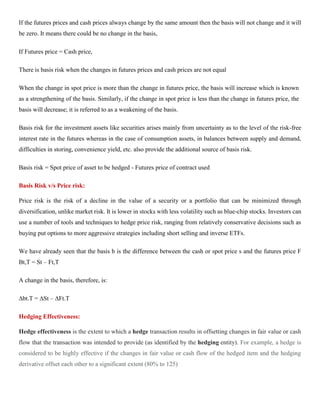
Understanding basis risk is fundamental to hedging. It is noted earlier that basis is the difference between the spot
price (cash price) and futures price of an underlying asset. If the spot price is higher than the futures price, then
the basis will be called as positive or over and vice-versa. This concept in equation form is as under
Basis T = Cash price - Futures price T1
If the futures prices and cash prices always change by the same amount then the basis will not change and it will
be zero. It means there could be no change in the basis,
If Futures price = Cash price,
There is basis risk when the changes in futures prices and cash prices are not equal
When the change in spot price is more than the change in futures price, the basis will increase which is known
as a strengthening of the basis. Similarly, if the change in spot price is less than the change in futures price, the
basis will decrease; it is referred to as a weakening of the basis.
Basis risk for the investment assets like securities arises mainly from uncertainty as to the level of the risk-free
interest rate in the futures whereas in the case of consumption assets, in balances between supply and demand,
difficulties in storing, convenience yield, etc. also provide the additional source of basis risk.
Basis risk = Spot price of asset to be hedged - Futures price of contract used
Basis Risk v/s Price risk:
Price risk is the risk of a decline in the value of a security or a portfolio that can be minimized through
diversification, unlike market risk. It is lower in stocks with less volatility such as blue-chip stocks. Investors can
use a number of tools and techniques to hedge price risk, ranging from relatively conservative decisions such as
buying put options to more aggressive strategies including short selling and inverse ETFs.
We have already seen that the basis b is the difference between the cash or spot price s and the futures price F
Bt,T = St – Ft,T
A change in the basis, therefore, is:
∆bt.T = ∆St – ∆Ft.T
Hedging Effectiveness:
Hedge effectiveness is the extent to which a hedge transaction results in offsetting changes in fair value or cash
flow that the transaction was intended to provide (as identified by the hedging entity). For example, a hedge is
considered to be highly effective if the changes in fair value or cash flow of the hedged item and the hedging
derivative offset each other to a significant extent (80% to 125)
As noted earlier that the objective of the hedging is to reduce the exposure to price risk, and so the hedgers trade
price risk for basis risk. Thus, one measure of anticipated hedging effectiveness (H.E.) is to compare the basis
risk with the price risk. The smaller the anticipated basis risk in comparison to the anticipated price risk, the more
effective is the hedge. This can be stated as follows:
H.E. = 1 - σ2 (bt.T) σ2 (St ) i.e., 1 minus the ratio of the expected variance of the basis to the expected variance
of cash prices.
This means that the closer the H.E., the more effective the hedge. However, H.E. is only a way of judging how
good a particular hedge is likely to be a priori. It should not be confused with the concept of an optimal hedge.
Devising a Hedging Strategy:
The basic objective of an hedging strategy is to minimize risk or to maximize hedging effectiveness. In this
respect, the first step towards designing a particular hedging strategy is to decide about the futures contract to be
undertaken. For this purpose, two aspects are considered:
First, what kind of futures to use, and
Second, which contract month of that futures to be used
Which Futures Contract
While deciding about the futures contract to be undertaken, the hedger must consider that the correlation between
the cash and futures prices must be very high. Thus, first starting point to select a futures contract is to select such
assets which are inter-related. In other words, evaluating the correlation coefficients of various price risk
associated with, for example, with jet fuel, heating oil, gasoline, crude oil, etc. Likewise, with gold we can use
gold coins, bullion, silver, silver coins, etc.
Which Contract Month
The second important consideration in designing a hedging strategy is to select the contract month. We see that
futures contracts are available in the market of different months. So, the selection of month of a futures contract
will depend upon the such period where the futures and spot prices are highly correlated. Obviously, the prices
of the near month contract are the most highly con-elated with cash price. Thus, using the near month futures
contract will reduce basis risk. Since it is seen that the variance of the basis increases as the price correlation
between cash and futures price decreases. Hence, hedging with the near month futures contract is preferable
because it minimizes the basis variation.
Thus, hedging in a continuous cash obligation, there can be two alternatives:
(a) Hedging with a nearby futures and rolling the hedge forward,
(b) Hedging with a more distant futures contract and rolling it less frequently.
Both the alternatives have their own mechanism depending upon the hedging objective. For example, using a
more distant contract usually increases basis risk because its price will be less correlated with spot market prices.
But the brokerage cost and other transaction costs will be more due to frequent sales and purchases in the market.
No specific rule can be made to decide between these alternatives. However, the hedgers in most cases, prefer to
hedge with a futures contract that has a high price correlation either with the near month or the second month
contract.
Hedging Objectiveness:
In the prior discussion of hedging strategies, we have assumed the only objective of hedging is to minimize the
risk. However, sometimes, the hedgers may be willing to assume more risk in order to earn more profit because
eliminating all price risk will lead to eliminating the profit of the firm, which may not be good at all the time.
Thus, the hedgers may use such hedging ratio other than the minimum-variance hedge ratio, or willingly may go
for under hedging.
The decision relating to how much to hedge will depend upon the hedger’s risk preference. The lesser he hedges,
the more risk he assumes. Not only this, the hedger may change his hedging strategy later on due to his strong
belief about the futures price movements. So hedging objective is a relative concept and much depends upon the
risk and return. In other words, it is the tradeoff between profits and risk reduction through hedging because it is
observed that risk could be reduced but at the cost of lost profits. The hedger may choose the risk and return
combination that he most prefers, or that he finds optimal.
Management of Hedge:
After establishing a hedge, it is essential to manage it effectively. regular monitoring and making adjustments are
the key factors in managing of the hedge. To manage effectively the hedging, following steps are taken:
Monitoring the Hedge: Continuous monitoring on the performance of an hedging is essential. For this purpose,
the following information should be available regularly on an up-to-date basis:
Cash Position The hedger must get the information of the current size of the cash position being hedged. What
are the changes in its magnitude since the inception of hedge? What are the gains or losses on this position to
date? What are the reasons of such deviation, if any?
Futures Position
Likewise, cash position, the information regarding the size of futures position, profits and losses incurred to date
on this position, etc. be collected for further consideration.
Margins
All such information concerning the margin like the total amounts of funds dedicated to margin requirements,
net financing to-date, ng costs to- and further, the availability of funding arrangements to meet futures margin
calls, etc. should be available continuously.
Basis Movements
All such information regarding the changes in basis should be collected to see whether they are consistent with a
priori expectations or there is any major deviations at the particular time intervals.
New Information Sometimes, new events occur in the market or there are new information regarding the
underlying assets which cause to change in the prices either of the spot or futures must be noted and analyzed
further to evaluate their impact on hedging strategy followed by the firm.
Concept of Stock Index:
A stock index or stock market index is a portfolio consisting of a collection of different stocks. In others words,
a stock index is just like a portfolio of different securities’ proportions traded on a particular stock exchange like
NIFTY S&P CNX traded on National Stock Exchange of India, the S&P 500 Index is composed of 500 common
stocks, etc.a change in a particular index reflects the change in the average value of the stocks included in that
index.
Common Features
1. A stock index contains a specific number of stocks, i.e., specification of certain sector number of stocks like
30, 50, 100, 200, 500 and so on
2. Selection of a base period on which index is based. Starting value of base of index is set to large round like
100, 1000, etc.
3. The method or rule of selection of a stock for inclusion in the index to determine the value of the index.
4. There are several methods commonly used to combine the prices of individual stock like arithmetic average,
weighted average, etc.
5. There are three types of index construction like price weighted index, return equally weighted index and
market capitalization weighted index.
6. A stock index represents the change in the value of a set of stocks which constitute the index. Hence, it is a
relative value expressed as weighted average of prices at a specific date.
7. . The index should represent the market and be able to represent the returns obtained by a typical portfolio of
that market.
8. A stock index acts as a barometer for market behavior, a benchmark for portfolio performance. Further, it
also reflects the changing expectations about the market.
9. The index components should be highly liquid, professionally maintained and accurately calculated. In the
present section, we will not discuss the mechanism of construction of a stock index. However, it is beneficial
to understand thoroughly the details of construction of an stock index particularly in which the investor is
interested to trade. Because when the differences and interrelationships among the indexes are understood, it
will be easier to understand the differences among the futures contracts that are based on those indexes.
Stock Index Futures:
A stock index futures contract, in simple terms, is a futures contract to buy or sell the face value of a stock index.
In India, both the BSE and the NSE have introduced one month contracts on the sensex and NIFTY respectively.
At any point of time, index futures of different maturities would trade simultaneously on the exchanges. Both
BSE and NSE have introduced three contracts on BSE sensitive index for one, two and three monthsmaturities.
Tick size on BSE has proposed of 0.1 index point for trading in sensex futures. Every index point for trading of
sensex contract is priced at Rs.50,0.1 point would be equivalent to Rs. 5.
Stock Index Futures as a Portfolio management Tool:
Funds managers or money managers use stock index futures basically for three purposes;
• Hedging
• Asset allocation and
• Yield enhancement.
Stock Index Futures as a Hedging Tool
All such investors, specifically managing a huge pool of funds or public funds like pension funds, mutual funds,
life insurance companies, investment and finance companies, banks, endowment funds, public provident funds,
etc. would like to reduce their 299 fund’s exposure to a fall in stock values caused due to uncertainties about
futures market developments. This can be done by selling the shares and repurchasing them at a later time, but
this strategy is not so appropriate because it would incur substantial transaction costs. As a result, fund’s managers
prefer to hedge with stock index futures instead of altering their portfolio structure, directly and repeatedly.
There are two types of risks associated with holding a security: 1. Systematic risk 2. Unsystematic risk
Unsystematic or firm specific risk is related to the particular firm or an industry. This risk can be diversified by
having diversified portfolio of many shares. Market risk cannot be eliminated by diversification since each of the
stock moves with the market to some degree. Thus, stock index futures can be used to hedge or manage this risk.
Measuring Market Risk
Beta is a measure of the systematic risk. It measures the sensitivity of the scrip (asset) vis-à-vis index movements.
Beta (β) is defined as the Covariance (Coy.) between a stock’s return and the return on the overall market divided
by the variance (var) of return on the market. The formula of a beta (β) of a security (i) is as under:
βi Cov (Ri ,Rm) = Var (Rm) where Rm is return on market portfolio (or market return)
and Ri is return on the security (i).
Stock betas can be estimated with the regression equation (also called linear regression line) as follows: Ri,t = a
+ b x Rm,t + - ei,t where
Ri,t is observed returns over a period t for stock i,
a is the constant return,
b is the estimate of the beta of stocks,
ei,t is the usual error term and
Rm return on market portfolio (or market return)
A portfolio of stocks has its own beta. Individual betas are used to calculate the portfolio beta. It is weighted
average of the betas of the individual scrips in the portfolio where weights are based on the proportion of
investment of scrips in the portfolio. If the value of a beta is more than one, the stock is more volatile than the
market, and if beta is less than one, then stock will be less volatile than the market.
Asset Allocation by the Funds Managers
The term asset allocation refers to the distribution of portfolio assets among equity shares, bonds, debentures and
other money market instruments. It means that how to divide funds among broad asset classes.
Usually it does include changing of the assets from one equity to other equity asset rather concentrates on asset
allocation from equity to debt or treasury bills and /vice versa. Further asset allocation focuses on the macro level
commitment of funds to various asset classes and the shifting of funds among these major asset classes. It is often
preferable to use stock index futures to change the portfolio mix, even though portfolio managers structure and
restructure their portfolio by buying and selling the different assets using futures because it is cheaper.
Yield enhancement.
Yield enhancement refers to the portfolio strategies of holding a ‘synthetic’ stock index fund that is capable of
earning higher return than a cash stock index fund. A portfolio consisting of a long position in stock inc.ex futures
and treasury bills will produce the same return (with the same risk) structured as stock portfolio to mirror the
stock index underlying the futures. However, a portfolio of stock index futures and treasury bills (synthetic stock)
can be constructed to outperform the corresponding stock portfolio (higher return with the similar risk), if stock
index futures are correctly priced or their actual value is higher or lower than their theoretical (fair) value. In this
way, with the use of stock index futures, a yield enhancement strategy be followed to enhance the return on a
portfolio.
Speculation and Stock Index Futures:
As we know that basic objective of the speculators is to earn super profit by going either bullish or bearish in the
market. Index futures permit them an ideal instrument where the vagaries of individual stocks, settlement cycles,
etc. do not have so much of an impact as they do on specific stock. The speculators can select a strategy where
they can have a bullish view and go long on futures. Similarly, they can have a bearish view and go short in
futures.
Stock Index Futures Trading in Indian Stock Market:
SEBI Board accepted the recommendations of Dr. L.C. Gupta Committee on May 11, 1998 and approved
introduction of derivatives trading in India in the phased manner. The recommendation sequence was stock index
futures, index options and options on stocksboth the stock exchanges, National Stock Exchange of India (NSE)
and Bombay Stock Exchange of India (BSE) took the initiative to introduce futures trading in India. The brief
particulars of their products are given here as under.
NSE’s N FUTIDX NIFTY (NIFTY)
The National Stock Exchange of India introduced futures named ‘NIFTY’ on June 12, 2000. The salient features
of this instrument are
1. Name of the instrument is N FUTIDX NIFTY.
2. The underlying index S&P CNX NIFTY (NSE 500).
3. Contract size. The index futures will be quoted as per the underlying asset which means that it will quote just
like the Nifty in points. The value of the contract (contract size), a multiplier of 200 is applied to the index. It
means that the value of a contract will be (` 200x index value) on that particular date. The multiplier can be
thought of as the market lot for the futures contract. This can be changed from time to time.
4. NSE has introduced three contracts for one month, two months and three months maturities. These contracts
of different maturities may be called near month (one month), middle month (two months) and far month (three
months) contracts. The month in which the contract will expire is called the contract month, for example, contract
month of April 2003 contract will be April, 2003.
5. Expiry. Each contract would have a specific code for representation purpose on the system. All these contracts
will expire on a specific day of the month and currently they are fixed for the last Thursday of the month. As
soon as the near month contract expires, middle contract will become near and so on.
6. Tick size/price step. Tick size is the minimum difference between two quotes of similar nature. Since the index
futures would be traded in term of index points, the tick size is to be defined in points only. The Nifty tick size is
` 0.05 which will be converted into points.
7. Position limits. Present, both types of contracts as for speculation and hedging purposes are allowed to be
traded. However, these are subject to change from time to time.
8. Trading hours. Trading hours are 10.30 a.m. to 3.30 p.m.
9. Margins. NSE fixes the minimum margin requirements and price limits on daily basis which are subject to
change periodically.
10. Settlement. Position remaining open at the close of business on the last day of trading are marked-to-market
according to the official opening level of the NSE-NIFTY on the following day. There is daily settlement also on
the closing of futures contract.
11. Volumes and open interest. Futures contracts have a unique way of reporting volumes and it is called open
interest. It provides the information about the number of outstanding/unsettled positions in the market as a whole
at a specific point of time. In the futures market, total long positions would be equal to the total short positions,
hence, only one side of the contracts are counted for determining the open interest position. Major stock
exchanges of the world Imblish the open interest position regularly
BSE’s BSX
The Bombay Stock Exchange introduced stock index futures trading on June 9, 2000 with the name of the
instrument as BSX with the underlying BSE Sensitive Index (SENSEX). The features regarding its trading are
more or less same with the NSE’s NIFTY index futures. A few important features are given in brief here as under:
1. Date of start June 9, 2000
2. Security name BSX
3. Underlying security BSE Sensitive Index (SENSEX)
4. Contract size Sensex value x 50
5. Tick size 0.1 point of Sensex (equivalent to Rs. 5)
6. Minimum price fluctuation Rs. 5
7. Price band not applicable
8. Expiration months Three months
9. Trading cycle A maximum of three months, the near month, next month and far
month
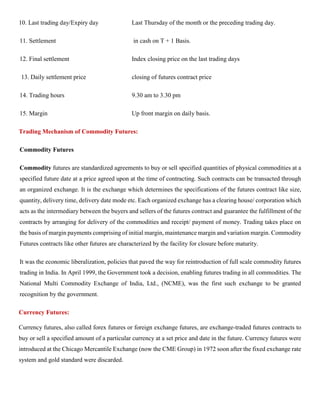
10. Last trading day/Expiry day Last Thursday of the month or the preceding trading day.
11. Settlement in cash on T + 1 Basis.
12. Final settlement Index closing price on the last trading days
13. Daily settlement price closing of futures contract price
14. Trading hours 9.30 am to 3.30 pm
15. Margin Up front margin on daily basis.
Trading Mechanism of Commodity Futures:
Commodity Futures
Commodity futures are standardized agreements to buy or sell specified quantities of physical commodities at a
specified future date at a price agreed upon at the time of contracting. Such contracts can be transacted through
an organized exchange. It is the exchange which determines the specifications of the futures contract like size,
quantity, delivery time, delivery date mode etc. Each organized exchange has a clearing house/ corporation which
acts as the intermediary between the buyers and sellers of the futures contract and guarantee the fulfillment of the
contracts by arranging for delivery of the commodities and receipt/ payment of money. Trading takes place on
the basis of margin payments comprising of initial margin, maintenance margin and variation margin. Commodity
Futures contracts like other futures are characterized by the facility for closure before maturity.
It was the economic liberalization, policies that paved the way for reintroduction of full scale commodity futures
trading in India. In April 1999, the Government took a decision, enabling futures trading in all commodities. The
National Multi Commodity Exchange of India, Ltd., (NCME), was the first such exchange to be granted
recognition by the government.
Currency Futures:
Currency futures, also called forex futures or foreign exchange futures, are exchange-traded futures contracts to
buy or sell a specified amount of a particular currency at a set price and date in the future. Currency futures were
introduced at the Chicago Mercantile Exchange (now the CME Group) in 1972 soon after the fixed exchange rate
system and gold standard were discarded.
Important currencies in which these futures contracts are made such as US-dollar, Pound Sterling, Yen, French
Francs, Marks, Canadian dollar, etc. Normally futures currency contracts are used for hedging purposes by the
exporters, importers, bankers, financial institutions and large companies.
A currency futures contract is also known as foreign exchange futures or FX future and has foreign currencies as
the underlying assets. One of the currencies in a currency futures contract is the US Dollar. The price of the other
currency is expressed in terms of the US dollar.The size or trade unit of each contract is a certain amount of the
other currency.
Settlement
There are two primary methods of settling a currency futures contract. In the vast majority of instances, buyers
and sellers will offset their original positions before the last day of trading (a day that varies depending on the
contract) by taking an opposite position. When an opposite position closes the trade prior to the last day of trading,
a profit or loss is credited to or debited from the trader's account.
Less frequently, contracts are held until the maturity date, at which time the contract is cash-settled or physically
delivered, depending on the specific contract and exchange. Most currency futures are subject to a physical
delivery process four times a year on the third Wednesday during the months of March, June, September and
December. Only a small percentage of currency futures contracts are settled in the physical delivery of foreign
exchange between a buyer and seller. When a currency futures contract is held to expiration and is physically
settled, the appropriate exchange and the participant each have duties to complete the delivery.
Currency futures are exchange-traded futures. Traders typically have accounts with brokers that direct orders to
the various exchanges to buy and sell currency futures contracts. A margin account is generally used in the trading
of currency futures; otherwise, a great deal of cash would be required to place a trade. With a margin account,
traders borrow money from the broker in order to place trades, usually a multiplier of the actual cash value of the
account. The buying power is the amount of money in the margin account that is available for trading. Different
brokers have varying requirements for margin accounts. In general, currency futures accounts allow a rather
conservative degree of margin (leverage) when compared to forex accounts that can offer as much as 400:1
leverage. The liberal margin rates of many forex accounts provide traders the opportunity to make impressive
gains, but more often suffer catastrophic losses.
UNIT - 4
Option
An option is a unique instrument that confers a right without an obligation to buy or sell another asset, called the
underlying asset. Like forwards and futures, it is a derivative instrument because the value of the right so conferred
would depend on the price of the underlying asset. As such options derive their values inter alia from the price of
the underlying asset. For easier comprehension of the concept of an option, an example from the stocks as
underlying asset is most apt. Consider an option on the share of a firm, say ITC Ltd. It would confer a right to the
holder to either buy or sell a share of ITC. Hence, an option on ITC would be priced according to the price of ITC
shares prevailing in the market. Of course, this right can be made available at a specific predetermined price and
remains valid for a certain period of time rather than extending indefinitely in time.
The unique feature of an option is that while it confers the right to buy or sell the underlying asset, the holder is
not obligated to perform. The holder of the option can force the counterparty to honors the commitment made.
Obligations of the holder would arise only when he decides to exercise the right. Therefore, an option may be
defined as a contract that gives the owner the right but no obligation to buy or sell at a predetermined price within
a given time frame.
There are two basic types of options, call options and put options.
o Call option: It gives the holder the right but not the obligation to buy an asset by a certain date for a
certain price.
o Put option: A It gives the holder the right but not the obligation to sell an asset by a certain date for a
certain price.
In addition to that there are some of the following options too:
o Index options: Have the index as the underlying. They can be European or American. They are also cash
settled.
o Stock options: They are options on individual stocks and give the holder the right to buy or sell shares at
the specified price. They can be European or American.
o Buyer of an option: The buyer of an option is the one who by paying the option premium buys the right
but not the obligation to exercise his option on the seller/writer.
o Writer of an option: The writer of a call/put option is the one who receives the option premium and is
thereby obliged to sell/buy the asset if the buyer exercises on him.
Options Payoffs
The optionality characteristic of options results in a non-linear payoff for options. In simple words, it means that
the losses for the buyer of an option are limited, however the profits are potentially unlimited. For a writer, the
payoff is exactly the opposite. His profits are limited to the option premium, however, his losses are potentially
unlimited. These non-linear payoffs are fascinating as they lend themselves to be used to generate various payoffs
by using combinations of options and the underlying. We look here at the six basic payoffs:
➢ Payoff profile of buyer of asset: Long asset
In this basic position, an investor buys the underlying asset, Nifty for instance, for 2220, and sells it at a future
date at an unknown price, St. Once it is purchased, the investor is said to be "long" the asset.
➢ Payoff profile for seller of asset: Short asset
In this basic position, an investor shorts the underlying asset, Nifty for instance, for 2220, and buys it back at a
future date at an unknown price, once it is sold, the investor is said to be "short" the asset.
➢ Payoff profile for buyer of call options: Long call
A call option gives the buyer the right to buy the underlying asset at the strike price specified in the option. The
profit/loss that the buyer makes on the option depends on the spot price of the underlying. If upon expiration, the
spot price exceeds the strike price, he makes a profit. Higher the spot price, more is the profit he makes. If the
spot price of the underlying is less than the strike price, he lets his option expire un-exercised. His loss in this
case is the premium he paid for buying the option.
➢ Payoff profile for writer of call options: Short call
A call option gives the buyer the right to buy the underlying asset at the strike price specified in the option. For
selling the option, the writer of the option charges a premium. The profit/loss that the buyer makes on the option
depends on the spot price of the underlying. Whatever is the buyer's profit is the seller's loss. If upon expiration,
the spot price exceeds the strike price, the buyer will exercise the option on the writer. Hence as the spot price
increases the writer of the option starts making losses. Higher the spot price, more is the loss he makes. If upon
expiration the spot price of the underlying is less than the strike price, the buyer lets his option expire un-exercised
and the writer gets to keep the premium.
➢ Payoff profile for buyer of put options: Long put
A put option gives the buyer the right to sell the underlying asset at the strike price specified in the option. The
profit/loss that the buyer makes on the option depends on the spot price of the underlying. If upon expiration, the
spot price is below the strike price, he makes a profit. Lower the spot price, more is the profit he makes. If the
spot price of the underlying is higher than the strike price, he lets his option expire un-exercised. His loss in this
case is the premium he paid for buying the option.
➢ Payoff profile for writer of put options: Short put
A put option gives the buyer the right to sell the underlying asset at the strike price specified in the option. For
selling the option, the writer of the option charges a premium. The profit/loss that the buyer makes on the option
depends on the spot price of the underlying. Whatever is the buyer's profit is the seller's loss. If upon expiration,
the spot price happens to be below the strike price, the buyer will exercise the option on the writer. If upon
expiration the spot price of the underlying is more than the strike price, the buyer lets his option un- exercised
and the writer gets to keep the premium.
Option strategies
o Bullish options trading strategies are strategies that are suitable for when you expect the price of an underlying
security to rise. The obvious, and most straightforward, way to profit from a rising price using options is to
simply buy calls. However, buying calls options isn't necessarily the best way to make a return from a moderate
upwards price movement and doing so offers no protection should the underlying security fall in price or not
move at all. The main advantage is that you can create credit spreads, which return an upfront payment, rather
than debit spreads which carry an upfront cost. The disadvantage is the added complication of trying to choose
the right strategy. The concept of buying calls is by itself relatively simple.
o Bearish options trading strategies: When your outlook on an underlying security is bearish, meaning you
expect it to fall in price, you will want to be using suitable trading strategies. A lot of beginner options traders
believe that the best way to generate profits from an underlying security falling in price is simply to buy puts,
but this isn't necessarily the case. Buying puts isn't a great idea if you are only expecting a small price reduction
in a financial instrument, and you have no protection if the price of that financial instrument doesn't move or
goes up instead.
o Neutral Market Trading Strategies
This function is unique to options, because there are no other financial instruments that can be traded to generate
profits from a lack of price movement. There are a large number of neutral options trading strategies (also known
as non-directional strategies) that can be used when you have a neutral outlook on an underlying security, and if
you can gain a good understanding of these then you will open up many opportunities for making profits. The
biggest advantage of neutral options trading strategies is really the simple fact that they exist. Being able to
profit from stocks and other financial instruments that remain relatively stable in price gives investors who use
options many more opportunities than those who don’t. The biggest drawback is the fact that the potential profits
of these is always limited, because the maximum amount of profit that can be made from any trade is essentially
fixed at the moment it's executed.
o Volatile Options Trading Strategies
When a stock or another security is volatile it means that a large price swing is likely, but it's difficult to predict
in which direction. By using volatile options trading strategies, it's possible to make trades where you will profit
providing an underlying security moves significantly in price, regardless of which direction it moves in. There
are many scenarios that can lead to a financial instrument being volatile. For example, a company may be about
to release its financial reports or announce some other big news, either of which probably lead to its stock being
volatile. Rumors of an impending takeover could have the same effect.
Some of the other option strategies:
Arbitrage Strategies: In very simple terms, arbitrage defines circumstances were price inequalities means that
an asset is effectively underpriced in one market and trading at a market price in another.
Synthetic Trading Strategies: Strategies that use a combination of options and stock to emulate other trading
strategies are said to be synthetic.
Delta Neutral Strategies: It is used to create positions where the delta value is zero, or close to it. Such positions
aren't affected by small price movements in the underlying security, meaning there's little directional risk
involved.
Gamma Neutral Strategies: These are designed to create trading positions where the gamma value is zero or
very close to zero; which would mean that the delta value of those positions should remain stable regardless of
what happens to the price of the underlying security.
Trading mechanism of option
The futures and options trading system of NSE, called NEAT-F&O trading system, provides a fully automated
screen-based trading for Index futures & options and Stock futures & options on a nationwide basis as well as an
online monitoring and surveillance mechanism. It supports an order driven market and provides complete
transparency of trading operations.
Entities in the trading system:
1.Trading members: Trading members are members of NSE. They can trade either on their own account or on
behalf of their clients including participants. The exchange assigns a trading member ID to each trading member.
Each trading member can have more than one user. The number of users allowed for each trading member is
notified by the exchange from time to time. Each user of a trading member must be registered with the exchange
and is assigned a unique user ID.
2.Clearing members: Clearing members are members of NSCCL. They carry out risk management activities and
confirmation/inquiry of trades through the trading system.
3.Professional clearing members: A professional clearing member is a clearing member who is not a trading
member. Typically, banks and custodians become professional clearing members and clear and settle for their
trading members.
4.Participants: A participant is a client of trading members like financial institutions. These clients may trade
through multiple trading members but settle through a single clearing member.
Basis of trading
The NEAT F&O system supports an order driven market, wherein orders match automatically. Order matching
is essentially on the basis of security, its price, time and quantity. All quantity fields are in units and price in
rupees. The exchange notifies the regular lot size and tick size for each of the contracts traded on this segment
from time to time. When any order enters the trading system, it is an active order. It tries to find a match on the
other side of the book. If it finds a match, a trade is generated. If it does not find a match, the order becomes
passive and goes and sits in the respective outstanding order book in the system.
Futures and Options Market Instruments
The F&O segment of NSE provides trading facilities for the following derivative instruments:
1. Index based futures
2. Index based options
3. Individual stock options
4. Individual stock futures
Stock Options
Options on individual shares of common stock have been traded for many years. Trading on standardized call
options on equity shares started in 1973 on whereas on put options began in 1977. Stock options on a number of
over-the-counter stocks are also available. While strike prices are not because of cash dividends paid to common
stock holders, the strike price is adjusted for stock splits, stock dividends, reorganization, recapitalizations, etc.
which affect the value of the underlying stock. Stock options are most popular assets, which are traded on various
exchanges all over the world.
Currency Option
A currency option is a contract that gives the buyer the right, but not the obligation, to buy or sell a certain
currency at a specified exchange rate on or before a specified date. For this right, a premium is paid to the seller,
the amount of which varies depending on the number of contracts if the option is bought on an exchange, or on
the nominal amount of the option if it is done on the over-the-counter market. Currency options are one of the
most common ways for corporations, individuals or financial institutions to hedge against adverse movements in
exchange rates.
Option pricing
Option pricing refers to the amount per share at which an option is traded. Options are derivative contracts that
give the holder (the "buyer") the right, but not the obligation, to buy or sell the underlying instrument at an agreed-
upon price on or before a specified future date. Although the holder of the option is not obligated to exercise the
option, the option writer (the "seller") has an obligation to buy or sell the underlying instrument if the option
isexercised.
1.Binomial option pricing model
The Cox-Ross-Rubinstein binomial option pricing model (CRR model) is a variation of the original Black-
Scholes option pricing model. It was first proposed in 1979 by financial economists/engineers John Carrington
Cox, Stephen Ross and Mark Edward Rubinstein. The model is popular because it considers the underlying
instrument over a period of time, instead of at just one point in time. It does this by using a lattice-based model,
which takes into account expected changes in various parameters over an option's life, thereby producing a more
accurate estimate of option prices than created by models that consider only one point in time. Because of this,
the CRR model is especially useful for analyzing American-style options, which can be exercised at any time up
to expiration (European-style options can only be exercised upon expiration). And, unlike the original Black-
Scholes option pricing model, the CRR model has the ability to take into account the effect of dividends paid out
by a stock during the life of an option. Like the Black-Scholes model, the CRR model makes certain assumptions,
including:
o There is no possibility of arbitrage; a perfectly efficient market.
o At each time node, the underlying price can only take an up or a down move and never both simultaneously
The CRR model is a two-state (or two-step) model in that it assumes the underlying price can only either increase
(up) or decrease (down) with time until expiration. Valuation begins at each of the final nodes (at expiration) and
iterations are performed backwards through the binomial tree up to the first node (date of valuation). In very basic
terms, the model involves three steps:
➢ The creation of the binomial price tree.
➢ Option value calculated at each final node.
➢ Option value calculated at each preceding node.
While the math behind the Cox-Ross-Rubinstein model is considered less complicated than the Black-Scholes
model, you can use online calculators and trad
2.Black—Scholes Option Pricing Model (BSOPM)
The Black-Scholes formula (also called Black-Scholes-Merton) was the first widely used model for option
pricing. It's used to calculate the theoretical value of European-style options using current stock prices, expected
dividends, the option's strike price, expected interest rates, time to expiration and expected volatility. The formula,
developed by three economists – Fischer Black, Myron Scholes and Robert Merton – is perhaps the world's most
well-known options pricing model. It was introduced in their 1973 paper, "The Pricing of Options and Corporate
Liabilities," published in the Journal of Political Economy. Black passed away two years before Scholes and
Merton were awarded the 1997 Nobel Prize in Economics for their work in finding a new method to determine
the value of derivatives (the Nobel Prize is not given posthumously; however, the Nobel committee acknowledged
Black's role in the Black-Scholes model).
The Black-Scholes model makes certain assumptions:
o The option is European and can only be exercised at expiration.
o No dividends are paid out during the life of the option.
o Markets are efficient (i.e., market movements cannot be predicted).
o There are no transaction costs in buying the option.
o The risk-free rate and volatility of the underlying are known and constant.
o The returns on the underlying are normally distributed.
The famous Black—Scholes formula for option pricing is given below:
o The Black/Scholes equation is done in continuous time. This requires continuous compounding. The “r”
that figures in this is ln (l + r). Example: if the interest rate per annum is 12%, you need to use ln1.12or
0.1133, which is the continuously compounded equivalent of 12%per annum.
o N () is the cumulative normal distribution. N(d1) is called the delta of the option which is a measure of
change in option price with respect to change in the price of the underlying asset.
o σ a measure of volatility, is the annualized standard deviation of continuously compounded returns on the
underlying. When daily sigma is given, they need to be converted into annualized sigma.
Options hedging strategies
Hedging is a technique that is frequently used by many investors, not just options traders. The basic principle of
the technique is that it is used to reduce or eliminate the risk of holding one particular investment position by
taking another position. The versatility of options contracts makes them particularly useful when it comes to
hedging, and they are commonly used for this purpose. Stock traders will often use options to hedge against a fall
in price of a specific stock, or portfolio of stocks, that they own. Options traders can hedge existing positions, by
taking up an opposing position.
Using options for hedging is, relatively speaking, fairly straightforward; although it can also be part of some
complex trading strategies. Many investors that don’t usually trade options will use them to hedge against existing
investment portfolios of other financial instruments such as stock. There a number of options trading strategies
that can specifically be used for this purpose, such as covered calls and protective puts.
The principle of using options to hedge against an existing portfolio is really quite simple, because it basically
just involves buying or writing options to protect a position. For example, if you own stock in Company X, then
buying puts based on Company X stock would be an effective hedge.
Most options trading strategies involve the use of spreads, either to reduce the initial cost of taking a position, or
to reduce the risk of taking a position. In practice most of these options spreads are a form of hedging in one way
or another, even this wasn't its specific purpose.
For active options traders, hedging isn't so much a strategy in itself, but rather a technique that can be used as part
of an overall strategy or in specific strategies. You will find that most successful options traders use it to some
degree, but your use of it should ultimately depend on your attitude towards risk.
UNIT - 5
SWAP
Swaps have become popular derivative instruments in recent years all over the world. A swap is an agreement
between two counter parties to exchange cash flows in the future. Under the swap agreement, various terms like
the dates when the cash flows are to be paid, the currency in which to be paid and the mode of payment are
determined and finalized by the parties. Usually the calculation of cash flows involves the future values of one or
more market variables.
There are two most popular forms of swap contracts, i.e., interest rate swaps and currency swaps. In the interest
rate swap one party agrees to pay the other party interest at a fixed rate on a notional principal amount, and in
return, it receives interest at a floating rate on the same principal notional amount for a specified period. The
currencies of the two sets of cash flows are the same. In case of currency swap, it involves in exchanging of
interest flows, in one currency for interest flows in other currency. In other words, it requires the exchange of
cash flows in two currencies. There are various forms of swaps based upon these two but having different features
in general.
Characteristics of Swaps:
• Exchange of interest payments on some agreed-upon notional amount.
• No exchange of principal amount
• Converts the interest rate on an asset or liability from
o fixed to floating
o floating to fixed
o floating to floating
• A swap is a powerful tool which allows the user to align risk characteristics of assets and liabilities
• A swap transaction, is a custom-tailored bilateral agreement two counter-parties agree to exchange
specified cash flows at periodic intervals over a pre-determined life of the swap on a notional amount
Currency Forwards
A currency forward contract is an agreement between two parties to exchange a certain amount of a currency for
another currency at a fixed exchange rate on a fixed future date.
By using a currency forward contract, the parties are able to effectively lock-in the exchange rate for a future
transaction.
The currency forward contracts are usually used by exporters and importers to hedge their foreign currency
payments from exchange rate fluctuations.
The currency forward contracts can be both deliverable or cash settled. In case of cash settled currency forwards
the payment is made by the party who is at loss to the party who is at gain.
Let’s take an example to understand how a currency forward contract works.
Assume a US exporter who is expecting to receive a payment of EUR 10million after 3 months. Since he will
need to convert these euros into US dollar, there is exchange rate risk involved. The exporter enters into a cash-
settled currency forward contract to exchange 10 million euros into US dollars after 3 months at a fixed exchange
rate of 1EUR = 1.2 USD. That means he will be able to exchange his 10 million euros for 12 million US dollars
after 3 months.
Now assume that the actual exchange rate after 3 months is 1 EUR = 1.18 USD.
If there were no forward contract, the exporter would have received USD 11.8 million by exchanging EUR 10
million at the market exchange rate.
Since there is a forward contract, the exporter should receive USD 12 million at the rate of 1 EUR = 1.2 USD.
Under the terms of the contract, the counterparty must compensate the exporter by making a payment equivalent
to the difference between the fixed rate and the current exchange rate to the exporter. In this case, the exporter
will receive USD 0.2 million from the counterparty as cash settlement.
Currency Futures ( refer Unit – 3 last page )
Currency swap
In a currency swap the exchange of cash flows between counterparties take place in two different currencies.
Since two currencies are involved, currency swaps become
different from interest rate swaps in its uses functionality, and administration. The first recorded currency swap
was initiated in 1981 between IBM and World Bank.
Where the exchange of cash flows is in two different currencies on the basis of a predetermined formula of
exchange rates, it is known as currency swap. More complex swaps involve two currencies with fixed and floating
rates of interest in two currencies. Such swaps are called ‘cocktail swaps’.
Features of Currency Swaps:
• A contract between two counter parties.
• Commitment to an exchange of cash flows over an agreed period
• One counter party pays a fixed or floating rate on a principal amount, denominated in one currency
• The other counter party pays a fixed or floating rate on a (different) principal amount, denominated in
another currency
• At the end of the period, the corresponding principal amounts are
• Exchange data pre-determined FX rate (usually spot FX rate)
• Synergy of comparative advantage.
• Exchange of principal takes place at the beginning & end whereas interest payments takes place during
the life of the swap.
• Banks act as intermediaries to eliminate counterparty risk. product available in India
• Each leg is in a different currency.
• Each leg can be floating or fixed
• The swap value is sensitive to For ex- rates
Example:
An agreement to pay 4.71% on GBP notional 100MM and receive3.39% on a USD notional of 190MMAt the
end of5Y, the principal amounts are exchanged.
In a currency swap the principal is exchanged at the end of the swap, and often also at the beginning. This
compares with an interest rate swap, in which the principal is not exchanged.
The major difference between a generic interest rate swap and a generic currency swap is that the latter includes
not only the exchange of interest rate payments but also the exchange of principal amounts both initially and on
termination. Since the payments made by the two parties are indifferent currencies, the payments need not netted.
Currency Options
A Currency Options (CO) Contract is an agreement that gives investors the right, but not the obligation, to buy
or sell a Currency Futures Contract on a future date at a fixed price. COs give investors the right to buy the
underlying Currency Future. Put Options give them the right to sell it. Investors are required to pay a premium
for choice of exercising the Option or not. The premium is calculated based on the volatility of the underlying
exchange rate.
Currency Option Terminology
• Exercise – The act performed by the option buyer of notifying the seller that they intend to deliver on the
option’s underlying forex contract.
• Expiration Date – The last date upon which the option can be exercised.
• Delivery Date – The date upon when the currencies will be exchanged if the option is exercised.
• Call Option – Confers the right to buy a currency.
• Put Option – Confers the right to sell a currency.
• Premium – The up-front cost involved in purchasing an option.
• Strike Price – The rate at which the currencies will be exchanged if the option is exercised.
Features
• Limit losses to the premium paid as investors are not obliged to buy or sell the CO underlying the Option on
expiry.
• Provide protection against exchange rate fluctuations in investment portfolios.
• Allow the holder to fix prices for import and export purposes.
• Allow investors to take advantage of price movements in the exchange rate because they can take a view as
to whether the exchange rate will strengthen or weaken.
• Standardized contracts traded on a regulated exchange eliminate counterparty risk.
• Highly liquid market.
• Investors may lose the premium paid if they choose not to exercise the Option.
• Traded based on margins that change based on the underlying currency’s volatility.
Interest rate swap
An interest rate swap is an agreement between two parties to exchange one stream of interest payments for
another, over a set period of time. Swaps are derivative contracts and trade over-the-counter.
The most commonly traded and most liquid interest rate swaps are known as “vanilla” swaps, which exchange
fixed-rate payments for floating-rate payments based on LIBOR (London Inter-Bank Offered Rate), which is the
interest rate high-credit quality banks charge one another for short-term financing. LIBOR is the benchmark for
floating short-term interest rates and is set daily. Although there are other types of interest rate swaps, such as
those that trade one floating rate for another, vanilla swaps comprise the vast majority of the market.
The “swap rate” is the fixed interest rate that the receiver demands in exchange for the uncertainty of having to
pay the short-term LIBOR (floating) rate over time. At any given time, the market’s forecast of what LIBOR will
be in the future is reflected in the forward LIBOR curve.
At the time of the swap agreement, the total value of the swap’s fixed rate flows will be equal to the value of
expected floating rate payments implied by the forward LIBOR curve. As forward expectations for LIBOR
change, so will the fixed rate that investors demand to enter into new swaps. Swaps are typically quoted in this
fixed rate, or alternatively in the “swap spread,” which is the difference between the swap rate and the equivalent
local government bond yield for the same maturity.
Credit derivatives
credit derivative refers to any one of various instruments and techniques designed to separate and then transfer
the credit risk or the risk of an event of default of a corporate or sovereign borrower, transferring it to an entity
other than the lender or debt holder. Simply explained it is the transfer of the credit risk from one party to another
without transferring the underlying.
They are the negotiable bilateral contracts (reciprocal arrangement between two parties to perform an act in
exchange of the other parties act) that help the users to manage their exposure to credit risks. The buyer pays a
fee to the party taking on the risk.
Types of credit derivatives
1. Unfunded credit derivatives.
2. Funded credit derivatives.
Unfunded credit derivatives: It is a contract between two parties where each is responsible of making the
payments under the contract. These are termed as unfunded as the seller makes no upfront payment to cover any
future liabilities. The seller makes any payment only when the settlement is met. Ultimately the buyer takes the
credit risk on whether the seller will be able to pay any cash / physical settlement amount. Credit Default Swap
(CDS) is the most common and popular type of unfunded credit derivatives.
Funded Credit derivatives: In this type, the party that is assuming the credit risk makes an initial payment that
is used to settle any credit events that may happen going forward. Thereby, the buyer is not exposed to the credit
risk of the seller. Credit Linked Note (CLN) and Collateralized Debt Obligation (CDO) are the charmers of the
funded credit derivative products. These kinds of transactions generally involve SPVs for issuing / raising a debt
obligation which is done through the seller. The proceeds are collateralized by investing in highly rated securities
and these note proceeds can be used for any cash or physical settlement.
Exotic options
An exotic option is an over the counter (OTC) option which is more complex than commonly traded plain vanilla
options in terms of the option behavior with respect to the underlying, computation and timing of the pay-out,
and the terms of the customized contract. Exotic options are generally used in the foreign exchange market, fixed
income market and high stakes over the counter equity and index trading markets. Since they are difficult to
understand and are highly customized, they are not allowed to be traded on exchanges. Many businesses use these
options to hedge their cash flow uncertainties and enter into over the counter contracts with large financial
institutions which can structure and price such products.

Derivatives

  • 1.
  • 2.
    UNIT-1 Derivatives The term “Derivative”indicates that it has no independent value, i.e., its value is entirely derived from the value of the underlying asset. The underlying asset can be securities, commodities, bullion, currency, livestock or anything else. In other words, derivative means forward, futures, option or any other hybrid contract of predetermined fixed duration, linked for the purpose of contract fulfillment to the value of a specified real or financial asset or to an index of securities. Definition The Securities Contracts (Regulation) Act 1956 defines “derivative” as under: “Derivative” includes 1. Security derived from a debt instrument, share, loan whether secured or unsecured, risk instrument or contract for differences or any other form of security. 2. A contract which derives its value from the prices, or index of prices of underlying securities. Features of financial derivatives 1. A derivative instrument relates to the future contract between two parties. It means there must be a contract- binding on the underlying parties and the same to be fulfilled in future. 2.Normally, the derivative instruments have the value which derived from the values of other underlying assets, such as agricultural commodities, metals, financial assets, intangible assets, etc. 3. In general, the counter parties have specified obligation under the derivative contract. Obviously, the nature of the obligation would be different as per the type of the instrument of a derivative 4.The derivatives contracts can be undertaken directly between the two parties or through the particular exchange like financial futures contracts. 5. In general, the financial derivatives are carried off-balance sheet. The size of the derivative contract depends upon its notional amount. The notional amount is the amount used to calculate the pay off. 7. Derivatives are also known as deferred delivery or deferred payment instrument. It means that it is easier to take short or long position in derivatives in comparison to other assets or securities. 8. Derivatives are mostly secondary market instruments and have little usefulness in mobilizing fresh capital by the corporate world; however, warrants and convertibles are exception in this respect. 9. Although in the market, the standardized, general and exchange-traded derivatives are being increasingly evolved, however, still there are so many privately negotiated customized, over-the-counter (OTC) traded derivatives are in existence. 10. Finally, the derivative instruments, sometimes, because of their off-balance sheet nature, can be used to clear up the balance sheet.
  • 3.
    Types of FinancialDerivatives 1.Forward Contracts A forward contract is a simple customized contract between two parties to buy or sell an asset at a certain time in the future for a certain price. Unlike future contracts, they are not traded on an exchange, rather traded in the over- the-counter market, usually between two financial institutions or between a financial institution and its client. Features: o Forward contracts are bilateral contracts, and hence, they are exposed to counterparty risk. There is risk of non-performance of obligation either of the parties, so these are riskier than to futures contracts. o Each contract is custom designed, and hence, is unique in terms of contract size, expiration date, the asset type, quality, etc. o The specified price in a forward contract is referred to as the delivery price o In the forward contract, derivative assets can often be contracted from the combination of underlying assets, such assets are oftenly known as synthetic assets in the forward market. o In the forward market, the contract has to be settled by delivery of the asset on expiration date. 2.Futures Contracts Like a forward contract, a futures contract is an agreement between two parties to buy or sell a specified quantity of an asset at a specified price and at a specified time and place. Futures contracts are normally traded on an exchange which sets the certain standardized norms for trading in the futures contracts. 3.Options Contracts Options are the most important group of derivative securities. Option may be defined as a contract, between two parties whereby one party obtains the right, but not the obligation, to buy or sell a particular asset, at a specified price, on or before a specified date. The person who acquires the right is known as the option buyer or option holder, while the other person (who confers the right) is known as option seller or option writer. The seller of the option for giving such option to the buyer charges an amount which is known as the option premium. Options can be divided into two types: calls and puts. A call option gives the holder the right to buy an asset at a specified date for a specified price. Whereas in put option, the holder gets the right to sell an asset at the specified price and time. The specified price in such contract is known as the exercise price or the strike price and the date in the contract is known as the expiration date or the exercise date or the maturity date. Warrants and convertibles are other important categories of financial derivatives, which are frequently traded in the market. Warrant is just like an option contract where the holder has the right to buy shares of a specified company at a certain price during the given time period
  • 4.
    4.Swaps Swaps are privateagreements between two parties to exchange cash flows in the future according to a prearranged formula. They can be regarded as portfolios of forward contracts. The two commonly used swaps: o Interest rate swaps: These involve swapping only the interest related cash flows between the parties in the same currency. o Currency swaps: These entail swapping both principal and interest between the parties, with the cash flows in one direction being in a different currency than those in the opposite direction. Uses of Derivatives 1. One of the most important services provided by the derivatives is to control, avoid, shift and manage efficiently different types of risks through various strategies like hedging, arbitraging, spreading, etc. These are specifically useful in highly volatile financial market conditions like erratic trading, highly flexible interest rates, volatile exchange rates and monetary chaos. 2. Derivatives serve as barometers of the future trends in prices which result in the discovery of new prices both on the spot and futures markets. As a result, they assist in appropriate and superior allocation of resources in the society. 3. As we see that in derivatives trading no immediate full amount of the transaction is required since most of them are based on margin trading. As a result, large numbers of traders, speculators arbitrageurs operate in such markets. So, derivatives trading enhance liquidity and reduce transaction costs in the markets for underlying assets. 4. The derivatives assist the investors, traders and managers of large pools of funds to devise such strategies so that they may make proper asset allocation increase their yields and achieve other investment goals. 5. It has been observed from the derivatives trading in the market that the derivatives have smoothen out price fluctuations, squeeze the price spread, integrate price structure at different points of time and remove gluts and shortages in the markets. 6. The derivatives trading encourage the competitive trading in the markets, different risk taking preference of the market operators like speculators, hedgers, traders, arbitrageurs, etc. resulting in increase in trading volume in the country. Critiques of Derivatives o Speculative and Gambling Motives: One of most important arguments against the derivatives is that they promote speculative activities in the market. It is witnessed from the financial markets throughout the world that the trading volume in derivatives have increased in multiples of the value of the underlying assets and hardly one to two percent derivatives are settled by the actual delivery of the underlying assets.
  • 5.
    o Increase inRisk: The derivatives are supposed to be efficient tool of risk management in the market. In fact, this is also one-sided argument. It has been observed that the derivatives market—especially OTC markets, as particularly customized, privately managed and negotiated, and thus, they are highly risky. o Instability of the Financial System: It is argued that derivatives have increased risk not only for their users but also for the whole financial system. The fears of micro and macro financial crisis have caused to the unchecked growth of derivatives which have turned many market players into big losers. The malpractices, desperate behaviour and fraud by the users of derivatives have threatened the stability of the financial markets and the financial system. o Price Instability: Derivatives have caused wild fluctuations in asset prices, and moreover, they have widened the range of such fluctuations in the prices. The derivatives may be helpful in price stabilization only if there exist a properly organized, competitive and well-regulated market. o Displacement Effect: There is another doubt about the growth of the derivatives that they will reduce the volume of the business in the primary or new issue market specifically for the new and small corporate units. It is apprehension that most of investors will divert to the derivatives markets, raising fresh capital by such units will be difficult, and hence, this will create displacement effect in the financial market. o Increased Regulatory Burden: Derivatives create instability in the financial system as a result, there will be more burden on the government or regulatory authorities to control the activities of the traders in financial derivatives. As we see various financial crises and scams in the market from time to time, most of time and energy of the regulatory authorities just spent on to find out new regulatory, supervisory and monitoring tools so that the derivatives do not lead to the fall of the financial system. Major Recommendations of Dr. L.C. Gupta Committee Before discussing the emerging structure of derivatives markets in India, let us have a brief view of the important recommendations made by the Dr. L.C. Gupta Committee on the introduction of derivatives markets in India. These are as under: 1. The Committee is strongly of the view that there is urgent need of introducing of financial derivatives to facilitate market development and hedging in a most cost-efficient way against market risk by the participants such as mutual funds and other investment institutions. 2. There is need for equity derivatives, interest rate derivatives and currency derivatives. 3. Futures trading through derivatives should be introduced in phased manner starting with stock index futures, which will be followed by options on index and later options on stocks. It will enhance the efficiency and liquidity of cash markets in equities through arbitrage process. 4. There should be two-level regulation (regulatory framework for derivatives trading), i.e., exchange level and SEBI level. Further, there must be considerable emphasis on self-regulatory competence of derivative exchanges under the overall supervision and guidance of SEBI.
  • 6.
    5. The derivativetrading should be initiated on a separate segment of existing stock exchanges having an independent governing council. The number of the trading members will be limited to 40 percent of the total number. The Chairman of the governing council will not be permitted to trade on any of the stock exchanges. 6. The settlement of derivatives will be through an independent clearing Corporation/Clearing house, which will become counter-party for all trades or alternatively guarantees the settlement of all trades. The clearing corporation will have adequate risk containment measures and will collect margins through EFT. 7. The derivatives exchange will have on-line-trading and adequate surveillance systems. It will disseminate trade and price information on real time basis through two information vending networks. It should inspect 100 percent of members every year. 8. There will be complete segregation of client money at the level of trading/clearing member and even at the level of clearing corporation. 9. The trading and clearing member will have stringent eligibility conditions. At least two persons should have passed the certification programme approved by the SEBI. 10. The clearing members should deposit minimum ` 50 lakh with clearing corporation and should have a net worth of ` 3 crore. 11. Removal of the regulatory prohibition on the use of derivatives by mutual funds while making the trustees responsible to restrict the use of derivatives by mutual funds only to hedging and portfolio balancing and not for specification. 12. The operations of the cash market on which the derivatives market will be based, needed improvement in many respects. 13. Creation of a Derivation Cell, a Derivative Advisory Committee, and Economic Research Wing by SEBI. 14. Declaration of derivatives as ‘securities’ under Section 2 (h) of the SCRA and suitable amendments in the notification issued by the Central Government in June, 1969 under Section 16 of the SCRA. Benefits of Derivatives 1. India’s financial market system will strongly benefit from smoothly functioning index derivatives markets. 2. Internationally, the launch of derivatives has been associated with substantial improvements in market quality on the underlying equity market. Liquidity and market efficiency on India’s equity market will improve once the derivatives commence trading. 3. Many risks in the financial markets can be eliminated by diversification. Index derivatives are special in so far as they can be used by the investors to protect themselves from the one risk in the equity market that cannot be diversified away, 4. Foreign investors coming into India would be more comfortable if the hedging vehicles routinely used by them worldwide are available to them.
  • 7.
    5. The launchof derivatives is a logical next step in the development of human capital in India. Skills in the financial sector have grown tremendously in the last few years. Categories of Derivatives Traded in India 1. Commodities futures for coffee, oil seeds, and oil, gold, silver, pepper, cotton, jute and jute goods are traded in the commodities futures. Forward Markets Commission regulates the trading of commodities futures. 2. Index futures based on Sensex and NIFTY index are also traded under the supervision of Securities and Exchange Board of India (SEBI). 3. The RBI has permitted banks, Financial Institutions (F1’s) and Primary Dealers (PD’s) to enter into forward rate agreement (FRAs)/interest rate stvaps in order to facilitate hedging of interest rate risk and ensuring orderly development of the derivatives market. 4. The National Stock Exchange (NSE) became the first exchange to launch trading in options on individual securities. Trading in options on individual securities commenced from July, 2001. 5. Options contracts are American style and cash settled and are available in about 40 securities Stipulated by the Securities and Exchange Board of India. 6. The NSE commenced trading in futures on individual securities on November 9,2001. The futures contracts are available in about 31 securities stipulated by SEBI.The BSE also started trading in stock options and futures (both Index and Stocks) around at the same time as the NSE. 7. The National Stock Exchange commenced trading in interest rate future on June 2003. Interest rate futures contracts are available on 91-day 1-bills, 10-year bonds and 10-year zero coupon bonds as specified by the SEBI. Derivatives Trading at NSE/BSE The National Stock Exchange of India Limited (NSE) commenced trading in derivatives with the launch of index futures on June 12, 2000. The futures contracts are based on the popular benchmark Nifty 50 Index. The Exchange introduced trading in Index Options (also based on Nifty 50) on June 4, 2001. NSE also became the first exchange to launch trading in options on individual securities from July 2, 2001. Futures on individual securities were introduced on November 9, 2001. Futures and Options on individual securities are available on 175 securities stipulated by SEBI. The Exchange has also introduced trading in Futures and Options contracts based on Nifty IT, Nifty Bank, and Nifty Midcap 50, Nifty Infrastructure, Nifty PSE, Nifty CPSE indices. This section provides you with an insight into the derivatives segment of NSE. Real-time quotes and information regarding derivative products, trading systems & processes, clearing and settlement, risk management, statistics etc. are available here.
  • 8.
    Products available inNSE: Since the launch of the Index Derivatives on the popular benchmark Nifty 50 Index in 2000, the National Stock Exchange of India Limited (NSE) today have moved ahead with a varied product offering in equity derivatives. The Exchange currently provides trading in Futures and Options contracts on 9 major indices and more than 100 securities. Derivatives on the following Products • Nifty 50 Index • Nifty IT Index • Nifty Bank Index • Nifty Midcap 50 Index • Nifty Infrastructure Index • Nifty PSE Index • Individual Securities • Nifty CPS Participants of Derivatives Markets Derivatives are those financial instruments which derive their value from the value of other assets. In other words, they have no value on their own rather their value depends on the value of the underlying asset There are 3 important participants in the derivatives market which include the following : 1. Hedgers – They are those who buy or sell in derivatives market in order to reduce their risk of their portfolio. For example, if the portfolio of hedger is long then he will protect or hedge this position by buying put options in derivatives market. 2. Speculators – Speculators are those who enter into the market purely for making profit by buying or selling the derivatives, they do not have any intention of hedging their portfolio or such thing their only aim is to make profit based on their judgment about the stock or market. 3. Arbitrageurs – Arbitrage refers to obtaining risk free profits by simultaneously buying and selling similar instruments in different markets. Arbitrageurs enter into derivative market in order to take advantage of any such opportunity and profit from it Regulation of Financial Derivatives in India With the amendment in the definition of ''securities'' under SC(R)A (to include derivative contracts in the definition of securities), derivatives trading takes place under the provisions of the Securities Contracts (Regulation) Act, 1956 and the Securities and Exchange Board of India Act, 1992.
  • 9.
    Dr. L.C GuptaCommittee constituted by SEBI had laid down the regulatory framework for derivative trading in India. SEBI has also framed suggestive bye-law for Derivative Exchanges/Segments and their Clearing Corporation/House which lays down the provisions for trading and settlement of derivative contracts. The Rules, Bye-laws & Regulations of the Derivative Segment of the Exchanges and their Clearing Corporation/House have to be framed in line with the suggestive Bye-laws. SEBI has also laid the eligibility conditions for Derivative Exchange/Segment and its Clearing Corporation/House. The eligibility conditions have been framed to ensure that Derivative Exchange/Segment & Clearing Corporation/House provide a transparent trading environment, safety & integrity and provide facilities for redressal of investor grievances. Some of the important eligibility conditions are – 1.Derivative trading to take place through an online screen based Trading System. 2.The Derivatives Exchange/Segment shall have online surveillance capability to monitor positions, prices, and volumes on a real time basis to deter market manipulation. 3.The Derivatives Exchange/ Segment should have arrangements for dissemination of information about trades, quantities and quotes on a real time basis through at least two information vending networks, which are easily accessible to investors across the country. 4.The Derivatives Exchange/Segment should have arbitration and investor grievances redressal mechanism operative from all the four areas / regions of the country. 5.The Derivatives Exchange/Segment should have satisfactory system of monitoring investor complaints and preventing irregularities in trading. 6.The Derivative Segment of the Exchange would have a separate Investor Protection Fund. 7.The Clearing Corporation/House shall perform full novation, i.e. the Clearing Corporation/House shall interpose itself between both legs of every trade, becoming the legal counterparty to both or alternatively should provide an unconditional guarantee for settlement of all trades. 8.The Clearing Corporation/House shall have the capacity to monitor the overall position of Members across both derivatives market and the underlying securities market for those Members who are participating in both. 9.The level of initial margin on Index Futures Contracts shall be related to the risk of loss on the position. The concept of value-at-risk shall be used in calculating required level of initial margins. The initial margins should be large enough to cover the one-day loss that can be encountered on the position on 99% of the days. 10.The Clearing Corporation/House shall establish facilities for electronic funds transfer (EFT) for swift movement of margin payments. 11.In the event of a Member defaulting in meeting its liabilities, the Clearing Corporation/House shall transfer client positions and assets to another solvent Member or close-out all open positions. 12.The Clearing Corporation/House should have capabilities to segregate initial margins deposited by Clearing
  • 10.
    Members for tradeson their own account and on account of his client. The Clearing Corporation/House shall hold the clients' margin money in trust for the client purposes only and should not allow its diversion for any other purpose. 13.The Clearing Corporation/House shall have a separate Trade Guarantee Fund for the trades executed on Derivative Exchange / Segment. Presently, SEBI has permitted Derivative Trading on the Derivative Segment of BSE and the F&O Segment of NSE. Structure of derivatives markets in India. Derivative Categories Generally, the derivatives are classified into two broad categories: 1) Forward Commitments 2) Contingent Claims 1)Forward Commitments: Forward commitments are contracts in which the parties promise to execute the transaction at a specific later date at a price agreed upon in the beginning. These contracts are further classified as follows: a. Over the Counter Contracts Over the counter contracts are of two types:
  • 11.
    Forward: In thistype of contract, one party commits to buy and the other commits to sell an underlying asset at a certain price on a certain future date. The underlying can either be a physical asset or a stock. The loss or gain of a particular party is determined by the price movement of the asset. If the price increases, the buyer incurs a gain as he still gets to buy the asset at the older and lower price. On the other hand, the seller incurs a loss in the same scenario. Swap: Swap can be defined as a series of forward derivatives. It is essentially a contract between two parties where they exchange a series of cash flows in the future. One party will consent to pay the floating interest rate on a principal amount while the other party will pay a fixed interest rate on the same amount in return. Currency and equity returns swaps are the most commonly used swaps in the markets. b. Exchange Traded Contracts Exchange traded forward commitments are called futures. A future contract is another version of a forward contract, which is exchange-traded and standardized. Unlike forward contracts, future contracts are actively traded in the secondary market, have the backing of the clearinghouse, follow regulations and involve a daily settlement cycle of gains and losses. 2.Contingent Claims: Contingent claims are contracts in which the payoff depends on the occurrence of a certain event. Unlike forward commitments where the contract is bound to be settled on or before the termination date, contingent claims are legally obliged to settle the contract only when a specific event occurs. Contingent claims are also categorized into OTC and exchange-traded contracts, depending on the type of contract. The contingent claims are further sub-divided into the following types of derivatives: o Options: Options are the type of contingent claims that are dependent on the price of the stock at a future date. Unlike the forward commitments derivatives where payoffs are calculated keeping the movement of the price in mind, the options have payoffs only if the price of the stock crosses a certain threshold. Options are of two types: Call and Put. A call option gives the option to buy the underlying asset at a specific price. A put option is the option to sell the underlying at a certain price. o Interest Rate Options: Options where the underlying is not a physical asset or a stock, but the interest rates. o Warrants: Warrants are the options which have a maturity period of more than one year and hence, are called long-dated options. These are mostly OTC derivatives. o Convertible Bonds: Convertible bonds are the type of contingent claims that gives the bondholder an option to participate in the capital gains caused by the upward movement in the stock price of the company, without any obligation to share the losses.
  • 12.
    o Callable Bonds:Callable bonds provide an option to the issuer to completely pay off the bonds before their maturity. o Asset-Backed Securities: Asset-backed securities are also a type of contingent claim as they contain an optional feature, which is the prepayment option available to the asset owners. o Options on Futures: A type of options that are based on the futures contracts. o Exotic Options: These are the advanced versions of the standard options, having more complex features. In addition to the categorization of derivatives on the basis of payoffs, they are also sub-divided on the basis of their underlying asset. Since a derivative will always have an underlying asset, it is common to categorize derivatives on the basis of the asset. Equity derivatives, weather derivatives, interest rate derivatives, commodity derivatives, exchange derivatives, etc are the most popular ones Trading systems o First do your research. This is more important for the derivatives market. However, remember that the strategies need to differ from that of the stock market. For example, you may wish you buy stocks that are likely to rise in the future. In this case, you conduct a buy transaction. In the derivatives market, this would need you to enter into a sell transaction. So the strategy would differ. o Arrange for the requisite margin amount. Stock market rules require you to constantly maintain your margin amount. This means, you cannot withdraw this amount from your trading account at any point in time until
  • 13.
    the trade issettled. Also remember that the margin amount changes as the price of the underlying stock rises or falls. So, always keep extra money in your account. o Conduct the transaction through your trading account. You will have to first make sure that your account allows you to trade in derivatives. If not, consult your brokerage or stock broker and get the required services activated. Once you do this, you can place an order online or on phone with your broker. o Select your stocks and their contracts on the basis of the amount you have in hand, the margin requirements, the price of the underlying shares, as well as the price of the contracts. Yes, you do have to pay a small amount to buy the contract. Ensure all this fits your budget. o You can wait until the contract is scheduled to expiry to settle the trade. UNIT-2 Forward Contracts: Forward contracts are contracts that initiated at one time but performance occurs at a subsequent time. The term of contract such as price, delivery date, quantity, and quality of the assets are specified at the time of initiating the contract but actual performance takes place at a later date. It is a type of contract which is settled at a maturity. It is there for a contract for forward delivery and not for immediate, spot or cash delivery. Pricing and Trading Mechanism of Forward Contracts: Delivery price or Forward Price: A forward price is the predetermined delivery price for an underlying commodity, currency or financial asset decided upon by the long (the buyer) and the short (the seller) to be paid at predetermined date in the future. At the inception of a forward contract, the forward price makes the value of the contract at that time, zero. The Forward Price can be determined by the following formula: F0=So*erT Determination of Forward Contract Price: The pre determined price at which the asset is to be bought or sold in the future is reffered to as the forward price or delivery price. The current market prioce of the underlying asset is reffered to as the spot price. The price is fixed based on the intereast calculation. Calculation of Interest:
  • 14.
    Interest is calculatedbased on simple interest or compound interest. An interest may be calculated periodically based on annually, semi annually, or quarterly. The compounding method of interest is preferred. The formula when interest is calculated on compounded basis is: A=P (1+r)n When compounding is done frequently then the formula can be written as, A=P (1+r/n)mn Continuous Compounding: In finance interest is compounded not in discrete intervals but continuously. At this stage ‘m’ becomes infinity. Then terminal value of an investment is arrived using the following formula: A=P*ern Where, A=Terminal Value P=Principle r=Rate of Interest n=No. of years to maturity e=2.718 Forward price of Investment Assets: The forward price of an Investment asset is based on continuous compounding and should not provide any opportunity for arbitrage. The forward price of a derivative is arrived by using a formula: F0=So*ern Where, F0= Forward Price So= Spot Price Ern =continuous Compounding If F0> So*ern or F0< So*ern , Arbitrage opportunity will arrive. Hence F0 should be equal to So*ern . Features of Forward Contract: The salient features of forward contracts are: 1. They are bilateral negotiated contract between two parties and hence exposed to counter party risk. 2. Each contract is custom designed, and hence is unique in terms of contract size, expiration date and the asset type, quality, etc. 3. A contract has to be settled in delivery or cash on expiry date. 4. The contract price is generally not available in the public domain. 5. If the party wishes to reverse the contract, it has to compulsorily got the same counter party, which often
  • 15.
    results in highprices being charged. Classification of Forward Contract: Forward contracts in India are broadly governed by the Forward Contracts (regulation) Act, 1952. According to this act, forward contracts are of the following three major categories. 1. Hedge Contracts: These are freely transferable contracts which do not require specification of a particular lot size, quality or delivery standards for the underlying assets. Most of these are necessary to be settled through delivery of underlying assets. 2. Transferable Specific Delivery Forward Contracts: Apart from being freely transferable between parties concerned, these forward contracts refer to a specific and predetermined lot size and variety of the underlying asset. It is compulsory for delivery of the underlying assets to take place at expiration of contract. 3. Non-transferable Specific Delivery Forward Contracts: These contracts are normally exempted from the provision of regulation under Forward Contract Act, 1952 but the Central Government reserves the right to bring them back under the Act when it feels necessary. These are contracts which cannot be transferred to another party. The contracts, the consignment lot size, and quality of underlying asset are required to be settled at expiration through delivery of the assets. Futures: A futures contract is a type of derivative instrument, or financial contract, in which two parties agree to transact a set of financial instruments or physical commodities for future delivery at a particular price. A future contract is a standardized agreement between the seller (short position) of the contract and the buyer (long position), traded on a futures exchange, to buy or sell a certain underlying instrument at a certain date in future, at a pre-set price. The future date is called the delivery date or final settlement date. The pre-set price is called the futures price. The price of the underlying asset on the delivery date is called the settlement price. Thus, futures is a standard contract in which the seller is obligated to deliver a specified asset (security, commodity or foreign exchange) to the buyer on a specified date in future and the buyer is obligated to pay the seller the then prevailing futures price upon delivery. Financial Futures Contract: A futures contract gives the holder the right and the obligation to buy or sell. Futures contracts or simply futures are exchange-traded derivatives. The exchange acts as counterparty on all contracts, sets margin requirements, etc. Futures contracts, unlike forwards, are traded on organized exchanges. They are traded in three primary areas: 1. Agricultural Commodities
  • 16.
    2. Metals andPetroleum, and 3. Financial Assets (individual stocks, indices, interest rate, currency) Types of Futures Contract: Futures contracts are of the following categories: Stock Index Futures These futures contract without actual delivery were introduced only in 1982 and are the most recent major futures contract to emerge. In the United States, these contracts trade on several market indices like Standard and Poor's 500, a major market index, the NYSE Index and the Value Line Index. Numerous contracts on industry indices are now trading as well. A stock index futures contract is a contract to buy or sell the face value of the underlying stock index where the face value is defined as being the value of index multiplied by the specified monetary amount. Commodity Futures The commodity futures include: Agricultural futures contracts: These contracts are traded in grains, oil and meal, livestock, forest products, textiles and foodstuff. Metallurgical futures contract: This category includes genuine metal and petroleum contracts. Among the metals, contracts are traded on gold, silver, platinum and copper. Of the petroleum products, only heating oil, crude oil and gasoline are traded. Currency Futures Currency future is the price of a particular currency for settlement at a specified future date. Currency futures are traded on future exchanges and the exchanges where the contracts are fungible (or transferable freely) are very popular. The two most popular future exchanges are the Singapore International Monetary Exchange (SIMEX) and the International Money Market, Chicago (IMM). Other exchanges are in London, Sydney, Frankfurt, New York, Philadelphia, etc. The first exchange-traded foreign currency futures contracts were launched on the International Monetary Market (IMM) – now part of the Chicago Mercantile Exchange (CME) The CME remains the most active market in these contracts to this day, though a number of other exchanges have launched their own contracts.
  • 17.
    Interest futures Interest futuresare the exchange of a fixed amount of cash in a single currency to receive an undetermined amount of cash or a debt security in a hard currency. The undetermined amount of cash depends on the future risk-free spot interest rate and does not depend on the risk interest rate of any entity. Interest futures are the price of the future risk-free spot interest rate. Stock futures Stock futures are the exchange of a fixed amount of cash for a stock instrument related to a specific date in the future. Stock futures are the relative price for the future value of the stock instrument and can also be the price of the future spot exchange rate and the future risk-free spot interest rate. Quotes for stock futures are the anticipated value of the stock at the maturity of the futures contract. The dividend associated with such stock and the interest rate until the maturity of the futures depends on the current value of the stock. Settlement: When a futures trader takes a position (long or short) in a futures contract, he can settle the contract in three different ways. Closeout: In this method, the futures trader closes out the futures contract even before the expiry. If he is long a futures contract, he can take a short position in the same contract. The long and the short position will be off-set and his margin account will be marked to market and adjusted for P&L. Similarly, if he is short a futures contract; he will take a long position in the same contract to close out the position. Physical Delivery: If the futures trader does not closeout the position before expiry, and keeps the position open and allows it to expire, then the futures contract will be settled by physical delivery or cash settlement (discussed below). This will depend on the contract specifications. In case of the physical delivery, the clearinghouse will select a counterparty for physical settlement (accept delivery) of the futures contract. Typically the counterpart selected will be the one with the oldest long position. So, at the expiry of the futures contract, the short position holder will deliver the underlying asset to the long position holder. Cash Settlement: In case of cash settlement (in case the contract has expired), there is no need for physical delivery of the contract. Instead the contract can be cash-settled. This can be done only if the contract specifies so. If a contract can be cash settled, the trader need not closeout the position before expiry, He can just leave the position open. When the contract expires, his margin account will be marked-to market for P&L on the final day of the contract. Cash settlement is a preferred option for most traders because of the savings in transaction costs.
  • 18.
    Theories of FuturesPrices: Cost of carry model Cost-of-carry model is an arbitrage-free pricing model. Its central theme is that futures contract is so priced as to prevent arbitrage profit. In other words, investors will be indifferent to spot and futures market to execute their buying and selling of underlying asset because the prices they obtain are effectively the same. Under this method, the theoretical price of a futures contract is spot price of the underlying plus the cost of carry. This model stipulates that future prices equal to sum of spot prices and carrying costs involved in buying and holding the underlying asset, and less the carry return (if any). According to the cost-of-carry model, the futures price is given by: Futures price = Spot Price + Carry Cost – Carry Return This can also be expressed as: F= S(1+ r)t where: r is the cost of financing, t is the time till expiration. Carry cost (CC) is the interest cost of holding the underlying asset (purchased in spot market) until the maturity of futures contract. Carry return (CR) is the income (e.g, dividend) derived from underlying asset during the holding period. The Cost of Carry is the sum of all costs incurred if a similar position is taken in cash market and carried to expiry of the futures contract less any revenue that may arise out of holding the underlying asset. The cost typically includes interest cost in case of financial futures (insurance and storage costs are also considered in case of commodity futures). Revenue may be in the form of dividend. Thus, the futures price (F) should be equal to spot price (S) plus carry cost minus carry return. If it is otherwise, there will be arbitrage opportunities as follows. When F > (S + CC – CR): Sell the (overpriced) futures contract, buy the underlying asset in spot market and carry it until the maturity of futures contract. This is called "cash-and- carry" arbitrage. When F < (S + CC – CR): Buy the (underpriced) futures contract, short-sell the underlying asset in spot market and invest the proceeds of short-sale until the maturity of futures contract. This is called "reverse cash-and-carry" arbitrage. The "reverse cash-and-carry" arbitrage assumes that the short-sellers receive the full proceeds of short- sale. In practice, this may be only partially true or even impossible.
  • 19.
    Thus, it makesno difference whether we buy or sell the underlying asset in spot or futures market. If we buy it in spot market, we require cash but also receive cash distributions (e.g., dividend) from the asset. If we buy it in futures market, the delivery is postponed to a later day and we can deposit the cash in an interest-bearing account but will also forego the cash distributions (like dividend) from the underlying asset. However, the difference in spot and futures price is just equal to the interest cost and the cash distributions. Assumptions of the model: 1. Markets tend to be perfectly efficient. 2. Markets tend to be perfectly efficient. This means there are no differences in the cash and futures price. 3. Eliminates any opportunity for arbitrage – the phenomenon where traders take advantage of price differences in two or more markets. 4. That the contract is held till maturity, so that a fair price can be arrived at. 5. In short, the price of a futures contract (FP) will be equal to the spot price (SP) plus the net cost incurred in carrying the asset till the maturity date of the futures contract. 6. FP = SP + (Carry Cost – Carry Return) 7. Here Carry Cost refers to the cost of holding the asset till the futures contract matures. This could include storage cost, interest paid to acquire and hold the asset, financing costs etc. Carry Return refers to any income derived from the asset while holding it like dividends, bonuses etc. While calculating the futures price of an index, the Carry Return refers to the average returns given by the index during the holding period in the cash market. A net of these two is called the net cost of carry. Forward Contract v/s Futures Contract: 1. Delivery of the underlying asset is the hallmark of a forward contract. To the contrary the vast majority of futures contracts – even though they provide for delivery – are satisfied by entering into an offsetting contract or selling the contract on the exchange – namely, no delivery. 2. Purpose-A forward contract is entered into for commercial purposes related to the business of the party wanting to enter into the forward. The producer, processor, fabricator, refiner, or merchandiser may want to purchase or sell a commodity for deferred shipment or delivery as part of the conduct of its business. In contrast, futures contracts are undertaken principally to assume or shift price risk without transferring the underlying commodity.
  • 20.
    3. Format -Aforward contract is privately and individually negotiated between two principals. A futures contract is an exchange-traded contract, with standardized provisions related to commodity units; margin requirements related to price movements; clearing organizations. Futurescontractsarestandardizedcontractsthataretradedonorganizedfuturesmarkets.Forward contracts, on the other hand, are private deals between two individuals who can sign any type of contract they agree on. The organization of futures trading with a clearing house reduces the default risks of trading. The exchange members, in effect, guarantee both sides of a contract. In contrast, a forward contract is a private deal between two parties and is subject to the risk that either side may default on the terms of the agreement. Distinction between forwards and futures Criteria/Factors Forwards Futures 1 Trading Traded by telephone or telex (OTC) Traded in a competitive arena (recognized exchange) 2 Size of contracts Decided between buyer and seller Standardized in each futures market 3 Price of contract Remains fixed till maturity Changes everyday 4 Mark to Market Not done Marketed to market everyday 5. Margin No margin required Margins are to be paid by both buyer and sellers 6. Counter Party Risk Present Not present 7. No. of contracts in a year There can be any number of contracts Number of contracts in a year is fixed. 8. Frequency of Delivery 90% of all forward contracts are settled by actual delivery. Very few future contracts are settled by actual delivery 9. Hedging These are tailor –made for specific date and quantity. So, it is perfect Hedging is by nearest month and quantity contracts. So, it is not perfect.
  • 21.
    UNIT – 3 StockIndex Futures Stock futures which are derivative contracts have evolved as a means of hedging the risk involved in stock trading. Stock futures can be used for speculation in the derivatives market. Index futures are futures contracts on a stock or financial index. For each index, there may be a different multiple for determining the price of the futures contract. Perfect Hedging Model: The Perfect Hedging Model The perfect hedge is referred to that position which completely eliminates the risk. In other words, the use of futures or forward position to reduce completely the business risk is called perfect hedge, for example, a jewellery manufacturer wants to lock in a price for purchasing silver for the coming June. This he can do by going long June silver futures, if silver prices rise, the risk of increased cost of silver will be offset by the profits earned on the futures position. Similarly, if the silver prices fall, the savings on the silver purchase will be offset by futures losses. In either case, the net silver cost is locked in at the futures price. However, it should be noted that only price risk is covered and not the quantity risk—the uncertainty about the quantity that will be sold or purchased at some futures date. No doubt, availability of quantity of the asset at futures date may also influence the determination of futures prices. Basic Long and Short Hedges: Basically, the hedging refers to by taking a position in the futures that is opposite to a position taken in cash market or to a future cash obligation that one has or will incur. Thus, the hedges can be classified into two categories: short hedges and long hedges. Short Hedge 10. Liquidity Not liquidity Highly liquid 11. Nature of Market Over the Counter Exchange traded 12. Mode of Delivery Specifically decided. Most of the contracts result in delivery Standardized. Most of the contracts are cash-settled. 13. Transactional Costs Costs are based on bid-ask spread Include brokerage fees for buy and sell others
  • 22.
    A short hedge(or a selling hedge) is a hedge that involves short position in futures contract. In other words, it occurs when a firm/trader plans to purchase or produce a cash commodity sells futures to hedge the cash position, in general sense, it means being short’ having a net sold position, or a commitment to deliver’, etc .A short hedge is appropriate when the hedger already owns all and expects to sell it at sometime in the futures Long Hedge On the other hand, a long hedge (or a buying hedge) involves where a long position is taken in a futures contract. The basic objective here is to protect itself against a price increase in the underlying asset prior to purchasing it in either the spot or forward market. A long hedge is appropriate when a firm has to purchase a certain asset in futures and wants to lock in a price 110w. It is also called as being long’ or having a net bought position or an actual holding of the asset. It is also known as inventory hedge because the firm already holds the asset in inventory. The terms ‘long’ and ‘short’ apply to both spot and futures market and are widely used in the futures trading. A person who hold stocks of an asset is obviously regarded as ‘being long’ in the spot market but it is not necessary to actually hold stock. Similarly, it is in the case of ‘short’, where one who has made a forward sale, regarded as ‘being short’ on the spot market. In brief, the position of long and short hedges is shown in Table: Long Vs Short Hedging Short hedger Long hedger Position in spot market Protection need against Position in futures market Long Price fall Short Short Price rise Long Cross Hedging: A cross hedge is used to manage risk by investing in two positively correlated securities that have similar price movements. The investor takes opposing positions in each investment in an attempt to reduce the risk of holding just one of the securities. Although the two securities are not identical, they have enough correlation to create a hedged position providing prices move in the same direction. The success of cross-hedging depends on how strongly correlated the hedged instrument is with the instrument underlying the derivatives contract. When using a cross hedge, the maturity of the two securities must be equal. In other words, you cannot hedge a long-term instrument with a short-term security. Both financial instruments have to have the same maturity. A cross hedge is a hedge in which the characteristics of the spot and futures positions do not match perfectly. Mismatch situations which make the hedge a cross hedge: ➢The hedging horizon (maturity) may not match the futures expiration date.
  • 23.
    ➢The quantity tobe hedged may not match with the quantity of the futures contract. ➢The physical features of the asset to be hedged may differ from the futures contract asset. Basis Risk and Hedging: Basis, in this context, is the difference between the price of a futures contract and the spot price, or cash price, of the underlying security or other asset that the futures contract represents or is based on. For example, if the current spot price, or cash market price, of gold is $1190, and the price of gold in the June gold futures contract is $1195, then the basis, the differential, is $5.00. Basis risk is the risk that the futures price might not move in normal, steady correlation with the price of the underlying asset and that this fluctuation in the basis may negate the effectiveness of a hedging strategy employed to minimize a trader’s exposure to potential loss. The price spread between the cash price and the futures price may either widen or narrow between the time when a hedging position is initiated and the time when it is liquidated. A hedging strategy is one where a trader adopts a second market position. The strategy involves taking a futures position contrary to one’s market position in the underlying asset – for example, selling futures short to offset a long, buy position in the underlying asset. When large investments are involved, basis risk can have a significant effect on eventual profits or losses realized. Even a modest change in the basis can potentially make the difference between bagging a profit and suffering a loss. This risk that is specifically associated with a futures hedging strategy is the basis risk. To examine the basis risk, let us use the following notations: S1 = Spot price at time t1 S2 = Spot price at time t2 F1 = Futures price at time t1 F2 = Futures price at time t2 B1 = Basis at time t1 B2 = Basis at time t2 Understanding basis risk is fundamental to hedging. It is noted earlier that basis is the difference between the spot price (cash price) and futures price of an underlying asset. If the spot price is higher than the futures price, then the basis will be called as positive or over and vice-versa. This concept in equation form is as under Basis T = Cash price - Futures price T1
  • 24.
    If the futuresprices and cash prices always change by the same amount then the basis will not change and it will be zero. It means there could be no change in the basis, If Futures price = Cash price, There is basis risk when the changes in futures prices and cash prices are not equal When the change in spot price is more than the change in futures price, the basis will increase which is known as a strengthening of the basis. Similarly, if the change in spot price is less than the change in futures price, the basis will decrease; it is referred to as a weakening of the basis. Basis risk for the investment assets like securities arises mainly from uncertainty as to the level of the risk-free interest rate in the futures whereas in the case of consumption assets, in balances between supply and demand, difficulties in storing, convenience yield, etc. also provide the additional source of basis risk. Basis risk = Spot price of asset to be hedged - Futures price of contract used Basis Risk v/s Price risk: Price risk is the risk of a decline in the value of a security or a portfolio that can be minimized through diversification, unlike market risk. It is lower in stocks with less volatility such as blue-chip stocks. Investors can use a number of tools and techniques to hedge price risk, ranging from relatively conservative decisions such as buying put options to more aggressive strategies including short selling and inverse ETFs. We have already seen that the basis b is the difference between the cash or spot price s and the futures price F Bt,T = St – Ft,T A change in the basis, therefore, is: ∆bt.T = ∆St – ∆Ft.T Hedging Effectiveness: Hedge effectiveness is the extent to which a hedge transaction results in offsetting changes in fair value or cash flow that the transaction was intended to provide (as identified by the hedging entity). For example, a hedge is considered to be highly effective if the changes in fair value or cash flow of the hedged item and the hedging derivative offset each other to a significant extent (80% to 125)
  • 25.
    As noted earlierthat the objective of the hedging is to reduce the exposure to price risk, and so the hedgers trade price risk for basis risk. Thus, one measure of anticipated hedging effectiveness (H.E.) is to compare the basis risk with the price risk. The smaller the anticipated basis risk in comparison to the anticipated price risk, the more effective is the hedge. This can be stated as follows: H.E. = 1 - σ2 (bt.T) σ2 (St ) i.e., 1 minus the ratio of the expected variance of the basis to the expected variance of cash prices. This means that the closer the H.E., the more effective the hedge. However, H.E. is only a way of judging how good a particular hedge is likely to be a priori. It should not be confused with the concept of an optimal hedge. Devising a Hedging Strategy: The basic objective of an hedging strategy is to minimize risk or to maximize hedging effectiveness. In this respect, the first step towards designing a particular hedging strategy is to decide about the futures contract to be undertaken. For this purpose, two aspects are considered: First, what kind of futures to use, and Second, which contract month of that futures to be used Which Futures Contract While deciding about the futures contract to be undertaken, the hedger must consider that the correlation between the cash and futures prices must be very high. Thus, first starting point to select a futures contract is to select such assets which are inter-related. In other words, evaluating the correlation coefficients of various price risk associated with, for example, with jet fuel, heating oil, gasoline, crude oil, etc. Likewise, with gold we can use gold coins, bullion, silver, silver coins, etc. Which Contract Month The second important consideration in designing a hedging strategy is to select the contract month. We see that futures contracts are available in the market of different months. So, the selection of month of a futures contract will depend upon the such period where the futures and spot prices are highly correlated. Obviously, the prices of the near month contract are the most highly con-elated with cash price. Thus, using the near month futures contract will reduce basis risk. Since it is seen that the variance of the basis increases as the price correlation between cash and futures price decreases. Hence, hedging with the near month futures contract is preferable because it minimizes the basis variation.
  • 26.
    Thus, hedging ina continuous cash obligation, there can be two alternatives: (a) Hedging with a nearby futures and rolling the hedge forward, (b) Hedging with a more distant futures contract and rolling it less frequently. Both the alternatives have their own mechanism depending upon the hedging objective. For example, using a more distant contract usually increases basis risk because its price will be less correlated with spot market prices. But the brokerage cost and other transaction costs will be more due to frequent sales and purchases in the market. No specific rule can be made to decide between these alternatives. However, the hedgers in most cases, prefer to hedge with a futures contract that has a high price correlation either with the near month or the second month contract. Hedging Objectiveness: In the prior discussion of hedging strategies, we have assumed the only objective of hedging is to minimize the risk. However, sometimes, the hedgers may be willing to assume more risk in order to earn more profit because eliminating all price risk will lead to eliminating the profit of the firm, which may not be good at all the time. Thus, the hedgers may use such hedging ratio other than the minimum-variance hedge ratio, or willingly may go for under hedging. The decision relating to how much to hedge will depend upon the hedger’s risk preference. The lesser he hedges, the more risk he assumes. Not only this, the hedger may change his hedging strategy later on due to his strong belief about the futures price movements. So hedging objective is a relative concept and much depends upon the risk and return. In other words, it is the tradeoff between profits and risk reduction through hedging because it is observed that risk could be reduced but at the cost of lost profits. The hedger may choose the risk and return combination that he most prefers, or that he finds optimal. Management of Hedge: After establishing a hedge, it is essential to manage it effectively. regular monitoring and making adjustments are the key factors in managing of the hedge. To manage effectively the hedging, following steps are taken: Monitoring the Hedge: Continuous monitoring on the performance of an hedging is essential. For this purpose, the following information should be available regularly on an up-to-date basis:
  • 27.
    Cash Position Thehedger must get the information of the current size of the cash position being hedged. What are the changes in its magnitude since the inception of hedge? What are the gains or losses on this position to date? What are the reasons of such deviation, if any? Futures Position Likewise, cash position, the information regarding the size of futures position, profits and losses incurred to date on this position, etc. be collected for further consideration. Margins All such information concerning the margin like the total amounts of funds dedicated to margin requirements, net financing to-date, ng costs to- and further, the availability of funding arrangements to meet futures margin calls, etc. should be available continuously. Basis Movements All such information regarding the changes in basis should be collected to see whether they are consistent with a priori expectations or there is any major deviations at the particular time intervals. New Information Sometimes, new events occur in the market or there are new information regarding the underlying assets which cause to change in the prices either of the spot or futures must be noted and analyzed further to evaluate their impact on hedging strategy followed by the firm. Concept of Stock Index: A stock index or stock market index is a portfolio consisting of a collection of different stocks. In others words, a stock index is just like a portfolio of different securities’ proportions traded on a particular stock exchange like NIFTY S&P CNX traded on National Stock Exchange of India, the S&P 500 Index is composed of 500 common stocks, etc.a change in a particular index reflects the change in the average value of the stocks included in that index. Common Features 1. A stock index contains a specific number of stocks, i.e., specification of certain sector number of stocks like 30, 50, 100, 200, 500 and so on 2. Selection of a base period on which index is based. Starting value of base of index is set to large round like 100, 1000, etc.
  • 28.
    3. The methodor rule of selection of a stock for inclusion in the index to determine the value of the index. 4. There are several methods commonly used to combine the prices of individual stock like arithmetic average, weighted average, etc. 5. There are three types of index construction like price weighted index, return equally weighted index and market capitalization weighted index. 6. A stock index represents the change in the value of a set of stocks which constitute the index. Hence, it is a relative value expressed as weighted average of prices at a specific date. 7. . The index should represent the market and be able to represent the returns obtained by a typical portfolio of that market. 8. A stock index acts as a barometer for market behavior, a benchmark for portfolio performance. Further, it also reflects the changing expectations about the market. 9. The index components should be highly liquid, professionally maintained and accurately calculated. In the present section, we will not discuss the mechanism of construction of a stock index. However, it is beneficial to understand thoroughly the details of construction of an stock index particularly in which the investor is interested to trade. Because when the differences and interrelationships among the indexes are understood, it will be easier to understand the differences among the futures contracts that are based on those indexes. Stock Index Futures: A stock index futures contract, in simple terms, is a futures contract to buy or sell the face value of a stock index. In India, both the BSE and the NSE have introduced one month contracts on the sensex and NIFTY respectively. At any point of time, index futures of different maturities would trade simultaneously on the exchanges. Both BSE and NSE have introduced three contracts on BSE sensitive index for one, two and three monthsmaturities. Tick size on BSE has proposed of 0.1 index point for trading in sensex futures. Every index point for trading of sensex contract is priced at Rs.50,0.1 point would be equivalent to Rs. 5. Stock Index Futures as a Portfolio management Tool: Funds managers or money managers use stock index futures basically for three purposes; • Hedging • Asset allocation and • Yield enhancement.
  • 29.
    Stock Index Futuresas a Hedging Tool All such investors, specifically managing a huge pool of funds or public funds like pension funds, mutual funds, life insurance companies, investment and finance companies, banks, endowment funds, public provident funds, etc. would like to reduce their 299 fund’s exposure to a fall in stock values caused due to uncertainties about futures market developments. This can be done by selling the shares and repurchasing them at a later time, but this strategy is not so appropriate because it would incur substantial transaction costs. As a result, fund’s managers prefer to hedge with stock index futures instead of altering their portfolio structure, directly and repeatedly. There are two types of risks associated with holding a security: 1. Systematic risk 2. Unsystematic risk Unsystematic or firm specific risk is related to the particular firm or an industry. This risk can be diversified by having diversified portfolio of many shares. Market risk cannot be eliminated by diversification since each of the stock moves with the market to some degree. Thus, stock index futures can be used to hedge or manage this risk. Measuring Market Risk Beta is a measure of the systematic risk. It measures the sensitivity of the scrip (asset) vis-à-vis index movements. Beta (β) is defined as the Covariance (Coy.) between a stock’s return and the return on the overall market divided by the variance (var) of return on the market. The formula of a beta (β) of a security (i) is as under: βi Cov (Ri ,Rm) = Var (Rm) where Rm is return on market portfolio (or market return) and Ri is return on the security (i). Stock betas can be estimated with the regression equation (also called linear regression line) as follows: Ri,t = a + b x Rm,t + - ei,t where Ri,t is observed returns over a period t for stock i, a is the constant return, b is the estimate of the beta of stocks, ei,t is the usual error term and Rm return on market portfolio (or market return)
  • 30.
    A portfolio ofstocks has its own beta. Individual betas are used to calculate the portfolio beta. It is weighted average of the betas of the individual scrips in the portfolio where weights are based on the proportion of investment of scrips in the portfolio. If the value of a beta is more than one, the stock is more volatile than the market, and if beta is less than one, then stock will be less volatile than the market. Asset Allocation by the Funds Managers The term asset allocation refers to the distribution of portfolio assets among equity shares, bonds, debentures and other money market instruments. It means that how to divide funds among broad asset classes. Usually it does include changing of the assets from one equity to other equity asset rather concentrates on asset allocation from equity to debt or treasury bills and /vice versa. Further asset allocation focuses on the macro level commitment of funds to various asset classes and the shifting of funds among these major asset classes. It is often preferable to use stock index futures to change the portfolio mix, even though portfolio managers structure and restructure their portfolio by buying and selling the different assets using futures because it is cheaper. Yield enhancement. Yield enhancement refers to the portfolio strategies of holding a ‘synthetic’ stock index fund that is capable of earning higher return than a cash stock index fund. A portfolio consisting of a long position in stock inc.ex futures and treasury bills will produce the same return (with the same risk) structured as stock portfolio to mirror the stock index underlying the futures. However, a portfolio of stock index futures and treasury bills (synthetic stock) can be constructed to outperform the corresponding stock portfolio (higher return with the similar risk), if stock index futures are correctly priced or their actual value is higher or lower than their theoretical (fair) value. In this way, with the use of stock index futures, a yield enhancement strategy be followed to enhance the return on a portfolio. Speculation and Stock Index Futures: As we know that basic objective of the speculators is to earn super profit by going either bullish or bearish in the market. Index futures permit them an ideal instrument where the vagaries of individual stocks, settlement cycles, etc. do not have so much of an impact as they do on specific stock. The speculators can select a strategy where they can have a bullish view and go long on futures. Similarly, they can have a bearish view and go short in futures.
  • 31.
    Stock Index FuturesTrading in Indian Stock Market: SEBI Board accepted the recommendations of Dr. L.C. Gupta Committee on May 11, 1998 and approved introduction of derivatives trading in India in the phased manner. The recommendation sequence was stock index futures, index options and options on stocksboth the stock exchanges, National Stock Exchange of India (NSE) and Bombay Stock Exchange of India (BSE) took the initiative to introduce futures trading in India. The brief particulars of their products are given here as under. NSE’s N FUTIDX NIFTY (NIFTY) The National Stock Exchange of India introduced futures named ‘NIFTY’ on June 12, 2000. The salient features of this instrument are 1. Name of the instrument is N FUTIDX NIFTY. 2. The underlying index S&P CNX NIFTY (NSE 500). 3. Contract size. The index futures will be quoted as per the underlying asset which means that it will quote just like the Nifty in points. The value of the contract (contract size), a multiplier of 200 is applied to the index. It means that the value of a contract will be (` 200x index value) on that particular date. The multiplier can be thought of as the market lot for the futures contract. This can be changed from time to time. 4. NSE has introduced three contracts for one month, two months and three months maturities. These contracts of different maturities may be called near month (one month), middle month (two months) and far month (three months) contracts. The month in which the contract will expire is called the contract month, for example, contract month of April 2003 contract will be April, 2003. 5. Expiry. Each contract would have a specific code for representation purpose on the system. All these contracts will expire on a specific day of the month and currently they are fixed for the last Thursday of the month. As soon as the near month contract expires, middle contract will become near and so on. 6. Tick size/price step. Tick size is the minimum difference between two quotes of similar nature. Since the index futures would be traded in term of index points, the tick size is to be defined in points only. The Nifty tick size is ` 0.05 which will be converted into points. 7. Position limits. Present, both types of contracts as for speculation and hedging purposes are allowed to be traded. However, these are subject to change from time to time.
  • 32.
    8. Trading hours.Trading hours are 10.30 a.m. to 3.30 p.m. 9. Margins. NSE fixes the minimum margin requirements and price limits on daily basis which are subject to change periodically. 10. Settlement. Position remaining open at the close of business on the last day of trading are marked-to-market according to the official opening level of the NSE-NIFTY on the following day. There is daily settlement also on the closing of futures contract. 11. Volumes and open interest. Futures contracts have a unique way of reporting volumes and it is called open interest. It provides the information about the number of outstanding/unsettled positions in the market as a whole at a specific point of time. In the futures market, total long positions would be equal to the total short positions, hence, only one side of the contracts are counted for determining the open interest position. Major stock exchanges of the world Imblish the open interest position regularly BSE’s BSX The Bombay Stock Exchange introduced stock index futures trading on June 9, 2000 with the name of the instrument as BSX with the underlying BSE Sensitive Index (SENSEX). The features regarding its trading are more or less same with the NSE’s NIFTY index futures. A few important features are given in brief here as under: 1. Date of start June 9, 2000 2. Security name BSX 3. Underlying security BSE Sensitive Index (SENSEX) 4. Contract size Sensex value x 50 5. Tick size 0.1 point of Sensex (equivalent to Rs. 5) 6. Minimum price fluctuation Rs. 5 7. Price band not applicable 8. Expiration months Three months 9. Trading cycle A maximum of three months, the near month, next month and far month
  • 33.
    10. Last tradingday/Expiry day Last Thursday of the month or the preceding trading day. 11. Settlement in cash on T + 1 Basis. 12. Final settlement Index closing price on the last trading days 13. Daily settlement price closing of futures contract price 14. Trading hours 9.30 am to 3.30 pm 15. Margin Up front margin on daily basis. Trading Mechanism of Commodity Futures: Commodity Futures Commodity futures are standardized agreements to buy or sell specified quantities of physical commodities at a specified future date at a price agreed upon at the time of contracting. Such contracts can be transacted through an organized exchange. It is the exchange which determines the specifications of the futures contract like size, quantity, delivery time, delivery date mode etc. Each organized exchange has a clearing house/ corporation which acts as the intermediary between the buyers and sellers of the futures contract and guarantee the fulfillment of the contracts by arranging for delivery of the commodities and receipt/ payment of money. Trading takes place on the basis of margin payments comprising of initial margin, maintenance margin and variation margin. Commodity Futures contracts like other futures are characterized by the facility for closure before maturity. It was the economic liberalization, policies that paved the way for reintroduction of full scale commodity futures trading in India. In April 1999, the Government took a decision, enabling futures trading in all commodities. The National Multi Commodity Exchange of India, Ltd., (NCME), was the first such exchange to be granted recognition by the government. Currency Futures: Currency futures, also called forex futures or foreign exchange futures, are exchange-traded futures contracts to buy or sell a specified amount of a particular currency at a set price and date in the future. Currency futures were introduced at the Chicago Mercantile Exchange (now the CME Group) in 1972 soon after the fixed exchange rate system and gold standard were discarded.
  • 34.
    Important currencies inwhich these futures contracts are made such as US-dollar, Pound Sterling, Yen, French Francs, Marks, Canadian dollar, etc. Normally futures currency contracts are used for hedging purposes by the exporters, importers, bankers, financial institutions and large companies. A currency futures contract is also known as foreign exchange futures or FX future and has foreign currencies as the underlying assets. One of the currencies in a currency futures contract is the US Dollar. The price of the other currency is expressed in terms of the US dollar.The size or trade unit of each contract is a certain amount of the other currency. Settlement There are two primary methods of settling a currency futures contract. In the vast majority of instances, buyers and sellers will offset their original positions before the last day of trading (a day that varies depending on the contract) by taking an opposite position. When an opposite position closes the trade prior to the last day of trading, a profit or loss is credited to or debited from the trader's account. Less frequently, contracts are held until the maturity date, at which time the contract is cash-settled or physically delivered, depending on the specific contract and exchange. Most currency futures are subject to a physical delivery process four times a year on the third Wednesday during the months of March, June, September and December. Only a small percentage of currency futures contracts are settled in the physical delivery of foreign exchange between a buyer and seller. When a currency futures contract is held to expiration and is physically settled, the appropriate exchange and the participant each have duties to complete the delivery. Currency futures are exchange-traded futures. Traders typically have accounts with brokers that direct orders to the various exchanges to buy and sell currency futures contracts. A margin account is generally used in the trading of currency futures; otherwise, a great deal of cash would be required to place a trade. With a margin account, traders borrow money from the broker in order to place trades, usually a multiplier of the actual cash value of the account. The buying power is the amount of money in the margin account that is available for trading. Different brokers have varying requirements for margin accounts. In general, currency futures accounts allow a rather conservative degree of margin (leverage) when compared to forex accounts that can offer as much as 400:1 leverage. The liberal margin rates of many forex accounts provide traders the opportunity to make impressive gains, but more often suffer catastrophic losses.
  • 35.
    UNIT - 4 Option Anoption is a unique instrument that confers a right without an obligation to buy or sell another asset, called the underlying asset. Like forwards and futures, it is a derivative instrument because the value of the right so conferred would depend on the price of the underlying asset. As such options derive their values inter alia from the price of the underlying asset. For easier comprehension of the concept of an option, an example from the stocks as underlying asset is most apt. Consider an option on the share of a firm, say ITC Ltd. It would confer a right to the holder to either buy or sell a share of ITC. Hence, an option on ITC would be priced according to the price of ITC shares prevailing in the market. Of course, this right can be made available at a specific predetermined price and remains valid for a certain period of time rather than extending indefinitely in time. The unique feature of an option is that while it confers the right to buy or sell the underlying asset, the holder is not obligated to perform. The holder of the option can force the counterparty to honors the commitment made. Obligations of the holder would arise only when he decides to exercise the right. Therefore, an option may be defined as a contract that gives the owner the right but no obligation to buy or sell at a predetermined price within a given time frame. There are two basic types of options, call options and put options. o Call option: It gives the holder the right but not the obligation to buy an asset by a certain date for a certain price. o Put option: A It gives the holder the right but not the obligation to sell an asset by a certain date for a certain price. In addition to that there are some of the following options too: o Index options: Have the index as the underlying. They can be European or American. They are also cash settled. o Stock options: They are options on individual stocks and give the holder the right to buy or sell shares at the specified price. They can be European or American. o Buyer of an option: The buyer of an option is the one who by paying the option premium buys the right but not the obligation to exercise his option on the seller/writer. o Writer of an option: The writer of a call/put option is the one who receives the option premium and is thereby obliged to sell/buy the asset if the buyer exercises on him.
  • 36.
    Options Payoffs The optionalitycharacteristic of options results in a non-linear payoff for options. In simple words, it means that the losses for the buyer of an option are limited, however the profits are potentially unlimited. For a writer, the payoff is exactly the opposite. His profits are limited to the option premium, however, his losses are potentially unlimited. These non-linear payoffs are fascinating as they lend themselves to be used to generate various payoffs by using combinations of options and the underlying. We look here at the six basic payoffs: ➢ Payoff profile of buyer of asset: Long asset In this basic position, an investor buys the underlying asset, Nifty for instance, for 2220, and sells it at a future date at an unknown price, St. Once it is purchased, the investor is said to be "long" the asset. ➢ Payoff profile for seller of asset: Short asset In this basic position, an investor shorts the underlying asset, Nifty for instance, for 2220, and buys it back at a future date at an unknown price, once it is sold, the investor is said to be "short" the asset. ➢ Payoff profile for buyer of call options: Long call A call option gives the buyer the right to buy the underlying asset at the strike price specified in the option. The profit/loss that the buyer makes on the option depends on the spot price of the underlying. If upon expiration, the spot price exceeds the strike price, he makes a profit. Higher the spot price, more is the profit he makes. If the spot price of the underlying is less than the strike price, he lets his option expire un-exercised. His loss in this case is the premium he paid for buying the option. ➢ Payoff profile for writer of call options: Short call A call option gives the buyer the right to buy the underlying asset at the strike price specified in the option. For selling the option, the writer of the option charges a premium. The profit/loss that the buyer makes on the option depends on the spot price of the underlying. Whatever is the buyer's profit is the seller's loss. If upon expiration, the spot price exceeds the strike price, the buyer will exercise the option on the writer. Hence as the spot price increases the writer of the option starts making losses. Higher the spot price, more is the loss he makes. If upon expiration the spot price of the underlying is less than the strike price, the buyer lets his option expire un-exercised and the writer gets to keep the premium. ➢ Payoff profile for buyer of put options: Long put A put option gives the buyer the right to sell the underlying asset at the strike price specified in the option. The profit/loss that the buyer makes on the option depends on the spot price of the underlying. If upon expiration, the spot price is below the strike price, he makes a profit. Lower the spot price, more is the profit he makes. If the spot price of the underlying is higher than the strike price, he lets his option expire un-exercised. His loss in this case is the premium he paid for buying the option. ➢ Payoff profile for writer of put options: Short put
  • 37.
    A put optiongives the buyer the right to sell the underlying asset at the strike price specified in the option. For selling the option, the writer of the option charges a premium. The profit/loss that the buyer makes on the option depends on the spot price of the underlying. Whatever is the buyer's profit is the seller's loss. If upon expiration, the spot price happens to be below the strike price, the buyer will exercise the option on the writer. If upon expiration the spot price of the underlying is more than the strike price, the buyer lets his option un- exercised and the writer gets to keep the premium. Option strategies o Bullish options trading strategies are strategies that are suitable for when you expect the price of an underlying security to rise. The obvious, and most straightforward, way to profit from a rising price using options is to simply buy calls. However, buying calls options isn't necessarily the best way to make a return from a moderate upwards price movement and doing so offers no protection should the underlying security fall in price or not move at all. The main advantage is that you can create credit spreads, which return an upfront payment, rather than debit spreads which carry an upfront cost. The disadvantage is the added complication of trying to choose the right strategy. The concept of buying calls is by itself relatively simple. o Bearish options trading strategies: When your outlook on an underlying security is bearish, meaning you expect it to fall in price, you will want to be using suitable trading strategies. A lot of beginner options traders believe that the best way to generate profits from an underlying security falling in price is simply to buy puts, but this isn't necessarily the case. Buying puts isn't a great idea if you are only expecting a small price reduction in a financial instrument, and you have no protection if the price of that financial instrument doesn't move or goes up instead. o Neutral Market Trading Strategies This function is unique to options, because there are no other financial instruments that can be traded to generate profits from a lack of price movement. There are a large number of neutral options trading strategies (also known as non-directional strategies) that can be used when you have a neutral outlook on an underlying security, and if you can gain a good understanding of these then you will open up many opportunities for making profits. The biggest advantage of neutral options trading strategies is really the simple fact that they exist. Being able to profit from stocks and other financial instruments that remain relatively stable in price gives investors who use options many more opportunities than those who don’t. The biggest drawback is the fact that the potential profits of these is always limited, because the maximum amount of profit that can be made from any trade is essentially fixed at the moment it's executed. o Volatile Options Trading Strategies When a stock or another security is volatile it means that a large price swing is likely, but it's difficult to predict in which direction. By using volatile options trading strategies, it's possible to make trades where you will profit providing an underlying security moves significantly in price, regardless of which direction it moves in. There
  • 38.
    are many scenariosthat can lead to a financial instrument being volatile. For example, a company may be about to release its financial reports or announce some other big news, either of which probably lead to its stock being volatile. Rumors of an impending takeover could have the same effect. Some of the other option strategies: Arbitrage Strategies: In very simple terms, arbitrage defines circumstances were price inequalities means that an asset is effectively underpriced in one market and trading at a market price in another. Synthetic Trading Strategies: Strategies that use a combination of options and stock to emulate other trading strategies are said to be synthetic. Delta Neutral Strategies: It is used to create positions where the delta value is zero, or close to it. Such positions aren't affected by small price movements in the underlying security, meaning there's little directional risk involved. Gamma Neutral Strategies: These are designed to create trading positions where the gamma value is zero or very close to zero; which would mean that the delta value of those positions should remain stable regardless of what happens to the price of the underlying security. Trading mechanism of option The futures and options trading system of NSE, called NEAT-F&O trading system, provides a fully automated screen-based trading for Index futures & options and Stock futures & options on a nationwide basis as well as an online monitoring and surveillance mechanism. It supports an order driven market and provides complete transparency of trading operations. Entities in the trading system: 1.Trading members: Trading members are members of NSE. They can trade either on their own account or on behalf of their clients including participants. The exchange assigns a trading member ID to each trading member. Each trading member can have more than one user. The number of users allowed for each trading member is notified by the exchange from time to time. Each user of a trading member must be registered with the exchange and is assigned a unique user ID. 2.Clearing members: Clearing members are members of NSCCL. They carry out risk management activities and confirmation/inquiry of trades through the trading system. 3.Professional clearing members: A professional clearing member is a clearing member who is not a trading member. Typically, banks and custodians become professional clearing members and clear and settle for their trading members.
  • 39.
    4.Participants: A participantis a client of trading members like financial institutions. These clients may trade through multiple trading members but settle through a single clearing member. Basis of trading The NEAT F&O system supports an order driven market, wherein orders match automatically. Order matching is essentially on the basis of security, its price, time and quantity. All quantity fields are in units and price in rupees. The exchange notifies the regular lot size and tick size for each of the contracts traded on this segment from time to time. When any order enters the trading system, it is an active order. It tries to find a match on the other side of the book. If it finds a match, a trade is generated. If it does not find a match, the order becomes passive and goes and sits in the respective outstanding order book in the system. Futures and Options Market Instruments The F&O segment of NSE provides trading facilities for the following derivative instruments: 1. Index based futures 2. Index based options 3. Individual stock options 4. Individual stock futures Stock Options Options on individual shares of common stock have been traded for many years. Trading on standardized call options on equity shares started in 1973 on whereas on put options began in 1977. Stock options on a number of over-the-counter stocks are also available. While strike prices are not because of cash dividends paid to common stock holders, the strike price is adjusted for stock splits, stock dividends, reorganization, recapitalizations, etc. which affect the value of the underlying stock. Stock options are most popular assets, which are traded on various exchanges all over the world. Currency Option A currency option is a contract that gives the buyer the right, but not the obligation, to buy or sell a certain currency at a specified exchange rate on or before a specified date. For this right, a premium is paid to the seller, the amount of which varies depending on the number of contracts if the option is bought on an exchange, or on the nominal amount of the option if it is done on the over-the-counter market. Currency options are one of the most common ways for corporations, individuals or financial institutions to hedge against adverse movements in exchange rates. Option pricing Option pricing refers to the amount per share at which an option is traded. Options are derivative contracts that give the holder (the "buyer") the right, but not the obligation, to buy or sell the underlying instrument at an agreed-
  • 40.
    upon price onor before a specified future date. Although the holder of the option is not obligated to exercise the option, the option writer (the "seller") has an obligation to buy or sell the underlying instrument if the option isexercised. 1.Binomial option pricing model The Cox-Ross-Rubinstein binomial option pricing model (CRR model) is a variation of the original Black- Scholes option pricing model. It was first proposed in 1979 by financial economists/engineers John Carrington Cox, Stephen Ross and Mark Edward Rubinstein. The model is popular because it considers the underlying instrument over a period of time, instead of at just one point in time. It does this by using a lattice-based model, which takes into account expected changes in various parameters over an option's life, thereby producing a more accurate estimate of option prices than created by models that consider only one point in time. Because of this, the CRR model is especially useful for analyzing American-style options, which can be exercised at any time up to expiration (European-style options can only be exercised upon expiration). And, unlike the original Black- Scholes option pricing model, the CRR model has the ability to take into account the effect of dividends paid out by a stock during the life of an option. Like the Black-Scholes model, the CRR model makes certain assumptions, including: o There is no possibility of arbitrage; a perfectly efficient market. o At each time node, the underlying price can only take an up or a down move and never both simultaneously The CRR model is a two-state (or two-step) model in that it assumes the underlying price can only either increase (up) or decrease (down) with time until expiration. Valuation begins at each of the final nodes (at expiration) and iterations are performed backwards through the binomial tree up to the first node (date of valuation). In very basic terms, the model involves three steps: ➢ The creation of the binomial price tree. ➢ Option value calculated at each final node. ➢ Option value calculated at each preceding node. While the math behind the Cox-Ross-Rubinstein model is considered less complicated than the Black-Scholes model, you can use online calculators and trad 2.Black—Scholes Option Pricing Model (BSOPM) The Black-Scholes formula (also called Black-Scholes-Merton) was the first widely used model for option pricing. It's used to calculate the theoretical value of European-style options using current stock prices, expected dividends, the option's strike price, expected interest rates, time to expiration and expected volatility. The formula, developed by three economists – Fischer Black, Myron Scholes and Robert Merton – is perhaps the world's most well-known options pricing model. It was introduced in their 1973 paper, "The Pricing of Options and Corporate
  • 41.
    Liabilities," published inthe Journal of Political Economy. Black passed away two years before Scholes and Merton were awarded the 1997 Nobel Prize in Economics for their work in finding a new method to determine the value of derivatives (the Nobel Prize is not given posthumously; however, the Nobel committee acknowledged Black's role in the Black-Scholes model). The Black-Scholes model makes certain assumptions: o The option is European and can only be exercised at expiration. o No dividends are paid out during the life of the option. o Markets are efficient (i.e., market movements cannot be predicted). o There are no transaction costs in buying the option. o The risk-free rate and volatility of the underlying are known and constant. o The returns on the underlying are normally distributed. The famous Black—Scholes formula for option pricing is given below: o The Black/Scholes equation is done in continuous time. This requires continuous compounding. The “r” that figures in this is ln (l + r). Example: if the interest rate per annum is 12%, you need to use ln1.12or 0.1133, which is the continuously compounded equivalent of 12%per annum. o N () is the cumulative normal distribution. N(d1) is called the delta of the option which is a measure of change in option price with respect to change in the price of the underlying asset. o σ a measure of volatility, is the annualized standard deviation of continuously compounded returns on the underlying. When daily sigma is given, they need to be converted into annualized sigma. Options hedging strategies Hedging is a technique that is frequently used by many investors, not just options traders. The basic principle of the technique is that it is used to reduce or eliminate the risk of holding one particular investment position by taking another position. The versatility of options contracts makes them particularly useful when it comes to hedging, and they are commonly used for this purpose. Stock traders will often use options to hedge against a fall
  • 42.
    in price ofa specific stock, or portfolio of stocks, that they own. Options traders can hedge existing positions, by taking up an opposing position. Using options for hedging is, relatively speaking, fairly straightforward; although it can also be part of some complex trading strategies. Many investors that don’t usually trade options will use them to hedge against existing investment portfolios of other financial instruments such as stock. There a number of options trading strategies that can specifically be used for this purpose, such as covered calls and protective puts. The principle of using options to hedge against an existing portfolio is really quite simple, because it basically just involves buying or writing options to protect a position. For example, if you own stock in Company X, then buying puts based on Company X stock would be an effective hedge. Most options trading strategies involve the use of spreads, either to reduce the initial cost of taking a position, or to reduce the risk of taking a position. In practice most of these options spreads are a form of hedging in one way or another, even this wasn't its specific purpose. For active options traders, hedging isn't so much a strategy in itself, but rather a technique that can be used as part of an overall strategy or in specific strategies. You will find that most successful options traders use it to some degree, but your use of it should ultimately depend on your attitude towards risk. UNIT - 5 SWAP Swaps have become popular derivative instruments in recent years all over the world. A swap is an agreement between two counter parties to exchange cash flows in the future. Under the swap agreement, various terms like the dates when the cash flows are to be paid, the currency in which to be paid and the mode of payment are determined and finalized by the parties. Usually the calculation of cash flows involves the future values of one or more market variables. There are two most popular forms of swap contracts, i.e., interest rate swaps and currency swaps. In the interest rate swap one party agrees to pay the other party interest at a fixed rate on a notional principal amount, and in return, it receives interest at a floating rate on the same principal notional amount for a specified period. The currencies of the two sets of cash flows are the same. In case of currency swap, it involves in exchanging of interest flows, in one currency for interest flows in other currency. In other words, it requires the exchange of cash flows in two currencies. There are various forms of swaps based upon these two but having different features in general. Characteristics of Swaps:
  • 43.
    • Exchange ofinterest payments on some agreed-upon notional amount. • No exchange of principal amount • Converts the interest rate on an asset or liability from o fixed to floating o floating to fixed o floating to floating • A swap is a powerful tool which allows the user to align risk characteristics of assets and liabilities • A swap transaction, is a custom-tailored bilateral agreement two counter-parties agree to exchange specified cash flows at periodic intervals over a pre-determined life of the swap on a notional amount Currency Forwards A currency forward contract is an agreement between two parties to exchange a certain amount of a currency for another currency at a fixed exchange rate on a fixed future date. By using a currency forward contract, the parties are able to effectively lock-in the exchange rate for a future transaction. The currency forward contracts are usually used by exporters and importers to hedge their foreign currency payments from exchange rate fluctuations. The currency forward contracts can be both deliverable or cash settled. In case of cash settled currency forwards the payment is made by the party who is at loss to the party who is at gain. Let’s take an example to understand how a currency forward contract works. Assume a US exporter who is expecting to receive a payment of EUR 10million after 3 months. Since he will need to convert these euros into US dollar, there is exchange rate risk involved. The exporter enters into a cash- settled currency forward contract to exchange 10 million euros into US dollars after 3 months at a fixed exchange rate of 1EUR = 1.2 USD. That means he will be able to exchange his 10 million euros for 12 million US dollars after 3 months. Now assume that the actual exchange rate after 3 months is 1 EUR = 1.18 USD. If there were no forward contract, the exporter would have received USD 11.8 million by exchanging EUR 10 million at the market exchange rate. Since there is a forward contract, the exporter should receive USD 12 million at the rate of 1 EUR = 1.2 USD.
  • 44.
    Under the termsof the contract, the counterparty must compensate the exporter by making a payment equivalent to the difference between the fixed rate and the current exchange rate to the exporter. In this case, the exporter will receive USD 0.2 million from the counterparty as cash settlement. Currency Futures ( refer Unit – 3 last page ) Currency swap In a currency swap the exchange of cash flows between counterparties take place in two different currencies. Since two currencies are involved, currency swaps become different from interest rate swaps in its uses functionality, and administration. The first recorded currency swap was initiated in 1981 between IBM and World Bank. Where the exchange of cash flows is in two different currencies on the basis of a predetermined formula of exchange rates, it is known as currency swap. More complex swaps involve two currencies with fixed and floating rates of interest in two currencies. Such swaps are called ‘cocktail swaps’. Features of Currency Swaps: • A contract between two counter parties. • Commitment to an exchange of cash flows over an agreed period • One counter party pays a fixed or floating rate on a principal amount, denominated in one currency • The other counter party pays a fixed or floating rate on a (different) principal amount, denominated in another currency • At the end of the period, the corresponding principal amounts are • Exchange data pre-determined FX rate (usually spot FX rate) • Synergy of comparative advantage. • Exchange of principal takes place at the beginning & end whereas interest payments takes place during the life of the swap. • Banks act as intermediaries to eliminate counterparty risk. product available in India • Each leg is in a different currency. • Each leg can be floating or fixed • The swap value is sensitive to For ex- rates Example:
  • 45.
    An agreement topay 4.71% on GBP notional 100MM and receive3.39% on a USD notional of 190MMAt the end of5Y, the principal amounts are exchanged. In a currency swap the principal is exchanged at the end of the swap, and often also at the beginning. This compares with an interest rate swap, in which the principal is not exchanged. The major difference between a generic interest rate swap and a generic currency swap is that the latter includes not only the exchange of interest rate payments but also the exchange of principal amounts both initially and on termination. Since the payments made by the two parties are indifferent currencies, the payments need not netted. Currency Options A Currency Options (CO) Contract is an agreement that gives investors the right, but not the obligation, to buy or sell a Currency Futures Contract on a future date at a fixed price. COs give investors the right to buy the underlying Currency Future. Put Options give them the right to sell it. Investors are required to pay a premium for choice of exercising the Option or not. The premium is calculated based on the volatility of the underlying exchange rate. Currency Option Terminology • Exercise – The act performed by the option buyer of notifying the seller that they intend to deliver on the option’s underlying forex contract. • Expiration Date – The last date upon which the option can be exercised. • Delivery Date – The date upon when the currencies will be exchanged if the option is exercised. • Call Option – Confers the right to buy a currency. • Put Option – Confers the right to sell a currency. • Premium – The up-front cost involved in purchasing an option. • Strike Price – The rate at which the currencies will be exchanged if the option is exercised.
  • 46.
    Features • Limit lossesto the premium paid as investors are not obliged to buy or sell the CO underlying the Option on expiry. • Provide protection against exchange rate fluctuations in investment portfolios. • Allow the holder to fix prices for import and export purposes. • Allow investors to take advantage of price movements in the exchange rate because they can take a view as to whether the exchange rate will strengthen or weaken. • Standardized contracts traded on a regulated exchange eliminate counterparty risk. • Highly liquid market. • Investors may lose the premium paid if they choose not to exercise the Option. • Traded based on margins that change based on the underlying currency’s volatility. Interest rate swap An interest rate swap is an agreement between two parties to exchange one stream of interest payments for another, over a set period of time. Swaps are derivative contracts and trade over-the-counter. The most commonly traded and most liquid interest rate swaps are known as “vanilla” swaps, which exchange fixed-rate payments for floating-rate payments based on LIBOR (London Inter-Bank Offered Rate), which is the interest rate high-credit quality banks charge one another for short-term financing. LIBOR is the benchmark for floating short-term interest rates and is set daily. Although there are other types of interest rate swaps, such as those that trade one floating rate for another, vanilla swaps comprise the vast majority of the market. The “swap rate” is the fixed interest rate that the receiver demands in exchange for the uncertainty of having to pay the short-term LIBOR (floating) rate over time. At any given time, the market’s forecast of what LIBOR will be in the future is reflected in the forward LIBOR curve. At the time of the swap agreement, the total value of the swap’s fixed rate flows will be equal to the value of expected floating rate payments implied by the forward LIBOR curve. As forward expectations for LIBOR change, so will the fixed rate that investors demand to enter into new swaps. Swaps are typically quoted in this fixed rate, or alternatively in the “swap spread,” which is the difference between the swap rate and the equivalent local government bond yield for the same maturity.
  • 47.
    Credit derivatives credit derivativerefers to any one of various instruments and techniques designed to separate and then transfer the credit risk or the risk of an event of default of a corporate or sovereign borrower, transferring it to an entity other than the lender or debt holder. Simply explained it is the transfer of the credit risk from one party to another without transferring the underlying. They are the negotiable bilateral contracts (reciprocal arrangement between two parties to perform an act in exchange of the other parties act) that help the users to manage their exposure to credit risks. The buyer pays a fee to the party taking on the risk. Types of credit derivatives 1. Unfunded credit derivatives. 2. Funded credit derivatives. Unfunded credit derivatives: It is a contract between two parties where each is responsible of making the payments under the contract. These are termed as unfunded as the seller makes no upfront payment to cover any future liabilities. The seller makes any payment only when the settlement is met. Ultimately the buyer takes the credit risk on whether the seller will be able to pay any cash / physical settlement amount. Credit Default Swap (CDS) is the most common and popular type of unfunded credit derivatives. Funded Credit derivatives: In this type, the party that is assuming the credit risk makes an initial payment that is used to settle any credit events that may happen going forward. Thereby, the buyer is not exposed to the credit risk of the seller. Credit Linked Note (CLN) and Collateralized Debt Obligation (CDO) are the charmers of the funded credit derivative products. These kinds of transactions generally involve SPVs for issuing / raising a debt obligation which is done through the seller. The proceeds are collateralized by investing in highly rated securities and these note proceeds can be used for any cash or physical settlement. Exotic options An exotic option is an over the counter (OTC) option which is more complex than commonly traded plain vanilla options in terms of the option behavior with respect to the underlying, computation and timing of the pay-out, and the terms of the customized contract. Exotic options are generally used in the foreign exchange market, fixed income market and high stakes over the counter equity and index trading markets. Since they are difficult to understand and are highly customized, they are not allowed to be traded on exchanges. Many businesses use these options to hedge their cash flow uncertainties and enter into over the counter contracts with large financial institutions which can structure and price such products.