.lusoftware verification & validation
VVS
Secure and Compliant Data
Management in FinTech
Applications
Prof. Lionel Briand, FNR PEARL Chair
UL 3X3 FinTech lecture series, February 10th, 2017
FinTech @ SnT Centre
• SnT: Luxembourg’s center on ICT
Security, reliability and Trust
• > 260 staff members
• 31 partners
• FinTech: One of SnT’s priorities
• Increasing momentum: 5 FinTech
partners, 7 projects, 2 laboratories
2
Alphonse Weicker Foundation
Software Verification and
Validation @ SnT
3
• Group established in 2012 (FNR
PEARL)
• Focus: Ensuring reliability and
security of IT systems through
automated, cost-effective V&V
solutions, e.g., testing
• ERC Advanced Grant
• ~ 25 staff members
• Industry partnerships
Objectives
• Create awareness about the challenges and solutions for
ensuring secure and compliant data management in FinTech
applications
• Motivate the need for research and innovation
• Non-technical presentation
• Not meant to be a complete treatment of the subject matter
4
FinTech
6
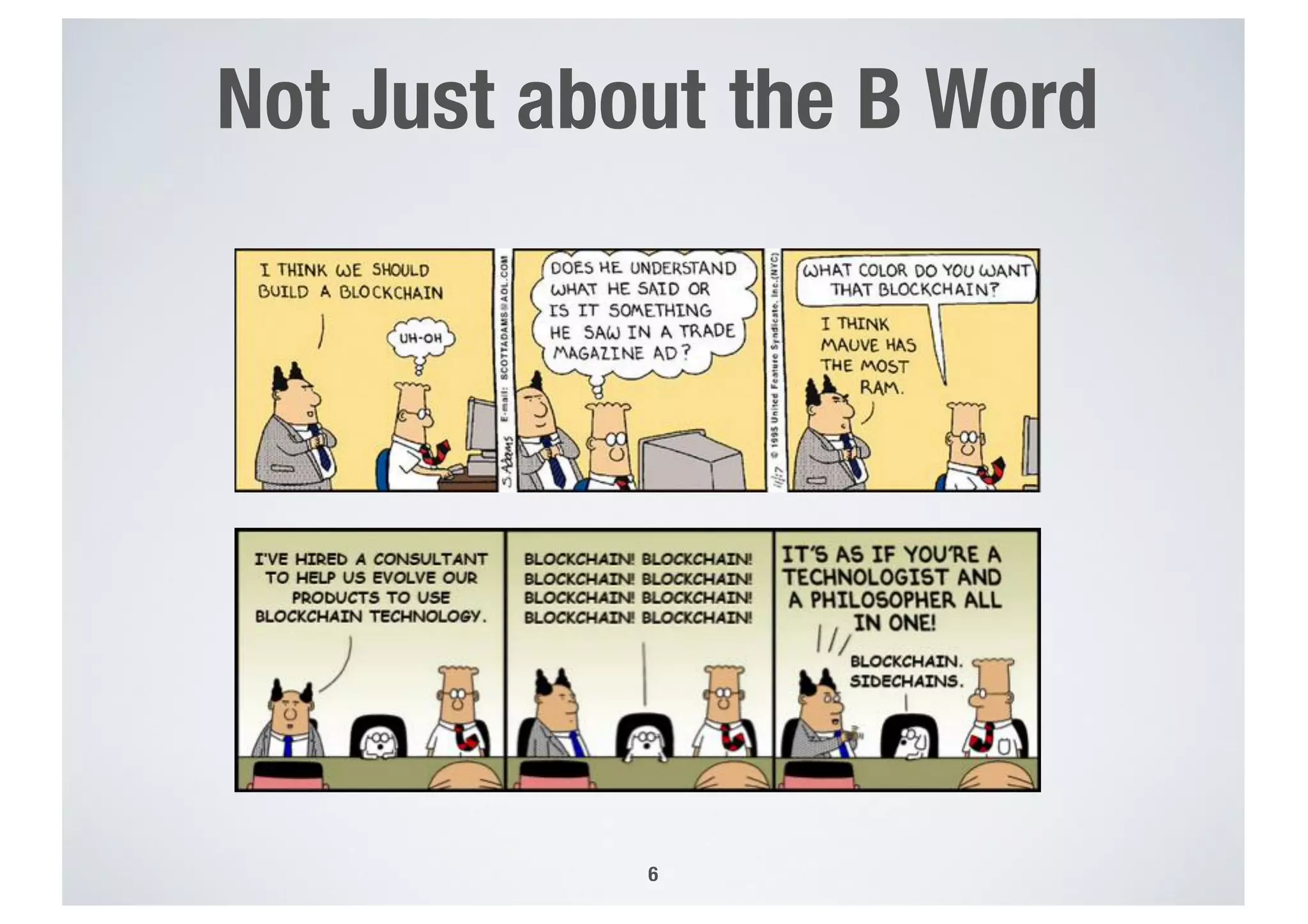
Not Just about the B Word
FinTech: State of Play
• $14.5 billion globally in venture capital in 2015, from $7.3 billion in
2014
• FinTech companies are proliferating
• Wide range of solutions that promise to impact nearly everyone
• Dramatically broaden the reach, flexibility, and level of innovation
of financial services
• Key challenge: Cybersecurity
• Risks: Financial losses, undermine confidence, lower adoption
7
Cybersecurity: Risk Factors
• “All that matters is to get to market fast” mentality
• Growing mismatch between technology and regulations
• Dilemma: Consumer protection versus the agility of the
innovation ecosystem
8
Cybersecurity: Risk Factors
• Reliance on machine learning and big data complicates the
picture regarding cybersecurity – unintended biases in system
behavior
• Many new “customers” with little knowledge of security risks
• More interfaces between traditional financial services and
FinTech applications
9
Did I manage to worry you?
10
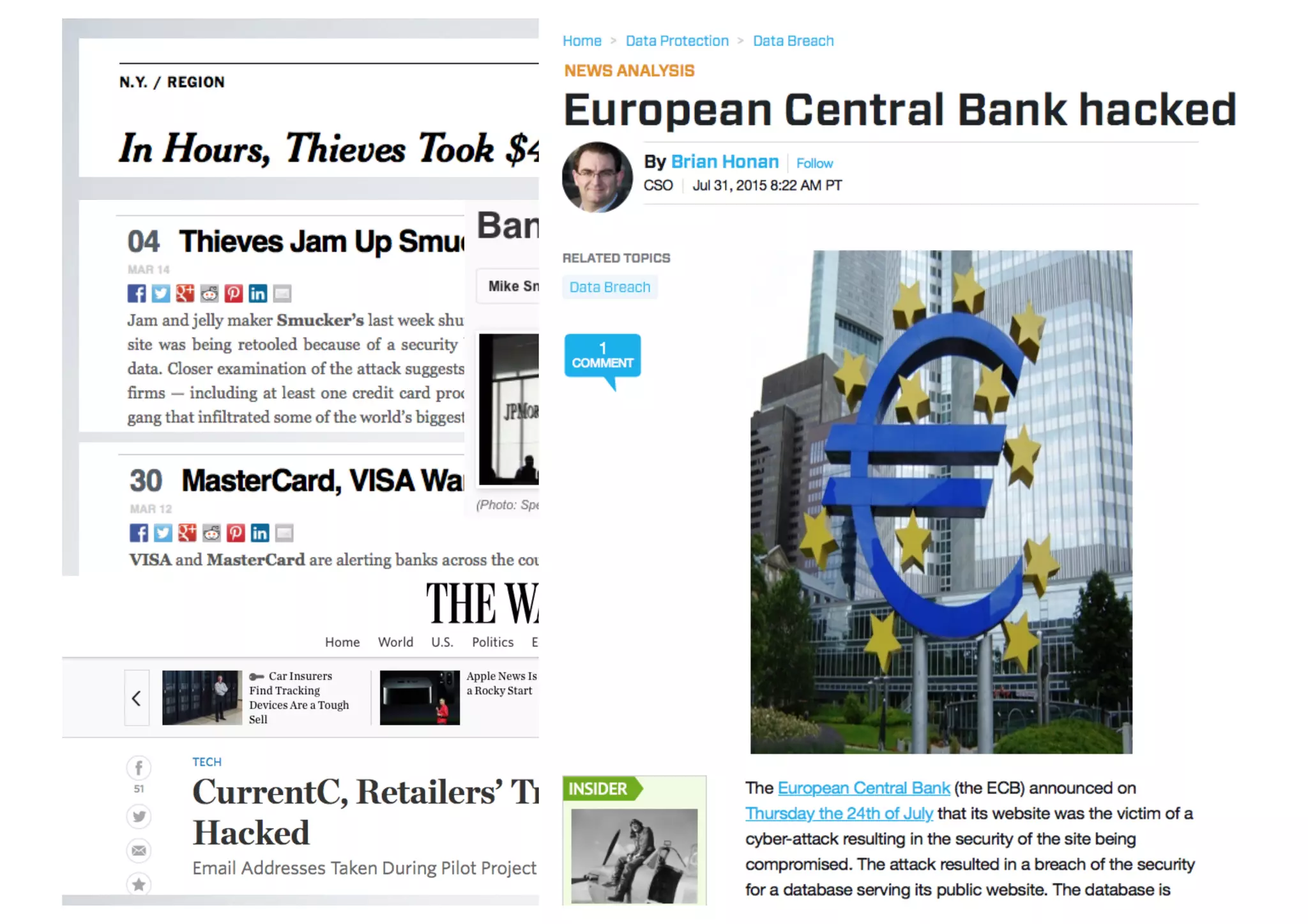
How Secure is our Data?
12
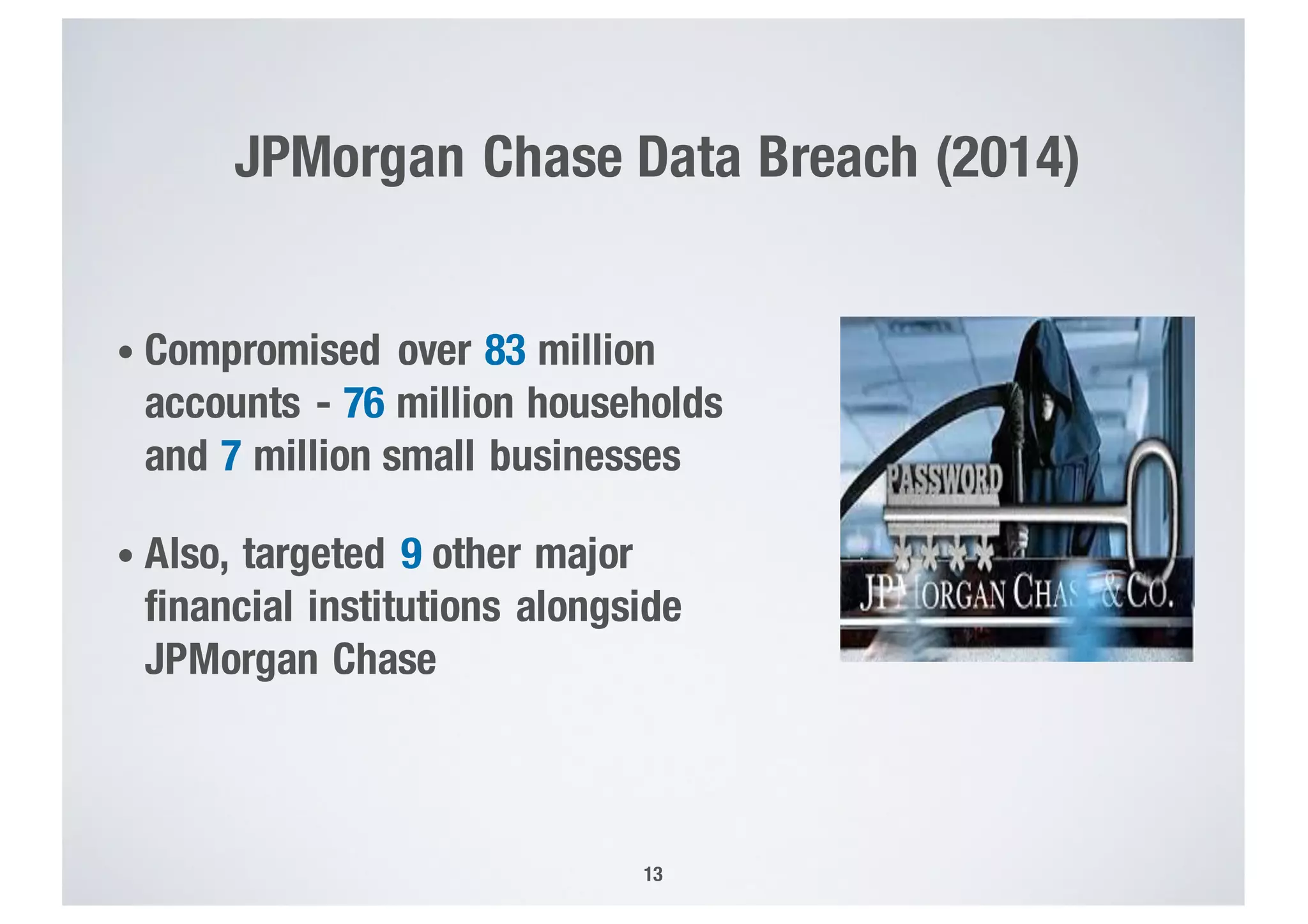
JPMorgan Chase Data Breach (2014)
13
• Compromised over 83 million
accounts - 76 million households
and 7 million small businesses
• Also, targeted 9 other major
financial institutions alongside
JPMorgan Chase
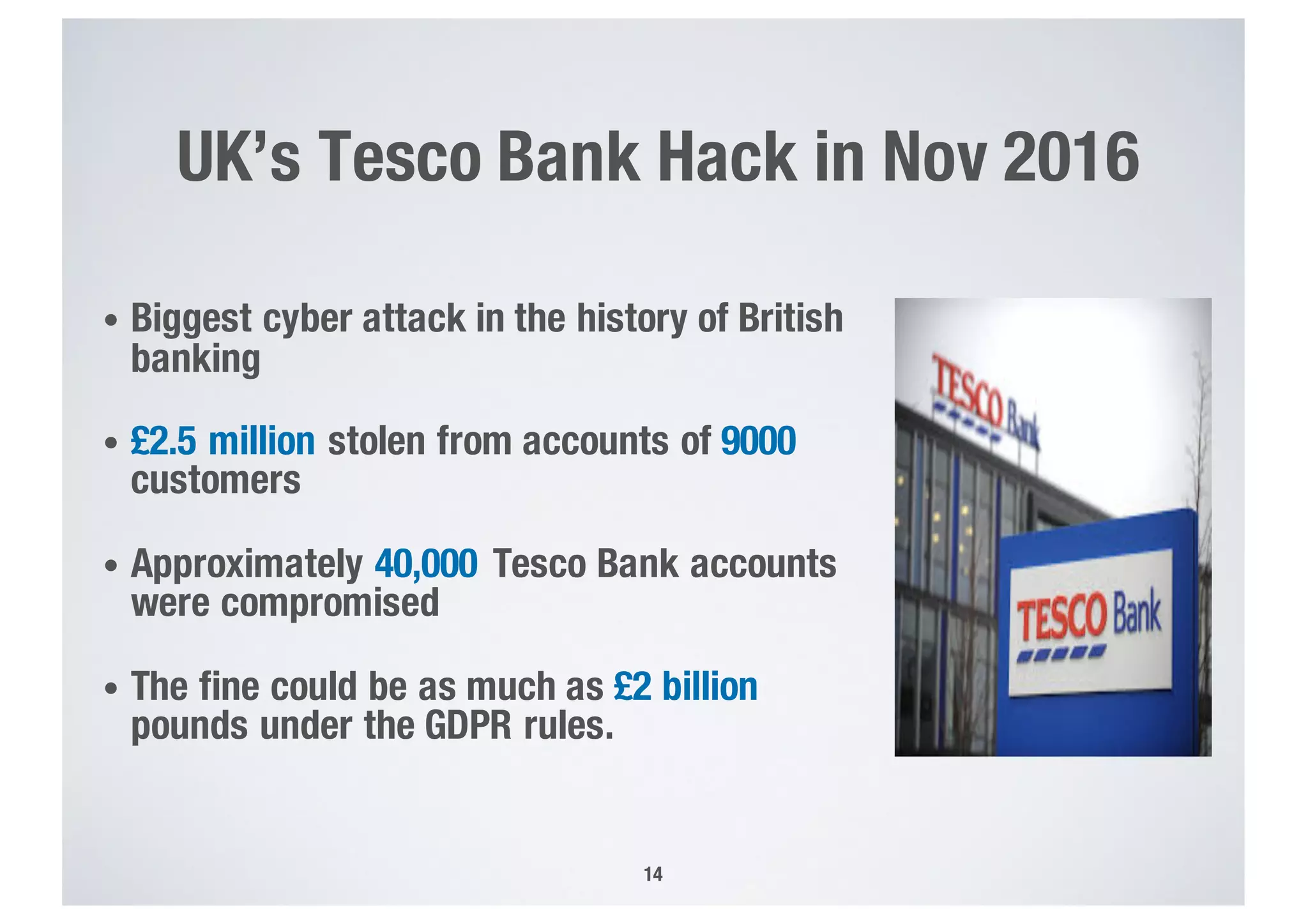
UK’s Tesco Bank Hack in Nov 2016
14
• Biggest cyber attack in the history of British
banking
• £2.5 million stolen from accounts of 9000
customers
• Approximately 40,000 Tesco Bank accounts
were compromised
• The fine could be as much as £2 billion
pounds under the GDPR rules.
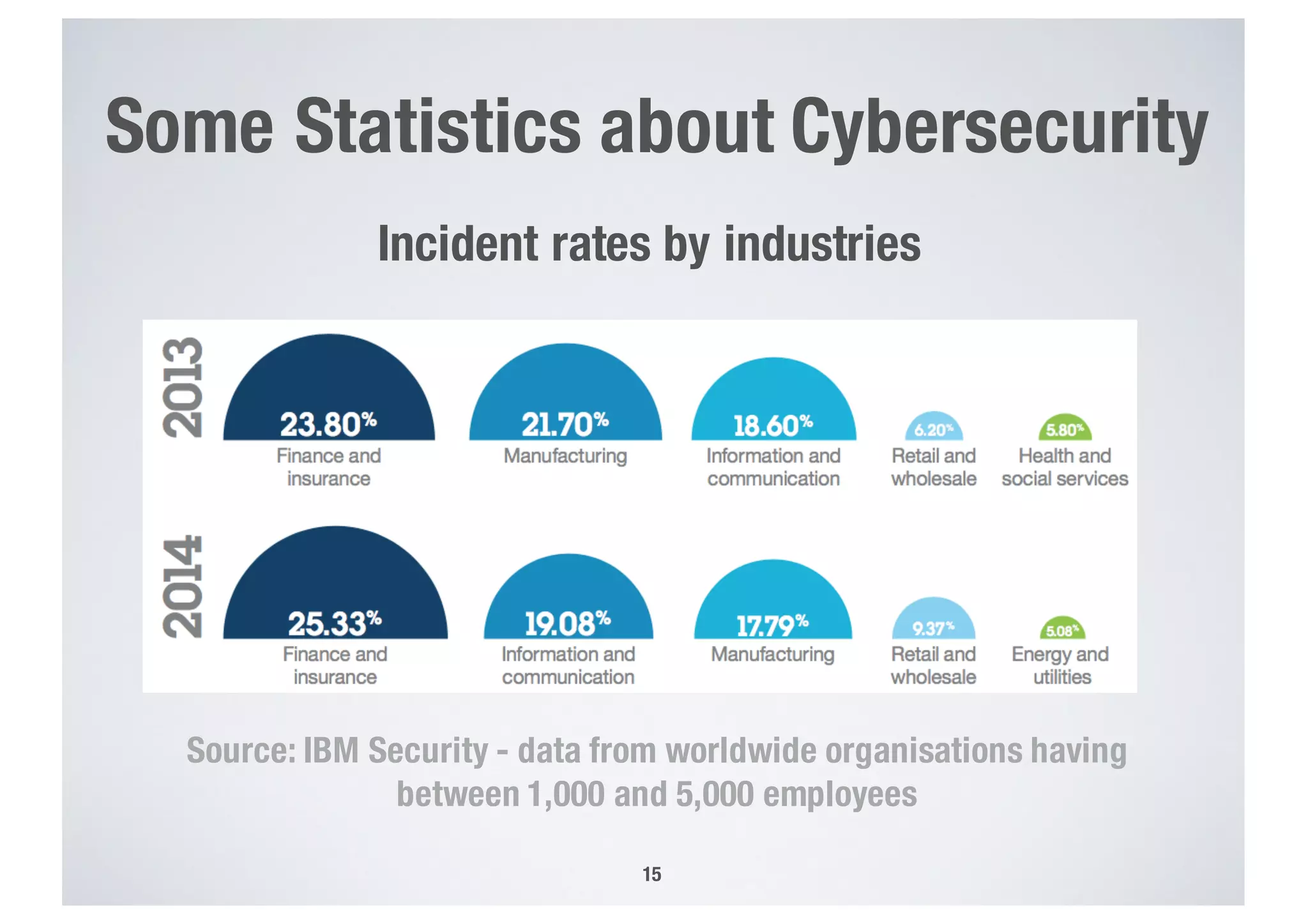
Some Statistics about Cybersecurity
15
Source: IBM Security - data from worldwide organisations having
between 1,000 and 5,000 employees
Incident rates by industries
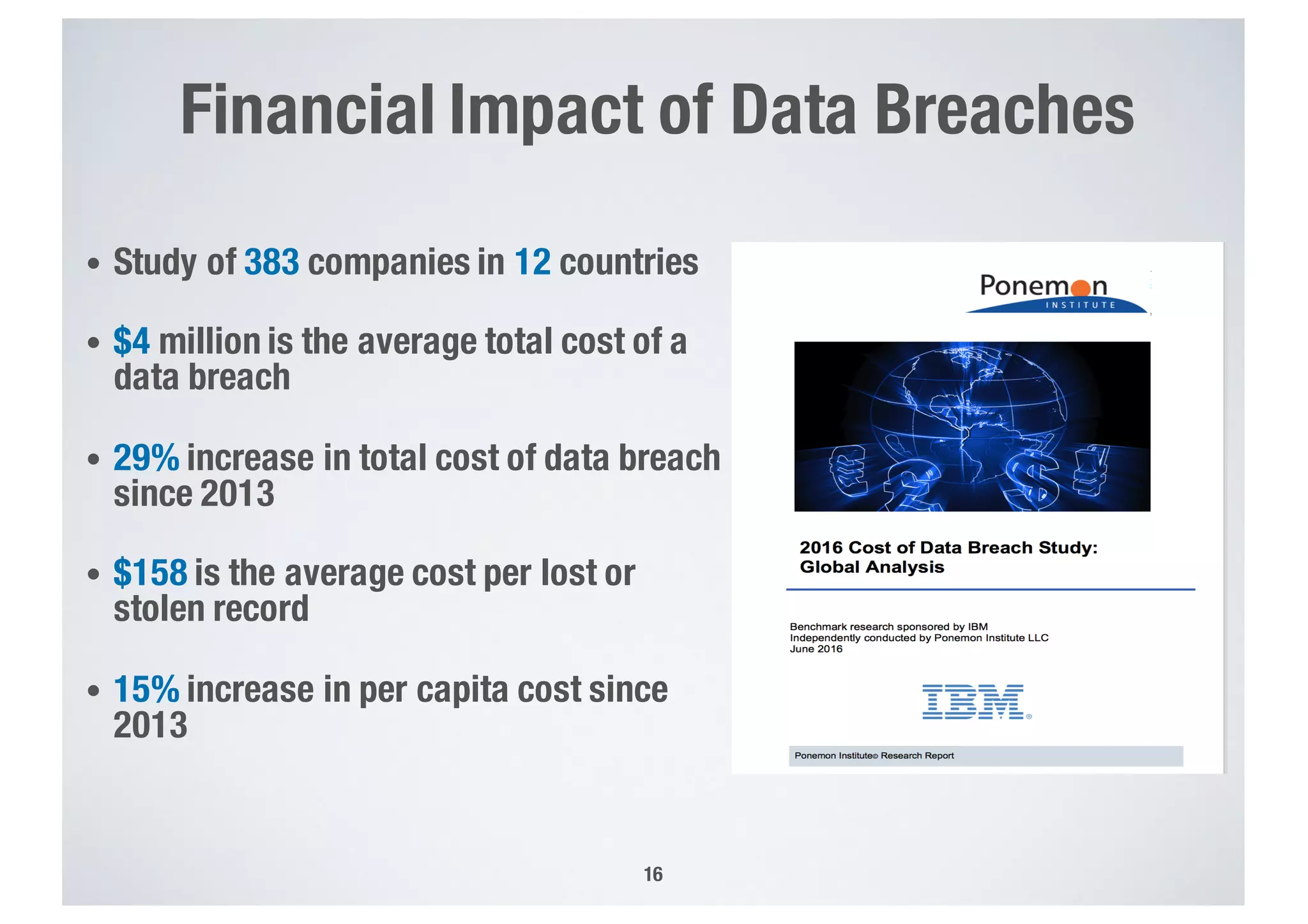
Financial Impact of Data Breaches
16
• Study of 383 companies in 12 countries
• $4 million is the average total cost of a
data breach
• 29% increase in total cost of data breach
since 2013
• $158 is the average cost per lost or
stolen record
• 15% increase in per capita cost since
2013
Are FinTech Applications
Different?
• Most FinTech applications are web applications or services,
possibly with a mobile front end – they are subject to the
same security challenges as many other systems
• FinTech applications handle sensitive data and perform
business-critical operations
• For now transactions are relatively limited, but risk factors
are even more acute than in traditional financial services
17
18
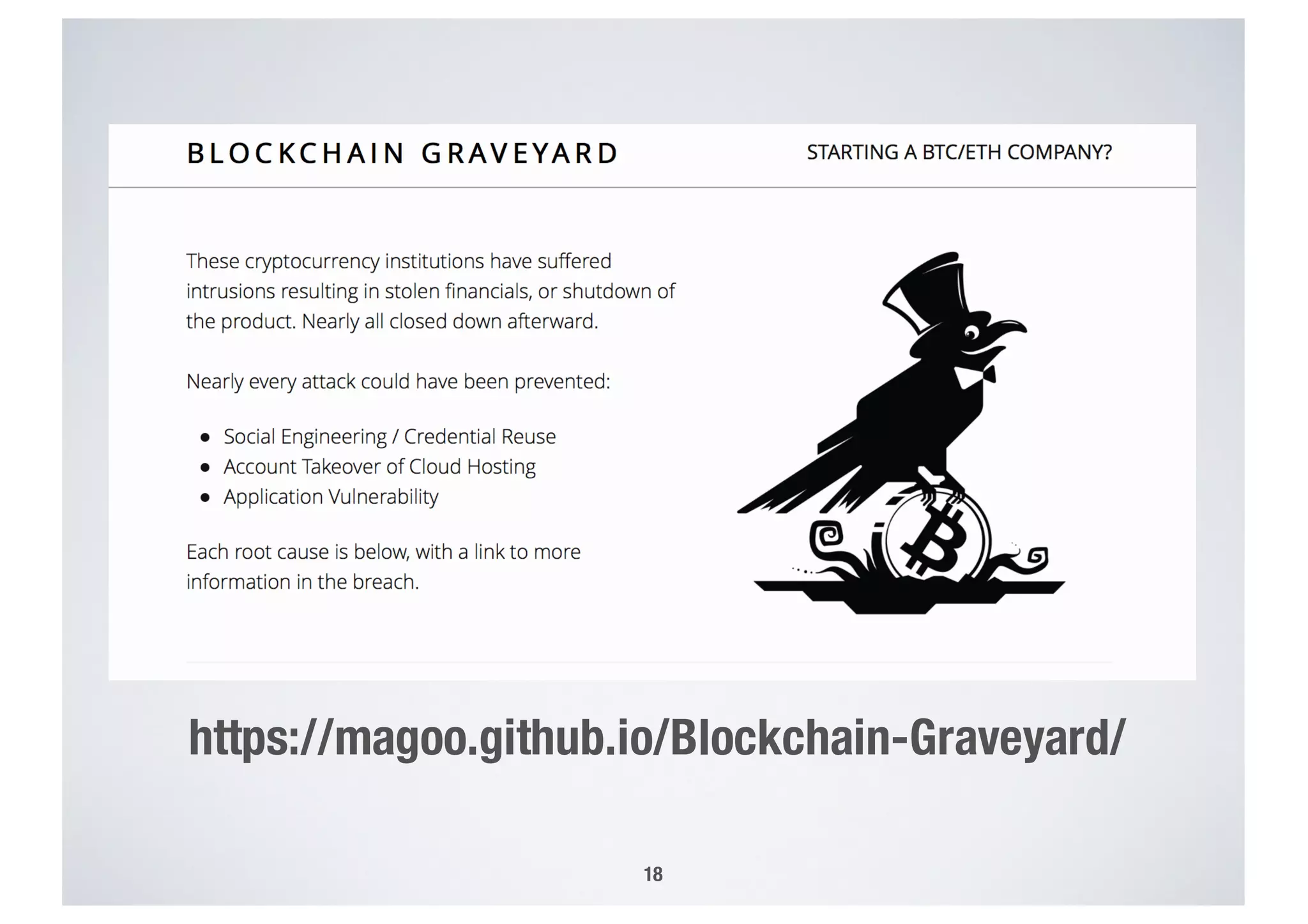
https://magoo.github.io/Blockchain-Graveyard/
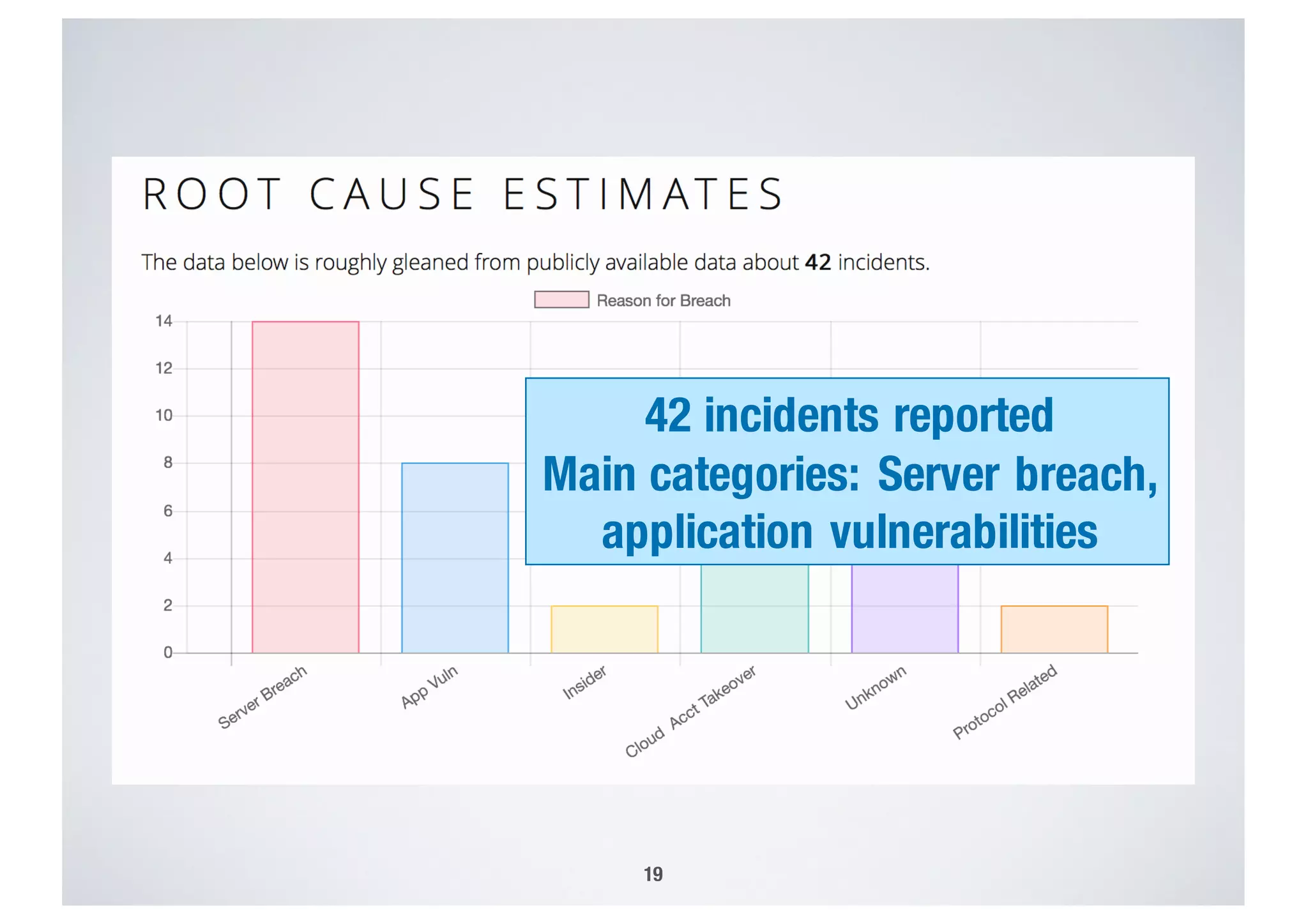
19
42 incidents reported
Main categories: Server breach,
application vulnerabilities
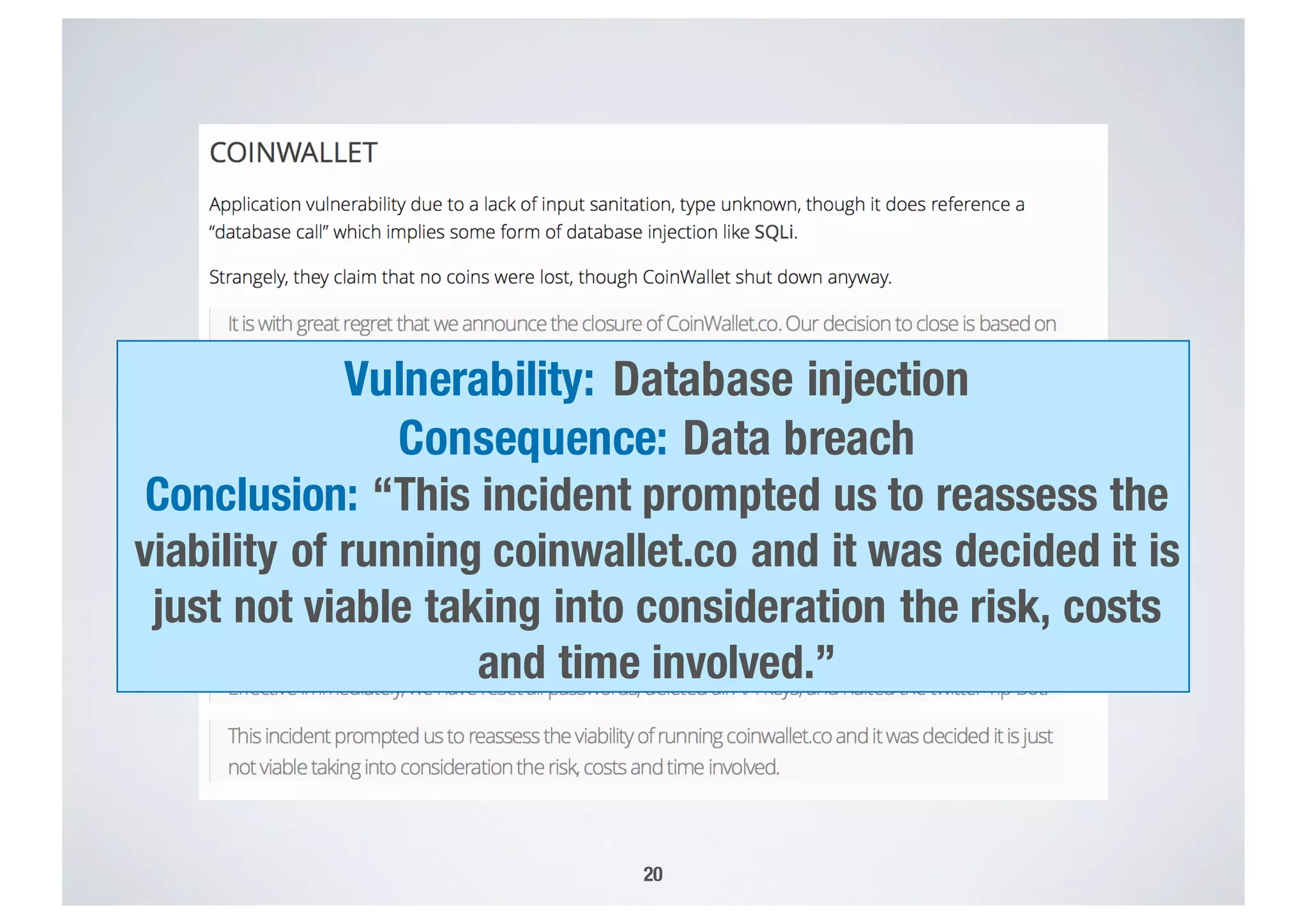
20
Vulnerability: Database injection
Consequence: Data breach
Conclusion: “This incident prompted us to reassess the
viability of running coinwallet.co and it was decided it is
just not viable taking into consideration the risk, costs
and time involved.”
Summary
• FinTech applications handle sensitive user and corporate data
• Data breaches can ruin a FinTech company’s reputation and
lead to significant financial damages and legal problems
• FinTech applications must be secure from a data management
point of view
• Regulations are becoming more stringent, including the GDPR
European legislation on data privacy
21
Secure data management cannot
be ensured during development
• Root causes
• time to market pressures,
• lack of disciplined programming,
• third-party solutions (services, components).
22
Consequences
• Many applications have problems with
• incomplete or improper security requirements,
• inadequate security architecture,
• implementation flaws,
• lack of systematic and effective testing,
• …
23
Compliance with Standards and
Regulations
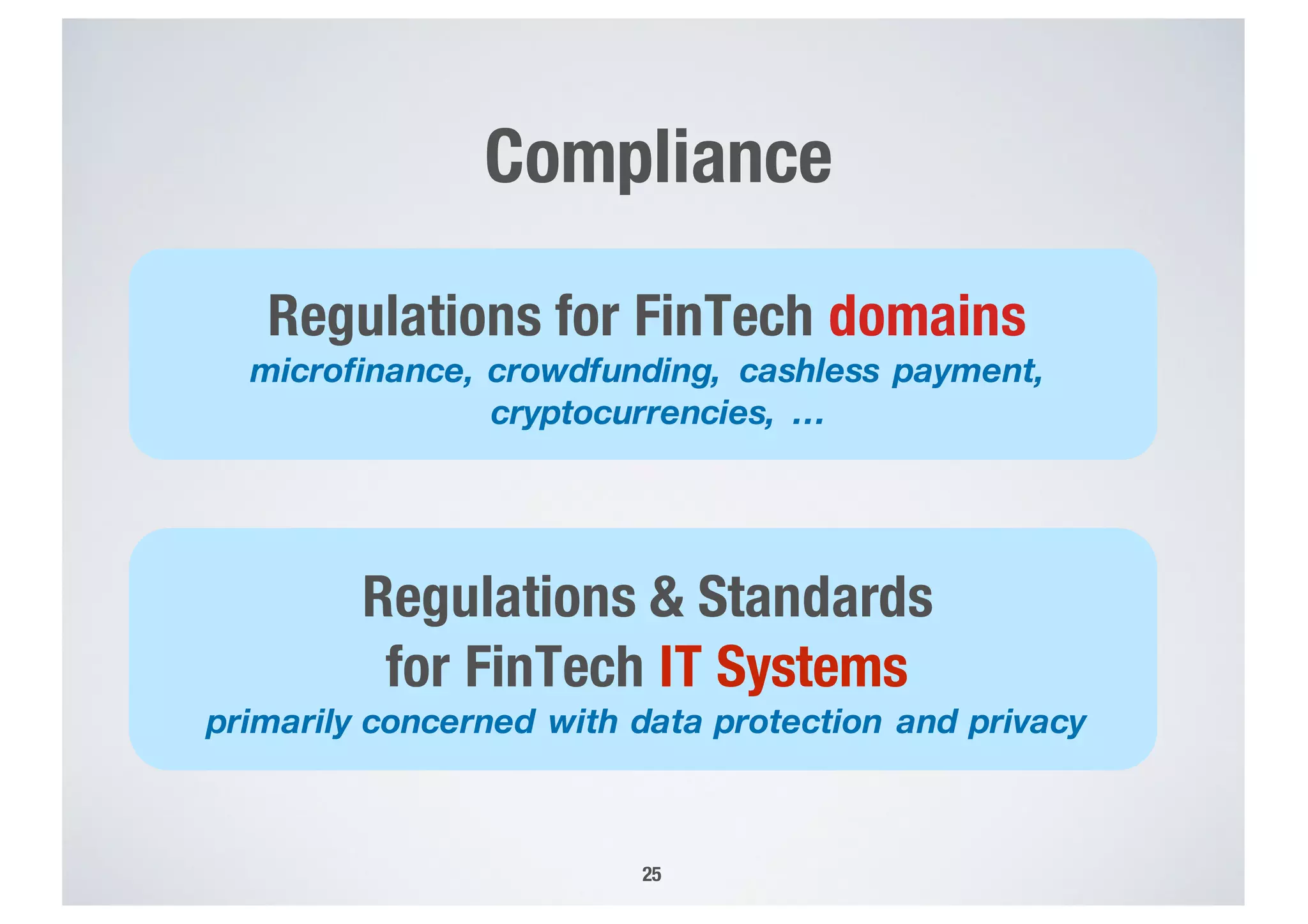
Compliance
25
Regulations for FinTech domains
microfinance, crowdfunding, cashless payment,
cryptocurrencies, …
Regulations & Standards
for FinTech IT Systems
primarily concerned with data protection and privacy
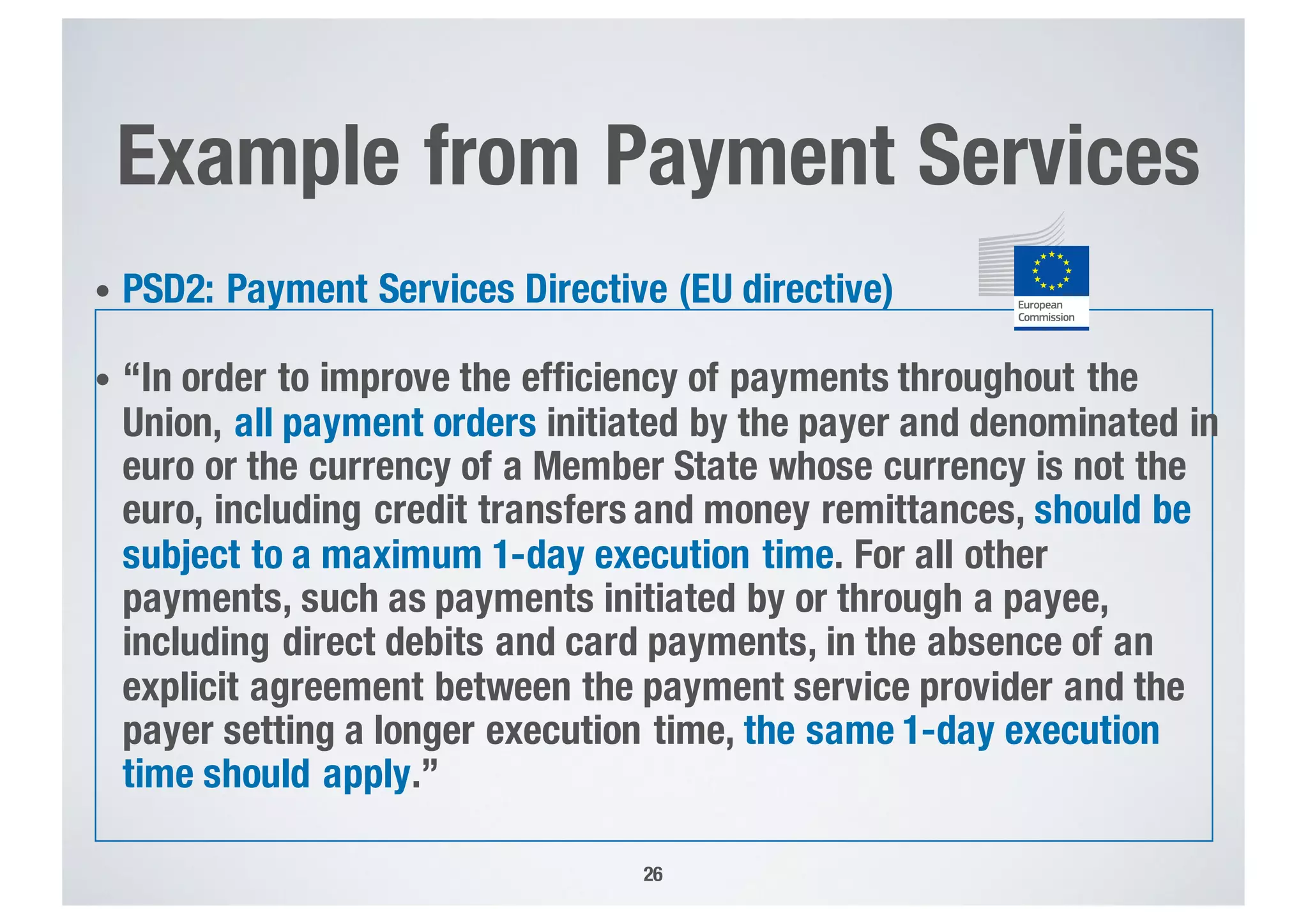
Example from Payment Services
• PSD2: Payment Services Directive (EU directive)
• “In order to improve the efficiency of payments throughout the
Union, all payment orders initiated by the payer and denominated in
euro or the currency of a Member State whose currency is not the
euro, including credit transfers and money remittances, should be
subject to a maximum 1-day execution time. For all other
payments, such as payments initiated by or through a payee,
including direct debits and card payments, in the absence of an
explicit agreement between the payment service provider and the
payer setting a longer execution time, the same 1-day execution
time should apply.”
26
Logo (vertical)
Positive versions
“standard”
The European Commission
logo exists in 6 versions
(positive and negative
CMYK, Reflex Blue and
black & white), all of which
are available in 6 different
formats (ai, eps, jpg, png,
tiff and pdf).
All these formats are
available on the Visual
Identity Page:
http://www.cc.cec/dgintranet/
comm/visual_identity/index_
en.htm
CMYK – for full-colour printing
Pantone EC Corporate Blue –
for 1-colour printing
Black – for black & white printing
The standard logo is the main logo
of the European Commission and,
as a general rule, should appear
top centred on all communication
material, documents and products
unless there is a special reason
not to substitute the standard
logo with the horizontal or mute
variation.
12
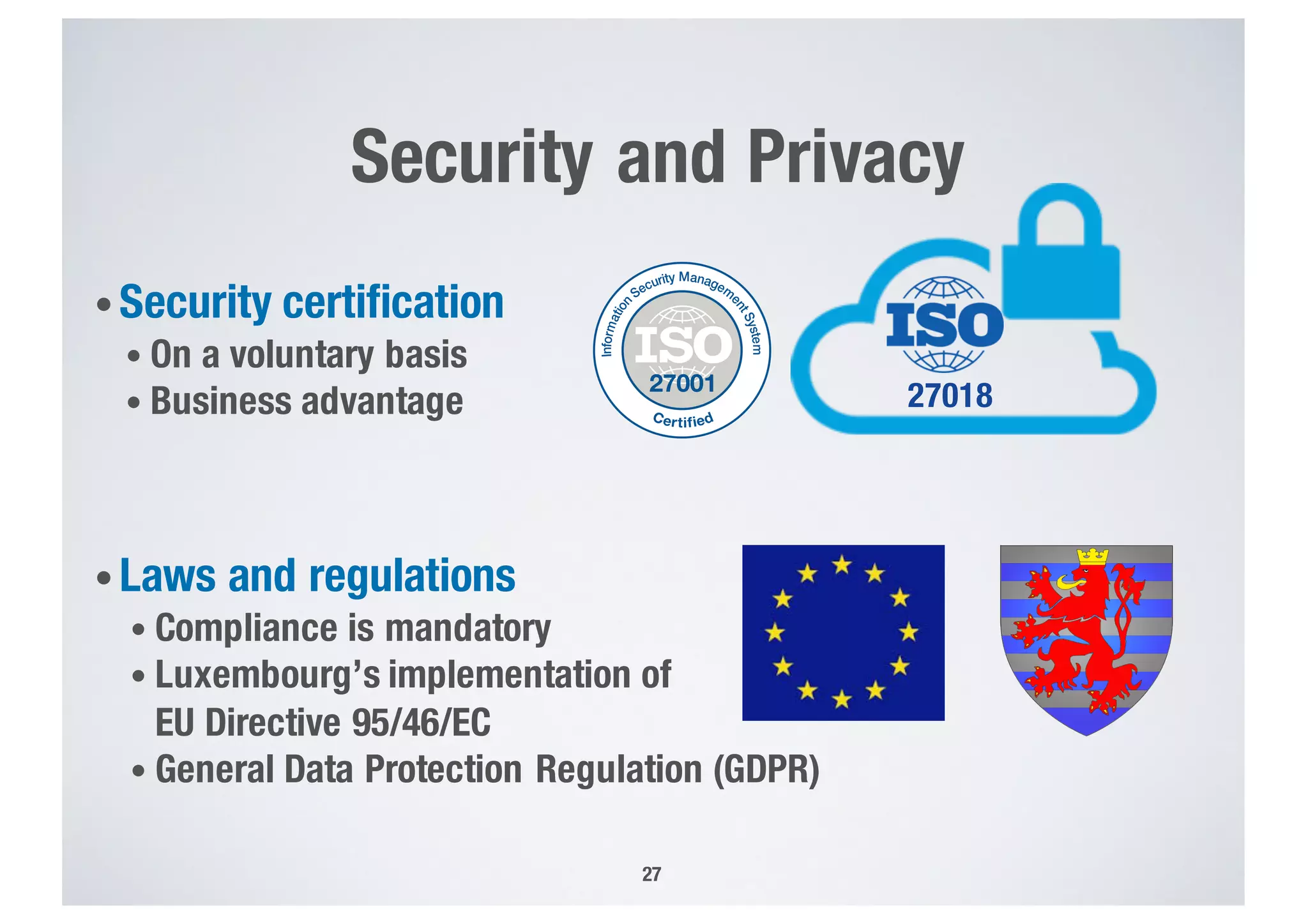
Security and Privacy
• Security certification
• On a voluntary basis
• Business advantage
• Laws and regulations
• Compliance is mandatory
• Luxembourg’s implementation of
EU Directive 95/46/EC
• General Data Protection Regulation (GDPR)
27
27018
28
• Sweeping powers for national data protection agencies
• Fines of up to 4% of annual turnover for major breaches
• Major new requirements, including:
• Reporting major data breaches within 72h
• Privacy by design
• Client’s right to be forgotten
• Verified technical and organizational measures necessary for
demonstrating security
GDPR
Industry Security Standards
• Payment Card Industry Data Security Standard (PCI DSS)
• Proprietary information and security standard for
organizations that handle branded credit cards
• Increase control on credit card data and reduce credit card
fraud
• Annual validation of compliance by Qualified Security
Assessors
29
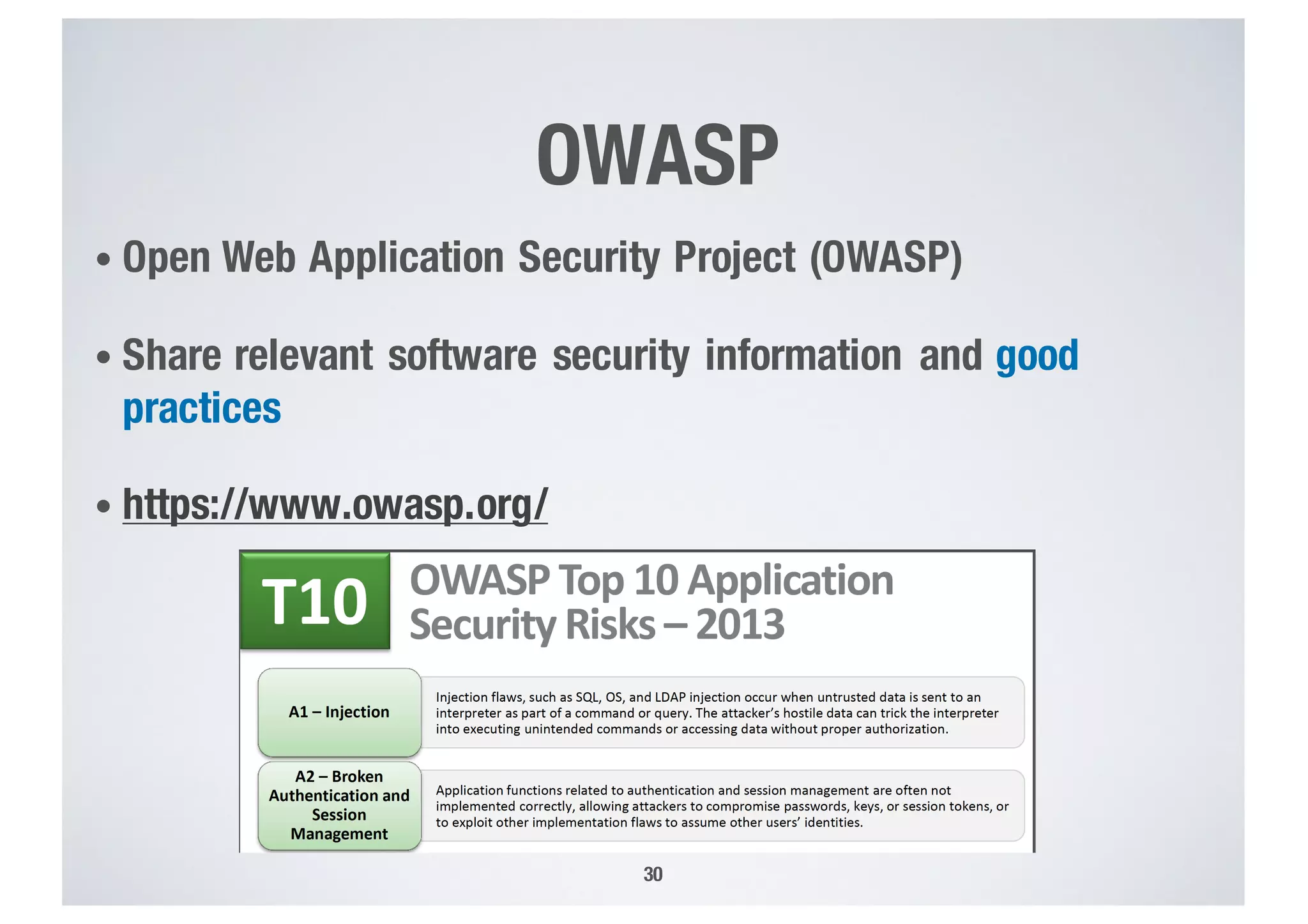
OWASP
• Open Web Application Security Project (OWASP)
• Share relevant software security information and good
practices
• https://www.owasp.org/
30
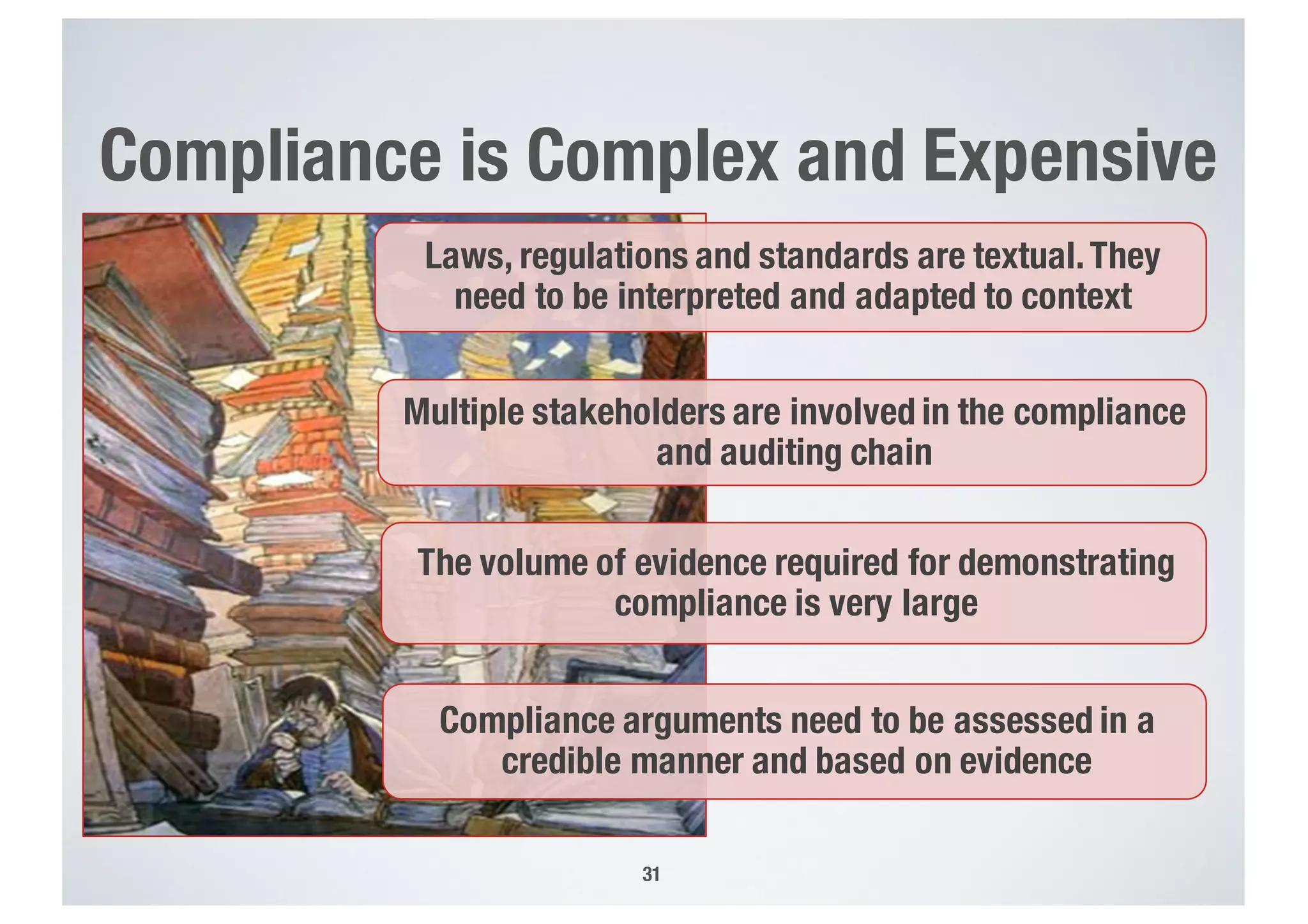
Compliance is Complex and Expensive
31
Laws, regulations and standards are textual.They
need to be interpreted and adapted to context
Multiple stakeholders are involved in the compliance
and auditing chain
The volume of evidence required for demonstrating
compliance is very large
Compliance arguments need to be assessed in a
credible manner and based on evidence
What can we do?
32
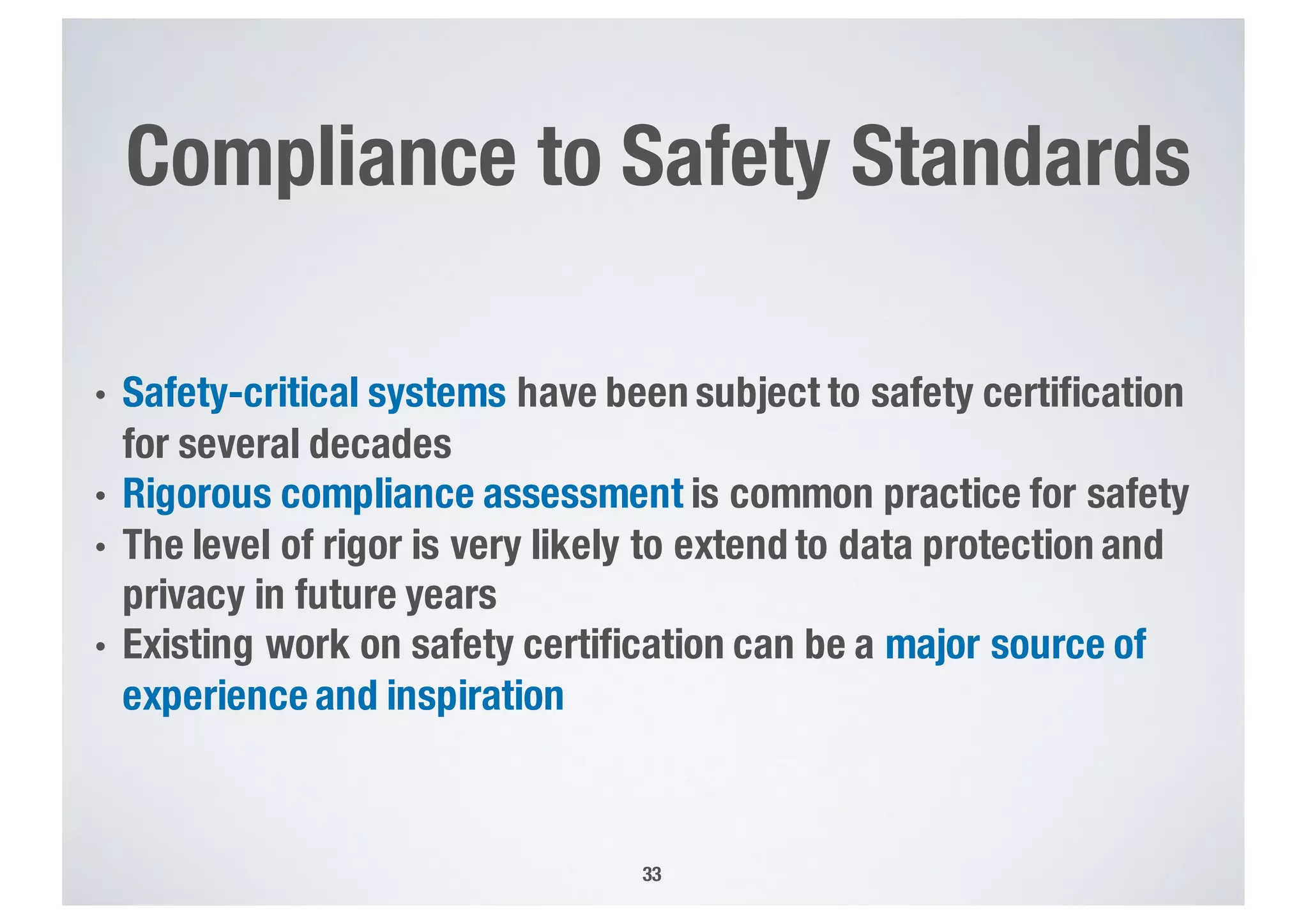
Compliance to Safety Standards
• Safety-critical systems have been subject to safety certification
for several decades
• Rigorous compliance assessment is common practice for safety
• The level of rigor is very likely to extend to data protection and
privacy in future years
• Existing work on safety certification can be a major source of
experience and inspiration
33
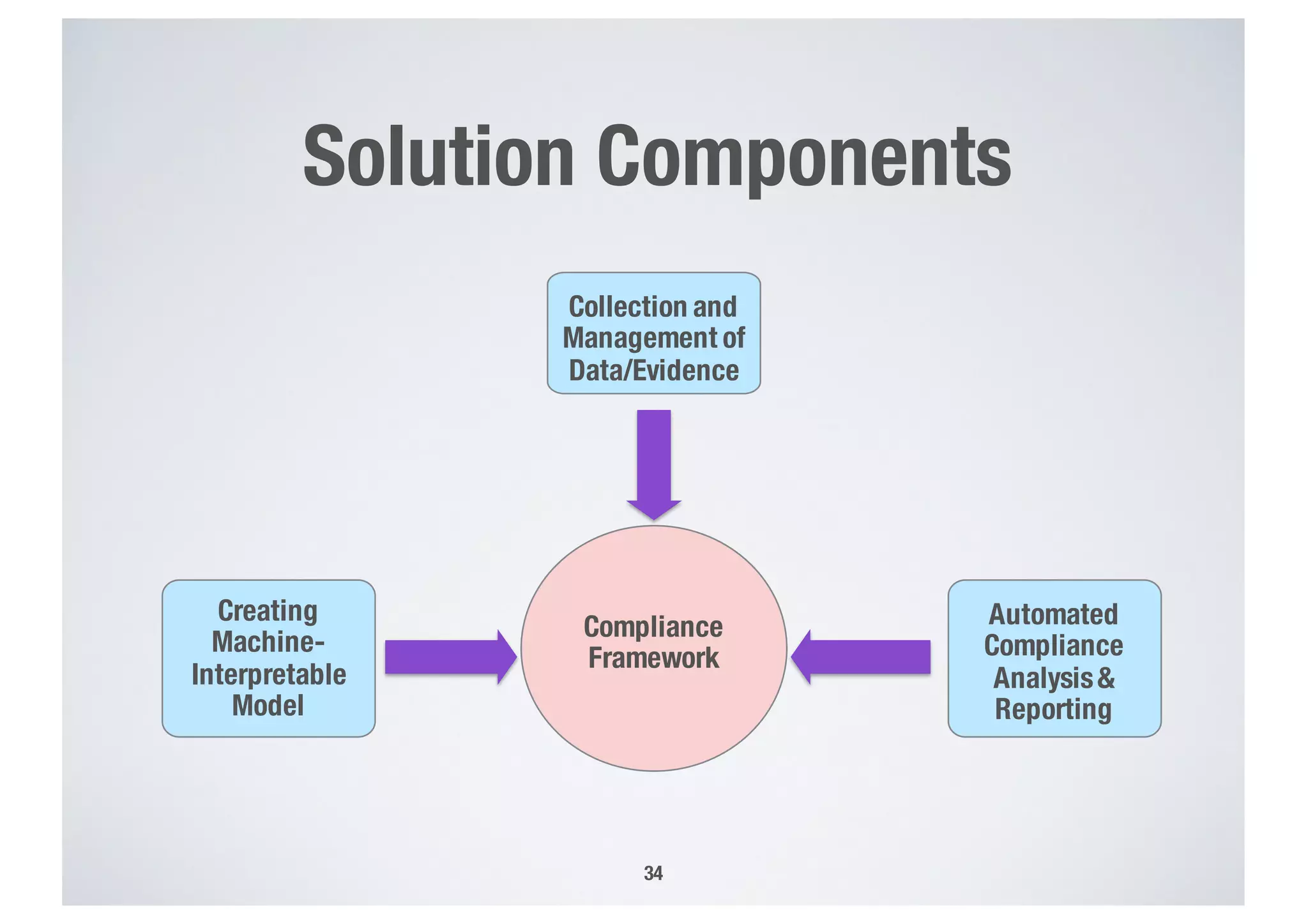
Solution Components
34
Compliance
Framework
Creating
Machine-
Interpretable
Model
Collection and
Management of
Data/Evidence
Automated
Compliance
Analysis&
Reporting
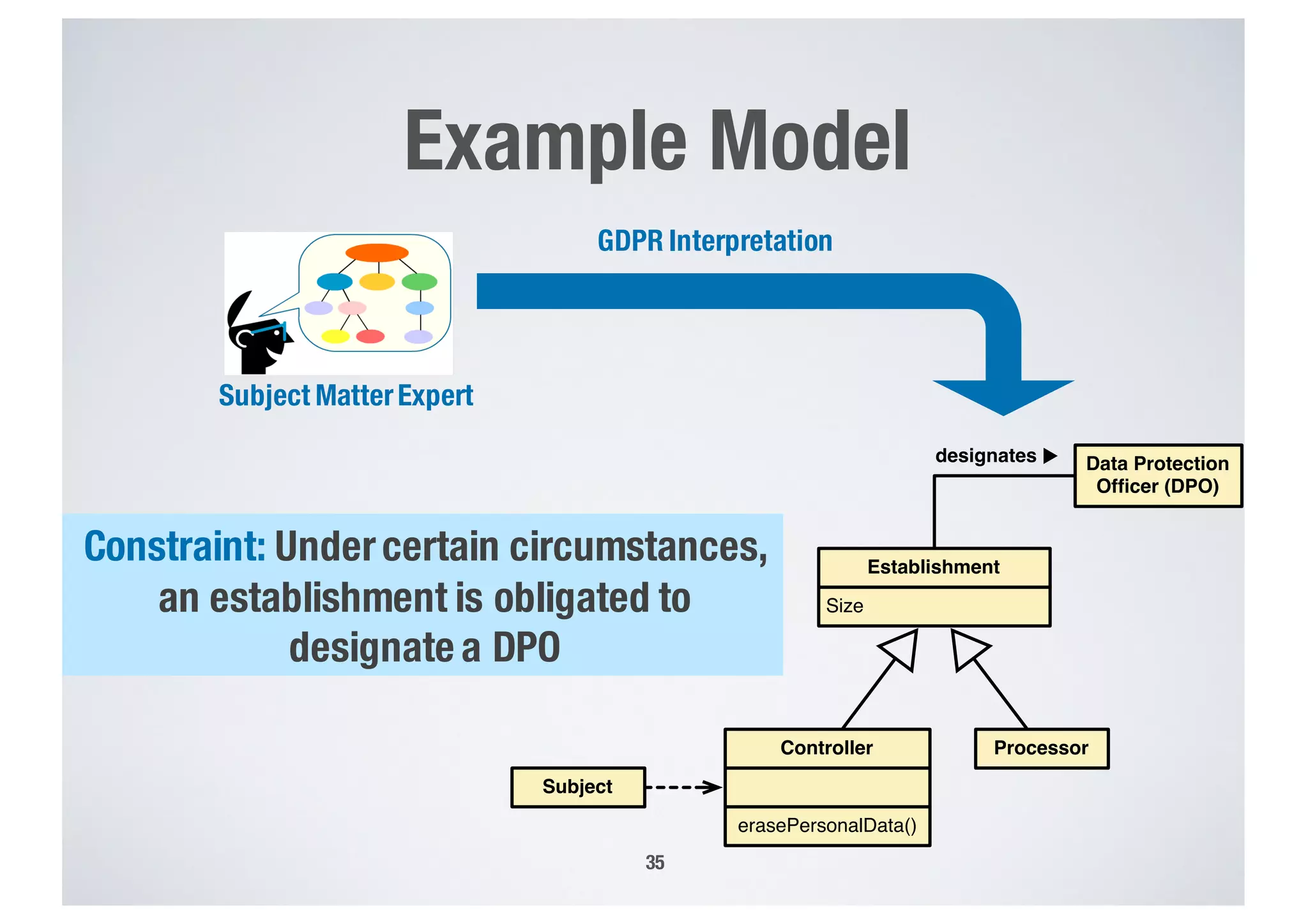
Example Model
35
Subject MatterExpert
GDPR Interpretation
Size
Establishment
erasePersonalData()
Controller Processor
Subject
Data Protection
Officer (DPO)
designates ▶︎
Constraint: Undercertain circumstances,
an establishment is obligated to
designate a DPO
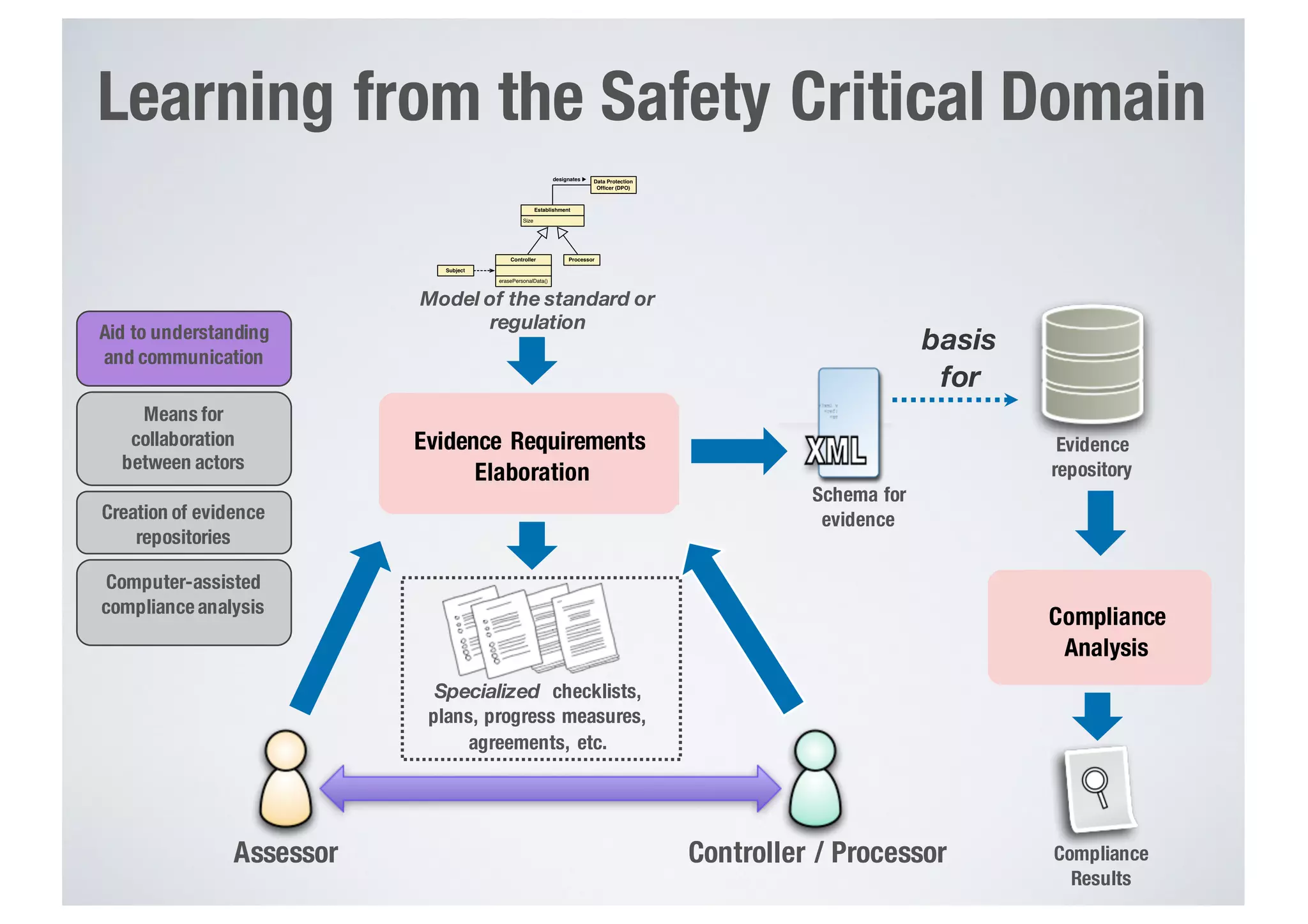
Assessor Controller / Processor
Specialized checklists,
plans, progress measures,
agreements, etc.
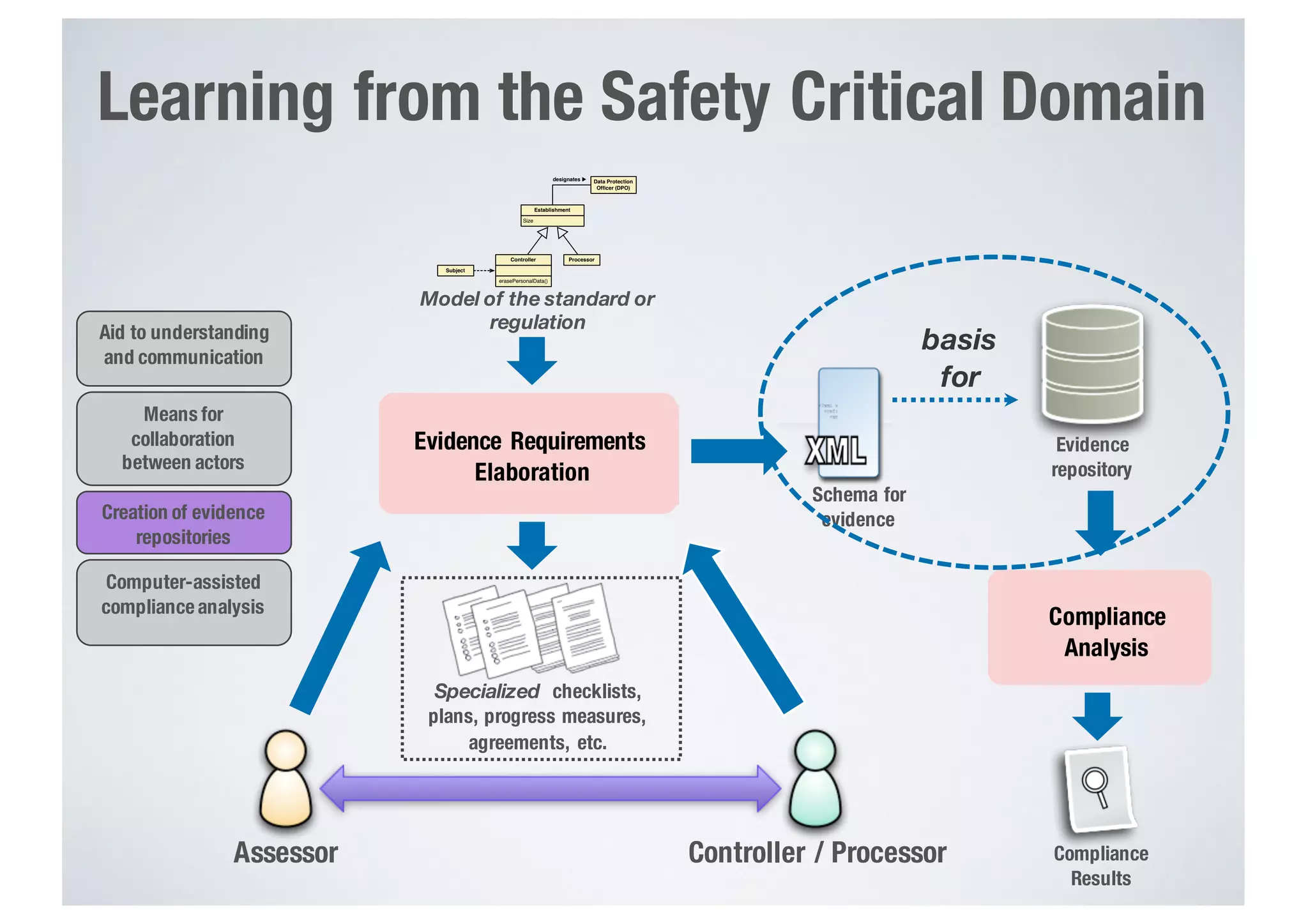
Schema for
evidence
Evidence
repository
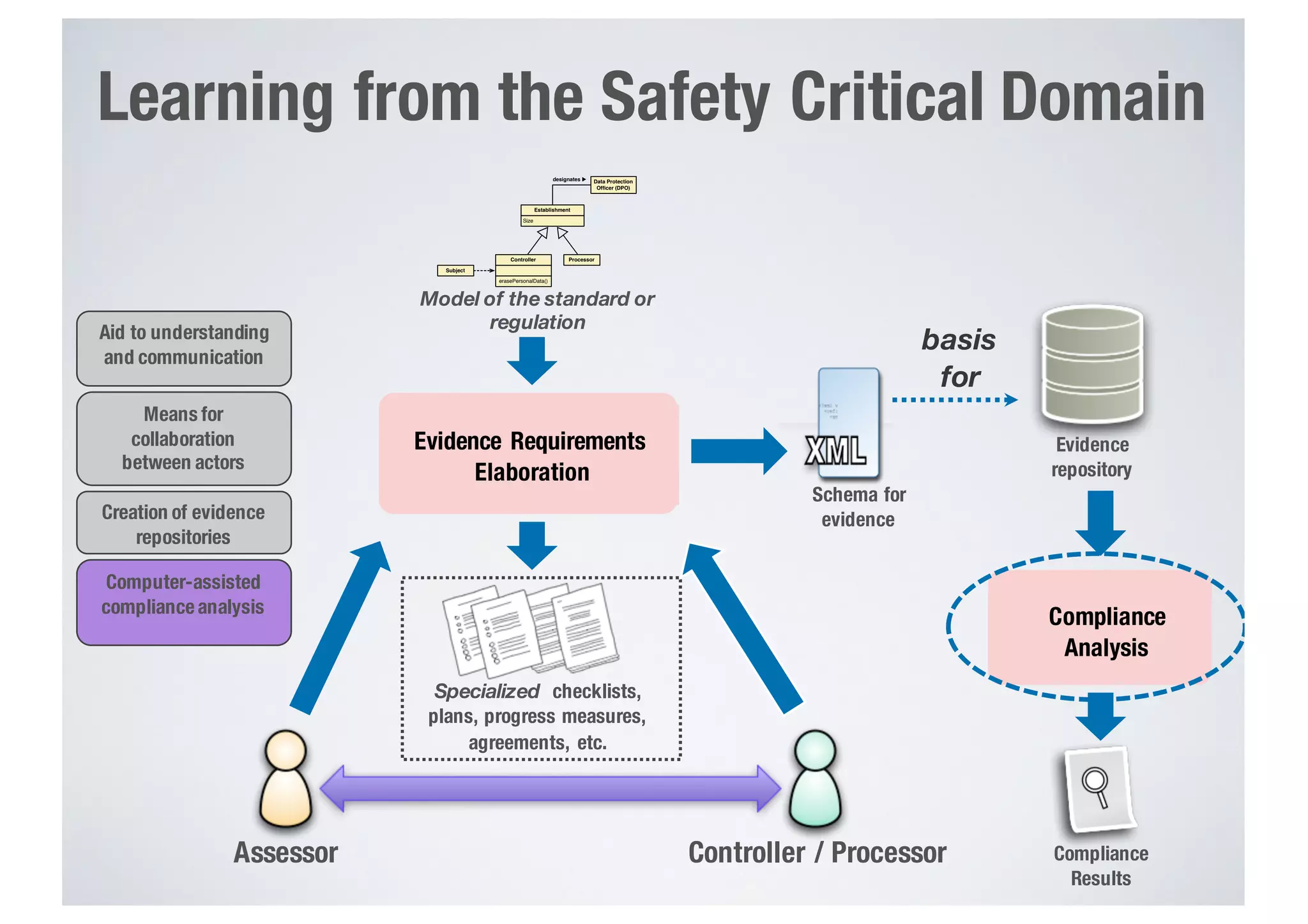
Compliance
Results
basis
for
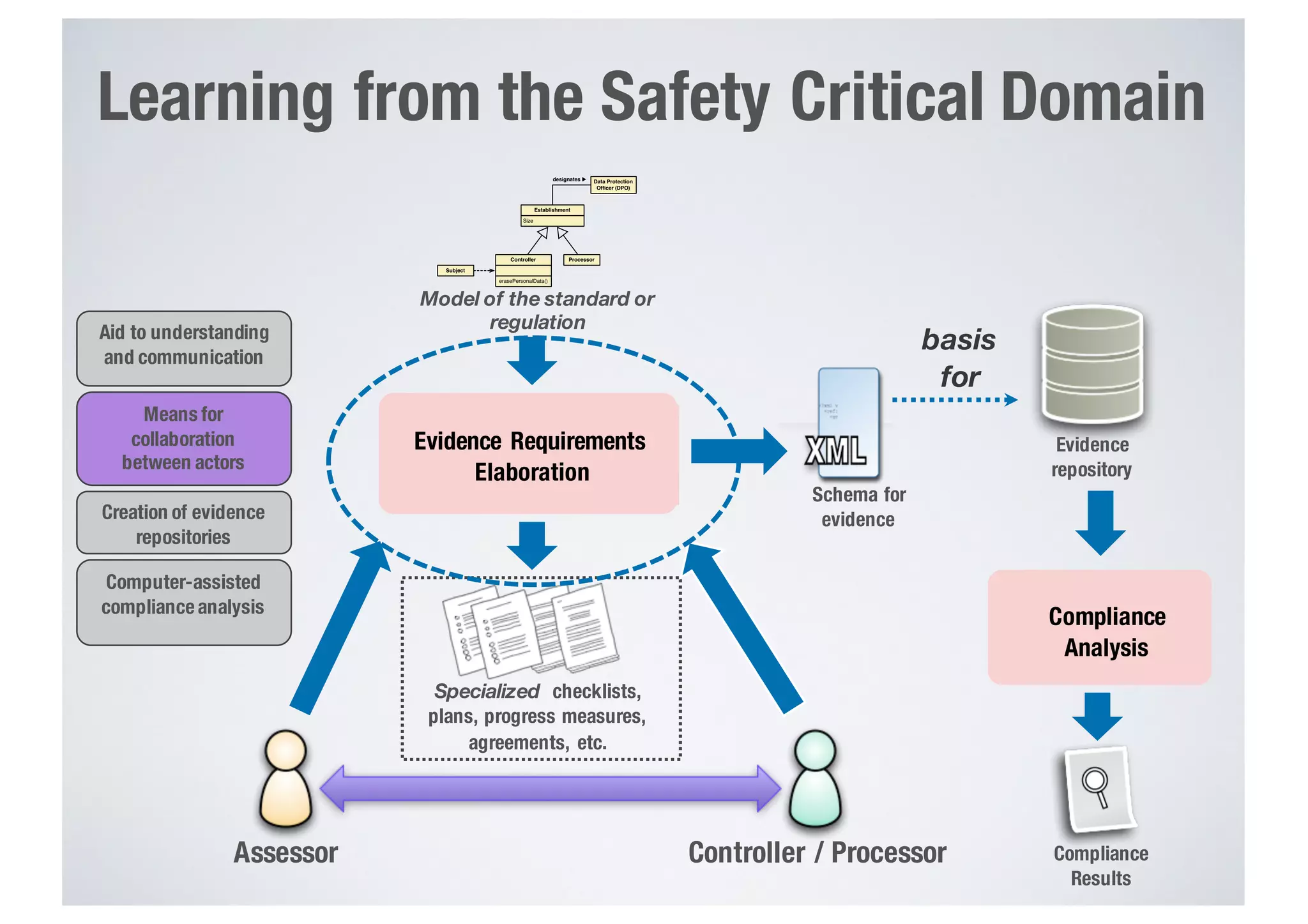
Evidence Requirements
Elaboration
Compliance
Analysis
Model of the standard or
regulation
Aid to understanding
and communication
Means for
collaboration
between actors
Creation of evidence
repositories
Computer-assisted
compliance analysis
Learning from the Safety Critical Domain
Size
Establishment
erasePersonalData()
Controller Processor
Subject
Data Protection
Officer (DPO)
designates ▶︎
Assessor Controller / Processor
Specialized checklists,
plans, progress measures,
agreements, etc.
Schema for
evidence
Evidence
repository
Compliance
Results
basis
for
Evidence Requirements
Elaboration
Compliance
Analysis
Model of the standard or
regulation
Aid to understanding
and communication
Means for
collaboration
between actors
Creation of evidence
repositories
Computer-assisted
compliance analysis
Learning from the Safety Critical Domain
Size
Establishment
erasePersonalData()
Controller Processor
Subject
Data Protection
Officer (DPO)
designates ▶︎
Assessor Controller / Processor
Specialized checklists,
plans, progress measures,
agreements, etc.
Schema for
evidence
Evidence
repository
Compliance
Results
basis
for
Evidence Requirements
Elaboration
Compliance
Analysis
Model of the standard or
regulation
Aid to understanding
and communication
Means for
collaboration
between actors
Creation of evidence
repositories
Computer-assisted
compliance analysis
Learning from the Safety Critical Domain
Size
Establishment
erasePersonalData()
Controller Processor
Subject
Data Protection
Officer (DPO)
designates ▶︎
Assessor Controller / Processor
Specialized checklists,
plans, progress measures,
agreements, etc.
Schema for
evidence
Evidence
repository
Compliance
Results
basis
for
Evidence Requirements
Elaboration
Compliance
Analysis
Model of the standard or
regulation
Aid to understanding
and communication
Means for
collaboration
between actors
Creation of evidence
repositories
Computer-assisted
compliance analysis
Learning from the Safety Critical Domain
Size
Establishment
erasePersonalData()
Controller Processor
Subject
Data Protection
Officer (DPO)
designates ▶︎
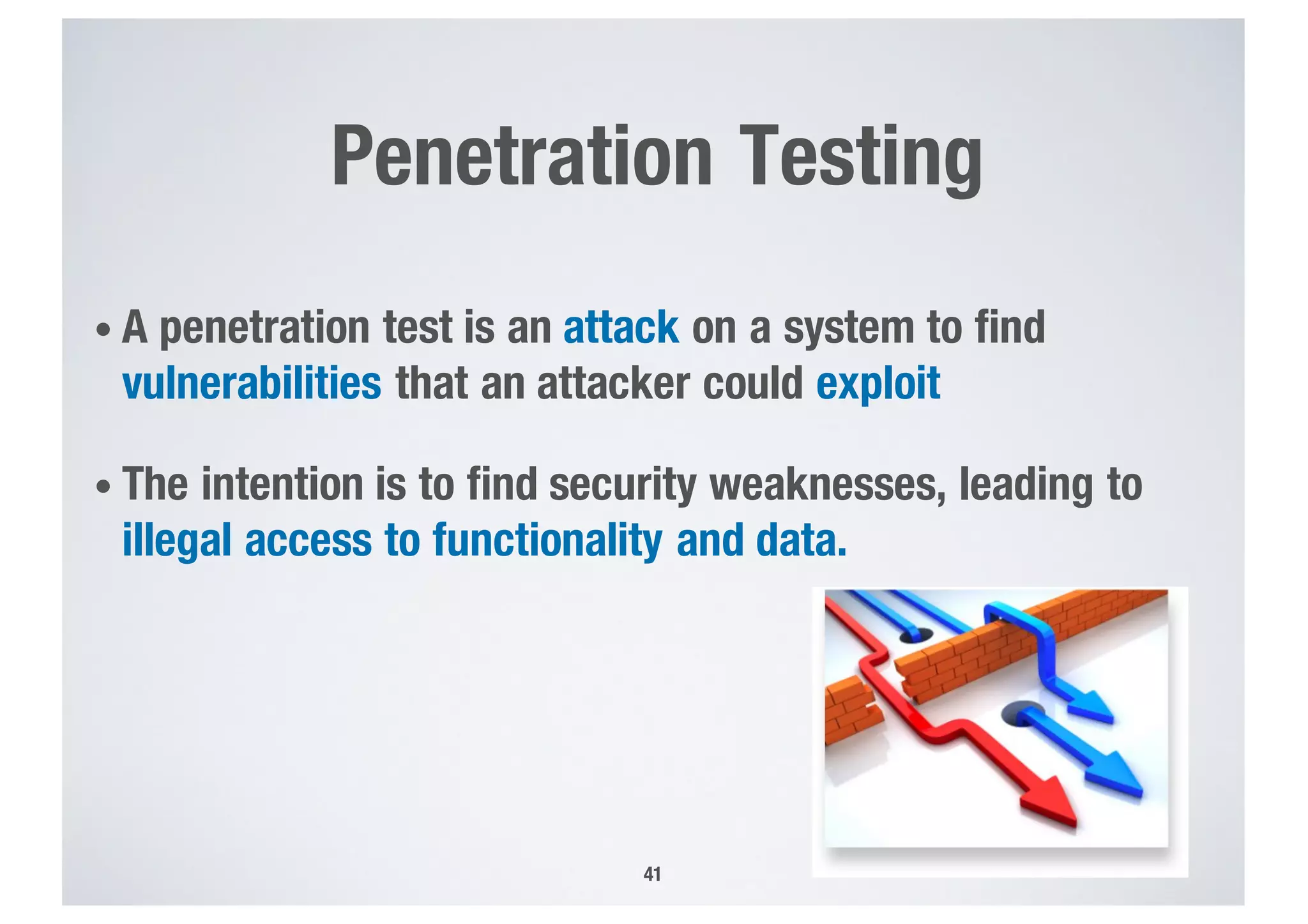
Penetration Testing
Penetration Testing
• A penetration test is an attack on a system to find
vulnerabilities that an attacker could exploit
• The intention is to find security weaknesses, leading to
illegal access to functionality and data.
41
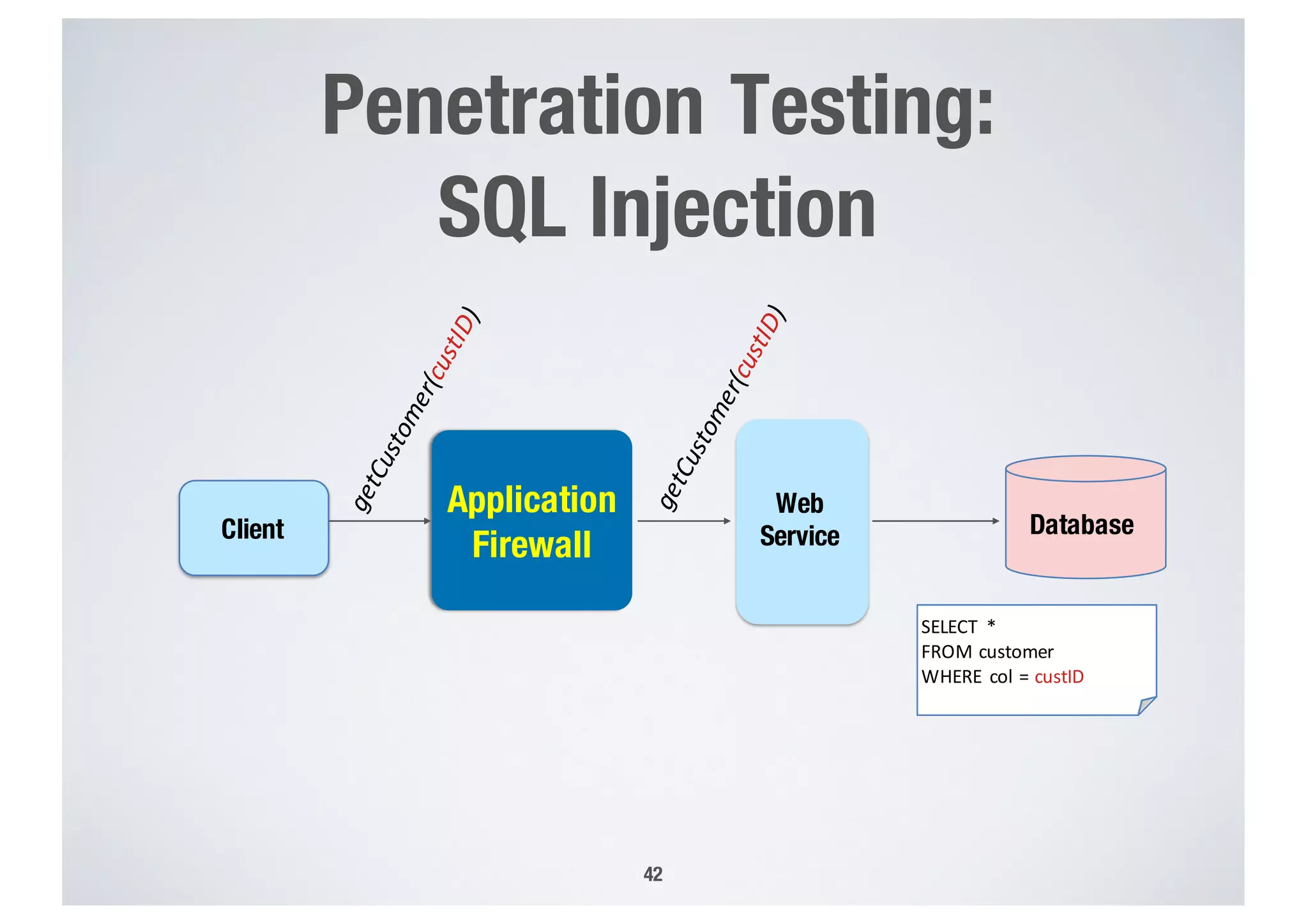
Penetration Testing:
SQL Injection
42
Client Database
Application
Firewall
SELECT	 *
FROM	customer
WHERE	 col	=	custID
Web
Service
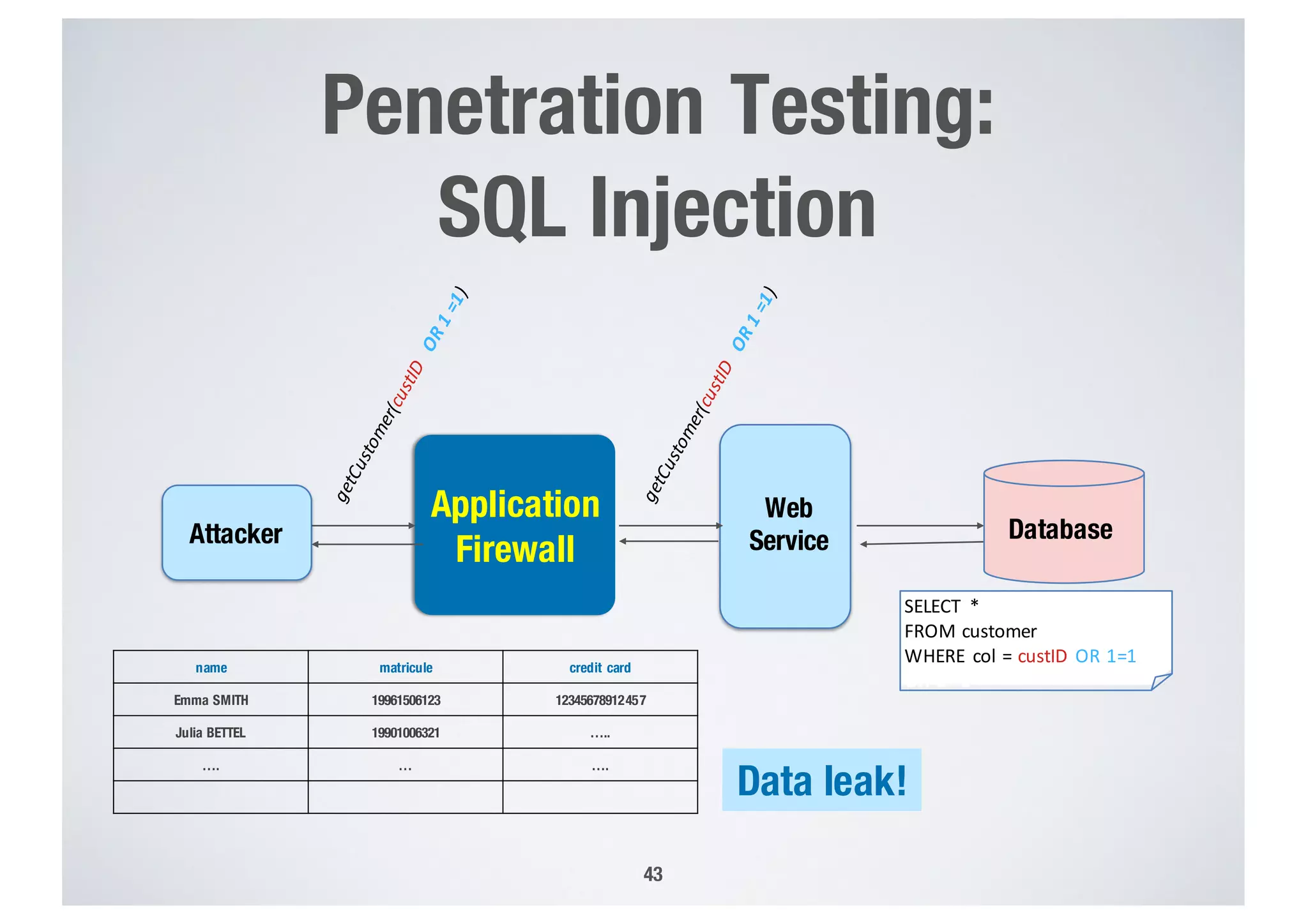
Penetration Testing:
SQL Injection
43
SELECT	 *
FROM	customer
WHERE	 col	=	custID OR	1=1
OR	1	=1
Attacker
Application
Firewall
Database
Web
Service
name matricule credit card
Emma SMITH 19961506123 12345678912457
Julia BETTEL 19901006321 …..
…. … ….
Data leak!
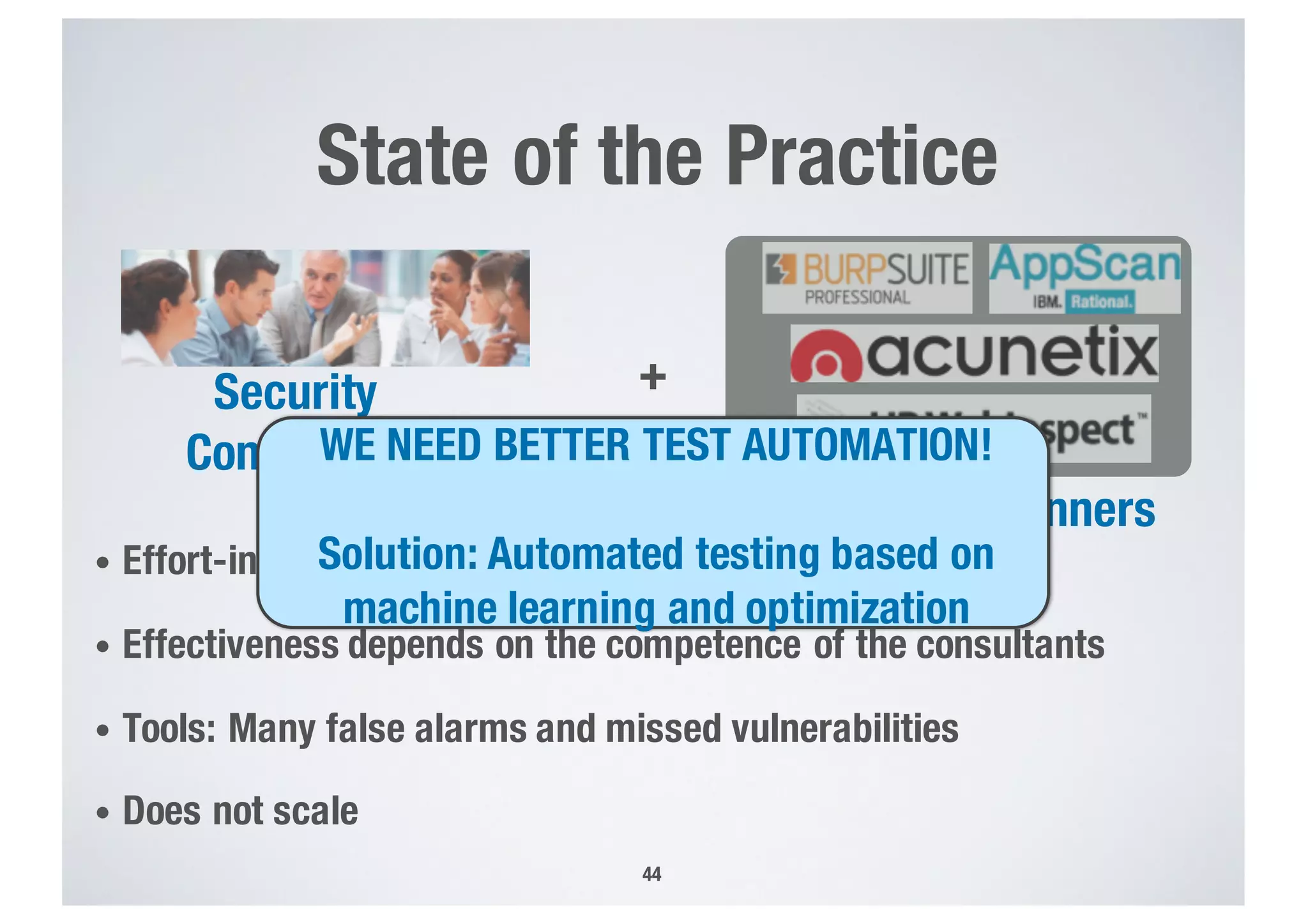
State of the Practice
• Effort-intensive
• Effectiveness depends on the competence of the consultants
• Tools: Many false alarms and missed vulnerabilities
• Does not scale
44
Security
Consultants
Security Scanners
+
WE NEED BETTER TEST AUTOMATION!
Solution: Automated testing based on
machine learning and optimization
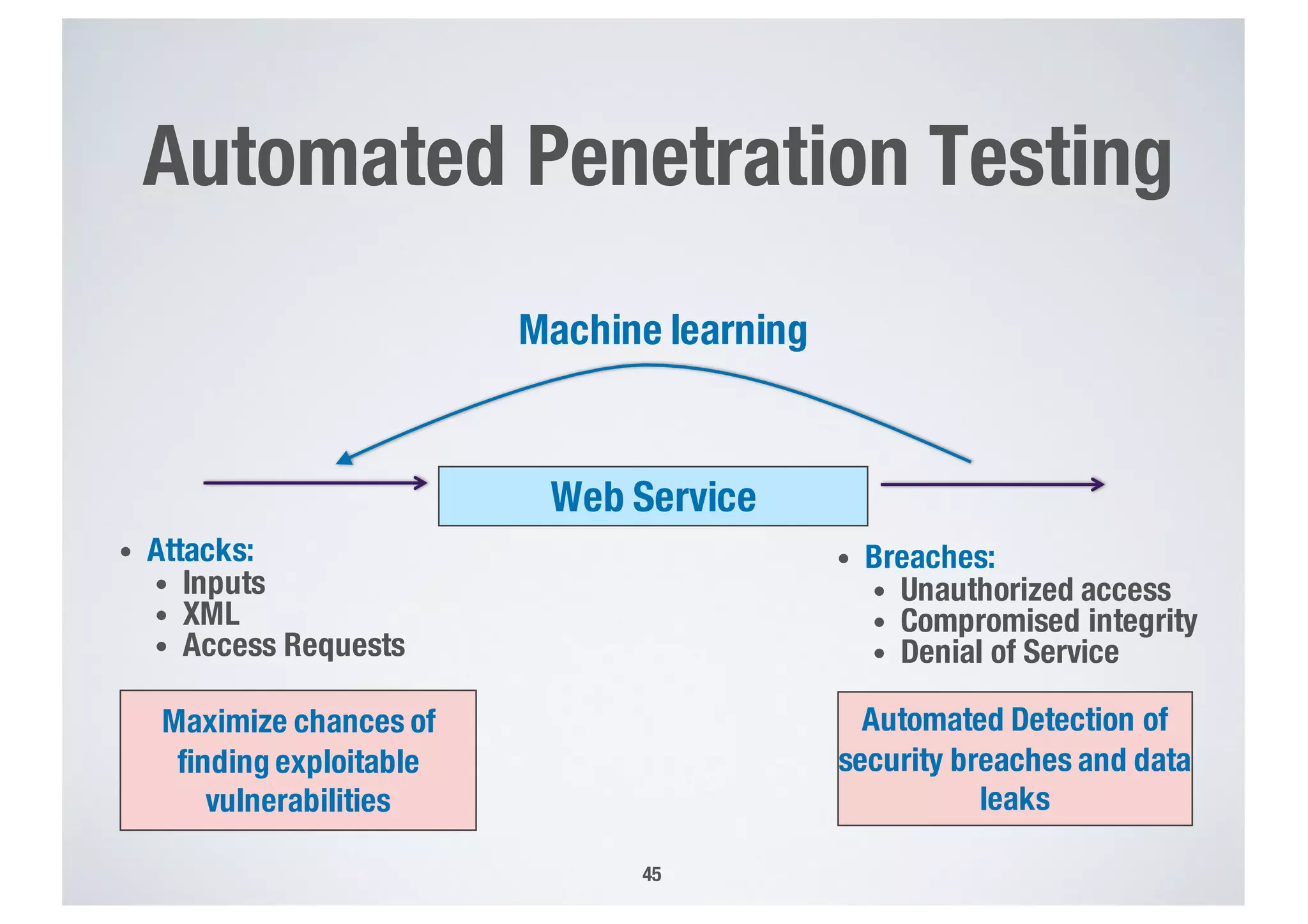
Automated Penetration Testing
45
• Attacks:
• Inputs
• XML
• Access Requests
Web Service
• Breaches:
• Unauthorized access
• Compromised integrity
• Denial of Service
Maximize chances of
finding exploitable
vulnerabilities
Automated Detection of
security breaches and data
leaks
Machine learning
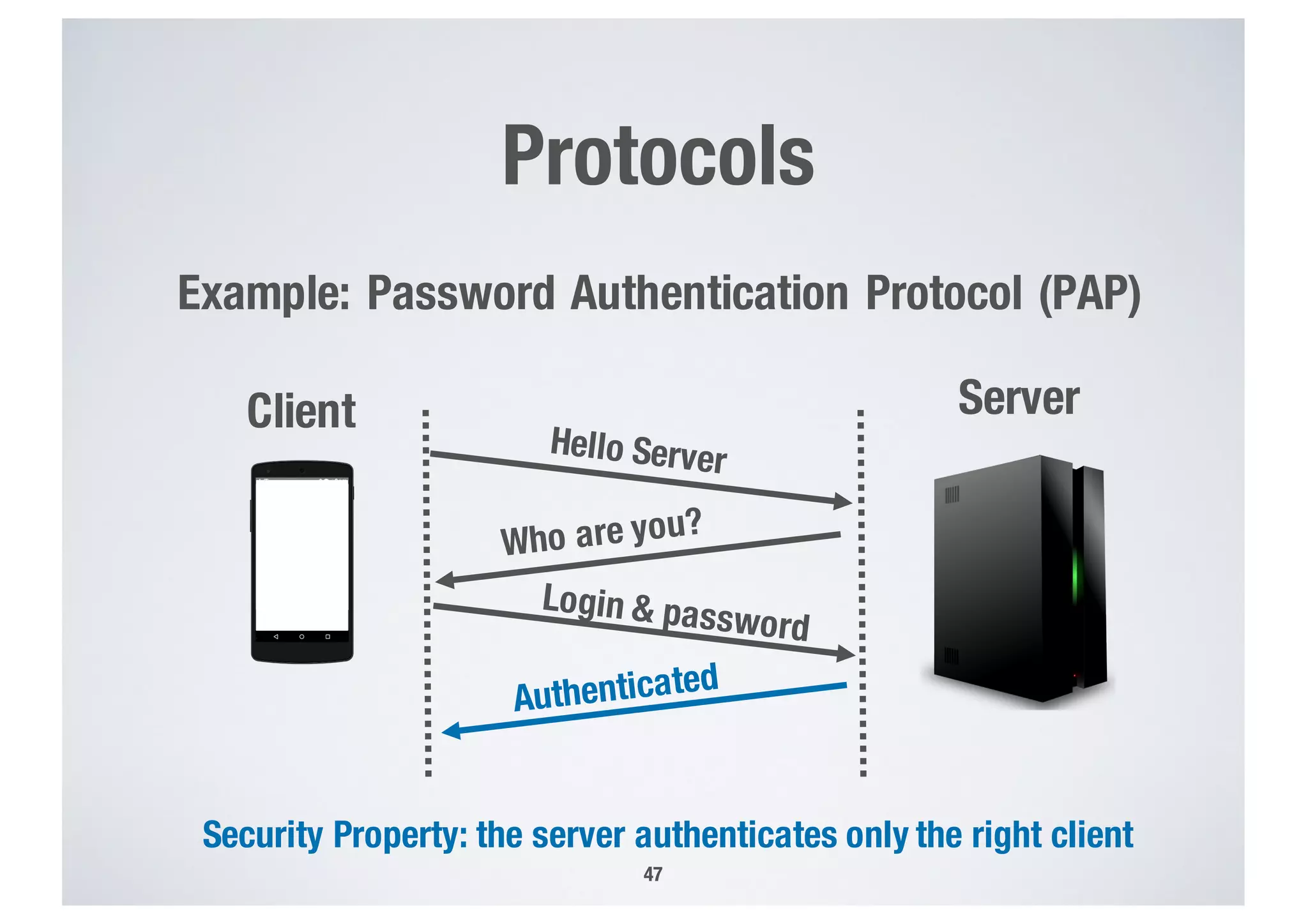
Protocol Verification
Client Server
Protocols
47
Example: Password Authentication Protocol (PAP)
Security Property: the server authenticates only the right client
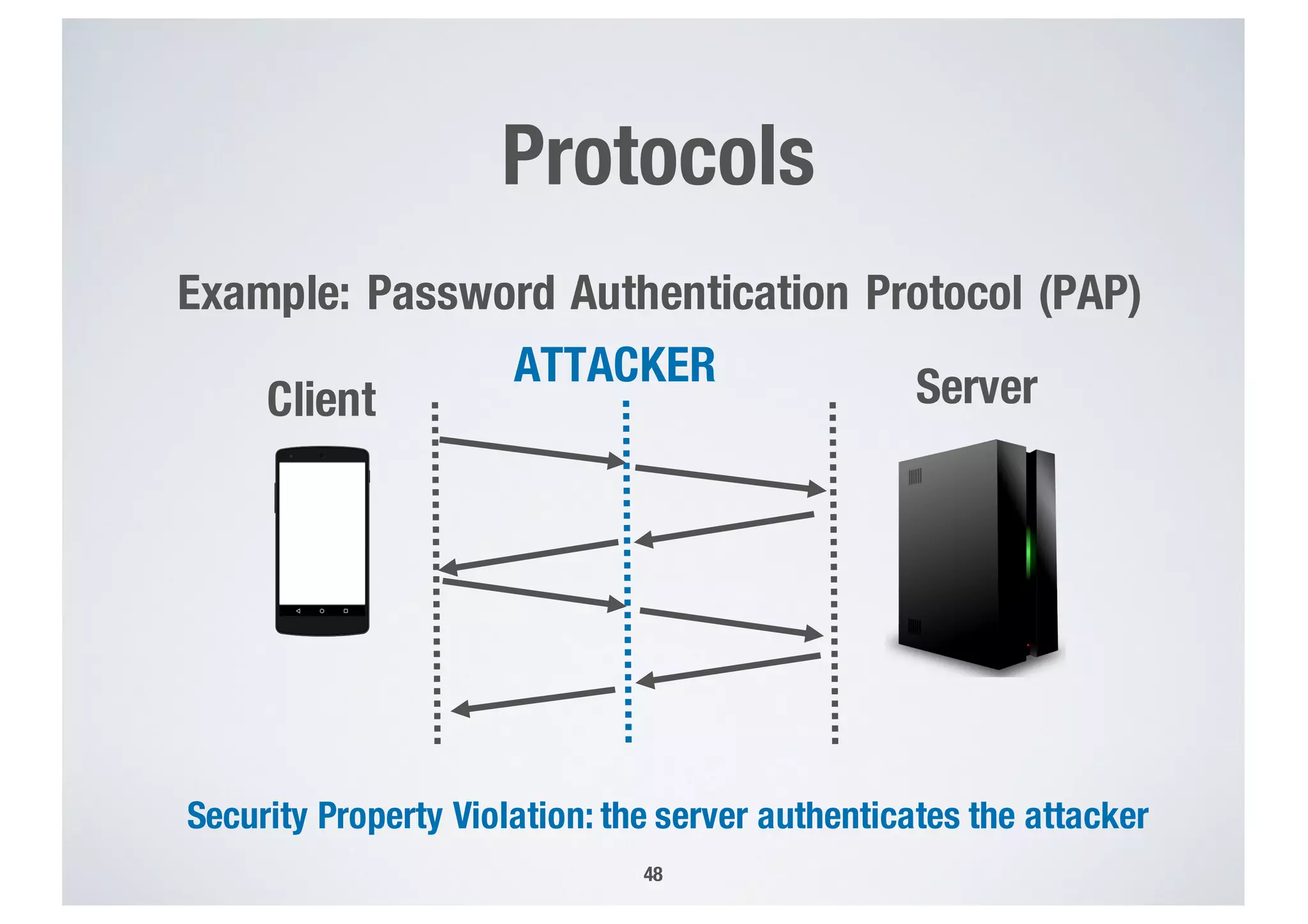
Protocols
48
Example: Password Authentication Protocol (PAP)
Client ServerATTACKER
Security Property Violation: the server authenticates the attacker
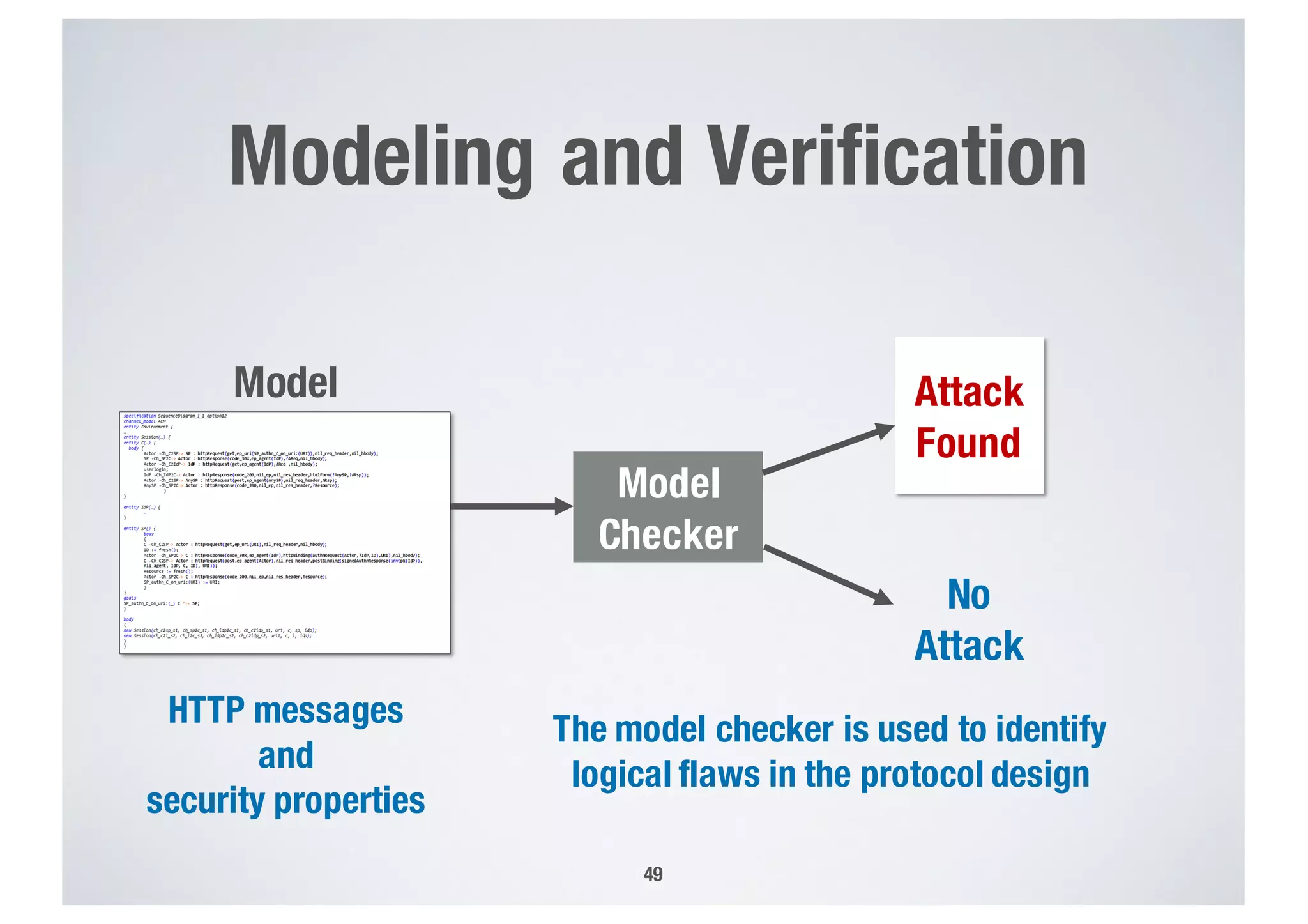
Modeling and Verification
Model
49
Model
Checker
Attack
Found
No
Attack
HTTP messages
and
security properties
The model checker is used to identify
logical flaws in the protocol design
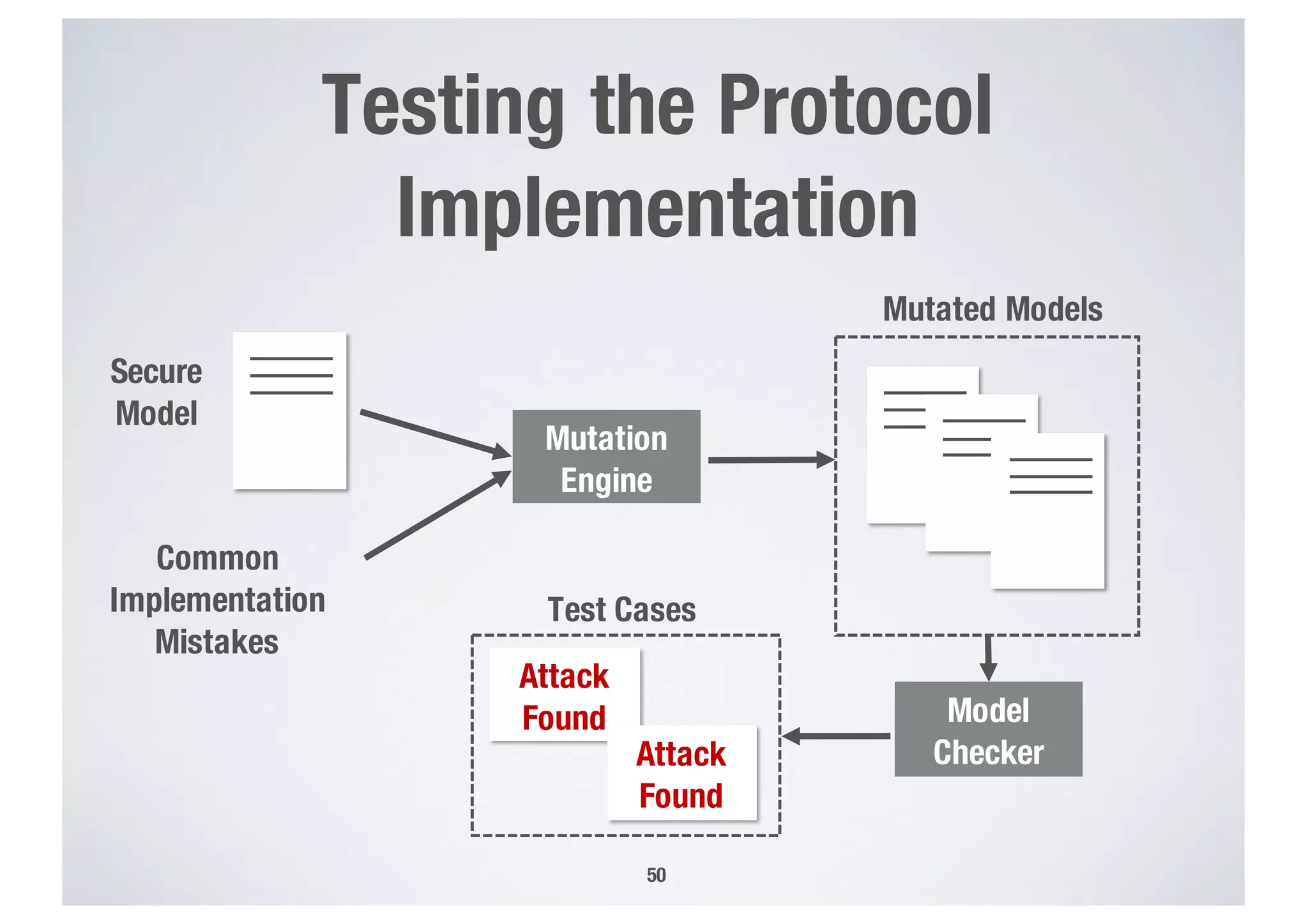
Testing the Protocol
Implementation
50
Mutation
Engine
Secure
Model
Common
Implementation
Mistakes
Mutated Models
Model
Checker
Attack
Found
Attack
Found
Test Cases
Automated Compliance Analysis
Run-time Verification
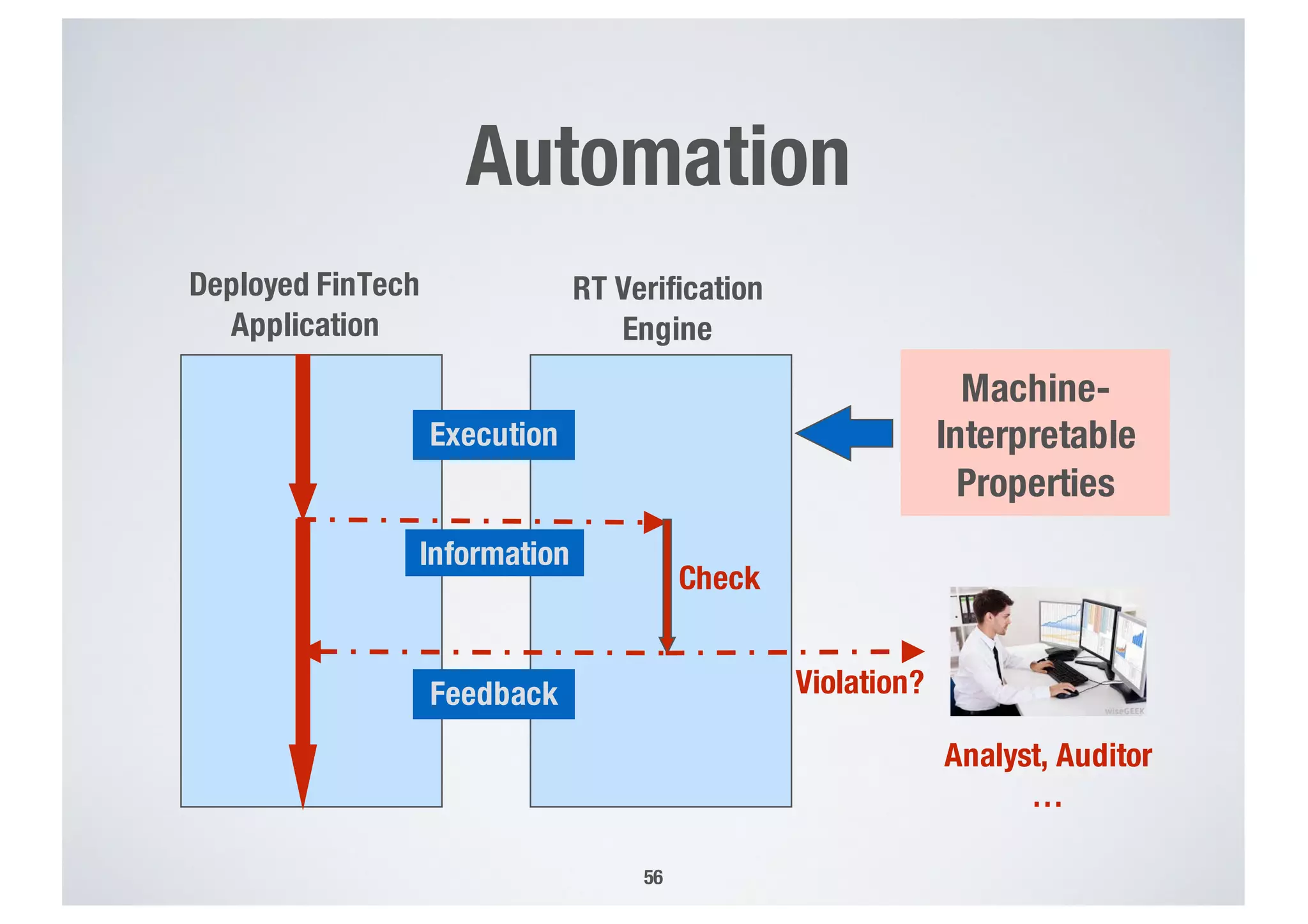
52
“A technique that verifies,
after the system is put in operation and is
executing, the behavior observed in the
system with respect to given properties”
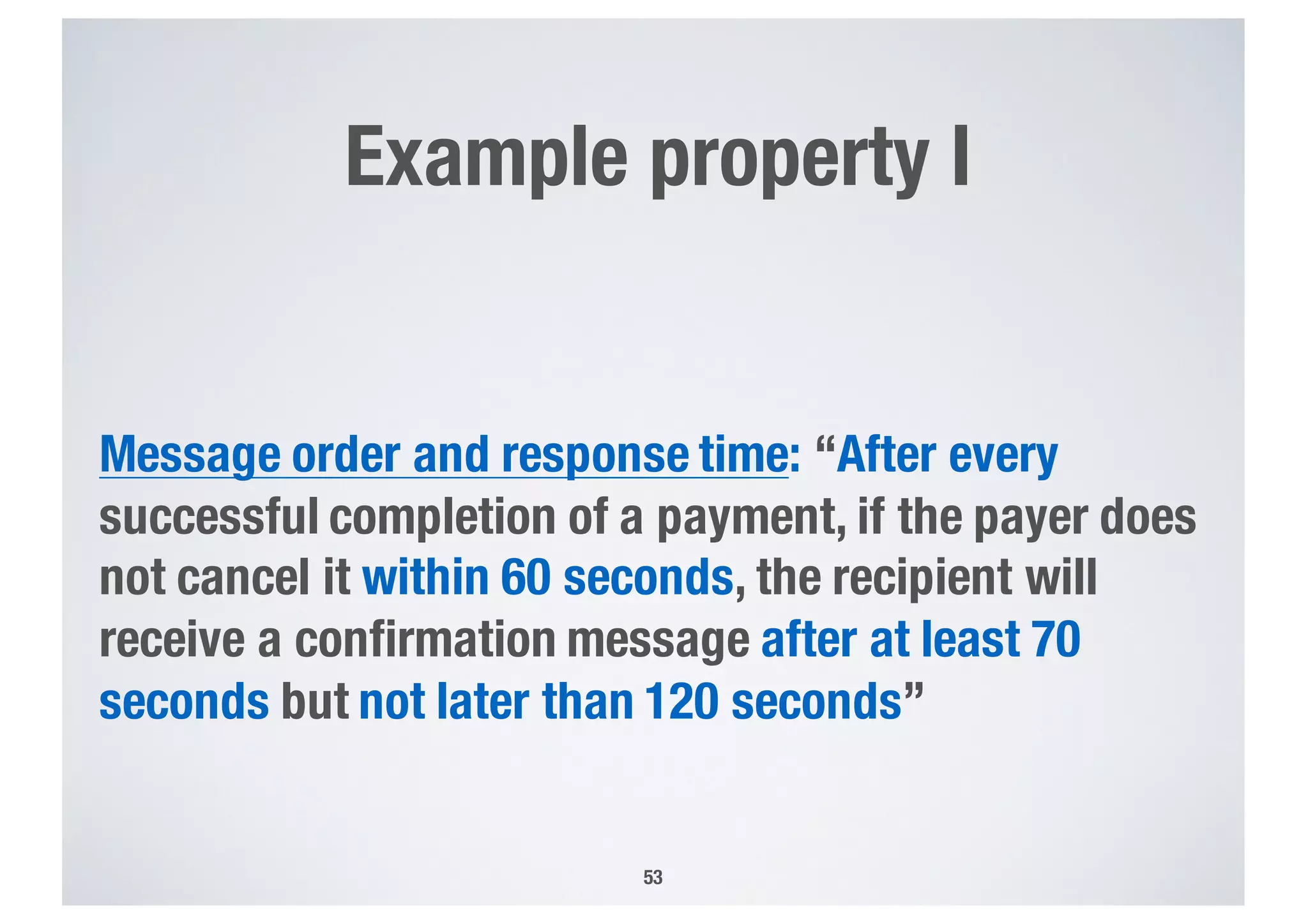
Example property I
Message order and response time: “After every
successful completion of a payment, if the payer does
not cancel it within 60 seconds, the recipient will
receive a confirmation message after at least 70
seconds but not later than 120 seconds”
53
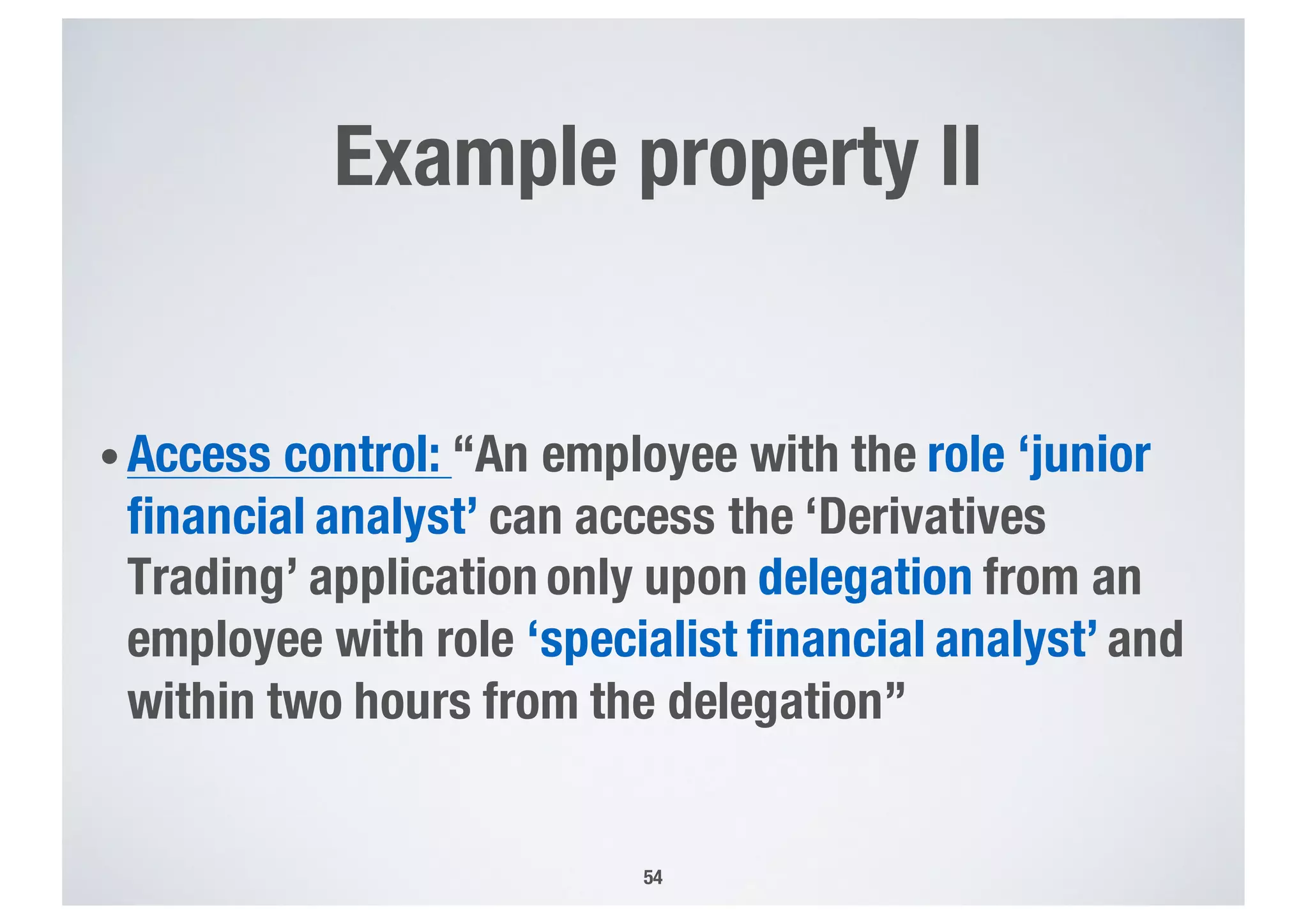
Example property II
• Access control: “An employee with the role ‘junior
financial analyst’ can access the ‘Derivatives
Trading’ application only upon delegation from an
employee with role ‘specialist financial analyst’ and
within two hours from the delegation”
54
Category of Properties
• Regulatory business rules
• Access control and data privacy
• Provisions from standards and best practices
• Service-level agreements
55
Machine-
Interpretable
Properties
56
Deployed FinTech
Application
RT Verification
Engine
Check
Violation?Feedback
Analyst, Auditor
…
Information
Execution
Automation
Solutions
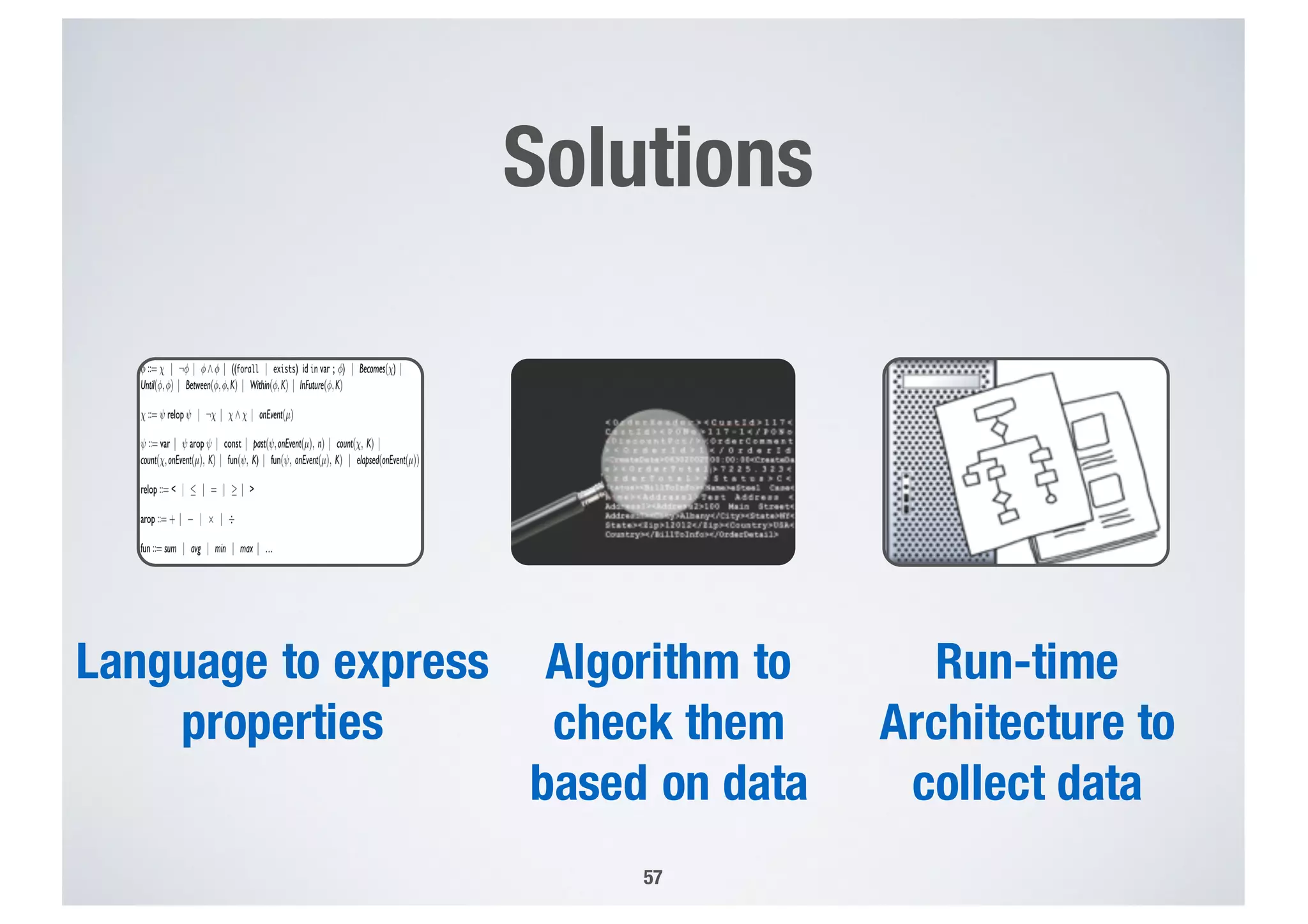
57
Language to express
properties
Algorithm to
check them
based on data
Run-time
Architecture to
collect data
Security Audits
Source code analysis to identify, locate, and
fix potential security & privacy issues
Security Audits: Definition
59
Manual auditing is
infeasible!
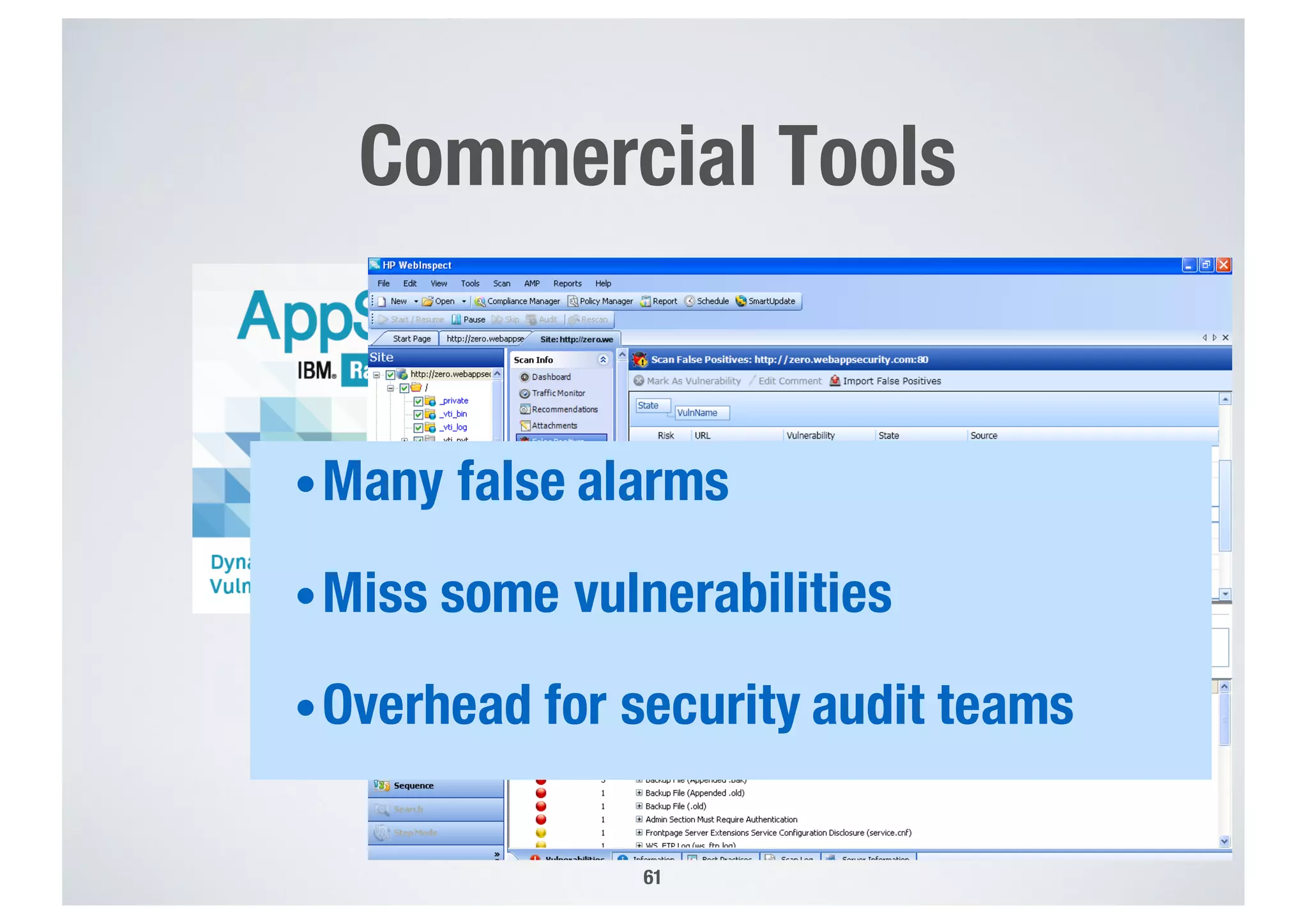
Commercial Tools
61
•Many false alarms
•Miss some vulnerabilities
•Overhead for security audit teams
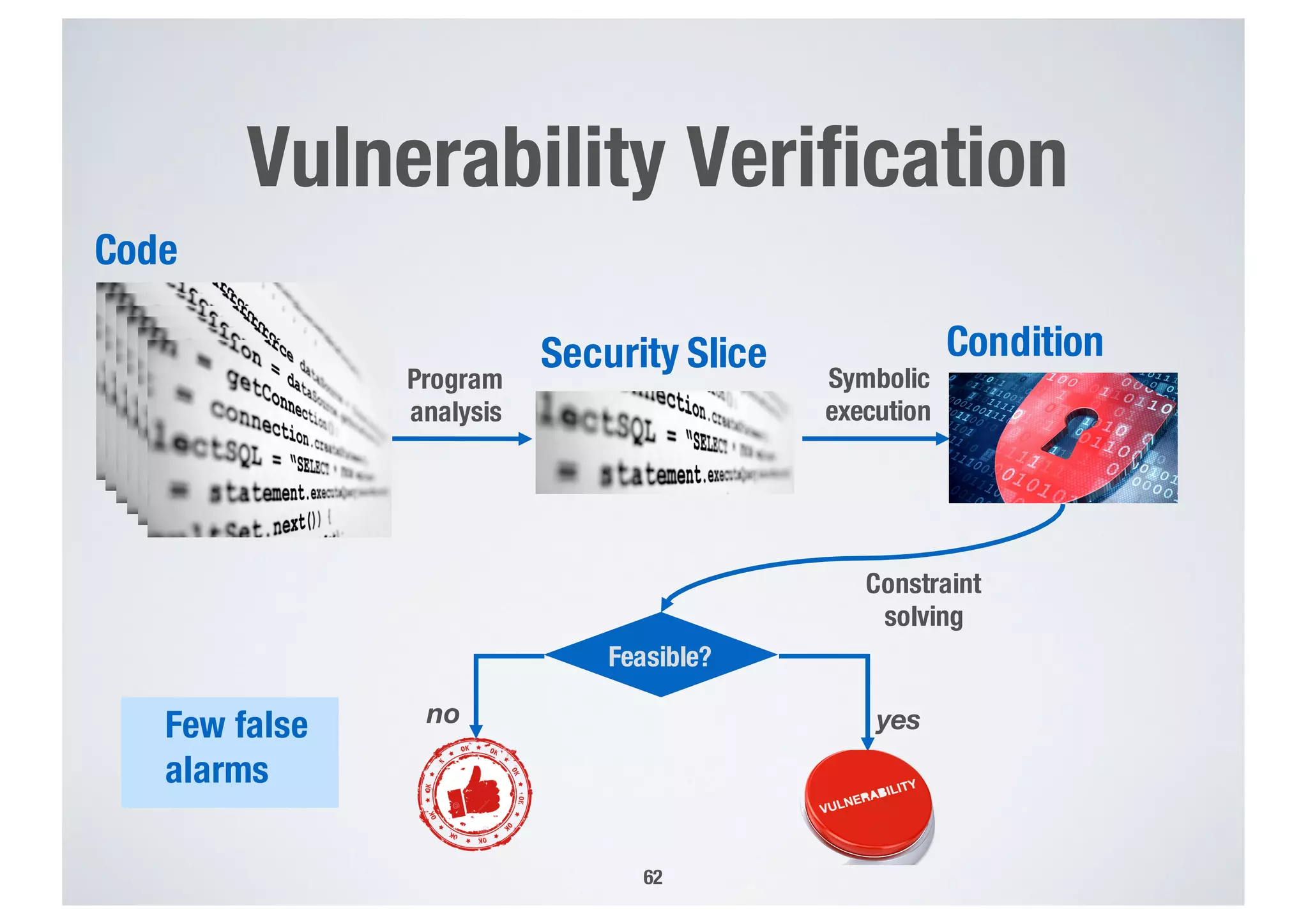
Vulnerability Verification
62
Code
Security Slice
Program
analysis
Symbolic
execution
Condition
Constraint
solving
Feasible?
yesno
Few false
alarms
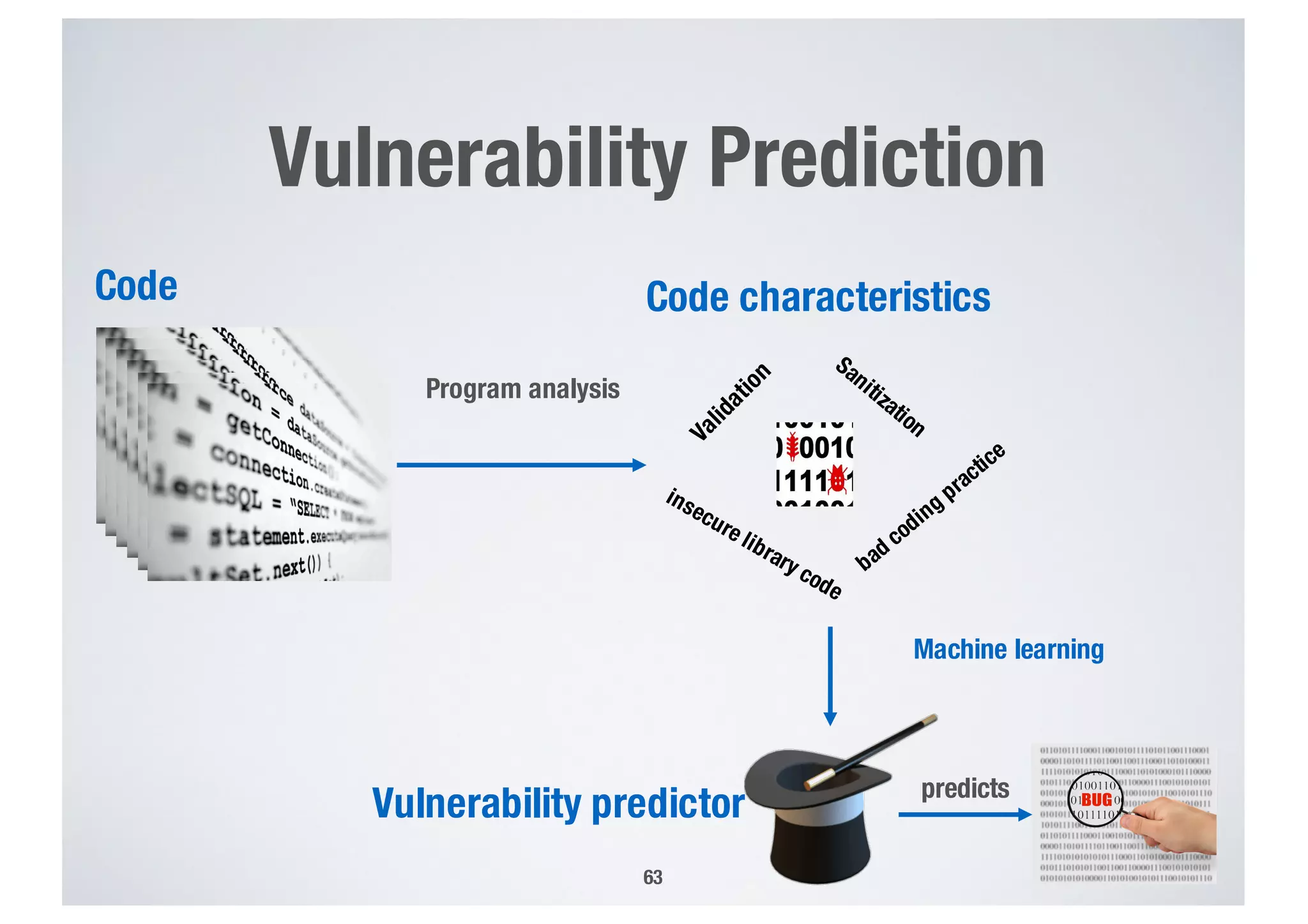
Vulnerability Prediction
63
Code
Program analysis
Code characteristics
Machine learning
Vulnerability predictor predicts
How does one get sufficient assurance about security
data management and compliance with regulations?
64
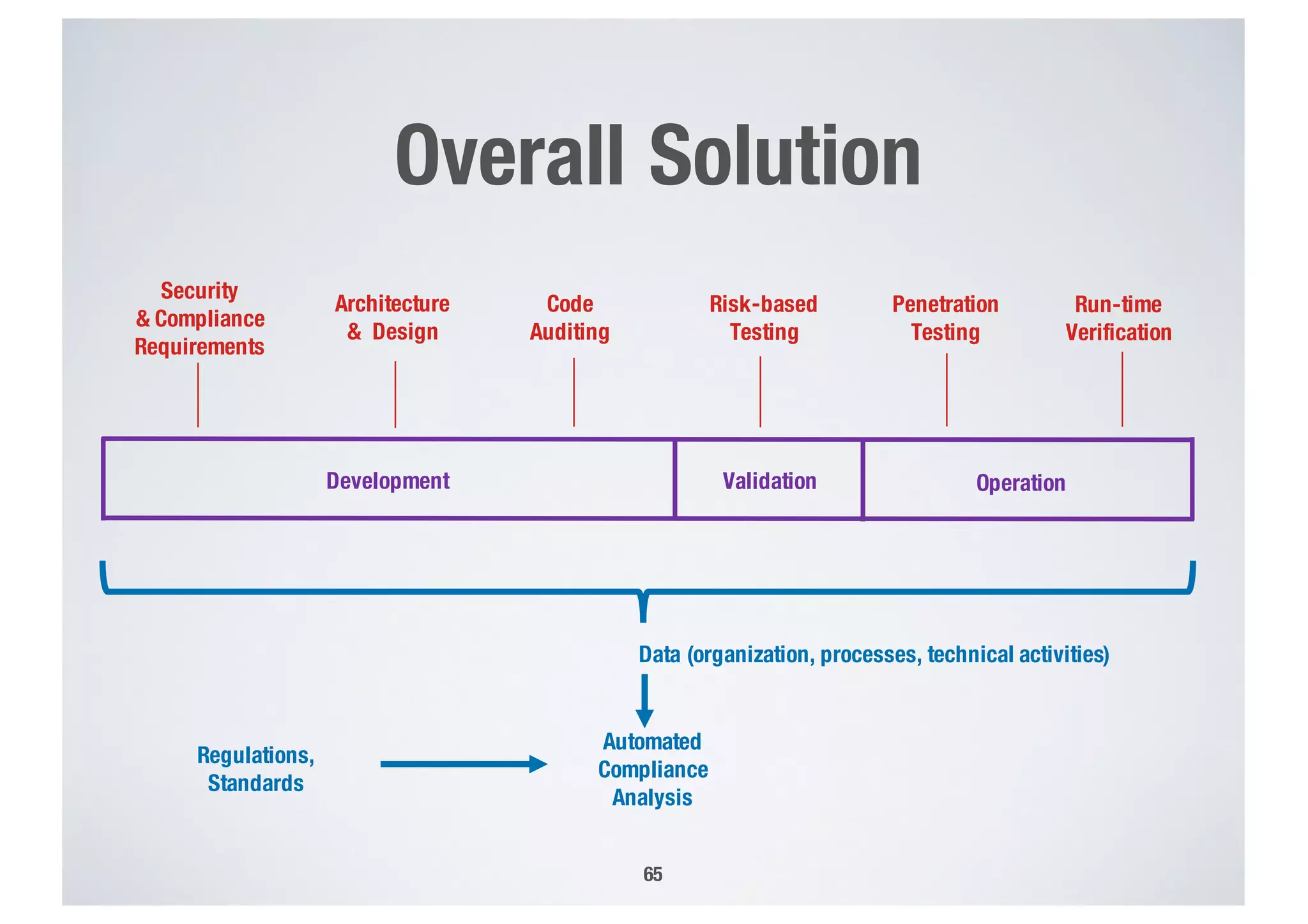
Overall Solution
65
Regulations,
Standards
Automated
Compliance
Analysis
Data (organization, processes, technical activities)
Security
& Compliance
Requirements
Architecture
& Design
Code
Auditing
Risk-based
Testing
Penetration
Testing
Run-time
Verification
Development Validation Operation
Additional Contacts
• Mike Sabetzadeh, Ph.D.: Regulatory compliance, security
requirements
• Domenico Bianculli, Ph.D.: Source code auditing, run-time
monitoring and verification
• Annibale Panichella, Ph.D.: Automated security testing
• Karl Johannesson: Project partnerships
66
.lusoftware verification & validation
VVS
Secure and Compliant Data
Management in FinTech
Applications
Prof. Lionel Briand, FNR PEARL Chair
UL 3X3 FinTech lecture series, February 10th, 2017

Secure and Compliant Data Management in FinTech Applications

  • 1.
    .lusoftware verification &validation VVS Secure and Compliant Data Management in FinTech Applications Prof. Lionel Briand, FNR PEARL Chair UL 3X3 FinTech lecture series, February 10th, 2017
  • 2.
    FinTech @ SnTCentre • SnT: Luxembourg’s center on ICT Security, reliability and Trust • > 260 staff members • 31 partners • FinTech: One of SnT’s priorities • Increasing momentum: 5 FinTech partners, 7 projects, 2 laboratories 2 Alphonse Weicker Foundation
  • 3.
    Software Verification and Validation@ SnT 3 • Group established in 2012 (FNR PEARL) • Focus: Ensuring reliability and security of IT systems through automated, cost-effective V&V solutions, e.g., testing • ERC Advanced Grant • ~ 25 staff members • Industry partnerships
  • 4.
    Objectives • Create awarenessabout the challenges and solutions for ensuring secure and compliant data management in FinTech applications • Motivate the need for research and innovation • Non-technical presentation • Not meant to be a complete treatment of the subject matter 4
  • 5.
  • 6.
    6 Not Just aboutthe B Word
  • 7.
    FinTech: State ofPlay • $14.5 billion globally in venture capital in 2015, from $7.3 billion in 2014 • FinTech companies are proliferating • Wide range of solutions that promise to impact nearly everyone • Dramatically broaden the reach, flexibility, and level of innovation of financial services • Key challenge: Cybersecurity • Risks: Financial losses, undermine confidence, lower adoption 7
  • 8.
    Cybersecurity: Risk Factors •“All that matters is to get to market fast” mentality • Growing mismatch between technology and regulations • Dilemma: Consumer protection versus the agility of the innovation ecosystem 8
  • 9.
    Cybersecurity: Risk Factors •Reliance on machine learning and big data complicates the picture regarding cybersecurity – unintended biases in system behavior • Many new “customers” with little knowledge of security risks • More interfaces between traditional financial services and FinTech applications 9
  • 10.
    Did I manageto worry you? 10
  • 11.
    How Secure isour Data?
  • 12.
  • 13.
    JPMorgan Chase DataBreach (2014) 13 • Compromised over 83 million accounts - 76 million households and 7 million small businesses • Also, targeted 9 other major financial institutions alongside JPMorgan Chase
  • 14.
    UK’s Tesco BankHack in Nov 2016 14 • Biggest cyber attack in the history of British banking • £2.5 million stolen from accounts of 9000 customers • Approximately 40,000 Tesco Bank accounts were compromised • The fine could be as much as £2 billion pounds under the GDPR rules.
  • 15.
    Some Statistics aboutCybersecurity 15 Source: IBM Security - data from worldwide organisations having between 1,000 and 5,000 employees Incident rates by industries
  • 16.
    Financial Impact ofData Breaches 16 • Study of 383 companies in 12 countries • $4 million is the average total cost of a data breach • 29% increase in total cost of data breach since 2013 • $158 is the average cost per lost or stolen record • 15% increase in per capita cost since 2013
  • 17.
    Are FinTech Applications Different? •Most FinTech applications are web applications or services, possibly with a mobile front end – they are subject to the same security challenges as many other systems • FinTech applications handle sensitive data and perform business-critical operations • For now transactions are relatively limited, but risk factors are even more acute than in traditional financial services 17
  • 18.
  • 19.
    19 42 incidents reported Maincategories: Server breach, application vulnerabilities
  • 20.
    20 Vulnerability: Database injection Consequence:Data breach Conclusion: “This incident prompted us to reassess the viability of running coinwallet.co and it was decided it is just not viable taking into consideration the risk, costs and time involved.”
  • 21.
    Summary • FinTech applicationshandle sensitive user and corporate data • Data breaches can ruin a FinTech company’s reputation and lead to significant financial damages and legal problems • FinTech applications must be secure from a data management point of view • Regulations are becoming more stringent, including the GDPR European legislation on data privacy 21
  • 22.
    Secure data managementcannot be ensured during development • Root causes • time to market pressures, • lack of disciplined programming, • third-party solutions (services, components). 22
  • 23.
    Consequences • Many applicationshave problems with • incomplete or improper security requirements, • inadequate security architecture, • implementation flaws, • lack of systematic and effective testing, • … 23
  • 24.
  • 25.
    Compliance 25 Regulations for FinTechdomains microfinance, crowdfunding, cashless payment, cryptocurrencies, … Regulations & Standards for FinTech IT Systems primarily concerned with data protection and privacy
  • 26.
    Example from PaymentServices • PSD2: Payment Services Directive (EU directive) • “In order to improve the efficiency of payments throughout the Union, all payment orders initiated by the payer and denominated in euro or the currency of a Member State whose currency is not the euro, including credit transfers and money remittances, should be subject to a maximum 1-day execution time. For all other payments, such as payments initiated by or through a payee, including direct debits and card payments, in the absence of an explicit agreement between the payment service provider and the payer setting a longer execution time, the same 1-day execution time should apply.” 26 Logo (vertical) Positive versions “standard” The European Commission logo exists in 6 versions (positive and negative CMYK, Reflex Blue and black & white), all of which are available in 6 different formats (ai, eps, jpg, png, tiff and pdf). All these formats are available on the Visual Identity Page: http://www.cc.cec/dgintranet/ comm/visual_identity/index_ en.htm CMYK – for full-colour printing Pantone EC Corporate Blue – for 1-colour printing Black – for black & white printing The standard logo is the main logo of the European Commission and, as a general rule, should appear top centred on all communication material, documents and products unless there is a special reason not to substitute the standard logo with the horizontal or mute variation. 12
  • 27.
    Security and Privacy •Security certification • On a voluntary basis • Business advantage • Laws and regulations • Compliance is mandatory • Luxembourg’s implementation of EU Directive 95/46/EC • General Data Protection Regulation (GDPR) 27 27018
  • 28.
    28 • Sweeping powersfor national data protection agencies • Fines of up to 4% of annual turnover for major breaches • Major new requirements, including: • Reporting major data breaches within 72h • Privacy by design • Client’s right to be forgotten • Verified technical and organizational measures necessary for demonstrating security GDPR
  • 29.
    Industry Security Standards •Payment Card Industry Data Security Standard (PCI DSS) • Proprietary information and security standard for organizations that handle branded credit cards • Increase control on credit card data and reduce credit card fraud • Annual validation of compliance by Qualified Security Assessors 29
  • 30.
    OWASP • Open WebApplication Security Project (OWASP) • Share relevant software security information and good practices • https://www.owasp.org/ 30
  • 31.
    Compliance is Complexand Expensive 31 Laws, regulations and standards are textual.They need to be interpreted and adapted to context Multiple stakeholders are involved in the compliance and auditing chain The volume of evidence required for demonstrating compliance is very large Compliance arguments need to be assessed in a credible manner and based on evidence
  • 32.
  • 33.
    Compliance to SafetyStandards • Safety-critical systems have been subject to safety certification for several decades • Rigorous compliance assessment is common practice for safety • The level of rigor is very likely to extend to data protection and privacy in future years • Existing work on safety certification can be a major source of experience and inspiration 33
  • 34.
  • 35.
    Example Model 35 Subject MatterExpert GDPRInterpretation Size Establishment erasePersonalData() Controller Processor Subject Data Protection Officer (DPO) designates ▶︎ Constraint: Undercertain circumstances, an establishment is obligated to designate a DPO
  • 36.
    Assessor Controller /Processor Specialized checklists, plans, progress measures, agreements, etc. Schema for evidence Evidence repository Compliance Results basis for Evidence Requirements Elaboration Compliance Analysis Model of the standard or regulation Aid to understanding and communication Means for collaboration between actors Creation of evidence repositories Computer-assisted compliance analysis Learning from the Safety Critical Domain Size Establishment erasePersonalData() Controller Processor Subject Data Protection Officer (DPO) designates ▶︎
  • 37.
    Assessor Controller /Processor Specialized checklists, plans, progress measures, agreements, etc. Schema for evidence Evidence repository Compliance Results basis for Evidence Requirements Elaboration Compliance Analysis Model of the standard or regulation Aid to understanding and communication Means for collaboration between actors Creation of evidence repositories Computer-assisted compliance analysis Learning from the Safety Critical Domain Size Establishment erasePersonalData() Controller Processor Subject Data Protection Officer (DPO) designates ▶︎
  • 38.
    Assessor Controller /Processor Specialized checklists, plans, progress measures, agreements, etc. Schema for evidence Evidence repository Compliance Results basis for Evidence Requirements Elaboration Compliance Analysis Model of the standard or regulation Aid to understanding and communication Means for collaboration between actors Creation of evidence repositories Computer-assisted compliance analysis Learning from the Safety Critical Domain Size Establishment erasePersonalData() Controller Processor Subject Data Protection Officer (DPO) designates ▶︎
  • 39.
    Assessor Controller /Processor Specialized checklists, plans, progress measures, agreements, etc. Schema for evidence Evidence repository Compliance Results basis for Evidence Requirements Elaboration Compliance Analysis Model of the standard or regulation Aid to understanding and communication Means for collaboration between actors Creation of evidence repositories Computer-assisted compliance analysis Learning from the Safety Critical Domain Size Establishment erasePersonalData() Controller Processor Subject Data Protection Officer (DPO) designates ▶︎
  • 40.
  • 41.
    Penetration Testing • Apenetration test is an attack on a system to find vulnerabilities that an attacker could exploit • The intention is to find security weaknesses, leading to illegal access to functionality and data. 41
  • 42.
    Penetration Testing: SQL Injection 42 ClientDatabase Application Firewall SELECT * FROM customer WHERE col = custID Web Service
  • 43.
    Penetration Testing: SQL Injection 43 SELECT * FROM customer WHERE col = custID OR 1=1 OR 1 =1 Attacker Application Firewall Database Web Service name matricule credit card Emma SMITH 19961506123 12345678912457 Julia BETTEL 19901006321 ….. …. … …. Data leak!
  • 44.
    State of thePractice • Effort-intensive • Effectiveness depends on the competence of the consultants • Tools: Many false alarms and missed vulnerabilities • Does not scale 44 Security Consultants Security Scanners + WE NEED BETTER TEST AUTOMATION! Solution: Automated testing based on machine learning and optimization
  • 45.
    Automated Penetration Testing 45 •Attacks: • Inputs • XML • Access Requests Web Service • Breaches: • Unauthorized access • Compromised integrity • Denial of Service Maximize chances of finding exploitable vulnerabilities Automated Detection of security breaches and data leaks Machine learning
  • 46.
  • 47.
    Client Server Protocols 47 Example: PasswordAuthentication Protocol (PAP) Security Property: the server authenticates only the right client
  • 48.
    Protocols 48 Example: Password AuthenticationProtocol (PAP) Client ServerATTACKER Security Property Violation: the server authenticates the attacker
  • 49.
    Modeling and Verification Model 49 Model Checker Attack Found No Attack HTTPmessages and security properties The model checker is used to identify logical flaws in the protocol design
  • 50.
  • 51.
  • 52.
    Run-time Verification 52 “A techniquethat verifies, after the system is put in operation and is executing, the behavior observed in the system with respect to given properties”
  • 53.
    Example property I Messageorder and response time: “After every successful completion of a payment, if the payer does not cancel it within 60 seconds, the recipient will receive a confirmation message after at least 70 seconds but not later than 120 seconds” 53
  • 54.
    Example property II •Access control: “An employee with the role ‘junior financial analyst’ can access the ‘Derivatives Trading’ application only upon delegation from an employee with role ‘specialist financial analyst’ and within two hours from the delegation” 54
  • 55.
    Category of Properties •Regulatory business rules • Access control and data privacy • Provisions from standards and best practices • Service-level agreements 55
  • 56.
  • 57.
    Solutions 57 Language to express properties Algorithmto check them based on data Run-time Architecture to collect data
  • 58.
  • 59.
    Source code analysisto identify, locate, and fix potential security & privacy issues Security Audits: Definition 59
  • 60.
  • 61.
    Commercial Tools 61 •Many falsealarms •Miss some vulnerabilities •Overhead for security audit teams
  • 62.
  • 63.
    Vulnerability Prediction 63 Code Program analysis Codecharacteristics Machine learning Vulnerability predictor predicts
  • 64.
    How does oneget sufficient assurance about security data management and compliance with regulations? 64
  • 65.
    Overall Solution 65 Regulations, Standards Automated Compliance Analysis Data (organization,processes, technical activities) Security & Compliance Requirements Architecture & Design Code Auditing Risk-based Testing Penetration Testing Run-time Verification Development Validation Operation
  • 66.
    Additional Contacts • MikeSabetzadeh, Ph.D.: Regulatory compliance, security requirements • Domenico Bianculli, Ph.D.: Source code auditing, run-time monitoring and verification • Annibale Panichella, Ph.D.: Automated security testing • Karl Johannesson: Project partnerships 66
  • 67.
    .lusoftware verification &validation VVS Secure and Compliant Data Management in FinTech Applications Prof. Lionel Briand, FNR PEARL Chair UL 3X3 FinTech lecture series, February 10th, 2017