The Past is Still
Part of our Present
Why the Legacy Matters Today
Guy Redmill
About Us
A brief overview of Redmill Marketing Associates
•	Outsourced marketing and strategic consultancy services for the
TMT sector
•	 Strategy
•	 Communications
•	 Analysis
•	 Deep knowledge of marketing and strategic needs of the TMT
industries
•	 Clear, insightful communications and actionable marketing
programmes
•	 An experienced, multi-skilled team to complement your in-house
resources
2
3
Moving to...
an all IP World
•	 Network convergence around IP
•	 LTE adoption and deployment
•	 IMS and VoLTE
•	 Legacy Protocols are disappearing
•	 SIP is the future; SS7 is the past
4
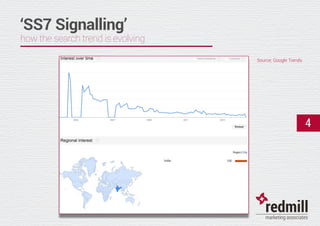
‘SS7 Signalling’
how the search trend is evolving
Source: Google Trends
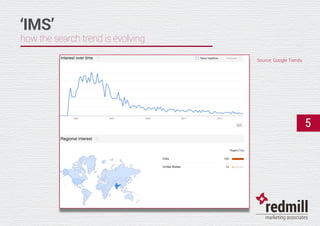
‘IMS’
how the search trend is evolving
5
Source: Google Trends
6
But...
there are problems
•	 Interconnection for transit
•	 Traffic hubs and exchanges
•	 Direct peering
•	 Interconnection with local partners
•	 Traffic delivery / collection
•	 Migration to new core
•	 NGN, IMS
7
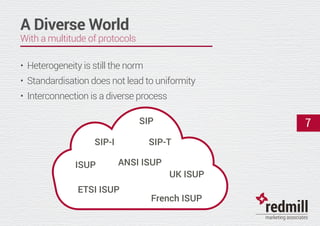
A Diverse World
With a multitude of protocols
•	 Heterogeneity is still the norm
•	 Standardisation does not lead to uniformity
•	 Interconnection is a diverse process
SIP
SIP-I
ANSI ISUP
SIP-T
French ISUP
ETSI ISUP
ISUP
UK ISUP
8
Network Reality
‘Legacy’ is very much part of today’s networks
•	 SS7 is a requirement for many operators
•	 It’s deployed, proven and reliable
•	 It’s cheaper to leverage this asset in their core
•	 There are long-established processes for interconnection
processes
•	 Many Tier-1 operators prefer it
•	 While NGN / IMS deployment adoption continues, any
international transit operator must be flexible
9
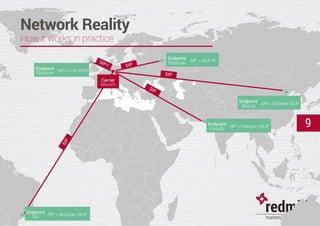
Network Reality
How it works in practice
Carrier
Munich
Endpoint
Glasgow
Endpoint
Moscow
Endpoint
Rio
Endpoint
Karachi
Endpoint
Beijing
SIP
SIP
SIP
SIP-ISIP
SIP > ISUP R
SIP-I > UK ISUP
SIP > Chinese ISUP
SIP > Brazilian ISUP
SIP > Pakistan ISUP
Service View
The need to maintain existing services
•	 SS7 enabled many advanced services
•	 Many of these generate significant revenue
•	 VPN
•	 IN non-geographic
•	 You cannot
•	 Simply turn them off willy-nilly
•	 Ignore them when migrating to a new core
10
11
In Practice
Legacy interconnect is essential
•	 Vendors with only an IP offer are limited
•	 They must partner with vendors with SS7 capabilities
•	 Tier 1 view is a fraction of the real picture
•	 It provides an alternative reality
•	 Worldwide, carriers, operators and service architects must
confront operational heterogeneity on a daily basis
12
Two examples
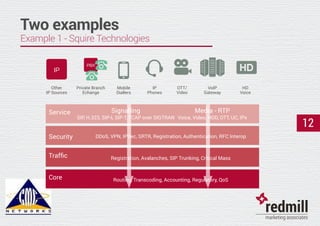
Example 1 - Squire Technologies
PBX
IP
Other
IP Sources
Private Branch
Echange
Mobile
Diallers
IP
Phones
OTT/
Video
VoIP
Gateway
HD
Voice
Service
Security
Traffic
Core
Signalling
SIP, H.323, SIP-I, SIP-T, TCAP over SIGTRAN
Media - RTP
Voice, Video, HDD, OTT, UC, IPx
DDoS, VPN, IPSec, SRTR, Registration, Authentication, RFC Interop
Registration, Avalanches, SIP Trunking, Critical Mass
Routing, Transcoding, Accounting, Regulatory, QoS
PBX
IP
Other
IP Sources
Private Branch
Echange
Mobile
Diallers
IP
Phones
OTT/
Video
VoIP
Gateway
HD
Voice
Signalling
SIP, H.323, SIP-I, SIP-T, TCAP over SIGTRAN
Service
Security
Traffic
Core
Media - RTP
Voice, Video, HDD, OTT, UC, IPx
DDoS, VPN, IPSec, SRTR, Registration, Authentication, RFC Interop
Registration, Avalanches, SIP Trunking, Critical Mass
Routing, Transcoding, Accounting, Regulatory, QoS
13
Two Examples
Example 1 - Squire Technologies
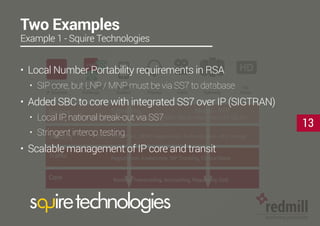
•	 Local Number Portability requirements in RSA
•	 SIP core, but LNP / MNP must be via SS7 to database
•	 Added SBC to core with integrated SS7 over IP (SIGTRAN)
•	 Local IP, national break-out via SS7
•	 Stringent interop testing
•	 Scalable management of IP core and transit
14
Two Examples
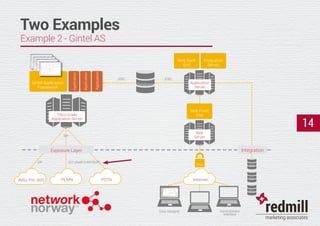
Example 2 - Gintel AS
SIP
IMS/ Pre -IMS PSTNPLMN
database
Telco Grade
Application Server
Gintel Application
Framework
Exposure Layer
Application
Application
Application
Internet
Web Back
End
Integration
Server
Web Front
End
Application
Server
Web
Server
Integration
NMS
Prov.
Billing
SS7 (INAP/CAP/ISUP)
https
SIP
JDBC JDBC
Easy Designer Administrator
Interface
SIP
IMS/ Pre -IMS PSTNPLMN
database
Telco Grade
Application Server
Gintel Application
Framework
Exposure Layer
Application
Application
Application
Internet
Web Back
End
Integration
Server
Web Front
End
Application
Server
Web
Server
Integration
NMS
Prov.
Billing
SS7 (INAP/CAP/ISUP)
https
SIP
JDBC JDBC
Two Examples
Example 2 - Gintel AS
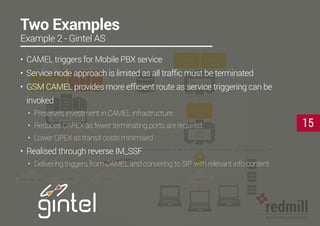
•	 CAMEL triggers for Mobile PBX service
•	 Service node approach is limited as all traffic must be terminated
•	 GSM CAMEL provides more efficient route as service triggering can be
invoked
•	 Preserves investment in CAMEL infrastructure
•	 Reduces CAPEX as fewer terminating ports are required
•	 Lower OPEX as transit costs minimised
•	 Realised through reverse IM_SSF
•	 Delivering triggers from CAMEL and convering to SIP with relevant info content
15
In Conclusion
Summing up
•	 SS7 is a necessary element of today’s infrastructure
•	 Even if Tier 1 core migrates to IP, legacy is fundamental to:
•	 Existing services
•	 Interconnection and peering
•	 For Tier 2 and 3 operators:
•	 Represents investment protection
•	 National interconnection often prefers SS7
•	 Despite clear market trends, don’t ignore it
•	 Adapt to local requirements and be flexible
16
info@ redmillcommunications.com
@redmill_mktg
+44 (0) 203 137 2070
www.redmillcommunications.com
17
Contacts
How to get in touch with us
Rma past present_v3

Rma past present_v3

  • 1.
    The Past isStill Part of our Present Why the Legacy Matters Today Guy Redmill
  • 2.
    About Us A briefoverview of Redmill Marketing Associates • Outsourced marketing and strategic consultancy services for the TMT sector • Strategy • Communications • Analysis • Deep knowledge of marketing and strategic needs of the TMT industries • Clear, insightful communications and actionable marketing programmes • An experienced, multi-skilled team to complement your in-house resources 2
  • 3.
    3 Moving to... an allIP World • Network convergence around IP • LTE adoption and deployment • IMS and VoLTE • Legacy Protocols are disappearing • SIP is the future; SS7 is the past
  • 4.
    4 ‘SS7 Signalling’ how thesearch trend is evolving Source: Google Trends
  • 5.
    ‘IMS’ how the searchtrend is evolving 5 Source: Google Trends
  • 6.
    6 But... there are problems • Interconnection for transit • Traffic hubs and exchanges • Direct peering • Interconnection with local partners • Traffic delivery / collection • Migration to new core • NGN, IMS
  • 7.
    7 A Diverse World Witha multitude of protocols • Heterogeneity is still the norm • Standardisation does not lead to uniformity • Interconnection is a diverse process SIP SIP-I ANSI ISUP SIP-T French ISUP ETSI ISUP ISUP UK ISUP
  • 8.
    8 Network Reality ‘Legacy’ isvery much part of today’s networks • SS7 is a requirement for many operators • It’s deployed, proven and reliable • It’s cheaper to leverage this asset in their core • There are long-established processes for interconnection processes • Many Tier-1 operators prefer it • While NGN / IMS deployment adoption continues, any international transit operator must be flexible
  • 9.
    9 Network Reality How itworks in practice Carrier Munich Endpoint Glasgow Endpoint Moscow Endpoint Rio Endpoint Karachi Endpoint Beijing SIP SIP SIP SIP-ISIP SIP > ISUP R SIP-I > UK ISUP SIP > Chinese ISUP SIP > Brazilian ISUP SIP > Pakistan ISUP
  • 10.
    Service View The needto maintain existing services • SS7 enabled many advanced services • Many of these generate significant revenue • VPN • IN non-geographic • You cannot • Simply turn them off willy-nilly • Ignore them when migrating to a new core 10
  • 11.
    11 In Practice Legacy interconnectis essential • Vendors with only an IP offer are limited • They must partner with vendors with SS7 capabilities • Tier 1 view is a fraction of the real picture • It provides an alternative reality • Worldwide, carriers, operators and service architects must confront operational heterogeneity on a daily basis
  • 12.
    12 Two examples Example 1- Squire Technologies PBX IP Other IP Sources Private Branch Echange Mobile Diallers IP Phones OTT/ Video VoIP Gateway HD Voice Service Security Traffic Core Signalling SIP, H.323, SIP-I, SIP-T, TCAP over SIGTRAN Media - RTP Voice, Video, HDD, OTT, UC, IPx DDoS, VPN, IPSec, SRTR, Registration, Authentication, RFC Interop Registration, Avalanches, SIP Trunking, Critical Mass Routing, Transcoding, Accounting, Regulatory, QoS
  • 13.
    PBX IP Other IP Sources Private Branch Echange Mobile Diallers IP Phones OTT/ Video VoIP Gateway HD Voice Signalling SIP,H.323, SIP-I, SIP-T, TCAP over SIGTRAN Service Security Traffic Core Media - RTP Voice, Video, HDD, OTT, UC, IPx DDoS, VPN, IPSec, SRTR, Registration, Authentication, RFC Interop Registration, Avalanches, SIP Trunking, Critical Mass Routing, Transcoding, Accounting, Regulatory, QoS 13 Two Examples Example 1 - Squire Technologies • Local Number Portability requirements in RSA • SIP core, but LNP / MNP must be via SS7 to database • Added SBC to core with integrated SS7 over IP (SIGTRAN) • Local IP, national break-out via SS7 • Stringent interop testing • Scalable management of IP core and transit
  • 14.
    14 Two Examples Example 2- Gintel AS SIP IMS/ Pre -IMS PSTNPLMN database Telco Grade Application Server Gintel Application Framework Exposure Layer Application Application Application Internet Web Back End Integration Server Web Front End Application Server Web Server Integration NMS Prov. Billing SS7 (INAP/CAP/ISUP) https SIP JDBC JDBC Easy Designer Administrator Interface
  • 15.
    SIP IMS/ Pre -IMSPSTNPLMN database Telco Grade Application Server Gintel Application Framework Exposure Layer Application Application Application Internet Web Back End Integration Server Web Front End Application Server Web Server Integration NMS Prov. Billing SS7 (INAP/CAP/ISUP) https SIP JDBC JDBC Two Examples Example 2 - Gintel AS • CAMEL triggers for Mobile PBX service • Service node approach is limited as all traffic must be terminated • GSM CAMEL provides more efficient route as service triggering can be invoked • Preserves investment in CAMEL infrastructure • Reduces CAPEX as fewer terminating ports are required • Lower OPEX as transit costs minimised • Realised through reverse IM_SSF • Delivering triggers from CAMEL and convering to SIP with relevant info content 15
  • 16.
    In Conclusion Summing up • SS7 is a necessary element of today’s infrastructure • Even if Tier 1 core migrates to IP, legacy is fundamental to: • Existing services • Interconnection and peering • For Tier 2 and 3 operators: • Represents investment protection • National interconnection often prefers SS7 • Despite clear market trends, don’t ignore it • Adapt to local requirements and be flexible 16
  • 17.
    info@ redmillcommunications.com @redmill_mktg +44 (0)203 137 2070 www.redmillcommunications.com 17 Contacts How to get in touch with us