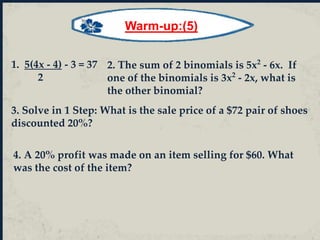
2. The sum of 2 binomials is 5x2
- 6x. If
one of the binomials is 3x2
- 2x, what is
the other binomial?
1. 5(4x - 4) - 3 = 37
2
3. Solve in 1 Step: What is the sale price of a $72 pair of shoes
discounted 20%?
Warm-up:(5)
4. A 20% profit was made on an item selling for $60. What
was the cost of the item?
Warm-up:(5)
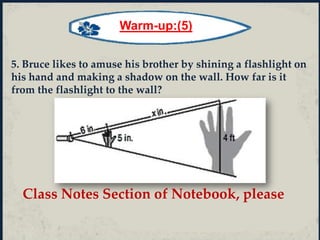
5. Bruce likes to amuse his brother by shining a flashlight on
his hand and making a shadow on the wall. How far is it
from the flashlight to the wall?
Class Notes Section of Notebook, please
Dividing Polynomials(2)
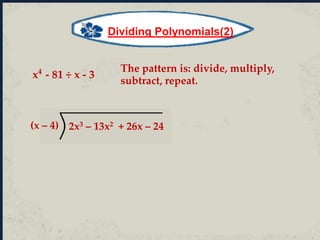
x4
- 81 ÷ x - 3
The pattern is: divide, multiply,
subtract, repeat.
2x3 – 13x2 + 26x – 24(x – 4)
Factoring Polynomials
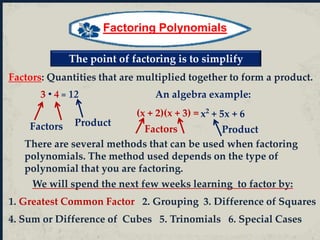
The point of factoring is to simplify
Factors: Quantities that are multiplied together to form a product.
3
Factors Product
An algebra example:
(x + 2)(x + 3) =
Factors Product
x2
+ 5x + 6
There are several methods that can be used when factoring
polynomials. The method used depends on the type of
polynomial that you are factoring.
We will spend the next few weeks learning to factor by:
1. Greatest Common Factor 2. Grouping 3. Difference of Squares
4. Sum or Difference of Cubes 5. Trinomials 6. Special Cases
Factoring Polynomials
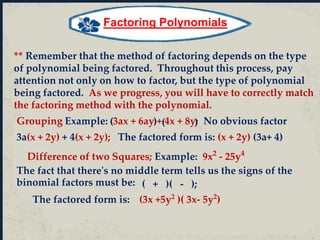
** Remember that the method of factoring depends on the type
of polynomial being factored. Throughout this process, pay
attention not only on how to factor, but the type of polynomial
being factored. As we progress, you will have to correctly match
the factoring method with the polynomial.
Grouping Example: 3ax + 6ay + 4x + 8y; No obvious factor
3a(x + 2y) + 4(x + 2y); The factored form is: (x + 2y) (3a+ 4)
Difference of two Squares; Example: 9x2
- 25y4
The fact that there's no middle term tells us the signs of the
binomial factors must be:
The factored form is: (3x +5y2
)( 3x- 5y2
)
( ) ( )
( + )( - );
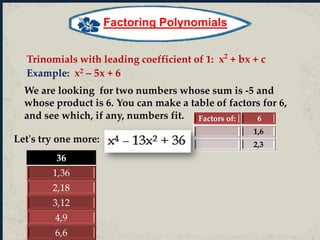
Trinomials with leading coefficient of 1: x2
+ bx + c
Example: x2 – 5x + 6
Factoring Polynomials
We are looking for two numbers whose sum is -5 and
whose product is 6. You can make a table of factors for 6,
and see which, if any, numbers fit. Factors of: 6
1,6
2,3
Let's try one more:
36
1,36
2,18
3,12
4,9
6,6
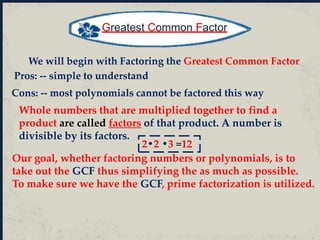
Whole numbers that are multiplied together to find a
product are called factors of that product. A number is
divisible by its factors.
Greatest Common Factor
2•2 •3 =12
We will begin with Factoring the Greatest Common Factor
Pros: -- simple to understand
Cons: -- most polynomials cannot be factored this way
Our goal, whether factoring numbers or polynomials, is to
take out the GCF thus simplifying the as much as possible.
To make sure we have the GCF, prime factorization is utilized.
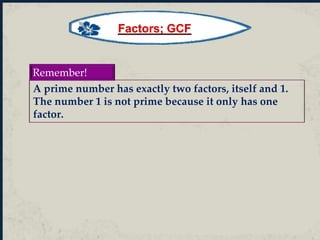
A prime number has exactly two factors, itself and 1.
The number 1 is not prime because it only has one
factor.
Remember!
Factors; GCF
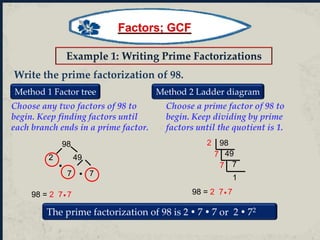
Example 1: Writing Prime Factorizations
Write the prime factorization of 98.
Method 1 Factor tree Method 2 Ladder diagram
Choose any two factors of 98 to
begin. Keep finding factors until
each branch ends in a prime factor.
Choose a prime factor of 98 to
begin. Keep dividing by prime
factors until the quotient is 1.
98 = 2 7 7
98
49
7
1
2
7
7
98 = 2 7 7
The prime factorization of 98 is 2  7  7 or 2  72
98
2 49
7 7


Factors; GCF
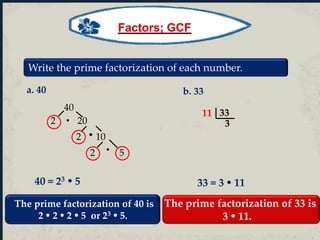
Write the prime factorization of each number.
a. 40
40
2 20
2 10


2 5
33
3
11
b. 33
40 = 23  5 33 = 3  11
The prime factorization of 40 is
2  2  2  5 or 23  5.
The prime factorization of 33 is
3  11.
Factors; GCF
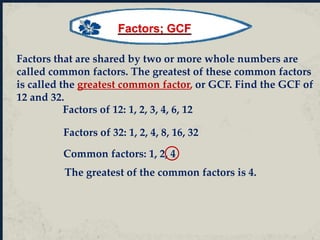
Factors that are shared by two or more whole numbers are
called common factors. The greatest of these common factors
is called the greatest common factor, or GCF. Find the GCF of
12 and 32.
Factors of 12: 1, 2, 3, 4, 6, 12
Factors of 32: 1, 2, 4, 8, 16, 32
Common factors: 1, 2, 4
The greatest of the common factors is 4.
Factors; GCF
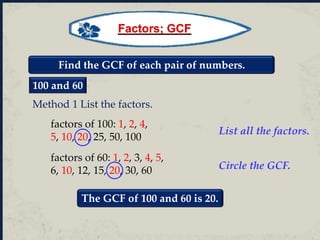
Find the GCF of each pair of numbers.
100 and 60
factors of 100: 1, 2, 4,
5, 10, 20, 25, 50, 100
factors of 60: 1, 2, 3, 4, 5,
6, 10, 12, 15, 20, 30, 60
The GCF of 100 and 60 is 20.
List all the factors.
Circle the GCF.
Method 1 List the factors.
Factors; GCF
Find the GCF of each pair of numbers.
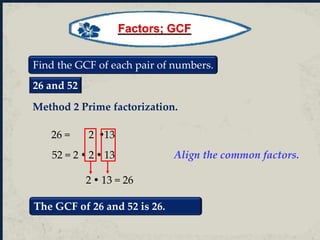
26 and 52
26 = 2 13
52 = 2  2  13 Align the common factors.
2  13 = 26
The GCF of 26 and 52 is 26.
Method 2 Prime factorization.
Factors; GCF
Find the GCF of each pair of numbers.
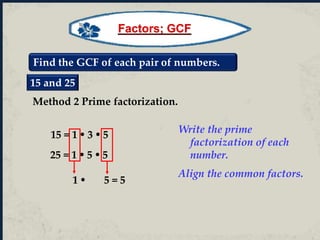
15 and 25
25 = 1  5  5
Write the prime
factorization of each
number.
Align the common factors.
1  5 = 5
15 = 1  3  5
Method 2 Prime factorization.
Factors; GCF
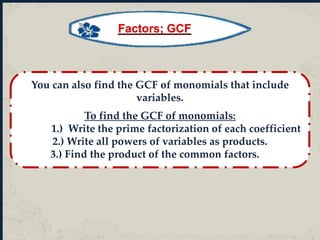
You can also find the GCF of monomials that include
variables.
To find the GCF of monomials:
1.) Write the prime factorization of each coefficient
2.) Write all powers of variables as products.
3.) Find the product of the common factors.
Factors; GCF
Example 3A: Finding the GCF of Monomials
Find the GCF of each pair of monomials.
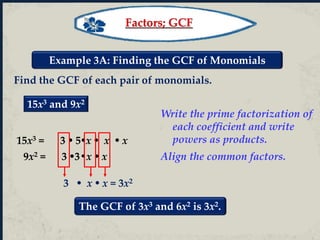
15x3 and 9x2
15x3 = 3  5x  x  x
9x2 = 3 3•x  x
3  x  x = 3x2
Write the prime factorization of
each coefficient and write
powers as products.
Align the common factors.
The GCF of 3x3 and 6x2 is 3x2.
Factors; GCF
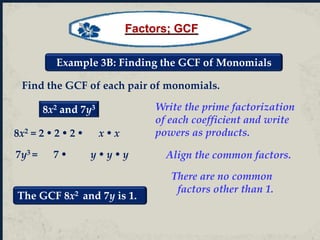
Example 3B: Finding the GCF of Monomials
Find the GCF of each pair of monomials.
8x2 and 7y3
8x2 = 2  2  2  x  x
7y3 = 7  y  y  y
Write the prime factorization
of each coefficient and write
powers as products.
Align the common factors.
There are no common
factors other than 1.
The GCF 8x2 and 7y is 1.
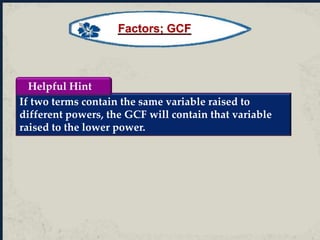
Factors; GCF
If two terms contain the same variable raised to
different powers, the GCF will contain that variable
raised to the lower power.
Helpful Hint
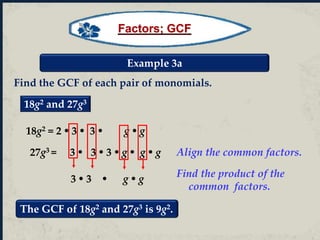
Factors; GCF
Example 3a
Find the GCF of each pair of monomials.
18g2 and 27g3
18g2 = 2  3  3  g  g
27g3 = 3  3  3  g  g  g
3  3  g  g
The GCF of 18g2 and 27g3 is 9g2.
Align the common factors.
Find the product of the
common factors.
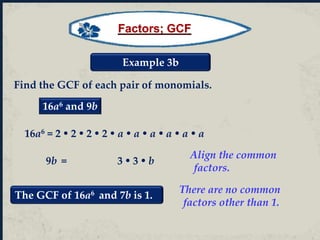
Factors; GCF
Example 3b
Find the GCF of each pair of monomials.
16a6 and 9b
9b = 3  3  b
16a6 = 2  2  2  2  a  a  a  a  a  a
Align the common
factors.
There are no common
factors other than 1.
The GCF of 16a6 and 7b is 1.
Factors; GCF
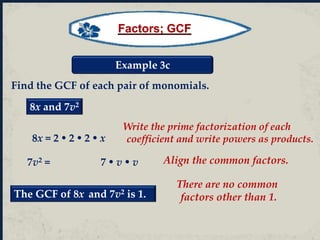
Example 3c
Find the GCF of each pair of monomials.
8x and 7v2
8x = 2  2  2  x
7v2 = 7  v  v
Write the prime factorization of each
coefficient and write powers as products.
Align the common factors.
There are no common
factors other than 1.The GCF of 8x and 7v2 is 1.
Factors; GCF
Application of the GCF:
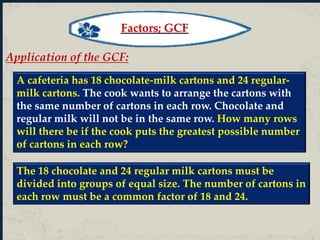
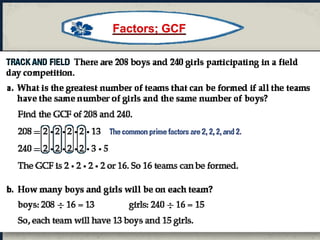
A cafeteria has 18 chocolate-milk cartons and 24 regular-
milk cartons. The cook wants to arrange the cartons with
the same number of cartons in each row. Chocolate and
regular milk will not be in the same row. How many rows
will there be if the cook puts the greatest possible number
of cartons in each row?
The 18 chocolate and 24 regular milk cartons must be
divided into groups of equal size. The number of cartons in
each row must be a common factor of 18 and 24.
Factors; GCF
Example 4 Continued
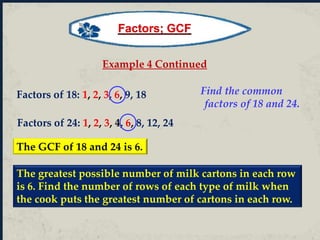
Factors of 18: 1, 2, 3, 6, 9, 18
Factors of 24: 1, 2, 3, 4, 6, 8, 12, 24
Find the common
factors of 18 and 24.
The GCF of 18 and 24 is 6.
The greatest possible number of milk cartons in each row
is 6. Find the number of rows of each type of milk when
the cook puts the greatest number of cartons in each row.
Factors; GCF
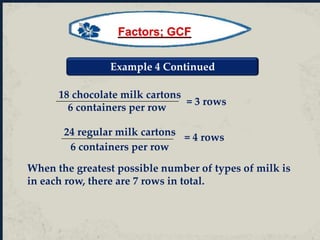
18 chocolate milk cartons
6 containers per row
= 3 rows
24 regular milk cartons
6 containers per row
= 4 rows
When the greatest possible number of types of milk is
in each row, there are 7 rows in total.
Example 4 Continued
Factors; GCF
Factors; GCF
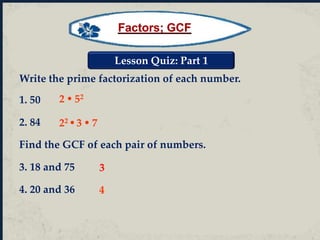
Lesson Quiz: Part 1
Write the prime factorization of each number.
1. 50
2. 84
Find the GCF of each pair of numbers.
3. 18 and 75
4. 20 and 36
22  3  7
2  52
4
3
Factors; GCF
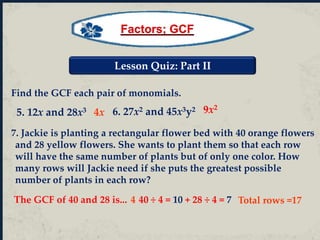
Lesson Quiz: Part II
Find the GCF each pair of monomials.
4x
Total rows =17
9x2
7. Jackie is planting a rectangular flower bed with 40 orange flowers
and 28 yellow flowers. She wants to plant them so that each row
will have the same number of plants but of only one color. How
many rows will Jackie need if she puts the greatest possible
number of plants in each row?
6. 27x2 and 45x3y2
5. 12x and 28x3
The GCF of 40 and 28 is... 4 40 ÷ 4 = 10 + 28 ÷ 4 = 7
Factors; GCF
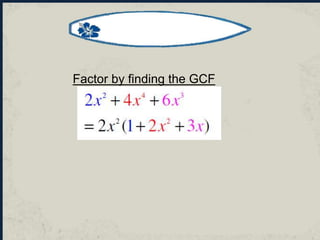
Factor by finding the GCF
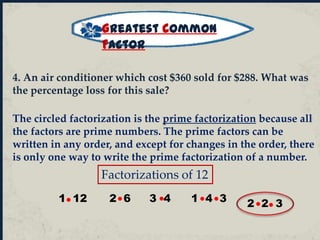
Factorizations of 12
1 12 2 6 3 4 1 4 3 2 2 3
The circled factorization is the prime factorization because all
the factors are prime numbers. The prime factors can be
written in any order, and except for changes in the order, there
is only one way to write the prime factorization of a number.
Greatest Common
Factor
4. An air conditioner which cost $360 sold for $288. What was
the percentage loss for this sale?

March 18, 2014

  • 2.
    2. The sumof 2 binomials is 5x2 - 6x. If one of the binomials is 3x2 - 2x, what is the other binomial? 1. 5(4x - 4) - 3 = 37 2 3. Solve in 1 Step: What is the sale price of a $72 pair of shoes discounted 20%? Warm-up:(5) 4. A 20% profit was made on an item selling for $60. What was the cost of the item?
  • 3.
    Warm-up:(5) 5. Bruce likesto amuse his brother by shining a flashlight on his hand and making a shadow on the wall. How far is it from the flashlight to the wall? Class Notes Section of Notebook, please
  • 4.
    Dividing Polynomials(2) x4 - 81÷ x - 3 The pattern is: divide, multiply, subtract, repeat. 2x3 – 13x2 + 26x – 24(x – 4)
  • 5.
    Factoring Polynomials The pointof factoring is to simplify Factors: Quantities that are multiplied together to form a product. 3 Factors Product An algebra example: (x + 2)(x + 3) = Factors Product x2 + 5x + 6 There are several methods that can be used when factoring polynomials. The method used depends on the type of polynomial that you are factoring. We will spend the next few weeks learning to factor by: 1. Greatest Common Factor 2. Grouping 3. Difference of Squares 4. Sum or Difference of Cubes 5. Trinomials 6. Special Cases
  • 6.
    Factoring Polynomials ** Rememberthat the method of factoring depends on the type of polynomial being factored. Throughout this process, pay attention not only on how to factor, but the type of polynomial being factored. As we progress, you will have to correctly match the factoring method with the polynomial. Grouping Example: 3ax + 6ay + 4x + 8y; No obvious factor 3a(x + 2y) + 4(x + 2y); The factored form is: (x + 2y) (3a+ 4) Difference of two Squares; Example: 9x2 - 25y4 The fact that there's no middle term tells us the signs of the binomial factors must be: The factored form is: (3x +5y2 )( 3x- 5y2 ) ( ) ( ) ( + )( - );
  • 7.
    Trinomials with leadingcoefficient of 1: x2 + bx + c Example: x2 – 5x + 6 Factoring Polynomials We are looking for two numbers whose sum is -5 and whose product is 6. You can make a table of factors for 6, and see which, if any, numbers fit. Factors of: 6 1,6 2,3 Let's try one more: 36 1,36 2,18 3,12 4,9 6,6
  • 8.
    Whole numbers thatare multiplied together to find a product are called factors of that product. A number is divisible by its factors. Greatest Common Factor 2•2 •3 =12 We will begin with Factoring the Greatest Common Factor Pros: -- simple to understand Cons: -- most polynomials cannot be factored this way Our goal, whether factoring numbers or polynomials, is to take out the GCF thus simplifying the as much as possible. To make sure we have the GCF, prime factorization is utilized.
  • 9.
    A prime numberhas exactly two factors, itself and 1. The number 1 is not prime because it only has one factor. Remember! Factors; GCF
  • 10.
    Example 1: WritingPrime Factorizations Write the prime factorization of 98. Method 1 Factor tree Method 2 Ladder diagram Choose any two factors of 98 to begin. Keep finding factors until each branch ends in a prime factor. Choose a prime factor of 98 to begin. Keep dividing by prime factors until the quotient is 1. 98 = 2 7 7 98 49 7 1 2 7 7 98 = 2 7 7 The prime factorization of 98 is 2  7  7 or 2  72 98 2 49 7 7   Factors; GCF
  • 11.
    Write the primefactorization of each number. a. 40 40 2 20 2 10   2 5 33 3 11 b. 33 40 = 23  5 33 = 3  11 The prime factorization of 40 is 2  2  2  5 or 23  5. The prime factorization of 33 is 3  11. Factors; GCF
  • 12.
    Factors that areshared by two or more whole numbers are called common factors. The greatest of these common factors is called the greatest common factor, or GCF. Find the GCF of 12 and 32. Factors of 12: 1, 2, 3, 4, 6, 12 Factors of 32: 1, 2, 4, 8, 16, 32 Common factors: 1, 2, 4 The greatest of the common factors is 4. Factors; GCF
  • 13.
    Find the GCFof each pair of numbers. 100 and 60 factors of 100: 1, 2, 4, 5, 10, 20, 25, 50, 100 factors of 60: 1, 2, 3, 4, 5, 6, 10, 12, 15, 20, 30, 60 The GCF of 100 and 60 is 20. List all the factors. Circle the GCF. Method 1 List the factors. Factors; GCF
  • 14.
    Find the GCFof each pair of numbers. 26 and 52 26 = 2 13 52 = 2  2  13 Align the common factors. 2  13 = 26 The GCF of 26 and 52 is 26. Method 2 Prime factorization. Factors; GCF
  • 15.
    Find the GCFof each pair of numbers. 15 and 25 25 = 1  5  5 Write the prime factorization of each number. Align the common factors. 1  5 = 5 15 = 1  3  5 Method 2 Prime factorization. Factors; GCF
  • 16.
    You can alsofind the GCF of monomials that include variables. To find the GCF of monomials: 1.) Write the prime factorization of each coefficient 2.) Write all powers of variables as products. 3.) Find the product of the common factors. Factors; GCF
  • 17.
    Example 3A: Findingthe GCF of Monomials Find the GCF of each pair of monomials. 15x3 and 9x2 15x3 = 3  5x  x  x 9x2 = 3 3•x  x 3  x  x = 3x2 Write the prime factorization of each coefficient and write powers as products. Align the common factors. The GCF of 3x3 and 6x2 is 3x2. Factors; GCF
  • 18.
    Example 3B: Findingthe GCF of Monomials Find the GCF of each pair of monomials. 8x2 and 7y3 8x2 = 2  2  2  x  x 7y3 = 7  y  y  y Write the prime factorization of each coefficient and write powers as products. Align the common factors. There are no common factors other than 1. The GCF 8x2 and 7y is 1. Factors; GCF
  • 19.
    If two termscontain the same variable raised to different powers, the GCF will contain that variable raised to the lower power. Helpful Hint Factors; GCF
  • 20.
    Example 3a Find theGCF of each pair of monomials. 18g2 and 27g3 18g2 = 2  3  3  g  g 27g3 = 3  3  3  g  g  g 3  3  g  g The GCF of 18g2 and 27g3 is 9g2. Align the common factors. Find the product of the common factors. Factors; GCF
  • 21.
    Example 3b Find theGCF of each pair of monomials. 16a6 and 9b 9b = 3  3  b 16a6 = 2  2  2  2  a  a  a  a  a  a Align the common factors. There are no common factors other than 1. The GCF of 16a6 and 7b is 1. Factors; GCF
  • 22.
    Example 3c Find theGCF of each pair of monomials. 8x and 7v2 8x = 2  2  2  x 7v2 = 7  v  v Write the prime factorization of each coefficient and write powers as products. Align the common factors. There are no common factors other than 1.The GCF of 8x and 7v2 is 1. Factors; GCF
  • 23.
    Application of theGCF: A cafeteria has 18 chocolate-milk cartons and 24 regular- milk cartons. The cook wants to arrange the cartons with the same number of cartons in each row. Chocolate and regular milk will not be in the same row. How many rows will there be if the cook puts the greatest possible number of cartons in each row? The 18 chocolate and 24 regular milk cartons must be divided into groups of equal size. The number of cartons in each row must be a common factor of 18 and 24. Factors; GCF
  • 24.
    Example 4 Continued Factorsof 18: 1, 2, 3, 6, 9, 18 Factors of 24: 1, 2, 3, 4, 6, 8, 12, 24 Find the common factors of 18 and 24. The GCF of 18 and 24 is 6. The greatest possible number of milk cartons in each row is 6. Find the number of rows of each type of milk when the cook puts the greatest number of cartons in each row. Factors; GCF
  • 25.
    18 chocolate milkcartons 6 containers per row = 3 rows 24 regular milk cartons 6 containers per row = 4 rows When the greatest possible number of types of milk is in each row, there are 7 rows in total. Example 4 Continued Factors; GCF
  • 26.
  • 27.
    Lesson Quiz: Part1 Write the prime factorization of each number. 1. 50 2. 84 Find the GCF of each pair of numbers. 3. 18 and 75 4. 20 and 36 22  3  7 2  52 4 3 Factors; GCF
  • 28.
    Lesson Quiz: PartII Find the GCF each pair of monomials. 4x Total rows =17 9x2 7. Jackie is planting a rectangular flower bed with 40 orange flowers and 28 yellow flowers. She wants to plant them so that each row will have the same number of plants but of only one color. How many rows will Jackie need if she puts the greatest possible number of plants in each row? 6. 27x2 and 45x3y2 5. 12x and 28x3 The GCF of 40 and 28 is... 4 40 ÷ 4 = 10 + 28 ÷ 4 = 7 Factors; GCF
  • 30.
  • 31.
    Factorizations of 12 112 2 6 3 4 1 4 3 2 2 3 The circled factorization is the prime factorization because all the factors are prime numbers. The prime factors can be written in any order, and except for changes in the order, there is only one way to write the prime factorization of a number. Greatest Common Factor 4. An air conditioner which cost $360 sold for $288. What was the percentage loss for this sale?