2
INTRODUCTION
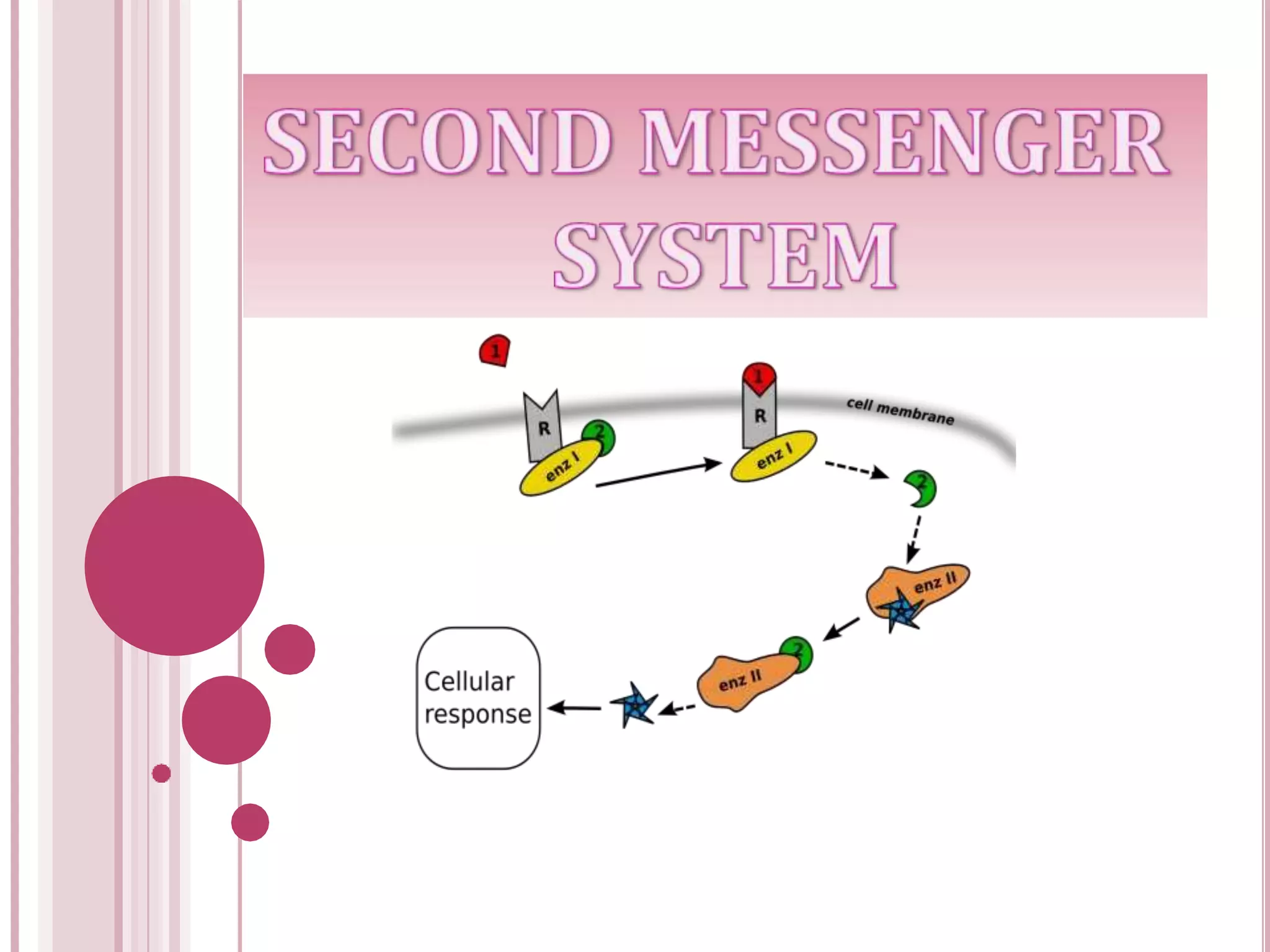
 Second messengers are molecules that relay signals
from receptors on the cell surface to target molecules
inside the cell.
 They greatly amplify the strength of the signal, cause
some kind of change in the activity of the cell.
 They are a component of cell signaling pathways.
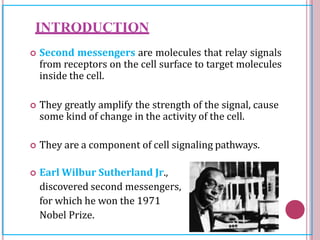
 Earl Wilbur Sutherland Jr.,
discovered second messengers,
for which he won the 1971
Nobel Prize.
SECOND MESSENGERS
 Short lived intracellular signaling molecules
 Elevated concentration of second messenger leads to
rapid alteration in the activity of one or more cellular
enzymes
 Removal or degradation of second messenger
terminate the cellular response
 Four classes of second messengers
⚫ Cyclic nucleotides
⚫ Membrane lipid derivatives
⚫ Ca2+
⚫ Nitric oxide/carbon monoxide
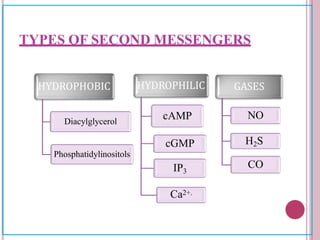
GASES
NO
H2S
CO
HYDROPHOBIC
Diacylglycerol
Phosphatidylinositols
HYDROPHILIC
cAMP
cGMP
IP3
Ca2+.
TYPES OF SECOND MESSENGERS
CYCLIC AMP
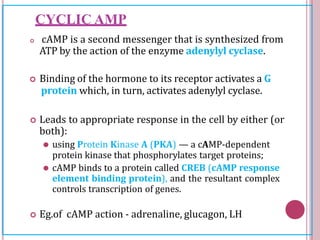
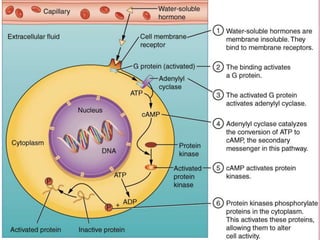
 cAMP is a second messenger that is synthesized from
ATP by the action of the enzyme adenylyl cyclase.
 Binding of the hormone to its receptor activates a G
protein which, in turn, activates adenylyl cyclase.
 Leads to appropriate response in the cell by either (or
both):
⚫ using Protein Kinase A (PKA) — a cAMP-dependent
protein kinase that phosphorylates target proteins;
⚫ cAMP binds to a protein called CREB (cAMP response
element binding protein), and the resultant complex
controls transcription of genes.
 Eg.of cAMP action - adrenaline, glucagon, LH
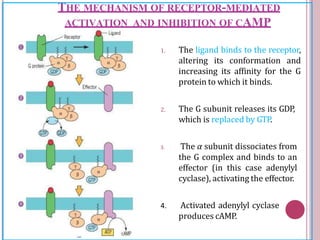
1. The ligand binds to the receptor,
altering its conformation and
increasing its affinity for the G
protein to which it binds.
2. The G subunit releases its GDP,
which is replaced by GTP.
3. The α subunit dissociates from
the G complex and binds to an
effector (in this case adenylyl
cyclase), activating the effector.
4. Activated adenylyl cyclase
produces cAMP.
THE MECHANISM OF RECEPTOR-MEDIATED
ACTIVATION AND INHIBITION OF CAMP
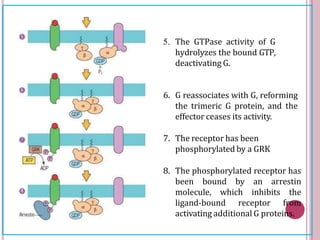
5. The GTPase activity of G
hydrolyzes the bound GTP,
deactivating G.
6. G reassociates with G, reforming
the trimeric G protein, and the
effector ceases its activity.
7. The receptor has been
phosphorylated by a GRK
8. The phosphorylated receptor has
been bound by an arrestin
molecule, which inhibits the
ligand-bound receptor from
activating additional G proteins.
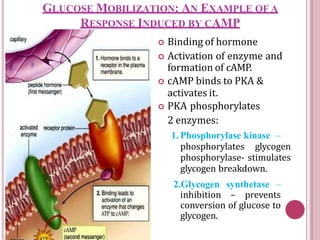
GLUCOSE MOBILIZATION: AN EXAMPLE OF A
RESPONSE INDUCED BY CAMP
 Binding of hormone
 Activation of enzyme and
formation of cAMP.
 cAMP binds to PKA &
activates it.
 PKA phosphorylates
2 enzymes:
1. Phosphorylase kinase –
phosphorylates glycogen
phosphorylase- stimulates
glycogen breakdown.
2.Glycogen synthetase –
inhibition – prevents
conversion of glucose to
glycogen.
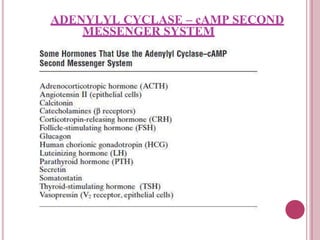
ADENYLYL CYCLASE – cAMP SECOND
MESSENGER SYSTEM
CYCLIC GMP
 cGMP is synthesized from the nucleotide GTP using the
enzyme guanylyl cyclase.
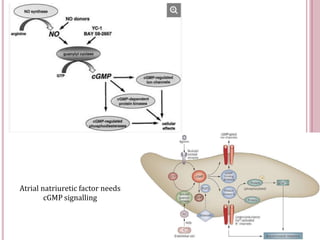
 Nitric oxide stimulates the synthesis of cGMP .
 Many cells contain a cGMP-stimulated protein kinase
that contains both catalytic and regulatory subunits.
 Some of the effects of cGMP are mediated through
Protein Kinase G (PKG)
 cGMP serves as the second messenger for
⚫ nitric oxide (NO)
⚫ the response of the rods of the retina to light.
NITRIC OXIDE
 Nitric oxide (NO) acts as a second messenger because
it is a free radical that can diffuse through the
plasma membrane and affect nearby cells.
 It is synthesised from arginine and oxygen by the
NO synthase.
 It activates soluble guanylyl cyclase, which when
activated produces another second messenger, cGMP.
 It is toxic in high concentrations , but is the cause of
many other functions like relaxation of blood vessels,
apoptosis etc.
Atrial natriuretic factor needs
cGMP signalling
PHOSPHATIDYLINOSITOL-DERIVED
SECOND MESSENGERS
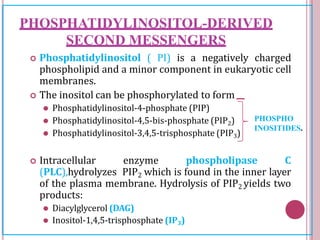
 Phosphatidylinositol ( PI) is a negatively charged
phospholipid and a minor component in eukaryotic cell
membranes.
 The inositol can be phosphorylated to form
⚫ Phosphatidylinositol-4-phosphate (PIP)
⚫ Phosphatidylinositol-4,5-bis-phosphate (PIP2)
⚫ Phosphatidylinositol-3,4,5-trisphosphate (PIP3)
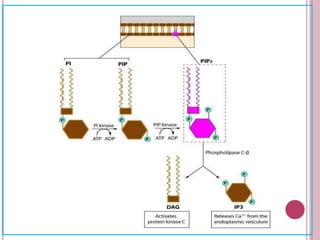
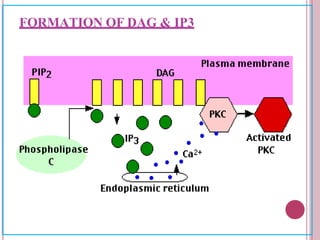
 Intracellular enzyme phospholipase C
(PLC),hydrolyzes PIP2 which is found in the inner layer
of the plasma membrane. Hydrolysis of PIP2 yields two
products:
⚫ Diacylglycerol (DAG)
⚫ Inositol-1,4,5-trisphosphate (IP3)
PHOSPHO
INOSITIDES.
DIACYLGLYCEROL
 Diacylglycerol stimulates protein kinase C activity by
greatly increasing the affinity of the enzyme for calcium
ions.
 Protein kinase C phosphorylates specific serine and
threonine residues in target proteins.
 Known target proteins include calmodulin, the glucose
transporter, HMG-CoA reductase, cytochrome P450 etc.
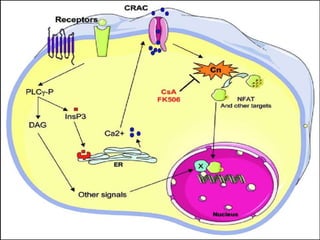
INOSITOL TRIPHOSPHATE, IP3
 This soluble molecule diffuses through the cytosol
and binds to receptors on the endoplasmic
reticulum causing the release of calcium ions (Ca2+)
into the cytosol.
 The rise in intracellular calcium triggers the response.
 Example: the calcium rise is needed for NF-AT (the
"nuclear factor of activated T cells") to turn on the
appropriate genes in the nucleus.
MODE OF ACTION
 Peptide and protein hormones like vasopressin, TSH, and
neurotransmitters like GABA bind to GPCRs
 This activate the intracellular enzyme phospholipase C
(PLC).
 PLC in turn cleaves PIP2 to yield two products – DAG and
IP3.
 Both of these products act as second messengers.
 So, the cleavage of PIP2 by PLC is the functional
equivalent of the synthesis of cAMP by adenylyl cyclase.
FORMATION OF DAG & IP3
CALCIUM IONS
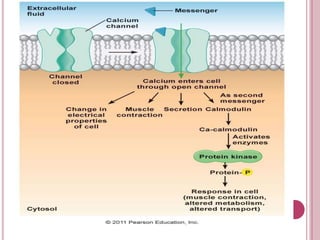
 Many cells respond to extracellular stimuli by altering
their intracellular calcium concentration.
 Ca++ acts as a second messenger in two ways:
⚫ it binds to an effector molecule, such as an enzyme,
activating it;
⚫ it binds to an intermediary cytosolic calcium binding
protein such as calmodulin.
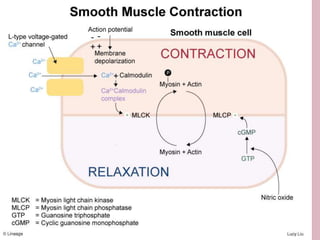
 The binding of Ca++ causes profound conformational
changes in calmodulin that increase calmodulin`s
affinity for its effector molecules.
 Calmodulin, when activated, causes contraction
of smooth muscles.
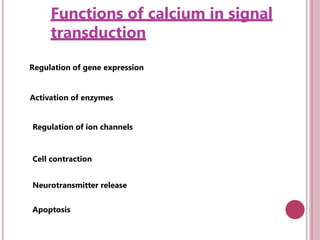
Functions of calcium in signal
transduction
Regulation of gene expression
Activation of enzymes
Regulation of ion channels
Cell contraction
Neurotransmitter release
Apoptosis
RECENT DEVELOPMENTS
 Feng-Yen Li, a student of PhD in biomedical sciences at
UCSF, discovered a "second-messenger" role for
magnesium in T cell signalling, by studying a family
of two boys who suffer from chronic Epstein-Barr virus
infections.
 A new Second Messenger, c-di-AMP was
discovered in Staphylococcus aureus with a Role in
Controlling Cell Size and Envelope Stress. This work was
published in the September 2011 Issue of PLoS
Pathogens.
CONCLUSION
 Signal transduction pathways allow cells to respond
to environmental signals.
 In these pathways, a signal is amplified.
 This signal amplification is brought about by second
messengers like c AMP, ,c GMP, Ca ions, IP3, DAG and
NO.
 Second messengers essentially serve as chemical
relays from the plasma membrane to the cytoplasm,
thus carrying out intracellular signal transduction.
REFERENCES
 Karp, Gerald. Cell and Molecular biology, 6th edition, John
Wiley and Sons, Inc.
 Rastogi S.C, Cell and Molecular biology, 3rd edition (2010),
New Age International (P) Limited, publishers.
 Twyman R.M, Advanced Molecular Biology (2003), Viva
Books Private Limited, New Delhi.
 http://users.rcn.com/jkimball.ma.ultranet/BiologyPages/
S/Second_messengers.html
 http://en.wikipedia.org/wiki/Second_messenger_system

Second Messenger(F-28).pptx

  • 2.
  • 3.
    INTRODUCTION  Second messengersare molecules that relay signals from receptors on the cell surface to target molecules inside the cell.  They greatly amplify the strength of the signal, cause some kind of change in the activity of the cell.  They are a component of cell signaling pathways.  Earl Wilbur Sutherland Jr., discovered second messengers, for which he won the 1971 Nobel Prize.
  • 4.
    SECOND MESSENGERS  Shortlived intracellular signaling molecules  Elevated concentration of second messenger leads to rapid alteration in the activity of one or more cellular enzymes  Removal or degradation of second messenger terminate the cellular response  Four classes of second messengers ⚫ Cyclic nucleotides ⚫ Membrane lipid derivatives ⚫ Ca2+ ⚫ Nitric oxide/carbon monoxide
  • 5.
  • 6.
    CYCLIC AMP  cAMPis a second messenger that is synthesized from ATP by the action of the enzyme adenylyl cyclase.  Binding of the hormone to its receptor activates a G protein which, in turn, activates adenylyl cyclase.  Leads to appropriate response in the cell by either (or both): ⚫ using Protein Kinase A (PKA) — a cAMP-dependent protein kinase that phosphorylates target proteins; ⚫ cAMP binds to a protein called CREB (cAMP response element binding protein), and the resultant complex controls transcription of genes.  Eg.of cAMP action - adrenaline, glucagon, LH
  • 8.
    1. The ligandbinds to the receptor, altering its conformation and increasing its affinity for the G protein to which it binds. 2. The G subunit releases its GDP, which is replaced by GTP. 3. The α subunit dissociates from the G complex and binds to an effector (in this case adenylyl cyclase), activating the effector. 4. Activated adenylyl cyclase produces cAMP. THE MECHANISM OF RECEPTOR-MEDIATED ACTIVATION AND INHIBITION OF CAMP
  • 9.
    5. The GTPaseactivity of G hydrolyzes the bound GTP, deactivating G. 6. G reassociates with G, reforming the trimeric G protein, and the effector ceases its activity. 7. The receptor has been phosphorylated by a GRK 8. The phosphorylated receptor has been bound by an arrestin molecule, which inhibits the ligand-bound receptor from activating additional G proteins.
  • 11.
    GLUCOSE MOBILIZATION: ANEXAMPLE OF A RESPONSE INDUCED BY CAMP  Binding of hormone  Activation of enzyme and formation of cAMP.  cAMP binds to PKA & activates it.  PKA phosphorylates 2 enzymes: 1. Phosphorylase kinase – phosphorylates glycogen phosphorylase- stimulates glycogen breakdown. 2.Glycogen synthetase – inhibition – prevents conversion of glucose to glycogen.
  • 12.
    ADENYLYL CYCLASE –cAMP SECOND MESSENGER SYSTEM
  • 13.
    CYCLIC GMP  cGMPis synthesized from the nucleotide GTP using the enzyme guanylyl cyclase.  Nitric oxide stimulates the synthesis of cGMP .  Many cells contain a cGMP-stimulated protein kinase that contains both catalytic and regulatory subunits.  Some of the effects of cGMP are mediated through Protein Kinase G (PKG)  cGMP serves as the second messenger for ⚫ nitric oxide (NO) ⚫ the response of the rods of the retina to light.
  • 14.
    NITRIC OXIDE  Nitricoxide (NO) acts as a second messenger because it is a free radical that can diffuse through the plasma membrane and affect nearby cells.  It is synthesised from arginine and oxygen by the NO synthase.  It activates soluble guanylyl cyclase, which when activated produces another second messenger, cGMP.  It is toxic in high concentrations , but is the cause of many other functions like relaxation of blood vessels, apoptosis etc.
  • 15.
    Atrial natriuretic factorneeds cGMP signalling
  • 16.
    PHOSPHATIDYLINOSITOL-DERIVED SECOND MESSENGERS  Phosphatidylinositol( PI) is a negatively charged phospholipid and a minor component in eukaryotic cell membranes.  The inositol can be phosphorylated to form ⚫ Phosphatidylinositol-4-phosphate (PIP) ⚫ Phosphatidylinositol-4,5-bis-phosphate (PIP2) ⚫ Phosphatidylinositol-3,4,5-trisphosphate (PIP3)  Intracellular enzyme phospholipase C (PLC),hydrolyzes PIP2 which is found in the inner layer of the plasma membrane. Hydrolysis of PIP2 yields two products: ⚫ Diacylglycerol (DAG) ⚫ Inositol-1,4,5-trisphosphate (IP3) PHOSPHO INOSITIDES.
  • 18.
    DIACYLGLYCEROL  Diacylglycerol stimulatesprotein kinase C activity by greatly increasing the affinity of the enzyme for calcium ions.  Protein kinase C phosphorylates specific serine and threonine residues in target proteins.  Known target proteins include calmodulin, the glucose transporter, HMG-CoA reductase, cytochrome P450 etc.
  • 19.
    INOSITOL TRIPHOSPHATE, IP3 This soluble molecule diffuses through the cytosol and binds to receptors on the endoplasmic reticulum causing the release of calcium ions (Ca2+) into the cytosol.  The rise in intracellular calcium triggers the response.  Example: the calcium rise is needed for NF-AT (the "nuclear factor of activated T cells") to turn on the appropriate genes in the nucleus.
  • 21.
    MODE OF ACTION Peptide and protein hormones like vasopressin, TSH, and neurotransmitters like GABA bind to GPCRs  This activate the intracellular enzyme phospholipase C (PLC).  PLC in turn cleaves PIP2 to yield two products – DAG and IP3.  Both of these products act as second messengers.  So, the cleavage of PIP2 by PLC is the functional equivalent of the synthesis of cAMP by adenylyl cyclase.
  • 22.
  • 23.
    CALCIUM IONS  Manycells respond to extracellular stimuli by altering their intracellular calcium concentration.  Ca++ acts as a second messenger in two ways: ⚫ it binds to an effector molecule, such as an enzyme, activating it; ⚫ it binds to an intermediary cytosolic calcium binding protein such as calmodulin.  The binding of Ca++ causes profound conformational changes in calmodulin that increase calmodulin`s affinity for its effector molecules.  Calmodulin, when activated, causes contraction of smooth muscles.
  • 24.
    Functions of calciumin signal transduction Regulation of gene expression Activation of enzymes Regulation of ion channels Cell contraction Neurotransmitter release Apoptosis
  • 27.
    RECENT DEVELOPMENTS  Feng-YenLi, a student of PhD in biomedical sciences at UCSF, discovered a "second-messenger" role for magnesium in T cell signalling, by studying a family of two boys who suffer from chronic Epstein-Barr virus infections.  A new Second Messenger, c-di-AMP was discovered in Staphylococcus aureus with a Role in Controlling Cell Size and Envelope Stress. This work was published in the September 2011 Issue of PLoS Pathogens.
  • 28.
    CONCLUSION  Signal transductionpathways allow cells to respond to environmental signals.  In these pathways, a signal is amplified.  This signal amplification is brought about by second messengers like c AMP, ,c GMP, Ca ions, IP3, DAG and NO.  Second messengers essentially serve as chemical relays from the plasma membrane to the cytoplasm, thus carrying out intracellular signal transduction.
  • 29.
    REFERENCES  Karp, Gerald.Cell and Molecular biology, 6th edition, John Wiley and Sons, Inc.  Rastogi S.C, Cell and Molecular biology, 3rd edition (2010), New Age International (P) Limited, publishers.  Twyman R.M, Advanced Molecular Biology (2003), Viva Books Private Limited, New Delhi.  http://users.rcn.com/jkimball.ma.ultranet/BiologyPages/ S/Second_messengers.html  http://en.wikipedia.org/wiki/Second_messenger_system