This document provides information about the second conditional in English grammar. It discusses:
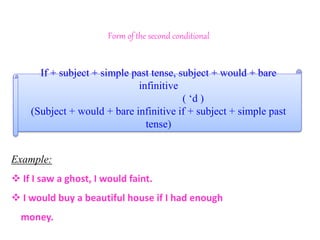
1) The form of the second conditional uses "if" plus the subject and simple past tense, followed by the subject plus "would" and the bare infinitive.
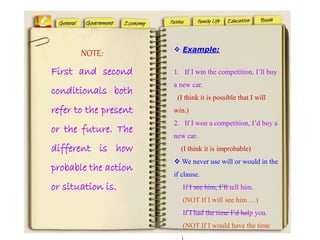
2) The second conditional refers to improbable or hypothetical situations in the present or future. It differs from the first conditional in that the action or situation is less probable.
3) Examples are given to illustrate the difference between the first and second conditional. The second conditional expresses something less probable than the first conditional.