Work Ethics
By Introcanvas
https://introcanvas.wordpress.com/
https://twitter.com/introcanvas
https://fb.com/introcanvas
Learning Outcome
By the end of this session we would be able to understand-
 Work Ethics
 Decision Making
 Ethical Relationship
 Integrity
© All Rights Reserved 2
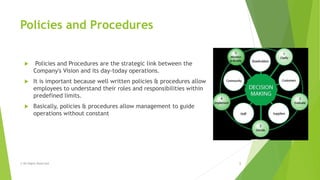
Policies and Procedures
 Policies and Procedures are the strategic link between the
Company's Vision and its day-today operations.
 It is important because well written policies & procedures allow
employees to understand their roles and responsibilities within
predefined limits.
 Basically, policies & procedures allow management to guide
operations without constant
© All Rights Reserved 3
ADHERENCE TO EMPLOYER POLICIES AND
PROCEDURES
 Managing employees can be one of the most difficult aspects of running a
business. Establishing policies and procedures and stating them in the employee
manual may ease the burden. Clearly communicated standards may help to
reduce employee complaints, absenteeism, and staff turnover. One of the
purposes of a personnel policy and procedure manual is to address legal
requirements such as equal opportunity employment.
 Managements understanding of the meaning of ethics for instance must be the
same as the employees understanding. In addition, the company has an
obligation to ensure the rules and regulations are enforced equitably, as soon as
possible after a deviation occurs.
© All Rights Reserved 4
CLARIFY-
 Determine precisely what must be decided.
 Formulate and devise the full range of alternatives.
 Eliminate patently impractical, illegal and improper alternatives.
 Force yourself to develop at least three ethically justifiable options.
 Examine each option to determine which ethical principles and values are involved.
© All Rights Reserved 5
EVALUATE-
 If any of the options requires the sacrifice of any ethical principle, evaluate the
facts and assumptions carefully.
 Distinguish solid facts from beliefs, desires, theories, suppositions, unsupported
conclusions, opinions, and rationalizations.
 Consider the credibility of sources, especially when they are self-interested,
ideological or biased.
 With regard to each alternative, carefully consider the benefits, burdens and risks to
each stakeholder.
© All Rights Reserved 6
DECIDE-
 Make a judgment about what is not true and what consequences are most
likely to occur.
 Evaluate the viable alternatives according to personal conscience.
 Prioritize the values so that you can choose which values to advance and
which to subordinate
 Determine who will be helped the most and harmed the least.
 Consider the worst-case scenario.
 Consider whether ethically questionable conduct can be avoided by changing
goals or methods, or by getting consent.
© All Rights Reserved 7
IMPLEMENT-
 Develop a plan of how to implement the decision.
 Maximize the benefits and minimize the costs and risks.
MONITOR and MODIFY-
 Monitor the effects of decisions
 Be prepared and willing to revise a plan, or take a different course of action.
 Adjust to new information
© All Rights Reserved 8
COMPANY EMPLOYEE RELATIONSHIP
 Handling employee relations‟ issues correctly is absolutely
essential for creating a successful company. One should never
ever forget, employees are a top asset, but if the relationship
with them is botched up, a work environment with low morale
and little productivity gets created. Needless to say, this isn’t
good for business.
© All Rights Reserved 9
LOYALTY-
 The current stormy economic condition means layoffs and employees on
both sides of the pink slip are unsettled. In such a case, loyalty is a very
powerful concept.
 Loyalty is really the glue that ties an employee to their job, and that tie
is a function of the respect and allegiance the entrepreneur attempts to
develop in their employees.
 But when either party to this contact fails to fulfill their role, the
contract that's hard to build in the first place gets broken. And then it's
extremely difficult to rebuild the trust that existed between the
employee and the boss.
 Loyal staffers help create a history and a culture of stability; people
who've been around awhile know the road, the rules and the "how it's
done around here."
© All Rights Reserved 10
PROFESSIONAL USE OF FACILITIES-
 The organizational facilities should be used carefully. Just because they do not
belong to us directly, they should not be misused.
 Following points need to be kept in mind while using the organizational facilities:
 The stationary should not be wasted
 Rest rooms should be kept clean
 Desks should not be shabby and dirty
 Cafeteria should be a place to relax and not a place to make noise
 Proper use of dust bins should be made
 Vending machines and other mechanical stuff and also computers should be
handles with care
© All Rights Reserved 11
PEER RELATIONSHIP- The peer group is critical to an individual’s success,
especially in matrixed, collaborative environments, where peer reviews
and opinions have heavy weight.
 Unbiased treatment of all peers - Today organizations are wide spread
across boundaries and also have a varied workforce. Peers in an
organization come from various cultural and social backgrounds. But
they should never be judged on this factor. All peers should be equally
treated so as to develop a healthy working environment.
 Treating a female peer -Female peer should be treated with respect in
an organization. The way one talks to men is different and should be
avoided while dealing with female peers. The body language also has to
be taken care of while dealing with female peers.
© All Rights Reserved 12
EMPLOYEE CLIENT RELATIONSHIP- Customers form relationships with the
employees who serve them as well as with the vendor firms these employees
represent. The costs of retaining current customers are much lower than the
costs of acquiring new ones. In many cases, a customer’s relationship with an
employee who is closest to them, a key contact employee may be stronger
than the customer’s relationship with the vendor firm.
 Honest selling -To strengthen employee client relationship, companies
should sell good products. The customer would feel cheated if the
product/service offered is not as promised. This would affect the loyalty
of the customer with the company.
 After sales service - Good after-sales service is the key to customer
retention. After sales service refers to various processes, which make
sure customers are satisfied with the products and services of the
organization.
© All Rights Reserved 13
Integrity
Used words describing people identified as possessing 'integrity':
• Strength of character
• Steadfast, resolute, having fiber
• Walking the talk, doing what was promised
• Authentic, straightforward, what's on the inside is displayed on the outside
• Open, honest and direct in their dealings with others
• Clear and uncompromised values, and clarity about what's right and wrong
• Committed, with the courage of their convictions
• Behaviours matched values (congruence)
• Principled, honorable, fair, accountable and responsible
© All Rights Reserved 14
5 Ways to Build Job Integrity
• Maintain accurate records
• Be accountable to another employee
• Keep your word
• Don't take advantage of relationships
• Pull your weight
© All Rights Reserved 15
Self Confidence
How to build self-confidence?
• Recognize your insecurities.
• Talk about it with friends and loved ones.
• Remember that no one is perfect.
• Identify your successes.
• Be thankful for what you have.
• Be Positive, even if you don't feel the same way.
• Accept compliments gracefully.
• Look in the mirror and smile.
© All Rights Reserved 16
© All Rights Reserved 17
For more information on topics related to Technology,
Android, iOS, Windows, Mac and Study Notes, kindly visit
to Introcanvas

Industrial Work Ethics

  • 1.
  • 2.
    Learning Outcome By theend of this session we would be able to understand-  Work Ethics  Decision Making  Ethical Relationship  Integrity © All Rights Reserved 2
  • 3.
    Policies and Procedures Policies and Procedures are the strategic link between the Company's Vision and its day-today operations.  It is important because well written policies & procedures allow employees to understand their roles and responsibilities within predefined limits.  Basically, policies & procedures allow management to guide operations without constant © All Rights Reserved 3
  • 4.
    ADHERENCE TO EMPLOYERPOLICIES AND PROCEDURES  Managing employees can be one of the most difficult aspects of running a business. Establishing policies and procedures and stating them in the employee manual may ease the burden. Clearly communicated standards may help to reduce employee complaints, absenteeism, and staff turnover. One of the purposes of a personnel policy and procedure manual is to address legal requirements such as equal opportunity employment.  Managements understanding of the meaning of ethics for instance must be the same as the employees understanding. In addition, the company has an obligation to ensure the rules and regulations are enforced equitably, as soon as possible after a deviation occurs. © All Rights Reserved 4
  • 5.
    CLARIFY-  Determine preciselywhat must be decided.  Formulate and devise the full range of alternatives.  Eliminate patently impractical, illegal and improper alternatives.  Force yourself to develop at least three ethically justifiable options.  Examine each option to determine which ethical principles and values are involved. © All Rights Reserved 5
  • 6.
    EVALUATE-  If anyof the options requires the sacrifice of any ethical principle, evaluate the facts and assumptions carefully.  Distinguish solid facts from beliefs, desires, theories, suppositions, unsupported conclusions, opinions, and rationalizations.  Consider the credibility of sources, especially when they are self-interested, ideological or biased.  With regard to each alternative, carefully consider the benefits, burdens and risks to each stakeholder. © All Rights Reserved 6
  • 7.
    DECIDE-  Make ajudgment about what is not true and what consequences are most likely to occur.  Evaluate the viable alternatives according to personal conscience.  Prioritize the values so that you can choose which values to advance and which to subordinate  Determine who will be helped the most and harmed the least.  Consider the worst-case scenario.  Consider whether ethically questionable conduct can be avoided by changing goals or methods, or by getting consent. © All Rights Reserved 7
  • 8.
    IMPLEMENT-  Develop aplan of how to implement the decision.  Maximize the benefits and minimize the costs and risks. MONITOR and MODIFY-  Monitor the effects of decisions  Be prepared and willing to revise a plan, or take a different course of action.  Adjust to new information © All Rights Reserved 8
  • 9.
    COMPANY EMPLOYEE RELATIONSHIP Handling employee relations‟ issues correctly is absolutely essential for creating a successful company. One should never ever forget, employees are a top asset, but if the relationship with them is botched up, a work environment with low morale and little productivity gets created. Needless to say, this isn’t good for business. © All Rights Reserved 9
  • 10.
    LOYALTY-  The currentstormy economic condition means layoffs and employees on both sides of the pink slip are unsettled. In such a case, loyalty is a very powerful concept.  Loyalty is really the glue that ties an employee to their job, and that tie is a function of the respect and allegiance the entrepreneur attempts to develop in their employees.  But when either party to this contact fails to fulfill their role, the contract that's hard to build in the first place gets broken. And then it's extremely difficult to rebuild the trust that existed between the employee and the boss.  Loyal staffers help create a history and a culture of stability; people who've been around awhile know the road, the rules and the "how it's done around here." © All Rights Reserved 10
  • 11.
    PROFESSIONAL USE OFFACILITIES-  The organizational facilities should be used carefully. Just because they do not belong to us directly, they should not be misused.  Following points need to be kept in mind while using the organizational facilities:  The stationary should not be wasted  Rest rooms should be kept clean  Desks should not be shabby and dirty  Cafeteria should be a place to relax and not a place to make noise  Proper use of dust bins should be made  Vending machines and other mechanical stuff and also computers should be handles with care © All Rights Reserved 11
  • 12.
    PEER RELATIONSHIP- Thepeer group is critical to an individual’s success, especially in matrixed, collaborative environments, where peer reviews and opinions have heavy weight.  Unbiased treatment of all peers - Today organizations are wide spread across boundaries and also have a varied workforce. Peers in an organization come from various cultural and social backgrounds. But they should never be judged on this factor. All peers should be equally treated so as to develop a healthy working environment.  Treating a female peer -Female peer should be treated with respect in an organization. The way one talks to men is different and should be avoided while dealing with female peers. The body language also has to be taken care of while dealing with female peers. © All Rights Reserved 12
  • 13.
    EMPLOYEE CLIENT RELATIONSHIP-Customers form relationships with the employees who serve them as well as with the vendor firms these employees represent. The costs of retaining current customers are much lower than the costs of acquiring new ones. In many cases, a customer’s relationship with an employee who is closest to them, a key contact employee may be stronger than the customer’s relationship with the vendor firm.  Honest selling -To strengthen employee client relationship, companies should sell good products. The customer would feel cheated if the product/service offered is not as promised. This would affect the loyalty of the customer with the company.  After sales service - Good after-sales service is the key to customer retention. After sales service refers to various processes, which make sure customers are satisfied with the products and services of the organization. © All Rights Reserved 13
  • 14.
    Integrity Used words describingpeople identified as possessing 'integrity': • Strength of character • Steadfast, resolute, having fiber • Walking the talk, doing what was promised • Authentic, straightforward, what's on the inside is displayed on the outside • Open, honest and direct in their dealings with others • Clear and uncompromised values, and clarity about what's right and wrong • Committed, with the courage of their convictions • Behaviours matched values (congruence) • Principled, honorable, fair, accountable and responsible © All Rights Reserved 14
  • 15.
    5 Ways toBuild Job Integrity • Maintain accurate records • Be accountable to another employee • Keep your word • Don't take advantage of relationships • Pull your weight © All Rights Reserved 15
  • 16.
    Self Confidence How tobuild self-confidence? • Recognize your insecurities. • Talk about it with friends and loved ones. • Remember that no one is perfect. • Identify your successes. • Be thankful for what you have. • Be Positive, even if you don't feel the same way. • Accept compliments gracefully. • Look in the mirror and smile. © All Rights Reserved 16
  • 17.
    © All RightsReserved 17 For more information on topics related to Technology, Android, iOS, Windows, Mac and Study Notes, kindly visit to Introcanvas