Customer Service
By Introcanvas
http://introcanvas.com/
https://twitter.com/introcanvas
https://fb.com/introcanvas
Objective
By the end of the session we would be able to
 Communicate effectively with customers
 Create a positive impression
 Develop and maintain customer service standards
 Plan good customer service
Who are Customers?
Definition of a customer
Internal/external customers
Customers are people who need your assistance. They are not an interruption to
your job, they are the reason you have a job..
Communicating Effectively with Customers
Definition:
What describes GOOD service and BAD service?
Good customer service is taking that extra step to help without being asked! It’s
all about attitude and skills.
Attitude Checklist
What attitudes assist in providing good service?
 Enjoy helping people
 Handle people well
 Care for your customers
 Give fair and equal treatment to all
 Be understanding of people with special needs
Skills for Customer Service
 Know about the organization you are associated with
 Learn the technical parts of the job
 Know your products well
 Communicate well
 Be consistent
 Be organized
 Know your place in the team and be a team player
What do Customers Want?
Brainstorm what it is that a customer wants when they enter your Service Center
Discuss and share with the group
Greeting Customers
The purpose is to create and maintain a welcoming environment - how can we
achieve this?
 Be attentive, acknowledge a person as soon as they appear, even if
you’re busy
 SMILE!
 Establish eye contact
 Tell them your name
 Ask how you can help
 Give the customer your full attention
 Be polite and courteous
Establishing Rapport
What does good rapport feel like?
Practice greeting someone
 Make the customer feel comfortable
 Make the customer feel important and valued
 Use empathy
Find out how You can Help
 How can you find out what people want?
 If you can’t help, what should you do?
 Offer alternatives if possible
 If they have to wait, how would you handle it?
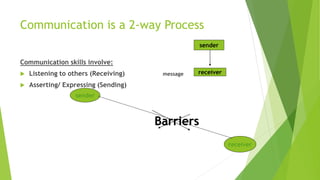
Communication is a 2-way Process
Communication skills involve:
 Listening to others (Receiving) message
 Asserting/ Expressing (Sending)
sender
receiver
sender
receiver
Barriers
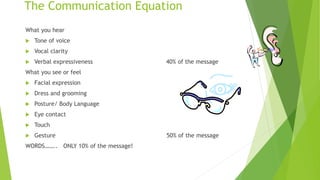
The Communication Equation
What you hear
 Tone of voice
 Vocal clarity
 Verbal expressiveness 40% of the message
What you see or feel
 Facial expression
 Dress and grooming
 Posture/ Body Language
 Eye contact
 Touch
 Gesture 50% of the message
WORDS…….. ONLY 10% of the message!
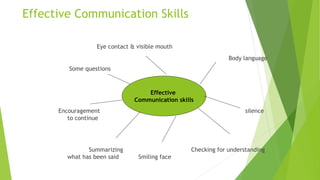
Effective Communication Skills
Eye contact & visible mouth
Body language
Some questions
Encouragement silence
to continue
Summarizing Checking for understanding
what has been said Smiling face
Effective
Communication skills
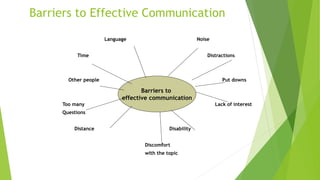
Barriers to Effective Communication
Language Noise
Time Distractions
Other people Put downs
Too many Lack of interest
Questions
Distance Disability
Discomfort
with the topic
Barriers to
effective communication
How to Listen to Customers
Active listening = Attending skills (being ready)
 Attend to immediate needs (if you need to finish something before giving your full
attention)
 Being available
 Eye contact
 Attentive posture
 Concentration
Following Skills
This opens the door to further communication
 Invitations
 Questions
 Encouragement
 Empathetic Silence
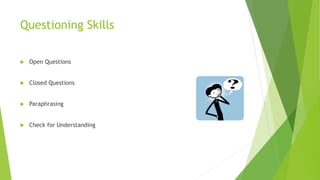
Questioning Skills
 Open Questions
 Closed Questions
 Paraphrasing
 Check for Understanding
Reflective Skills
Keeps the door open for further communication
• Paraphrasing
• Reflecting Facts
• Reflecting Feelings
• Reflecting Silence
• Summarizing
• Choosing your Words
• Useful Phrases
Using Your Voice
Do you
 Become loud when angry or upset
 Speak faster when nervous
 Speak slowly when tired or bored
 Have a cheerful voice
 My tone of voice is warm and understanding
 Find it easy to talk to people you don’t know
 Control your tone in most situations
 Sound bossy, weak or unsure
 Have a clear and easy-to-hear voice
 Speak in a very formal or very trendy manner?
Think about how you might modify your voice in certain situations
Body Language for a Positive Result
Brainstorm some examples of good body language
 Smile
 Introduce yourself (if appropriate) or wear a name badge
 Shake hands if appropriate
 Lean forward
 Be aware of cultural differences
Telephone Skills
 Know how to use the phones
 Speak clearly and slowly
 Smile (you can hear it in your voice!)
 State your name and the organization you are associated with
 Write down the caller’s name and use it
 Don’t say rude things while someone’s on hold
 If they’re explaining something use words to show you’re listening (umm, yes …)
 Have pad and pencil ready to take notes or messages (check spelling and message content)
 Don’t eat or drink while on the phone
Written Communication
 Write clearly and concisely
 Refer to their letter, date and query
 Be friendly without being too informal (Dear Aunt writing style)
 Check your spelling and grammar
 Make sure you’ve answered their query or request or explained why you can’t
 Be timely or apologise for any delay in replying
Guaranteeing Return Business
 Leave a positive impression, smile
 Check customers have everything they need
 If you’ve said you’ll follow-up, do so
 Tell them something that may be useful to them later
(eg new service starting soon)
 Invite them back
 Say goodbye
A Positive Organisational Image
First impressions count and will affect the interaction. People make
judgements in the first 30 seconds.
Golden Rule – You only have one chance to make a first impression!
Organizational Assessment - Activity
 Take a look at your organization through the eyes of a customer.
 What are the first things you notice?
 What has the organization done to make you feel welcome?
 Does anything make you feel uncomfortable?
 How could you feel more at ease?
Form small groups and discuss different methods used to help people feel
welcome.
One person from each group to present back.
Presentation and Manner
Does your Organization have a policy on presentation?
 Uniforms, badges, etc
 Personal hygiene
 Clothing – appropriate to the situation
 Hair – cleanliness and style
 Accessories – jewellery, earrings, watches, tattoos,
 Expression – facial expressions
 Tone of voice
 Body language
 Surroundings (Can they see a messy desk? Dead flowers in the vase? Eating your
lunch?...)
A Positive First Impression
 Be confident
 Knowledge - know your organisation and the services you provide
 Confidentiality
 Follow up (don’t just say you’ll do something, do it)
 Strengthen the customer’s commitment to your organisation
What to Avoid
 Saying ‘I don’t know’ without offering an option
 Saying you don’t know where a colleague is or saying they’re at lunch/ toilet/
gone for coffee etc
 Leaving people on hold/ Waiting for a long time
 Ignoring people if you’re busy
 Treating people unequally
Service Standards
How can you contribute to the development and maintenance of service
standards in your organization?
 Read and understand your organization's policies and procedures on
customer service
 Be prompt and efficient
 Ensure services are delivered in accordance with legislative or
statutory requirements
 Maintain accurate records
 Ensure any special needs of customers are taken into account
Factors Affecting the Quality of Service
 Reliability
 Confidence
 Responsiveness
 Efficiency
 Consistency
 Organisation
 Acceptance of and adherence to policies and procedures
Customers with Special Needs
 Language issues
 People with disabilities
 People from other areas who may not be familiar with the way things are
done here
 People with limited mobility
Planning Good Customer Service
 Recording procedures (when are your busy times)
 Reporting procedures (meeting organisational/ funding/ legislative
requirements)
 Observe and report customer needs
 Be proactive in improving service
 Market your organization and service center
 Have processes and procedures for dealing with difficult situations BEFORE
they happen and make sure staff are trained.
Dealing with Difficult Behaviour
 Label the behaviour, not the customer
 Listen
 Don’t get defensive
 Don’t take it personally
 Find out what the customer wants
 Discuss alternatives
 Take responsibility for what you CAN do
 Agree on action
The Talkative Customer
 Ask closed questions
 Limit the time available for them to interrupt (don’t have long pauses)
 Provide minimal response
 Smile and be pleasant, but don’t encourage them
 Wind up – thank them for coming, walk them to the door but don’t be rude or
dismissive
The Angry Customer
 Listen carefully without interrupting so you understand the problem
 Empathies in a broad way
 Stay calm and remain polite
 Don’t escalate the problem
 Don’t take it personally, be defensive or blame others
 Propose an action plan and follow it
 Seek support if you are scared, if you can’t agree on a solution or if the
customer asks to see “whoever’s in charge”
The ‘know it all’ Customer
 Acknowledge what they say
 Compliment them on their research
 Be generous with praise
 Don’t put them in their place no matter how tempting
 Don’t try to be smart – you can’t win!
 Ask them questions and use them to improve your knowledge
The Indecisive Customer
 Find out what they really want
 Ask them for the options
 Reflect back to them what they’ve said
 Assume control gently and point out the best course of action from what they’ve told you they
need
 Be logical
 Confirm a plan of action with them
 Maybe even put it in writing
The Suspicious Customer
 Establish your credibility
 Ensure you know your product or service
 They will try and catch you out so don’t guess or tell them something you’re
not sure of
 Be careful what you say
 Be polite
 Don’t take it personally, they don’t trust anyone!
Role Play
In pairs, one person takes on the role of a customer and one is the volunteer
 Use your own scenario if you have one
 Swap after 5 minutes
© All Rights Reserved 40
For more information on topics related to Technology,
Android, iOS, Windows, Mac and Study Notes, kindly visit
to http://introcanvas.com/

Effective Customer Service Policies

  • 1.
  • 2.
    Objective By the endof the session we would be able to  Communicate effectively with customers  Create a positive impression  Develop and maintain customer service standards  Plan good customer service
  • 3.
    Who are Customers? Definitionof a customer Internal/external customers Customers are people who need your assistance. They are not an interruption to your job, they are the reason you have a job..
  • 4.
    Communicating Effectively withCustomers Definition: What describes GOOD service and BAD service? Good customer service is taking that extra step to help without being asked! It’s all about attitude and skills.
  • 5.
    Attitude Checklist What attitudesassist in providing good service?  Enjoy helping people  Handle people well  Care for your customers  Give fair and equal treatment to all  Be understanding of people with special needs
  • 6.
    Skills for CustomerService  Know about the organization you are associated with  Learn the technical parts of the job  Know your products well  Communicate well  Be consistent  Be organized  Know your place in the team and be a team player
  • 7.
    What do CustomersWant? Brainstorm what it is that a customer wants when they enter your Service Center Discuss and share with the group
  • 8.
    Greeting Customers The purposeis to create and maintain a welcoming environment - how can we achieve this?  Be attentive, acknowledge a person as soon as they appear, even if you’re busy  SMILE!  Establish eye contact  Tell them your name  Ask how you can help  Give the customer your full attention  Be polite and courteous
  • 9.
    Establishing Rapport What doesgood rapport feel like? Practice greeting someone  Make the customer feel comfortable  Make the customer feel important and valued  Use empathy
  • 10.
    Find out howYou can Help  How can you find out what people want?  If you can’t help, what should you do?  Offer alternatives if possible  If they have to wait, how would you handle it?
  • 11.
    Communication is a2-way Process Communication skills involve:  Listening to others (Receiving) message  Asserting/ Expressing (Sending) sender receiver sender receiver Barriers
  • 12.
    The Communication Equation Whatyou hear  Tone of voice  Vocal clarity  Verbal expressiveness 40% of the message What you see or feel  Facial expression  Dress and grooming  Posture/ Body Language  Eye contact  Touch  Gesture 50% of the message WORDS…….. ONLY 10% of the message!
  • 13.
    Effective Communication Skills Eyecontact & visible mouth Body language Some questions Encouragement silence to continue Summarizing Checking for understanding what has been said Smiling face Effective Communication skills
  • 14.
    Barriers to EffectiveCommunication Language Noise Time Distractions Other people Put downs Too many Lack of interest Questions Distance Disability Discomfort with the topic Barriers to effective communication
  • 15.
    How to Listento Customers Active listening = Attending skills (being ready)  Attend to immediate needs (if you need to finish something before giving your full attention)  Being available  Eye contact  Attentive posture  Concentration
  • 16.
    Following Skills This opensthe door to further communication  Invitations  Questions  Encouragement  Empathetic Silence
  • 17.
    Questioning Skills  OpenQuestions  Closed Questions  Paraphrasing  Check for Understanding
  • 18.
    Reflective Skills Keeps thedoor open for further communication • Paraphrasing • Reflecting Facts • Reflecting Feelings • Reflecting Silence • Summarizing • Choosing your Words • Useful Phrases
  • 19.
    Using Your Voice Doyou  Become loud when angry or upset  Speak faster when nervous  Speak slowly when tired or bored  Have a cheerful voice  My tone of voice is warm and understanding  Find it easy to talk to people you don’t know  Control your tone in most situations  Sound bossy, weak or unsure  Have a clear and easy-to-hear voice  Speak in a very formal or very trendy manner? Think about how you might modify your voice in certain situations
  • 20.
    Body Language fora Positive Result Brainstorm some examples of good body language  Smile  Introduce yourself (if appropriate) or wear a name badge  Shake hands if appropriate  Lean forward  Be aware of cultural differences
  • 21.
    Telephone Skills  Knowhow to use the phones  Speak clearly and slowly  Smile (you can hear it in your voice!)  State your name and the organization you are associated with  Write down the caller’s name and use it  Don’t say rude things while someone’s on hold  If they’re explaining something use words to show you’re listening (umm, yes …)  Have pad and pencil ready to take notes or messages (check spelling and message content)  Don’t eat or drink while on the phone
  • 22.
    Written Communication  Writeclearly and concisely  Refer to their letter, date and query  Be friendly without being too informal (Dear Aunt writing style)  Check your spelling and grammar  Make sure you’ve answered their query or request or explained why you can’t  Be timely or apologise for any delay in replying
  • 23.
    Guaranteeing Return Business Leave a positive impression, smile  Check customers have everything they need  If you’ve said you’ll follow-up, do so  Tell them something that may be useful to them later (eg new service starting soon)  Invite them back  Say goodbye
  • 24.
    A Positive OrganisationalImage First impressions count and will affect the interaction. People make judgements in the first 30 seconds. Golden Rule – You only have one chance to make a first impression!
  • 25.
    Organizational Assessment -Activity  Take a look at your organization through the eyes of a customer.  What are the first things you notice?  What has the organization done to make you feel welcome?  Does anything make you feel uncomfortable?  How could you feel more at ease? Form small groups and discuss different methods used to help people feel welcome. One person from each group to present back.
  • 26.
    Presentation and Manner Doesyour Organization have a policy on presentation?  Uniforms, badges, etc  Personal hygiene  Clothing – appropriate to the situation  Hair – cleanliness and style  Accessories – jewellery, earrings, watches, tattoos,  Expression – facial expressions  Tone of voice  Body language  Surroundings (Can they see a messy desk? Dead flowers in the vase? Eating your lunch?...)
  • 27.
    A Positive FirstImpression  Be confident  Knowledge - know your organisation and the services you provide  Confidentiality  Follow up (don’t just say you’ll do something, do it)  Strengthen the customer’s commitment to your organisation
  • 28.
    What to Avoid Saying ‘I don’t know’ without offering an option  Saying you don’t know where a colleague is or saying they’re at lunch/ toilet/ gone for coffee etc  Leaving people on hold/ Waiting for a long time  Ignoring people if you’re busy  Treating people unequally
  • 29.
    Service Standards How canyou contribute to the development and maintenance of service standards in your organization?  Read and understand your organization's policies and procedures on customer service  Be prompt and efficient  Ensure services are delivered in accordance with legislative or statutory requirements  Maintain accurate records  Ensure any special needs of customers are taken into account
  • 30.
    Factors Affecting theQuality of Service  Reliability  Confidence  Responsiveness  Efficiency  Consistency  Organisation  Acceptance of and adherence to policies and procedures
  • 31.
    Customers with SpecialNeeds  Language issues  People with disabilities  People from other areas who may not be familiar with the way things are done here  People with limited mobility
  • 32.
    Planning Good CustomerService  Recording procedures (when are your busy times)  Reporting procedures (meeting organisational/ funding/ legislative requirements)  Observe and report customer needs  Be proactive in improving service  Market your organization and service center  Have processes and procedures for dealing with difficult situations BEFORE they happen and make sure staff are trained.
  • 33.
    Dealing with DifficultBehaviour  Label the behaviour, not the customer  Listen  Don’t get defensive  Don’t take it personally  Find out what the customer wants  Discuss alternatives  Take responsibility for what you CAN do  Agree on action
  • 34.
    The Talkative Customer Ask closed questions  Limit the time available for them to interrupt (don’t have long pauses)  Provide minimal response  Smile and be pleasant, but don’t encourage them  Wind up – thank them for coming, walk them to the door but don’t be rude or dismissive
  • 35.
    The Angry Customer Listen carefully without interrupting so you understand the problem  Empathies in a broad way  Stay calm and remain polite  Don’t escalate the problem  Don’t take it personally, be defensive or blame others  Propose an action plan and follow it  Seek support if you are scared, if you can’t agree on a solution or if the customer asks to see “whoever’s in charge”
  • 36.
    The ‘know itall’ Customer  Acknowledge what they say  Compliment them on their research  Be generous with praise  Don’t put them in their place no matter how tempting  Don’t try to be smart – you can’t win!  Ask them questions and use them to improve your knowledge
  • 37.
    The Indecisive Customer Find out what they really want  Ask them for the options  Reflect back to them what they’ve said  Assume control gently and point out the best course of action from what they’ve told you they need  Be logical  Confirm a plan of action with them  Maybe even put it in writing
  • 38.
    The Suspicious Customer Establish your credibility  Ensure you know your product or service  They will try and catch you out so don’t guess or tell them something you’re not sure of  Be careful what you say  Be polite  Don’t take it personally, they don’t trust anyone!
  • 39.
    Role Play In pairs,one person takes on the role of a customer and one is the volunteer  Use your own scenario if you have one  Swap after 5 minutes
  • 40.
    © All RightsReserved 40 For more information on topics related to Technology, Android, iOS, Windows, Mac and Study Notes, kindly visit to http://introcanvas.com/