The International
Banking
& Money Market
PART II
The International
Euro-Equity Market
Mobilizing Equity Flows
For mobilising equity investments, the companies
can approach:
1. Domestic markets
2. Foreign stock exchanges
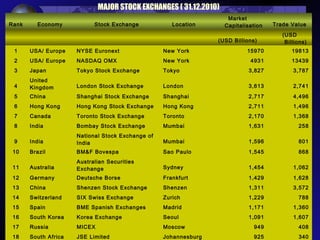
MAJOR STOCK EXCHANGES ( 31.12.2010)
Rank Economy Stock Exchange Location
Market
Capitalisation Trade Value
        (USD Billions)
(USD
Billions)
1 USA/ Europe NYSE Euronext New York 15970 19813
2 USA/ Europe NASDAQ OMX New York 4931 13439
3 Japan Tokyo Stock Exchange Tokyo 3,827 3,787
4
United
Kingdom London Stock Exchange London 3,613 2,741
5 China Shanghai Stock Exchange Shanghai 2,717 4,496
6 Hong Kong Hong Kong Stock Exchange Hong Kong 2,711 1,496
7 Canada Toronto Stock Exchange Toronto 2,170 1,368
8 India Bombay Stock Exchange Mumbai 1,631 258
9 India
National Stock Exchange of
India Mumbai 1,596 801
10 Brazil BM&F Bovespa Sao Paulo 1,545 868
11 Australia
Australian Securities
Exchange Sydney 1,454 1,062
12 Germany Deutsche Borse Frankfurt 1,429 1,628
13 China Shenzen Stock Exchange Shenzen 1,311 3,572
14 Switzerland SIX Swiss Exchange Zurich 1,229 788
15 Spain BME Spanish Exchanges Madrid 1,171 1,360
16 South Korea Korea Exchange Seoul 1,091 1,607
17 Russia MICEX Moscow 949 408
18 South Africa JSE Limited Johannesburg 925 340
Mobilizing Equity Flows – Cross
Listing
Cross-listing refers to a firm having its equity
shares listed on one or more foreign
exchanges, in addition to the home country
stock exchange
MNCs often cross-list their shares, but non-
MNCs also cross-list
Foreign Investors
 Foreign investors enter an equity market with
basic risk return trade off in their minds
 While entering a nation, the FIIs undertake a
country study in which various economic
indicators are tracked and analysed…..
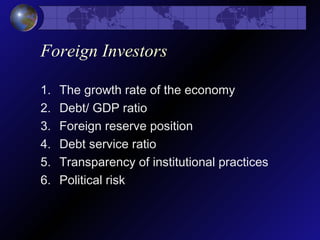
Foreign Investors
1. The growth rate of the economy
2. Debt/ GDP ratio
3. Foreign reserve position
4. Debt service ratio
5. Transparency of institutional practices
6. Political risk
Mobilizing Equity Flows
 In developed equity markets, accounting
standards and disclosure norms are stringent
 Therefore, it is usually difficult to list equity
on these exchanges
 To avoid this, depository receipts can be
issued and funds mobilised
ADRs & GDRs
In American markets, there are two important
instruments with the help of which the funds can
be mobilised:
1. American Depository Receipts (ADRs)
2. Global Depository Receipts (GDRs)
ADRs have less stricter norms than GDRs
GDRs
 GDR represents a certain number of
underlying equity shares
( e.g. Reliance 1 GDR = 2 equity shares)
 The shares are issued by the company to the
intermediary called the depository, in whose
name the shares are registered
 It is the depository which subsequently issues
the GDRs
GDRs
 The physical possession of the equity shares
is
with custodian
 GDRs do not figure in the books of accounts of
the company
 Though the GDRs are quoted in dollars, the
underlying is in rupees
GDRs
 The dividend outflow is in rupees. The
depository converts it in US dollars and pays
to the investors after deducting tax
 GDRs can be cancelled and exchanged
against
share certificates
Uses of GDR for Corporate Financing
 To raise debt or equity capital
 To diversify shareholder base
 To increase demand for their securities
 To create dollar denominated securities for
tax efficient acquisitions
 To enhance global image
 The company does not assume any foreign
exchange risk
Benefits to the Investors
 GDRs are quoted in dollars, dividend and
interest are also in dollars
 GDRs overcome foreign investment
restrictions
 GDRs overcome obstacles that institutional
investors have in purchasing and holding
securities outside the domestic markets
GDRs
 Prices of GDRs are often close to values of
related shares, but they are traded & settled
independently of the underlying share
 Several international banks issue GDRs, such
as
JP Morgan Chase, Citigroup, Deutsche Bank,
Bank of New York
GDRs
 GDRs are often listed in the Luxembourg Stock
Exchange and in the London Stock Exchange,
where they are traded on the International
Order Book (IOB)
 Normally 1 GDR = 10 Shares, but not always
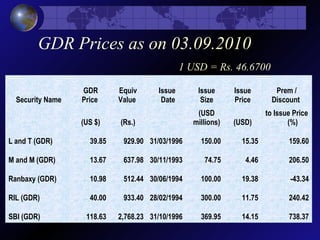
GDR Prices as on 03.09.2010
1 USD = Rs. 46.6700
Security Name
GDR
Price
Equiv
Value
Issue
Date
Issue
Size
Issue
Price
Prem /
Discount
  (US $) (Rs.)  
(USD
millions) (USD)
to Issue Price
(%)
L and T (GDR) 39.85 929.90 31/03/1996 150.00 15.35 159.60
M and M (GDR) 13.67 637.98 30/11/1993 74.75 4.46 206.50
Ranbaxy (GDR) 10.98 512.44 30/06/1994 100.00 19.38 -43.34
RIL (GDR) 40.00 933.40 28/02/1994 300.00 11.75 240.42
SBI (GDR) 118.63 2,768.23 31/10/1996 369.95 14.15 738.37
American Depositary Receipts (ADRs)
 ADR represents ownership in the shares of a
non-U.S. company and trades in U.S. financial
markets
 The stock of many non-US companies trade on
US stock exchanges through the use of ADRs
American Depositary Receipt (ADRs)
 ADRs enable U.S. investors to buy shares in
foreign companies without the hazards or
inconveniences of cross-border & cross-
currency transactions
 ADRs carry prices in US dollars, pay dividends
in US dollars, and can be traded like the shares
of US-based companies
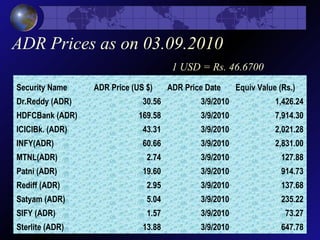
ADR Prices as on 03.09.2010
1 USD = Rs. 46.6700
Security Name ADR Price (US $) ADR Price Date Equiv Value (Rs.)
Dr.Reddy (ADR) 30.56 3/9/2010 1,426.24
HDFCBank (ADR) 169.58 3/9/2010 7,914.30
ICICIBk. (ADR) 43.31 3/9/2010 2,021.28
INFY(ADR) 60.66 3/9/2010 2,831.00
MTNL(ADR) 2.74 3/9/2010 127.88
Patni (ADR) 19.60 3/9/2010 914.73
Rediff (ADR) 2.95 3/9/2010 137.68
Satyam (ADR) 5.04 3/9/2010 235.22
SIFY (ADR) 1.57 3/9/2010 73.27
Sterlite (ADR) 13.88 3/9/2010 647.78
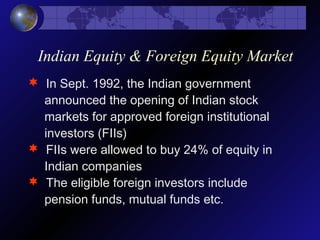
Indian Equity & Foreign Equity Market
 In Sept. 1992, the Indian government
announced the opening of Indian stock
markets for approved foreign institutional
investors (FIIs)
 FIIs were allowed to buy 24% of equity in
Indian companies
 The eligible foreign investors include
pension funds, mutual funds etc.
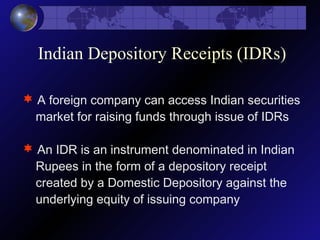
Indian Depository Receipts (IDRs)
 A foreign company can access Indian securities
market for raising funds through issue of IDRs
 An IDR is an instrument denominated in Indian
Rupees in the form of a depository receipt
created by a Domestic Depository against the
underlying equity of issuing company
Indian Depository Receipts (IDRs)
Just like overseas investors in the US-listed
American Depository Receipts (ADRs) of
Infosys and Wipro get receipts against
ownership of shares held by an Indian
custodian, an IDR is proof of ownership of
foreign company’s shares
The IDRs are denominated in Indian currency
Indian Depository Receipts (IDRs)
 IDRs will be issued to Indian residents in the
same way as domestic shares are issued
 Investors eligible to participate in an IDR issue
are institutional investors, including FIIs — but
excluding insurance companies and venture
capital funds — retail investors and non-
Institutional Investors
 NRIs can also participate in the Issue
Indian Depository Receipts (IDRs)
Indian individual investors have restrictions on
holding shares in foreign companies, but IDR
gives Indian residents a chance to invest in a
listed foreign entity
No resident individual can hold more than
$200,000 worth of foreign securities, including
shares, as per foreign exchange regulations.
However, this will not be applicable for IDR
Indian Depository Receipts (IDRs)
Standard Chartered PLC, a UK based
multinational bank has become the first global
company to file for an issue of Indian
Depository Receipts in India
The company’s issue for 24 crore IDRs opened
on may 25, 2010 and sought to raise between
Rs. 2400 to Rs. 2700 Crore.
The issue was subscribed 2.20 times on an
overall basis
Indian Depository Receipts (IDRs)
10 IDRs represent one share of US $ 0.50
nominal value
Standard Chartered Bank, Mumbai is the
domestic depository, and it appointed Bank of
New York, Mellon as its overseas depository
Thank you

11 theinternationalequitymarket-111123033435-phpapp02

  • 1.
  • 2.
  • 3.
    Mobilizing Equity Flows Formobilising equity investments, the companies can approach: 1. Domestic markets 2. Foreign stock exchanges
  • 4.
    MAJOR STOCK EXCHANGES( 31.12.2010) Rank Economy Stock Exchange Location Market Capitalisation Trade Value         (USD Billions) (USD Billions) 1 USA/ Europe NYSE Euronext New York 15970 19813 2 USA/ Europe NASDAQ OMX New York 4931 13439 3 Japan Tokyo Stock Exchange Tokyo 3,827 3,787 4 United Kingdom London Stock Exchange London 3,613 2,741 5 China Shanghai Stock Exchange Shanghai 2,717 4,496 6 Hong Kong Hong Kong Stock Exchange Hong Kong 2,711 1,496 7 Canada Toronto Stock Exchange Toronto 2,170 1,368 8 India Bombay Stock Exchange Mumbai 1,631 258 9 India National Stock Exchange of India Mumbai 1,596 801 10 Brazil BM&F Bovespa Sao Paulo 1,545 868 11 Australia Australian Securities Exchange Sydney 1,454 1,062 12 Germany Deutsche Borse Frankfurt 1,429 1,628 13 China Shenzen Stock Exchange Shenzen 1,311 3,572 14 Switzerland SIX Swiss Exchange Zurich 1,229 788 15 Spain BME Spanish Exchanges Madrid 1,171 1,360 16 South Korea Korea Exchange Seoul 1,091 1,607 17 Russia MICEX Moscow 949 408 18 South Africa JSE Limited Johannesburg 925 340
  • 5.
    Mobilizing Equity Flows– Cross Listing Cross-listing refers to a firm having its equity shares listed on one or more foreign exchanges, in addition to the home country stock exchange MNCs often cross-list their shares, but non- MNCs also cross-list
  • 6.
    Foreign Investors  Foreigninvestors enter an equity market with basic risk return trade off in their minds  While entering a nation, the FIIs undertake a country study in which various economic indicators are tracked and analysed…..
  • 7.
    Foreign Investors 1. Thegrowth rate of the economy 2. Debt/ GDP ratio 3. Foreign reserve position 4. Debt service ratio 5. Transparency of institutional practices 6. Political risk
  • 8.
    Mobilizing Equity Flows In developed equity markets, accounting standards and disclosure norms are stringent  Therefore, it is usually difficult to list equity on these exchanges  To avoid this, depository receipts can be issued and funds mobilised
  • 9.
    ADRs & GDRs InAmerican markets, there are two important instruments with the help of which the funds can be mobilised: 1. American Depository Receipts (ADRs) 2. Global Depository Receipts (GDRs) ADRs have less stricter norms than GDRs
  • 10.
    GDRs  GDR representsa certain number of underlying equity shares ( e.g. Reliance 1 GDR = 2 equity shares)  The shares are issued by the company to the intermediary called the depository, in whose name the shares are registered  It is the depository which subsequently issues the GDRs
  • 11.
    GDRs  The physicalpossession of the equity shares is with custodian  GDRs do not figure in the books of accounts of the company  Though the GDRs are quoted in dollars, the underlying is in rupees
  • 12.
    GDRs  The dividendoutflow is in rupees. The depository converts it in US dollars and pays to the investors after deducting tax  GDRs can be cancelled and exchanged against share certificates
  • 13.
    Uses of GDRfor Corporate Financing  To raise debt or equity capital  To diversify shareholder base  To increase demand for their securities  To create dollar denominated securities for tax efficient acquisitions  To enhance global image  The company does not assume any foreign exchange risk
  • 14.
    Benefits to theInvestors  GDRs are quoted in dollars, dividend and interest are also in dollars  GDRs overcome foreign investment restrictions  GDRs overcome obstacles that institutional investors have in purchasing and holding securities outside the domestic markets
  • 15.
    GDRs  Prices ofGDRs are often close to values of related shares, but they are traded & settled independently of the underlying share  Several international banks issue GDRs, such as JP Morgan Chase, Citigroup, Deutsche Bank, Bank of New York
  • 16.
    GDRs  GDRs areoften listed in the Luxembourg Stock Exchange and in the London Stock Exchange, where they are traded on the International Order Book (IOB)  Normally 1 GDR = 10 Shares, but not always
  • 17.
    GDR Prices ason 03.09.2010 1 USD = Rs. 46.6700 Security Name GDR Price Equiv Value Issue Date Issue Size Issue Price Prem / Discount   (US $) (Rs.)   (USD millions) (USD) to Issue Price (%) L and T (GDR) 39.85 929.90 31/03/1996 150.00 15.35 159.60 M and M (GDR) 13.67 637.98 30/11/1993 74.75 4.46 206.50 Ranbaxy (GDR) 10.98 512.44 30/06/1994 100.00 19.38 -43.34 RIL (GDR) 40.00 933.40 28/02/1994 300.00 11.75 240.42 SBI (GDR) 118.63 2,768.23 31/10/1996 369.95 14.15 738.37
  • 18.
    American Depositary Receipts(ADRs)  ADR represents ownership in the shares of a non-U.S. company and trades in U.S. financial markets  The stock of many non-US companies trade on US stock exchanges through the use of ADRs
  • 19.
    American Depositary Receipt(ADRs)  ADRs enable U.S. investors to buy shares in foreign companies without the hazards or inconveniences of cross-border & cross- currency transactions  ADRs carry prices in US dollars, pay dividends in US dollars, and can be traded like the shares of US-based companies
  • 20.
    ADR Prices ason 03.09.2010 1 USD = Rs. 46.6700 Security Name ADR Price (US $) ADR Price Date Equiv Value (Rs.) Dr.Reddy (ADR) 30.56 3/9/2010 1,426.24 HDFCBank (ADR) 169.58 3/9/2010 7,914.30 ICICIBk. (ADR) 43.31 3/9/2010 2,021.28 INFY(ADR) 60.66 3/9/2010 2,831.00 MTNL(ADR) 2.74 3/9/2010 127.88 Patni (ADR) 19.60 3/9/2010 914.73 Rediff (ADR) 2.95 3/9/2010 137.68 Satyam (ADR) 5.04 3/9/2010 235.22 SIFY (ADR) 1.57 3/9/2010 73.27 Sterlite (ADR) 13.88 3/9/2010 647.78
  • 21.
    Indian Equity &Foreign Equity Market  In Sept. 1992, the Indian government announced the opening of Indian stock markets for approved foreign institutional investors (FIIs)  FIIs were allowed to buy 24% of equity in Indian companies  The eligible foreign investors include pension funds, mutual funds etc.
  • 22.
    Indian Depository Receipts(IDRs)  A foreign company can access Indian securities market for raising funds through issue of IDRs  An IDR is an instrument denominated in Indian Rupees in the form of a depository receipt created by a Domestic Depository against the underlying equity of issuing company
  • 23.
    Indian Depository Receipts(IDRs) Just like overseas investors in the US-listed American Depository Receipts (ADRs) of Infosys and Wipro get receipts against ownership of shares held by an Indian custodian, an IDR is proof of ownership of foreign company’s shares The IDRs are denominated in Indian currency
  • 24.
    Indian Depository Receipts(IDRs)  IDRs will be issued to Indian residents in the same way as domestic shares are issued  Investors eligible to participate in an IDR issue are institutional investors, including FIIs — but excluding insurance companies and venture capital funds — retail investors and non- Institutional Investors  NRIs can also participate in the Issue
  • 25.
    Indian Depository Receipts(IDRs) Indian individual investors have restrictions on holding shares in foreign companies, but IDR gives Indian residents a chance to invest in a listed foreign entity No resident individual can hold more than $200,000 worth of foreign securities, including shares, as per foreign exchange regulations. However, this will not be applicable for IDR
  • 26.
    Indian Depository Receipts(IDRs) Standard Chartered PLC, a UK based multinational bank has become the first global company to file for an issue of Indian Depository Receipts in India The company’s issue for 24 crore IDRs opened on may 25, 2010 and sought to raise between Rs. 2400 to Rs. 2700 Crore. The issue was subscribed 2.20 times on an overall basis
  • 27.
    Indian Depository Receipts(IDRs) 10 IDRs represent one share of US $ 0.50 nominal value Standard Chartered Bank, Mumbai is the domestic depository, and it appointed Bank of New York, Mellon as its overseas depository
  • 28.