















mericanADRs&lobalGFCCBsBy: Deepak Verma
Introduction
Depositary Receipts???DRs represent sharesof an Indian company trading on a foreign stock exchange
The DR holders are part of foreign holding in a company but unlike FDI, investors in DRs do not enjoy voting rights
DRs of most Indian companies experienced a sharp fall due to market meltdown. However, recently the DRs have recovered and trading turnovers have improved.
DRs have become popular because of two-way fungibility
No prior approval of SEBI, RBI or government is required for issue of DRs
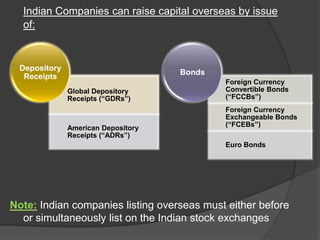
No restrictions on the use of proceeds except investment in real estate and the stock marketsIndian Companies can raise capital overseas by issue of:Note: Indian companies listing overseas must either before or simultaneously list on the Indian stock exchanges
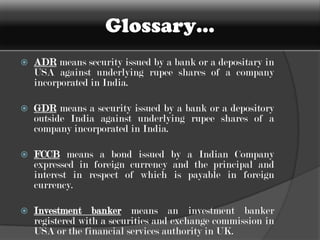
Glossary…ADR means security issued by a bank or a depositary in USA against underlying rupee shares of a company incorporated in India.GDR means a security issued by a bank or a depository outside India against underlying rupee shares of a company incorporated in India.FCCB means a bond issued by a Indian Company expressed in foreign currency and the principal and interest in respect of which is payable in foreign currency.Investment banker means an investment banker registered with a securities and exchange commission in USA or the financial services authority in UK.
Authorities involved…SEC’s mission is to protect investors, maintain fair, orderly and efficient markets and facilitate capital formation.IOSCO’s mission is the protection of investors, ensuring that markets are fair, efficient and transparent and finally the reduction of systematic risk.
American Depository Receipt - I
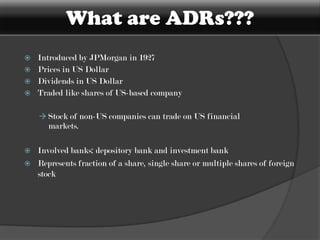
What are ADRs???Introduced by JPMorgan in 1927Prices in US DollarDividends in US DollarTraded like shares of US-based companyStock of non-US companies can trade on US financial    markets.Involved banks: depository bank and investment bankRepresents fraction of a share, single share or multiple shares of foreign stock
Composite ADR Index...450 companies39 countriesListed onNYSEAMEXNASDAQSubsets:3 Regional Indexes4 Market indexes3 Sector indexes8 Selected Indexes39 Country IndexesNew ADR are added quarterlyIndex is rebalanced quarterly
Types...a) Unsponsored DRIssued by one or more depositoriesBased on market demandTrade on the „over-the-counter“ marketNo formal agreementb) Sponsored DRDesignated depository acting as ist transfer agencyDeposit Agreement or service contractControl over facilitiesThree levelsTwo restricted programs
Types...Level ITraded in the „over the counter“ (OTC) market & some exchange outside US No full Securities and Exchange Commission (SEC) declosureNo Generally Accepted Accounting Principles (GAAP)Security listed on one or more stock exchange in a foreign jurisdictionOnly annual report on its homepage in English
Types...Level II (listed)Listed on U.S. exchange or quoted on NASDAQGet higher visibility trading volumeTo set up  File a registration statement with the SEC
More under SEC regulation
File a form 20-F annually
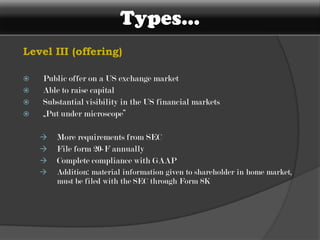
Partial compliance with GAAPTypes...Level III (offering)Public offer on a US exchange marketAble to raise capitalSubstantial visibility in the US financial markets„Put under microscope“More requirements from SEC
File form 20-F annually
Complete compliance with GAAP
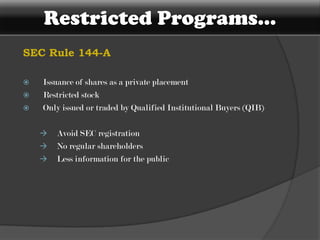
Addition: material information given to shareholder in home market, must be filed with the SEC through Form 8KRestricted Programs...SEC Rule 144-AIssuance of shares as a private placementRestricted stockOnly issued or traded by Qualified Institutional Buyers (QIB)Avoid SEC registration
No regular shareholders
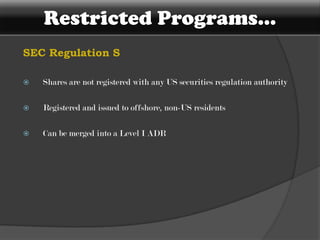
Less information for the publicRestricted Programs...SEC Regulation SShares are not registered with any US securities regulation authorityRegistered and issued to offshore, non-US residentsCan be merged into a Level I ADR
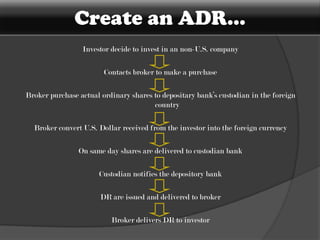
Create an ADR...Investor decide to invest in an non-U.S. companyContacts broker to make a purchaseBroker purchase actual ordinary shares to depositary bank‘s custodian in the foreign countryBroker convert U.S. Dollar received from the investor into the foreign currencyOn same day shares are delivered to custodian bankCustodian notifies the depository bankDR are issued and delivered to brokerBroker delivers DR to investor
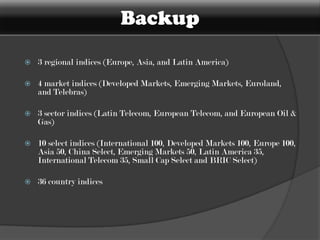
Backup3 regional indices (Europe, Asia, and Latin America)4 market indices (Developed Markets, Emerging Markets, Euroland, and Telebras)3 sector indices (Latin Telecom, European Telecom, and European Oil & Gas)10 select indices (International 100, Developed Markets 100, Europe 100, Asia 50, China Select, Emerging Markets 50, Latin America 35, International Telecom 35, Small Cap Select and BRIC Select)36 country indices
American Depository Receipts - II
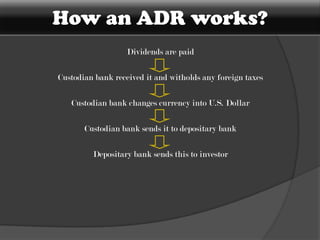
How an ADR works?Dividends are paid Custodian bank received it and witholds any foreign taxesCustodian bank changes currency into U.S. DollarCustodian bank sends it to depositary bankDepositary bank sends this to investor
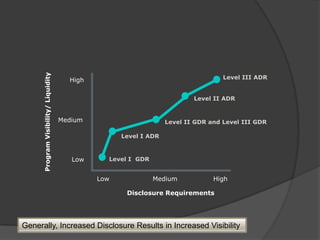
Level III ADRHighLevel II ADRMediumProgram Visibility/ LiquidityLevel II GDR and Level III GDRLevel I ADRLevel I  GDRLowLowMediumHighDisclosure RequirementsGenerally, Increased Disclosure Results in Increased Visibility
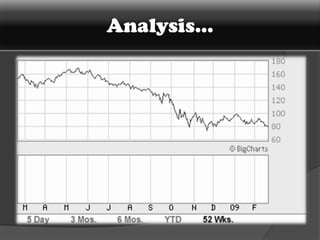
Analysis...
Advantages...Flexibility to list on national exchange in the USAbility to raise capitalIncrease awareness of companyDiversify portfolioSave money by reducing administration costs & avoiding foreign taxes on each transactionTrade is clear and settle in US Dollar
Disadvantages...Only small selection of ADRs available for tradingLong time to receive informationDepository bank charge fees & expenses for converting currencyCountry specific riskCurrency exchange riskFor diversification: enough funds to split in over 15 ADRPolitical and economical risks
Global Depository Receipts - I
GDRs…It is a certificate issued by a depository bank, which purchases shares of foreign companies and deposits it on the account.A financial instrument used by private markets to raise capital denominated in either U.S. dollars or euros.
Salient Features…Track RecordUnderlying sharesDenominationListingSettlementLock-inVotingDividend
Parties Involved…ISSUING COMPANYCUSTODIANDEPOSITORYLEAD MANAGERUNDERWRITERSFOREIGN INVESTOR
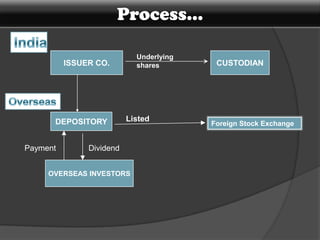
Process…IndiaISSUER CO.CUSTODIANUnderlying sharesOverseasDEPOSITORYListedForeign Stock ExchangeDividendPaymentOVERSEAS INVESTORS
Global Depository Receipts - II
Statutory Requirements…Indian companies	(i) A company must not be barred from raising funds from the Indian capital market nor restrained from accessing the securities market by SEBI.	(ii) The applicant company must be a listed company or be in the process of getting listed on any Indian stock exchange.
Statutory Requirements…Subscribers		Overseas Corporate Bodies (OCBs) and other entities, which are not eligible to invest in India through portfolio route i.e. directly on the stock exchanges in India and entities which are prohibited to buy, sell or deal in securities by SEBI are prohibited from subscribing to GDR issues.
FEMA guidelines in accordance with MoFApproval from MOFNot otherwise ineligibleIssued in accordance with GDR schemes
Benefits To An Issuing CompanyAccess to capital markets outside the home market.Enhancement of company visibility.Increase potential liquidity by enlarging the market for the company’s shares.It helps the issuing company to extend its research base to foreign countries.
Benefits to an InvestorThey facilitate diversification into foreign securities.Eliminate custody charges.Can be easily compared to securities of similar companies.Permit prompt dividend payments and corporate action notifications.GDRs offer most of the same corporate rights, especially voting rights, to the holders of GDRs.
Foreign Currency ConvertibleBonds - I
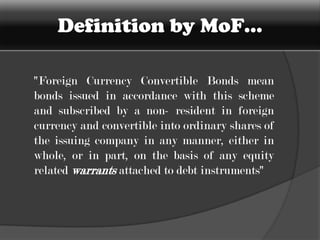
Definition by MoF…"Foreign Currency Convertible Bonds mean bonds issued in accordance with this scheme and subscribed by a non- resident in foreign currency and convertible into ordinary shares of the issuing company in any manner, either in whole, or in part, on the basis of any equity related warrants attached to debt instruments"
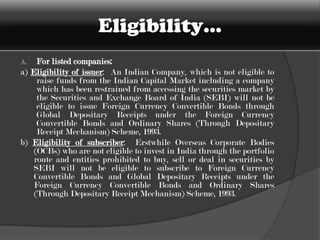
Eligibility…For listed companies:a) Eligibility of issuer:  An Indian Company, which is not eligible to raise funds from the Indian Capital Market including a company which has been restrained from accessing the securities market by the Securities and Exchange Board of India (SEBI) will not be eligible to issue Foreign Currency Convertible Bonds through Global Depositary Receipts under the Foreign Currency Convertible Bonds and Ordinary Shares (Through Depositary Receipt Mechanism) Scheme, 1993.b) Eligibility of subscriber:  Erstwhile Overseas Corporate Bodies (OCBs) who are not eligible to invest in India through the portfolio route and entities prohibited to buy, sell or deal in securities by SEBI will not be eligible to subscribe to Foreign Currency Convertible Bonds and Global Depositary Receipts under the Foreign Currency Convertible Bonds and Ordinary Shares (Through Depositary Receipt Mechanism) Scheme, 1993.
c) Pricing: The pricing of Global Depositary Receipt and Foreign Currency Convertible Bond issues should be made at a price not less than the higher of the following two averages:  (i)  The average of the weekly high and low of the closing prices of the related shares quoted on the stock exchange during the six months preceding the relevant date; (ii)  The average of the weekly high and low of the closing prices of the related shares quoted on a stock exchange during the two weeks preceding the relevant date.The "relevant date" means the date thirty days prior to the date on which the meeting of the general body of shareholders is held, in terms of section 81 (IA) of the Companies Act, 1956, to consider the proposed issue.
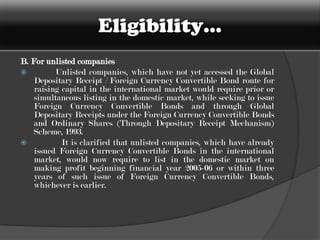
Eligibility…B. For unlisted companies       Unlisted companies, which have not yet accessed the Global Depositary Receipt / Foreign Currency Convertible Bond route for raising capital in the international market would require prior or simultaneous listing in the domestic market, while seeking to issue Foreign Currency Convertible Bonds and through Global Depositary Receipts under the Foreign Currency Convertible Bonds and Ordinary Shares (Through Depositary Receipt Mechanism) Scheme, 1993.          It is clarified that unlisted companies, which have already issued Foreign Currency Convertible Bonds in the international market, would now require to list in the domestic market on making profit beginning financial year 2005-06 or within three years of such issue of Foreign Currency Convertible Bonds, whichever is earlier.
Foreign Currency Convertible Bonds - II
RBI Guidelines…FCCB can be raised under Automatic route .Minimum Average Maturity of FCCB shall be 3 years for borrowing up to US$ 20 million and 5 years in case it exceeds US$ 20 Million.Prepayment of FCCB is permitted upto US$ 200 Million subject to compliance of minimum  average maturity period . For higher prepayment amount, RBI approval is needed.No Guarantee, Letter of Comfort, letter of Undertaking can be issued by Banks, FIIs or NBFC relating to FCCB .
Role of SEBI…An application for listing of the Bonds has to be made to the stock exchange of the country where the FCCBs are to be issued and traded . Approval has to be obtained from the Indian Stock exchange to list the shares issued upon conversion of bonds, when the bondholder exercises the convertibility option.Filing the Offer Documents with SEBI , RBI and stock exchanges prior to FCCB issue.
Company Law Requirements…FCCBs are bonds issued by an Indian company expressed in foreign currency to non-resident investors, which fall under Debentures  .Prior intimation Notice should be given to listed Stock exchange, at least 7 days before the date of Board meeting in which the FCCB is to decided.Issuing Power of FCCBs is with the Board of Directors of the issuer Company .Convening a General Shareholders Meeting for procuring the shareholders consent with regard to the enhancement of borrowing powers of the Board .

Depository Receipts

  • 1.
  • 2.
  • 3.
    Depositary Receipts???DRs representsharesof an Indian company trading on a foreign stock exchange
  • 4.
    The DR holdersare part of foreign holding in a company but unlike FDI, investors in DRs do not enjoy voting rights
  • 5.
    DRs of mostIndian companies experienced a sharp fall due to market meltdown. However, recently the DRs have recovered and trading turnovers have improved.
  • 6.
    DRs have becomepopular because of two-way fungibility
  • 7.
    No prior approvalof SEBI, RBI or government is required for issue of DRs
  • 8.
    No restrictions onthe use of proceeds except investment in real estate and the stock marketsIndian Companies can raise capital overseas by issue of:Note: Indian companies listing overseas must either before or simultaneously list on the Indian stock exchanges
  • 9.
    Glossary…ADR means securityissued by a bank or a depositary in USA against underlying rupee shares of a company incorporated in India.GDR means a security issued by a bank or a depository outside India against underlying rupee shares of a company incorporated in India.FCCB means a bond issued by a Indian Company expressed in foreign currency and the principal and interest in respect of which is payable in foreign currency.Investment banker means an investment banker registered with a securities and exchange commission in USA or the financial services authority in UK.
  • 10.
    Authorities involved…SEC’s missionis to protect investors, maintain fair, orderly and efficient markets and facilitate capital formation.IOSCO’s mission is the protection of investors, ensuring that markets are fair, efficient and transparent and finally the reduction of systematic risk.
  • 11.
  • 12.
    What are ADRs???Introducedby JPMorgan in 1927Prices in US DollarDividends in US DollarTraded like shares of US-based companyStock of non-US companies can trade on US financial markets.Involved banks: depository bank and investment bankRepresents fraction of a share, single share or multiple shares of foreign stock
  • 13.
    Composite ADR Index...450companies39 countriesListed onNYSEAMEXNASDAQSubsets:3 Regional Indexes4 Market indexes3 Sector indexes8 Selected Indexes39 Country IndexesNew ADR are added quarterlyIndex is rebalanced quarterly
  • 14.
    Types...a) Unsponsored DRIssuedby one or more depositoriesBased on market demandTrade on the „over-the-counter“ marketNo formal agreementb) Sponsored DRDesignated depository acting as ist transfer agencyDeposit Agreement or service contractControl over facilitiesThree levelsTwo restricted programs
  • 15.
    Types...Level ITraded inthe „over the counter“ (OTC) market & some exchange outside US No full Securities and Exchange Commission (SEC) declosureNo Generally Accepted Accounting Principles (GAAP)Security listed on one or more stock exchange in a foreign jurisdictionOnly annual report on its homepage in English
  • 16.
    Types...Level II (listed)Listedon U.S. exchange or quoted on NASDAQGet higher visibility trading volumeTo set up  File a registration statement with the SEC
  • 17.
    More under SECregulation
  • 18.
    File a form20-F annually
  • 19.
    Partial compliance withGAAPTypes...Level III (offering)Public offer on a US exchange marketAble to raise capitalSubstantial visibility in the US financial markets„Put under microscope“More requirements from SEC
  • 20.
  • 21.
  • 22.
    Addition: material informationgiven to shareholder in home market, must be filed with the SEC through Form 8KRestricted Programs...SEC Rule 144-AIssuance of shares as a private placementRestricted stockOnly issued or traded by Qualified Institutional Buyers (QIB)Avoid SEC registration
  • 23.
  • 24.
    Less information forthe publicRestricted Programs...SEC Regulation SShares are not registered with any US securities regulation authorityRegistered and issued to offshore, non-US residentsCan be merged into a Level I ADR
  • 25.
    Create an ADR...Investordecide to invest in an non-U.S. companyContacts broker to make a purchaseBroker purchase actual ordinary shares to depositary bank‘s custodian in the foreign countryBroker convert U.S. Dollar received from the investor into the foreign currencyOn same day shares are delivered to custodian bankCustodian notifies the depository bankDR are issued and delivered to brokerBroker delivers DR to investor
  • 26.
    Backup3 regional indices(Europe, Asia, and Latin America)4 market indices (Developed Markets, Emerging Markets, Euroland, and Telebras)3 sector indices (Latin Telecom, European Telecom, and European Oil & Gas)10 select indices (International 100, Developed Markets 100, Europe 100, Asia 50, China Select, Emerging Markets 50, Latin America 35, International Telecom 35, Small Cap Select and BRIC Select)36 country indices
  • 27.
  • 28.
    How an ADRworks?Dividends are paid Custodian bank received it and witholds any foreign taxesCustodian bank changes currency into U.S. DollarCustodian bank sends it to depositary bankDepositary bank sends this to investor
  • 29.
    Level III ADRHighLevelII ADRMediumProgram Visibility/ LiquidityLevel II GDR and Level III GDRLevel I ADRLevel I GDRLowLowMediumHighDisclosure RequirementsGenerally, Increased Disclosure Results in Increased Visibility
  • 30.
  • 31.
    Advantages...Flexibility to liston national exchange in the USAbility to raise capitalIncrease awareness of companyDiversify portfolioSave money by reducing administration costs & avoiding foreign taxes on each transactionTrade is clear and settle in US Dollar
  • 32.
    Disadvantages...Only small selectionof ADRs available for tradingLong time to receive informationDepository bank charge fees & expenses for converting currencyCountry specific riskCurrency exchange riskFor diversification: enough funds to split in over 15 ADRPolitical and economical risks
  • 33.
  • 34.
    GDRs…It is acertificate issued by a depository bank, which purchases shares of foreign companies and deposits it on the account.A financial instrument used by private markets to raise capital denominated in either U.S. dollars or euros.
  • 35.
    Salient Features…Track RecordUnderlyingsharesDenominationListingSettlementLock-inVotingDividend
  • 36.
  • 37.
  • 38.
  • 39.
    Statutory Requirements…Indian companies (i)A company must not be barred from raising funds from the Indian capital market nor restrained from accessing the securities market by SEBI. (ii) The applicant company must be a listed company or be in the process of getting listed on any Indian stock exchange.
  • 40.
    Statutory Requirements…Subscribers Overseas CorporateBodies (OCBs) and other entities, which are not eligible to invest in India through portfolio route i.e. directly on the stock exchanges in India and entities which are prohibited to buy, sell or deal in securities by SEBI are prohibited from subscribing to GDR issues.
  • 41.
    FEMA guidelines inaccordance with MoFApproval from MOFNot otherwise ineligibleIssued in accordance with GDR schemes
  • 42.
    Benefits To AnIssuing CompanyAccess to capital markets outside the home market.Enhancement of company visibility.Increase potential liquidity by enlarging the market for the company’s shares.It helps the issuing company to extend its research base to foreign countries.
  • 43.
    Benefits to anInvestorThey facilitate diversification into foreign securities.Eliminate custody charges.Can be easily compared to securities of similar companies.Permit prompt dividend payments and corporate action notifications.GDRs offer most of the same corporate rights, especially voting rights, to the holders of GDRs.
  • 44.
  • 45.
    Definition by MoF…"ForeignCurrency Convertible Bonds mean bonds issued in accordance with this scheme and subscribed by a non- resident in foreign currency and convertible into ordinary shares of the issuing company in any manner, either in whole, or in part, on the basis of any equity related warrants attached to debt instruments"
  • 46.
    Eligibility…For listed companies:a)Eligibility of issuer:  An Indian Company, which is not eligible to raise funds from the Indian Capital Market including a company which has been restrained from accessing the securities market by the Securities and Exchange Board of India (SEBI) will not be eligible to issue Foreign Currency Convertible Bonds through Global Depositary Receipts under the Foreign Currency Convertible Bonds and Ordinary Shares (Through Depositary Receipt Mechanism) Scheme, 1993.b) Eligibility of subscriber:  Erstwhile Overseas Corporate Bodies (OCBs) who are not eligible to invest in India through the portfolio route and entities prohibited to buy, sell or deal in securities by SEBI will not be eligible to subscribe to Foreign Currency Convertible Bonds and Global Depositary Receipts under the Foreign Currency Convertible Bonds and Ordinary Shares (Through Depositary Receipt Mechanism) Scheme, 1993.
  • 47.
    c) Pricing: Thepricing of Global Depositary Receipt and Foreign Currency Convertible Bond issues should be made at a price not less than the higher of the following two averages:  (i) The average of the weekly high and low of the closing prices of the related shares quoted on the stock exchange during the six months preceding the relevant date; (ii)  The average of the weekly high and low of the closing prices of the related shares quoted on a stock exchange during the two weeks preceding the relevant date.The "relevant date" means the date thirty days prior to the date on which the meeting of the general body of shareholders is held, in terms of section 81 (IA) of the Companies Act, 1956, to consider the proposed issue.
  • 48.
    Eligibility…B. For unlisted companies       Unlistedcompanies, which have not yet accessed the Global Depositary Receipt / Foreign Currency Convertible Bond route for raising capital in the international market would require prior or simultaneous listing in the domestic market, while seeking to issue Foreign Currency Convertible Bonds and through Global Depositary Receipts under the Foreign Currency Convertible Bonds and Ordinary Shares (Through Depositary Receipt Mechanism) Scheme, 1993.          It is clarified that unlisted companies, which have already issued Foreign Currency Convertible Bonds in the international market, would now require to list in the domestic market on making profit beginning financial year 2005-06 or within three years of such issue of Foreign Currency Convertible Bonds, whichever is earlier.
  • 49.
  • 50.
    RBI Guidelines…FCCB canbe raised under Automatic route .Minimum Average Maturity of FCCB shall be 3 years for borrowing up to US$ 20 million and 5 years in case it exceeds US$ 20 Million.Prepayment of FCCB is permitted upto US$ 200 Million subject to compliance of minimum average maturity period . For higher prepayment amount, RBI approval is needed.No Guarantee, Letter of Comfort, letter of Undertaking can be issued by Banks, FIIs or NBFC relating to FCCB .
  • 51.
    Role of SEBI…Anapplication for listing of the Bonds has to be made to the stock exchange of the country where the FCCBs are to be issued and traded . Approval has to be obtained from the Indian Stock exchange to list the shares issued upon conversion of bonds, when the bondholder exercises the convertibility option.Filing the Offer Documents with SEBI , RBI and stock exchanges prior to FCCB issue.
  • 52.
    Company Law Requirements…FCCBsare bonds issued by an Indian company expressed in foreign currency to non-resident investors, which fall under Debentures .Prior intimation Notice should be given to listed Stock exchange, at least 7 days before the date of Board meeting in which the FCCB is to decided.Issuing Power of FCCBs is with the Board of Directors of the issuer Company .Convening a General Shareholders Meeting for procuring the shareholders consent with regard to the enhancement of borrowing powers of the Board .

Editor's Notes

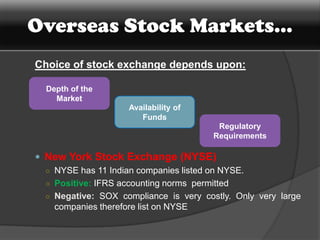
  • #48 IFRS: International Financial Reporting SystemSOX: Sarbanes Oxley Act-which targets to prevent misconduct and improve corporate governance practices