Presented By-
Sanjog Zimbar
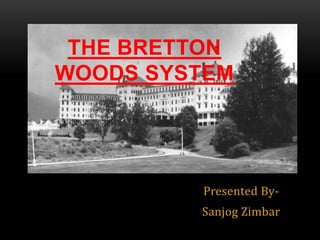
THE BRETTON
WOODS SYSTEM
CONTENT
• Introduction
• Goals of conference
• Expected benefit
• Outcome
• Problems
• Evaluation and Breakdown.
• Example
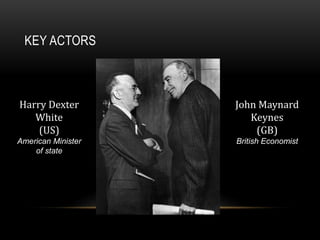
KEY ACTORS
Harry Dexter
White
(US)
American Minister
of state
John Maynard
Keynes
(GB)
British Economist
INTRODUCTION
• Bretton wood system established in 1944.
• Large capital movement and less controllable.
• Requirement of stabilizing system.
• Financial security and stable situation.
• Restructure international finance and currency
relationships.
• Implementing a system of fixed exchange rates with
the U.S. dollar as the key currency.
GOALS OF CONFERENCE
• Intended to govern currency regulations and establish
legal obligations (through the IMF).
• Set a standard for exchange rates. (1 ounce gold= $35)
• Establish international monetary cooperation.
• Money pool from which member nations can borrow
funds.
EXPECTED BENEFIT FROM THE SYSTEM
• Through capital controls, the
countries would pursue the full
employment and price stability
(low inflation) and the external
balance (keeping exchange rates
stable) simultaneously.
OUTCOME
• Quotas embedded in the IMF.
• Several conferences dealing with the world monetary
problems caused by the ‘Great Depression’ had ended.
• The creation of the IMF and World Bank.
• The dollar standard.
PROBLEMS
• Occasional devaluations under the supervision of the
IMF to remove “fundamental disequilibria” in the
balance of payments (BOP).
• United States free from external economic pressures.
• Countries were not willing to accept the high inflation
rates.
• Countries no longer based this value on gold.
EVOLUTION AND BREAKDOWN
• The reserves of most countries became a mixture of
gold and dollars.
• In 1958, countries in Europe completed the
restoration of convertibility.
• National interest rates were closely linked with each
other due to the opportunity to move funds across
borders.
• In 1970s the balance of payment crisis were so massive
that finally countries couldn’t keep up with the
adjustments, so the system collapsed and replaced
with a regime of floating exchange rates
EXAMPLE
If Britain devaluated pound due to a CA deficit, the
foreign currency value of pound assets would
decrease, thus savings would shift into other
currencies. In order to hold the pound’s exchange
rate against the dollar pegged, the Bank of England
should sell foreign assets to market and buy pounds
instead. Now, without enough reserves, the foreign
reserves’ loss might cause a devaluation, if large
enough
THANK YOU…….!

The bretton woods system

  • 1.
    Presented By- Sanjog Zimbar THEBRETTON WOODS SYSTEM
  • 2.
    CONTENT • Introduction • Goalsof conference • Expected benefit • Outcome • Problems • Evaluation and Breakdown. • Example
  • 3.
    KEY ACTORS Harry Dexter White (US) AmericanMinister of state John Maynard Keynes (GB) British Economist
  • 4.
    INTRODUCTION • Bretton woodsystem established in 1944. • Large capital movement and less controllable. • Requirement of stabilizing system. • Financial security and stable situation. • Restructure international finance and currency relationships. • Implementing a system of fixed exchange rates with the U.S. dollar as the key currency.
  • 5.
    GOALS OF CONFERENCE •Intended to govern currency regulations and establish legal obligations (through the IMF). • Set a standard for exchange rates. (1 ounce gold= $35) • Establish international monetary cooperation. • Money pool from which member nations can borrow funds.
  • 6.
    EXPECTED BENEFIT FROMTHE SYSTEM • Through capital controls, the countries would pursue the full employment and price stability (low inflation) and the external balance (keeping exchange rates stable) simultaneously.
  • 7.
    OUTCOME • Quotas embeddedin the IMF. • Several conferences dealing with the world monetary problems caused by the ‘Great Depression’ had ended. • The creation of the IMF and World Bank. • The dollar standard.
  • 8.
    PROBLEMS • Occasional devaluationsunder the supervision of the IMF to remove “fundamental disequilibria” in the balance of payments (BOP). • United States free from external economic pressures. • Countries were not willing to accept the high inflation rates. • Countries no longer based this value on gold.
  • 9.
    EVOLUTION AND BREAKDOWN •The reserves of most countries became a mixture of gold and dollars. • In 1958, countries in Europe completed the restoration of convertibility. • National interest rates were closely linked with each other due to the opportunity to move funds across borders. • In 1970s the balance of payment crisis were so massive that finally countries couldn’t keep up with the adjustments, so the system collapsed and replaced with a regime of floating exchange rates
  • 10.
    EXAMPLE If Britain devaluatedpound due to a CA deficit, the foreign currency value of pound assets would decrease, thus savings would shift into other currencies. In order to hold the pound’s exchange rate against the dollar pegged, the Bank of England should sell foreign assets to market and buy pounds instead. Now, without enough reserves, the foreign reserves’ loss might cause a devaluation, if large enough
  • 11.