International Monetary System
             and
 International Monetary Fund
The Gold Standard (1880-1913)
• Each country defined the value of its
  currency in terms of gold –
  – US : $/ounce ; Britain : Pound/ounce
• The exchange rate is calculated as $ per
  ounce of gold/ Pound per ounce gold
• Central banks were restricted to issue
  more currency
Advantages and Disadvantages
• Price Stability
  – Central banks are unable to expand Money
    supply
  – Money supply is increased by increased
    production of gold
  – Or by running BOP a/c surplus
• Volatility in the supply of gold causes
  adverse shocks to the economy
• Monetary policy won’t be helpful in
  achieving the macroeconomic goals
War Years (1914-1945)
• End of gold standard
• Countries started printing currencies to
  pay for their war related expenditures
• Convertibility of currencies into gold was
  abolished
• High rates of inflation
• Focus shifted on cooperation and
  rebuilding of war affected countries
Bretton-Woods System(1945-1971)
• In July 1944, conference is organized by the
  UN to eliminate the chaos of war
• The conference was known as International
  Monetary and Financial Conference
• It was led by US and Britain and included 42
  other nations
• Creation of new financial system
  – Stabilize the exchange rates
  – Capital for reconstruction
  – International cooperation
Bretton-Woods System(1945-1971)
• It was a “Gold-Exchange “ standard
• Only dollar was backed by and
  convertible into gold
• Other countries have “adjustable peg”
• IMF was created to monitor the agreement
• IMF holds the gold and currency reserves
  of its members and then lends the money
  to other members facing difficulty in
  meeting their international payments
Bretton-Woods System(1945-1971)
• In this period US encountered BOP deficit
• But, European countries and Japan build up
  their international reserves
• Foreign held dollar reserves exceeded the
  gold reserves of U.S
• Devaluation could not be performed
• Adoption of flexible exchange rate system
• In 1973, adopted the managed floating
  exchange rate system
IMF was established to promote balanced
 expansion of world trade, stability of
 exchange rates, avoidance of competitive
 currency devaluation, and the correction
 of country’s BOP problems.
How the purposes are served
• Monitors economic and financial
  developments and policies, in the member
  countries and gives policy advice to its
  members.
• Lends to member countries with BOP
  problems, not just to provide temporary
  financing but to support adjustment and
  reform policies aimed to correct bop
• Provides the govt. and central banks of its
  member countries with technical assistance
  and training in its areas of its expertise
IMF’s Special Drawing Rights
               (SDR)
• It is an international reserve asset or artificial currency
  created by IMF in 1969
• To supplement the existing official reserves of
  members
• It serves as a unit of account in IMF
• Value of SDR in now based on basket of key
  international currencies
• SDR is not a claim on IMF but a potential claim on the
  currencies of IMF members
• Two ways to obtain currencies using SDR
   – Voluntary Exchange
   – Involving IMF
IMF’s Special Drawing Rights
              (SDR)
• IMF has an SDR department which
  handles the SDR transactions among
  member nations
• Members having larger holdings of SDR
  than their quota will get interest rate and
  vice-versa.
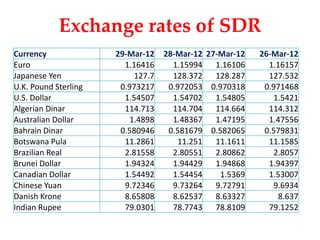
• Exchange rates of SDR are published daily
  except on IMF holidays or whenever the
  IMF is closed for business
Exchange rates of SDR
Currency              29-Mar-12   28-Mar-12 27-Mar-12   26-Mar-12
Euro                    1.16416     1.15994 1.16106       1.16157
Japanese Yen              127.7     128.372 128.287       127.532
U.K. Pound Sterling    0.973217    0.972053 0.970318     0.971468
U.S. Dollar             1.54507     1.54702 1.54805        1.5421
Algerian Dinar          114.713     114.704 114.664       114.312
Australian Dollar        1.4898     1.48367 1.47195       1.47556
Bahrain Dinar          0.580946    0.581679 0.582065     0.579831
Botswana Pula           11.2861      11.251 11.1611       11.1585
Brazilian Real          2.81558     2.80551 2.80862        2.8057
Brunei Dollar           1.94324     1.94429 1.94868       1.94397
Canadian Dollar         1.54492     1.54454    1.5369     1.53007
Chinese Yuan            9.72346     9.73264 9.72791        9.6934
Danish Krone            8.65808     8.62537 8.63327         8.637
Indian Rupee            79.0301     78.7743 78.8109       79.1252
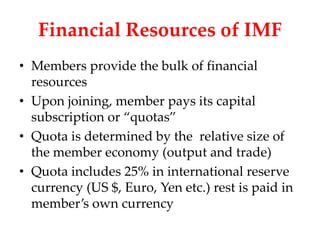
Financial Resources of IMF
• Members provide the bulk of financial
  resources
• Upon joining, member pays its capital
  subscription or “quotas”
• Quota is determined by the relative size of
  the member economy (output and trade)
• Quota includes 25% in international reserve
  currency (US $, Euro, Yen etc.) rest is paid in
  member’s own currency
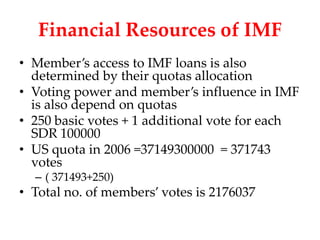
Financial Resources of IMF
• Member’s access to IMF loans is also
  determined by their quotas allocation
• Voting power and member’s influence in IMF
  is also depend on quotas
• 250 basic votes + 1 additional vote for each
  SDR 100000
• US quota in 2006 =37149300000 = 371743
  votes
  – ( 371493+250)
• Total no. of members’ votes is 2176037
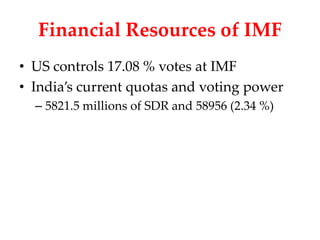
Financial Resources of IMF
• US controls 17.08 % votes at IMF
• India’s current quotas and voting power
  – 5821.5 millions of SDR and 58956 (2.34 %)
Decision- Making in IMF
• 24 member executive board is the main decision
  making body
• Countries with five largest quotas have permanent
  seats on the board ( US, Japan, Germany, France and
  UK)
• All other members are organized into regional groups
• Each regional group selects its representative member
  to represent regional constituency in the executive
  board.
• Changing quotas requires 85% approval in executive
  board
• US having 17% voting alone can veto redistribution of
  quotas and voting power

Imf

  • 1.
    International Monetary System and International Monetary Fund
  • 2.
    The Gold Standard(1880-1913) • Each country defined the value of its currency in terms of gold – – US : $/ounce ; Britain : Pound/ounce • The exchange rate is calculated as $ per ounce of gold/ Pound per ounce gold • Central banks were restricted to issue more currency
  • 3.
    Advantages and Disadvantages •Price Stability – Central banks are unable to expand Money supply – Money supply is increased by increased production of gold – Or by running BOP a/c surplus • Volatility in the supply of gold causes adverse shocks to the economy • Monetary policy won’t be helpful in achieving the macroeconomic goals
  • 4.
    War Years (1914-1945) •End of gold standard • Countries started printing currencies to pay for their war related expenditures • Convertibility of currencies into gold was abolished • High rates of inflation • Focus shifted on cooperation and rebuilding of war affected countries
  • 5.
    Bretton-Woods System(1945-1971) • InJuly 1944, conference is organized by the UN to eliminate the chaos of war • The conference was known as International Monetary and Financial Conference • It was led by US and Britain and included 42 other nations • Creation of new financial system – Stabilize the exchange rates – Capital for reconstruction – International cooperation
  • 6.
    Bretton-Woods System(1945-1971) • Itwas a “Gold-Exchange “ standard • Only dollar was backed by and convertible into gold • Other countries have “adjustable peg” • IMF was created to monitor the agreement • IMF holds the gold and currency reserves of its members and then lends the money to other members facing difficulty in meeting their international payments
  • 7.
    Bretton-Woods System(1945-1971) • Inthis period US encountered BOP deficit • But, European countries and Japan build up their international reserves • Foreign held dollar reserves exceeded the gold reserves of U.S • Devaluation could not be performed • Adoption of flexible exchange rate system • In 1973, adopted the managed floating exchange rate system
  • 8.
    IMF was establishedto promote balanced expansion of world trade, stability of exchange rates, avoidance of competitive currency devaluation, and the correction of country’s BOP problems.
  • 9.
    How the purposesare served • Monitors economic and financial developments and policies, in the member countries and gives policy advice to its members. • Lends to member countries with BOP problems, not just to provide temporary financing but to support adjustment and reform policies aimed to correct bop • Provides the govt. and central banks of its member countries with technical assistance and training in its areas of its expertise
  • 10.
    IMF’s Special DrawingRights (SDR) • It is an international reserve asset or artificial currency created by IMF in 1969 • To supplement the existing official reserves of members • It serves as a unit of account in IMF • Value of SDR in now based on basket of key international currencies • SDR is not a claim on IMF but a potential claim on the currencies of IMF members • Two ways to obtain currencies using SDR – Voluntary Exchange – Involving IMF
  • 11.
    IMF’s Special DrawingRights (SDR) • IMF has an SDR department which handles the SDR transactions among member nations • Members having larger holdings of SDR than their quota will get interest rate and vice-versa. • Exchange rates of SDR are published daily except on IMF holidays or whenever the IMF is closed for business
  • 12.
    Exchange rates ofSDR Currency 29-Mar-12 28-Mar-12 27-Mar-12 26-Mar-12 Euro 1.16416 1.15994 1.16106 1.16157 Japanese Yen 127.7 128.372 128.287 127.532 U.K. Pound Sterling 0.973217 0.972053 0.970318 0.971468 U.S. Dollar 1.54507 1.54702 1.54805 1.5421 Algerian Dinar 114.713 114.704 114.664 114.312 Australian Dollar 1.4898 1.48367 1.47195 1.47556 Bahrain Dinar 0.580946 0.581679 0.582065 0.579831 Botswana Pula 11.2861 11.251 11.1611 11.1585 Brazilian Real 2.81558 2.80551 2.80862 2.8057 Brunei Dollar 1.94324 1.94429 1.94868 1.94397 Canadian Dollar 1.54492 1.54454 1.5369 1.53007 Chinese Yuan 9.72346 9.73264 9.72791 9.6934 Danish Krone 8.65808 8.62537 8.63327 8.637 Indian Rupee 79.0301 78.7743 78.8109 79.1252
  • 13.
    Financial Resources ofIMF • Members provide the bulk of financial resources • Upon joining, member pays its capital subscription or “quotas” • Quota is determined by the relative size of the member economy (output and trade) • Quota includes 25% in international reserve currency (US $, Euro, Yen etc.) rest is paid in member’s own currency
  • 14.
    Financial Resources ofIMF • Member’s access to IMF loans is also determined by their quotas allocation • Voting power and member’s influence in IMF is also depend on quotas • 250 basic votes + 1 additional vote for each SDR 100000 • US quota in 2006 =37149300000 = 371743 votes – ( 371493+250) • Total no. of members’ votes is 2176037
  • 15.
    Financial Resources ofIMF • US controls 17.08 % votes at IMF • India’s current quotas and voting power – 5821.5 millions of SDR and 58956 (2.34 %)
  • 16.
    Decision- Making inIMF • 24 member executive board is the main decision making body • Countries with five largest quotas have permanent seats on the board ( US, Japan, Germany, France and UK) • All other members are organized into regional groups • Each regional group selects its representative member to represent regional constituency in the executive board. • Changing quotas requires 85% approval in executive board • US having 17% voting alone can veto redistribution of quotas and voting power