By: Shah Jahan Sirat
Teacher: Dr.Sadegh Dorri
1
 Introduction to SDN
 Characteristics of SDN
 Traditional Network and SDN
 SDN-Cloud Architectures
 Introduction to NFV
 Features of NFV
 NFV Architecture
 NFV vs SDN
 Introduction to edge computing
 Categorization of edge computing systems
 Edge Computing definitions
 Edge computing applications
 The basic edge computing architecture
 Standard Architecture of Edge Computing Networks
 Comparison of EC with other Technologies
2
Table of Contents
 When first considered, networks seem to be the essence of a hardware-defined
object.
 SDN moves the software definition of the network to the forefront, making the
network more dependent on the software than the hardware device and links.
 How can this be done? One part is creating a local network where every device
is reachable either in one hop or through a tunnel.
 tunnel is a way to make multiple hops through switches or routers appear as one
hop.
3
Introduction to SDN
 Software Defined Networking (SDN) is an architecture that gives networks more
programmability and flexibility by separating the control plane from the data
plane.
 In the SDN architecture:
 the control and data planes are decoupled.
 network intelligence and state are logically centralized.
 the underlying network infrastructure is abstracted from the applications.
4
Introduction (continue)
 Separation of the network control plane from the data plane.
 Control plane: Tells the data plane what to do with traffic.
 Data plane: Tells the traffic how to reach its destination.
 A centralized controller to provide a unified view of the network.
 Virtualization of the network functions and replacement of specialized h/w and
s/w with standard architectures.
 Open interfaces between the control plane controller(s) and the data plane
devices.
 Orchestration of all the above to make a complete and unified whole from the
user perspective.
5
Characteristics of SDN
 Separation of the network control plane from the data plane.
6
Traditional Network and SDN
7
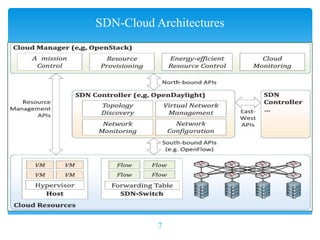
SDN-Cloud Architectures
 NFV is a way to virtualize network services, such as routers, firewalls, and load
balancers, that have traditionally been run on proprietary hardware.
 The different functions — such as load balancing ,routing ,switching— are
called virtual network functions(VNFs).
 VNFs run in virtual machines.
 NFV allows for scaling of VMs to handle changes in data center traffic.
 NFV replaces costly dedicated hardware with generic servers that use software
to provide a bunch VNFs.
8
Introduction to NFV
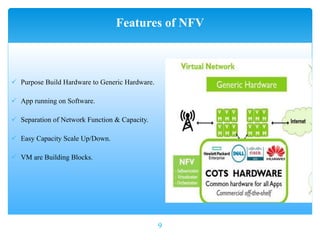
 Purpose Build Hardware to Generic Hardware.
 App running on Software.
 Separation of Network Function & Capacity.
 Easy Capacity Scale Up/Down.
 VM are Building Blocks.
9
Features of NFV
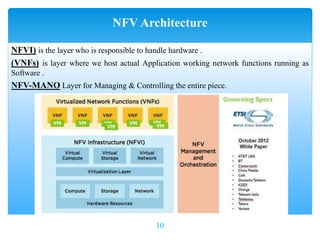
NFVI) is the layer who is responsible to handle hardware .
(VNFs) is layer where we host actual Application working network functions running as
Software .
NFV-MANO Layer for Managing & Controlling the entire piece.
10
NFV Architecture
 NFV virtualizes network infrastructure and SDN centralizes network control.
 NFV provides basic networking functions, while SDN controls and orchestrates them for
specific uses.
 SDN abstracts physical networking resources –switches, routers and so on – and moves
decision making to a virtual network control plane.
 NFV aims to virtualize all physical network resources, allows the network to grow
without the addition of more devices.
 Combined, SDN and NFV create a network that is built, operated, and managed by
software.
11
NFV vs SDN
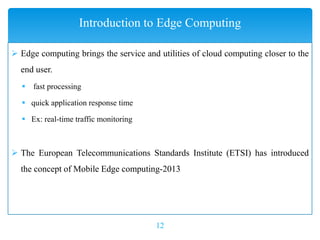
 Edge computing brings the service and utilities of cloud computing closer to the
end user.
 fast processing
 quick application response time
 Ex: real-time traffic monitoring
 The European Telecommunications Standards Institute (ETSI) has introduced
the concept of Mobile Edge computing-2013
12
Introduction to Edge Computing
13
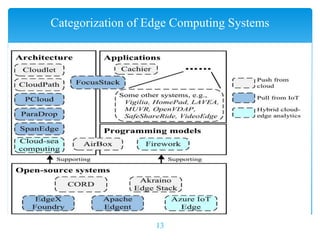
Categorization of Edge Computing Systems
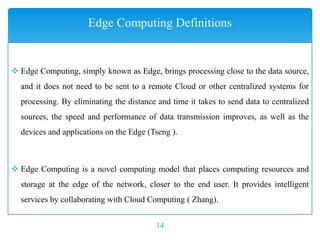
 Edge Computing, simply known as Edge, brings processing close to the data source,
and it does not need to be sent to a remote Cloud or other centralized systems for
processing. By eliminating the distance and time it takes to send data to centralized
sources, the speed and performance of data transmission improves, as well as the
devices and applications on the Edge (Tseng ).
 Edge Computing is a novel computing model that places computing resources and
storage at the edge of the network, closer to the end user. It provides intelligent
services by collaborating with Cloud Computing ( Zhang).
14
Edge Computing Definitions
15
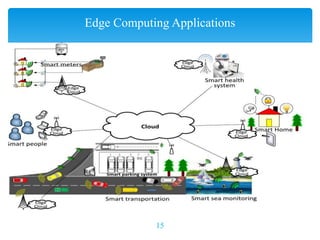
Edge Computing Applications
16
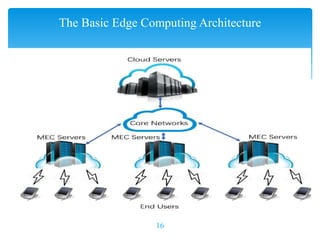
The Basic Edge Computing Architecture
17
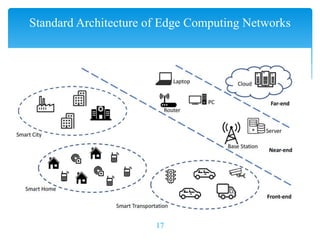
Standard Architecture of Edge Computing Networks
18
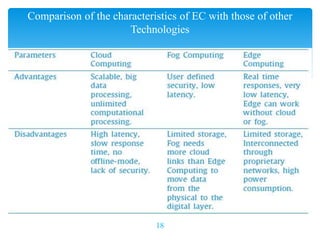
Comparison of the characteristics of EC with those of other
Technologies
19
References
 [1] W. You and W. Learn, “Cloud, SDN, and NFV,” pp. 731–757, 2017, doi: 10.1016/B978-0-
12-811027-0.00029-1.
 [2] M. Alenezi, K. Almustafa, and K. Amjad, “Cloud based SDN and NFV architectures for IoT
infrastructure,” Egypt. Informatics J., 2018, doi: 10.1016/j.eij.2018.03.004.
 [3] M. Banikazemi, D. Olshefski, A. Shaikh, J. Tracey, and G. Wang, “Meridian : An SDN
Platform for Cloud Network Services,” no. February, pp. 120–127, 2013.
 [4] T. Wood, K. K. Ramakrishnan, J. Hwang, G. Liu, and W. Zhang, “Toward a Software-Based
Network: Integrating Software Defined Networking and Network Function Virtualization,” no. June,
pp. 36–41, 2015.
 [5] S. Azodolmolky, P. Wieder, and R. Yahyapour, “SDN-Based Cloud Computing Networking,”
pp. 1–4, 2013.
20
References
 [6] W. Zada, E. Ahmed, S. Hakak, I. Yaqoob, and A. Ahmed, “Edge computing : A survey,”
Futur. Gener. Comput. Syst., vol. 97, pp. 219–235, 2019, doi: 10.1016/j.future.2019.02.050.
 [7] I. Sittón-Candanedo, R. S. Alonso, J. M. Corchado, S. Rodríguez-González, and R. Casado-
Vara, “A review of edge computing reference architectures and a new global edge proposal,” Futur.
Gener. Comput. Syst., vol. 99, no. 2019, pp. 278–294, 2019, doi: 10.1016/j.future.2019.04.016.
 [8] F. Liu, G. Tang, Y. Li, Z. Cai, X. Zhang, and T. Zhou, “A Survey on Edge Computing
Systems and Tools,” Proc. IEEE, vol. 107, no. 8, 2019, doi: 10.1109/JPROC.2019.2920341.
 [9] Margaret Chiosi, Steve Wright, Don Clarke, Peter Willis “NFV White Paper Update, ”
October 2013 http://portal.etsi.org/NFV/NFV_White_Paper2.pdf
 [10] NFV ISG PoC Framework: http://www.etsi.org/technologies-clusters/technologies/nfv/nfv-
poc
 [11] https://telecomtutorial.info/introduction-to-nfv-network-function-virtualization/
21

Introduction to SDN, NFV & Edge Computing

  • 1.
    By: Shah JahanSirat Teacher: Dr.Sadegh Dorri 1
  • 2.
     Introduction toSDN  Characteristics of SDN  Traditional Network and SDN  SDN-Cloud Architectures  Introduction to NFV  Features of NFV  NFV Architecture  NFV vs SDN  Introduction to edge computing  Categorization of edge computing systems  Edge Computing definitions  Edge computing applications  The basic edge computing architecture  Standard Architecture of Edge Computing Networks  Comparison of EC with other Technologies 2 Table of Contents
  • 3.
     When firstconsidered, networks seem to be the essence of a hardware-defined object.  SDN moves the software definition of the network to the forefront, making the network more dependent on the software than the hardware device and links.  How can this be done? One part is creating a local network where every device is reachable either in one hop or through a tunnel.  tunnel is a way to make multiple hops through switches or routers appear as one hop. 3 Introduction to SDN
  • 4.
     Software DefinedNetworking (SDN) is an architecture that gives networks more programmability and flexibility by separating the control plane from the data plane.  In the SDN architecture:  the control and data planes are decoupled.  network intelligence and state are logically centralized.  the underlying network infrastructure is abstracted from the applications. 4 Introduction (continue)
  • 5.
     Separation ofthe network control plane from the data plane.  Control plane: Tells the data plane what to do with traffic.  Data plane: Tells the traffic how to reach its destination.  A centralized controller to provide a unified view of the network.  Virtualization of the network functions and replacement of specialized h/w and s/w with standard architectures.  Open interfaces between the control plane controller(s) and the data plane devices.  Orchestration of all the above to make a complete and unified whole from the user perspective. 5 Characteristics of SDN
  • 6.
     Separation ofthe network control plane from the data plane. 6 Traditional Network and SDN
  • 7.
  • 8.
     NFV isa way to virtualize network services, such as routers, firewalls, and load balancers, that have traditionally been run on proprietary hardware.  The different functions — such as load balancing ,routing ,switching— are called virtual network functions(VNFs).  VNFs run in virtual machines.  NFV allows for scaling of VMs to handle changes in data center traffic.  NFV replaces costly dedicated hardware with generic servers that use software to provide a bunch VNFs. 8 Introduction to NFV
  • 9.
     Purpose BuildHardware to Generic Hardware.  App running on Software.  Separation of Network Function & Capacity.  Easy Capacity Scale Up/Down.  VM are Building Blocks. 9 Features of NFV
  • 10.
    NFVI) is thelayer who is responsible to handle hardware . (VNFs) is layer where we host actual Application working network functions running as Software . NFV-MANO Layer for Managing & Controlling the entire piece. 10 NFV Architecture
  • 11.
     NFV virtualizesnetwork infrastructure and SDN centralizes network control.  NFV provides basic networking functions, while SDN controls and orchestrates them for specific uses.  SDN abstracts physical networking resources –switches, routers and so on – and moves decision making to a virtual network control plane.  NFV aims to virtualize all physical network resources, allows the network to grow without the addition of more devices.  Combined, SDN and NFV create a network that is built, operated, and managed by software. 11 NFV vs SDN
  • 12.
     Edge computingbrings the service and utilities of cloud computing closer to the end user.  fast processing  quick application response time  Ex: real-time traffic monitoring  The European Telecommunications Standards Institute (ETSI) has introduced the concept of Mobile Edge computing-2013 12 Introduction to Edge Computing
  • 13.
    13 Categorization of EdgeComputing Systems
  • 14.
     Edge Computing,simply known as Edge, brings processing close to the data source, and it does not need to be sent to a remote Cloud or other centralized systems for processing. By eliminating the distance and time it takes to send data to centralized sources, the speed and performance of data transmission improves, as well as the devices and applications on the Edge (Tseng ).  Edge Computing is a novel computing model that places computing resources and storage at the edge of the network, closer to the end user. It provides intelligent services by collaborating with Cloud Computing ( Zhang). 14 Edge Computing Definitions
  • 15.
  • 16.
    16 The Basic EdgeComputing Architecture
  • 17.
    17 Standard Architecture ofEdge Computing Networks
  • 18.
    18 Comparison of thecharacteristics of EC with those of other Technologies
  • 19.
    19 References  [1] W.You and W. Learn, “Cloud, SDN, and NFV,” pp. 731–757, 2017, doi: 10.1016/B978-0- 12-811027-0.00029-1.  [2] M. Alenezi, K. Almustafa, and K. Amjad, “Cloud based SDN and NFV architectures for IoT infrastructure,” Egypt. Informatics J., 2018, doi: 10.1016/j.eij.2018.03.004.  [3] M. Banikazemi, D. Olshefski, A. Shaikh, J. Tracey, and G. Wang, “Meridian : An SDN Platform for Cloud Network Services,” no. February, pp. 120–127, 2013.  [4] T. Wood, K. K. Ramakrishnan, J. Hwang, G. Liu, and W. Zhang, “Toward a Software-Based Network: Integrating Software Defined Networking and Network Function Virtualization,” no. June, pp. 36–41, 2015.  [5] S. Azodolmolky, P. Wieder, and R. Yahyapour, “SDN-Based Cloud Computing Networking,” pp. 1–4, 2013.
  • 20.
    20 References  [6] W.Zada, E. Ahmed, S. Hakak, I. Yaqoob, and A. Ahmed, “Edge computing : A survey,” Futur. Gener. Comput. Syst., vol. 97, pp. 219–235, 2019, doi: 10.1016/j.future.2019.02.050.  [7] I. Sittón-Candanedo, R. S. Alonso, J. M. Corchado, S. Rodríguez-González, and R. Casado- Vara, “A review of edge computing reference architectures and a new global edge proposal,” Futur. Gener. Comput. Syst., vol. 99, no. 2019, pp. 278–294, 2019, doi: 10.1016/j.future.2019.04.016.  [8] F. Liu, G. Tang, Y. Li, Z. Cai, X. Zhang, and T. Zhou, “A Survey on Edge Computing Systems and Tools,” Proc. IEEE, vol. 107, no. 8, 2019, doi: 10.1109/JPROC.2019.2920341.  [9] Margaret Chiosi, Steve Wright, Don Clarke, Peter Willis “NFV White Paper Update, ” October 2013 http://portal.etsi.org/NFV/NFV_White_Paper2.pdf  [10] NFV ISG PoC Framework: http://www.etsi.org/technologies-clusters/technologies/nfv/nfv- poc  [11] https://telecomtutorial.info/introduction-to-nfv-network-function-virtualization/
  • 21.