SDLC
(Software Development Life Cycle)
-By
M.Dhilsath Fathima
SDLC
• SDLC stands for
– Systems /software
– Development
– Life
– Cycle
• It is also called as Software development
process.
• The software development life cycle (SDLC) is
a framework for defining tasks to be
performed at each step in the software
development process.
SDLC –It’s a Methodology
• A methodology is, in simple terms, a set of
steps, guidelines, activities and/or principles to
follow in a particular situation.
– Most methodologies are comprehensive, multi-
step approaches to systems development
What is SDLC?-Definition
• SDLC is a process/Methodology/Framework
followed for a software project, within a
software organization.
• It consists of a detailed plan describing how to
develop, maintain, replace and alter or enhance
specific software.
• The life cycle defines a methodology for
improving the quality of software and the
overall development process.
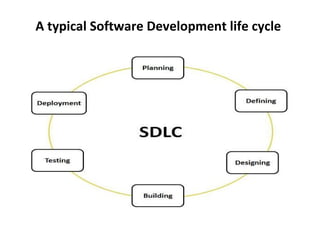
A typical Software Development life cycle
Phases/Stages of SDLC
• Stage 1: Planning and Requirement Analysis
• Stage 2: Defining Requirements
• Stage 3: Designing the product architecture
• Stage 4: Building or Developing the Product
• Stage 5: Testing the Product
• Stage 6: Deployment in the Market and
Maintenance
Stage 1: Planning and Requirement Analysis
• Requirement analysis is the most important and
fundamental stage in SDLC.
• It is performed by the senior members of the team with
inputs from the customer, the sales department, market
surveys and domain experts in the industry.
• This information is then used to plan the basic project
approach and to conduct product feasibility study in the
economical, operational, and technical areas.
• Planning for the quality assurance requirements and
identification of the risks associated with the project is
also done in the planning stage.
• The outcome of the technical feasibility study is to define
the various technical approaches that can be followed to
implement the project successfully with minimum risks.
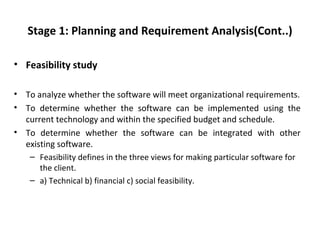
Stage 1: Planning and Requirement Analysis(Cont..)
• Feasibility study
• To analyze whether the software will meet organizational requirements.
• To determine whether the software can be implemented using the
current technology and within the specified budget and schedule.
• To determine whether the software can be integrated with other
existing software.
– Feasibility defines in the three views for making particular software for
the client.
– a) Technical b) financial c) social feasibility.
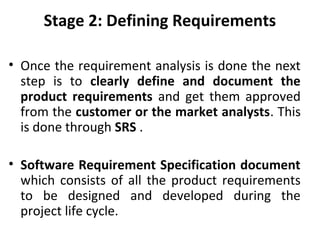
Stage 2: Defining Requirements
• Once the requirement analysis is done the next
step is to clearly define and document the
product requirements and get them approved
from the customer or the market analysts. This
is done through SRS .
• Software Requirement Specification document
which consists of all the product requirements
to be designed and developed during the
project life cycle.
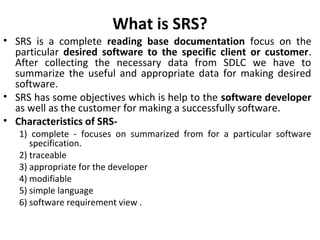
What is SRS?
• SRS is a complete reading base documentation focus on the
particular desired software to the specific client or customer.
After collecting the necessary data from SDLC we have to
summarize the useful and appropriate data for making desired
software.
• SRS has some objectives which is help to the software developer
as well as the customer for making a successfully software.
• Characteristics of SRS-
1) complete - focuses on summarized from for a particular software
specification.
2) traceable
3) appropriate for the developer
4) modifiable
5) simple language
6) software requirement view .
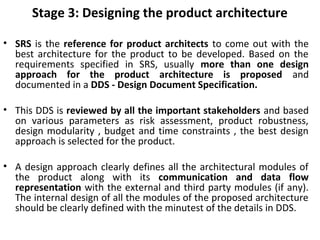
Stage 3: Designing the product architecture
• SRS is the reference for product architects to come out with the
best architecture for the product to be developed. Based on the
requirements specified in SRS, usually more than one design
approach for the product architecture is proposed and
documented in a DDS - Design Document Specification.
• This DDS is reviewed by all the important stakeholders and based
on various parameters as risk assessment, product robustness,
design modularity , budget and time constraints , the best design
approach is selected for the product.
• A design approach clearly defines all the architectural modules of
the product along with its communication and data flow
representation with the external and third party modules (if any).
The internal design of all the modules of the proposed architecture
should be clearly defined with the minutest of the details in DDS.
Stage 4: Building or Developing the Product
• In this stage of SDLC the actual development starts and
the product is built.
• The programming code is generated as per DDS during
this stage. If the design is performed in a detailed and
organized manner, code generation can be accomplished
without much hassle.
• Developers have to follow the coding guidelines defined
by their organization and programming tools like
compilers, interpreters, debuggers etc are used to
generate the code. Different high level programming
languages such as C, C++, Pascal, Java, and PHP are used
for coding.
• The programming language is chosen with respect to the
type of software being developed.
Stage 5: Testing the Product
• This stage is usually a subset of all the stages as in the modern SDLC
models, the testing activities are mostly involved in all the stages of
SDLC.
• However this stage refers to the testing only stage of the product
where products defects are reported, tracked, fixed and retested, until
the product reaches the quality standards defined in the SRS.
• The main testing techniques are
1) white box testing
2) black box testing
3) Acceptance Testing
4) system testing
5) unit testing
Stage 6: Deployment in the Market
and Maintenance
• Once the product is tested and ready to be deployed it
is released formally in the appropriate market.
Sometime product deployment happens in stages as per
the organizations business strategy. The product may
first be released in a limited segment and tested in the
real business environment (UAT- User acceptance
testing).
• Then based on the feedback, the product may be
released as it is or with suggested enhancements in the
targeting market segment.
• After the product is released in the market, its
maintenance is done for the existing customer base.

Sdlc model

  • 1.
    SDLC (Software Development LifeCycle) -By M.Dhilsath Fathima
  • 2.
    SDLC • SDLC standsfor – Systems /software – Development – Life – Cycle • It is also called as Software development process. • The software development life cycle (SDLC) is a framework for defining tasks to be performed at each step in the software development process.
  • 3.
    SDLC –It’s aMethodology • A methodology is, in simple terms, a set of steps, guidelines, activities and/or principles to follow in a particular situation. – Most methodologies are comprehensive, multi- step approaches to systems development
  • 4.
    What is SDLC?-Definition •SDLC is a process/Methodology/Framework followed for a software project, within a software organization. • It consists of a detailed plan describing how to develop, maintain, replace and alter or enhance specific software. • The life cycle defines a methodology for improving the quality of software and the overall development process.
  • 5.
    A typical SoftwareDevelopment life cycle
  • 6.
    Phases/Stages of SDLC •Stage 1: Planning and Requirement Analysis • Stage 2: Defining Requirements • Stage 3: Designing the product architecture • Stage 4: Building or Developing the Product • Stage 5: Testing the Product • Stage 6: Deployment in the Market and Maintenance
  • 7.
    Stage 1: Planningand Requirement Analysis • Requirement analysis is the most important and fundamental stage in SDLC. • It is performed by the senior members of the team with inputs from the customer, the sales department, market surveys and domain experts in the industry. • This information is then used to plan the basic project approach and to conduct product feasibility study in the economical, operational, and technical areas. • Planning for the quality assurance requirements and identification of the risks associated with the project is also done in the planning stage. • The outcome of the technical feasibility study is to define the various technical approaches that can be followed to implement the project successfully with minimum risks.
  • 8.
    Stage 1: Planningand Requirement Analysis(Cont..) • Feasibility study • To analyze whether the software will meet organizational requirements. • To determine whether the software can be implemented using the current technology and within the specified budget and schedule. • To determine whether the software can be integrated with other existing software. – Feasibility defines in the three views for making particular software for the client. – a) Technical b) financial c) social feasibility.
  • 9.
    Stage 2: DefiningRequirements • Once the requirement analysis is done the next step is to clearly define and document the product requirements and get them approved from the customer or the market analysts. This is done through SRS . • Software Requirement Specification document which consists of all the product requirements to be designed and developed during the project life cycle.
  • 10.
    What is SRS? •SRS is a complete reading base documentation focus on the particular desired software to the specific client or customer. After collecting the necessary data from SDLC we have to summarize the useful and appropriate data for making desired software. • SRS has some objectives which is help to the software developer as well as the customer for making a successfully software. • Characteristics of SRS- 1) complete - focuses on summarized from for a particular software specification. 2) traceable 3) appropriate for the developer 4) modifiable 5) simple language 6) software requirement view .
  • 11.
    Stage 3: Designingthe product architecture • SRS is the reference for product architects to come out with the best architecture for the product to be developed. Based on the requirements specified in SRS, usually more than one design approach for the product architecture is proposed and documented in a DDS - Design Document Specification. • This DDS is reviewed by all the important stakeholders and based on various parameters as risk assessment, product robustness, design modularity , budget and time constraints , the best design approach is selected for the product. • A design approach clearly defines all the architectural modules of the product along with its communication and data flow representation with the external and third party modules (if any). The internal design of all the modules of the proposed architecture should be clearly defined with the minutest of the details in DDS.
  • 12.
    Stage 4: Buildingor Developing the Product • In this stage of SDLC the actual development starts and the product is built. • The programming code is generated as per DDS during this stage. If the design is performed in a detailed and organized manner, code generation can be accomplished without much hassle. • Developers have to follow the coding guidelines defined by their organization and programming tools like compilers, interpreters, debuggers etc are used to generate the code. Different high level programming languages such as C, C++, Pascal, Java, and PHP are used for coding. • The programming language is chosen with respect to the type of software being developed.
  • 13.
    Stage 5: Testingthe Product • This stage is usually a subset of all the stages as in the modern SDLC models, the testing activities are mostly involved in all the stages of SDLC. • However this stage refers to the testing only stage of the product where products defects are reported, tracked, fixed and retested, until the product reaches the quality standards defined in the SRS. • The main testing techniques are 1) white box testing 2) black box testing 3) Acceptance Testing 4) system testing 5) unit testing
  • 14.
    Stage 6: Deploymentin the Market and Maintenance • Once the product is tested and ready to be deployed it is released formally in the appropriate market. Sometime product deployment happens in stages as per the organizations business strategy. The product may first be released in a limited segment and tested in the real business environment (UAT- User acceptance testing). • Then based on the feedback, the product may be released as it is or with suggested enhancements in the targeting market segment. • After the product is released in the market, its maintenance is done for the existing customer base.