SDLC Steps
Software Development Life Cycle
By
Lav Kumar
Outline
• What is SDLC model ?
• SDLC General steps.
SDLC Model
• A framework that describes the
activities performed at each
stage of a software development
project.
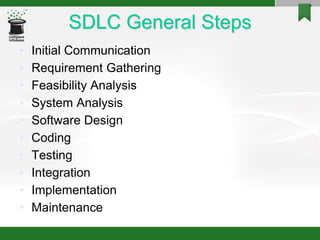
SDLC General Steps
• Initial Communication
• Requirement Gathering
• Feasibility Analysis
• System Analysis
• Software Design
• Coding
• Testing
• Integration
• Implementation
• Maintenance
Initial Communication
• User initiates the request for new software
product.
• User communicates with service provider
for software or set of functionalities.
• This kind of order is making for initiating
the SDLC
Requirement Gathering
• Used by software development team.
• The team holds the discussion with stack holders
to get more information about their requirements.
• The requirements are collected using :
• Studying the existing system
• Studying the existing s/w and its module
• Study of existing database structure, DFD etc.
• Developing questionnaires and collecting written
responses for questions to be used as
documentation.
Feasibility Analysis
• After gathering the basic requirements, the
software development team comes up with a blue
print of software development process. At this
stage, the team analysis the software they are
planning to develop, full fill the requirements of
the client or not. It is found out, if the project is
financially, practically and technologically well
suited for the organization then this is processed
on the next step or make the necessary changes
before moving to the next step.
System Analysis
• At this stage the software experts make a proper
roadmap of their plan and try their best effort to
bring the best software model for the project. It
includes an understanding of software product
limitations, learning system or necessary
changes to be made in existing systems
beforehand, identifying and addressing the
effect of project on organization and
personnel(group) etc.
Software Design
• The final output of this step comes in the
form of logical design or physical design.
Developers develop metadata, logical
diagrams, data-flow diagrams and in some
exceptional cases pseudo codes.
Coding
• This step is better known as programming
phase. The development of software
design starts in terms of writing,
programming code and easier
understanding programming language that
is helpful in the development of error free
executable programs.
Testing
• Small bugs can ruin(loss) your software
development objectives. This process is
done while coding by the developers and
thorough testing is conducted by the
testing experts at various stages of code
such as module testing, program testing,
and product testing. Early removing the
existing bugs and their remedy is the key
to reliable software.
Integration
• The integration of the software may
require its association to a larger set of
APIs, libraries, system modules, existing
and new datasets, storage and backup
procedures.
• In this stage, the s/w integration with outer
world entities and the platform which will
run the software.
Implementation
• Installing software on user machines is its
implementation.
• It is one of the most crucial (important)
step where user's get the benefits of
specific software, and able to do work fast
and impressively.
Maintenance
• This step ensures the software operation in
terms of more efficiency and bug free. If there is
any requirement of the training, then software
development organization provides the
appropriate training on how to operate the
software and how to keep the software
operational. The software is maintained timely
by updating the existing code according to the
changes taking place in technology or user end
environment.
Thank You

Sdlc model

  • 1.
    SDLC Steps Software DevelopmentLife Cycle By Lav Kumar
  • 2.
    Outline • What isSDLC model ? • SDLC General steps.
  • 3.
    SDLC Model • Aframework that describes the activities performed at each stage of a software development project.
  • 4.
    SDLC General Steps •Initial Communication • Requirement Gathering • Feasibility Analysis • System Analysis • Software Design • Coding • Testing • Integration • Implementation • Maintenance
  • 5.
    Initial Communication • Userinitiates the request for new software product. • User communicates with service provider for software or set of functionalities. • This kind of order is making for initiating the SDLC
  • 6.
    Requirement Gathering • Usedby software development team. • The team holds the discussion with stack holders to get more information about their requirements. • The requirements are collected using : • Studying the existing system • Studying the existing s/w and its module • Study of existing database structure, DFD etc. • Developing questionnaires and collecting written responses for questions to be used as documentation.
  • 7.
    Feasibility Analysis • Aftergathering the basic requirements, the software development team comes up with a blue print of software development process. At this stage, the team analysis the software they are planning to develop, full fill the requirements of the client or not. It is found out, if the project is financially, practically and technologically well suited for the organization then this is processed on the next step or make the necessary changes before moving to the next step.
  • 8.
    System Analysis • Atthis stage the software experts make a proper roadmap of their plan and try their best effort to bring the best software model for the project. It includes an understanding of software product limitations, learning system or necessary changes to be made in existing systems beforehand, identifying and addressing the effect of project on organization and personnel(group) etc.
  • 9.
    Software Design • Thefinal output of this step comes in the form of logical design or physical design. Developers develop metadata, logical diagrams, data-flow diagrams and in some exceptional cases pseudo codes.
  • 10.
    Coding • This stepis better known as programming phase. The development of software design starts in terms of writing, programming code and easier understanding programming language that is helpful in the development of error free executable programs.
  • 11.
    Testing • Small bugscan ruin(loss) your software development objectives. This process is done while coding by the developers and thorough testing is conducted by the testing experts at various stages of code such as module testing, program testing, and product testing. Early removing the existing bugs and their remedy is the key to reliable software.
  • 12.
    Integration • The integrationof the software may require its association to a larger set of APIs, libraries, system modules, existing and new datasets, storage and backup procedures. • In this stage, the s/w integration with outer world entities and the platform which will run the software.
  • 13.
    Implementation • Installing softwareon user machines is its implementation. • It is one of the most crucial (important) step where user's get the benefits of specific software, and able to do work fast and impressively.
  • 14.
    Maintenance • This stepensures the software operation in terms of more efficiency and bug free. If there is any requirement of the training, then software development organization provides the appropriate training on how to operate the software and how to keep the software operational. The software is maintained timely by updating the existing code according to the changes taking place in technology or user end environment.
  • 15.