Agenda
 Introduction
 Objectives
 Problem Statement
 Literature Review
 Proposed System Design (Black Diagram, Algorithm, Tools)
 Experimental Results (Performance Metrics)
 Conclusion
 References
Introduction
• The software development life cycle (SDLC) is a structured process that is used to
design, develop, and test good-quality software.
• SDLC, or software development life cycle is a methodology that defines the
entire procedure of software development step-by-step.
• SDLC stands for software development life cycle. It is a process followed for
software building within a software organization.
• SDLC consists of a precise plan that describes how to develop, maintain, replace,
replace, and enhance specific software.
• The life cycle defines a method for improving the quality of software and the all-
the all-around development process.
Objective
1.Quality Assurance: Ensure that the software is of high quality, free of defects, and meets
the specified requirements and user expectations.
2.Cost Control: Manage and control development costs by providing a structured approach
to project management, resource allocation, and budgeting.
3.Time Management: Ensure that the software is developed within a reasonable timeframe
by defining clear timelines and milestones.
4.Risk Management: Identify and mitigate risks throughout the development process to
minimize the impact of potential issues.
5.User Satisfaction: Develop software that aligns with user needs and expectations,
resulting in a product that satisfies end-users.
6.Efficiency: Streamline the development process to make the best use of available
resources, time, and budget.
Problem Statement
• Problem Statement: In today's fast-paced and dynamic software
development environment, organizations face a multitude of challenges in
managing the software development life cycle.
1.Inconsistent Processes: The organization lacks a standardized and
consistent SDLC process, resulting in variability in development practices,
which leads to quality issues, delays, and inefficiencies.
2.Communication Gaps: Communication breakdowns among development
teams, stakeholders, and end-users during different SDLC phases result in
misunderstandings, requirements ambiguities, and, ultimately, defects in
the final product.
3.Resource Allocation: Inefficient resource allocation, such as manpower,
time, and budget, leads to overruns and underutilization, impacting project
delivery and cost-effectiveness.
Problem Statement
4.Quality Assuerance: Quality control and assurance procedures are not
effectively integrated into the SDLC, resulting in post-development defects and
costly bug fixes.
5.Compliance and Security: Ensuring regulatory compliance and cybersecurity
throughout the SDLC is challenging, as these aspects are often retrofitted rather
than being an integral part of the development process.

6.Project Visibility: Lack of transparency and visibility into project progress, status,
and risks hinders effective decision-making and planning.
7.Documentation Overload: Excessive documentation requirements can be
overwhelming, leading to inefficiencies and diverting resources from actual
development work.
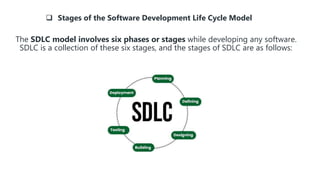
 Stages of the Software Development Life Cycle Model
The SDLC model involves six phases or stages while developing any software.
SDLC is a collection of these six stages, and the stages of SDLC are as follows:
Stage-1: Planning and Requirement Analysis
Planning is a crucial step in everything, just as in software development. In this same stage, requirement analysis
is also performed by the developers of the organization. This is attained from customer inputs, and sales
department/market surveys.
The information from this analysis forms the building blocks of a basic project. The quality of the project is a
result of planning. Thus, in this stage, the basic project is designed with all the available information.
Stage-2: Defining Requirements
In this stage, all the requirements for the target software are specified. These requirements get approval from
customers, market analysts, and stakeholders.
This is fulfilled by utilizing SRS (Software Requirement Specification). This is a sort of document that specifies all
those things that need to be defined and created during the entire project cycle.
Stage-3: Designing Architecture
SRS is a reference for software designers to come up with the best architecture for the software. Hence, with the
requirements defined in SRS, multiple designs for the product architecture are present in the Design Document
Specification (DDS).
This DDS is assessed by market analysts and stakeholders. After evaluating all the possible factors, the most
practical and logical design is chosen for development.
Stage-4: Developing Product
At this stage, the fundamental development of the product starts. For this, developers use a specific
programming code as per the design in the DDS. Hence, it is important for the coders to follow the protocols
set by the association. Conventional programming tools like compilers, interpreters, debuggers, etc. are also put
into use at this stage. Some popular languages like C/C++, Python, Java, etc. are put into use as per the software
regulations
Stage-5: Product Testing and Integration
After the development of the product, testing of the software is necessary to ensure its smooth execution.
Although, minimal testing is conducted at every stage of SDLC. Therefore, at this stage, all the probable flaws
are tracked, fixed, and retested. This ensures that the product confronts the quality requirements of SRS.
Stage 6: Deployment and Maintenance of Products
After detailed testing, the conclusive product is released in phases as per the organization’s strategy. Then it
is tested in a real industrial environment. It is important to ensure its smooth performance. If it performs well,
the organization sends out the product as a whole. After retrieving beneficial feedback, the company
releases it as it is or with auxiliary improvements to make it further helpful for the customers. However, this
alone is not enough. Therefore, along with the deployment, the product’s supervision.
Software Development Life Cycle Models
This day, we have more than 50 recognized SDLC models in use. But None of them is perfect, and
each brings its favorable aspects and disadvantages for a specific software development project or
a team.
1. Waterfall Model
It is the fundamental model of the software development life cycle. This is a very simple model.
The waterfall model is not in practice anymore, but it is the basis for all other SDLC models.
Because of its simple structure, the waterfall model is easier to use and provides a tangible output.
In the waterfall model, once a phase seems to be completed, it cannot be changed, and due to
this less flexible nature, the waterfall model is not in practice anymore.
2. V-Shaped Model
The V-shaped model is executed in a sequential manner in V-shape. Each stage or phase of this
model is integrated with a testing phase. After every development phase, a testing phase is
associated with it, and the next phase will start once the previous phase is completed, i.e.,
development & testing. It is also known as the verification or validation model.
LiteratuRe survey
LITERATURE SURVEY
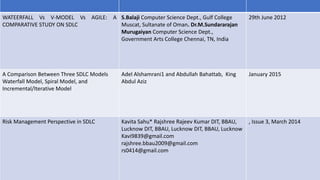
WATEERFALL Vs V-MODEL Vs AGILE: A
COMPARATIVE STUDY ON SDLC
S.Balaji Computer Science Dept., Gulf College
Muscat, Sultanate of Oman. Dr.M.Sundararajan
Murugaiyan Computer Science Dept.,
Government Arts College Chennai, TN, India
29th June 2012
A Comparison Between Three SDLC Models
Waterfall Model, Spiral Model, and
Incremental/Iterative Model
Adel Alshamrani1 and Abdullah Bahattab, King
Abdul Aziz
January 2015
Risk Management Perspective in SDLC Kavita Sahu* Rajshree Rajeev Kumar DIT, BBAU,
Lucknow DIT, BBAU, Lucknow DIT, BBAU, Lucknow
Kavi9839@gmail.com
rajshree.bbau2009@gmail.com
rs0414@gmail.com
, Issue 3, March 2014
Conclusion
• Structured Approach for Development:
Emphasize the importance of a structured approach throughout the SDLC phases.
• Risk Management and Quality Assurance:
Showcase how SDLC integrates risk management and quality assurance at
various stages.
• Improved Collaboration and Communication:
Stress the significance of collaboration and communication among project
stakeholders during SDLC.
• Flexibility and Adaptability:
Highlight the flexibility of SDLC in accommodating changes and adaptations during
the development process.
Refrences:-
https://mediaweb.saintleo.edu/
SDLC-libre.pdf (d1wqtxts1xzle7.cloudfront.net)
Risk-Management-Perspective-in-SDLC.pdf (researchgate.net)
SDLC Life Cycle for Beginners | Software Development Life Cycle
with Real life example - YouTube
THANK YOU

Software development life cycle (Software engineering) pptx

  • 1.
    Agenda  Introduction  Objectives Problem Statement  Literature Review  Proposed System Design (Black Diagram, Algorithm, Tools)  Experimental Results (Performance Metrics)  Conclusion  References
  • 2.
    Introduction • The softwaredevelopment life cycle (SDLC) is a structured process that is used to design, develop, and test good-quality software. • SDLC, or software development life cycle is a methodology that defines the entire procedure of software development step-by-step. • SDLC stands for software development life cycle. It is a process followed for software building within a software organization. • SDLC consists of a precise plan that describes how to develop, maintain, replace, replace, and enhance specific software. • The life cycle defines a method for improving the quality of software and the all- the all-around development process.
  • 3.
    Objective 1.Quality Assurance: Ensurethat the software is of high quality, free of defects, and meets the specified requirements and user expectations. 2.Cost Control: Manage and control development costs by providing a structured approach to project management, resource allocation, and budgeting. 3.Time Management: Ensure that the software is developed within a reasonable timeframe by defining clear timelines and milestones. 4.Risk Management: Identify and mitigate risks throughout the development process to minimize the impact of potential issues. 5.User Satisfaction: Develop software that aligns with user needs and expectations, resulting in a product that satisfies end-users. 6.Efficiency: Streamline the development process to make the best use of available resources, time, and budget.
  • 4.
    Problem Statement • ProblemStatement: In today's fast-paced and dynamic software development environment, organizations face a multitude of challenges in managing the software development life cycle. 1.Inconsistent Processes: The organization lacks a standardized and consistent SDLC process, resulting in variability in development practices, which leads to quality issues, delays, and inefficiencies. 2.Communication Gaps: Communication breakdowns among development teams, stakeholders, and end-users during different SDLC phases result in misunderstandings, requirements ambiguities, and, ultimately, defects in the final product. 3.Resource Allocation: Inefficient resource allocation, such as manpower, time, and budget, leads to overruns and underutilization, impacting project delivery and cost-effectiveness.
  • 5.
    Problem Statement 4.Quality Assuerance:Quality control and assurance procedures are not effectively integrated into the SDLC, resulting in post-development defects and costly bug fixes. 5.Compliance and Security: Ensuring regulatory compliance and cybersecurity throughout the SDLC is challenging, as these aspects are often retrofitted rather than being an integral part of the development process. 6.Project Visibility: Lack of transparency and visibility into project progress, status, and risks hinders effective decision-making and planning. 7.Documentation Overload: Excessive documentation requirements can be overwhelming, leading to inefficiencies and diverting resources from actual development work.
  • 6.
     Stages ofthe Software Development Life Cycle Model The SDLC model involves six phases or stages while developing any software. SDLC is a collection of these six stages, and the stages of SDLC are as follows:
  • 7.
    Stage-1: Planning andRequirement Analysis Planning is a crucial step in everything, just as in software development. In this same stage, requirement analysis is also performed by the developers of the organization. This is attained from customer inputs, and sales department/market surveys. The information from this analysis forms the building blocks of a basic project. The quality of the project is a result of planning. Thus, in this stage, the basic project is designed with all the available information. Stage-2: Defining Requirements In this stage, all the requirements for the target software are specified. These requirements get approval from customers, market analysts, and stakeholders. This is fulfilled by utilizing SRS (Software Requirement Specification). This is a sort of document that specifies all those things that need to be defined and created during the entire project cycle. Stage-3: Designing Architecture SRS is a reference for software designers to come up with the best architecture for the software. Hence, with the requirements defined in SRS, multiple designs for the product architecture are present in the Design Document Specification (DDS). This DDS is assessed by market analysts and stakeholders. After evaluating all the possible factors, the most practical and logical design is chosen for development. Stage-4: Developing Product At this stage, the fundamental development of the product starts. For this, developers use a specific programming code as per the design in the DDS. Hence, it is important for the coders to follow the protocols set by the association. Conventional programming tools like compilers, interpreters, debuggers, etc. are also put into use at this stage. Some popular languages like C/C++, Python, Java, etc. are put into use as per the software regulations
  • 8.
    Stage-5: Product Testingand Integration After the development of the product, testing of the software is necessary to ensure its smooth execution. Although, minimal testing is conducted at every stage of SDLC. Therefore, at this stage, all the probable flaws are tracked, fixed, and retested. This ensures that the product confronts the quality requirements of SRS. Stage 6: Deployment and Maintenance of Products After detailed testing, the conclusive product is released in phases as per the organization’s strategy. Then it is tested in a real industrial environment. It is important to ensure its smooth performance. If it performs well, the organization sends out the product as a whole. After retrieving beneficial feedback, the company releases it as it is or with auxiliary improvements to make it further helpful for the customers. However, this alone is not enough. Therefore, along with the deployment, the product’s supervision.
  • 9.
    Software Development LifeCycle Models This day, we have more than 50 recognized SDLC models in use. But None of them is perfect, and each brings its favorable aspects and disadvantages for a specific software development project or a team. 1. Waterfall Model It is the fundamental model of the software development life cycle. This is a very simple model. The waterfall model is not in practice anymore, but it is the basis for all other SDLC models. Because of its simple structure, the waterfall model is easier to use and provides a tangible output. In the waterfall model, once a phase seems to be completed, it cannot be changed, and due to this less flexible nature, the waterfall model is not in practice anymore. 2. V-Shaped Model The V-shaped model is executed in a sequential manner in V-shape. Each stage or phase of this model is integrated with a testing phase. After every development phase, a testing phase is associated with it, and the next phase will start once the previous phase is completed, i.e., development & testing. It is also known as the verification or validation model.
  • 10.
  • 11.
    LITERATURE SURVEY WATEERFALL VsV-MODEL Vs AGILE: A COMPARATIVE STUDY ON SDLC S.Balaji Computer Science Dept., Gulf College Muscat, Sultanate of Oman. Dr.M.Sundararajan Murugaiyan Computer Science Dept., Government Arts College Chennai, TN, India 29th June 2012 A Comparison Between Three SDLC Models Waterfall Model, Spiral Model, and Incremental/Iterative Model Adel Alshamrani1 and Abdullah Bahattab, King Abdul Aziz January 2015 Risk Management Perspective in SDLC Kavita Sahu* Rajshree Rajeev Kumar DIT, BBAU, Lucknow DIT, BBAU, Lucknow DIT, BBAU, Lucknow Kavi9839@gmail.com rajshree.bbau2009@gmail.com rs0414@gmail.com , Issue 3, March 2014
  • 12.
    Conclusion • Structured Approachfor Development: Emphasize the importance of a structured approach throughout the SDLC phases. • Risk Management and Quality Assurance: Showcase how SDLC integrates risk management and quality assurance at various stages. • Improved Collaboration and Communication: Stress the significance of collaboration and communication among project stakeholders during SDLC. • Flexibility and Adaptability: Highlight the flexibility of SDLC in accommodating changes and adaptations during the development process.
  • 13.
  • 14.