8
Software Development Life Cycle, SDLC for short, is a well-defined, structured
sequence of stages in software engineering to develop the intended software
product.
SDLC Activities
SDLC provides a series of steps to be followed to design and develop a software
product efficiently. SDLC framework includes the following steps:
Communication
This is the first step where the user initiates the request for a desired software
product. The user contacts the service provider and tries to negotiate the terms,
submits the request to the service providing organization in writing.
Requirement Gathering
This step onwards the software development team works to carry on the project.
The team holds discussions with various stakeholders from problem domain and
tries to bring out as much information as possible on their requirements. The
requirements are contemplated and segregated into user requirements, system
requirements and functional requirements. The requirements are collected using
a number of practices as given -
Software Development Life Cycle
2
Prepared By: Ghayour Abbas
9
 studying the existing or obsolete system and software,
 conducting interviews of users and developers,
 referring to the database or
 collecting answers from the questionnaires.
Feasibility Study
After requirement gathering, the team comes up with a rough plan of software
process. At this step the team analyzes if a software can be designed to fulfill all
requirements of the user, and if there is any possibility of software being no more
useful. It is also analyzed if the project is financially, practically, and
technologically feasible for the organization to take up. There are many algorithms
available, which help the developers to conclude the feasibility of a software
project.
System Analysis
At this step the developers decide a roadmap of their plan and try to bring up the
best software model suitable for the project. System analysis includes
understanding of software product limitations, learning system related problems
or changes to be done in existing systems beforehand, identifying and addressing
the impact of project on organization and personnel etc. The project team analyzes
the scope of the project and plans the schedule and resources accordingly.
Software Design
Next step is to bring down whole knowledge of requirements and analysis on the
desk and design the software product. The inputs from users and information
gathered in requirement gathering phase are the inputs of this step. The output
of this step comes in the form of two designs; logical design, and physical design.
Engineers produce meta-data and data dictionaries, logical diagrams, data-flow
diagrams, and in some cases pseudo codes.
Coding
This step is also known as programming phase. The implementation of software
design starts in terms of writing program code in the suitable programming
language and developing error-free executable programs efficiently.
Testing
An estimate says that 50% of whole software development process should be
tested. Errors may ruin the software from critical level to its own removal.
Software testing is done while coding by the developers and thorough testing is
conducted by testing experts at various levels of code such as module testing,
10
program testing, product testing, in-house testing, and testing the product at
user’s end. Early discovery of errors and their remedy is the key to reliable
software.
Integration
Software may need to be integrated with the libraries, databases, and other
program(s). This stage of SDLC is involved in the integration of software with
outer world entities.
Implementation
This means installing the software on user machines. At times, software needs
post-installation configurations at user end. Software is tested for portability and
adaptability and integration related issues are solved during implementation.
Operation and Maintenance
This phase confirms the software operation in terms of more efficiency and less
errors. If required, the users are trained on, or aided with the documentation on
how to operate the software and how to keep the software operational. The
software is maintained timely by updating the code according to the changes
taking place in user end environment or technology. This phase may face
challenges from hidden bugs and real-world unidentified problems.
Software Development Paradigm
The software development paradigm helps a developer to select a strategy to
develop the software. A software development paradigm has its own set of tools,
methods, and procedures, which are expressed clearly and defines software
development life cycle. A few of software development paradigms or process
models are defined as follows:
Waterfall Model
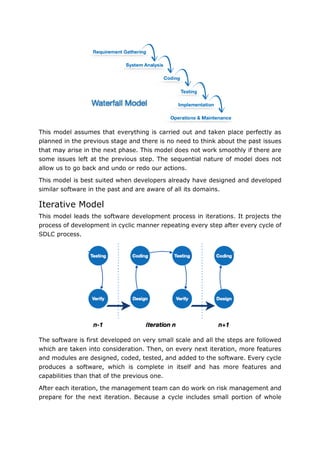
Waterfall model is the simplest model of software development paradigm. All the
phases of SDLC will function one after another in linear manner. That is, when the
first phase is finished then only the second phase will start and so on.
11
This model assumes that everything is carried out and taken place perfectly as
planned in the previous stage and there is no need to think about the past issues
that may arise in the next phase. This model does not work smoothly if there are
some issues left at the previous step. The sequential nature of model does not
allow us to go back and undo or redo our actions.
This model is best suited when developers already have designed and developed
similar software in the past and are aware of all its domains.
Iterative Model
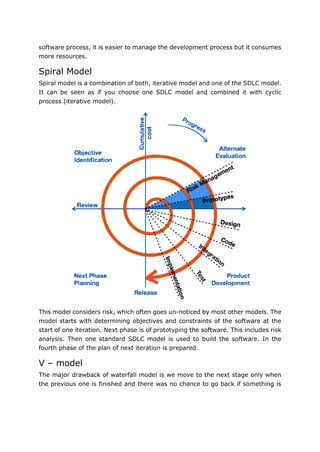
This model leads the software development process in iterations. It projects the
process of development in cyclic manner repeating every step after every cycle of
SDLC process.
The software is first developed on very small scale and all the steps are followed
which are taken into consideration. Then, on every next iteration, more features
and modules are designed, coded, tested, and added to the software. Every cycle
produces a software, which is complete in itself and has more features and
capabilities than that of the previous one.
After each iteration, the management team can do work on risk management and
prepare for the next iteration. Because a cycle includes small portion of whole
12
software process, it is easier to manage the development process but it consumes
more resources.
Spiral Model
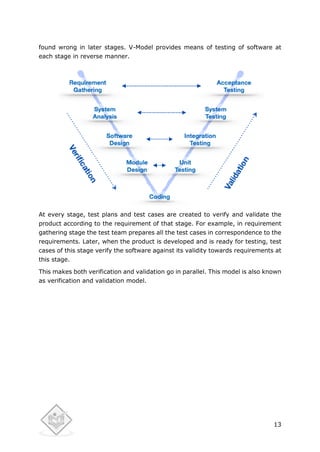
Spiral model is a combination of both, iterative model and one of the SDLC model.
It can be seen as if you choose one SDLC model and combined it with cyclic
process (iterative model).
This model considers risk, which often goes un-noticed by most other models. The
model starts with determining objectives and constraints of the software at the
start of one iteration. Next phase is of prototyping the software. This includes risk
analysis. Then one standard SDLC model is used to build the software. In the
fourth phase of the plan of next iteration is prepared.
V – model
The major drawback of waterfall model is we move to the next stage only when
the previous one is finished and there was no chance to go back if something is
13
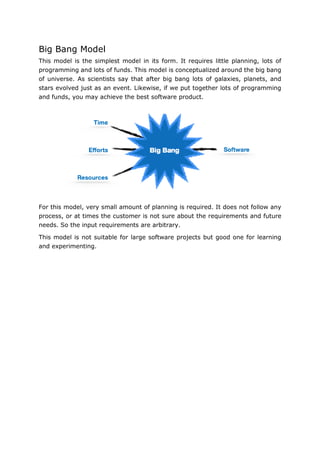
found wrong in later stages. V-Model provides means of testing of software at
each stage in reverse manner.
At every stage, test plans and test cases are created to verify and validate the
product according to the requirement of that stage. For example, in requirement
gathering stage the test team prepares all the test cases in correspondence to the
requirements. Later, when the product is developed and is ready for testing, test
cases of this stage verify the software against its validity towards requirements at
this stage.
This makes both verification and validation go in parallel. This model is also known
as verification and validation model.
14
Big Bang Model
This model is the simplest model in its form. It requires little planning, lots of
programming and lots of funds. This model is conceptualized around the big bang
of universe. As scientists say that after big bang lots of galaxies, planets, and
stars evolved just as an event. Likewise, if we put together lots of programming
and funds, you may achieve the best software product.
For this model, very small amount of planning is required. It does not follow any
process, or at times the customer is not sure about the requirements and future
needs. So the input requirements are arbitrary.
This model is not suitable for large software projects but good one for learning
and experimenting.

SWE-401 - 2. Software Development life cycle (SDLC)

  • 1.
    8 Software Development LifeCycle, SDLC for short, is a well-defined, structured sequence of stages in software engineering to develop the intended software product. SDLC Activities SDLC provides a series of steps to be followed to design and develop a software product efficiently. SDLC framework includes the following steps: Communication This is the first step where the user initiates the request for a desired software product. The user contacts the service provider and tries to negotiate the terms, submits the request to the service providing organization in writing. Requirement Gathering This step onwards the software development team works to carry on the project. The team holds discussions with various stakeholders from problem domain and tries to bring out as much information as possible on their requirements. The requirements are contemplated and segregated into user requirements, system requirements and functional requirements. The requirements are collected using a number of practices as given - Software Development Life Cycle 2 Prepared By: Ghayour Abbas
  • 2.
    9  studying theexisting or obsolete system and software,  conducting interviews of users and developers,  referring to the database or  collecting answers from the questionnaires. Feasibility Study After requirement gathering, the team comes up with a rough plan of software process. At this step the team analyzes if a software can be designed to fulfill all requirements of the user, and if there is any possibility of software being no more useful. It is also analyzed if the project is financially, practically, and technologically feasible for the organization to take up. There are many algorithms available, which help the developers to conclude the feasibility of a software project. System Analysis At this step the developers decide a roadmap of their plan and try to bring up the best software model suitable for the project. System analysis includes understanding of software product limitations, learning system related problems or changes to be done in existing systems beforehand, identifying and addressing the impact of project on organization and personnel etc. The project team analyzes the scope of the project and plans the schedule and resources accordingly. Software Design Next step is to bring down whole knowledge of requirements and analysis on the desk and design the software product. The inputs from users and information gathered in requirement gathering phase are the inputs of this step. The output of this step comes in the form of two designs; logical design, and physical design. Engineers produce meta-data and data dictionaries, logical diagrams, data-flow diagrams, and in some cases pseudo codes. Coding This step is also known as programming phase. The implementation of software design starts in terms of writing program code in the suitable programming language and developing error-free executable programs efficiently. Testing An estimate says that 50% of whole software development process should be tested. Errors may ruin the software from critical level to its own removal. Software testing is done while coding by the developers and thorough testing is conducted by testing experts at various levels of code such as module testing,
  • 3.
    10 program testing, producttesting, in-house testing, and testing the product at user’s end. Early discovery of errors and their remedy is the key to reliable software. Integration Software may need to be integrated with the libraries, databases, and other program(s). This stage of SDLC is involved in the integration of software with outer world entities. Implementation This means installing the software on user machines. At times, software needs post-installation configurations at user end. Software is tested for portability and adaptability and integration related issues are solved during implementation. Operation and Maintenance This phase confirms the software operation in terms of more efficiency and less errors. If required, the users are trained on, or aided with the documentation on how to operate the software and how to keep the software operational. The software is maintained timely by updating the code according to the changes taking place in user end environment or technology. This phase may face challenges from hidden bugs and real-world unidentified problems. Software Development Paradigm The software development paradigm helps a developer to select a strategy to develop the software. A software development paradigm has its own set of tools, methods, and procedures, which are expressed clearly and defines software development life cycle. A few of software development paradigms or process models are defined as follows: Waterfall Model Waterfall model is the simplest model of software development paradigm. All the phases of SDLC will function one after another in linear manner. That is, when the first phase is finished then only the second phase will start and so on.
  • 4.
    11 This model assumesthat everything is carried out and taken place perfectly as planned in the previous stage and there is no need to think about the past issues that may arise in the next phase. This model does not work smoothly if there are some issues left at the previous step. The sequential nature of model does not allow us to go back and undo or redo our actions. This model is best suited when developers already have designed and developed similar software in the past and are aware of all its domains. Iterative Model This model leads the software development process in iterations. It projects the process of development in cyclic manner repeating every step after every cycle of SDLC process. The software is first developed on very small scale and all the steps are followed which are taken into consideration. Then, on every next iteration, more features and modules are designed, coded, tested, and added to the software. Every cycle produces a software, which is complete in itself and has more features and capabilities than that of the previous one. After each iteration, the management team can do work on risk management and prepare for the next iteration. Because a cycle includes small portion of whole
  • 5.
    12 software process, itis easier to manage the development process but it consumes more resources. Spiral Model Spiral model is a combination of both, iterative model and one of the SDLC model. It can be seen as if you choose one SDLC model and combined it with cyclic process (iterative model). This model considers risk, which often goes un-noticed by most other models. The model starts with determining objectives and constraints of the software at the start of one iteration. Next phase is of prototyping the software. This includes risk analysis. Then one standard SDLC model is used to build the software. In the fourth phase of the plan of next iteration is prepared. V – model The major drawback of waterfall model is we move to the next stage only when the previous one is finished and there was no chance to go back if something is
  • 6.
    13 found wrong inlater stages. V-Model provides means of testing of software at each stage in reverse manner. At every stage, test plans and test cases are created to verify and validate the product according to the requirement of that stage. For example, in requirement gathering stage the test team prepares all the test cases in correspondence to the requirements. Later, when the product is developed and is ready for testing, test cases of this stage verify the software against its validity towards requirements at this stage. This makes both verification and validation go in parallel. This model is also known as verification and validation model.
  • 7.
    14 Big Bang Model Thismodel is the simplest model in its form. It requires little planning, lots of programming and lots of funds. This model is conceptualized around the big bang of universe. As scientists say that after big bang lots of galaxies, planets, and stars evolved just as an event. Likewise, if we put together lots of programming and funds, you may achieve the best software product. For this model, very small amount of planning is required. It does not follow any process, or at times the customer is not sure about the requirements and future needs. So the input requirements are arbitrary. This model is not suitable for large software projects but good one for learning and experimenting.