Leading and Managing Change for
     Diversity and Inclusion

          Nishant Mehta!
    Summer Diversity Institute 2012!
          Watertown, CT
Contact Information

               Nishant N. Mehta

Assistant Head, Alexandria Country Day School

            Trustee, Lowell School
I live on the web at:

     nmehta@acdsnet.org 

     Twitter: @NishantMehta

     Blog: www.edu21k12.net

     FB: www.fb.com/NishantNMehta
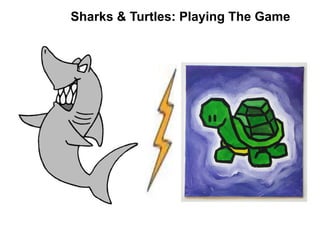
Sharks & Turtles: Playing The Game
School Culture: What is it?


"The way we do things around here."

            M. Bower
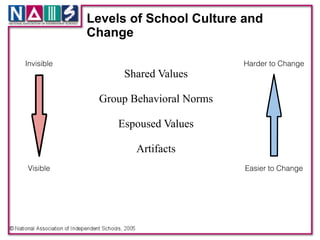
Levels of School Culture and
              Change

Invisible !                              Harder to Change
                   Shared Values


               Group Behavioral Norms


                  Espoused Values


                      Artifacts!
Visible                                  Easier to Change
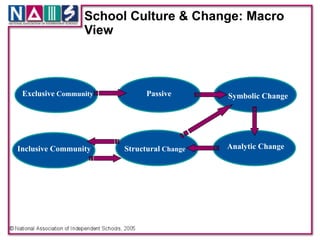
School Culture & Change: Macro
                 View


 Exclusive Community         Passive       Symbolic Change


Inclusive Community    Structural Change   Analytic Change
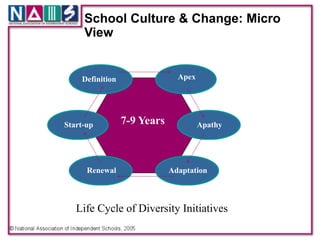
School Culture & Change: Micro
     View


    Definition                 Apex


Start-up         7-9 Years            Apathy


      Renewal                Adaptation


   Life Cycle of Diversity Initiatives
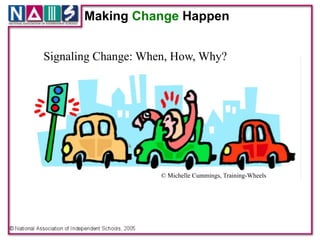
Making Change Happen


Signaling Change: When, How, Why?


                     © Michelle Cummings, Training-Wheels
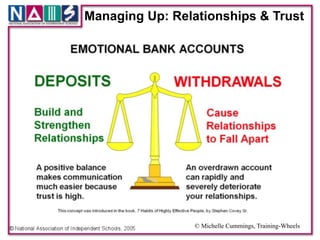
Managing Up: Relationships & Trust


                 © Michelle Cummings, Training-Wheels
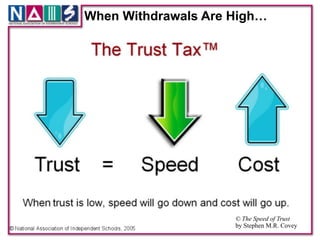
When Withdrawals Are High…


                     © The Speed of Trust !
                     by Stephen M.R. Covey
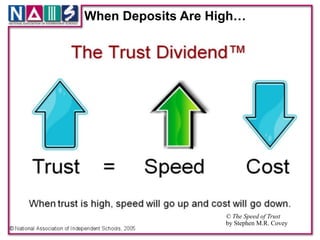
When Deposits Are High…


                    © The Speed of Trust !
                    by Stephen M.R. Covey
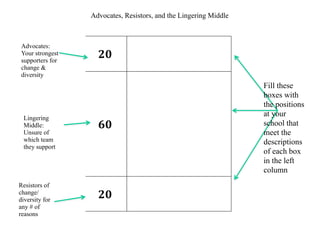
Advocates, Resistors, and the Lingering Middle


Advocates:
Your strongest
supporters for
change &
diversity
                                                                  Fill these
                                                                  boxes with
                                                                  the positions
 Lingering
                                                                  at your
 Middle:                                                          school that
 Unsure of                                                        meet the
 which team                                                       descriptions
 they support
                                                                  of each box
                                                                  in the left
                                                                  column
Resistors of
change/
diversity for
any # of
reasons
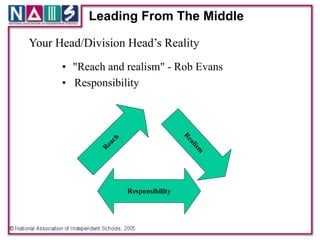
Leading From The Middle

Your Head/Division Head’s Reality
      • "Reach and realism" - Rob Evans
      • Responsibility


                     ch


                                           Re
                  ea


                                             al
              R


                          Responsibility       ism
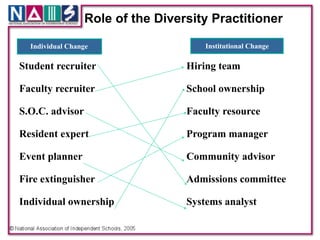
Role of the Diversity Practitioner

    Individual Change                   Institutional Change

Student recruiter
                  Hiring team

!                                   !
Faculty recruiter
                  School ownership 

!                                   !
S.O.C. advisor
                     Faculty resource!
!                                   

Resident expert
                    Program manager"
!                                   !
Event planner
                      Community advisor!
!                                   !
Fire extinguisher
                  Admissions committee"
!                                   !
Individual ownership                Systems analyst
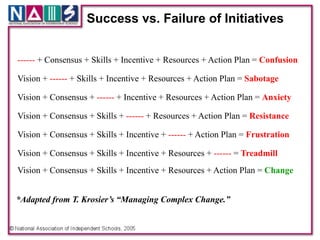
Success vs. Failure of Initiatives


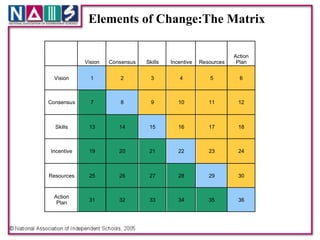
------ + Consensus + Skills + Incentive + Resources + Action Plan = Confusion

Vision + ------ + Skills + Incentive + Resources + Action Plan = Sabotage

Vision + Consensus + ------ + Incentive + Resources + Action Plan = Anxiety

Vision + Consensus + Skills + ------ + Resources + Action Plan = Resistance

Vision + Consensus + Skills + Incentive + ------ + Action Plan = Frustration

Vision + Consensus + Skills + Incentive + Resources + ------ = Treadmill
Vision + Consensus + Skills + Incentive + Resources + Action Plan = Change


*Adapted from T. Krosier’s “Managing Complex Change.”
Additional Information & Resources
Elements of Change:The Matrix
School Culture: Change Agents

Connectors: the people who "link us up with the world ...
people with a special gift for bringing the world together."!
!
Mavens: "information specialists", or "people we rely upon
to connect us with new information.”!
!
Salesmen: "persuaders", charismatic people with powerful
negotiation skills. They tend to have an indefinable trait
that goes beyond what they say, that makes others want to
agree with them. !
                                         The Tipping Point, Malcolm Gladwell
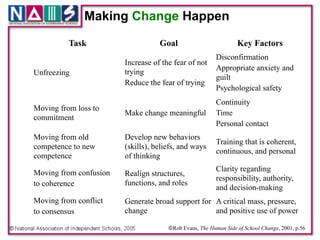
Making Change Happen

          Task                       Goal                          Key Factors
                                                           Disconfirmation!
                          Increase of the fear of not
                                                           Appropriate anxiety and
Unfreezing                trying!
                                                           guilt!
                          Reduce the fear of trying
                                                           Psychological safety
                                                           Continuity!
Moving from loss to
                          Make change meaningful           Time!
commitment
                                                           Personal contact
Moving from old           Develop new behaviors
                                                           Training that is coherent,
competence to new         (skills), beliefs, and ways
                                                           continuous, and personal
competence                of thinking
                                                           Clarity regarding
Moving from confusion !   Realign structures,
                                                           responsibility, authority,
to coherence              functions, and roles
                                                           and decision-making
Moving from conflict !    Generate broad support for A critical mass, pressure,
to consensus              change                     and positive use of power

                                        ©Rob Evans, The Human Side of School Change, 2001, p.56
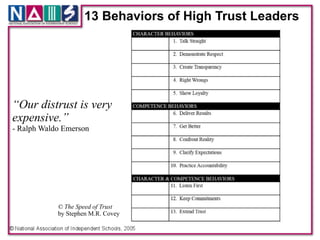
13 Behaviors of High Trust Leaders


“Our distrust is very
expensive.”!
- Ralph Waldo Emerson


            © The Speed of Trust !
            by Stephen M.R. Covey
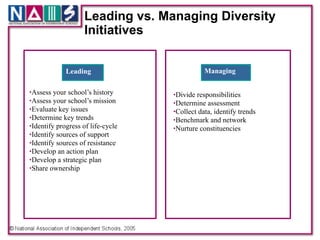
Leading vs. Managing Diversity
                    Initiatives

            Leading
             Leading                           Managing

•Assess your school’s history!      •Divide responsibilities!
•Assess your school’s mission!      •Determine assessment!
•Evaluate key issues!               •Collect data, identify trends!
•Determine key trends!              •Benchmark and network!
•Identify progress of life-cycle!   •Nurture constituencies
•Identify sources of support!
•Identify sources of resistance!
•Develop an action plan!
•Develop a strategic plan!
•Share ownership
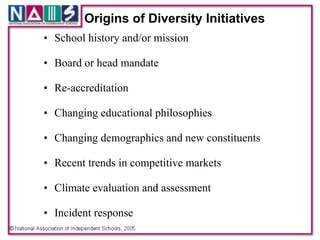
Origins of Diversity Initiatives
• School history and/or mission

  !
• Board or head mandate

  !
• Re-accreditation

  !
• Changing educational philosophies

  !
• Changing demographics and new constituents

  !
• Recent trends in competitive markets

  !
• Climate evaluation and assessment

  !
• Incident response
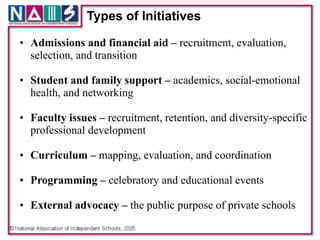
Types of Initiatives

• Admissions and financial aid – recruitment, evaluation,
  selection, and transition

  !
• Student and family support – academics, social-emotional
  health, and networking 

  !
• Faculty issues – recruitment, retention, and diversity-specific
  professional development

  !
• Curriculum – mapping, evaluation, and coordination

  !
• Programming – celebratory and educational events

  !
• External advocacy – the public purpose of private schools
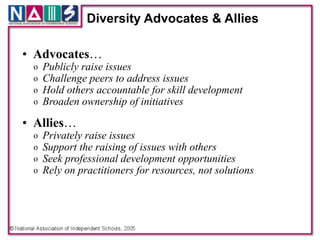
Diversity Advocates & Allies
!
    • Advocates…!
      o   Publicly raise issues!
      o   Challenge peers to address issues!
      o   Hold others accountable for skill development!
      o   Broaden ownership of initiatives

          !
    • Allies…!
      o   Privately raise issues!
      o   Support the raising of issues with others!
      o   Seek professional development opportunities!
      o   Rely on practitioners for resources, not solutions
Key Attributes of Leaders &
                 Managers
    • Creativity (independent schools; independent
      solutions)!
!
    • Commitment (belief in the school and the
      initiative)!
!
    • Patience (change is slow and sometimes invisible)!
!
    • Resiliency (setbacks are inevitable)!
!
    • Humor (necessary for survival)!
Key Knowledge for Leaders &
             Managers


• Bias & Anti-Bias

  !
• Core Cultural Identifiers and the “isms”

  !
• Power and power structures

  !
• School culture, mission, and history

  !
• Organizational development
Key Skills for Leading & Managing


    • Facilitation (not a hands-off process)!
!
    • Selectivity (the ability to say no)!
!
    • Program implementation (details, details)!
!
    • Tracking (thorough record keeping)!
!
    • Strategic planning (big picture thinking)
Sharks & Turtles: Instructions
•Divide the groups into two teams and explain that they are going to participate in a game.!
•Ask each group to choose a spokesperson.!
•Read the following instructions:!
   1. The goal of the game is to choose the most points.!
   2. Each team will choose either shark or turtle, not letting the other team know what is
         being chosen. There will be no communicating between the two teams.!
   3. Teams write their chosen animal on a piece of paper, and the spokespeople then
         meet in the middle of the room.!
   4. The two spokespeople, at the facilitator’s signal, show their drawings to their
         counterpart.!
   5. If both teams chose turtle, then both get 50 points. If one team chooses shark and
         the other turtle, then the team that chose shark gets 100 points and the turtle team
         gets negative 50 points. If both teams choose shark, both teams get negative 50
         points.!
•Next, instruct teams to choose shark or turtle, and then write their choice on a piece of
paper.!
•The spokespeople then meet in the middle of the room to reveal their team’s choices.!
•Tally the points on the board.!
•Repeat the process 5 times.
Selected Resources


• Cornell University ILR Management Programs
  (www.ilr.cornell.edu)!
•   National Training Lab (www.ntl.org)!
•   Robert Evans, The Human Side of School Change!
•   Malcolm Gladwell, The Tipping Point!
•   Jim Collins, Good To Great!
•   Stephen R. Covey’s Coveylink!
•   Stephen M. R. Covey, The Speed of Trust!
•   Michelle Cummings, Training-Wheels.com!
•   Terrence Deal and Kent Peterson, Shaping School
    Culture: The Heart of Leadership
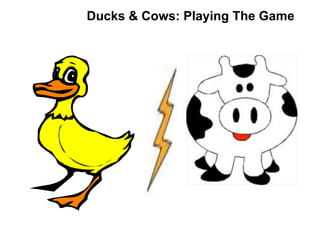
Ducks & Cows: Playing The Game
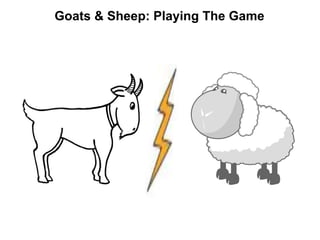
Goats & Sheep: Playing The Game
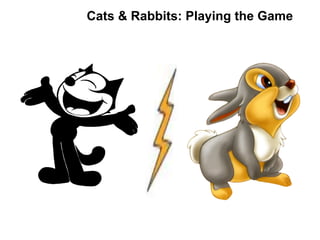
Cats & Rabbits: Playing the Game
Chickens & Pigs: Playing The Game

SDI 2012: Leading and Managing Change for Diversity and Inclusion

  • 1.
    Leading and ManagingChange for Diversity and Inclusion Nishant Mehta! Summer Diversity Institute 2012! Watertown, CT
  • 2.
    Contact Information Nishant N. Mehta Assistant Head, Alexandria Country Day School Trustee, Lowell School I live on the web at: nmehta@acdsnet.org Twitter: @NishantMehta Blog: www.edu21k12.net FB: www.fb.com/NishantNMehta
  • 3.
    Sharks & Turtles:Playing The Game
  • 4.
    School Culture: Whatis it? 


 "The way we do things around here."
 M. Bower
  • 5.
    Levels of SchoolCulture and Change Invisible ! Harder to Change Shared Values
 
 Group Behavioral Norms
 
 Espoused Values
 
 Artifacts! Visible Easier to Change
  • 6.
    School Culture &Change: Macro View Exclusive Community Passive Symbolic Change Inclusive Community Structural Change Analytic Change
  • 7.
    School Culture &Change: Micro View Definition Apex Start-up 7-9 Years Apathy Renewal Adaptation Life Cycle of Diversity Initiatives
  • 8.
    Making Change Happen SignalingChange: When, How, Why? © Michelle Cummings, Training-Wheels
  • 9.
    Managing Up: Relationships& Trust © Michelle Cummings, Training-Wheels
  • 10.
    When Withdrawals AreHigh… © The Speed of Trust ! by Stephen M.R. Covey
  • 11.
    When Deposits AreHigh… © The Speed of Trust ! by Stephen M.R. Covey
  • 12.
    Advocates, Resistors, andthe Lingering Middle Advocates: Your strongest supporters for change & diversity Fill these boxes with the positions Lingering at your Middle: school that Unsure of meet the which team descriptions they support of each box in the left column Resistors of change/ diversity for any # of reasons
  • 13.
    Leading From TheMiddle Your Head/Division Head’s Reality • "Reach and realism" - Rob Evans • Responsibility ch Re ea al R Responsibility ism
  • 14.
    Role of theDiversity Practitioner Individual Change Institutional Change Student recruiter
 Hiring team
 ! ! Faculty recruiter
 School ownership 
 ! ! S.O.C. advisor
 Faculty resource! ! 
 Resident expert
 Program manager" ! ! Event planner
 Community advisor! ! ! Fire extinguisher
 Admissions committee" ! ! Individual ownership Systems analyst
  • 15.
    Success vs. Failureof Initiatives ------ + Consensus + Skills + Incentive + Resources + Action Plan = Confusion Vision + ------ + Skills + Incentive + Resources + Action Plan = Sabotage Vision + Consensus + ------ + Incentive + Resources + Action Plan = Anxiety Vision + Consensus + Skills + ------ + Resources + Action Plan = Resistance Vision + Consensus + Skills + Incentive + ------ + Action Plan = Frustration Vision + Consensus + Skills + Incentive + Resources + ------ = Treadmill Vision + Consensus + Skills + Incentive + Resources + Action Plan = Change *Adapted from T. Krosier’s “Managing Complex Change.”
  • 16.
  • 17.
  • 18.
    School Culture: ChangeAgents Connectors: the people who "link us up with the world ... people with a special gift for bringing the world together."! ! Mavens: "information specialists", or "people we rely upon to connect us with new information.”! ! Salesmen: "persuaders", charismatic people with powerful negotiation skills. They tend to have an indefinable trait that goes beyond what they say, that makes others want to agree with them. ! The Tipping Point, Malcolm Gladwell
  • 19.
    Making Change Happen Task Goal Key Factors Disconfirmation! Increase of the fear of not Appropriate anxiety and Unfreezing trying! guilt! Reduce the fear of trying Psychological safety Continuity! Moving from loss to Make change meaningful Time! commitment Personal contact Moving from old Develop new behaviors Training that is coherent, competence to new (skills), beliefs, and ways continuous, and personal competence of thinking Clarity regarding Moving from confusion ! Realign structures, responsibility, authority, to coherence functions, and roles and decision-making Moving from conflict ! Generate broad support for A critical mass, pressure, to consensus change and positive use of power ©Rob Evans, The Human Side of School Change, 2001, p.56
  • 20.
    13 Behaviors ofHigh Trust Leaders “Our distrust is very expensive.”! - Ralph Waldo Emerson © The Speed of Trust ! by Stephen M.R. Covey
  • 21.
    Leading vs. ManagingDiversity Initiatives Leading Leading Managing •Assess your school’s history! •Divide responsibilities! •Assess your school’s mission! •Determine assessment! •Evaluate key issues! •Collect data, identify trends! •Determine key trends! •Benchmark and network! •Identify progress of life-cycle! •Nurture constituencies •Identify sources of support! •Identify sources of resistance! •Develop an action plan! •Develop a strategic plan! •Share ownership
  • 22.
    Origins of DiversityInitiatives • School history and/or mission
 ! • Board or head mandate
 ! • Re-accreditation
 ! • Changing educational philosophies
 ! • Changing demographics and new constituents
 ! • Recent trends in competitive markets
 ! • Climate evaluation and assessment
 ! • Incident response
  • 23.
    Types of Initiatives •Admissions and financial aid – recruitment, evaluation, selection, and transition
 ! • Student and family support – academics, social-emotional health, and networking 
 ! • Faculty issues – recruitment, retention, and diversity-specific professional development
 ! • Curriculum – mapping, evaluation, and coordination
 ! • Programming – celebratory and educational events
 ! • External advocacy – the public purpose of private schools
  • 24.
    Diversity Advocates &Allies ! • Advocates…! o Publicly raise issues! o Challenge peers to address issues! o Hold others accountable for skill development! o Broaden ownership of initiatives
 ! • Allies…! o Privately raise issues! o Support the raising of issues with others! o Seek professional development opportunities! o Rely on practitioners for resources, not solutions
  • 25.
    Key Attributes ofLeaders & Managers • Creativity (independent schools; independent solutions)! ! • Commitment (belief in the school and the initiative)! ! • Patience (change is slow and sometimes invisible)! ! • Resiliency (setbacks are inevitable)! ! • Humor (necessary for survival)!
  • 26.
    Key Knowledge forLeaders & Managers • Bias & Anti-Bias
 ! • Core Cultural Identifiers and the “isms”
 ! • Power and power structures
 ! • School culture, mission, and history
 ! • Organizational development
  • 27.
    Key Skills forLeading & Managing • Facilitation (not a hands-off process)! ! • Selectivity (the ability to say no)! ! • Program implementation (details, details)! ! • Tracking (thorough record keeping)! ! • Strategic planning (big picture thinking)
  • 28.
    Sharks & Turtles:Instructions •Divide the groups into two teams and explain that they are going to participate in a game.! •Ask each group to choose a spokesperson.! •Read the following instructions:! 1. The goal of the game is to choose the most points.! 2. Each team will choose either shark or turtle, not letting the other team know what is being chosen. There will be no communicating between the two teams.! 3. Teams write their chosen animal on a piece of paper, and the spokespeople then meet in the middle of the room.! 4. The two spokespeople, at the facilitator’s signal, show their drawings to their counterpart.! 5. If both teams chose turtle, then both get 50 points. If one team chooses shark and the other turtle, then the team that chose shark gets 100 points and the turtle team gets negative 50 points. If both teams choose shark, both teams get negative 50 points.! •Next, instruct teams to choose shark or turtle, and then write their choice on a piece of paper.! •The spokespeople then meet in the middle of the room to reveal their team’s choices.! •Tally the points on the board.! •Repeat the process 5 times.
  • 29.
    Selected Resources • CornellUniversity ILR Management Programs (www.ilr.cornell.edu)! • National Training Lab (www.ntl.org)! • Robert Evans, The Human Side of School Change! • Malcolm Gladwell, The Tipping Point! • Jim Collins, Good To Great! • Stephen R. Covey’s Coveylink! • Stephen M. R. Covey, The Speed of Trust! • Michelle Cummings, Training-Wheels.com! • Terrence Deal and Kent Peterson, Shaping School Culture: The Heart of Leadership
  • 30.
    Ducks & Cows:Playing The Game
  • 31.
    Goats & Sheep:Playing The Game
  • 32.
    Cats & Rabbits:Playing the Game
  • 33.
    Chickens & Pigs:Playing The Game