TRAINING ON THE
MATATAG CURRICULUM
Venue
Date
1
TRAINING ON THE
MATATAG CURRICULUM
Venue
Date
2
SCIENCE 7
MATATAG Curriculum Training | 2024
Grade 4/7 Learning Journey
3
Day 1
Pretest
Opening Program
Session 1
The General Shape of the
MATATAG Curriculum
Session 2
21st Century Skills in the
MATATAG Curriculum
Session 3
Walkthrough of [Learning
Area] Shaping Paper
Day 2
Session 4
Quarter 1 Curriculum
Standards and
Unpacking/Clustering of
Learning Competencies
Session 5
Quarter 2 Curriculum
Standards and
Unpacking/Clustering of
Learning Competencies
Day 3
Session 6
MATATAG Curriculum:
Instructional Design
Framework
Session 7A
MATATAG (Learning Area)

Instructional Design
Framework
(IDF): Pedagogy and
Assessment
Session 7B
MATATAG (Learning Area)
Walkthrough of Learning
Resources
Day 4
Session 8
Integrating 21st Century
Skills in Classroom-based
Assessment
Session 9
Classroom Practices
to Promote
Inclusion for Special Needs
Education Learners (SNED)
Session 10
Collaborative Expertise
Session 11
Class Observation in the
Context of MATATAG
Curriculum
Day 5
Session 12
Management of School-
based Professional
Development Programs
Session 13
Facilitation Skills
Posttest
Closing Program
*For School Leaders Only
MATATAG Curriculum Training | 2024
Grade 4/7 Learning Journey
4
Day 1
Pretest
Opening Program
Session 1
The General Shape of the
MATATAG Curriculum
Session 2
21st Century Skills in the
MATATAG Curriculum
Session 3
Walkthrough of [Learning
Area] Shaping Paper
Day 2
Session 4
Quarter 1 Curriculum
Standards and
Unpacking/Clustering of
Learning Competencies
Session 5
Quarter 2 Curriculum
Standards and
Unpacking/Clustering of
Learning Competencies
Day 3
Session 6
MATATAG Curriculum:
Instructional Design
Framework
Session 7A
MATATAG (Learning Area)
Instructional Design
Framework
(IDF): Pedagogy and
Assessment
Session 7B
MATATAG (Learning Area)
Walkthrough of Learning
Resources
Day 4
Session 8
Integrating 21st Century
Skills in Classroom-based
Assessment
Session 9
Classroom Practices
to Promote
Inclusion for Special Needs
Education Learners (SNED)
Session 10
Collaborative Expertise
Session 11
Class Observation in the
Context of MATATAG
Curriculum
Day 5
Session 12
Management of School-
based Professional
Development Programs
Session 13
Facilitation Skills
Posttest
Closing Program
*For School Leaders Only
MATATAG Curriculum Training | 2024
SESSION 4
Science 7
Quarter 1 Curriculum Standards
&Unpacking of Learning
Competencies
Name of Resource Person
5
MATATAG Curriculum Training | 2024
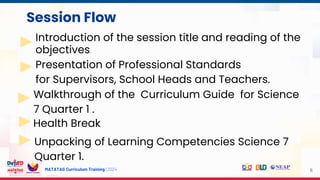
Session Flow
Introduction of the session title and reading of the
objectives.
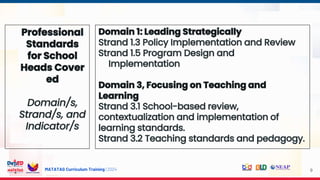
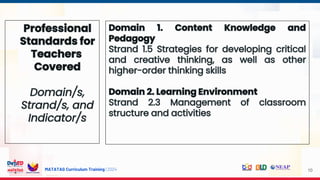
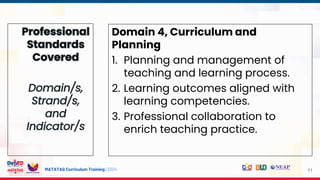
Presentation of Professional Standards
for Supervisors, School Heads and Teachers.
Walkthrough of the Curriculum Guide for Science
7 Quarter 1 .
Unpacking of Learning Competencies Science 7
Quarter 1.
6
Health Break
MATATAG Curriculum Training | 2024 7
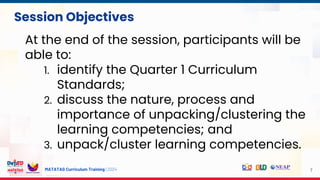
Session Objectives
At the end of the session, participants will be
able to:
1. identify the Quarter 1 Curriculum
Standards;
2. discuss the nature, process and
importance of unpacking/clustering the
learning competencies; and
3. unpack/cluster learning competencies.
MATATAG Curriculum Training | 2024 8
MATATAG Curriculum Training | 2024 9
MATATAG Curriculum Training | 2024 10
MATATAG Curriculum Training | 2024 11
Domain 4, Curriculum and
Planning
1. Planning and management of
teaching and learning process.
2. Learning outcomes aligned with
learning competencies.
3. Professional collaboration to
enrich teaching practice.
MATATAG Curriculum Training | 2024 12
“Take me to where I should be”
MATATAG Curriculum Training | 2024 13
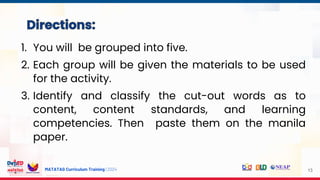
1. You will be grouped into five.
2. Each group will be given the materials to be used
for the activity.
3. Identify and classify the cut-out words as to
content, content standards, and learning
competencies. Then paste them on the manila
paper.
MATATAG Curriculum Training | 2024 14
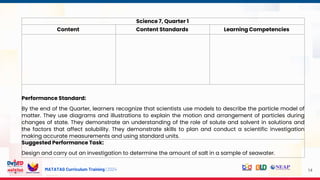
Science 7, Quarter 1
Content Content Standards Learning Competencies
Performance Standard:
By the end of the Quarter, learners recognize that scientists use models to describe the particle model of
matter. They use diagrams and illustrations to explain the motion and arrangement of particles during
changes of state. They demonstrate an understanding of the role of solute and solvent in solutions and
the factors that affect solubility. They demonstrate skills to plan and conduct a scientific investigation
making accurate measurements and using standard units.
Suggested Performance Task:
Design and carry out an investigation to determine the amount of salt in a sample of seawater.
MATATAG Curriculum Training | 2024 15
Presentation of Output
MATATAG Curriculum Training | 2024 16
MATATAG Curriculum Training | 2024 17
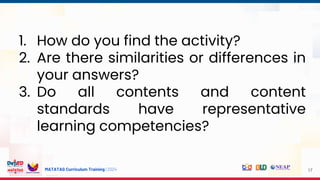
1. How do you find the activity?
2. Are there similarities or differences in
your answers?
3. Do all contents and content
standards have representative
learning competencies?
MATATAG Curriculum Training | 2024
4. What are your bases for
classifying the cut-out words as
contents, content standards, and
learning competencies?
5. Are all the contents represented
in the content standards?
18
MATATAG Curriculum Training | 2024 19
6. Does all the content have
representative learning competencies?
7. How do content, content standards,
and learning competencies differ with
one another?
MATATAG Curriculum Training | 2024 20
Remember that:
• Content – signals the key areas of focus for
a quarter.
• Content Standards – indicates the
conceptual level expected for the Quarter.
Support teachers to identify the level of
science knowledge, skills, attitudes, and
values to be taught and learned.
MATATAG Curriculum Training | 2024
Learning Competencies – identifies the
specific aspects of content for learners
to achieve.
21
MATATAG Curriculum Training | 2024
Performance Standards– provide a level for
teachers to use to judge learner achievement at
the end of each quarter.
It supports the teacher to assess the levels of
knowledge, skills, and values that learners
demonstrate in relation to the content and
learning competencies addressed during and at
the end of each quarter of teaching and learning.
22
MATATAG Curriculum Training | 2024 23
Suggested Performance Tasks – samples of
tasks where the learner applies their
knowledge, understanding, skills, values and
attitudes, through which teachers can judge
the levels of achievement of the performance
standard for each quarter in the domain.
MATATAG Curriculum Training | 2024 24
HEALTH BREAK
MATATAG Curriculum Training | 2024
25
John Mark B. Marasigan
Session 3
Unpacking of Learning
Competencies
Science 7 Quarter 1
MATATAG Curriculum Training | 2024 26
Session Objectives
At the end of the session, participants will be
able to:
1. Discuss the nature, process, and
importance of unpacking/clustering the
learning competencies; and
2. Unpack/cluster learning competencies.
MATATAG Curriculum Training | 2024 27
MATATAG Curriculum Training | 2024 28
Learning Competency:
MATATAG Curriculum Training | 2024
Direction:
29
1. You will unpack the given learning competency
from Grade 7, Quarter 1.
2. Unpack the competency using specific,
measurable, attainable, relevant and time-bound
or SMART objectives.
3. Write your responses in the meta cards and paste
them on the chart corresponding to its target
cognitive process dimension of the Revised
Bloom’s Taxonomy.
MATATAG Curriculum Training | 2024 30
MATATAG Curriculum Training | 2024 31
GUIDE QUESTIONS:
1. Do we expect learners to master broad learning
competencies in the CG without unpacking them?
Why?
2. What are the consequences when we teach and
assess without unpacking the competencies? Are
the unpacked competencies within the required
learning standards?
MATATAG Curriculum Training | 2024 32
3. In lesson planning and learning delivery, what is
the relevance of unpacking the learning
competencies from lower cognitive process
dimensions to higher cognitive process dimensions?
4. How will you make sure that the unpacked
competencies are relevant to attaining the content,
performance standards, and broad learning
competencies in the CG?
MATATAG Curriculum Training | 2024
STEPS IN UNPACKING OF LEARNING
COMPETENCIES INTO
LEARNING OBJECTIVES
33
MATATAG Curriculum Training | 2024 34
1.Revisit the standards in the curriculum guide.
2.Examine the learning competency to be
unpacked by looking at the skill requirement
represented by verbs, knowledge requirement
represented by nouns, and the learning
conditions on how these knowledge and skills
should be learned.
MATATAG Curriculum Training | 2024 35
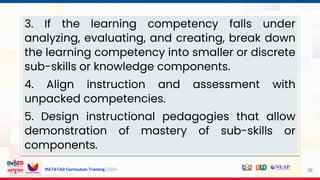
3. If the learning competency falls under
analyzing, evaluating, and creating, break down
the learning competency into smaller or discrete
sub-skills or knowledge components.
4. Align instruction and assessment with
unpacked competencies.
5. Design instructional pedagogies that allow
demonstration of mastery of sub-skills or
components.
MATATAG Curriculum Training | 2024 36
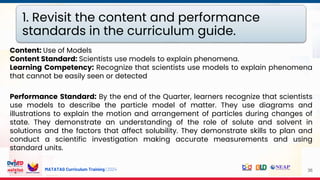
Content: Use of Models
Content Standard: Scientists use models to explain phenomena.
Learning Competency: Recognize that scientists use models to explain phenomena
that cannot be easily seen or detected
Performance Standard: By the end of the Quarter, learners recognize that scientists
use models to describe the particle model of matter. They use diagrams and
illustrations to explain the motion and arrangement of particles during changes of
state. They demonstrate an understanding of the role of solute and solvent in
solutions and the factors that affect solubility. They demonstrate skills to plan and
conduct a scientific investigation making accurate measurements and using
standard units.
1. Revisit the content and performance
standards in the curriculum guide.
MATATAG Curriculum Training | 2024 37
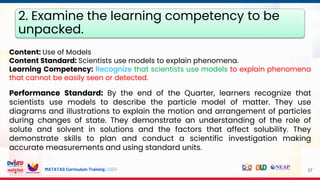
Content: Use of Models
Content Standard: Scientists use models to explain phenomena.
Learning Competency: Recognize that scientists use models to explain phenomena
that cannot be easily seen or detected.
Performance Standard: By the end of the Quarter, learners recognize that
scientists use models to describe the particle model of matter. They use
diagrams and illustrations to explain the motion and arrangement of particles
during changes of state. They demonstrate an understanding of the role of
solute and solvent in solutions and the factors that affect solubility. They
demonstrate skills to plan and conduct a scientific investigation making
accurate measurements and using standard units.
2. Examine the learning competency to be
unpacked.
MATATAG Curriculum Training | 2024 38
3. If the learning competency falls
under applying, analyzing,
evaluating and creating, break
down the learning competency into
smaller or discrete sub-skills or
knowledge components.
MATATAG Curriculum Training | 2024 39
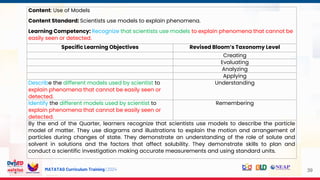
Content: Use of Models
Content Standard: Scientists use models to explain phenomena.
Learning Competency: Recognize that scientists use models to explain phenomena that cannot be
easily seen or detected.
Specific Learning Objectives Revised Bloom’s Taxonomy Level
Creating
Evaluating
Analyzing
Applying
Describe the different models used by scientist to
explain phenomena that cannot be easily seen or
detected.
Understanding
Identify the different models used by scientist to
explain phenomena that cannot be easily seen or
detected.
Remembering
By the end of the Quarter, learners recognize that scientists use models to describe the particle
model of matter. They use diagrams and illustrations to explain the motion and arrangement of
particles during changes of state. They demonstrate an understanding of the role of solute and
solvent in solutions and the factors that affect solubility. They demonstrate skills to plan and
conduct a scientific investigation making accurate measurements and using standard units.
MATATAG Curriculum Training | 2024 40
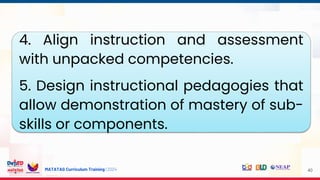
4. Align instruction and assessment
with unpacked competencies.
5. Design instructional pedagogies that
allow demonstration of mastery of sub-
skills or components.
MATATAG Curriculum Training | 2024 41
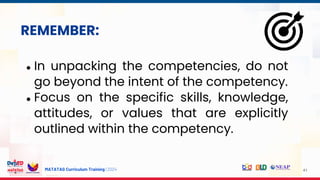
REMEMBER:
● In unpacking the competencies, do not
go beyond the intent of the competency.
● Focus on the specific skills, knowledge,
attitudes, or values that are explicitly
outlined within the competency.
MATATAG Curriculum Training | 2024
42
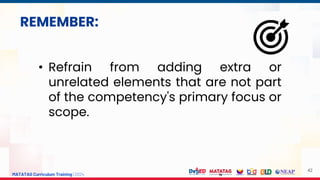
• Refrain from adding extra or
unrelated elements that are not part
of the competency's primary focus or
scope.
REMEMBER:
MATATAG Curriculum Training | 2024
43
Unpacking the MATATAG
Science Curriculum
MATATAG Curriculum Training | 2024 44
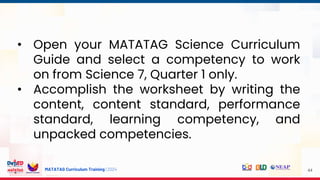
• Open your MATATAG Science Curriculum
Guide and select a competency to work
on from Science 7, Quarter 1 only.
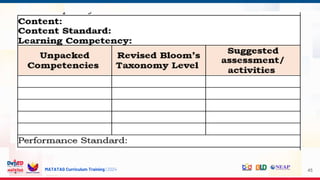
• Accomplish the worksheet by writing the
content, content standard, performance
standard, learning competency, and
unpacked competencies.
MATATAG Curriculum Training | 2024 45
MATATAG Curriculum Training | 2024 46
MATATAG Curriculum Training | 2024
Program Management Team
Curriculum and Teaching Strand
Bureau of Curriculum Development
Bureau of Learning Delivery
Bureau of Education Assessment
Bureau of Alternative Education
Bureau of Learning Resources
Human Resources and Organizational Development
Strand
National Educators Academy of the Philippines
(NEAP)
Professional Development Division
Quality Assurance Division
Session Guide and Presentation
Deck Developer/s
Marcial M. Acha, Jr.
Lily Rose Y. Rafaila
MATATAG CURRICULUM TRAINING RESOURCE PACKAGE
MARAMING SALAMAT!
48

SD Science 7 Session 4 Quarter 1 Curriculum

  • 1.
    TRAINING ON THE MATATAGCURRICULUM Venue Date 1
  • 2.
    TRAINING ON THE MATATAGCURRICULUM Venue Date 2 SCIENCE 7
  • 3.
    MATATAG Curriculum Training| 2024 Grade 4/7 Learning Journey 3 Day 1 Pretest Opening Program Session 1 The General Shape of the MATATAG Curriculum Session 2 21st Century Skills in the MATATAG Curriculum Session 3 Walkthrough of [Learning Area] Shaping Paper Day 2 Session 4 Quarter 1 Curriculum Standards and Unpacking/Clustering of Learning Competencies Session 5 Quarter 2 Curriculum Standards and Unpacking/Clustering of Learning Competencies Day 3 Session 6 MATATAG Curriculum: Instructional Design Framework Session 7A MATATAG (Learning Area) Instructional Design Framework (IDF): Pedagogy and Assessment Session 7B MATATAG (Learning Area) Walkthrough of Learning Resources Day 4 Session 8 Integrating 21st Century Skills in Classroom-based Assessment Session 9 Classroom Practices to Promote Inclusion for Special Needs Education Learners (SNED) Session 10 Collaborative Expertise Session 11 Class Observation in the Context of MATATAG Curriculum Day 5 Session 12 Management of School- based Professional Development Programs Session 13 Facilitation Skills Posttest Closing Program *For School Leaders Only
  • 4.
    MATATAG Curriculum Training| 2024 Grade 4/7 Learning Journey 4 Day 1 Pretest Opening Program Session 1 The General Shape of the MATATAG Curriculum Session 2 21st Century Skills in the MATATAG Curriculum Session 3 Walkthrough of [Learning Area] Shaping Paper Day 2 Session 4 Quarter 1 Curriculum Standards and Unpacking/Clustering of Learning Competencies Session 5 Quarter 2 Curriculum Standards and Unpacking/Clustering of Learning Competencies Day 3 Session 6 MATATAG Curriculum: Instructional Design Framework Session 7A MATATAG (Learning Area) Instructional Design Framework (IDF): Pedagogy and Assessment Session 7B MATATAG (Learning Area) Walkthrough of Learning Resources Day 4 Session 8 Integrating 21st Century Skills in Classroom-based Assessment Session 9 Classroom Practices to Promote Inclusion for Special Needs Education Learners (SNED) Session 10 Collaborative Expertise Session 11 Class Observation in the Context of MATATAG Curriculum Day 5 Session 12 Management of School- based Professional Development Programs Session 13 Facilitation Skills Posttest Closing Program *For School Leaders Only
  • 5.
    MATATAG Curriculum Training| 2024 SESSION 4 Science 7 Quarter 1 Curriculum Standards &Unpacking of Learning Competencies Name of Resource Person 5
  • 6.
    MATATAG Curriculum Training| 2024 Session Flow Introduction of the session title and reading of the objectives. Presentation of Professional Standards for Supervisors, School Heads and Teachers. Walkthrough of the Curriculum Guide for Science 7 Quarter 1 . Unpacking of Learning Competencies Science 7 Quarter 1. 6 Health Break
  • 7.
    MATATAG Curriculum Training| 2024 7 Session Objectives At the end of the session, participants will be able to: 1. identify the Quarter 1 Curriculum Standards; 2. discuss the nature, process and importance of unpacking/clustering the learning competencies; and 3. unpack/cluster learning competencies.
  • 8.
  • 9.
  • 10.
  • 11.
    MATATAG Curriculum Training| 2024 11 Domain 4, Curriculum and Planning 1. Planning and management of teaching and learning process. 2. Learning outcomes aligned with learning competencies. 3. Professional collaboration to enrich teaching practice.
  • 12.
    MATATAG Curriculum Training| 2024 12 “Take me to where I should be”
  • 13.
    MATATAG Curriculum Training| 2024 13 1. You will be grouped into five. 2. Each group will be given the materials to be used for the activity. 3. Identify and classify the cut-out words as to content, content standards, and learning competencies. Then paste them on the manila paper.
  • 14.
    MATATAG Curriculum Training| 2024 14 Science 7, Quarter 1 Content Content Standards Learning Competencies Performance Standard: By the end of the Quarter, learners recognize that scientists use models to describe the particle model of matter. They use diagrams and illustrations to explain the motion and arrangement of particles during changes of state. They demonstrate an understanding of the role of solute and solvent in solutions and the factors that affect solubility. They demonstrate skills to plan and conduct a scientific investigation making accurate measurements and using standard units. Suggested Performance Task: Design and carry out an investigation to determine the amount of salt in a sample of seawater.
  • 15.
    MATATAG Curriculum Training| 2024 15 Presentation of Output
  • 16.
  • 17.
    MATATAG Curriculum Training| 2024 17 1. How do you find the activity? 2. Are there similarities or differences in your answers? 3. Do all contents and content standards have representative learning competencies?
  • 18.
    MATATAG Curriculum Training| 2024 4. What are your bases for classifying the cut-out words as contents, content standards, and learning competencies? 5. Are all the contents represented in the content standards? 18
  • 19.
    MATATAG Curriculum Training| 2024 19 6. Does all the content have representative learning competencies? 7. How do content, content standards, and learning competencies differ with one another?
  • 20.
    MATATAG Curriculum Training| 2024 20 Remember that: • Content – signals the key areas of focus for a quarter. • Content Standards – indicates the conceptual level expected for the Quarter. Support teachers to identify the level of science knowledge, skills, attitudes, and values to be taught and learned.
  • 21.
    MATATAG Curriculum Training| 2024 Learning Competencies – identifies the specific aspects of content for learners to achieve. 21
  • 22.
    MATATAG Curriculum Training| 2024 Performance Standards– provide a level for teachers to use to judge learner achievement at the end of each quarter. It supports the teacher to assess the levels of knowledge, skills, and values that learners demonstrate in relation to the content and learning competencies addressed during and at the end of each quarter of teaching and learning. 22
  • 23.
    MATATAG Curriculum Training| 2024 23 Suggested Performance Tasks – samples of tasks where the learner applies their knowledge, understanding, skills, values and attitudes, through which teachers can judge the levels of achievement of the performance standard for each quarter in the domain.
  • 24.
    MATATAG Curriculum Training| 2024 24 HEALTH BREAK
  • 25.
    MATATAG Curriculum Training| 2024 25 John Mark B. Marasigan Session 3 Unpacking of Learning Competencies Science 7 Quarter 1
  • 26.
    MATATAG Curriculum Training| 2024 26 Session Objectives At the end of the session, participants will be able to: 1. Discuss the nature, process, and importance of unpacking/clustering the learning competencies; and 2. Unpack/cluster learning competencies.
  • 27.
  • 28.
    MATATAG Curriculum Training| 2024 28 Learning Competency:
  • 29.
    MATATAG Curriculum Training| 2024 Direction: 29 1. You will unpack the given learning competency from Grade 7, Quarter 1. 2. Unpack the competency using specific, measurable, attainable, relevant and time-bound or SMART objectives. 3. Write your responses in the meta cards and paste them on the chart corresponding to its target cognitive process dimension of the Revised Bloom’s Taxonomy.
  • 30.
  • 31.
    MATATAG Curriculum Training| 2024 31 GUIDE QUESTIONS: 1. Do we expect learners to master broad learning competencies in the CG without unpacking them? Why? 2. What are the consequences when we teach and assess without unpacking the competencies? Are the unpacked competencies within the required learning standards?
  • 32.
    MATATAG Curriculum Training| 2024 32 3. In lesson planning and learning delivery, what is the relevance of unpacking the learning competencies from lower cognitive process dimensions to higher cognitive process dimensions? 4. How will you make sure that the unpacked competencies are relevant to attaining the content, performance standards, and broad learning competencies in the CG?
  • 33.
    MATATAG Curriculum Training| 2024 STEPS IN UNPACKING OF LEARNING COMPETENCIES INTO LEARNING OBJECTIVES 33
  • 34.
    MATATAG Curriculum Training| 2024 34 1.Revisit the standards in the curriculum guide. 2.Examine the learning competency to be unpacked by looking at the skill requirement represented by verbs, knowledge requirement represented by nouns, and the learning conditions on how these knowledge and skills should be learned.
  • 35.
    MATATAG Curriculum Training| 2024 35 3. If the learning competency falls under analyzing, evaluating, and creating, break down the learning competency into smaller or discrete sub-skills or knowledge components. 4. Align instruction and assessment with unpacked competencies. 5. Design instructional pedagogies that allow demonstration of mastery of sub-skills or components.
  • 36.
    MATATAG Curriculum Training| 2024 36 Content: Use of Models Content Standard: Scientists use models to explain phenomena. Learning Competency: Recognize that scientists use models to explain phenomena that cannot be easily seen or detected Performance Standard: By the end of the Quarter, learners recognize that scientists use models to describe the particle model of matter. They use diagrams and illustrations to explain the motion and arrangement of particles during changes of state. They demonstrate an understanding of the role of solute and solvent in solutions and the factors that affect solubility. They demonstrate skills to plan and conduct a scientific investigation making accurate measurements and using standard units. 1. Revisit the content and performance standards in the curriculum guide.
  • 37.
    MATATAG Curriculum Training| 2024 37 Content: Use of Models Content Standard: Scientists use models to explain phenomena. Learning Competency: Recognize that scientists use models to explain phenomena that cannot be easily seen or detected. Performance Standard: By the end of the Quarter, learners recognize that scientists use models to describe the particle model of matter. They use diagrams and illustrations to explain the motion and arrangement of particles during changes of state. They demonstrate an understanding of the role of solute and solvent in solutions and the factors that affect solubility. They demonstrate skills to plan and conduct a scientific investigation making accurate measurements and using standard units. 2. Examine the learning competency to be unpacked.
  • 38.
    MATATAG Curriculum Training| 2024 38 3. If the learning competency falls under applying, analyzing, evaluating and creating, break down the learning competency into smaller or discrete sub-skills or knowledge components.
  • 39.
    MATATAG Curriculum Training| 2024 39 Content: Use of Models Content Standard: Scientists use models to explain phenomena. Learning Competency: Recognize that scientists use models to explain phenomena that cannot be easily seen or detected. Specific Learning Objectives Revised Bloom’s Taxonomy Level Creating Evaluating Analyzing Applying Describe the different models used by scientist to explain phenomena that cannot be easily seen or detected. Understanding Identify the different models used by scientist to explain phenomena that cannot be easily seen or detected. Remembering By the end of the Quarter, learners recognize that scientists use models to describe the particle model of matter. They use diagrams and illustrations to explain the motion and arrangement of particles during changes of state. They demonstrate an understanding of the role of solute and solvent in solutions and the factors that affect solubility. They demonstrate skills to plan and conduct a scientific investigation making accurate measurements and using standard units.
  • 40.
    MATATAG Curriculum Training| 2024 40 4. Align instruction and assessment with unpacked competencies. 5. Design instructional pedagogies that allow demonstration of mastery of sub- skills or components.
  • 41.
    MATATAG Curriculum Training| 2024 41 REMEMBER: ● In unpacking the competencies, do not go beyond the intent of the competency. ● Focus on the specific skills, knowledge, attitudes, or values that are explicitly outlined within the competency.
  • 42.
    MATATAG Curriculum Training| 2024 42 • Refrain from adding extra or unrelated elements that are not part of the competency's primary focus or scope. REMEMBER:
  • 43.
    MATATAG Curriculum Training| 2024 43 Unpacking the MATATAG Science Curriculum
  • 44.
    MATATAG Curriculum Training| 2024 44 • Open your MATATAG Science Curriculum Guide and select a competency to work on from Science 7, Quarter 1 only. • Accomplish the worksheet by writing the content, content standard, performance standard, learning competency, and unpacked competencies.
  • 45.
  • 46.
  • 47.
    MATATAG Curriculum Training| 2024 Program Management Team Curriculum and Teaching Strand Bureau of Curriculum Development Bureau of Learning Delivery Bureau of Education Assessment Bureau of Alternative Education Bureau of Learning Resources Human Resources and Organizational Development Strand National Educators Academy of the Philippines (NEAP) Professional Development Division Quality Assurance Division Session Guide and Presentation Deck Developer/s Marcial M. Acha, Jr. Lily Rose Y. Rafaila MATATAG CURRICULUM TRAINING RESOURCE PACKAGE
  • 48.

Editor's Notes

  • #2 Purpose of the Slide: Say: Do: Note: Change the title to reflect the governance level and target audience. Download this document as a PPT.
  • #3 Purpose of the Slide: Say: Do: Note: Change the title to reflect the governance level and target audience. Download this document as a PPT.
  • #4 Purpose of the Slide: to give an overview of the sessions Say: To refresh your memory, there are X sessions for this training--. What session are we now? Other Notes: Replace it with the next slide if this will be used for a school leaders’ training.
  • #5 Purpose of the Slide: to give an overview of the sessions Say: To refresh your memory, there are X sessions for this training--. What session are we now? Other Notes: Replace it with the next slide if this will be used for a school leaders’ training.
  • #8 Say: By the end of the session, you should be able to: Identify the Quarter 1 curriculum standards. Discuss the nature, process and importance of unpacking/clustering the learning competencies. Unpack/
  • #9 Say: This session is anchored on the Professional Standards for Supervisors, School Heads and Teachers
  • #13 Say: Let’s do the priming activity :Let us now explore Quarter 1, Science 7 Curriculum Guide of the MATATAG Curriculum by doing a 3-column matching activity titled “Take me to where I should be”.
  • #14 Note: The LF should read the directions of the activity. I will divide the class into 5 groups. I will distribute metacards that contain the content, content standards, and learning competencies. These standards are jumbled and are found inside this envelope Say: At the end of the activity, each group is expected to present their output.
  • #15 Say: All you need to do is to identify which of the standards belong to content, content standard, and learning competency by placing them in their appropriate column. While pasting them in the chart, you also have to align the content to its representative content standards and to its representative learning competencies. After 15 minutes, you need to tack your charts on the wall. Each group shall also select a representative to read the group’s output within 3 minutes.   Do: The LF will distribute 5 sets of materials (manila paper, metacards stored in an envelope, and masking tape.) to each of the 5 groups. Say: Are there clarifications? If none, your 10 minutes starts now.
  • #16 The LF will allow each group to present their output. SAY: - Let’s move on to the presentation of your output. - Choose a representative from your group who will present the output. - Each group will be given 3 minutes to present.
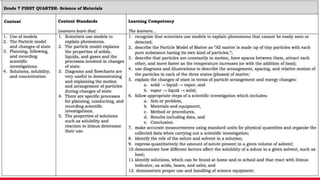
  • #17 This is the expected answer. Mentioned that there are four contents, 5 content standards, and 12 learning competencies for Quarter 1, Science 7.
  • #18 Say: Now, let’s answer these questions: Do: Call participants to read and answer. 3. (Expected answer: Yes! Contents are represented by content standards, and content standards are represented by one or more learning competencies.) 4. Expected answer: Some of the bases in classifying contents, content standards, and learning competencies are their keywords, how they are phrased or sentenced, and the cognitive demand they possess. Contents are more general than content standards, and learning competencies are more specific and always begin with verbs.)
  • #20 Say: Now, let’s answer these questions: Do: Call participants to read and answer. 5. (Expected answer: Yes! All contents and represented by content standards.) 6. (Expected answer: Yes! All contents and represented by one or more learning competencies.) 7.
  • #21 Say: Thank you so much for your responses. Your answers to the questions are enforced by how science curriculum is structured. Say: As articulated in the CG, science curriculum provides content standards for each domain and grade to support teachers to identify the level of science knowledge, skills, attitudes, and values to be taught and learned. It also clearly articulates performance standards to support the teacher to assess the levels of knowledge, skills, and values that learners demonstrate in relation to the content and learning competencies addressed during and at the end of each quarter of teaching and learning.
  • #24 Say: The big ideas (Harlen, et al. 2015) are very evident on how the content, content standards, learning competencies, and performance standards are articulated in the curriculum guide. 
  • #25 Say: The big ideas (Harlen, et al. 2015) are very evident on how the content, content standards, learning competencies, and performance standards are articulated in the curriculum guide. 
  • #26 The LF greets all the participants and ensure they feel comfortable.
  • #27 Say: We had our walkthrough on the curriculum standards for Grade 7 Science, this time we will continue our next session focusing on the unpacking of learning competencies.
  • #28 Say: Now that we are done with the walkthrough for Science 7, Quarter 1, it is important for both teachers who will deliver the standards, and education leaders who will provide technical assistance, to learn and relearn how to unpack them into manageable learning bits for our learners. Say: This time, let us have another activity. I will group you into five groups. Do: LF groups the participants into five.
  • #29 Say: On the slide is one of the learning competencies found in Science 7, Quarter 1. Everybody, please read. Say: Thank you. Using the said learning competency, unpack it into specific, measurable, attainable, relevant and time-bounded or SMART objectives. Write your responses in the meta cards and paste them on the chart corresponding to its target cognitive process dimension of the Revised Bloom’s Taxonomy. I will give you 10 minutes for this. Do: Distribute the meta cards, markers, and masking tape per table, and tack the blank chart on the wall. Set the timer for 10 minutes.
  • #31 Say: Time is up. Post your output on the wall and be ready for the presentation.
  • #32 Say: I will call volunteers to share their answers to the questions. Note: Call volunteers to answer. Should some participants have different answers, the facilitator must encourage the participant to explain their answers and permit healthy and respectful discussion. 1. Expected answer: No! Learners will experience difficulty in mastering competencies if they are not unpacked.) 2. (Expected answer: Some of the consequences when we teach and assess without unpacking the competencies include lack of clarity and understanding of the lesson, ineffective instruction, inconsistent assessment, and misalignment of learning goals.)
  • #33 3. Expected answer: Unpacking learning competencies from lower to higher cognitive process dimensions in lesson planning and learning delivery ensures a progressive approach that promotes a deeper understanding, application, and mastery of the subject matter.)
  • #34 Say: Thank you so much for your answers. Indeed, unpacking breaks down complex skills or concepts into manageable parts. It makes curriculum standards and learning competencies more explicit and actionable through learning objectives, and it supports instructional planning. We unpack if competencies are broad or have a high cognitive demand. Now, here are the steps in unpacking learning competencies. Check if these steps were followed when we had our activity earlier.
  • #35 Say: Thank you so much for your answers. Indeed, unpacking breaks down complex skills or concepts into manageable parts. It makes curriculum standards and learning competencies more explicit and actionable through learning objectives, and it supports instructional planning. We unpack if competencies are broad or have a high cognitive demand. Now, here are the steps in unpacking learning competencies. Check if these steps were followed when we had our activity earlier. (Do: From the standards select one learning competency to be unpacked. LC: Demonstrate how different factors affect the solubility of a solute in a given solvent, such as heat)
  • #37 You can revisit the standards in the curriculum guide. Every teacher has to read the curriculum guide. We encourage every teacher to read the entire document, and familiarize with the standards, it is one way to know the boundaries per grade level and per key stage.
  • #38 Examine the learning competency to be unpacked by looking at the skill requirement represented by verbs, knowledge requirement represented by nouns, and the learning conditions on how these knowledge and skills should be learned. (Do: Present an examined learning competency in the slide. Blue texts are the skill requirements, red texts are the knowledge requirements, and green texts are the learning conditions).  Content: Use of Models Content Standards: Scientists use models to explain phenomena. Learning Competency: Recognize that scientiist use models to explain phenomena that cannot be easily seen or detected
  • #42 In unpacking the competencies, do not go beyond the intent of the competency. While analyzing or breaking down the competencies, one should focus on comprehending the specific skills, knowledge, behaviors, or abilities that are explicitly outlined within the competency. Refrain from adding extra or unrelated elements that are not part of the competency's primary focus or scope. The aim is to delve deeply into the competencies to understand their core components without extending into areas that are not directly related to the defined competency. These basic guidelines ensure a clear understanding and alignment with the intended skills or capabilities outlined within the competency to avoid the old same problem on congestion.
  • #45 Say: This time, let us concretize your learning. I will give you an individual worksheet for you to accomplish. Do: Distribute the worksheet (see attached worksheet). Say: All you need to do is open your MATATAG Science Curriculum Guide and select a competency to work on from Science 7, Quarter 1 only. Accomplish the worksheet by writing the content, content standard, performance standard, learning competency, and unpacked competencies. The unpacked competencies must be laid to their corresponding target cognitive process dimension in the Revised Bloom’s Taxonomy. Take note that it is not necessary to complete all the cognitive process dimensions, since it will depend on the cognitive demand of the curriculum standards. Because doable objectives or unpacked competencies should be measurable, suggest also assessment or activities.
  • #46 Say: I will give you 20 minutes to do the task. Do: Set timer for 20 minutes. The LF facilitates peer-evaluation of the outputs.
  • #47 Say: This time, we will do the peer evaluation of your output. Please select a partner, exchange and examine each other’s your work. Consider the first three (3) steps we used in unpacking learning competencies. You will be given 5 minutes to do this activity. Note: Set the time for 5 minutes. Say: Time is up. Return the output. Were you able to learn from the activity? Do you have any clarifications? Do: Call volunteers to share or answer questions. Say: We’re done with our activity. I hope that you learn about how a learning competency can be unpacked.
  • #49 The LF wraps up the session and thank the participants. Say: We’re done with our sessions this morning. Thank you so much for your active participation.