Developing
MATATAG-Compliant Lesson
Plans in SCIENCE
MATATAG Series
Episode 3:
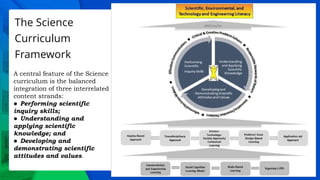
The Science
Curriculum
Framework
A central feature of the Science
curriculum is the balanced
integration of three interrelated
content strands:
● Performing scientific
inquiry skills;
● Understanding and
applying scientific
knowledge; and
● Developing and
demonstrating scientific
attitudes and values.
’Big Ideas’
of and about
Science
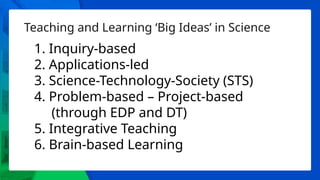
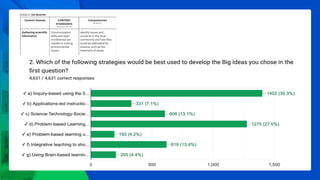
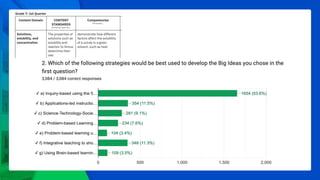
Teaching and Learning ‘Big Ideas’ in Science
1. Inquiry-based
2. Applications-led
3. Science-Technology-Society (STS)
4. Problem-based – Project-based
(through EDP and DT)
5. Integrative Teaching
6. Brain-based Learning
1. The Lesson
Planning (LP)
Process
2. Lesson Plan
Non-negotiables
3. Outputs from
Session 2
4. Way Forward
Session Topics
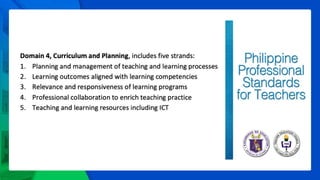
Domain 4 addresses teachers’ knowledge of and interaction with the
national and local curriculum requirements. This Domain encompasses their
ability to translate curriculum content into learning activities that are
relevant to learners and based on the principles of effective teaching and
learning. It expects teachers to apply their professional knowledge to plan
and design, individually or in collaboration with colleagues, well-
structured and sequenced lessons. These lesson sequences and associated
learning programs should be contextually relevant, responsive to learners’
needs and incorporate a range of teaching and learning resources. The
Domain expects teachers to communicate learning goals to support learner
participation, understanding and achievement.
The Teachers…
1. Instructional Designers
2. Advocates of Lifelong Learning
3. Promoters of Ethical Digital
Literacy
4. Catalysts of Transformation
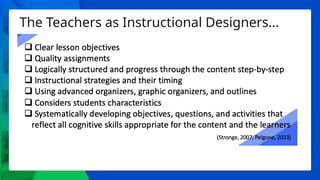
The Teachers as Instructional Designers…
 Demonstrate mastery of subject
matter and/or in their
specialization across the
curriculum
The Teachers as Instructional Designers…
 Unpack learning competencies
to determine what learners
need to know, understand, and
be able to do
The Teachers as Instructional Designers…
 Design and deliver appropriate,
engaging, and meaningful
lessons
The Teachers as Instructional Designers…
 Utilize various teaching and
assessment approaches to
address the diverse needs of
learners
The Teachers as Instructional Designers…
 Select and seamlessly integrate
digital tools and technology in
the TL process
The Teachers as Instructional Designers…
 Develop learning resources
aligned with the MATATAG
Curriculum IDF
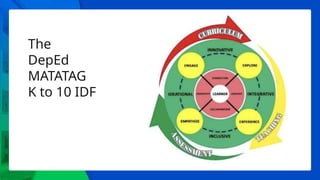
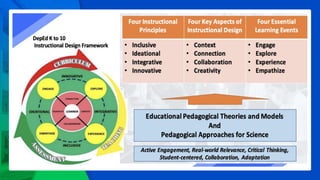
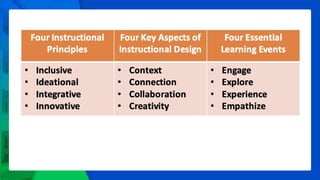
The
DepEd
MATATAG
K to 10 IDF
The
DepEd
MATATAG
K to 10 IDF
Essential Components of the Lesson Plan
1. Identify the curriculum content,
standards, and lesson
competencies
Essential Components of the Lesson Plan
2. Identify all available and
applicable learning resources
Essential Components of the Lesson Plan
3. Plan the TL procedure
Essential Components of the Lesson Plan
3. Plan the TL procedure
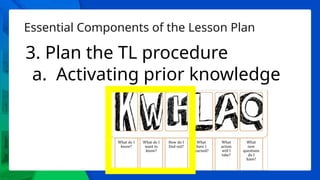
a. Activating prior knowledge
Essential Components of the Lesson Plan
3. Plan the TL procedure
a. Activating prior knowledge
Essential Components of the Lesson Plan
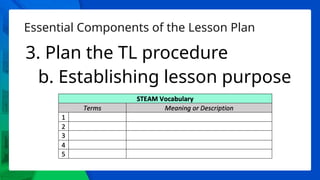
3. Plan the TL procedure
b. Establishing lesson purpose
Essential Components of the Lesson Plan
3. Plan the TL procedure
b. Establishing lesson purpose
Essential Components of the Lesson Plan
3. Plan the TL procedure
c. Developing and deepening
understanding
Essential Components of the Lesson Plan
3. Plan the TL procedure
c. Developing and deepening
understanding
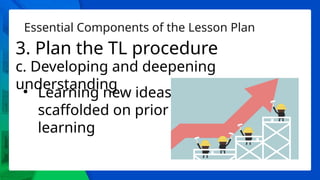
• Learning new ideas
scaffolded on prior
learning
Essential Components of the Lesson Plan
3. Plan the TL procedure
c. Developing and deepening
understanding
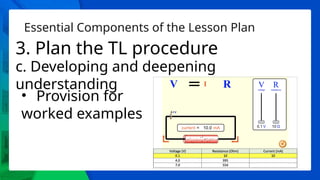
• Provision for
worked examples
Essential Components of the Lesson Plan
3. Plan the TL procedure
c. Developing and deepening
understanding
• Appropriate, adequate, & diverse
activities allowing for both independent
work and collaboration
Essential Components of the Lesson Plan
3. Plan the TL procedure
d. Making generalization
Essential Components of the Lesson Plan
3. Plan the TL procedure
d. Making generalization
• Essential points
• Take-aways
• Reflections or Realizations
Essential Components of the Lesson Plan
3. Plan the TL procedure
d. Making generalization
Essential Components of the Lesson Plan
3. Plan the TL procedure
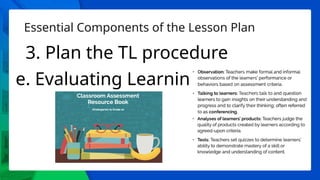
e. Evaluating Learning
Essential Components of the Lesson Plan
3. Plan the TL procedure
e. Evaluating Learning
• Aligned, adequate, & diverse
assessment forms
• HW for deliberate practice
After Implementation of the LP
 LP remarks
 Teacher’s reflections
 Instructional decision
 Revision (LE development)
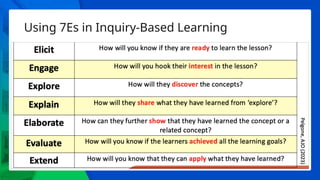
Using 7Es in Inquiry-Based Learning
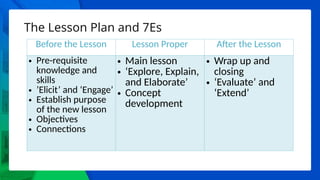
The Lesson Plan and 7Es
Before the Lesson Lesson Proper After the Lesson
• Pre-requisite
knowledge and
skills
• ’Elicit’ and ‘Engage’
• Establish purpose
of the new lesson
• Objectives
• Connections
• Main lesson
• ‘Explore, Explain,
and Elaborate’
• Concept
development
• Wrap up and
closing
• ‘Evaluate’ and
‘Extend’
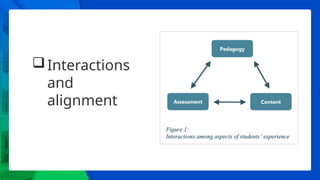
Interactions
and
alignment
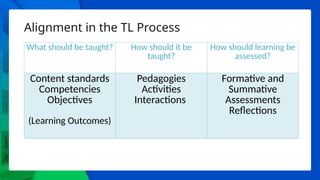
Alignment in the TL Process
What should be taught? How should it be
taught?
How should learning be
assessed?
Content standards
Competencies
Objectives
(Learning Outcomes)
Pedagogies
Activities
Interactions
Formative and
Summative
Assessments
Reflections
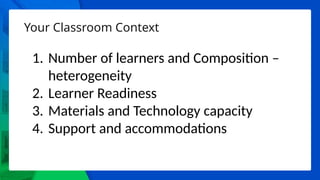
Your Classroom Context
1. Number of learners and Composition –
heterogeneity
2. Learner Readiness
3. Materials and Technology capacity
4. Support and accommodations
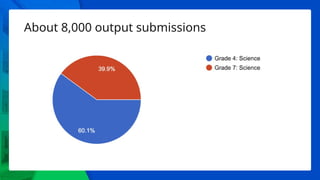
About 8,000 output submissions
Michelle Kay M Bendaña
Teacher I, Boboy Elementary School
Batangas Province, Calabarzon
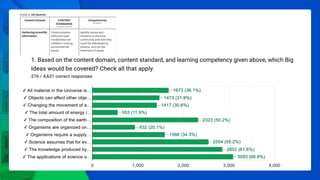
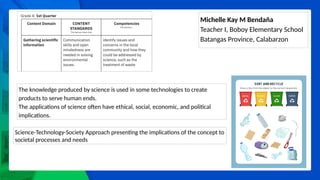
The knowledge produced by science is used in some technologies to create
products to serve human ends.
The applications of science often have ethical, social, economic, and political
implications.
Science-Technology-Society Approach presenting the implications of the concept to
societal processes and needs
Michelle Kay M Bendaña
Teacher I, Boboy Elementary School
Batangas Province, Calabarzon
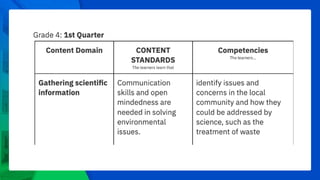
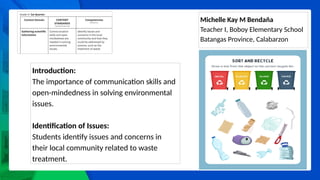
Introduction:
The importance of communication skills and
open-mindedness in solving environmental
issues.
Identification of Issues:
Students identify issues and concerns in
their local community related to waste
treatment.
Michelle Kay M Bendaña
Teacher I, Boboy Elementary School
Batangas Province, Calabarzon
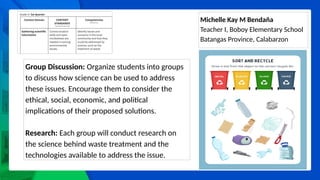
Group Discussion: Organize students into groups
to discuss how science can be used to address
these issues. Encourage them to consider the
ethical, social, economic, and political
implications of their proposed solutions.
Research: Each group will conduct research on
the science behind waste treatment and the
technologies available to address the issue.
Michelle Kay M Bendaña
Teacher I, Boboy Elementary School
Batangas Province, Calabarzon
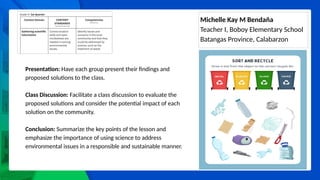
Presentation: Have each group present their findings and
proposed solutions to the class.
Class Discussion: Facilitate a class discussion to evaluate the
proposed solutions and consider the potential impact of each
solution on the community.
Conclusion: Summarize the key points of the lesson and
emphasize the importance of using science to address
environmental issues in a responsible and sustainable manner.
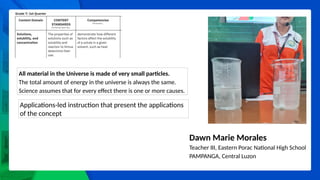
Dawn Marie Morales
Teacher III, Eastern Porac National High School
PAMPANGA, Central Luzon
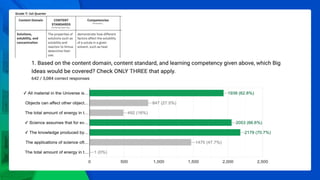
Applications-led instruction that present the applications
of the concept
All material in the Universe is made of very small particles.
The total amount of energy in the universe is always the same.
Science assumes that for every effect there is one or more causes.
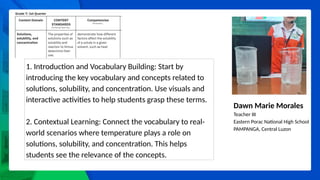
Dawn Marie Morales
Teacher III
Eastern Porac National High School
PAMPANGA, Central Luzon
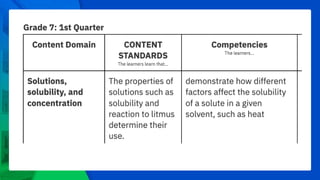
1. Introduction and Vocabulary Building: Start by
introducing the key vocabulary and concepts related to
solutions, solubility, and concentration. Use visuals and
interactive activities to help students grasp these terms.
2. Contextual Learning: Connect the vocabulary to real-
world scenarios where temperature plays a role on
solutions, solubility, and concentration. This helps
students see the relevance of the concepts.
Dawn Marie Morales
Teacher III
Eastern Porac National High School
PAMPANGA, Central Luzon
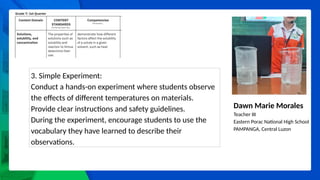
3. Simple Experiment:
Conduct a hands-on experiment where students observe
the effects of different temperatures on materials.
Provide clear instructions and safety guidelines.
During the experiment, encourage students to use the
vocabulary they have learned to describe their
observations.
Dawn Marie Morales
Teacher III
Eastern Porac National High School
PAMPANGA, Central Luzon
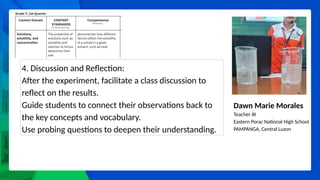
4. Discussion and Reflection:
After the experiment, facilitate a class discussion to
reflect on the results.
Guide students to connect their observations back to
the key concepts and vocabulary.
Use probing questions to deepen their understanding.
Dawn Marie Morales
Teacher III
Eastern Porac National High School
PAMPANGA, Central Luzon
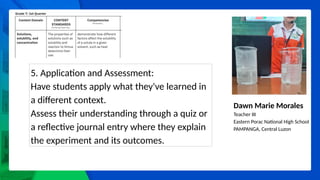
5. Application and Assessment:
Have students apply what they've learned in
a different context.
Assess their understanding through a quiz or
a reflective journal entry where they explain
the experiment and its outcomes.
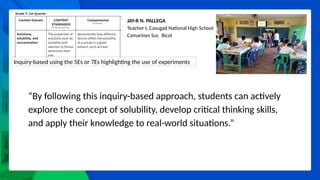
JAY-R N. PALLEGA
Teacher I, Casugad National High School
Camarines Sur, Bicol
Inquiry-based using the 5Es or 7Es highlighting the use of experiments
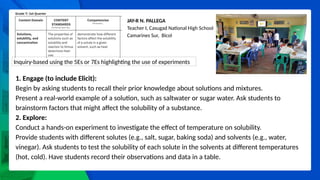
1. Engage (to include Elicit):
Begin by asking students to recall their prior knowledge about solutions and mixtures.
Present a real-world example of a solution, such as saltwater or sugar water. Ask students to
brainstorm factors that might affect the solubility of a substance.
2. Explore:
Conduct a hands-on experiment to investigate the effect of temperature on solubility.
Provide students with different solutes (e.g., salt, sugar, baking soda) and solvents (e.g., water,
vinegar). Ask students to test the solubility of each solute in the solvents at different temperatures
(hot, cold). Have students record their observations and data in a table.
JAY-R N. PALLEGA
Teacher I, Casugad National High School
Camarines Sur, Bicol
Inquiry-based using the 5Es or 7Es highlighting the use of experiments
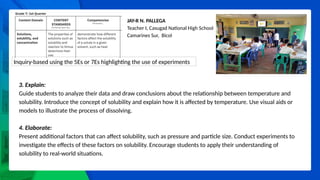
3. Explain:
Guide students to analyze their data and draw conclusions about the relationship between temperature and
solubility. Introduce the concept of solubility and explain how it is affected by temperature. Use visual aids or
models to illustrate the process of dissolving.
4. Elaborate:
Present additional factors that can affect solubility, such as pressure and particle size. Conduct experiments to
investigate the effects of these factors on solubility. Encourage students to apply their understanding of
solubility to real-world situations.
JAY-R N. PALLEGA
Teacher I, Casugad National High School
Camarines Sur, Bicol
Inquiry-based using the 5Es or 7Es highlighting the use of experiments
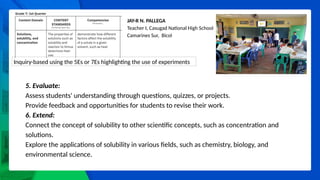
5. Evaluate:
Assess students' understanding through questions, quizzes, or projects.
Provide feedback and opportunities for students to revise their work.
6. Extend:
Connect the concept of solubility to other scientific concepts, such as concentration and
solutions.
Explore the applications of solubility in various fields, such as chemistry, biology, and
environmental science.
JAY-R N. PALLEGA
Teacher I, Casugad National High School
Camarines Sur, Bicol
Inquiry-based using the 5Es or 7Es highlighting the use of experiments
“By following this inquiry-based approach, students can actively
explore the concept of solubility, develop critical thinking skills,
and apply their knowledge to real-world situations.”
Ways Forward
Ways Forward
Effective Lesson Planning
translates to effective TL
Ways Forward
 Non-negotiables in LP
1. Learning Standards and Learning Outcomes
2. Identify Pre-requisite Knowledge and Skills and how to ensure
that learners are ready for the lesson
3. Engaging Activity/ies
4. Concept Development Activities
5. Extend Activities
6. Formative and Summative Assessment
Ways Forward
 LP: a work in progress, an
experiment
Ways Forward
 In LP ask, “Who are you planning
for?”
From one teacher to another,
“It is what we (teachers) allow
learners to experience in
science, that ultimately makes
them scientifically literate or
dream of becoming scientists.”
Alfons Jayson O. Pelgone
Science Teacher
Thank you!
Alfons Jayson O. Pelgone
Faculty of Science, Technology, and Mathematics
Philippine Normal University
The National Center for Teacher Education

Session 3 Developing MATATAG Lesson Plans - Prof Alfons (1).pptx

  • 1.
    Developing MATATAG-Compliant Lesson Plans inSCIENCE MATATAG Series Episode 3:
  • 2.
    The Science Curriculum Framework A centralfeature of the Science curriculum is the balanced integration of three interrelated content strands: ● Performing scientific inquiry skills; ● Understanding and applying scientific knowledge; and ● Developing and demonstrating scientific attitudes and values.
  • 3.
  • 4.
    Teaching and Learning‘Big Ideas’ in Science 1. Inquiry-based 2. Applications-led 3. Science-Technology-Society (STS) 4. Problem-based – Project-based (through EDP and DT) 5. Integrative Teaching 6. Brain-based Learning
  • 6.
    1. The Lesson Planning(LP) Process 2. Lesson Plan Non-negotiables 3. Outputs from Session 2 4. Way Forward Session Topics
  • 11.
    Domain 4 addressesteachers’ knowledge of and interaction with the national and local curriculum requirements. This Domain encompasses their ability to translate curriculum content into learning activities that are relevant to learners and based on the principles of effective teaching and learning. It expects teachers to apply their professional knowledge to plan and design, individually or in collaboration with colleagues, well- structured and sequenced lessons. These lesson sequences and associated learning programs should be contextually relevant, responsive to learners’ needs and incorporate a range of teaching and learning resources. The Domain expects teachers to communicate learning goals to support learner participation, understanding and achievement.
  • 12.
    The Teachers… 1. InstructionalDesigners 2. Advocates of Lifelong Learning 3. Promoters of Ethical Digital Literacy 4. Catalysts of Transformation
  • 13.
    The Teachers asInstructional Designers…  Demonstrate mastery of subject matter and/or in their specialization across the curriculum
  • 14.
    The Teachers asInstructional Designers…  Unpack learning competencies to determine what learners need to know, understand, and be able to do
  • 15.
    The Teachers asInstructional Designers…
  • 16.
    The Teachers asInstructional Designers…  Design and deliver appropriate, engaging, and meaningful lessons
  • 17.
    The Teachers asInstructional Designers…  Utilize various teaching and assessment approaches to address the diverse needs of learners
  • 18.
    The Teachers asInstructional Designers…  Select and seamlessly integrate digital tools and technology in the TL process
  • 19.
    The Teachers asInstructional Designers…  Develop learning resources aligned with the MATATAG Curriculum IDF
  • 20.
  • 22.
  • 23.
    Essential Components ofthe Lesson Plan 1. Identify the curriculum content, standards, and lesson competencies
  • 24.
    Essential Components ofthe Lesson Plan 2. Identify all available and applicable learning resources
  • 25.
    Essential Components ofthe Lesson Plan 3. Plan the TL procedure
  • 26.
    Essential Components ofthe Lesson Plan 3. Plan the TL procedure a. Activating prior knowledge
  • 27.
    Essential Components ofthe Lesson Plan 3. Plan the TL procedure a. Activating prior knowledge
  • 28.
    Essential Components ofthe Lesson Plan 3. Plan the TL procedure b. Establishing lesson purpose
  • 29.
    Essential Components ofthe Lesson Plan 3. Plan the TL procedure b. Establishing lesson purpose
  • 30.
    Essential Components ofthe Lesson Plan 3. Plan the TL procedure c. Developing and deepening understanding
  • 31.
    Essential Components ofthe Lesson Plan 3. Plan the TL procedure c. Developing and deepening understanding • Learning new ideas scaffolded on prior learning
  • 32.
    Essential Components ofthe Lesson Plan 3. Plan the TL procedure c. Developing and deepening understanding • Provision for worked examples
  • 33.
    Essential Components ofthe Lesson Plan 3. Plan the TL procedure c. Developing and deepening understanding • Appropriate, adequate, & diverse activities allowing for both independent work and collaboration
  • 34.
    Essential Components ofthe Lesson Plan 3. Plan the TL procedure d. Making generalization
  • 35.
    Essential Components ofthe Lesson Plan 3. Plan the TL procedure d. Making generalization • Essential points • Take-aways • Reflections or Realizations
  • 36.
    Essential Components ofthe Lesson Plan 3. Plan the TL procedure d. Making generalization
  • 37.
    Essential Components ofthe Lesson Plan 3. Plan the TL procedure e. Evaluating Learning
  • 38.
    Essential Components ofthe Lesson Plan 3. Plan the TL procedure e. Evaluating Learning • Aligned, adequate, & diverse assessment forms • HW for deliberate practice
  • 39.
    After Implementation ofthe LP  LP remarks  Teacher’s reflections  Instructional decision  Revision (LE development)
  • 40.
    Using 7Es inInquiry-Based Learning
  • 41.
    The Lesson Planand 7Es Before the Lesson Lesson Proper After the Lesson • Pre-requisite knowledge and skills • ’Elicit’ and ‘Engage’ • Establish purpose of the new lesson • Objectives • Connections • Main lesson • ‘Explore, Explain, and Elaborate’ • Concept development • Wrap up and closing • ‘Evaluate’ and ‘Extend’
  • 42.
  • 43.
    Alignment in theTL Process What should be taught? How should it be taught? How should learning be assessed? Content standards Competencies Objectives (Learning Outcomes) Pedagogies Activities Interactions Formative and Summative Assessments Reflections
  • 44.
    Your Classroom Context 1.Number of learners and Composition – heterogeneity 2. Learner Readiness 3. Materials and Technology capacity 4. Support and accommodations
  • 45.
    About 8,000 outputsubmissions
  • 49.
    Michelle Kay MBendaña Teacher I, Boboy Elementary School Batangas Province, Calabarzon The knowledge produced by science is used in some technologies to create products to serve human ends. The applications of science often have ethical, social, economic, and political implications. Science-Technology-Society Approach presenting the implications of the concept to societal processes and needs
  • 50.
    Michelle Kay MBendaña Teacher I, Boboy Elementary School Batangas Province, Calabarzon Introduction: The importance of communication skills and open-mindedness in solving environmental issues. Identification of Issues: Students identify issues and concerns in their local community related to waste treatment.
  • 51.
    Michelle Kay MBendaña Teacher I, Boboy Elementary School Batangas Province, Calabarzon Group Discussion: Organize students into groups to discuss how science can be used to address these issues. Encourage them to consider the ethical, social, economic, and political implications of their proposed solutions. Research: Each group will conduct research on the science behind waste treatment and the technologies available to address the issue.
  • 52.
    Michelle Kay MBendaña Teacher I, Boboy Elementary School Batangas Province, Calabarzon Presentation: Have each group present their findings and proposed solutions to the class. Class Discussion: Facilitate a class discussion to evaluate the proposed solutions and consider the potential impact of each solution on the community. Conclusion: Summarize the key points of the lesson and emphasize the importance of using science to address environmental issues in a responsible and sustainable manner.
  • 56.
    Dawn Marie Morales TeacherIII, Eastern Porac National High School PAMPANGA, Central Luzon Applications-led instruction that present the applications of the concept All material in the Universe is made of very small particles. The total amount of energy in the universe is always the same. Science assumes that for every effect there is one or more causes.
  • 57.
    Dawn Marie Morales TeacherIII Eastern Porac National High School PAMPANGA, Central Luzon 1. Introduction and Vocabulary Building: Start by introducing the key vocabulary and concepts related to solutions, solubility, and concentration. Use visuals and interactive activities to help students grasp these terms. 2. Contextual Learning: Connect the vocabulary to real- world scenarios where temperature plays a role on solutions, solubility, and concentration. This helps students see the relevance of the concepts.
  • 58.
    Dawn Marie Morales TeacherIII Eastern Porac National High School PAMPANGA, Central Luzon 3. Simple Experiment: Conduct a hands-on experiment where students observe the effects of different temperatures on materials. Provide clear instructions and safety guidelines. During the experiment, encourage students to use the vocabulary they have learned to describe their observations.
  • 59.
    Dawn Marie Morales TeacherIII Eastern Porac National High School PAMPANGA, Central Luzon 4. Discussion and Reflection: After the experiment, facilitate a class discussion to reflect on the results. Guide students to connect their observations back to the key concepts and vocabulary. Use probing questions to deepen their understanding.
  • 60.
    Dawn Marie Morales TeacherIII Eastern Porac National High School PAMPANGA, Central Luzon 5. Application and Assessment: Have students apply what they've learned in a different context. Assess their understanding through a quiz or a reflective journal entry where they explain the experiment and its outcomes.
  • 61.
    JAY-R N. PALLEGA TeacherI, Casugad National High School Camarines Sur, Bicol Inquiry-based using the 5Es or 7Es highlighting the use of experiments 1. Engage (to include Elicit): Begin by asking students to recall their prior knowledge about solutions and mixtures. Present a real-world example of a solution, such as saltwater or sugar water. Ask students to brainstorm factors that might affect the solubility of a substance. 2. Explore: Conduct a hands-on experiment to investigate the effect of temperature on solubility. Provide students with different solutes (e.g., salt, sugar, baking soda) and solvents (e.g., water, vinegar). Ask students to test the solubility of each solute in the solvents at different temperatures (hot, cold). Have students record their observations and data in a table.
  • 62.
    JAY-R N. PALLEGA TeacherI, Casugad National High School Camarines Sur, Bicol Inquiry-based using the 5Es or 7Es highlighting the use of experiments 3. Explain: Guide students to analyze their data and draw conclusions about the relationship between temperature and solubility. Introduce the concept of solubility and explain how it is affected by temperature. Use visual aids or models to illustrate the process of dissolving. 4. Elaborate: Present additional factors that can affect solubility, such as pressure and particle size. Conduct experiments to investigate the effects of these factors on solubility. Encourage students to apply their understanding of solubility to real-world situations.
  • 63.
    JAY-R N. PALLEGA TeacherI, Casugad National High School Camarines Sur, Bicol Inquiry-based using the 5Es or 7Es highlighting the use of experiments 5. Evaluate: Assess students' understanding through questions, quizzes, or projects. Provide feedback and opportunities for students to revise their work. 6. Extend: Connect the concept of solubility to other scientific concepts, such as concentration and solutions. Explore the applications of solubility in various fields, such as chemistry, biology, and environmental science.
  • 64.
    JAY-R N. PALLEGA TeacherI, Casugad National High School Camarines Sur, Bicol Inquiry-based using the 5Es or 7Es highlighting the use of experiments “By following this inquiry-based approach, students can actively explore the concept of solubility, develop critical thinking skills, and apply their knowledge to real-world situations.”
  • 65.
  • 66.
    Ways Forward Effective LessonPlanning translates to effective TL
  • 67.
    Ways Forward  Non-negotiablesin LP 1. Learning Standards and Learning Outcomes 2. Identify Pre-requisite Knowledge and Skills and how to ensure that learners are ready for the lesson 3. Engaging Activity/ies 4. Concept Development Activities 5. Extend Activities 6. Formative and Summative Assessment
  • 68.
    Ways Forward  LP:a work in progress, an experiment
  • 69.
    Ways Forward  InLP ask, “Who are you planning for?”
  • 70.
    From one teacherto another, “It is what we (teachers) allow learners to experience in science, that ultimately makes them scientifically literate or dream of becoming scientists.” Alfons Jayson O. Pelgone Science Teacher
  • 71.
    Thank you! Alfons JaysonO. Pelgone Faculty of Science, Technology, and Mathematics Philippine Normal University The National Center for Teacher Education