TRAINING ON THE
MATATAG CURRICULUM
1
Venue: Molave Hotel, Tagum City
Date: July 8-12, 2024
TRAINING ON THE
MATATAG CURRICULUM
2
Venue: Molave Hotel, Tagum City
Date: July 8-12, 2024
SCIENCE 4
MATATAG Curriculum Training | 2024
Session 7B
MATATAG Science 4 Curriculum
Walkthrough of Learning Resources
JULIE ANN L. CORTES
School Head
3
MATATAG Curriculum Training | 2024
Grade 4/7 Learning Journey
4
Day 1
Pretest
Opening Program
Session 1
The General Shape of the
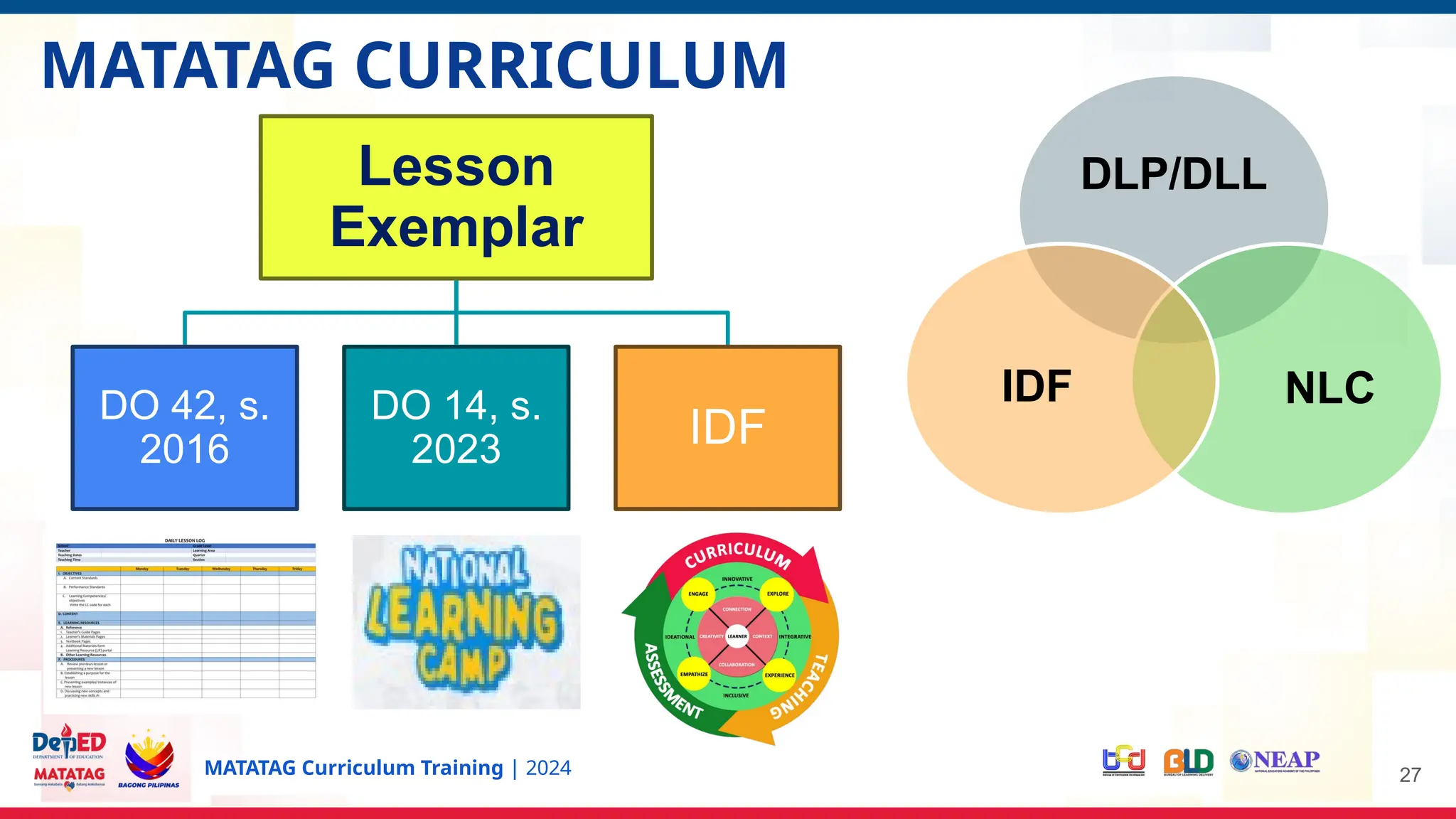
MATATAG Curriculum
Session 2
21st Century Skills in the
MATATAG Curriculum
Session 3
Walkthrough of [Learning
Area] Shaping Paper
Day 2
Session 4
Quarter 1 Curriculum
Standards and
Unpacking/Clustering of
Learning Competencies
Session 5
Quarter 2 Curriculum
Standards and
Unpacking/Clustering of
Learning Competencies
Day 3
Session 6
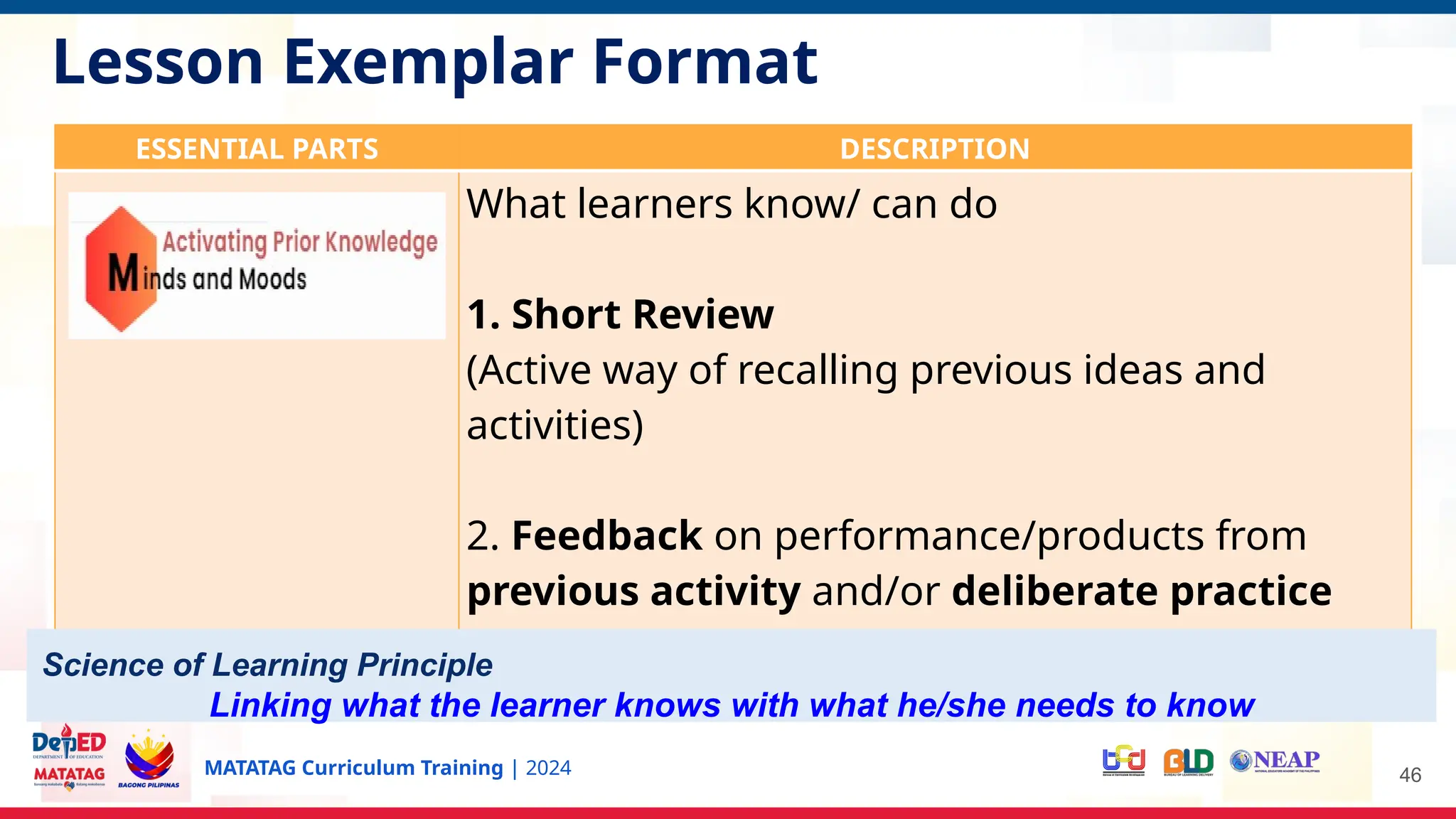
MATATAG Curriculum:
Instructional Design
Framework
Session 7A
MATATAG (Learning Area)
Instructional Design
Framework (IDF): Pedagogy
and Assessment
Session 7B
MATATAG (Learning Area)
Walkthrough of Learning
Resources
Day 4
Session 8
Integrating 21st Century
Skills in Classroom-based
Assessment
Session 9
Classroom Practices
to Promote
Inclusion for Special Needs
Education Learners (SNED)
Session 10
Collaborative Expertise
Session 11
Class Observation in the
Context of MATATAG
Curriculum
Day 5
Session 12
Management of School-
based Professional
Development Programs
Session 13
Facilitation Skills
Posttest
Closing Program
*For School Leaders Only
MATATAG Curriculum Training | 2024
Grade 4/7 Learning Journey
5
Day 1
Pretest
Opening Program
Session 1
The General Shape of the
MATATAG Curriculum
Session 2
21st Century Skills in the
MATATAG Curriculum
Session 3
Walkthrough of [Learning
Area] Shaping Paper
Day 2
Session 4
Quarter 1 Curriculum
Standards and
Unpacking/Clustering of
Learning Competencies
Session 5
Quarter 2 Curriculum
Standards and
Unpacking/Clustering of
Learning Competencies
Day 3
Session 6
MATATAG Curriculum:
Instructional Design
Framework
Session 7A
MATATAG (Learning Area)
Instructional Design
Framework (IDF): Pedagogy
and Assessment
Session 7B
MATATAG (Learning Area)
Walkthrough of Learning
Resources
Day 4
Session 8
Integrating 21st Century
Skills in Classroom-based
Assessment
Session 9
Classroom Practices
to Promote
Inclusion for Special Needs
Education Learners (SNED)
Session 10
Collaborative Expertise
Session 11
Class Observation in the
Context of MATATAG
Curriculum
Day 5
Session 12
Management of School-
based Professional
Development Programs
Session 13
Facilitation Skills
Posttest
Closing Program
*For School Leaders Only
MATATAG Curriculum Training | 2024
Session Objectives
At the end of the session, participants will be able to:
1. explain the design of the lesson plan for the MATATAG
Science 4 Curriculum;
2. enhance a sample lesson exemplar following a
prescribed design, and considering its alignment with
the IDF, and pedagogies for Science; and
3. appreciate the value of designing a lesson plan that
aligns with the K to 10 IDF, pedagogies and assessment
in Science.
6
MATATAG Curriculum Training | 2024
Professional Standards Addressed:
7
Philippine Professional Standards for School Heads
PPSSH 3.1 School-based review, contextualization and implementation of learning
standards
PPSSH 3.2 Teaching standards and pedagogies
PPSSH 4.1. Personal and professional development
PPSSH 4.5. Professional development of school personnel
Philippine Professional Standards for Supervisors
PPSS 1.1 Supporting curriculum implementation
PPSS 3.1 Support for instructional leadership
PPSS 4.1 Learning and development
PPSS 4.3 Personal and professional development
MATATAG Curriculum Training | 2024
Professional Standards Addressed:
8
Philippine Professional Standards for Teachers
PPST 1: Content Knowledge and Pedagogy
1.2 Research-based knowledge and principles of teaching and learning;
1.5 Strategies for developing critical and creative thinking, as well as other
higher-order thinking skills;
PPST 2: Learning Environment
2.3 Management of classroom structure and activities;
2.4 Support for learner participation; and
2.5 Promotion of purposive learning.
PPST 4: Curriculum and Planning
4.1. Planning and management of teaching and learning process;
4.2 Learning outcomes aligned with learning competencies
MATATAG Curriculum Training | 2024
Session Flow
Lesson Design for the MATATAG Curriculum
Features of the Lesson Exemplar / Lesson Plan
Parts of a Lesson Plan
Walkthrough of Sample Teaching and Learning Resources
9
MATATAG Curriculum Training | 2024
Switching the Paper Doll Dresses
1.Stay with your existing group.
2.Exchange your paper dolls with
the other group’s dolls.
3.Try if the patterns you have and
the dresses you have made would
fit your new paper doll.
10
Time Duration: 3 minutes.
MATATAG Curriculum Training | 2024
Questions:
1. How did you initially feel when switching the paper
dolls and trying with it the dresses you have?
2. Which paper doll dress felt like the best fit for your
new doll?
3. Why is it important that the design and dress should
be appropriate and suitable to the paper doll?
11
MATATAG Curriculum Training | 2024 12
In the context of lesson
planning, how do we ensure its
appropriateness and
effectiveness to the learners?
MATATAG Curriculum Training | 2024 13
GRADE 4 SCIENCE
LET’S TRY
“Stop-Look-Review: Lesson Plan Inspection”
MATATAG Curriculum Training | 2024 14
1. Review the sample lesson
exemplar provided.
2. Analyze each part of the LE, by
identifying the Teaching
Strategy/ Method used, and
the IDF features surfaced.
3. Provide your comment/s and
recommendation for each
part of the LE in the REMARKS
Column, as shown below.
Time Duration: 10 minutes.
What to do?
“Stop-Look-Review: Lesson Plan Inspection”
MATATAG Curriculum Training | 2024 15
Time Duration: 10 minutes.
Template “Stop-Look-Review: Lesson Plan Inspection”
Eg: Video presentation Context, Integration Answer the Guide questions by group; involve Collaboration
MATATAG Curriculum Training | 2024 16
“Stop-Look-Review:
Lesson Plan Inspection”
https://bit.ly/Sci4_8B_Activity
MATATAG Curriculum Training | 2024
PRESENTATION
OF OUTPUTS
17
MATATAG Curriculum Training | 2024
Let’s Dig Into
18
MATATAG Curriculum Training | 2024
Let’s Dig Into!
How does the lesson present the
alignment of Curriculum, Teaching and
Assessment?
19
MATATAG Curriculum Training | 2024
What most prominent IDF features have
surfaced in the parts of the Lesson Plan?
20
Let’s Dig Into!
MATATAG Curriculum Training | 2024
How is the design and strategies/parts
of the lesson contribute to the
attainment of lesson objective/s?
21
Let’s Dig Into!
MATATAG Curriculum Training | 2024
Is the lesson applicable to your own type of
learners? What general suggestion for
improvement of the lesson did you give?
22
Let’s Dig Into!
MATATAG Curriculum Training | 2024
Let’s Discuss
23
MATATAG Curriculum Training | 2024 24
a detailed outline or guide that
teachers use to structure and
organize their instructional
activities for a specific lesson or class
period
serves as a roadmap for teachers,
helping them effectively deliver
content, engage students, and
achieve desired learning target
Lesson Plan
DepEd Order No. 42, s. 2016 Policy Guidelines on Daily Lesson Preparation for the K to 12
Basic Education Program
MATATAG Curriculum Training | 2024 25
A Lesson Plan detailed outline or guide
developed by the teacher/s before delivering
instruction. It serves as a roadmap for what will
be covered in a particular lesson.
A Lesson Exemplar is a detailed,
exemplary model or example of a lesson plan.
It typically showcases best practices,
innovative teaching strategies, and effective
ways to achieve learning objectives.
Lesson Exemplar and Lesson Plan
Wiggins, G., & McTighe, J. (2005). Understanding by Design. ASCD.
MATATAG Curriculum Training | 2024
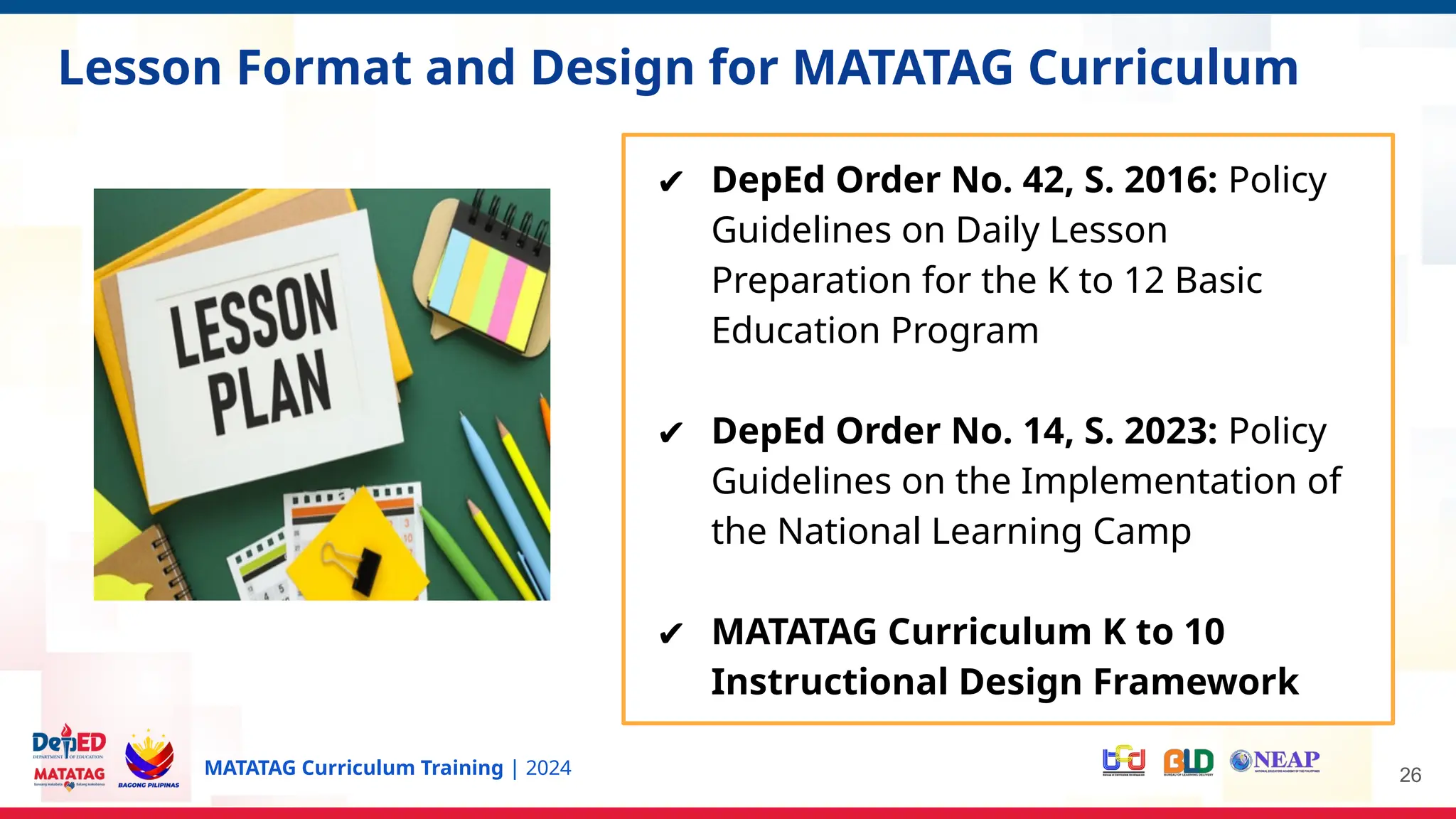
Lesson Format and Design for MATATAG Curriculum
✔ DepEd Order No. 42, S. 2016: Policy
Guidelines on Daily Lesson
Preparation for the K to 12 Basic
Education Program
✔ DepEd Order No. 14, S. 2023: Policy
Guidelines on the Implementation of
the National Learning Camp
✔ MATATAG Curriculum K to 10
Instructional Design Framework
26
MATATAG Curriculum Training | 2024
MATATAG CURRICULUM
Lesson
Exemplar
DO 42, s.
2016
DO 14, s.
2023 IDF
DLP/DLL
NLC
IDF
27
MATATAG Curriculum Training | 2024
Parts of Lesson Plan
Objectives Content Learning
Resources
Procedures
Evaluating
Learning
Additional
Activities
Remarks Reflection
Short Review
Lesson
Purpose/
Intention
Lesson
Language
Practice
Lesson
Conclusion
Lesson
Activity
DO 42, s. 2016 DO 14, s. 2023
28
MATATAG Curriculum Training | 2024
Parts of Lesson Plan
29
Parts of Lesson Exemplar used
for the Quarter 1 (Pilot)
MATATAG Curriculum Training | 2024
Parts of Lesson Plan
30
Parts of Lesson Exemplar used for the Quarter 2-4 (Pilot)
MATATAG Curriculum Training | 2024
Short Task
31
With a partner,
compare and contrast
the parts of the
Lesson Exemplar used
in Q1 and Q2 for pilot
schools.
MATATAG Curriculum Training | 2024
Features of Lesson Plan
32
MATATAG Curriculum Training | 2024 33
Lesson Exemplar Format
MATATAG Curriculum Training | 2024
Lesson Exemplar Format
34
ESSENTIAL PARTS DESCRIPTION
I. Curriculum
Content,
Standards, And
Lesson
Competencies
This part includes objectives related to
content knowledge and competencies.
It also describes the behavior or
performance teachers want learners to
exhibit to consider them competent. It
states what the teacher intends to teach
and serves as a guide for instruction and
assessment.
MATATAG Curriculum Training | 2024
Lesson Exemplar Format
35
ESSENTIAL PARTS DESCRIPTION
Benchmarks of Knowledge and Skills.
The content standards define what students are
expected to know (knowledge: facts and
information), what they should be able to do
(process or skills) with what they know, and the
meanings or understandings that they construct or
make as they process the facts and information.
Key concepts and skills that are covered in the
quarter
MATATAG Curriculum Training | 2024 36
ESSENTIAL PARTS DESCRIPTION
as Benchmarks of Transfer of Learning.
Level of and/or evidence of performance
expected to be exhibited by learners at the end
of the quarter.
The performance standards define the expected
proficiency level which is expressed in two ways:
students should be able to use their learning
or understanding in real-life situations, and they
should be able to do this on their own.
Lesson Exemplar Format
MATATAG Curriculum Training | 2024 37
ESSENTIAL PARTS DESCRIPTION
are specific skills performed with varying degrees
of independence.
also refers to the ability to perform activities
according to standards expected by drawing from
one’s knowledge, skills, and attitudes.
have different degrees of difficulty and
performance levels.
The competencies are unpacked through learning
objectives which the lesson will address.
Lesson Exemplar Format
MATATAG Curriculum Training | 2024 38
ESSENTIAL PARTS DESCRIPTION
are SMART and based on the learning
competencies
SMART – Specific, Measurable, Attainable,
Realistic, Time-bound
usually written by the teacher in an
effort to unpack the learning
competencies
Lesson Exemplar Format
MATATAG Curriculum Training | 2024
Learning Objectives
39
Cognitive
(Understanding and Applying
Scientific Knowledge)
Psychomotor
(Performing Scientific Inquiry
Skills)
Affective
(Developing and Demonstrating
Scientific Attitudes and values)
MATATAG Curriculum Training | 2024
Learning Objectives
40
Cognitive
(Understanding and
Applying Scientific
Knowledge)
https://tips.uark.edu
MATATAG Curriculum Training | 2024
Learning Objectives
41
Psychomotor
(Performing Scientific
Process / Inquiry
Skills)
Scientific, Technological, and Environmental Literacy Study. (2005). UP-NISMED
MATATAG Curriculum Training | 2024
Learning Objectives
42
Affective
(Developing and
Demonstrating
Scientific Attitudes and
values)
https://moe.edu.sg/
MATATAG Curriculum Training | 2024 43
ESSENTIAL PARTS DESCRIPTION
The subject matter of the lesson.
It encompasses the key concepts, facts, skills,
and understandings that learners are expected
to acquire (topics and subtopics).
It indicates the connection of the content to
different subject areas or disciplines to create
a more holistic and interconnected learning
experience.
Integration of topics, themes, and/or advocacies
Lesson Exemplar Format
MATATAG Curriculum Training | 2024 44
Learning Resources
 The references include the pages of the
TG, LM, textbook, and the additional
materials from the LRMDS portal.
 The other learning resources refer to
materials such as those that are teacher-
made, authentic, and others not included
in the references.
 This part can also include the supplies,
equipment, tools and other non-print
materials needed for activities before,
during, and after the lesson.
MATATAG Curriculum Training | 2024
Teaching and Learning Procedures (with Prompts)
45
• Activating Prior Knowledge (Mind
and Mood)
• Establishing Lesson Purpose
(Aims)
• Developing and Deepening
Understanding (Tasks and
Thought)
• Making Generalizations
(Abstractions)
• Evaluating Learning (Tools for
Assessment)
• Teacher’s Remarks (Annotations)
• Reflection (Gains)
MATATAG Curriculum Training | 2024
Lesson Exemplar Format
46
ESSENTIAL PARTS DESCRIPTION
What learners know/ can do
1. Short Review
(Active way of recalling previous ideas and
activities)
2. Feedback on performance/products from
previous activity and/or deliberate practice
(Optional)
Science of Learning Principle
Linking what the learner knows with what he/she needs to know
MATATAG Curriculum Training | 2024
Lesson Exemplar Format
47
ESSENTIAL PARTS DESCRIPTION
1. Engagement activities
2. Establishing reason for learning the new
lesson
3. Unlocking content area of vocabulary
(general words and/or domain specific
words) and important words that will
facilitate understanding of the lesson.
Science of Learning Principle
Preparing learners for what is to come
Providing learners the necessary language that the teacher will use
MATATAG Curriculum Training | 2024
Lesson Exemplar Format
48
ESSENTIAL PARTS DESCRIPTION
• Explicitation
- Processing of initial understanding of new idea
• Worked Example
-Modeling, Experiments
- Guided deliberate practice, Elaboration and/or
extended practice, Translating errors into useful
knowledge
• Lesson Activity (Application and/or integration)
- Working on multiple examples (varied and repetitive),,
Independent / Extended practice
Science of Learning Principle
Developing the ‘idea’ of the lesson, working on an example, and application
MATATAG Curriculum Training | 2024
Lesson Exemplar Format
49
ESSENTIAL PARTS DESCRIPTION
1. Learners’ Takeaways (conceptual
understanding/written record)
2. Reflection on Learning (metacognition-
thinking about what and how they learned.
Science of Learning Principle
Allowing learners to write and/or talk about the idea they have understood
after practice activities
Having learners reflect on how they learned (gains and challenges)
MATATAG Curriculum Training | 2024
Lesson Exemplar Format
50
ESSENTIAL PARTS DESCRIPTION
1. Formative Assessment (performance,
product, written output)
Various assessment methods and tools may
be utilized.
2. Homework (optional)
-reasonable extended deliberate practice
ools for
Assessment / Test
Science of Learning Principle
Assessing content understanding and skill development
MATATAG Curriculum Training | 2024
Lesson Exemplar Format
51
COMPONENTS DESCRIPTION
F. Teacher’s
Remarks
(Annotation)
Notes on:
1. Relevant observations (critical incident)
2. Learning outcomes accomplished
3. Tasks that will be continued the next
day
4. Additional activities needed
MATATAG Curriculum Training | 2024
Lesson Exemplar Format
52
COMPONENTS DESCRIPTION
G. Reflection
(Gains)
Teacher’s Reflection after the Instructional lesson
that may be input of LAC/ Collaborative Expertise
Session
• Explored strategy, method, or activity
• Experience about the materials used and the
learners engagement
• Problems encountered and actions to taken
• Anticipated challenges and intended solutions
Supporting teachers in their reflective practice
MATATAG Curriculum Training | 2024
Lesson Exemplar Format
53
• Duration
• Materials
needed
• Online
references
• Other
suggested
strategies
• Safety
consideration
• Etc.
MATATAG Curriculum Training | 2024
Learners Worksheet Parts
54
Worksheet Parts Description
I. Activity No.: Title
II. Objective(s)
III. Materials Needed
copy of text, link to viewing/media text, materials
for projects and/or experiments, and tools for
application tasks
IV. Instructions
● guide to the learner on the purpose and
procedure of the activity
● learner support (sample responses, illustrations,
and/or models)
● differentiation in terms of task difficulty, output
options, texts choices
MATATAG Curriculum Training | 2024
Learners Worksheet Parts
55
Worksheet Parts Description
V. Synthesis/
Extended Practice/
Differentiation
● synthesis question or prompt to have learners
write/talk about their conceptual understanding
● additional activities for extended practice
● suggestions for differentiation to match learners’
progress
MATATAG Curriculum Training | 2024
Learners Worksheet Parts
56
MATATAG Curriculum Training | 2024
Lesson Exemplar Format
57
III. TEACHING AND LEARNING PROCEDURES
A. Activating
Prior Knowledge
(Minds and Moods)
Short Review/ Elicit recall of previous ideas and activities
B. Establishing
Purpose of the
Lesson
(Aims)
Motivation / Priming / Engagement activities
Establish reason for learning new lesson
Unlocking content area vocabulary and important words to facilitate learning
C. Developing
and Deepening
Understanding
(Task and Thought)
• Experiments / Modeling / Guided Activity / Processing of understanding /
Exploration and Explanation of understanding
• Elaboration and/or Extended practice / Independent Practice / Integration
D. Making
Generalization
(Abstraction)
Learners take-away (Elaboration of Conceptual understanding)
Reflection on Learning (Metacognition)
E. Evaluating
Learning
(Tool for Evaluation / Assessment)
Assessment / Evaluation (Conceptual understanding) and/or
Homework (optional) / Extension of understanding and skills
Remarks (Annotation) – Relevant observations, remarks on assessment and tasks
Reflection (Gains) – Best practice/strategy, Problems encountered w/solutions (LAC)
MATATAG Curriculum Training | 2024 58
The 5E / 7E
Inquiry-
based
Instructional
Model
Elicit
Determine students' prior
knowledge and existing
misconceptions related to the topic.
Extend
Allow students to apply their
knowledge and skills in
new contexts or extensions.
https://knowledgequest.aasl.org/
MATATAG Curriculum Training | 2024 59
The 5E / 7E Model and the Lesson Plan Parts
III. TEACHING AND LEARNING PROCEDURES
A. Activating Prior
Knowledge
ELICIT
B. Establishing Purpose of
the Lesson
ENGAGE
C. Developing and
Deepening Understanding
EXPLORE – EXPLAIN
ELABORATE
D. Making Generalization EXPLAIN - ELABORATE
E. Evaluating Learning EVALUATE - EXTEND
Remarks
Reflection
MATATAG Curriculum Training | 2024 60
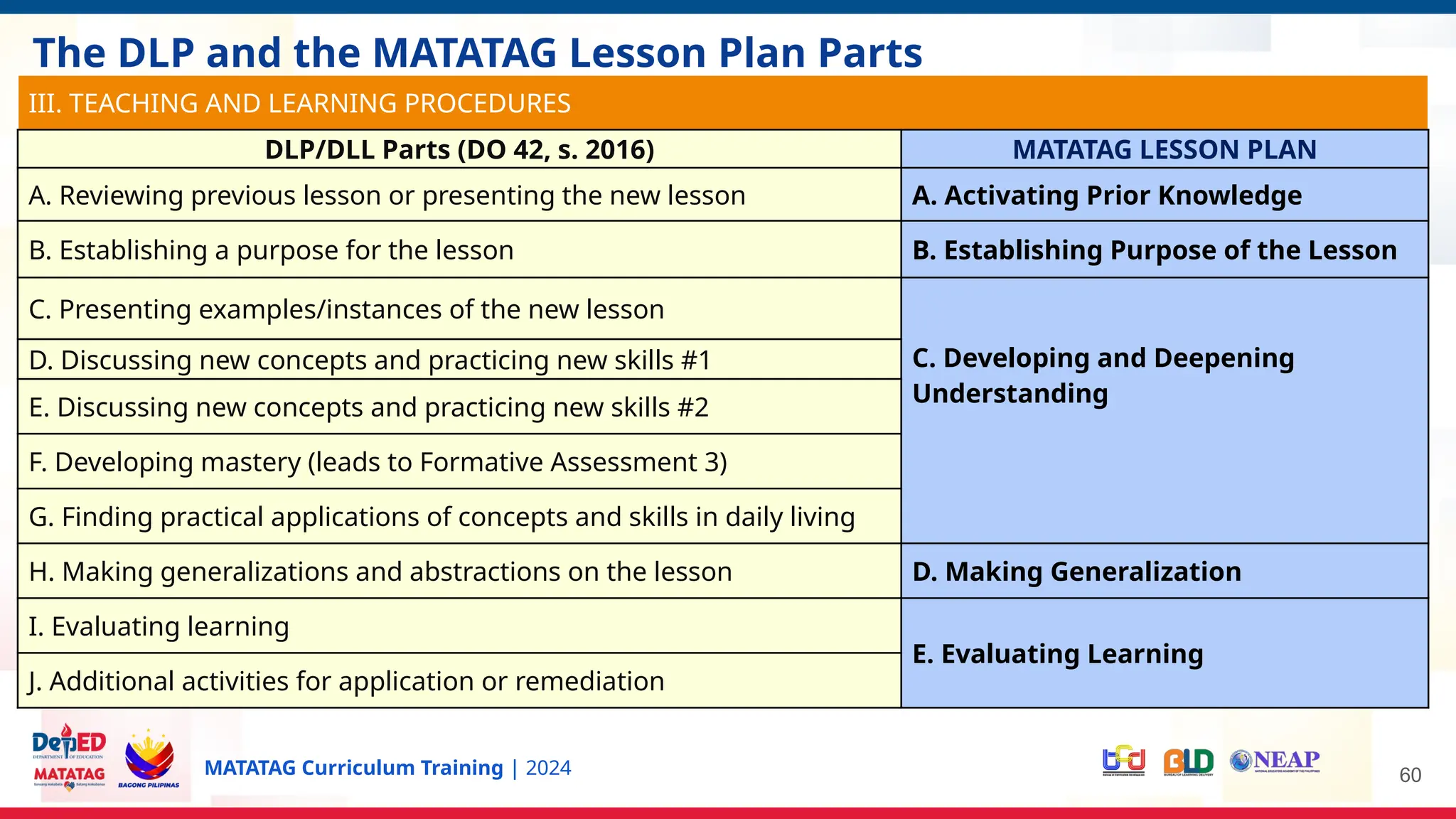
The DLP and the MATATAG Lesson Plan Parts
III. TEACHING AND LEARNING PROCEDURES
DLP/DLL Parts (DO 42, s. 2016) MATATAG LESSON PLAN
A. Reviewing previous lesson or presenting the new lesson A. Activating Prior Knowledge
B. Establishing a purpose for the lesson B. Establishing Purpose of the Lesson
C. Presenting examples/instances of the new lesson
C. Developing and Deepening
Understanding
D. Discussing new concepts and practicing new skills #1
E. Discussing new concepts and practicing new skills #2
F. Developing mastery (leads to Formative Assessment 3)
G. Finding practical applications of concepts and skills in daily living
H. Making generalizations and abstractions on the lesson D. Making Generalization
I. Evaluating learning
E. Evaluating Learning
J. Additional activities for application or remediation
MATATAG Curriculum Training | 2024 61
WALKTHROUGH
OF A SAMPLE SCIENCE LESSON
MATATAG Curriculum Training | 2024 62
Content
Standards
Learners learned that animals and plants have systems that function to keep
them alive.
Performance
Standards
By the end of the quarter, learners identify that plants and animals have
systems whose function is to keep them alive.
Learning
Competency:
The learners describe in simple terms how the following human body
systems work: muscular, skeletal, digestive,
circulatory, and respiratory.
Objective/s: At the end of the lesson, Describe the main functions of the muscular
system in simple terms. (Week 1 / Day 1-3)
Content: Human Body Systems: Muscular System
Integration: Health and Wellness / Good Health and Well-being
CURRICULUM CONTENT, STANDARDS, AND LESSON
COMPETENCIES
MATATAG Curriculum Training | 2024 63
TEACHING AND LEARNING PROCEDURES
Activating
Prior
Knowledge
Short Review
A. Animal Needs Scavenger Hunt: Students will identify and understand the basic needs
of animals.
Instructions: Organize a scavenger hunt in the schoolyard or a local park. Provide
students with a list of things animals need (e.g., food, water, shelter, air). Have them
search for examples of each in the natural environment and discuss
their findings after.
Guide Questions:
1. What is one example of an animal's need for food that you observed during the
scavenger hunt? Describe the food source and the animal's interaction with it.
2. Can you find evidence of animals accessing water sources during the scavenger
hunt? How important is water to the survival of these animals?
3. Did you come across any natural shelters or hiding places that animals might
use for protection? What kinds of animals do you think would seek refuge in these
areas?
4. How do you think animals in the environment you explored obtain the air they
need to breathe? Can you see any signs of animals using the air for respiration?
MATATAG Curriculum Training | 2024 64
TEACHING AND LEARNING PROCEDURES
Establishing
Lesson
Purpose
Lesson Purpose
Muscular System
• Begin with a short video or interactive presentation that highlights the
incredible feats of the muscular system, such as athletes performing in
sports or other professionals such as ballet dancers, runners, swimmers,
divers.
• Prompt a class discussion by asking students to share instances when
they used their muscles to accomplish something impressive, like lifting
a heavy object or running a long distance, or performing dance
movements or simple gymnastics.
• Explain that understanding the muscular system can help them
improve our body - physical abilities, posture, strength, and health.
• Maybe, the teacher may introduce how to make the muscular system
healthy or ways to prevent injuries or damage to the muscles (i.e., sprain,
bruises, burns, contusions, etc.)
MATATAG Curriculum Training | 2024 65
TEACHING AND LEARNING PROCEDURES
Establishing
Lesson Purpose
Unlocking Content Area Vocabulary
Muscular System
• Provide students with a list of related words such as “muscles”,
“movement”, “posture”, “strength”, “flexibility”, and “voluntary”.
• Encourage the students to find and write down simplified
explanations
or synonyms for these words.
Developing and
Deepening
Understanding
1. Explicitation
• Divide students into groups and provide each group with a set of
cards containing terms related to the muscular system, such as
“muscles”, “movement”, “posture”, "strength", "flexibility", and
"voluntary."
• Ask each group to sort the cards into categories and provide simple
explanations or synonyms for each term.
• Have each group present their categorized cards and explanations to
the class.
MATATAG Curriculum Training | 2024 66
TEACHING AND LEARNING PROCEDURES
Developing and
Deepening
Understanding
2. Worked Example
• In the Philippines, we often help our families with farming and
fishing. Our muscles are like the 'engines' that power us through
these tasks. When we plant rice in the fields, our muscles help us dig
and carry heavy loads of rice. They also enable us to paddle boats
when we go fishing, just like the engine of a boat.
• Muscles give us the proper posture, strength and flexibility to do
these important jobs.
Note: The teacher may provide pictures showing farming, fishing
activities to the students to augment the discussion.
MATATAG Curriculum Training | 2024 67
TEACHING AND LEARNING PROCEDURES
Developing and
Deepening
Understanding
3. Lesson Activity
• Show students images or diagrams of the muscular system.
• Divide the class into small groups and provide each group with a set of
labels for different muscle types (e.g., skeletal, smooth, and cardiac muscles).
• Have each group create a poster or diagram that illustrates the functions
of these muscles using simple language and visuals. Encourage them to
explain the function of muscles such as movement, support and protection of
internal organs, generates heat, and aid blood circulation.
• Ask the students to perform Activity No. 1 titled “Muscle Mania:
Understanding the Muscular System”, and let them answer the guide
questions found in the work sheet. (Muscles Labeling Activity)
• Ask the students to perform Activity No. 2 titled “Muscle Power: A Hands-
On Exploration”, and let them answer the guide questions found in the
worksheet. (Muscle contraction and relaxation by using a simple model)
MATATAG Curriculum Training | 2024 68
TEACHING AND LEARNING PROCEDURES
Making
Generalizations
Learners’ Takeaways
Muscular System: Main Functions
Direction: Complete the concept map below by providing the main
functions of the muscular system to the bubbles that are connected to the
central bubble labeled "Muscular System".
MATATAG Curriculum Training | 2024 69
TEACHING AND LEARNING PROCEDURES
Evaluating
Learning
Analyze a short passage below and answer the questions that follows.
"Keeping our muscles healthy is crucial for staying active and strong. Regular exercise, such as
biking or playing sports, helps strengthen our muscles, while warming up before activities
reduces the risk of injury. Staying hydrated, getting enough rest, and maintaining a balanced diet
with protein-rich foods contribute to muscle health. Listening to our bodies, taking breaks when
needed, and seeking help if we experience unusual pain are essential practices. By incorporating
these habits into our daily lives, we not only promote muscle strength but also ensure overall well-
being, allowing us to enjoy a healthy and active lifestyle.”
1. What are two examples of activities mentioned in the passage that help strengthen
muscles?
a) Watching TV b) Biking and playing sports
c) Eating ice cream d) Sleeping all day
2. According to the passage, why is it important to warm up before physical activities?
a) To make the activity more difficult b) To reduce the risk of injury
c) To avoid exercising d) To save time
3. What is the main function of the Muscular System and why is it important to maintain
our muscles healthy?
MATATAG Curriculum Training | 2024 70
TEACHING AND LEARNING PROCEDURES
Teacher’s
Remarks
Teacher’s
Reflection
Direction: Answer briefly the following questions.
1. What principles and beliefs informed my lesson?
2. Why did I teach the lesson the way I did?
3. What roles did my students play in my lesson?
4. What did my students learn? How did they learn?
5. What could I have done differently?
6. What can I explore in the next lesson?
Note on observation
on the following area
Effective Practice Problem Encountered
Strategy explored
Materials Used
Learners
Engagement
Other
MATATAG Curriculum Training | 2024 71
LESSON COVERAGE
III. T-LPROCEDURES DAY 1 DAY 2 DAY 3
A. Activating Prior Knowledge
Recall Recall Recall
B. Establishing Purpose of the
Lesson
Motivation
C. Developing and Deepening
Understanding
Activity 1 Activity 1 -2 Activity 2/
Application/
Integration
D. Making Generalization
Abstraction /
Extension
E. Evaluating Learning
(Informal FA) (Informal FA) Evaluation
Note: Science for Grades 3 to 6 is allotted for 45 minutes daily (five days)
MATATAG Curriculum Training | 2024 72
Based from the presented Lesson Exemplar,
what modification can you suggest for its
enhancement, if you will deliver the lesson in your own
class?
MATATAG Curriculum Training | 2024 73
Let’s Put
Into Action
Plan It Right: Lesson Plan
Make-over!
MATATAG Curriculum Training | 2024
Plan It Right: Lesson Plan Make-over!
Review and analyze a
sample Lesson Exemplar. Try
to provide comments and
modify into your own lesson
plan based on the previous
discussions on IDF, Pedagogy
and Assessment.
You may log first the
important activities in each
part of the Lesson Plan.
74
MATATAG Curriculum Training | 2024 75
Time Duration: 10 minutes.
Template Plan It Right: Lesson Plan Make-over!
MATATAG Curriculum Training | 2024 76
Time Duration: 10 minutes.
Template and Sample LEs
Plan It Right: Lesson Plan Make-over!
bit.ly/Science4_Session6B
MATATAG Curriculum Training | 2024 77
MATATAG Curriculum Training | 2024
PRESENTATION
OF OUTPUTS
78
MATATAG Curriculum Training | 2024 79
As an instructional leader, what is the
value of reviewing a pre-prepared
Lesson Exemplar by your teachers?
MATATAG Curriculum Training | 2024
CLOSING
81
“Plans are of little
importance, but
planning is
essential.”
- Winston Churchill
MATATAG Curriculum Training | 2024 82
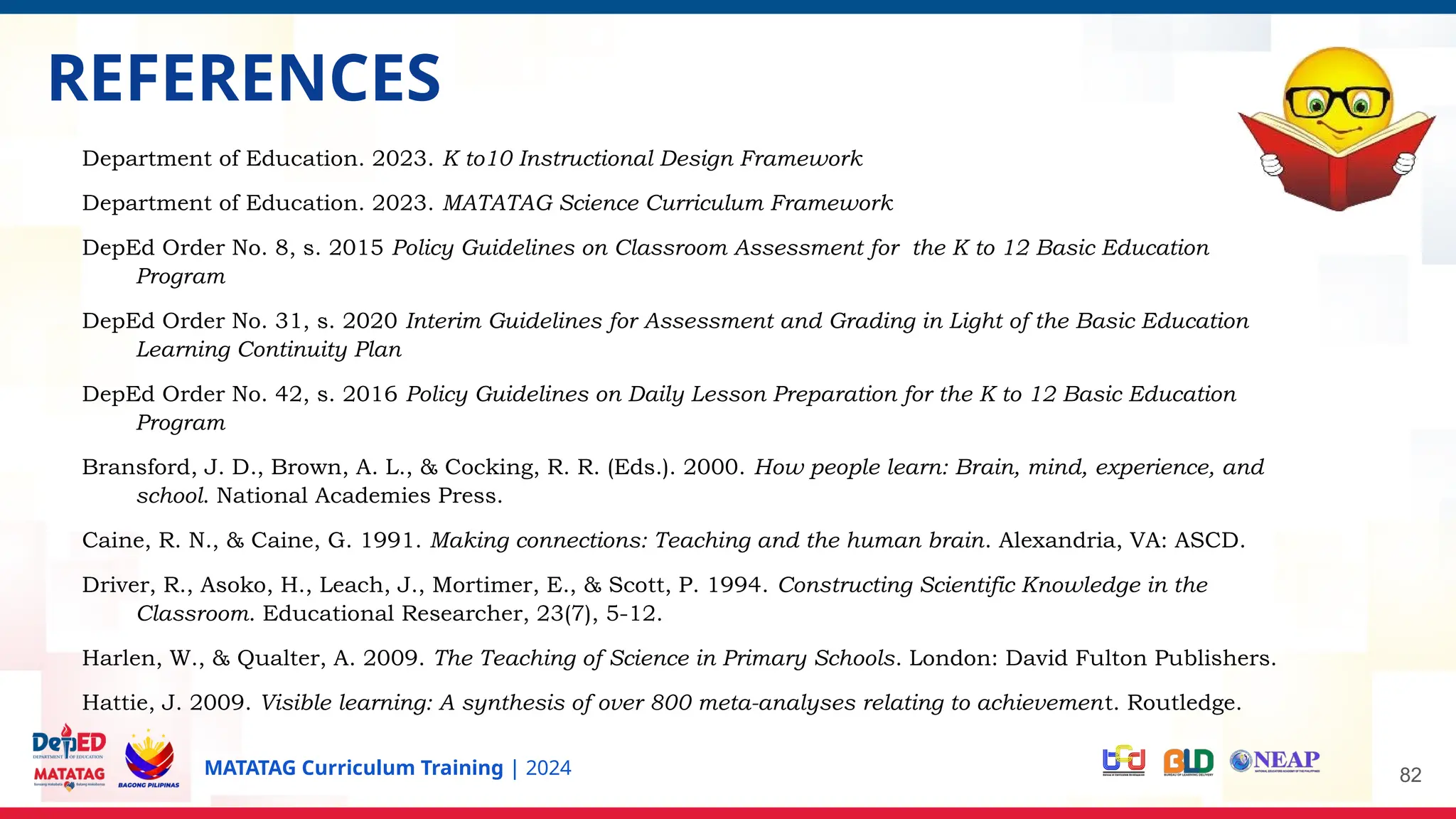
REFERENCES
Department of Education. 2023. K to10 Instructional Design Framework
Department of Education. 2023. MATATAG Science Curriculum Framework
DepEd Order No. 8, s. 2015 Policy Guidelines on Classroom Assessment for the K to 12 Basic Education
Program
DepEd Order No. 31, s. 2020 Interim Guidelines for Assessment and Grading in Light of the Basic Education
Learning Continuity Plan
DepEd Order No. 42, s. 2016 Policy Guidelines on Daily Lesson Preparation for the K to 12 Basic Education
Program
Bransford, J. D., Brown, A. L., & Cocking, R. R. (Eds.). 2000. How people learn: Brain, mind, experience, and
school. National Academies Press.
Caine, R. N., & Caine, G. 1991. Making connections: Teaching and the human brain. Alexandria, VA: ASCD.
Driver, R., Asoko, H., Leach, J., Mortimer, E., & Scott, P. 1994. Constructing Scientific Knowledge in the
Classroom. Educational Researcher, 23(7), 5-12.
Harlen, W., & Qualter, A. 2009. The Teaching of Science in Primary Schools. London: David Fulton Publishers.
Hattie, J. 2009. Visible learning: A synthesis of over 800 meta-analyses relating to achievement. Routledge.
MATATAG Curriculum Training | 2024
Program Management Team
Curriculum and Teaching Strand
Bureau of Curriculum Development
Bureau of Learning Delivery
Bureau of Education Assessment
Bureau of Alternative Education
Bureau of Learning Resources
Human Resources and Organizational
Development Strand
National Educators Academy of the Philippines
(NEAP)
Professional Development Division
Quality Assurance Division
Session Guide and Presentation
Deck Developer/s
BLD
Julieven R. Abrea
MATATAG CURRICULUM TRAINING RESOURCE PACKAGE
MARAMING SALAMAT!
84

Science 4_Session_Matatag Curriculum_deped_philippines

  • 1.
    TRAINING ON THE MATATAGCURRICULUM 1 Venue: Molave Hotel, Tagum City Date: July 8-12, 2024
  • 2.
    TRAINING ON THE MATATAGCURRICULUM 2 Venue: Molave Hotel, Tagum City Date: July 8-12, 2024 SCIENCE 4
  • 3.
    MATATAG Curriculum Training| 2024 Session 7B MATATAG Science 4 Curriculum Walkthrough of Learning Resources JULIE ANN L. CORTES School Head 3
  • 4.
    MATATAG Curriculum Training| 2024 Grade 4/7 Learning Journey 4 Day 1 Pretest Opening Program Session 1 The General Shape of the MATATAG Curriculum Session 2 21st Century Skills in the MATATAG Curriculum Session 3 Walkthrough of [Learning Area] Shaping Paper Day 2 Session 4 Quarter 1 Curriculum Standards and Unpacking/Clustering of Learning Competencies Session 5 Quarter 2 Curriculum Standards and Unpacking/Clustering of Learning Competencies Day 3 Session 6 MATATAG Curriculum: Instructional Design Framework Session 7A MATATAG (Learning Area) Instructional Design Framework (IDF): Pedagogy and Assessment Session 7B MATATAG (Learning Area) Walkthrough of Learning Resources Day 4 Session 8 Integrating 21st Century Skills in Classroom-based Assessment Session 9 Classroom Practices to Promote Inclusion for Special Needs Education Learners (SNED) Session 10 Collaborative Expertise Session 11 Class Observation in the Context of MATATAG Curriculum Day 5 Session 12 Management of School- based Professional Development Programs Session 13 Facilitation Skills Posttest Closing Program *For School Leaders Only
  • 5.
    MATATAG Curriculum Training| 2024 Grade 4/7 Learning Journey 5 Day 1 Pretest Opening Program Session 1 The General Shape of the MATATAG Curriculum Session 2 21st Century Skills in the MATATAG Curriculum Session 3 Walkthrough of [Learning Area] Shaping Paper Day 2 Session 4 Quarter 1 Curriculum Standards and Unpacking/Clustering of Learning Competencies Session 5 Quarter 2 Curriculum Standards and Unpacking/Clustering of Learning Competencies Day 3 Session 6 MATATAG Curriculum: Instructional Design Framework Session 7A MATATAG (Learning Area) Instructional Design Framework (IDF): Pedagogy and Assessment Session 7B MATATAG (Learning Area) Walkthrough of Learning Resources Day 4 Session 8 Integrating 21st Century Skills in Classroom-based Assessment Session 9 Classroom Practices to Promote Inclusion for Special Needs Education Learners (SNED) Session 10 Collaborative Expertise Session 11 Class Observation in the Context of MATATAG Curriculum Day 5 Session 12 Management of School- based Professional Development Programs Session 13 Facilitation Skills Posttest Closing Program *For School Leaders Only
  • 6.
    MATATAG Curriculum Training| 2024 Session Objectives At the end of the session, participants will be able to: 1. explain the design of the lesson plan for the MATATAG Science 4 Curriculum; 2. enhance a sample lesson exemplar following a prescribed design, and considering its alignment with the IDF, and pedagogies for Science; and 3. appreciate the value of designing a lesson plan that aligns with the K to 10 IDF, pedagogies and assessment in Science. 6
  • 7.
    MATATAG Curriculum Training| 2024 Professional Standards Addressed: 7 Philippine Professional Standards for School Heads PPSSH 3.1 School-based review, contextualization and implementation of learning standards PPSSH 3.2 Teaching standards and pedagogies PPSSH 4.1. Personal and professional development PPSSH 4.5. Professional development of school personnel Philippine Professional Standards for Supervisors PPSS 1.1 Supporting curriculum implementation PPSS 3.1 Support for instructional leadership PPSS 4.1 Learning and development PPSS 4.3 Personal and professional development
  • 8.
    MATATAG Curriculum Training| 2024 Professional Standards Addressed: 8 Philippine Professional Standards for Teachers PPST 1: Content Knowledge and Pedagogy 1.2 Research-based knowledge and principles of teaching and learning; 1.5 Strategies for developing critical and creative thinking, as well as other higher-order thinking skills; PPST 2: Learning Environment 2.3 Management of classroom structure and activities; 2.4 Support for learner participation; and 2.5 Promotion of purposive learning. PPST 4: Curriculum and Planning 4.1. Planning and management of teaching and learning process; 4.2 Learning outcomes aligned with learning competencies
  • 9.
    MATATAG Curriculum Training| 2024 Session Flow Lesson Design for the MATATAG Curriculum Features of the Lesson Exemplar / Lesson Plan Parts of a Lesson Plan Walkthrough of Sample Teaching and Learning Resources 9
  • 10.
    MATATAG Curriculum Training| 2024 Switching the Paper Doll Dresses 1.Stay with your existing group. 2.Exchange your paper dolls with the other group’s dolls. 3.Try if the patterns you have and the dresses you have made would fit your new paper doll. 10 Time Duration: 3 minutes.
  • 11.
    MATATAG Curriculum Training| 2024 Questions: 1. How did you initially feel when switching the paper dolls and trying with it the dresses you have? 2. Which paper doll dress felt like the best fit for your new doll? 3. Why is it important that the design and dress should be appropriate and suitable to the paper doll? 11
  • 12.
    MATATAG Curriculum Training| 2024 12 In the context of lesson planning, how do we ensure its appropriateness and effectiveness to the learners?
  • 13.
    MATATAG Curriculum Training| 2024 13 GRADE 4 SCIENCE LET’S TRY “Stop-Look-Review: Lesson Plan Inspection”
  • 14.
    MATATAG Curriculum Training| 2024 14 1. Review the sample lesson exemplar provided. 2. Analyze each part of the LE, by identifying the Teaching Strategy/ Method used, and the IDF features surfaced. 3. Provide your comment/s and recommendation for each part of the LE in the REMARKS Column, as shown below. Time Duration: 10 minutes. What to do? “Stop-Look-Review: Lesson Plan Inspection”
  • 15.
    MATATAG Curriculum Training| 2024 15 Time Duration: 10 minutes. Template “Stop-Look-Review: Lesson Plan Inspection” Eg: Video presentation Context, Integration Answer the Guide questions by group; involve Collaboration
  • 16.
    MATATAG Curriculum Training| 2024 16 “Stop-Look-Review: Lesson Plan Inspection” https://bit.ly/Sci4_8B_Activity
  • 17.
    MATATAG Curriculum Training| 2024 PRESENTATION OF OUTPUTS 17
  • 18.
    MATATAG Curriculum Training| 2024 Let’s Dig Into 18
  • 19.
    MATATAG Curriculum Training| 2024 Let’s Dig Into! How does the lesson present the alignment of Curriculum, Teaching and Assessment? 19
  • 20.
    MATATAG Curriculum Training| 2024 What most prominent IDF features have surfaced in the parts of the Lesson Plan? 20 Let’s Dig Into!
  • 21.
    MATATAG Curriculum Training| 2024 How is the design and strategies/parts of the lesson contribute to the attainment of lesson objective/s? 21 Let’s Dig Into!
  • 22.
    MATATAG Curriculum Training| 2024 Is the lesson applicable to your own type of learners? What general suggestion for improvement of the lesson did you give? 22 Let’s Dig Into!
  • 23.
    MATATAG Curriculum Training| 2024 Let’s Discuss 23
  • 24.
    MATATAG Curriculum Training| 2024 24 a detailed outline or guide that teachers use to structure and organize their instructional activities for a specific lesson or class period serves as a roadmap for teachers, helping them effectively deliver content, engage students, and achieve desired learning target Lesson Plan DepEd Order No. 42, s. 2016 Policy Guidelines on Daily Lesson Preparation for the K to 12 Basic Education Program
  • 25.
    MATATAG Curriculum Training| 2024 25 A Lesson Plan detailed outline or guide developed by the teacher/s before delivering instruction. It serves as a roadmap for what will be covered in a particular lesson. A Lesson Exemplar is a detailed, exemplary model or example of a lesson plan. It typically showcases best practices, innovative teaching strategies, and effective ways to achieve learning objectives. Lesson Exemplar and Lesson Plan Wiggins, G., & McTighe, J. (2005). Understanding by Design. ASCD.
  • 26.
    MATATAG Curriculum Training| 2024 Lesson Format and Design for MATATAG Curriculum ✔ DepEd Order No. 42, S. 2016: Policy Guidelines on Daily Lesson Preparation for the K to 12 Basic Education Program ✔ DepEd Order No. 14, S. 2023: Policy Guidelines on the Implementation of the National Learning Camp ✔ MATATAG Curriculum K to 10 Instructional Design Framework 26
  • 27.
    MATATAG Curriculum Training| 2024 MATATAG CURRICULUM Lesson Exemplar DO 42, s. 2016 DO 14, s. 2023 IDF DLP/DLL NLC IDF 27
  • 28.
    MATATAG Curriculum Training| 2024 Parts of Lesson Plan Objectives Content Learning Resources Procedures Evaluating Learning Additional Activities Remarks Reflection Short Review Lesson Purpose/ Intention Lesson Language Practice Lesson Conclusion Lesson Activity DO 42, s. 2016 DO 14, s. 2023 28
  • 29.
    MATATAG Curriculum Training| 2024 Parts of Lesson Plan 29 Parts of Lesson Exemplar used for the Quarter 1 (Pilot)
  • 30.
    MATATAG Curriculum Training| 2024 Parts of Lesson Plan 30 Parts of Lesson Exemplar used for the Quarter 2-4 (Pilot)
  • 31.
    MATATAG Curriculum Training| 2024 Short Task 31 With a partner, compare and contrast the parts of the Lesson Exemplar used in Q1 and Q2 for pilot schools.
  • 32.
    MATATAG Curriculum Training| 2024 Features of Lesson Plan 32
  • 33.
    MATATAG Curriculum Training| 2024 33 Lesson Exemplar Format
  • 34.
    MATATAG Curriculum Training| 2024 Lesson Exemplar Format 34 ESSENTIAL PARTS DESCRIPTION I. Curriculum Content, Standards, And Lesson Competencies This part includes objectives related to content knowledge and competencies. It also describes the behavior or performance teachers want learners to exhibit to consider them competent. It states what the teacher intends to teach and serves as a guide for instruction and assessment.
  • 35.
    MATATAG Curriculum Training| 2024 Lesson Exemplar Format 35 ESSENTIAL PARTS DESCRIPTION Benchmarks of Knowledge and Skills. The content standards define what students are expected to know (knowledge: facts and information), what they should be able to do (process or skills) with what they know, and the meanings or understandings that they construct or make as they process the facts and information. Key concepts and skills that are covered in the quarter
  • 36.
    MATATAG Curriculum Training| 2024 36 ESSENTIAL PARTS DESCRIPTION as Benchmarks of Transfer of Learning. Level of and/or evidence of performance expected to be exhibited by learners at the end of the quarter. The performance standards define the expected proficiency level which is expressed in two ways: students should be able to use their learning or understanding in real-life situations, and they should be able to do this on their own. Lesson Exemplar Format
  • 37.
    MATATAG Curriculum Training| 2024 37 ESSENTIAL PARTS DESCRIPTION are specific skills performed with varying degrees of independence. also refers to the ability to perform activities according to standards expected by drawing from one’s knowledge, skills, and attitudes. have different degrees of difficulty and performance levels. The competencies are unpacked through learning objectives which the lesson will address. Lesson Exemplar Format
  • 38.
    MATATAG Curriculum Training| 2024 38 ESSENTIAL PARTS DESCRIPTION are SMART and based on the learning competencies SMART – Specific, Measurable, Attainable, Realistic, Time-bound usually written by the teacher in an effort to unpack the learning competencies Lesson Exemplar Format
  • 39.
    MATATAG Curriculum Training| 2024 Learning Objectives 39 Cognitive (Understanding and Applying Scientific Knowledge) Psychomotor (Performing Scientific Inquiry Skills) Affective (Developing and Demonstrating Scientific Attitudes and values)
  • 40.
    MATATAG Curriculum Training| 2024 Learning Objectives 40 Cognitive (Understanding and Applying Scientific Knowledge) https://tips.uark.edu
  • 41.
    MATATAG Curriculum Training| 2024 Learning Objectives 41 Psychomotor (Performing Scientific Process / Inquiry Skills) Scientific, Technological, and Environmental Literacy Study. (2005). UP-NISMED
  • 42.
    MATATAG Curriculum Training| 2024 Learning Objectives 42 Affective (Developing and Demonstrating Scientific Attitudes and values) https://moe.edu.sg/
  • 43.
    MATATAG Curriculum Training| 2024 43 ESSENTIAL PARTS DESCRIPTION The subject matter of the lesson. It encompasses the key concepts, facts, skills, and understandings that learners are expected to acquire (topics and subtopics). It indicates the connection of the content to different subject areas or disciplines to create a more holistic and interconnected learning experience. Integration of topics, themes, and/or advocacies Lesson Exemplar Format
  • 44.
    MATATAG Curriculum Training| 2024 44 Learning Resources  The references include the pages of the TG, LM, textbook, and the additional materials from the LRMDS portal.  The other learning resources refer to materials such as those that are teacher- made, authentic, and others not included in the references.  This part can also include the supplies, equipment, tools and other non-print materials needed for activities before, during, and after the lesson.
  • 45.
    MATATAG Curriculum Training| 2024 Teaching and Learning Procedures (with Prompts) 45 • Activating Prior Knowledge (Mind and Mood) • Establishing Lesson Purpose (Aims) • Developing and Deepening Understanding (Tasks and Thought) • Making Generalizations (Abstractions) • Evaluating Learning (Tools for Assessment) • Teacher’s Remarks (Annotations) • Reflection (Gains)
  • 46.
    MATATAG Curriculum Training| 2024 Lesson Exemplar Format 46 ESSENTIAL PARTS DESCRIPTION What learners know/ can do 1. Short Review (Active way of recalling previous ideas and activities) 2. Feedback on performance/products from previous activity and/or deliberate practice (Optional) Science of Learning Principle Linking what the learner knows with what he/she needs to know
  • 47.
    MATATAG Curriculum Training| 2024 Lesson Exemplar Format 47 ESSENTIAL PARTS DESCRIPTION 1. Engagement activities 2. Establishing reason for learning the new lesson 3. Unlocking content area of vocabulary (general words and/or domain specific words) and important words that will facilitate understanding of the lesson. Science of Learning Principle Preparing learners for what is to come Providing learners the necessary language that the teacher will use
  • 48.
    MATATAG Curriculum Training| 2024 Lesson Exemplar Format 48 ESSENTIAL PARTS DESCRIPTION • Explicitation - Processing of initial understanding of new idea • Worked Example -Modeling, Experiments - Guided deliberate practice, Elaboration and/or extended practice, Translating errors into useful knowledge • Lesson Activity (Application and/or integration) - Working on multiple examples (varied and repetitive),, Independent / Extended practice Science of Learning Principle Developing the ‘idea’ of the lesson, working on an example, and application
  • 49.
    MATATAG Curriculum Training| 2024 Lesson Exemplar Format 49 ESSENTIAL PARTS DESCRIPTION 1. Learners’ Takeaways (conceptual understanding/written record) 2. Reflection on Learning (metacognition- thinking about what and how they learned. Science of Learning Principle Allowing learners to write and/or talk about the idea they have understood after practice activities Having learners reflect on how they learned (gains and challenges)
  • 50.
    MATATAG Curriculum Training| 2024 Lesson Exemplar Format 50 ESSENTIAL PARTS DESCRIPTION 1. Formative Assessment (performance, product, written output) Various assessment methods and tools may be utilized. 2. Homework (optional) -reasonable extended deliberate practice ools for Assessment / Test Science of Learning Principle Assessing content understanding and skill development
  • 51.
    MATATAG Curriculum Training| 2024 Lesson Exemplar Format 51 COMPONENTS DESCRIPTION F. Teacher’s Remarks (Annotation) Notes on: 1. Relevant observations (critical incident) 2. Learning outcomes accomplished 3. Tasks that will be continued the next day 4. Additional activities needed
  • 52.
    MATATAG Curriculum Training| 2024 Lesson Exemplar Format 52 COMPONENTS DESCRIPTION G. Reflection (Gains) Teacher’s Reflection after the Instructional lesson that may be input of LAC/ Collaborative Expertise Session • Explored strategy, method, or activity • Experience about the materials used and the learners engagement • Problems encountered and actions to taken • Anticipated challenges and intended solutions Supporting teachers in their reflective practice
  • 53.
    MATATAG Curriculum Training| 2024 Lesson Exemplar Format 53 • Duration • Materials needed • Online references • Other suggested strategies • Safety consideration • Etc.
  • 54.
    MATATAG Curriculum Training| 2024 Learners Worksheet Parts 54 Worksheet Parts Description I. Activity No.: Title II. Objective(s) III. Materials Needed copy of text, link to viewing/media text, materials for projects and/or experiments, and tools for application tasks IV. Instructions ● guide to the learner on the purpose and procedure of the activity ● learner support (sample responses, illustrations, and/or models) ● differentiation in terms of task difficulty, output options, texts choices
  • 55.
    MATATAG Curriculum Training| 2024 Learners Worksheet Parts 55 Worksheet Parts Description V. Synthesis/ Extended Practice/ Differentiation ● synthesis question or prompt to have learners write/talk about their conceptual understanding ● additional activities for extended practice ● suggestions for differentiation to match learners’ progress
  • 56.
    MATATAG Curriculum Training| 2024 Learners Worksheet Parts 56
  • 57.
    MATATAG Curriculum Training| 2024 Lesson Exemplar Format 57 III. TEACHING AND LEARNING PROCEDURES A. Activating Prior Knowledge (Minds and Moods) Short Review/ Elicit recall of previous ideas and activities B. Establishing Purpose of the Lesson (Aims) Motivation / Priming / Engagement activities Establish reason for learning new lesson Unlocking content area vocabulary and important words to facilitate learning C. Developing and Deepening Understanding (Task and Thought) • Experiments / Modeling / Guided Activity / Processing of understanding / Exploration and Explanation of understanding • Elaboration and/or Extended practice / Independent Practice / Integration D. Making Generalization (Abstraction) Learners take-away (Elaboration of Conceptual understanding) Reflection on Learning (Metacognition) E. Evaluating Learning (Tool for Evaluation / Assessment) Assessment / Evaluation (Conceptual understanding) and/or Homework (optional) / Extension of understanding and skills Remarks (Annotation) – Relevant observations, remarks on assessment and tasks Reflection (Gains) – Best practice/strategy, Problems encountered w/solutions (LAC)
  • 58.
    MATATAG Curriculum Training| 2024 58 The 5E / 7E Inquiry- based Instructional Model Elicit Determine students' prior knowledge and existing misconceptions related to the topic. Extend Allow students to apply their knowledge and skills in new contexts or extensions. https://knowledgequest.aasl.org/
  • 59.
    MATATAG Curriculum Training| 2024 59 The 5E / 7E Model and the Lesson Plan Parts III. TEACHING AND LEARNING PROCEDURES A. Activating Prior Knowledge ELICIT B. Establishing Purpose of the Lesson ENGAGE C. Developing and Deepening Understanding EXPLORE – EXPLAIN ELABORATE D. Making Generalization EXPLAIN - ELABORATE E. Evaluating Learning EVALUATE - EXTEND Remarks Reflection
  • 60.
    MATATAG Curriculum Training| 2024 60 The DLP and the MATATAG Lesson Plan Parts III. TEACHING AND LEARNING PROCEDURES DLP/DLL Parts (DO 42, s. 2016) MATATAG LESSON PLAN A. Reviewing previous lesson or presenting the new lesson A. Activating Prior Knowledge B. Establishing a purpose for the lesson B. Establishing Purpose of the Lesson C. Presenting examples/instances of the new lesson C. Developing and Deepening Understanding D. Discussing new concepts and practicing new skills #1 E. Discussing new concepts and practicing new skills #2 F. Developing mastery (leads to Formative Assessment 3) G. Finding practical applications of concepts and skills in daily living H. Making generalizations and abstractions on the lesson D. Making Generalization I. Evaluating learning E. Evaluating Learning J. Additional activities for application or remediation
  • 61.
    MATATAG Curriculum Training| 2024 61 WALKTHROUGH OF A SAMPLE SCIENCE LESSON
  • 62.
    MATATAG Curriculum Training| 2024 62 Content Standards Learners learned that animals and plants have systems that function to keep them alive. Performance Standards By the end of the quarter, learners identify that plants and animals have systems whose function is to keep them alive. Learning Competency: The learners describe in simple terms how the following human body systems work: muscular, skeletal, digestive, circulatory, and respiratory. Objective/s: At the end of the lesson, Describe the main functions of the muscular system in simple terms. (Week 1 / Day 1-3) Content: Human Body Systems: Muscular System Integration: Health and Wellness / Good Health and Well-being CURRICULUM CONTENT, STANDARDS, AND LESSON COMPETENCIES
  • 63.
    MATATAG Curriculum Training| 2024 63 TEACHING AND LEARNING PROCEDURES Activating Prior Knowledge Short Review A. Animal Needs Scavenger Hunt: Students will identify and understand the basic needs of animals. Instructions: Organize a scavenger hunt in the schoolyard or a local park. Provide students with a list of things animals need (e.g., food, water, shelter, air). Have them search for examples of each in the natural environment and discuss their findings after. Guide Questions: 1. What is one example of an animal's need for food that you observed during the scavenger hunt? Describe the food source and the animal's interaction with it. 2. Can you find evidence of animals accessing water sources during the scavenger hunt? How important is water to the survival of these animals? 3. Did you come across any natural shelters or hiding places that animals might use for protection? What kinds of animals do you think would seek refuge in these areas? 4. How do you think animals in the environment you explored obtain the air they need to breathe? Can you see any signs of animals using the air for respiration?
  • 64.
    MATATAG Curriculum Training| 2024 64 TEACHING AND LEARNING PROCEDURES Establishing Lesson Purpose Lesson Purpose Muscular System • Begin with a short video or interactive presentation that highlights the incredible feats of the muscular system, such as athletes performing in sports or other professionals such as ballet dancers, runners, swimmers, divers. • Prompt a class discussion by asking students to share instances when they used their muscles to accomplish something impressive, like lifting a heavy object or running a long distance, or performing dance movements or simple gymnastics. • Explain that understanding the muscular system can help them improve our body - physical abilities, posture, strength, and health. • Maybe, the teacher may introduce how to make the muscular system healthy or ways to prevent injuries or damage to the muscles (i.e., sprain, bruises, burns, contusions, etc.)
  • 65.
    MATATAG Curriculum Training| 2024 65 TEACHING AND LEARNING PROCEDURES Establishing Lesson Purpose Unlocking Content Area Vocabulary Muscular System • Provide students with a list of related words such as “muscles”, “movement”, “posture”, “strength”, “flexibility”, and “voluntary”. • Encourage the students to find and write down simplified explanations or synonyms for these words. Developing and Deepening Understanding 1. Explicitation • Divide students into groups and provide each group with a set of cards containing terms related to the muscular system, such as “muscles”, “movement”, “posture”, "strength", "flexibility", and "voluntary." • Ask each group to sort the cards into categories and provide simple explanations or synonyms for each term. • Have each group present their categorized cards and explanations to the class.
  • 66.
    MATATAG Curriculum Training| 2024 66 TEACHING AND LEARNING PROCEDURES Developing and Deepening Understanding 2. Worked Example • In the Philippines, we often help our families with farming and fishing. Our muscles are like the 'engines' that power us through these tasks. When we plant rice in the fields, our muscles help us dig and carry heavy loads of rice. They also enable us to paddle boats when we go fishing, just like the engine of a boat. • Muscles give us the proper posture, strength and flexibility to do these important jobs. Note: The teacher may provide pictures showing farming, fishing activities to the students to augment the discussion.
  • 67.
    MATATAG Curriculum Training| 2024 67 TEACHING AND LEARNING PROCEDURES Developing and Deepening Understanding 3. Lesson Activity • Show students images or diagrams of the muscular system. • Divide the class into small groups and provide each group with a set of labels for different muscle types (e.g., skeletal, smooth, and cardiac muscles). • Have each group create a poster or diagram that illustrates the functions of these muscles using simple language and visuals. Encourage them to explain the function of muscles such as movement, support and protection of internal organs, generates heat, and aid blood circulation. • Ask the students to perform Activity No. 1 titled “Muscle Mania: Understanding the Muscular System”, and let them answer the guide questions found in the work sheet. (Muscles Labeling Activity) • Ask the students to perform Activity No. 2 titled “Muscle Power: A Hands- On Exploration”, and let them answer the guide questions found in the worksheet. (Muscle contraction and relaxation by using a simple model)
  • 68.
    MATATAG Curriculum Training| 2024 68 TEACHING AND LEARNING PROCEDURES Making Generalizations Learners’ Takeaways Muscular System: Main Functions Direction: Complete the concept map below by providing the main functions of the muscular system to the bubbles that are connected to the central bubble labeled "Muscular System".
  • 69.
    MATATAG Curriculum Training| 2024 69 TEACHING AND LEARNING PROCEDURES Evaluating Learning Analyze a short passage below and answer the questions that follows. "Keeping our muscles healthy is crucial for staying active and strong. Regular exercise, such as biking or playing sports, helps strengthen our muscles, while warming up before activities reduces the risk of injury. Staying hydrated, getting enough rest, and maintaining a balanced diet with protein-rich foods contribute to muscle health. Listening to our bodies, taking breaks when needed, and seeking help if we experience unusual pain are essential practices. By incorporating these habits into our daily lives, we not only promote muscle strength but also ensure overall well- being, allowing us to enjoy a healthy and active lifestyle.” 1. What are two examples of activities mentioned in the passage that help strengthen muscles? a) Watching TV b) Biking and playing sports c) Eating ice cream d) Sleeping all day 2. According to the passage, why is it important to warm up before physical activities? a) To make the activity more difficult b) To reduce the risk of injury c) To avoid exercising d) To save time 3. What is the main function of the Muscular System and why is it important to maintain our muscles healthy?
  • 70.
    MATATAG Curriculum Training| 2024 70 TEACHING AND LEARNING PROCEDURES Teacher’s Remarks Teacher’s Reflection Direction: Answer briefly the following questions. 1. What principles and beliefs informed my lesson? 2. Why did I teach the lesson the way I did? 3. What roles did my students play in my lesson? 4. What did my students learn? How did they learn? 5. What could I have done differently? 6. What can I explore in the next lesson? Note on observation on the following area Effective Practice Problem Encountered Strategy explored Materials Used Learners Engagement Other
  • 71.
    MATATAG Curriculum Training| 2024 71 LESSON COVERAGE III. T-LPROCEDURES DAY 1 DAY 2 DAY 3 A. Activating Prior Knowledge Recall Recall Recall B. Establishing Purpose of the Lesson Motivation C. Developing and Deepening Understanding Activity 1 Activity 1 -2 Activity 2/ Application/ Integration D. Making Generalization Abstraction / Extension E. Evaluating Learning (Informal FA) (Informal FA) Evaluation Note: Science for Grades 3 to 6 is allotted for 45 minutes daily (five days)
  • 72.
    MATATAG Curriculum Training| 2024 72 Based from the presented Lesson Exemplar, what modification can you suggest for its enhancement, if you will deliver the lesson in your own class?
  • 73.
    MATATAG Curriculum Training| 2024 73 Let’s Put Into Action Plan It Right: Lesson Plan Make-over!
  • 74.
    MATATAG Curriculum Training| 2024 Plan It Right: Lesson Plan Make-over! Review and analyze a sample Lesson Exemplar. Try to provide comments and modify into your own lesson plan based on the previous discussions on IDF, Pedagogy and Assessment. You may log first the important activities in each part of the Lesson Plan. 74
  • 75.
    MATATAG Curriculum Training| 2024 75 Time Duration: 10 minutes. Template Plan It Right: Lesson Plan Make-over!
  • 76.
    MATATAG Curriculum Training| 2024 76 Time Duration: 10 minutes. Template and Sample LEs Plan It Right: Lesson Plan Make-over! bit.ly/Science4_Session6B
  • 77.
  • 78.
    MATATAG Curriculum Training| 2024 PRESENTATION OF OUTPUTS 78
  • 79.
    MATATAG Curriculum Training| 2024 79 As an instructional leader, what is the value of reviewing a pre-prepared Lesson Exemplar by your teachers?
  • 80.
    MATATAG Curriculum Training| 2024 CLOSING 81 “Plans are of little importance, but planning is essential.” - Winston Churchill
  • 81.
    MATATAG Curriculum Training| 2024 82 REFERENCES Department of Education. 2023. K to10 Instructional Design Framework Department of Education. 2023. MATATAG Science Curriculum Framework DepEd Order No. 8, s. 2015 Policy Guidelines on Classroom Assessment for the K to 12 Basic Education Program DepEd Order No. 31, s. 2020 Interim Guidelines for Assessment and Grading in Light of the Basic Education Learning Continuity Plan DepEd Order No. 42, s. 2016 Policy Guidelines on Daily Lesson Preparation for the K to 12 Basic Education Program Bransford, J. D., Brown, A. L., & Cocking, R. R. (Eds.). 2000. How people learn: Brain, mind, experience, and school. National Academies Press. Caine, R. N., & Caine, G. 1991. Making connections: Teaching and the human brain. Alexandria, VA: ASCD. Driver, R., Asoko, H., Leach, J., Mortimer, E., & Scott, P. 1994. Constructing Scientific Knowledge in the Classroom. Educational Researcher, 23(7), 5-12. Harlen, W., & Qualter, A. 2009. The Teaching of Science in Primary Schools. London: David Fulton Publishers. Hattie, J. 2009. Visible learning: A synthesis of over 800 meta-analyses relating to achievement. Routledge.
  • 82.
    MATATAG Curriculum Training| 2024 Program Management Team Curriculum and Teaching Strand Bureau of Curriculum Development Bureau of Learning Delivery Bureau of Education Assessment Bureau of Alternative Education Bureau of Learning Resources Human Resources and Organizational Development Strand National Educators Academy of the Philippines (NEAP) Professional Development Division Quality Assurance Division Session Guide and Presentation Deck Developer/s BLD Julieven R. Abrea MATATAG CURRICULUM TRAINING RESOURCE PACKAGE
  • 83.

Editor's Notes

  • #1 Purpose of the Slide: Say: Do: Note: Change the title to reflect the governance level and target audience. Download this document as a PPT.
  • #2 Purpose of the Slide: Say: Do: Note: Change the title to reflect the governance level and target audience. Download this document as a PPT.
  • #3 Purpose of the Slide: To give the Session tile and introduce the name of facilitator Say: Our session is titled MATATAG Science 4 Curriculum Walkthrough of Learning Resources. I am _________, I wish that everybody will enthusiastically engage yourself in the session. Other Notes:
  • #4 Purpose of the Slide: to give an overview of the sessions Say: To refresh your memory, there are X sessions for this training--. What session are we now? Other Notes: Replace it with the next slide if this will be used for a school leaders’ training.
  • #5 Purpose of the Slide: to give an overview of the sessions Say: To refresh your memory, there are X sessions for this training--. What session are we now? Other Notes: Replace it with the next slide if this will be used for a school leaders’ training.
  • #6 Purpose of the Slide: To give the session objectives Say: "By the end of this session, you'll have the skills to analyze how teaching-learning resources align with the K to 10 Instructional Design Framework in the context of Grade 4 Science. Let's break down what you'll learn: First, we'll delve into explaining the design of teaching-learning resources. You'll gain insights into the underlying concepts, practices, and important factors that shape these resources. Next, it's crucial that we learn how to align these teaching-learning resources with the K to 10 Instructional Design Framework. Ensuring this alignment is key to making our instructional strategies and resources work effectively together. Lastly, we'll focus on appreciating the value of designing teaching-learning resources that complement the Instructional Design Framework. Understanding this will empower you to create more impactful and meaningful lessons for your learners. I encourage everyone to actively participate, ask questions, and share your perspectives throughout our session." Other Notes:
  • #7 Purpose of the Slide: To give the list of Professional Standards for Teachers, SH and Supervisors which the session will be addressing. Say: This session aligns with PPST, PPSHS and PPSS in several of its domain. This will show how relevant this session in doing our respective functions and responsibilities. Other Notes:
  • #8 Purpose of the Slide: To give the list of Professional Standards for Teachers, SH and Supervisors which the session will be addressing. Say: This session aligns with PPST, PPSHS and PPSS in several of its domain. This will show how relevant this session in doing our respective functions and responsibilities. Other Notes:
  • #9 Purpose of the Slide: To give the flow of the session Say: This session will cover the following contents: Lesson Design for the MATATAG Curriculum, Features of the Lesson Exemplar / Lesson Plan, Parts of a Lesson Plan, and Walkthrough of Sample Teaching and Learning Resources Other Notes:
  • #10 Purpose of the Slide: To give Priming Activity of the session Say: "To Start, let us have a quick, engaging activity that will add a fresh aspect to our session. You'll stay in your existing groups. One member from each group will choose a different paper doll — one you haven't worked on yet. Then, exchange your paper doll clothing designs with each other. After the swap, please answer the questions provided as part of this activity. Other Notes:
  • #11 Purpose of the Slide: To give guide questions about the priming activity Say: How did you feel when switching the paper doll dresses? Which paper doll dress felt like the best fit for your doll? Why is it important that the design should be appropriate and suitable to the paper doll? Other Notes: Let each group to present first before asking the guide questions. Let the questions be flashed one after the another and call a participant per group to answer each of the question.
  • #12 Purpose of the Slide: To transition from the priming activity to the main session activity. Say: Let us try reflect to this question: In the context of lesson planning, how do we ensure its appropriateness and effectiveness to the learners?. Write your answers in metacards. Other Notes: Ask pax to write their responses (at least 3-5) in metacards
  • #13 Purpose of the Slide: To introduce the main session activity. Say: The title of the activity is: Stop-Look-Review: Lesson Plan Inspection Other Notes:
  • #14 Purpose of the Slide: To give the instructions for the main session activity. Say: In this activity you will: Review the sample lesson exemplar provided. Analyze each part of the LE, by identifying the Teaching Strategy/ Method used, and the IDF features surfaced. And provide your comment/s and recommendation for each part of the LE in the REMARKS Column in the template. You will work for 10min in this activity. Other Notes:
  • #15 Purpose of the Slide: To share how the activity template looks Say: This is how the template look like. For each row which is the parts of the lesson, write the strategy used. IDF that surfaced and some comments and remarks about the activity presented in the lesson exemplar. To facilitate answering, here is an example answer or entries on a row/ part of the lesson. Other Notes:
  • #17 Purpose of the Slide: To prompt for the presentation of outputs of the participants Say: Let us start the presentation of the activity output. We will start with Group no. ___. Other Notes: Take note of the answers of the pax and highlight the similarities and differences.
  • #18 Purpose of the Slide: To prompt for the processing of the activity. Say: Let us try to dig deeper into our outputs by answering the following questions. We will try answer each question from each group. Other Notes: Take note of the answers of the pax and highlight key points of their response.
  • #19 Purpose of the Slide: To present question 1. Say: How does the lesson present the alignment of Curriculum, Teaching and Assessment? Other Notes: Answers may vary but highlight key point of the responses.
  • #20 Purpose of the Slide: To present question 2. Say: What most prominent IDF features have surfaced in the parts of the Lesson Plan? Other Notes: Answers may vary but highlight key point of the responses.
  • #21 Purpose of the Slide: To present question 3. Say: How is the design and strategies/parts of the lesson contribute to the attainment of lesson objective/s? Other Notes: Answers may vary but highlight key point of the responses.
  • #22 Purpose of the Slide: To present question 4. Say: Is the lesson applicable to your own type of learners? What general suggestion for improvement of the lesson did you give? Other Notes: Answers may vary but highlight key point of the responses.
  • #23 Purpose of the Slide: To prompt for the Abstraction/Discussion of key ideas of the session. Say: Let us try to dig deeper into our outputs by answering the following questions. We will try answer each question from each group. Other Notes: Take note of the answers of the pax and highlight key points of their response.
  • #24 Purpose of the Slide: To define a lesson plan per DepEd Order No. 42, s. 2016 Say: What is a Lesson Plan? A lesson plan is a detailed outline or guide that educators use to structure and organize their teaching. It typically includes specific objectives, instructional strategies, learning activities, assessment methods, and other essential components to facilitate effective teaching and learning within a specific time frame. Now, let us try to explore the specific parts and components of a lesson exemplar which embodies a lesson plan.” Other Notes: Ensure participants understand by asking clarification on the info/slide.
  • #25 Purpose of the Slide: To difefrentiate a lesson plan and lesson exemplar Say: What is a Lesson Plan? A lesson plan is a detailed outline or guide that educators use to structure and organize their teaching. It typically includes specific objectives, instructional strategies, learning activities, assessment methods, and other essential components to facilitate effective teaching and learning within a specific time frame. Now, let us try to explore the specific parts and components of a lesson exemplar which embodies a lesson plan.” Other Notes: Ensure participants understand by asking clarification on the info/slide.
  • #26 Purpose of the Slide: Legal bases for the development of LP template for Matatag Curriculum Do: Present the slides showing the issuances that serve as bases for developing the lesson plan template for the MATATAG Curriculum.   Say: Look at the components of lesson plans as indicated in these issuances. Examine their commonality. Notice that these issuances have served as references in crafting the new lesson plan format and design.
  • #27 Purpose of the Slide: Legal bases for the development of LP template for Matatag Curriculum Do: Present the slides showing the issuances that serve as bases for developing the lesson plan template for the MATATAG Curriculum.   Say: Look at the components of lesson plans as indicated in these issuances. Examine their commonality. Notice that these issuances have served as references in crafting the new lesson plan format and design.
  • #28 Purpose of the Slide: Legal bases for the development of LP template for Matatag Curriculum Do: Present the slides showing the issuances that serve as bases for developing the lesson plan template for the MATATAG Curriculum.   Say: Look at the components of lesson plans as indicated in these issuances. Examine their commonality. Notice that these issuances have served as references in crafting the new lesson plan format and design.
  • #29 Purpose of the Slide: Parts of a Lesson Plan   Say: Look at the components of a lesson plan. Examine their commonality. Notice that these issuances have served as references in crafting the new lesson plan format and design. Other Notes: Ensure participants understand by asking clarification on the info/slide.
  • #30 Purpose of the Slide: Parts of a Lesson Plan   Say: Look at the components of a lesson plan. Examine their commonality. Notice that these issuances have served as references in crafting the new lesson plan format and design. Other Notes: Ensure participants understand by asking clarification on the info/slide.
  • #31 Purpose of the Slide: Parts of a Lesson Plan   Say: Look at the components of a lesson plan. Examine their commonality. Write the similarities and differences in metacard. Other Notes: Ensure participants understand by asking clarification on the info/slide.
  • #32 Purpose of the Slide: Lesson Exemplar Format Do: Present the following components of the lesson plan and explain each part. Show: Slides of each part Curriculum Content, Standards, and Lesson Competencies Content Standards Performance Standards Learning Competencies and Objectives Content Integration
  • #33 Purpose of the Slide: Lesson Exemplar Format Do: Present the following components of the lesson plan and explain each part. Show: Slides of each part Curriculum Content, Standards, and Lesson Competencies Content Standards Performance Standards Learning Competencies and Objectives Content Integration
  • #34 Purpose of the Slide: Lesson Exemplar Format Do: Present the following components of the lesson plan and explain each part. Show: Slides of each part Curriculum Content, Standards, and Lesson Competencies Content Standards Performance Standards Learning Competencies and Objectives Content Integration
  • #35 Purpose of the Slide: Lesson Exemplar Format Do: Present the following components of the lesson plan and explain each part. Show: Slides of each part Curriculum Content, Standards, and Lesson Competencies Content Standards Performance Standards Learning Competencies and Objectives Content Integration
  • #36 Purpose of the Slide: Lesson Exemplar Format Do: Present the following components of the lesson plan and explain each part. Show: Slides of each part Curriculum Content, Standards, and Lesson Competencies Content Standards Performance Standards Learning Competencies and Objectives Content Integration
  • #37 Purpose of the Slide: Lesson Exemplar Format Do: Present the following components of the lesson plan and explain each part. Show: Slides of each part Curriculum Content, Standards, and Lesson Competencies Content Standards Performance Standards Learning Competencies and Objectives Content Integration
  • #38 Purpose of the Slide: Lesson Exemplar Format Do: Present the following components of the lesson plan and explain each part. Show: Slides of each part Curriculum Content, Standards, and Lesson Competencies Content Standards Performance Standards Learning Competencies and Objectives Content Integration
  • #39 Purpose of the Slide: How are the learning objectives be written? Do: Present the Science Curriculum Framework, lead the attention to the Science Learning domains that spell the key aspect of development for a holistic science learning Show: Slides of each part Learning domains Cognitive aspect based form Revised Bloom Taxonomy Psychomotor based from Science Process/ Inquiry Skills Affective based from the Scientific attitudes and values
  • #40 Purpose of the Slide: How are the learning objectives be written? Do: Present the Science Curriculum Framework, lead the attention to the Science Learning domains that spell the key aspect of development for a holistic science learning Show: Slides of each part Learning domains Cognitive aspect based form Revised Bloom Taxonomy Psychomotor based from Science Process/ Inquiry Skills Affective based from the Scientific attitudes and values
  • #41 Purpose of the Slide: How are the learning objectives be written? Do: Present the Science Curriculum Framework, lead the attention to the Science Learning domains that spell the key aspect of development for a holistic science learning Show: Slides of each part Learning domains Cognitive aspect based form Revised Bloom Taxonomy Psychomotor based from Science Process/ Inquiry Skills Affective based from the Scientific attitudes and values
  • #42 Purpose of the Slide: How are the learning objectives be written? Do: Present the Science Curriculum Framework, lead the attention to the Science Learning domains that spell the key aspect of development for a holistic science learning Show: Slides of each part Learning domains Cognitive aspect based form Revised Bloom Taxonomy Psychomotor based from Science Process/ Inquiry Skills Affective based from the Scientific attitudes and values
  • #43 Purpose of the Slide: Lesson Exemplar Format Show: Show: Slides 13 - 18 and explain Curriculum Content, Standards, and Lesson Competencies Content Standards Performance Standards Learning Competencies and Objectives Content Integration Other Notes:
  • #44 Purpose of the Slide: Abstraction: Lesson Design, Features of the Lesson Plan, and Parts of the Lesson Plan   DO: Discussion of the types of teaching-learning materials available to be used.
  • #45 Purpose of the Slide: Lesson Exemplar Format Do: Present the following components of the lesson plan and explain each part. Highlight on the alternative term for each parts which forms MATATAG. Other Notes:
  • #46 Purpose of the Slide: Abstraction: Lesson Design, Features of the Lesson Plan, and Parts of the Lesson Plan   DO: Discussion of Activating Prior Knowledge, as shown.
  • #47 Purpose of the Slide: Abstraction: Lesson Design, Features of the Lesson Plan, and Parts of the Lesson Plan   DO: Discussion of Establishing purpose, as shown
  • #48 Purpose of the Slide: Abstraction: Lesson Design, Features of the Lesson Plan, and Parts of the Lesson Plan   DO: Discussion of Developing and Deepening Understanding, as shown.
  • #49 Purpose of the Slide: Abstraction: Lesson Design, Features of the Lesson Plan, and Parts of the Lesson Plan   DO: Discussion of Making Generalization and Evaluating Learning, as shown.
  • #50 Purpose of the Slide: Abstraction: Lesson Design, Features of the Lesson Plan, and Parts of the Lesson Plan   DO: Discussion of Making Generalization and Evaluating Learning, as shown.
  • #51 Purpose of the Slide: Abstraction: Lesson Design, Features of the Lesson Plan, and Parts of the Lesson Plan   DO: Discussion of Teachers Remark. This is to be accomplished by the teacher.
  • #52 Purpose of the Slide: Abstraction: Lesson Design, Features of the Lesson Plan, and Parts of the Lesson Plan   DO: Discussion on Reflection. This is to be accomplished by the teacher.
  • #53 Purpose of the Slide: Abstraction: Lesson Design, Features of the Lesson Plan, and Parts of the Lesson Plan   DO: Discuss the possible contents of the Notes of the Teachers
  • #54 Purpose of the Slide: Abstraction: Lesson Design, Features of the Lesson Plan, and Parts of the Lesson Plan   DO: Discuss the possible contents of the Worksheets
  • #55 Purpose of the Slide: Abstraction: Lesson Design, Features of the Lesson Plan, and Parts of the Lesson Plan   DO: Discuss the possible contents of the Worksheets
  • #56 Purpose of the Slide: Abstraction: Lesson Design, Features of the Lesson Plan, and Parts of the Lesson Plan   DO: Show and discuss the parts of the Worksheets
  • #57  Purpose of the Slide: The Lesson Plan Parts and the Inquiry-based Instructional Model   DO: Discussion of parts of the lessons that are common and aligned with the stages of Inquiry-based instructional model.
  • #58 Purpose of the Slide: The Lesson Plan Parts and the Inquiry-based Instructional Model   DO: Discussion/recall of 5E and 7E Instructional Model.
  • #59 Purpose of the Slide: The Lesson Plan Parts and the Inquiry-based Instructional Model   DO: Discussion on alignment of MATATAG Lesson Design with the stages of Inquiry-based instructional model.
  • #60 Purpose of the Slide: The MATATAG Lesson Plan Parts and DLP/DLL Parts   DO: Discussion on alignment of MATATAG Lesson Parts with the DLP/DLL Parts in the DO. S. 2016. Note that DO 42 s 2016 requires teachers to plan and prepare for instruction using DLL/DLP, with parts aligned still with the MATATAG Lesson Plan parts.
  • #61 Purpose of the Slide: Walkthrough of a sample Science 4 LE (Quarter 2) DO: Discussion
  • #62 Purpose of the Slide: Walkthrough of a sample Science 4 LE (Quarter 2)   DO: Discussion. Ask participants about their comment/suggestion on the part and IDF reflected in the lesson activity.
  • #63 Purpose of the Slide: Walkthrough of a sample Science 4 LE (Quarter 2)   DO: Discussion. Ask participants about their comment/suggestion on the part and IDF reflected in the lesson activity. Main Question/s: What IDF feature/component is exemplified? What Strategy/method was utilized? What comments/recommendation for improvement can you give?
  • #64 Purpose of the Slide: Walkthrough of a sample Science 4 LE (Quarter 2)   DO: Discussion. Ask participants about their comment/suggestion on the part and IDF reflected in the lesson activity. Main Question/s: What IDF feature/component is exemplified? What Strategy/method was utilized? What comments/recommendation for improvement can you give?
  • #65 Purpose of the Slide: Walkthrough of a sample Science 4 LE (Quarter 2)   DO: Discussion. Ask participants about their comment/suggestion on the part and IDF reflected in the lesson activity. Main Question/s: What IDF feature/component is exemplified? What Strategy/method was utilized? What comments/recommendation for improvement can you give?
  • #66 Purpose of the Slide: Walkthrough of a sample Science 4 LE (Quarter 2)   DO: Discussion. Ask participants about their comment/suggestion on the part and IDF reflected in the lesson activity. Main Question/s: What IDF feature/component is exemplified? What Strategy/method was utilized? What comments/recommendation for improvement can you give?
  • #67 Purpose of the Slide: Walkthrough of a sample Science 4 LE (Quarter 2)   DO: Discussion. Ask participants about their comment/suggestion on the part and IDF reflected in the lesson activity. Main Question/s: What IDF feature/component is exemplified? What Strategy/method was utilized? What comments/recommendation for improvement can you give?
  • #68 Purpose of the Slide: Walkthrough of a sample Science 4 LE (Quarter 2)   DO: Discussion. Ask participants about their comment/suggestion on the part and IDF reflected in the lesson activity. Main Question/s: What IDF feature/component is exemplified? What Strategy/method was utilized? What comments/recommendation for improvement can you give?
  • #69 Purpose of the Slide: Walkthrough of a sample Science 4 LE (Quarter 2)   DO: Discussion. Ask participants about their comment/suggestion on the part and IDF reflected in the lesson activity. Main Question/s: What IDF feature/component is exemplified? What Strategy/method was utilized? What comments/recommendation for improvement can you give?
  • #70 Purpose of the Slide: Abstraction: Lesson Design, Features of the Lesson Plan, and Parts of the Lesson Plan   DO: Discussion. Ask participants about their comment/suggestion on the part.
  • #71 Purpose of the Slide: Abstraction: Lesson Design, Features of the Lesson Plan, and Parts of the Lesson Plan (LP)   DO: Discussion on how the LE can be delivered in three days in the LP. The type of Informal FA should be indicated in the LP, e.g. Ask and discuss with the learners two questions about the activity.
  • #72 Purpose of the Slide: To transition to the Application part Say: Based from the presented Lesson Exemplar, what modification can you suggest for its enhancement, if you will deliver the lesson in your own class? Do: Based from the answers of the participants, lead them for the discussion and expected task of the next part. Other Notes:
  • #73 Purpose of the Slide: Lesson Exemplar Format Do: Distribute the template 6B - Plan It Right: Lesson Plan Make-over! Say: Using the given template, review the sample lesson exemplar provided. Write your comments and recommendations for each part of the LE. You are given 15 minutes to work on this activity. Afterwards, choose one or two group/s to present. Note: Presentation of group outputs will follow. Processing will be done through the guide questions provided.
  • #74 Purpose of the Slide: Lesson Exemplar Format Do: Distribute the template 6B - Plan It Right: Lesson Plan Make-over! Say: Using the given template, review the sample lesson exemplar provided. Write your comments and recommendations for each part of the LE. You are given 15 minutes to work on this activity. Afterwards, choose one or two group/s to present. Note: Presentation of group outputs will follow. Processing will be done through the guide questions provided.
  • #75 Purpose of the Slide: Lesson Exemplar Format Do: Distribute the template 6B - Plan It Right: Lesson Plan Make-over! Say: Using the given template, review the sample lesson exemplar provided. Write your comments and recommendations for each part of the LE. You are given 15 minutes to work on this activity. Afterwards, choose one or two group/s to present. Note: Presentation of group outputs will follow. Processing will be done through the guide questions provided.
  • #76 Purpose of the Slide: Lesson Exemplar Format Do: Distribute the template 6B - Plan It Right: Lesson Plan Make-over! Say: Using the given template, review the sample lesson exemplar provided. Write your comments and recommendations for each part of the LE. You are given 15 minutes to work on this activity. Afterwards, choose one or two group/s to present. Note: Presentation of group outputs will follow. Processing will be done through the guide questions provided.
  • #78 Purpose of the Slide: To prompt for the presentation of outputs Note: Ask 1-2 groups to present outputs only, or more if time permits.
  • #79 Purpose of the Slide: Synthesize of the session Do: Ask pax to write their responses (at least 3-5) in metacards fo the questions: As teacher, what is the value of reviewing a pre-prepared Lesson Exemplar? Other Notes: This slide is for the instructional leaders as participants. Faci may add more ad libs.
  • #80 Purpose of the Slide: Synthesize of the session Do: Ask pax to write their responses (at least 3-5) in metacards fo the questions: As teacher, what is the value of reviewing a pre-prepared Lesson Exemplar? Other Notes: This slide is for the teachers as participants. Faci may add more ad libs.
  • #81 Purpose of the Slide: Closing Do: Discuss that planning is important especially in delivering Science lesson, as reflected from the words of Winston Churchill. Other Notes: Faci may add more ad libs.
  • #82 Purpose: Reference of the session Do: Read the references cited.
  • #84 Purpose: Thank you slide. Do: Thank everyone for participating actively in the session.