ROSALIE E. BONGON
Bureau of Learning Delivery
Fostering Excellence Together:
Harnessing the Power of
Collaborative Expertise in the NLC
Capacity Building of Chief Trainers on the Implementation of the National Learning Camp
Cebu City l July 11 – 14, 2023
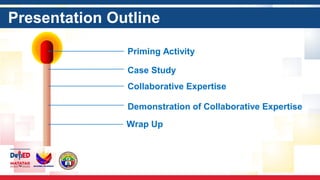
Priming Activity
Case Study
Collaborative Expertise
Demonstration of Collaborative Expertise
Presentation Outline
Wrap Up
Once upon a time, in the bustling city of Cebu, there were Grade 7 teachers, Mr. De La
Cruz and Ms. Liwayway. Both were passionate about teaching and dedicated to their
students’ success. However, they had very different approaches to their professional
development.
Mr. De La Cruz, a seasoned teacher with over 15 years of experience, preferred to work in
isolation. He believed that he had already mastered his teaching skills and didn’t see the
need for collaboration or seeking support from instructional leaders. He relied on his past
successes and what he learned early in his career, rarely seeking new strategies or
feedback.
On the other hand, Ms. Liwayway, a relatively new teacher with just three years of
experience, recognized the value of collaborative expertise. She actively sought
opportunities to collaborate with her colleagues, attended professional development
workshops, and engaged in learning action cells organized by the school. She believed that
continuous learning and sharing ideas with fellow teachers and instructional leaders were
crucial for her professional growth.
As time went by, the impact of their differing approaches became apparent. Mr. De
La Cruz’s classroom remained stagnant, and although his teaching was adequate,
he struggled to adapt to the changing needs of his students. He felt isolated, lacking
fresh perspectives and innovative teaching strategies. Over time, his passion for
teaching waned, and his students’ engagement and learning outcomes gradually
declined.
Meanwhile, Ms. Liwayway thrived in her collaborative approach. She participated
actively in learning action cells, where teachers came together to share best
practices, discuss challenges, and seek support form instructional leaders. Through
these interactions, she gained valuable insights, discovered new teaching
techniques, and received feedback from experienced colleagues and instructional
leaders. This collaborative expertise not only rejuvenated her passion for teaching
but also enhanced her pedagogical skills and classroom management techniques.
Ms. Liwayway’s students benefited greatly from her participation in collaborative expertise.
Her classroom became a hub of active learning, with students eagerly participating and
excelling academically.
The stark contrasts between Mr. De La Cruz’s and Ms. Liwayway’s teaching practice didn’t
go unnoticed by the school’s instructional leaders. Recognizing the importance of
collaborative expertise, they organized more opportunities for teachers to engage in
learning action cells, share their experiences, and learn from one another. They also
provided ongoing support, mentoring, and professional development opportunities to
facilitate teacher growth.
Over time, Mr. De La Cruz realized the value of collaborative expertise and sought support
from instructional leaders. With their guidance, he began participating in learning action
cells and collaborating with his colleagues. This transformative experience revitalized his
teaching practice, reignited his passion, and significantly improved student outcomes.
1. Reflecting on the case, what key differences did you
notice in the approaches of Mr. De La Cruz and Ms.
Liwayway to collaborative expertise? How did it
impact their teaching effectiveness and student
outcomes?
2. In your experience, how has participating in
collaborative expertise, such as learning action cells or
professional learning communities, influenced your own
teaching practice/instructional leadership practices? Can
you share specific examples on how collaboration has
benefited you, your teachers, and the students in your
school?
3. What are some potential challenges or barriers that
teachers may face when trying to engage in
collaborative expertise? How can instructional leaders
support and address these challenges to promote a
culture of collaboration within a school or district?
4. How can instructional leaders ensure that the
collaborative expertise among teachers translates into
meaningful instructional improvements and student
learning outcomes?
“The greatest influence on student learning is
having expert, inspired, and passionate
teachers and school leaders working together to
maximize the effect of their teaching on all
students in their care.” - Hattie, J. 2015
NLC Policy
“Teaching must be rigorous and relevant.”
DepEd Order No. 35, s. 2016
“Learning Action Cell is a group of teachers
who engage in collaborative learning
sessions to solve shared challenges
encountered in the school facilitated by the
school head or a designated LAC leader.”
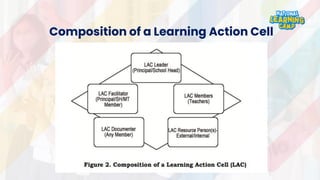
Composition of a Learning Action Cell
“Collaborative Expertise is described as
communities within and across schools that
work collaboratively to diagnose what
teachers need to do, plan programs and
teaching intervention and evaluate the
success of the interventions…” – Hattie, J.
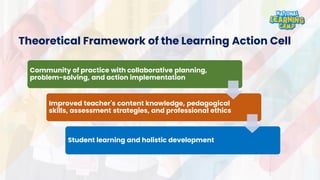
Theoretical Framework of the Learning Action Cell
Community of practice with collaborative planning,
problem-solving, and action implementation
Improved teacher's content knowledge, pedagogical
skills, assessment strategies, and professional ethics
Student learning and holistic development
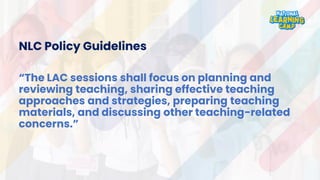
NLC Policy Guidelines
“The LAC sessions shall focus on planning and
reviewing teaching, sharing effective teaching
approaches and strategies, preparing teaching
materials, and discussing other teaching-related
concerns.”
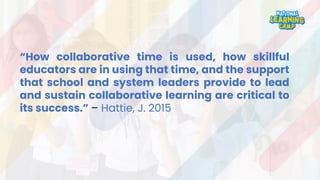
“How collaborative time is used, how skillful
educators are in using that time, and the support
that school and system leaders provide to lead
and sustain collaborative learning are critical to
its success.” – Hattie, J. 2015
Limitation/Prohibitions
The holding of LAC sessions for purposes other than
those provided herein is prohibited. Prohibited purposes
may include but shall not be limited to the following:
sale of goods and other merchandise; lending
transactions; political and religious meetings and other
purposes which are not included in this policy.” – DO 25,
s. 2016.
Collaborative Expertise and LAC
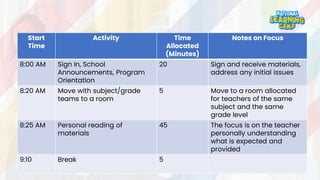
Teacher Timetable
for Collaborative Expertise on Mondays
Start
Time
Activity Time
Allocated
(Minutes)
Notes on Focus
8:00 AM Sign In, School
Announcements, Program
Orientation
20 Sign and receive materials,
address any initial issues
8:20 AM Move with subject/grade
teams to a room
5 Move to a room allocated
for teachers of the same
subject and the same
grade level
8:25 AM Personal reading of
materials
45 The focus is on the teacher
personally understanding
what is expected and
provided
9:10 Break 5
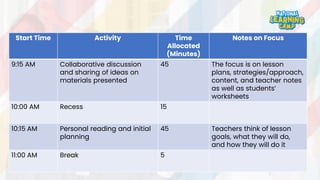
Start Time Activity Time
Allocated
(Minutes)
Notes on Focus
9:15 AM Collaborative discussion
and sharing of ideas on
materials presented
45 The focus is on lesson
plans, strategies/approach,
content, and teacher notes
as well as students’
worksheets
10:00 AM Recess 15
10:15 AM Personal reading and initial
planning
45 Teachers think of lesson
goals, what they will do,
and how they will do it
11:00 AM Break 5
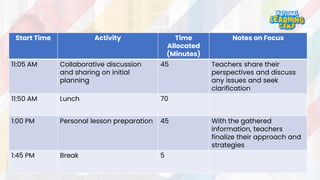
Start Time Activity Time
Allocated
(Minutes)
Notes on Focus
11:05 AM Collaborative discussion
and sharing on initial
planning
45 Teachers share their
perspectives and discuss
any issues and seek
clarification
11:50 AM Lunch 70
1:00 PM Personal lesson preparation 45 With the gathered
information, teachers
finalize their approach and
strategies
1:45 PM Break 5
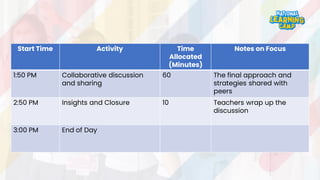
Start Time Activity Time
Allocated
(Minutes)
Notes on Focus
1:50 PM Collaborative discussion
and sharing
60 The final approach and
strategies shared with
peers
2:50 PM Insights and Closure 10 Teachers wrap up the
discussion
3:00 PM End of Day
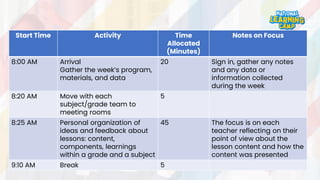
Teacher Timetable
for Collaborative Expertise on Fridays
Start Time Activity Time
Allocated
(Minutes)
Notes on Focus
8:00 AM Arrival
Gather the week’s program,
materials, and data
20 Sign in, gather any notes
and any data or
information collected
during the week
8:20 AM Move with each
subject/grade team to
meeting rooms
5
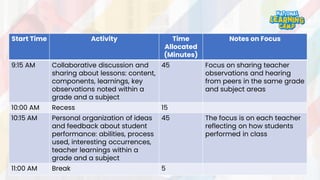
8:25 AM Personal organization of
ideas and feedback about
lessons: content,
components, learnings
within a grade and a subject
45 The focus is on each
teacher reflecting on their
point of view about the
lesson content and how the
content was presented
9:10 AM Break 5
Start Time Activity Time
Allocated
(Minutes)
Notes on Focus
9:15 AM Collaborative discussion and
sharing about lessons: content,
components, learnings, key
observations noted within a
grade and a subject
45 Focus on sharing teacher
observations and hearing
from peers in the same grade
and subject areas
10:00 AM Recess 15
10:15 AM Personal organization of ideas
and feedback about student
performance: abilities, process
used, interesting occurrences,
teacher learnings within a
grade and a subject
45 The focus is on each teacher
reflecting on how students
performed in class
11:00 AM Break 5
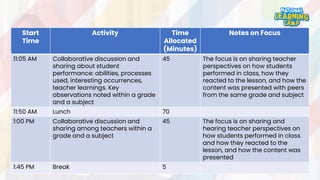
Start
Time
Activity Time
Allocated
(Minutes)
Notes on Focus
11:05 AM Collaborative discussion and
sharing about student
performance: abilities, processes
used, interesting occurrences,
teacher learnings. Key
observations noted within a grade
and a subject
45 The focus is on sharing teacher
perspectives on how students
performed in class, how they
reacted to the lesson, and how the
content was presented with peers
from the same grade and subject
11:50 AM Lunch 70
1:00 PM Collaborative discussion and
sharing among teachers within a
grade and a subject
45 The focus is on sharing and
hearing teacher perspectives on
how students performed in class
and how they reacted to the
lesson, and how the content was
presented
1:45 PM Break 5
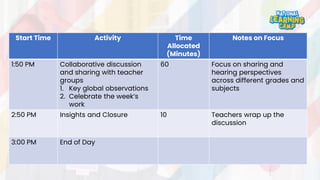
Start Time Activity Time
Allocated
(Minutes)
Notes on Focus
1:50 PM Collaborative discussion
and sharing with teacher
groups
1. Key global observations
2. Celebrate the week’s
work
60 Focus on sharing and
hearing perspectives
across different grades and
subjects
2:50 PM Insights and Closure 10 Teachers wrap up the
discussion
3:00 PM End of Day
Sample Demonstration of
Collaborative Expertise
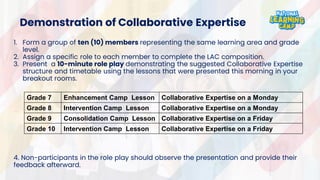
Demonstration of Collaborative Expertise
1. Form a group of ten (10) members representing the same learning area and grade
level.
2. Assign a specific role to each member to complete the LAC composition.
3. Present a 10-minute role play demonstrating the suggested Collaborative Expertise
structure and timetable using the lessons that were presented this morning in your
breakout rooms.
4. Non-participants in the role play should observe the presentation and provide their
feedback afterward.
Grade 7 Enhancement Camp Lesson Collaborative Expertise on a Monday
Grade 8 Intervention Camp Lesson Collaborative Expertise on a Monday
Grade 9 Consolidation Camp Lesson Collaborative Expertise on a Friday
Grade 10 Intervention Camp Lesson Collaborative Expertise on a Friday
Recipe for a Successful Collaborative Expertise
Ingredients:
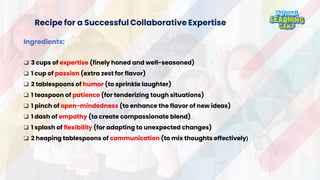
❑ 3 cups of expertise (finely honed and well-seasoned)
❑ 1 cup of passion (extra zest for flavor)
❑ 2 tablespoons of humor (to sprinkle laughter)
❑ 1 teaspoon of patience (for tenderizing tough situations)
❑ 1 pinch of open-mindedness (to enhance the flavor of new ideas)
❑ 1 dash of empathy (to create compassionate blend)
❑ 1 splash of flexibility (for adapting to unexpected changes)
❑ 2 heaping tablespoons of communication (to mix thoughts effectively)
Recipe for a Successful Collaborative Expertise
Instructions:
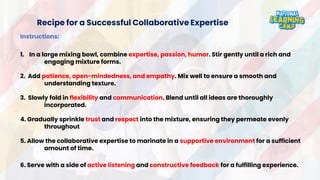
1. In a large mixing bowl, combine expertise, passion, humor. Stir gently until a rich and
engaging mixture forms.
2. Add patience, open-mindedness, and empathy. Mix well to ensure a smooth and
understanding texture.
3. Slowly fold in flexibility and communication. Blend until all ideas are thoroughly
incorporated.
4. Gradually sprinkle trust and respect into the mixture, ensuring they permeate evenly
throughout
5. Allow the collaborative expertise to marinate in a supportive environment for a sufficient
amount of time.
6. Serve with a side of active listening and constructive feedback for a fulfilling experience.
Recipe for a Successful
Collaborative Expertise
Adjust measurements to taste and adapt to the
specific needs of your collaboration.
Enjoy the recipe and may your collaborative
endeavors be fruitful!
Collaborative-Expertise-NLC-Final.pdf Collaborative-Expertise-NLC-Final.pdf

Collaborative-Expertise-NLC-Final.pdf Collaborative-Expertise-NLC-Final.pdf

  • 1.
    ROSALIE E. BONGON Bureauof Learning Delivery Fostering Excellence Together: Harnessing the Power of Collaborative Expertise in the NLC Capacity Building of Chief Trainers on the Implementation of the National Learning Camp Cebu City l July 11 – 14, 2023
  • 2.
    Priming Activity Case Study CollaborativeExpertise Demonstration of Collaborative Expertise Presentation Outline Wrap Up
  • 4.
    Once upon atime, in the bustling city of Cebu, there were Grade 7 teachers, Mr. De La Cruz and Ms. Liwayway. Both were passionate about teaching and dedicated to their students’ success. However, they had very different approaches to their professional development. Mr. De La Cruz, a seasoned teacher with over 15 years of experience, preferred to work in isolation. He believed that he had already mastered his teaching skills and didn’t see the need for collaboration or seeking support from instructional leaders. He relied on his past successes and what he learned early in his career, rarely seeking new strategies or feedback. On the other hand, Ms. Liwayway, a relatively new teacher with just three years of experience, recognized the value of collaborative expertise. She actively sought opportunities to collaborate with her colleagues, attended professional development workshops, and engaged in learning action cells organized by the school. She believed that continuous learning and sharing ideas with fellow teachers and instructional leaders were crucial for her professional growth.
  • 5.
    As time wentby, the impact of their differing approaches became apparent. Mr. De La Cruz’s classroom remained stagnant, and although his teaching was adequate, he struggled to adapt to the changing needs of his students. He felt isolated, lacking fresh perspectives and innovative teaching strategies. Over time, his passion for teaching waned, and his students’ engagement and learning outcomes gradually declined. Meanwhile, Ms. Liwayway thrived in her collaborative approach. She participated actively in learning action cells, where teachers came together to share best practices, discuss challenges, and seek support form instructional leaders. Through these interactions, she gained valuable insights, discovered new teaching techniques, and received feedback from experienced colleagues and instructional leaders. This collaborative expertise not only rejuvenated her passion for teaching but also enhanced her pedagogical skills and classroom management techniques.
  • 6.
    Ms. Liwayway’s studentsbenefited greatly from her participation in collaborative expertise. Her classroom became a hub of active learning, with students eagerly participating and excelling academically. The stark contrasts between Mr. De La Cruz’s and Ms. Liwayway’s teaching practice didn’t go unnoticed by the school’s instructional leaders. Recognizing the importance of collaborative expertise, they organized more opportunities for teachers to engage in learning action cells, share their experiences, and learn from one another. They also provided ongoing support, mentoring, and professional development opportunities to facilitate teacher growth. Over time, Mr. De La Cruz realized the value of collaborative expertise and sought support from instructional leaders. With their guidance, he began participating in learning action cells and collaborating with his colleagues. This transformative experience revitalized his teaching practice, reignited his passion, and significantly improved student outcomes.
  • 7.
    1. Reflecting onthe case, what key differences did you notice in the approaches of Mr. De La Cruz and Ms. Liwayway to collaborative expertise? How did it impact their teaching effectiveness and student outcomes?
  • 8.
    2. In yourexperience, how has participating in collaborative expertise, such as learning action cells or professional learning communities, influenced your own teaching practice/instructional leadership practices? Can you share specific examples on how collaboration has benefited you, your teachers, and the students in your school?
  • 9.
    3. What aresome potential challenges or barriers that teachers may face when trying to engage in collaborative expertise? How can instructional leaders support and address these challenges to promote a culture of collaboration within a school or district?
  • 10.
    4. How caninstructional leaders ensure that the collaborative expertise among teachers translates into meaningful instructional improvements and student learning outcomes?
  • 14.
    “The greatest influenceon student learning is having expert, inspired, and passionate teachers and school leaders working together to maximize the effect of their teaching on all students in their care.” - Hattie, J. 2015
  • 16.
    NLC Policy “Teaching mustbe rigorous and relevant.”
  • 17.
    DepEd Order No.35, s. 2016 “Learning Action Cell is a group of teachers who engage in collaborative learning sessions to solve shared challenges encountered in the school facilitated by the school head or a designated LAC leader.”
  • 18.
    Composition of aLearning Action Cell
  • 19.
    “Collaborative Expertise isdescribed as communities within and across schools that work collaboratively to diagnose what teachers need to do, plan programs and teaching intervention and evaluate the success of the interventions…” – Hattie, J.
  • 20.
    Theoretical Framework ofthe Learning Action Cell Community of practice with collaborative planning, problem-solving, and action implementation Improved teacher's content knowledge, pedagogical skills, assessment strategies, and professional ethics Student learning and holistic development
  • 21.
    NLC Policy Guidelines “TheLAC sessions shall focus on planning and reviewing teaching, sharing effective teaching approaches and strategies, preparing teaching materials, and discussing other teaching-related concerns.”
  • 22.
    “How collaborative timeis used, how skillful educators are in using that time, and the support that school and system leaders provide to lead and sustain collaborative learning are critical to its success.” – Hattie, J. 2015
  • 24.
    Limitation/Prohibitions The holding ofLAC sessions for purposes other than those provided herein is prohibited. Prohibited purposes may include but shall not be limited to the following: sale of goods and other merchandise; lending transactions; political and religious meetings and other purposes which are not included in this policy.” – DO 25, s. 2016.
  • 25.
  • 26.
  • 27.
    Start Time Activity Time Allocated (Minutes) Notes onFocus 8:00 AM Sign In, School Announcements, Program Orientation 20 Sign and receive materials, address any initial issues 8:20 AM Move with subject/grade teams to a room 5 Move to a room allocated for teachers of the same subject and the same grade level 8:25 AM Personal reading of materials 45 The focus is on the teacher personally understanding what is expected and provided 9:10 Break 5
  • 28.
    Start Time ActivityTime Allocated (Minutes) Notes on Focus 9:15 AM Collaborative discussion and sharing of ideas on materials presented 45 The focus is on lesson plans, strategies/approach, content, and teacher notes as well as students’ worksheets 10:00 AM Recess 15 10:15 AM Personal reading and initial planning 45 Teachers think of lesson goals, what they will do, and how they will do it 11:00 AM Break 5
  • 29.
    Start Time ActivityTime Allocated (Minutes) Notes on Focus 11:05 AM Collaborative discussion and sharing on initial planning 45 Teachers share their perspectives and discuss any issues and seek clarification 11:50 AM Lunch 70 1:00 PM Personal lesson preparation 45 With the gathered information, teachers finalize their approach and strategies 1:45 PM Break 5
  • 30.
    Start Time ActivityTime Allocated (Minutes) Notes on Focus 1:50 PM Collaborative discussion and sharing 60 The final approach and strategies shared with peers 2:50 PM Insights and Closure 10 Teachers wrap up the discussion 3:00 PM End of Day
  • 31.
  • 32.
    Start Time ActivityTime Allocated (Minutes) Notes on Focus 8:00 AM Arrival Gather the week’s program, materials, and data 20 Sign in, gather any notes and any data or information collected during the week 8:20 AM Move with each subject/grade team to meeting rooms 5 8:25 AM Personal organization of ideas and feedback about lessons: content, components, learnings within a grade and a subject 45 The focus is on each teacher reflecting on their point of view about the lesson content and how the content was presented 9:10 AM Break 5
  • 33.
    Start Time ActivityTime Allocated (Minutes) Notes on Focus 9:15 AM Collaborative discussion and sharing about lessons: content, components, learnings, key observations noted within a grade and a subject 45 Focus on sharing teacher observations and hearing from peers in the same grade and subject areas 10:00 AM Recess 15 10:15 AM Personal organization of ideas and feedback about student performance: abilities, process used, interesting occurrences, teacher learnings within a grade and a subject 45 The focus is on each teacher reflecting on how students performed in class 11:00 AM Break 5
  • 34.
    Start Time Activity Time Allocated (Minutes) Notes onFocus 11:05 AM Collaborative discussion and sharing about student performance: abilities, processes used, interesting occurrences, teacher learnings. Key observations noted within a grade and a subject 45 The focus is on sharing teacher perspectives on how students performed in class, how they reacted to the lesson, and how the content was presented with peers from the same grade and subject 11:50 AM Lunch 70 1:00 PM Collaborative discussion and sharing among teachers within a grade and a subject 45 The focus is on sharing and hearing teacher perspectives on how students performed in class and how they reacted to the lesson, and how the content was presented 1:45 PM Break 5
  • 35.
    Start Time ActivityTime Allocated (Minutes) Notes on Focus 1:50 PM Collaborative discussion and sharing with teacher groups 1. Key global observations 2. Celebrate the week’s work 60 Focus on sharing and hearing perspectives across different grades and subjects 2:50 PM Insights and Closure 10 Teachers wrap up the discussion 3:00 PM End of Day
  • 36.
  • 37.
    Demonstration of CollaborativeExpertise 1. Form a group of ten (10) members representing the same learning area and grade level. 2. Assign a specific role to each member to complete the LAC composition. 3. Present a 10-minute role play demonstrating the suggested Collaborative Expertise structure and timetable using the lessons that were presented this morning in your breakout rooms. 4. Non-participants in the role play should observe the presentation and provide their feedback afterward. Grade 7 Enhancement Camp Lesson Collaborative Expertise on a Monday Grade 8 Intervention Camp Lesson Collaborative Expertise on a Monday Grade 9 Consolidation Camp Lesson Collaborative Expertise on a Friday Grade 10 Intervention Camp Lesson Collaborative Expertise on a Friday
  • 38.
    Recipe for aSuccessful Collaborative Expertise Ingredients: ❑ 3 cups of expertise (finely honed and well-seasoned) ❑ 1 cup of passion (extra zest for flavor) ❑ 2 tablespoons of humor (to sprinkle laughter) ❑ 1 teaspoon of patience (for tenderizing tough situations) ❑ 1 pinch of open-mindedness (to enhance the flavor of new ideas) ❑ 1 dash of empathy (to create compassionate blend) ❑ 1 splash of flexibility (for adapting to unexpected changes) ❑ 2 heaping tablespoons of communication (to mix thoughts effectively)
  • 39.
    Recipe for aSuccessful Collaborative Expertise Instructions: 1. In a large mixing bowl, combine expertise, passion, humor. Stir gently until a rich and engaging mixture forms. 2. Add patience, open-mindedness, and empathy. Mix well to ensure a smooth and understanding texture. 3. Slowly fold in flexibility and communication. Blend until all ideas are thoroughly incorporated. 4. Gradually sprinkle trust and respect into the mixture, ensuring they permeate evenly throughout 5. Allow the collaborative expertise to marinate in a supportive environment for a sufficient amount of time. 6. Serve with a side of active listening and constructive feedback for a fulfilling experience.
  • 40.
    Recipe for aSuccessful Collaborative Expertise Adjust measurements to taste and adapt to the specific needs of your collaboration. Enjoy the recipe and may your collaborative endeavors be fruitful!