Hi Ryan, I am Ashley. I have heard
that you have worked in both
Kanban and Scrum teams. Would
you please let us know about your
experience in both the teams?
Hi Ashely. Yes, I have. Though the underlying
principles are the same, these two
frameworks have their unique features. Let
us explore in what terms these two agile
frameworks are different.
Agenda
1. What is Agile Software Development?
2. Similarities Between Scrum & Kanban
3. How does Scrum work?
4. How does Kanban work?
5. Scrum vs Kanban: Key Differences
6. The Takeaway
01
What is Agile Software
Development?
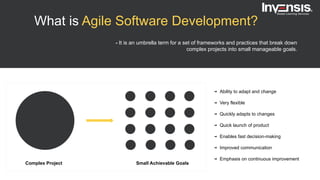
What is Agile Software Development?
- It is an umbrella term for a set of frameworks and practices that break down
complex projects into small manageable goals.
Complex Project Small Achievable Goals
Ability to adapt and change
Very flexible
Quickly adapts to changes
Quick launch of product
Enables fast decision-making
Improved communication
Emphasis on continuous improvement
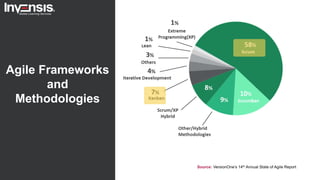
Agile Frameworks
and
Methodologies
02
Similarities Between Scrum
& Kanban
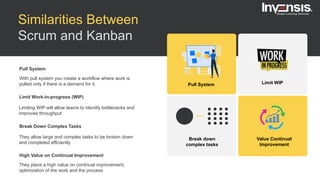
Similarities Between
Scrum and Kanban
With pull system you create a workflow where work is
pulled only if there is a demand for it.
Pull System
Pull System
Limit Work-in-progress (WIP)
Limiting WIP will allow teams to identify bottlenecks and
improves throughput
Break Down Complex Tasks
They allow large and complex tasks to be broken down
and completed efficiently
High Value on Continual Improvement
They place a high value on continual improvement,
optimization of the work and the process
Limit WIP
Break down
complex tasks
Value Continual
Improvement
03
How Does Scrum Work?
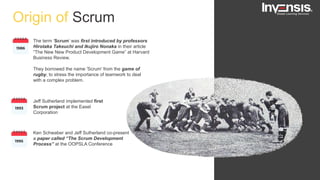
Origin of Scrum
Jeff Sutherland implemented first
Scrum project at the Easel
Corporation
Ken Schwaber and Jeff Sutherland co-present
a paper called “The Scrum Development
Process” at the OOPSLA Conference
The term ‘Scrum’ was first introduced by professors
Hirotaka Takeuchi and Ikujiro Nonaka in their article
“The New New Product Development Game” at Harvard
Business Review.
They borrowed the name 'Scrum' from the game of
rugby, to stress the importance of teamwork to deal
with a complex problem.
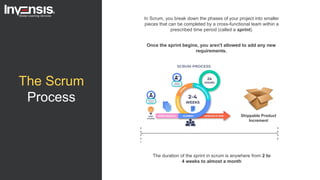
The Scrum
Process
In Scrum, you break down the phases of your project into smaller
pieces that can be completed by a cross-functional team within a
prescribed time period (called a sprint).
The duration of the sprint in scrum is anywhere from 2 to
4 weeks to almost a month
Shippable Product
Increment
Once the sprint begins, you aren't allowed to add any new
requirements.
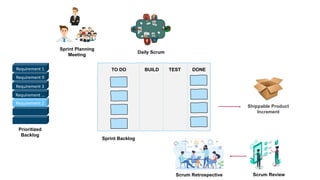
TO DO BUILD TEST DONERequirement 1
Requirement 2
Requirement 3
Requirement 9
Requirement 1
Requirement 2
Requirement 3
Requirement 9
Prioritized
Backlog
Sprint Planning
Meeting
Requirement 1
Requirement 9
Requirement 3
Requirement …
Sprint Backlog
Daily Scrum
Scrum Review
Shippable Product
Increment
Scrum Retrospective
04
How Does Kanban Work?
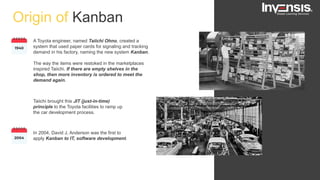
Origin of Kanban
A Toyota engineer, named Taiichi Ohno, created a
system that used paper cards for signaling and tracking
demand in his factory, naming the new system Kanban.
The way the items were restoked in the marketplaces
inspired Taiichi. If there are empty shelves in the
shop, then more inventory is ordered to meet the
demand again.
Taiichi brought this JIT (just-in-time)
principle to the Toyota facilities to ramp up
the car development process.
In 2004, David J. Anderson was the first to
apply Kanban to IT, software development.
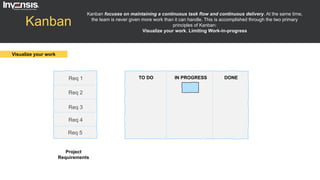
TO DO IN PROGRESS DONE
Kanban
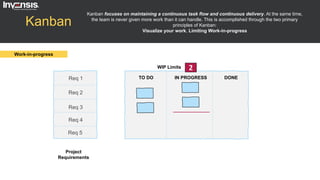
Kanban focuses on maintaining a continuous task flow and continuous delivery. At the same time,
the team is never given more work than it can handle. This is accomplished through the two primary
principles of Kanban:
Visualize your work, Limiting Work-in-progress
Project
Requirements
Req 1
Req 2
Req 3
Req 4
Req 5
Visualize your work
TO DO IN PROGRESS DONE
Kanban
Kanban focuses on maintaining a continuous task flow and continuous delivery. At the same time,
the team is never given more work than it can handle. This is accomplished through the two primary
principles of Kanban:
Visualize your work, Limiting Work-in-progress
Project
Requirements
Req 1
Req 2
Req 3
Req 4
Req 5
Work-in-progress
2WIP Limits
So, that’s how Scrum and Kanban
work. Were you able to pick up any
fundamental differences between
these frameworks after getting to
know how they work?
Definitely. I could pick up pick a point or two.
So, let me summarize.
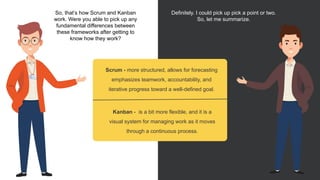
Scrum - more structured, allows for forecasting
emphasizes teamwork, accountability, and
iterative progress toward a well-defined goal.
Kanban - is a bit more flexible, and it is a
visual system for managing work as it moves
through a continuous process.
05
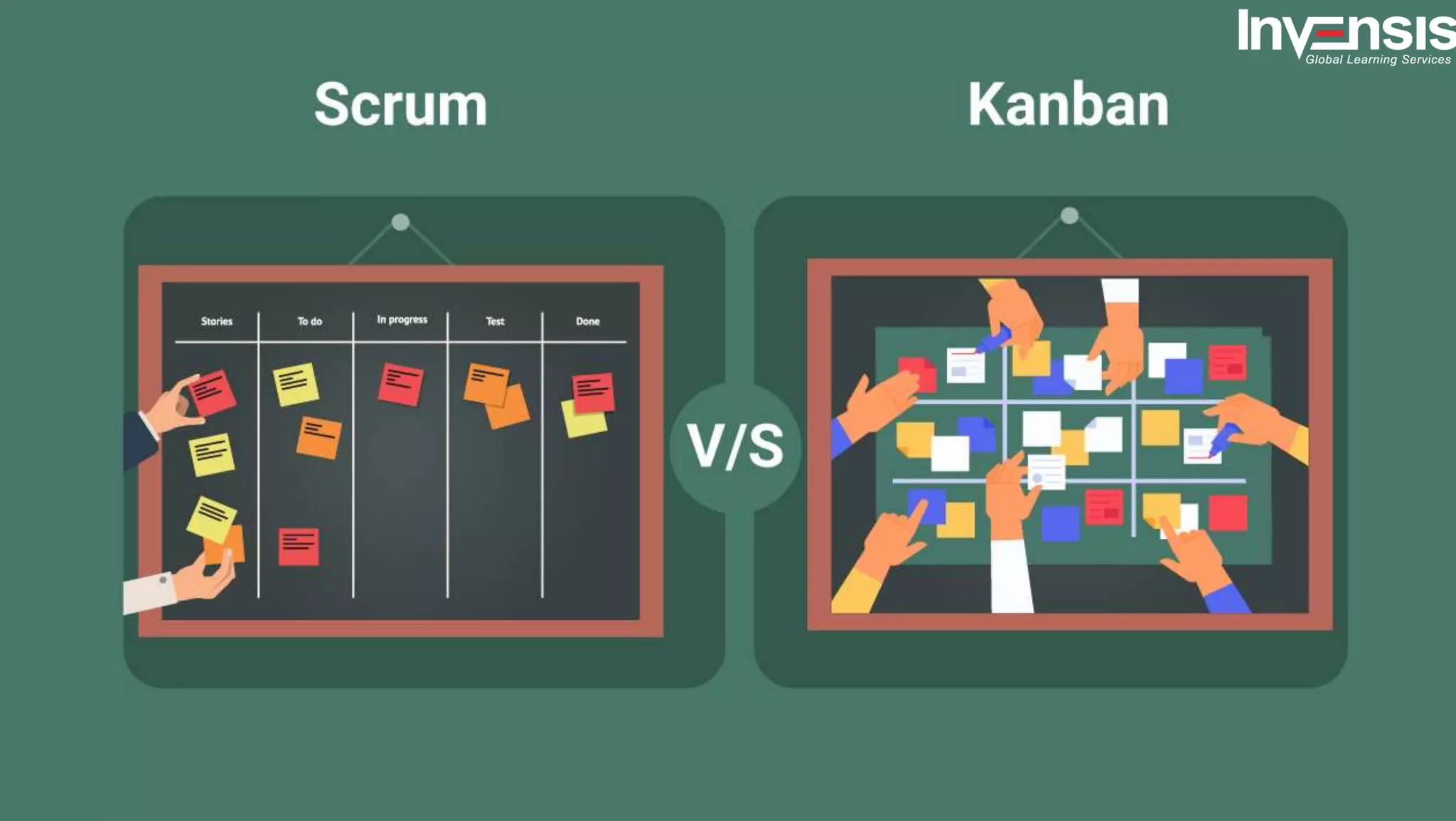
Scrum vs Kanban
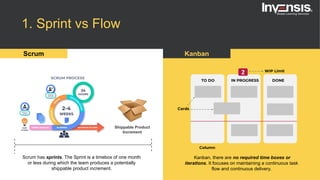
1. Sprint vs Flow
Scrum has sprints. The Sprint is a timebox of one month
or less during which the team produces a potentially
shippable product increment.
Shippable Product
Increment
Scrum Kanban
Kanban, there are no required time boxes or
iterations. It focuses on maintaining a continuous task
flow and continuous delivery.
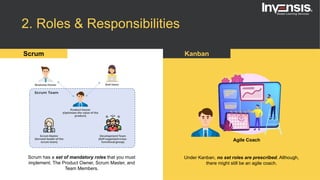
2. Roles & Responsibilities
Scrum Kanban
Scrum has a set of mandatory roles that you must
implement. The Product Owner, Scrum Master, and
Team Members.
Under Kanban, no set roles are prescribed. Although,
there might still be an agile coach.
Agile Coach
3. Commitment
Scrum Kanban
Commitment is based on capacity. Work in progress
(WIP) limits prevent team members from working on
multiple tasks.
The team commits to a specific amount of work for
each iteration. If the capacity is not measured
accurately, sprint might fail.
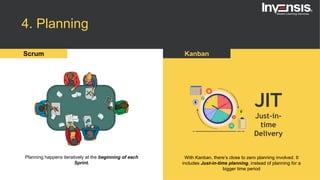
4. Planning
Scrum Kanban
Planning happens iteratively at the beginning of each
Sprint.
With Kanban, there’s close to zero planning involved. It
includes Just-in-time planning, instead of planning for a
bigger time period
JIT
Just-in-
time
Delivery
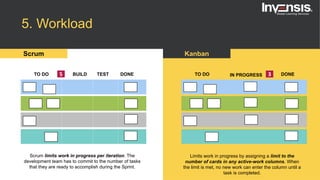
5. Workload
Scrum Kanban
Scrum limits work in progress per iteration. The
development team has to commit to the number of tasks
that they are ready to accomplish during the Sprint.
TO DO BUILD TEST DONE5
Limits work in progress by assigning a limit to the
number of cards in any active-work columns. When
the limit is met, no new work can enter the column until a
task is completed.
TO DO IN PROGRESS DONE3
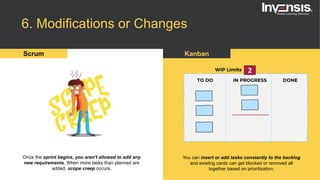
6. Modifications or Changes
Scrum Kanban
Once the sprint begins, you aren't allowed to add any
new requirements. When more tasks than planned are
added, scope creep occurs.
You can insert or add tasks constantly to the backlog
and existing cards can get blocked or removed all
together based on prioritization.
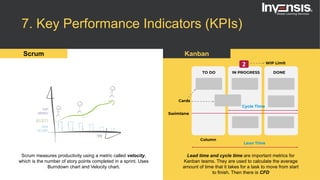
7. Key Performance Indicators (KPIs)
Scrum Kanban
Scrum measures productivity using a metric called velocity,
which is the number of story points completed in a sprint. Uses
Burndown chart and Velocity chart.
Lead time and cycle time are important metrics for
Kanban teams. They are used to calculate the average
amount of time that it takes for a task to move from start
to finish. Then there is CFD
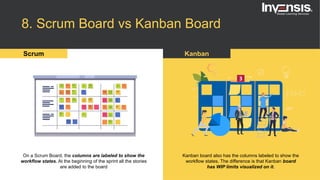
8. Scrum Board vs Kanban Board
Scrum Kanban
On a Scrum Board, the columns are labeled to show the
workflow states. At the beginning of the sprint all the stories
are added to the board
Kanban board also has the columns labeled to show the
workflow states. The difference is that Kanban board
has WIP limits visualized on it.
3
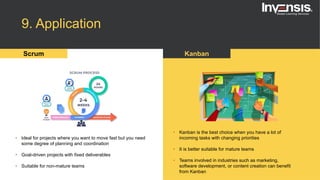
9. Application
Scrum Kanban
• Ideal for projects where you want to move fast but you need
some degree of planning and coordination
• Goal-driven projects with fixed deliverables
• Suitable for non-mature teams
• Kanban is the best choice when you have a lot of
incoming tasks with changing priorities
• It is better suitable for mature teams
• Teams involved in industries such as marketing,
software development, or content creation can benefit
from Kanban
06
Key Takeaway
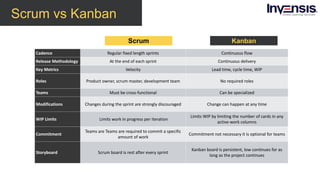
Scrum vs Kanban
Cadence Regular fixed length sprints Continuous flow
Release Methodology At the end of each sprint Continuous delivery
Key Metrics Velocity Lead time, cycle time, WIP
Roles Product owner, scrum master, development team No required roles
Teams Must be cross-functional Can be specialized
Modifications Changes during the sprint are strongly discouraged Change can happen at any time
WIP Limits Limits work in progress per iteration
Limits WIP by limiting the number of cards in any
active-work columns
Commitment
Teams are Teams are required to commit a specific
amount of work
Commitment not necessary it is optional for teams
Storyboard Scrum board is rest after every sprint
Kanban board is persistent, low continues for as
long as the project continues
Scrum Kanban
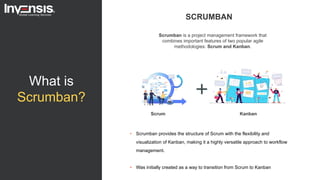
What is
Scrumban?
Scrumban is a project management framework that
combines important features of two popular agile
methodologies: Scrum and Kanban.
SCRUMBAN
Scrum Kanban
• Scrumban provides the structure of Scrum with the flexibility and
visualization of Kanban, making it a highly versatile approach to workflow
management.
• Was initially created as a way to transition from Scrum to Kanban
Sounds Interesting?
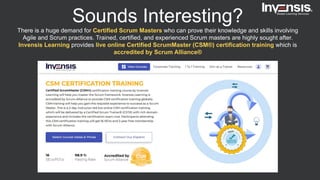
There is a huge demand for Certified Scrum Masters who can prove their knowledge and skills involving
Agile and Scrum practices. Trained, certified, and experienced Scrum masters are highly sought after.
Invensis Learning provides live online Certified ScrumMaster (CSM®) certification training which is
accredited by Scrum Alliance®
Become a Certified Scrum Master
ENROLL NOW
Visit us here: https://www.invensislearning.com/

Scrum vs Kanban - Which Agile Methodology Fits Best For Your Team?

  • 2.
    Hi Ryan, Iam Ashley. I have heard that you have worked in both Kanban and Scrum teams. Would you please let us know about your experience in both the teams? Hi Ashely. Yes, I have. Though the underlying principles are the same, these two frameworks have their unique features. Let us explore in what terms these two agile frameworks are different. Agenda 1. What is Agile Software Development? 2. Similarities Between Scrum & Kanban 3. How does Scrum work? 4. How does Kanban work? 5. Scrum vs Kanban: Key Differences 6. The Takeaway
  • 3.
    01 What is AgileSoftware Development?
  • 4.
    What is AgileSoftware Development? - It is an umbrella term for a set of frameworks and practices that break down complex projects into small manageable goals. Complex Project Small Achievable Goals Ability to adapt and change Very flexible Quickly adapts to changes Quick launch of product Enables fast decision-making Improved communication Emphasis on continuous improvement
  • 5.
  • 6.
  • 7.
    Similarities Between Scrum andKanban With pull system you create a workflow where work is pulled only if there is a demand for it. Pull System Pull System Limit Work-in-progress (WIP) Limiting WIP will allow teams to identify bottlenecks and improves throughput Break Down Complex Tasks They allow large and complex tasks to be broken down and completed efficiently High Value on Continual Improvement They place a high value on continual improvement, optimization of the work and the process Limit WIP Break down complex tasks Value Continual Improvement
  • 8.
  • 9.
    Origin of Scrum JeffSutherland implemented first Scrum project at the Easel Corporation Ken Schwaber and Jeff Sutherland co-present a paper called “The Scrum Development Process” at the OOPSLA Conference The term ‘Scrum’ was first introduced by professors Hirotaka Takeuchi and Ikujiro Nonaka in their article “The New New Product Development Game” at Harvard Business Review. They borrowed the name 'Scrum' from the game of rugby, to stress the importance of teamwork to deal with a complex problem.
  • 10.
    The Scrum Process In Scrum,you break down the phases of your project into smaller pieces that can be completed by a cross-functional team within a prescribed time period (called a sprint). The duration of the sprint in scrum is anywhere from 2 to 4 weeks to almost a month Shippable Product Increment Once the sprint begins, you aren't allowed to add any new requirements.
  • 11.
    TO DO BUILDTEST DONERequirement 1 Requirement 2 Requirement 3 Requirement 9 Requirement 1 Requirement 2 Requirement 3 Requirement 9 Prioritized Backlog Sprint Planning Meeting Requirement 1 Requirement 9 Requirement 3 Requirement … Sprint Backlog Daily Scrum Scrum Review Shippable Product Increment Scrum Retrospective
  • 12.
  • 13.
    Origin of Kanban AToyota engineer, named Taiichi Ohno, created a system that used paper cards for signaling and tracking demand in his factory, naming the new system Kanban. The way the items were restoked in the marketplaces inspired Taiichi. If there are empty shelves in the shop, then more inventory is ordered to meet the demand again. Taiichi brought this JIT (just-in-time) principle to the Toyota facilities to ramp up the car development process. In 2004, David J. Anderson was the first to apply Kanban to IT, software development.
  • 14.
    TO DO INPROGRESS DONE Kanban Kanban focuses on maintaining a continuous task flow and continuous delivery. At the same time, the team is never given more work than it can handle. This is accomplished through the two primary principles of Kanban: Visualize your work, Limiting Work-in-progress Project Requirements Req 1 Req 2 Req 3 Req 4 Req 5 Visualize your work
  • 15.
    TO DO INPROGRESS DONE Kanban Kanban focuses on maintaining a continuous task flow and continuous delivery. At the same time, the team is never given more work than it can handle. This is accomplished through the two primary principles of Kanban: Visualize your work, Limiting Work-in-progress Project Requirements Req 1 Req 2 Req 3 Req 4 Req 5 Work-in-progress 2WIP Limits
  • 16.
    So, that’s howScrum and Kanban work. Were you able to pick up any fundamental differences between these frameworks after getting to know how they work? Definitely. I could pick up pick a point or two. So, let me summarize. Scrum - more structured, allows for forecasting emphasizes teamwork, accountability, and iterative progress toward a well-defined goal. Kanban - is a bit more flexible, and it is a visual system for managing work as it moves through a continuous process.
  • 17.
  • 18.
    1. Sprint vsFlow Scrum has sprints. The Sprint is a timebox of one month or less during which the team produces a potentially shippable product increment. Shippable Product Increment Scrum Kanban Kanban, there are no required time boxes or iterations. It focuses on maintaining a continuous task flow and continuous delivery.
  • 19.
    2. Roles &Responsibilities Scrum Kanban Scrum has a set of mandatory roles that you must implement. The Product Owner, Scrum Master, and Team Members. Under Kanban, no set roles are prescribed. Although, there might still be an agile coach. Agile Coach
  • 20.
    3. Commitment Scrum Kanban Commitmentis based on capacity. Work in progress (WIP) limits prevent team members from working on multiple tasks. The team commits to a specific amount of work for each iteration. If the capacity is not measured accurately, sprint might fail.
  • 21.
    4. Planning Scrum Kanban Planninghappens iteratively at the beginning of each Sprint. With Kanban, there’s close to zero planning involved. It includes Just-in-time planning, instead of planning for a bigger time period JIT Just-in- time Delivery
  • 22.
    5. Workload Scrum Kanban Scrumlimits work in progress per iteration. The development team has to commit to the number of tasks that they are ready to accomplish during the Sprint. TO DO BUILD TEST DONE5 Limits work in progress by assigning a limit to the number of cards in any active-work columns. When the limit is met, no new work can enter the column until a task is completed. TO DO IN PROGRESS DONE3
  • 23.
    6. Modifications orChanges Scrum Kanban Once the sprint begins, you aren't allowed to add any new requirements. When more tasks than planned are added, scope creep occurs. You can insert or add tasks constantly to the backlog and existing cards can get blocked or removed all together based on prioritization.
  • 24.
    7. Key PerformanceIndicators (KPIs) Scrum Kanban Scrum measures productivity using a metric called velocity, which is the number of story points completed in a sprint. Uses Burndown chart and Velocity chart. Lead time and cycle time are important metrics for Kanban teams. They are used to calculate the average amount of time that it takes for a task to move from start to finish. Then there is CFD
  • 25.
    8. Scrum Boardvs Kanban Board Scrum Kanban On a Scrum Board, the columns are labeled to show the workflow states. At the beginning of the sprint all the stories are added to the board Kanban board also has the columns labeled to show the workflow states. The difference is that Kanban board has WIP limits visualized on it. 3
  • 26.
    9. Application Scrum Kanban •Ideal for projects where you want to move fast but you need some degree of planning and coordination • Goal-driven projects with fixed deliverables • Suitable for non-mature teams • Kanban is the best choice when you have a lot of incoming tasks with changing priorities • It is better suitable for mature teams • Teams involved in industries such as marketing, software development, or content creation can benefit from Kanban
  • 27.
  • 28.
    Scrum vs Kanban CadenceRegular fixed length sprints Continuous flow Release Methodology At the end of each sprint Continuous delivery Key Metrics Velocity Lead time, cycle time, WIP Roles Product owner, scrum master, development team No required roles Teams Must be cross-functional Can be specialized Modifications Changes during the sprint are strongly discouraged Change can happen at any time WIP Limits Limits work in progress per iteration Limits WIP by limiting the number of cards in any active-work columns Commitment Teams are Teams are required to commit a specific amount of work Commitment not necessary it is optional for teams Storyboard Scrum board is rest after every sprint Kanban board is persistent, low continues for as long as the project continues Scrum Kanban
  • 29.
    What is Scrumban? Scrumban isa project management framework that combines important features of two popular agile methodologies: Scrum and Kanban. SCRUMBAN Scrum Kanban • Scrumban provides the structure of Scrum with the flexibility and visualization of Kanban, making it a highly versatile approach to workflow management. • Was initially created as a way to transition from Scrum to Kanban
  • 30.
    Sounds Interesting? There isa huge demand for Certified Scrum Masters who can prove their knowledge and skills involving Agile and Scrum practices. Trained, certified, and experienced Scrum masters are highly sought after. Invensis Learning provides live online Certified ScrumMaster (CSM®) certification training which is accredited by Scrum Alliance®
  • 31.
    Become a CertifiedScrum Master ENROLL NOW Visit us here: https://www.invensislearning.com/