From
Scrum
to
Kanban
Neil Johnson
Scrum
Kanban
Lessons Learned
“The only thing that really
matters is the quality of the
team. Everything else is an
optimisation.“
Scrum
Working environment
• Software as a Service
• Services sold on their reliability and availability
• Industry is still very young, continual innovation is
essential
• Teams are cross functional
• All members responsible for design,
implementation, deployment and maintenance
• Easy access to Product Development/Business
Before Kanban we used Scrum (kinda)
• Scrum practices
• Time boxed iterations of 2 weeks
• White board and post its to track status
• Daily stand ups
• Fortnightly retrospectives
• Not Scrum
• Deploy multiple times an iteration
• No formal product owner
• No end of iteration demo
What we liked about Scrum
• A sense of rhythm and points to reflect on our
working practices
• Better visibility over tasks that were dragging
on
• A highly visible feedback loop to help improve
our estimations
Scrum was great but we had
two problems with it….
The iteration deadline felt artificial
• No expectation from business of a post
iteration demo
• High dependence on outside parties
• Frequently over/undershoot due to external
dependencies
• Time box limited choice of tasks in case of
undershoot
Not flexible enough mid iteration
• A 2 weeks iteration promises, on average, a 3 week
delay
• The team is responsible for 2nd line support,
operations and maintenance
• We can assign a maintainer role to shield the team
from day to day requests, though this is not always
sufficient
• Need a process that actively embraces the notion
unplanned work
Kanban
Scrum vs Kanban comparison
• In common:-
• Both are Lean and Agile
• Both use pull scheduling
• Both use transparency to drive process
improvement
• Both focus on delivering working software as soon
as possible
Scrum vs Kanban comparison
• Differences
• Kanban less prescriptive than Scrum
• Kanban does not prescribe fixed iterations
• In Kanban Lead Time is the principle metric, in
Scrum it is velocity
• Kanban limits Work in Progress directly, Scrum
does this indirectly through sprint planning
Why Kanban?
• Retain our discipline and structure
• Limit work in progress rather than work per
time
• Improve responsiveness, through reduction in
Lead Time
• Can accommodate unexpected work without
modifying the system
• Always able to work on the next most
important or risky task
Kanban fundamentals
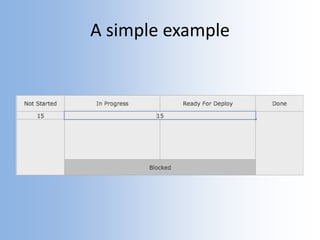
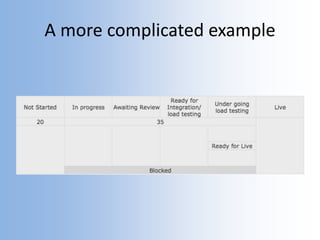
• Visualise the workflow
• Split the work down into small pieces
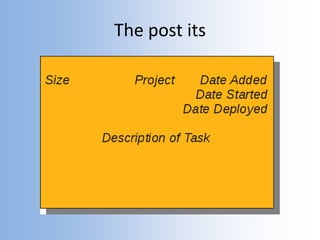
• Represent each work item on a post it and put on the board
• Use named columns to express where the work item is in the
workflow
• Limit Work in Progress
• Assign explicit limits to how many items may be in progress in
each workflow state, or set of states
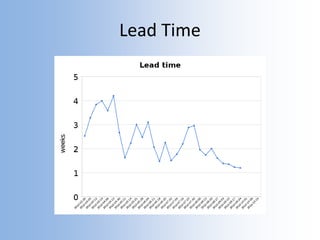
• Measure the lead time (average time to complete one
item)
• Optimise the process, aiming to make the Lead Time as small
and as predictable as possible
The Board
• Should reflect your real working practices
• Placement of the board is crucial
• Work in progress limits drive behaviour
• Start with loose, achievable limits and expect
to fine tune
• Expect the board to change state on a daily
basis
A simple example
A more complicated example
The post its
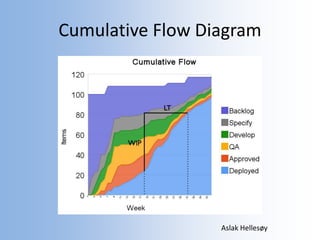
How to measure lead time and
optimise the process?
Cumulative Flow Diagram
Aslak Hellesøy
Lead Time
Lessons Learned
Lessons Learned
• Benefits
• Greater flexibility in our work flow
• We no longer feel that we are fighting our process
• Better able to embrace and support unexpected
work items
• Negatives
• Greater discipline is required in ensuring that all
tasks are completed in a timely manner
Lessons Learned
Protect yourself. If you make the team better able
to take on ad-hoc tasks, you must track the
impact and the load.
I have found the following categorisations to be
effective
• Planned Product Development work
• Planned Engineering work e.g. large scale refactoring
• Unplanned Product work e.g. one of reports, small
tweaks to behaviour
• Unplanned engineering work e.g. urgent bug fixes
Lessons Learned
• Further observations
• Adoption was almost completely painless
• Due to day to day interaction, the board takes on
a much more important role than it ever did under
scrum
• The team is more confident in deciding what to do
next
• Our stand ups have become much more focused
• Our retrospectives are no longer coupled to the
period of our iteration.
Is Kanban for you?
You may find value in Kanban over Scrum if:-
• The team has support, maintenance or Dev Ops
responsibilities
• Time boxed iterations make little sense in your work
flow
• Your priorities change rapidly
• Your organisation is unable to easily support Scrum
roles
You may also want to consider hybrid approaches such as
‘Scrumban’
Scrum
Kanban
Lessons Learned
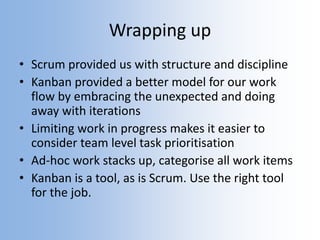
Wrapping up
• Scrum provided us with structure and discipline
• Kanban provided a better model for our work
flow by embracing the unexpected and doing
away with iterations
• Limiting work in progress makes it easier to
consider team level task prioritisation
• Ad-hoc work stacks up, categorise all work items
• Kanban is a tool, as is Scrum. Use the right tool
for the job.
And Finally…..
• Contact
• neil@fragile.org.uk
• http://fragile.org.uk/
• @neilisfragile
• References
• http://open.bekk.no/2009/11/03/cumulative-
flow-diagrams-with-google-spreadsheets/
• http://www.crisp.se/henrik.kniberg/Kanban-vs-
Scrum.pdf

Switch tokanban2

  • 1.
  • 2.
  • 3.
    “The only thingthat really matters is the quality of the team. Everything else is an optimisation.“
  • 4.
  • 5.
    Working environment • Softwareas a Service • Services sold on their reliability and availability • Industry is still very young, continual innovation is essential • Teams are cross functional • All members responsible for design, implementation, deployment and maintenance • Easy access to Product Development/Business
  • 6.
    Before Kanban weused Scrum (kinda) • Scrum practices • Time boxed iterations of 2 weeks • White board and post its to track status • Daily stand ups • Fortnightly retrospectives • Not Scrum • Deploy multiple times an iteration • No formal product owner • No end of iteration demo
  • 7.
    What we likedabout Scrum • A sense of rhythm and points to reflect on our working practices • Better visibility over tasks that were dragging on • A highly visible feedback loop to help improve our estimations
  • 8.
    Scrum was greatbut we had two problems with it….
  • 9.
    The iteration deadlinefelt artificial • No expectation from business of a post iteration demo • High dependence on outside parties • Frequently over/undershoot due to external dependencies • Time box limited choice of tasks in case of undershoot
  • 10.
    Not flexible enoughmid iteration • A 2 weeks iteration promises, on average, a 3 week delay • The team is responsible for 2nd line support, operations and maintenance • We can assign a maintainer role to shield the team from day to day requests, though this is not always sufficient • Need a process that actively embraces the notion unplanned work
  • 11.
  • 12.
    Scrum vs Kanbancomparison • In common:- • Both are Lean and Agile • Both use pull scheduling • Both use transparency to drive process improvement • Both focus on delivering working software as soon as possible
  • 13.
    Scrum vs Kanbancomparison • Differences • Kanban less prescriptive than Scrum • Kanban does not prescribe fixed iterations • In Kanban Lead Time is the principle metric, in Scrum it is velocity • Kanban limits Work in Progress directly, Scrum does this indirectly through sprint planning
  • 14.
    Why Kanban? • Retainour discipline and structure • Limit work in progress rather than work per time • Improve responsiveness, through reduction in Lead Time • Can accommodate unexpected work without modifying the system • Always able to work on the next most important or risky task
  • 15.
    Kanban fundamentals • Visualisethe workflow • Split the work down into small pieces • Represent each work item on a post it and put on the board • Use named columns to express where the work item is in the workflow • Limit Work in Progress • Assign explicit limits to how many items may be in progress in each workflow state, or set of states • Measure the lead time (average time to complete one item) • Optimise the process, aiming to make the Lead Time as small and as predictable as possible
  • 16.
    The Board • Shouldreflect your real working practices • Placement of the board is crucial • Work in progress limits drive behaviour • Start with loose, achievable limits and expect to fine tune • Expect the board to change state on a daily basis
  • 17.
  • 18.
  • 19.
  • 20.
    How to measurelead time and optimise the process?
  • 21.
  • 22.
  • 23.
  • 24.
    Lessons Learned • Benefits •Greater flexibility in our work flow • We no longer feel that we are fighting our process • Better able to embrace and support unexpected work items • Negatives • Greater discipline is required in ensuring that all tasks are completed in a timely manner
  • 25.
    Lessons Learned Protect yourself.If you make the team better able to take on ad-hoc tasks, you must track the impact and the load. I have found the following categorisations to be effective • Planned Product Development work • Planned Engineering work e.g. large scale refactoring • Unplanned Product work e.g. one of reports, small tweaks to behaviour • Unplanned engineering work e.g. urgent bug fixes
  • 26.
    Lessons Learned • Furtherobservations • Adoption was almost completely painless • Due to day to day interaction, the board takes on a much more important role than it ever did under scrum • The team is more confident in deciding what to do next • Our stand ups have become much more focused • Our retrospectives are no longer coupled to the period of our iteration.
  • 27.
    Is Kanban foryou? You may find value in Kanban over Scrum if:- • The team has support, maintenance or Dev Ops responsibilities • Time boxed iterations make little sense in your work flow • Your priorities change rapidly • Your organisation is unable to easily support Scrum roles You may also want to consider hybrid approaches such as ‘Scrumban’
  • 28.
  • 29.
    Wrapping up • Scrumprovided us with structure and discipline • Kanban provided a better model for our work flow by embracing the unexpected and doing away with iterations • Limiting work in progress makes it easier to consider team level task prioritisation • Ad-hoc work stacks up, categorise all work items • Kanban is a tool, as is Scrum. Use the right tool for the job.
  • 30.
    And Finally….. • Contact •neil@fragile.org.uk • http://fragile.org.uk/ • @neilisfragile • References • http://open.bekk.no/2009/11/03/cumulative- flow-diagrams-with-google-spreadsheets/ • http://www.crisp.se/henrik.kniberg/Kanban-vs- Scrum.pdf

Editor's Notes

  • #7 High light non scrums
  • #11 What is a mainainter? Talk about 2nd line support. Talk about devops
  • #15 Something about expectations of actually being live. Talk about importance of lead time.
  • #17 Will self post it wall?
  • #18 Entire team does everything, an idea for number of post its, move on a daily basis
  • #22 Aslak Helloy < name Aslak on the slide or at the end, rate of doing work