









Blending
SCRUM and Kanban
to create a
Scalable Lean-Agile
Enterprise
Ravneet Kaur
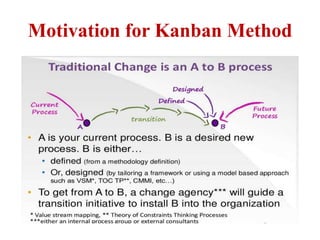
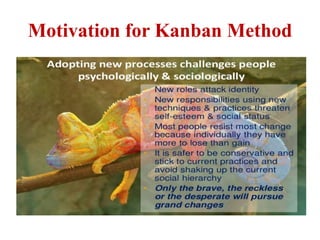
Motivation for Kanban Method
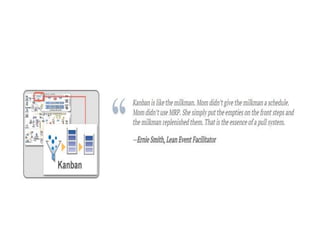
Kanban is like flowing water
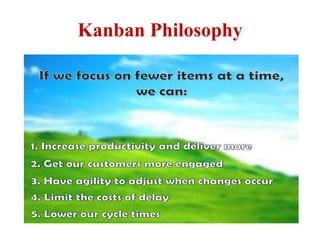
Kanban Philosophy
Kanban Philosophy
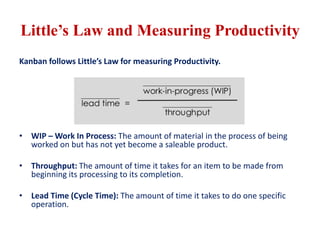
Little’s Law and Measuring Productivity
Kanban follows Little’s Law for measuring Productivity.
• WIP – Work In Process: The amount of material in the process of being
worked on but has not yet become a saleable product.
• Throughput: The amount of time it takes for an item to be made from
beginning its processing to its completion.
• Lead Time (Cycle Time): The amount of time it takes to do one specific
operation.
Little’s Law and Measuring Productivity
Is our goal 100% utilization
Limiting WIP (Work in Progress)
Why limiting work in
progress makes sense ?
Case Study
We will use a drive-thru to explain why.
Limiting WIP (Work in Progress)
For the complete video of the Case Study, please
click on the following link.
https://www.youtube.com/watch?v=W92wG-
HW8gg&list=WL&index=84
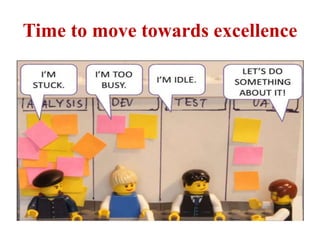
Time to move towards excellence
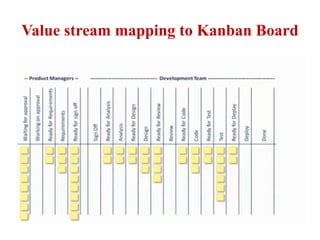
Visualise workflow with value stream mapping
Value stream mapping to Kanban Board
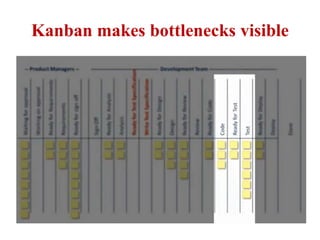
Kanban makes bottlenecks visible
Kanban helps in improving process
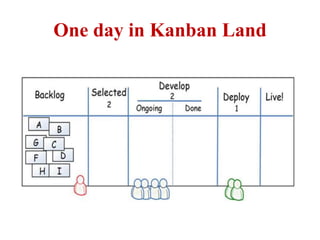
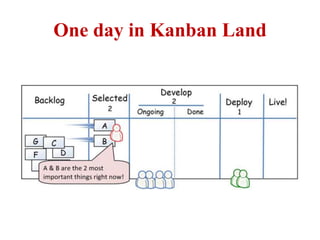
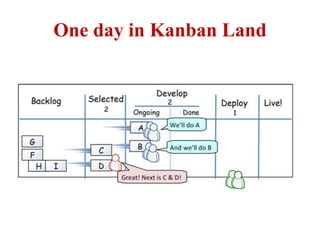
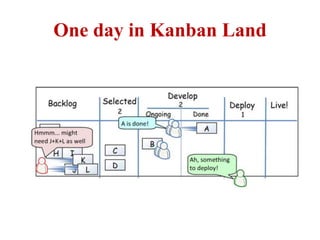
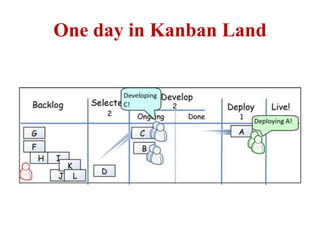
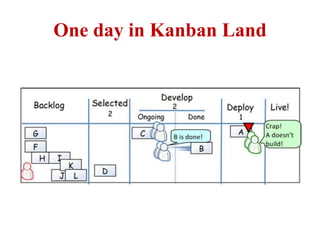
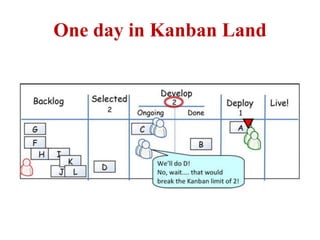
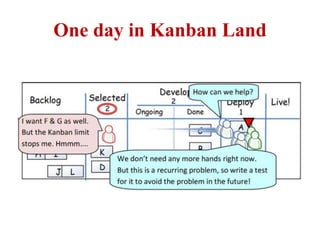
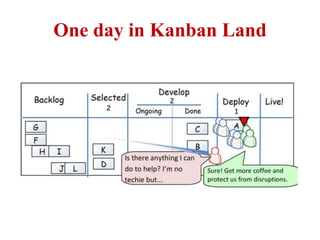
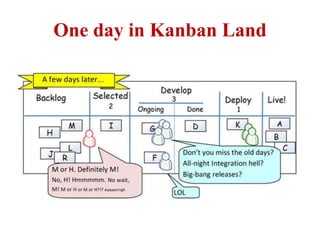
One day in Kanban Land
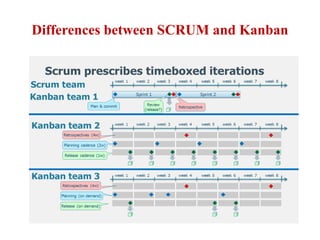
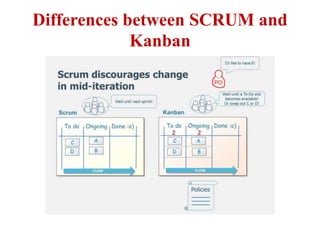
Differences between SCRUM and Kanban
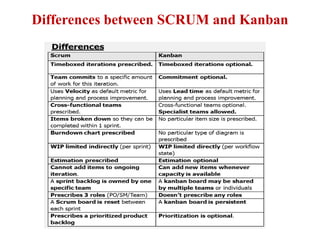
Differences between SCRUM and
Kanban
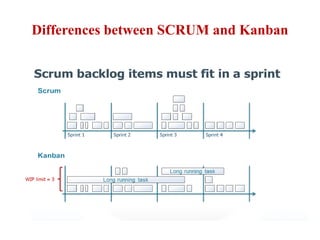
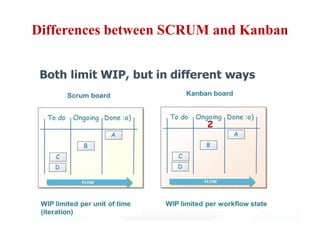
Differences between SCRUM and Kanban
For the complete video for Differences between
SCRUM and Kanban, please click on the
following link.
https://www.youtube.com/watch?v=Jx6_E5XxqEo
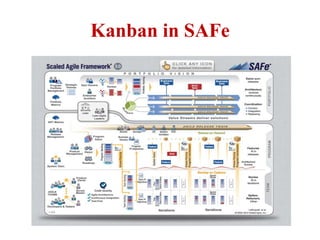
Kanban in SAFe
Kanban in SAFe
Kanban is the key ingredients for implementing
SAFe (Scaled Agile Framework).
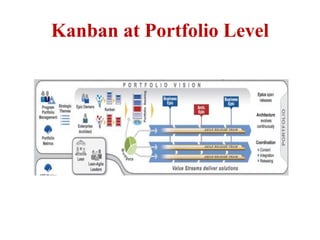
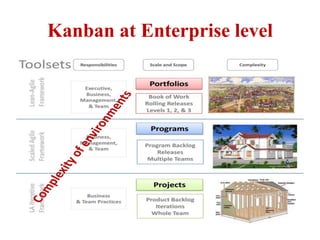
At Portfolio Level, Kanban is recommended.
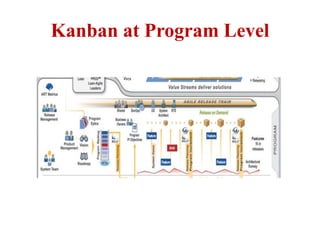
At Program Level, Kanban is recommended.
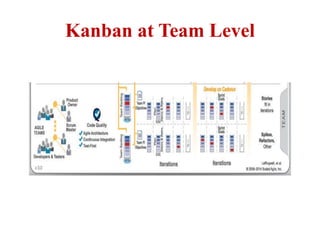
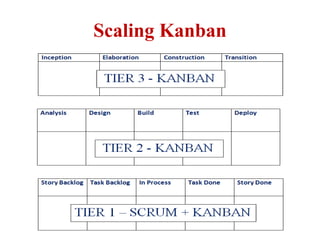
At Team Level, combination of SCRUM and
Kanban is recommended.
Kanban creates a Pull System across the entire
Portfolio that is limited by the Teams‘ Capacity.
Kanban at Portfolio Level
Kanban at Program Level
Kanban at Team Level
Scaling Kanban
Kanban at Team Level
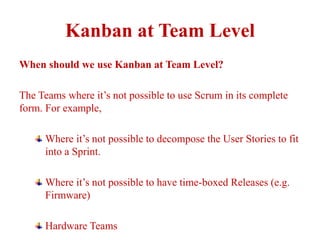
When should we use Kanban at Team Level?
The Teams where it’s not possible to use Scrum in its complete
form. For example,
Where it’s not possible to decompose the User Stories to fit
into a Sprint.
Where it’s not possible to have time-boxed Releases (e.g.
Firmware)
Hardware Teams
Kanban at Team Level
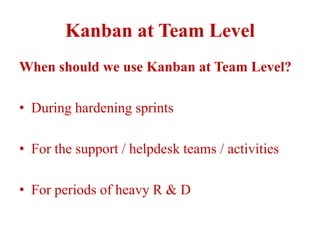
When should we use Kanban at Team Level?
• During hardening sprints
• For the support / helpdesk teams / activities
• For periods of heavy R & D
Kanban at Team Level
When should we use Kanban at Team Level?
For the Teams where Scrum is used in its complete form.
It is highly recommended to overlay Kanban on top of Scrum by
restricting WIP to an optimal value for each of the columns in
Scrum Board.
This will result in higher throughput and helps in determining
bottlenecks and increasing overall productivity at all level of the
enterprise.
This will also result in better collaboration among the team
members.
Kanban at Enterprise level
Scrum_Kanban_Scaled_Lean_Agile

Scrum_Kanban_Scaled_Lean_Agile