Unit 19: Scriptwriting Learning Aim B
A script is written by screenwriters. They can be used for television programmes, films and
video games. They can be original works or even adaptations from existing pieces of writing.
There are three different script formats such as Master Scene scripts, shooting scripts and radio
scripts.
Master Screen Scripts (MSS) is the standard and accepted format for film production. It is
designed to offer a simple and easy to access format for producers to show investors. It also
offers a mix of description and dialogue to allow the reader / audience to easily follow the story
as the story is the most important thing. In addition to this technical information is very limited
within the master screen script format. The script which I will be using as an example is the
1990 Romance / Comedy Edward Scissorhands.
A new scene is introduced by a slugline, which is generally placed at the very beginning of the
scene before any dialogue is introduced. The MSS is split into scene headings, narrative
descriptions and dialogue blocks. A scene heading is known as the slugline and is composed of
three parts:
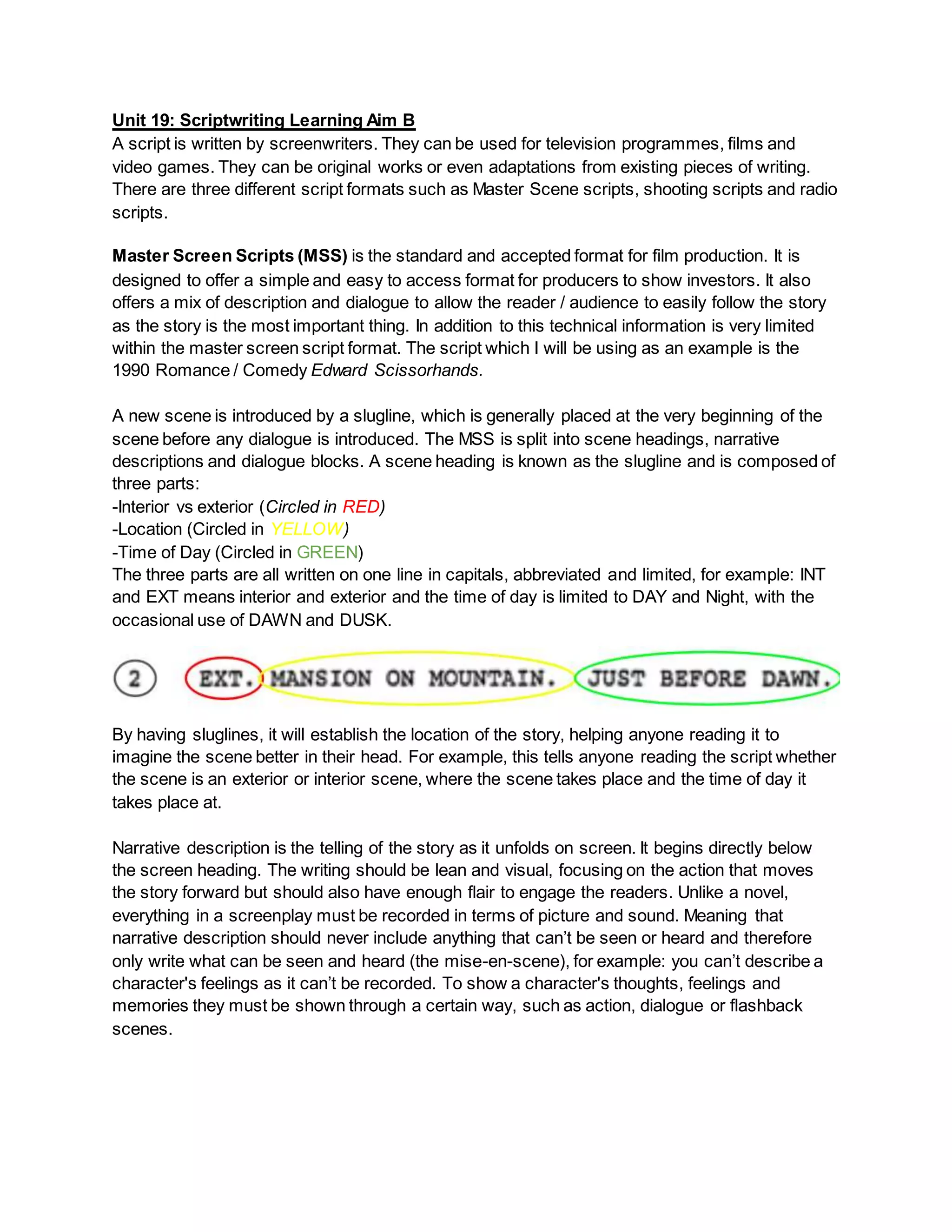
-Interior vs exterior (Circled in RED)
-Location (Circled in YELLOW)
-Time of Day (Circled in GREEN)
The three parts are all written on one line in capitals, abbreviated and limited, for example: INT
and EXT means interior and exterior and the time of day is limited to DAY and Night, with the
occasional use of DAWN and DUSK.
By having sluglines, it will establish the location of the story, helping anyone reading it to
imagine the scene better in their head. For example, this tells anyone reading the script whether
the scene is an exterior or interior scene, where the scene takes place and the time of day it
takes place at.
Narrative description is the telling of the story as it unfolds on screen. It begins directly below
the screen heading. The writing should be lean and visual, focusing on the action that moves
the story forward but should also have enough flair to engage the readers. Unlike a novel,
everything in a screenplay must be recorded in terms of picture and sound. Meaning that
narrative description should never include anything that can’t be seen or heard and therefore
only write what can be seen and heard (the mise-en-scene), for example: you can’t describe a
character's feelings as it can’t be recorded. To show a character's thoughts, feelings and
memories they must be shown through a certain way, such as action, dialogue or flashback
scenes.
Examples of mise-en-scene include clothing, vehicles, houses and any other props that help to
tell the story across the script. In the case of a shooting script, the text can include info to be
applied during the editing process, such as certain sounds etc. However, this doesn’t apply in
the Master Scene Script.
In the film industry, it is an assumption that one page of screenplay equals one minute of time
on screen. In terms of planning purposes, this is convenient since the average feature is 120
minutes therefore the average script should be around 120 pages in length. Because of this,
description passages should cover as many pages as the scene is expected to run in real time.
Meaning that if an action scene takes one minute of screen time, it should be written to cover
one page rather than just a line, making sure to get all description and key features in.
Dialogue blocks are also known as ‘speeches’ and are composed of three parts: character
name, wryly and dialogue. Character names are written in capitals whereas wrylies are written
in lowercase inside the parenthesis and dialogue is written in normal sentence case. A wryly
was named after all the beginner screenwriters whose characters say things in a “wry” way.
Wrylies should only be used if the subtext of the dialogue is not clear. It is essential to keep
them to a bare minimum as they indicate how a line should be said. In addition to this, character
names are identified before any dialogue is spoken.
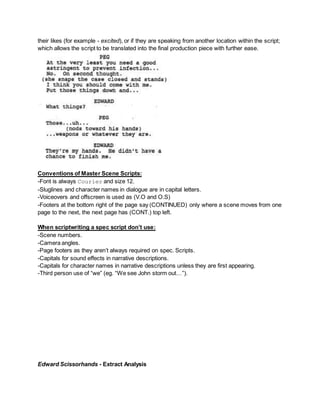
Parentheticals are used to give extra information to the reader about the dialogue. The type of
information given in these things such as whether a character begins talking to another
character. Examples of parentheticals within scripts include: in what manner the character reads
their likes (for example - excited), or if they are speaking from another location within the script;
which allows the script to be translated into the final production piece with further ease.
Conventions of Master Scene Scripts:
-Font is always Courier and size 12.
-Sluglines and character names in dialogue are in capital letters.
-Voiceovers and offscreen is used as (V.O and O.S)
-Footers at the bottom right of the page say (CONTINUED) only where a scene moves from one
page to the next, the next page has (CONT.) top left.
When scriptwriting a spec script don’t use:
-Scene numbers.
-Camera angles.
-Page footers as they aren’t always required on spec. Scripts.
-Capitals for sound effects in narrative descriptions.
-Capitals for character names in narrative descriptions unless they are first appearing.
-Third person use of “we” (eg. “We see John storm out…”).
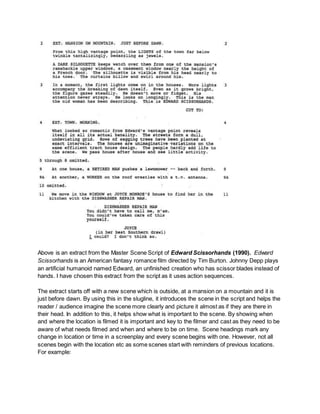
Edward Scissorhands - Extract Analysis
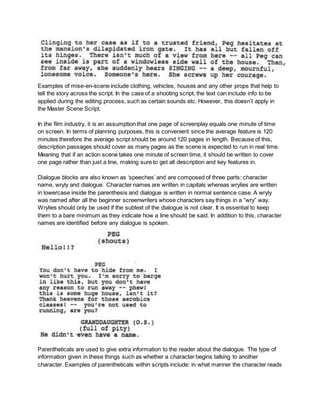
Above is an extract from the Master Scene Script of Edward Scissorhands (1990). Edward
Scissorhands is an American fantasy romance film directed by Tim Burton. Johnny Depp plays
an artificial humanoid named Edward, an unfinished creation who has scissor blades instead of
hands. I have chosen this extract from the script as it uses action sequences.
The extract starts off with a new scene which is outside, at a mansion on a mountain and it is
just before dawn. By using this in the slugline, it introduces the scene in the script and helps the
reader / audience imagine the scene more clearly and picture it almost as if they are there in
their head. In addition to this, it helps show what is important to the scene. By showing when
and where the location is filmed it is important and key to the filmer and cast as they need to be
aware of what needs filmed and when and where to be on time. Scene headings mark any
change in location or time in a screenplay and every scene begins with one. However, not all
scenes begin with the location etc as some scenes start with reminders of previous locations.
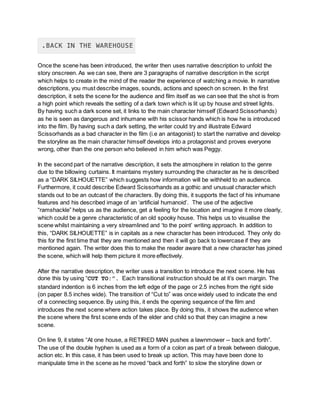
For example:
Once the scene has been introduced, the writer then uses narrative description to unfold the
story onscreen. As we can see, there are 3 paragraphs of narrative description in the script
which helps to create in the mind of the reader the experience of watching a movie. In narrative
descriptions, you must describe images, sounds, actions and speech on screen. In the first
description, it sets the scene for the audience and film itself as we can see that the shot is from
a high point which reveals the setting of a dark town which is lit up by house and street lights.
By having such a dark scene set, it links to the main character himself (Edward Scissorhands)
as he is seen as dangerous and inhumane with his scissor hands which is how he is introduced
into the film. By having such a dark setting, the writer could try and illustrate Edward
Scissorhands as a bad character in the film (i.e an antagonist) to start the narrative and develop
the storyline as the main character himself develops into a protagonist and proves everyone
wrong, other than the one person who believed in him which was Peggy.
In the second part of the narrative description, it sets the atmosphere in relation to the genre
due to the billowing curtains. It maintains mystery surrounding the character as he is described
as a “DARK SILHOUETTE” which suggests how information will be withheld to an audience.
Furthermore, it could describe Edward Scissorhands as a gothic and unusual character which
stands out to be an outcast of the characters. By doing this, it supports the fact of his inhumane
features and his described image of an ‘artificial humanoid’. The use of the adjective
“ramshackle” helps us as the audience, get a feeling for the location and imagine it more clearly,
which could be a genre characteristic of an old spooky house. This helps us to visualise the
scene whilst maintaining a very streamlined and ‘to the point’ writing approach. In addition to
this, “DARK SILHOUETTE” is in capitals as a new character has been introduced. They only do
this for the first time that they are mentioned and then it will go back to lowercase if they are
mentioned again. The writer does this to make the reader aware that a new character has joined
the scene, which will help them picture it more effectively.
After the narrative description, the writer uses a transition to introduce the next scene. He has
done this by using “CUT TO:”. Each transitional instruction should be at it’s own margin. The
standard indention is 6 inches from the left edge of the page or 2.5 inches from the right side
(on paper 8.5 inches wide). The transition of “Cut to” was once widely used to indicate the end
of a connecting sequence. By using this, it ends the opening sequence of the film and
introduces the next scene where action takes place. By doing this, it shows the audience when
the scene where the first scene ends of the elder and child so that they can imagine a new
scene.
On line 9, it states “At one house, a RETIRED MAN pushes a lawnmower -- back and forth”.
The use of the double hyphen is used as a form of a colon as part of a break between dialogue,
action etc. In this case, it has been used to break up action. This may have been done to
manipulate time in the scene as he moved “back and forth” to slow the storyline down or
possibly foreshadow an event in the story. However this may have also been done to direct the
audiences eye to clearly visualise the shot and the mise-en-scene used.
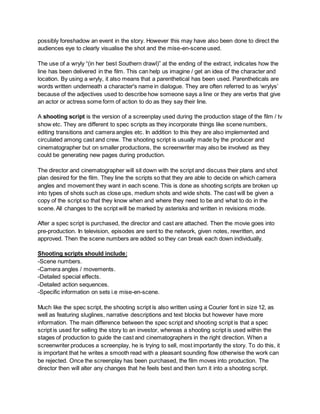
The use of a wryly “(in her best Southern drawl)” at the ending of the extract, indicates how the
line has been delivered in the film. This can help us imagine / get an idea of the character and
location. By using a wryly, it also means that a parenthetical has been used. Parentheticals are
words written underneath a character's name in dialogue. They are often referred to as ‘wrylys’
because of the adjectives used to describe how someone says a line or they are verbs that give
an actor or actress some form of action to do as they say their line.
A shooting script is the version of a screenplay used during the production stage of the film / tv
show etc. They are different to spec scripts as they incorporate things like scene numbers,
editing transitions and camera angles etc. In addition to this they are also implemented and
circulated among cast and crew. The shooting script is usually made by the producer and
cinematographer but on smaller productions, the screenwriter may also be involved as they
could be generating new pages during production.
The director and cinematographer will sit down with the script and discuss their plans and shot
plan desired for the film. They line the scripts so that they are able to decide on which camera
angles and movement they want in each scene. This is done as shooting scripts are broken up
into types of shots such as close ups, medium shots and wide shots. The cast will be given a
copy of the script so that they know when and where they need to be and what to do in the
scene. All changes to the script will be marked by asterisks and written in revisions mode.
After a spec script is purchased, the director and cast are attached. Then the movie goes into
pre-production. In television, episodes are sent to the network, given notes, rewritten, and
approved. Then the scene numbers are added so they can break each down individually.
Shooting scripts should include:
-Scene numbers.
-Camera angles / movements.
-Detailed special effects.
-Detailed action sequences.
-Specific information on sets i.e mise-en-scene.
Much like the spec script, the shooting script is also written using a Courier font in size 12, as
well as featuring sluglines, narrative descriptions and text blocks but however have more
information. The main difference between the spec script and shooting script is that a spec
script is used for selling the story to an investor, whereas a shooting script is used within the
stages of production to guide the cast and cinematographers in the right direction. When a
screenwriter produces a screenplay, he is trying to sell, most importantly the story. To do this, it
is important that he writes a smooth read with a pleasant sounding flow otherwise the work can
be rejected. Once the screenplay has been purchased, the film moves into production. The
director then will alter any changes that he feels best and then turn it into a shooting script.
The audience may not enjoy reading this type of script but it is essential to the complicated
production of feature films amongst other formats. The main aim is to make crew members
aware of what mise-en-scene, equipment etc is needed on that day so that they have everything
in order to film. Furthermore, scene numbers are also added - these remain constant through
any revisions (which are printed on coloured paper). As well as this, techniques are also
included to help the crew shoot on set - these can include camera composition / movement and
editing.
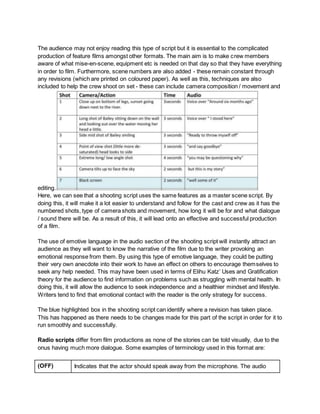
Here, we can see that a shooting script uses the same features as a master scene script. By
doing this, it will make it a lot easier to understand and follow for the cast and crew as it has the
numbered shots, type of camera shots and movement, how long it will be for and what dialogue
/ sound there will be. As a result of this, it will lead onto an effective and successful production
of a film.
The use of emotive language in the audio section of the shooting script will instantly attract an
audience as they will want to know the narrative of the film due to the writer provoking an
emotional response from them. By using this type of emotive language, they could be putting
their very own anecdote into their work to have an effect on others to encourage themselves to
seek any help needed. This may have been used in terms of Elihu Katz’ Uses and Gratification
theory for the audience to find information on problems such as struggling with mental health. In
doing this, it will allow the audience to seek independence and a healthier mindset and lifestyle.
Writers tend to find that emotional contact with the reader is the only strategy for success.
The blue highlighted box in the shooting script can identify where a revision has taken place.
This has happened as there needs to be changes made for this part of the script in order for it to
run smoothly and successfully.
Radio scripts differ from film productions as none of the stories can be told visually, due to the
onus having much more dialogue. Some examples of terminology used in this format are:
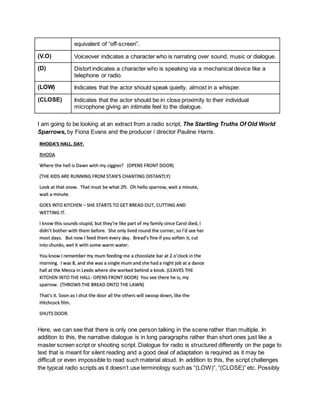
(OFF) Indicates that the actor should speak away from the microphone. The audio
equivalent of “off-screen”.
(V.O) Voiceover indicates a character who is narrating over sound, music or dialogue.
(D) Distort indicates a character who is speaking via a mechanical device like a
telephone or radio.
(LOW) Indicates that the actor should speak quietly, almost in a whisper.
(CLOSE) Indicates that the actor should be in close proximity to their individual
microphone giving an intimate feel to the dialogue.
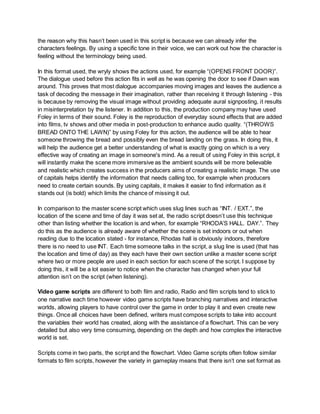
I am going to be looking at an extract from a radio script, The Startling Truths Of Old World
Sparrows, by Fiona Evans and the producer / director Pauline Harris.
Here, we can see that there is only one person talking in the scene rather than multiple. In
addition to this, the narrative dialogue is in long paragraphs rather than short ones just like a
master screen script or shooting script. Dialogue for radio is structured differently on the page to
text that is meant for silent reading and a good deal of adaptation is required as it may be
difficult or even impossible to read such material aloud. In addition to this, the script challenges
the typical radio scripts as it doesn’t use terminology such as “(LOW)”, “(CLOSE)” etc. Possibly
the reason why this hasn’t been used in this script is because we can already infer the
characters feelings. By using a specific tone in their voice, we can work out how the character is
feeling without the terminology being used.
In this format used, the wryly shows the actions used, for example “(OPENS FRONT DOOR)”.
The dialogue used before this action fits in well as he was opening the door to see if Dawn was
around. This proves that most dialogue accompanies moving images and leaves the audience a
task of decoding the message in their imagination, rather than receiving it through listening - this
is because by removing the visual image without providing adequate aural signposting, it results
in misinterpretation by the listener. In addition to this, the production company may have used
Foley in terms of their sound. Foley is the reproduction of everyday sound effects that are added
into films, tv shows and other media in post-production to enhance audio quality. “(THROWS
BREAD ONTO THE LAWN)” by using Foley for this action, the audience will be able to hear
someone throwing the bread and possibly even the bread landing on the grass. In doing this, it
will help the audience get a better understanding of what is exactly going on which is a very
effective way of creating an image in someone's mind. As a result of using Foley in this script, it
will instantly make the scene more immersive as the ambient sounds will be more believable
and realistic which creates success in the producers aims of creating a realistic image. The use
of capitals helps identify the information that needs calling too, for example when producers
need to create certain sounds. By using capitals, it makes it easier to find information as it
stands out (is bold) which limits the chance of missing it out.
In comparison to the master scene script which uses slug lines such as “INT. / EXT.”, the
location of the scene and time of day it was set at, the radio script doesn’t use this technique
other than listing whether the location is and when, for example “RHODA’S HALL. DAY.”. They
do this as the audience is already aware of whether the scene is set indoors or out when
reading due to the location stated - for instance, Rhodas hall is obviously indoors, therefore
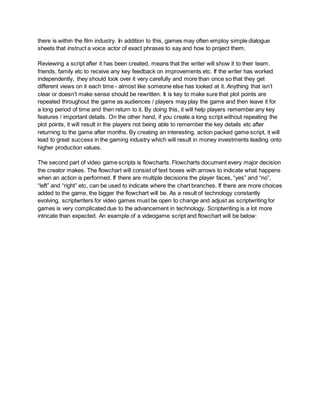
there is no need to use INT. Each time someone talks in the script, a slug line is used (that has
the location and time of day) as they each have their own section unlike a master scene script
where two or more people are used in each section for each scene of the script. I suppose by
doing this, it will be a lot easier to notice when the character has changed when your full
attention isn’t on the script (when listening).
Video game scripts are different to both film and radio, Radio and film scripts tend to stick to
one narrative each time however video game scripts have branching narratives and interactive
worlds, allowing players to have control over the game in order to play it and even create new
things. Once all choices have been defined, writers must compose scripts to take into account
the variables their world has created, along with the assistance of a flowchart. This can be very
detailed but also very time consuming, depending on the depth and how complex the interactive
world is set.
Scripts come in two parts, the script and the flowchart. Video Game scripts often follow similar
formats to film scripts, however the variety in gameplay means that there isn’t one set format as
there is within the film industry. In addition to this, games may often employ simple dialogue
sheets that instruct a voice actor of exact phrases to say and how to project them.
Reviewing a script after it has been created, means that the writer will show it to their team,
friends, family etc to receive any key feedback on improvements etc. If the writer has worked
independently, they should look over it very carefully and more than once so that they get
different views on it each time - almost like someone else has looked at it. Anything that isn’t
clear or doesn’t make sense should be rewritten. It is key to make sure that plot points are
repeated throughout the game as audiences / players may play the game and then leave it for
a long period of time and then return to it. By doing this, it will help players remember any key
features / important details. On the other hand, if you create a long script without repeating the
plot points, it will result in the players not being able to remember the key details etc after
returning to the game after months. By creating an interesting, action packed game script, it will
lead to great success in the gaming industry which will result in money investments leading onto
higher production values.
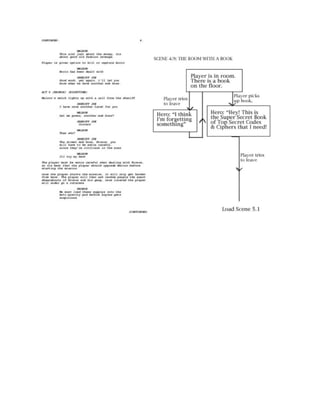
The second part of video game scripts is flowcharts. Flowcharts document every major decision
the creator makes. The flowchart will consist of text boxes with arrows to indicate what happens
when an action is performed. If there are multiple decisions the player faces, “yes” and “no”,
“left” and “right” etc, can be used to indicate where the chart branches. If there are more choices
added to the game, the bigger the flowchart will be. As a result of technology constantly
evolving, scriptwriters for video games must be open to change and adjust as scriptwriting for
games is very complicated due to the advancement in technology. Scriptwriting is a lot more
intricate than expected. An example of a videogame script and flowchart will be below:
Unit 19 - Scriptwriting

Unit 19 - Scriptwriting

  • 1.
    Unit 19: ScriptwritingLearning Aim B A script is written by screenwriters. They can be used for television programmes, films and video games. They can be original works or even adaptations from existing pieces of writing. There are three different script formats such as Master Scene scripts, shooting scripts and radio scripts. Master Screen Scripts (MSS) is the standard and accepted format for film production. It is designed to offer a simple and easy to access format for producers to show investors. It also offers a mix of description and dialogue to allow the reader / audience to easily follow the story as the story is the most important thing. In addition to this technical information is very limited within the master screen script format. The script which I will be using as an example is the 1990 Romance / Comedy Edward Scissorhands. A new scene is introduced by a slugline, which is generally placed at the very beginning of the scene before any dialogue is introduced. The MSS is split into scene headings, narrative descriptions and dialogue blocks. A scene heading is known as the slugline and is composed of three parts: -Interior vs exterior (Circled in RED) -Location (Circled in YELLOW) -Time of Day (Circled in GREEN) The three parts are all written on one line in capitals, abbreviated and limited, for example: INT and EXT means interior and exterior and the time of day is limited to DAY and Night, with the occasional use of DAWN and DUSK. By having sluglines, it will establish the location of the story, helping anyone reading it to imagine the scene better in their head. For example, this tells anyone reading the script whether the scene is an exterior or interior scene, where the scene takes place and the time of day it takes place at. Narrative description is the telling of the story as it unfolds on screen. It begins directly below the screen heading. The writing should be lean and visual, focusing on the action that moves the story forward but should also have enough flair to engage the readers. Unlike a novel, everything in a screenplay must be recorded in terms of picture and sound. Meaning that narrative description should never include anything that can’t be seen or heard and therefore only write what can be seen and heard (the mise-en-scene), for example: you can’t describe a character's feelings as it can’t be recorded. To show a character's thoughts, feelings and memories they must be shown through a certain way, such as action, dialogue or flashback scenes.
  • 2.
    Examples of mise-en-sceneinclude clothing, vehicles, houses and any other props that help to tell the story across the script. In the case of a shooting script, the text can include info to be applied during the editing process, such as certain sounds etc. However, this doesn’t apply in the Master Scene Script. In the film industry, it is an assumption that one page of screenplay equals one minute of time on screen. In terms of planning purposes, this is convenient since the average feature is 120 minutes therefore the average script should be around 120 pages in length. Because of this, description passages should cover as many pages as the scene is expected to run in real time. Meaning that if an action scene takes one minute of screen time, it should be written to cover one page rather than just a line, making sure to get all description and key features in. Dialogue blocks are also known as ‘speeches’ and are composed of three parts: character name, wryly and dialogue. Character names are written in capitals whereas wrylies are written in lowercase inside the parenthesis and dialogue is written in normal sentence case. A wryly was named after all the beginner screenwriters whose characters say things in a “wry” way. Wrylies should only be used if the subtext of the dialogue is not clear. It is essential to keep them to a bare minimum as they indicate how a line should be said. In addition to this, character names are identified before any dialogue is spoken. Parentheticals are used to give extra information to the reader about the dialogue. The type of information given in these things such as whether a character begins talking to another character. Examples of parentheticals within scripts include: in what manner the character reads
  • 3.
    their likes (forexample - excited), or if they are speaking from another location within the script; which allows the script to be translated into the final production piece with further ease. Conventions of Master Scene Scripts: -Font is always Courier and size 12. -Sluglines and character names in dialogue are in capital letters. -Voiceovers and offscreen is used as (V.O and O.S) -Footers at the bottom right of the page say (CONTINUED) only where a scene moves from one page to the next, the next page has (CONT.) top left. When scriptwriting a spec script don’t use: -Scene numbers. -Camera angles. -Page footers as they aren’t always required on spec. Scripts. -Capitals for sound effects in narrative descriptions. -Capitals for character names in narrative descriptions unless they are first appearing. -Third person use of “we” (eg. “We see John storm out…”). Edward Scissorhands - Extract Analysis
  • 4.
    Above is anextract from the Master Scene Script of Edward Scissorhands (1990). Edward Scissorhands is an American fantasy romance film directed by Tim Burton. Johnny Depp plays an artificial humanoid named Edward, an unfinished creation who has scissor blades instead of hands. I have chosen this extract from the script as it uses action sequences. The extract starts off with a new scene which is outside, at a mansion on a mountain and it is just before dawn. By using this in the slugline, it introduces the scene in the script and helps the reader / audience imagine the scene more clearly and picture it almost as if they are there in their head. In addition to this, it helps show what is important to the scene. By showing when and where the location is filmed it is important and key to the filmer and cast as they need to be aware of what needs filmed and when and where to be on time. Scene headings mark any change in location or time in a screenplay and every scene begins with one. However, not all scenes begin with the location etc as some scenes start with reminders of previous locations. For example:
  • 5.
    Once the scenehas been introduced, the writer then uses narrative description to unfold the story onscreen. As we can see, there are 3 paragraphs of narrative description in the script which helps to create in the mind of the reader the experience of watching a movie. In narrative descriptions, you must describe images, sounds, actions and speech on screen. In the first description, it sets the scene for the audience and film itself as we can see that the shot is from a high point which reveals the setting of a dark town which is lit up by house and street lights. By having such a dark scene set, it links to the main character himself (Edward Scissorhands) as he is seen as dangerous and inhumane with his scissor hands which is how he is introduced into the film. By having such a dark setting, the writer could try and illustrate Edward Scissorhands as a bad character in the film (i.e an antagonist) to start the narrative and develop the storyline as the main character himself develops into a protagonist and proves everyone wrong, other than the one person who believed in him which was Peggy. In the second part of the narrative description, it sets the atmosphere in relation to the genre due to the billowing curtains. It maintains mystery surrounding the character as he is described as a “DARK SILHOUETTE” which suggests how information will be withheld to an audience. Furthermore, it could describe Edward Scissorhands as a gothic and unusual character which stands out to be an outcast of the characters. By doing this, it supports the fact of his inhumane features and his described image of an ‘artificial humanoid’. The use of the adjective “ramshackle” helps us as the audience, get a feeling for the location and imagine it more clearly, which could be a genre characteristic of an old spooky house. This helps us to visualise the scene whilst maintaining a very streamlined and ‘to the point’ writing approach. In addition to this, “DARK SILHOUETTE” is in capitals as a new character has been introduced. They only do this for the first time that they are mentioned and then it will go back to lowercase if they are mentioned again. The writer does this to make the reader aware that a new character has joined the scene, which will help them picture it more effectively. After the narrative description, the writer uses a transition to introduce the next scene. He has done this by using “CUT TO:”. Each transitional instruction should be at it’s own margin. The standard indention is 6 inches from the left edge of the page or 2.5 inches from the right side (on paper 8.5 inches wide). The transition of “Cut to” was once widely used to indicate the end of a connecting sequence. By using this, it ends the opening sequence of the film and introduces the next scene where action takes place. By doing this, it shows the audience when the scene where the first scene ends of the elder and child so that they can imagine a new scene. On line 9, it states “At one house, a RETIRED MAN pushes a lawnmower -- back and forth”. The use of the double hyphen is used as a form of a colon as part of a break between dialogue, action etc. In this case, it has been used to break up action. This may have been done to manipulate time in the scene as he moved “back and forth” to slow the storyline down or
  • 6.
    possibly foreshadow anevent in the story. However this may have also been done to direct the audiences eye to clearly visualise the shot and the mise-en-scene used. The use of a wryly “(in her best Southern drawl)” at the ending of the extract, indicates how the line has been delivered in the film. This can help us imagine / get an idea of the character and location. By using a wryly, it also means that a parenthetical has been used. Parentheticals are words written underneath a character's name in dialogue. They are often referred to as ‘wrylys’ because of the adjectives used to describe how someone says a line or they are verbs that give an actor or actress some form of action to do as they say their line. A shooting script is the version of a screenplay used during the production stage of the film / tv show etc. They are different to spec scripts as they incorporate things like scene numbers, editing transitions and camera angles etc. In addition to this they are also implemented and circulated among cast and crew. The shooting script is usually made by the producer and cinematographer but on smaller productions, the screenwriter may also be involved as they could be generating new pages during production. The director and cinematographer will sit down with the script and discuss their plans and shot plan desired for the film. They line the scripts so that they are able to decide on which camera angles and movement they want in each scene. This is done as shooting scripts are broken up into types of shots such as close ups, medium shots and wide shots. The cast will be given a copy of the script so that they know when and where they need to be and what to do in the scene. All changes to the script will be marked by asterisks and written in revisions mode. After a spec script is purchased, the director and cast are attached. Then the movie goes into pre-production. In television, episodes are sent to the network, given notes, rewritten, and approved. Then the scene numbers are added so they can break each down individually. Shooting scripts should include: -Scene numbers. -Camera angles / movements. -Detailed special effects. -Detailed action sequences. -Specific information on sets i.e mise-en-scene. Much like the spec script, the shooting script is also written using a Courier font in size 12, as well as featuring sluglines, narrative descriptions and text blocks but however have more information. The main difference between the spec script and shooting script is that a spec script is used for selling the story to an investor, whereas a shooting script is used within the stages of production to guide the cast and cinematographers in the right direction. When a screenwriter produces a screenplay, he is trying to sell, most importantly the story. To do this, it is important that he writes a smooth read with a pleasant sounding flow otherwise the work can be rejected. Once the screenplay has been purchased, the film moves into production. The director then will alter any changes that he feels best and then turn it into a shooting script.
  • 7.
    The audience maynot enjoy reading this type of script but it is essential to the complicated production of feature films amongst other formats. The main aim is to make crew members aware of what mise-en-scene, equipment etc is needed on that day so that they have everything in order to film. Furthermore, scene numbers are also added - these remain constant through any revisions (which are printed on coloured paper). As well as this, techniques are also included to help the crew shoot on set - these can include camera composition / movement and editing. Here, we can see that a shooting script uses the same features as a master scene script. By doing this, it will make it a lot easier to understand and follow for the cast and crew as it has the numbered shots, type of camera shots and movement, how long it will be for and what dialogue / sound there will be. As a result of this, it will lead onto an effective and successful production of a film. The use of emotive language in the audio section of the shooting script will instantly attract an audience as they will want to know the narrative of the film due to the writer provoking an emotional response from them. By using this type of emotive language, they could be putting their very own anecdote into their work to have an effect on others to encourage themselves to seek any help needed. This may have been used in terms of Elihu Katz’ Uses and Gratification theory for the audience to find information on problems such as struggling with mental health. In doing this, it will allow the audience to seek independence and a healthier mindset and lifestyle. Writers tend to find that emotional contact with the reader is the only strategy for success. The blue highlighted box in the shooting script can identify where a revision has taken place. This has happened as there needs to be changes made for this part of the script in order for it to run smoothly and successfully. Radio scripts differ from film productions as none of the stories can be told visually, due to the onus having much more dialogue. Some examples of terminology used in this format are: (OFF) Indicates that the actor should speak away from the microphone. The audio
  • 8.
    equivalent of “off-screen”. (V.O)Voiceover indicates a character who is narrating over sound, music or dialogue. (D) Distort indicates a character who is speaking via a mechanical device like a telephone or radio. (LOW) Indicates that the actor should speak quietly, almost in a whisper. (CLOSE) Indicates that the actor should be in close proximity to their individual microphone giving an intimate feel to the dialogue. I am going to be looking at an extract from a radio script, The Startling Truths Of Old World Sparrows, by Fiona Evans and the producer / director Pauline Harris. Here, we can see that there is only one person talking in the scene rather than multiple. In addition to this, the narrative dialogue is in long paragraphs rather than short ones just like a master screen script or shooting script. Dialogue for radio is structured differently on the page to text that is meant for silent reading and a good deal of adaptation is required as it may be difficult or even impossible to read such material aloud. In addition to this, the script challenges the typical radio scripts as it doesn’t use terminology such as “(LOW)”, “(CLOSE)” etc. Possibly
  • 9.
    the reason whythis hasn’t been used in this script is because we can already infer the characters feelings. By using a specific tone in their voice, we can work out how the character is feeling without the terminology being used. In this format used, the wryly shows the actions used, for example “(OPENS FRONT DOOR)”. The dialogue used before this action fits in well as he was opening the door to see if Dawn was around. This proves that most dialogue accompanies moving images and leaves the audience a task of decoding the message in their imagination, rather than receiving it through listening - this is because by removing the visual image without providing adequate aural signposting, it results in misinterpretation by the listener. In addition to this, the production company may have used Foley in terms of their sound. Foley is the reproduction of everyday sound effects that are added into films, tv shows and other media in post-production to enhance audio quality. “(THROWS BREAD ONTO THE LAWN)” by using Foley for this action, the audience will be able to hear someone throwing the bread and possibly even the bread landing on the grass. In doing this, it will help the audience get a better understanding of what is exactly going on which is a very effective way of creating an image in someone's mind. As a result of using Foley in this script, it will instantly make the scene more immersive as the ambient sounds will be more believable and realistic which creates success in the producers aims of creating a realistic image. The use of capitals helps identify the information that needs calling too, for example when producers need to create certain sounds. By using capitals, it makes it easier to find information as it stands out (is bold) which limits the chance of missing it out. In comparison to the master scene script which uses slug lines such as “INT. / EXT.”, the location of the scene and time of day it was set at, the radio script doesn’t use this technique other than listing whether the location is and when, for example “RHODA’S HALL. DAY.”. They do this as the audience is already aware of whether the scene is set indoors or out when reading due to the location stated - for instance, Rhodas hall is obviously indoors, therefore there is no need to use INT. Each time someone talks in the script, a slug line is used (that has the location and time of day) as they each have their own section unlike a master scene script where two or more people are used in each section for each scene of the script. I suppose by doing this, it will be a lot easier to notice when the character has changed when your full attention isn’t on the script (when listening). Video game scripts are different to both film and radio, Radio and film scripts tend to stick to one narrative each time however video game scripts have branching narratives and interactive worlds, allowing players to have control over the game in order to play it and even create new things. Once all choices have been defined, writers must compose scripts to take into account the variables their world has created, along with the assistance of a flowchart. This can be very detailed but also very time consuming, depending on the depth and how complex the interactive world is set. Scripts come in two parts, the script and the flowchart. Video Game scripts often follow similar formats to film scripts, however the variety in gameplay means that there isn’t one set format as
  • 10.
    there is withinthe film industry. In addition to this, games may often employ simple dialogue sheets that instruct a voice actor of exact phrases to say and how to project them. Reviewing a script after it has been created, means that the writer will show it to their team, friends, family etc to receive any key feedback on improvements etc. If the writer has worked independently, they should look over it very carefully and more than once so that they get different views on it each time - almost like someone else has looked at it. Anything that isn’t clear or doesn’t make sense should be rewritten. It is key to make sure that plot points are repeated throughout the game as audiences / players may play the game and then leave it for a long period of time and then return to it. By doing this, it will help players remember any key features / important details. On the other hand, if you create a long script without repeating the plot points, it will result in the players not being able to remember the key details etc after returning to the game after months. By creating an interesting, action packed game script, it will lead to great success in the gaming industry which will result in money investments leading onto higher production values. The second part of video game scripts is flowcharts. Flowcharts document every major decision the creator makes. The flowchart will consist of text boxes with arrows to indicate what happens when an action is performed. If there are multiple decisions the player faces, “yes” and “no”, “left” and “right” etc, can be used to indicate where the chart branches. If there are more choices added to the game, the bigger the flowchart will be. As a result of technology constantly evolving, scriptwriters for video games must be open to change and adjust as scriptwriting for games is very complicated due to the advancement in technology. Scriptwriting is a lot more intricate than expected. An example of a videogame script and flowchart will be below: