Screen Writing
Screen Writing
 The art of writing scripts for a visual
medium
What is a script?
 A document that outlines every aural,
visual, behavioral, lingual element required
to tell a story.
 Must conform to standards that all involved
parties understand
 Intended to overview the typical elements
Screen Writing Rules
 Written on 8.5” x 11” white 3-hole punched paper
 A page number in the upper right corner
 No page number on the first page
 Font style: Courier
 Font size: 12
 Margins: between 0.5” – 1” (right, top & bottom)
between 1.2” – 1.6” (left)
Script Elements
 Scene Heading
 A short description of the location and time of
day of a scene, also known as a "slugline”
e.g.
EXT. MOUNTAIN CABIN - DAY
Script Elements
 Scene Heading
 Are we indoors or outdoors?
 Name of the location
 Time of the day
 Continuous action
 Stock shot
Script Elements
 Scene Heading
 Aligned flush left
 Written in ALL CAPS
 Used a period after the INT. or EXT.
 Used a hyphen between the other elements
Script Elements
 Action
 The moving pictures we see on screen
 The direction given by a director indicating that
filming
e.g.
FADE IN:
EXT. KEY WEST MARINA - DAWN -
ESTABLISHING Sailboats, yachts,
and cabin cruisers all bob up
and down in the warm blue water.
Script Elements
 Action
 Sets the scene
 Describes the setting
 Allows to introduce the characters
Script Elements
 Action
 Written in REAL TIME
 Use active voice
 Always write in PRESENT TENSE
 From left to right margin
 4-5 lines
Script Elements
 Character Name
 Can be an actual name or description or an
occupation
e.g.
INT. MASTER SUITE – MORNING
Sunlight filters through
portholes over the figure of
FRANKIE CAMPISI, 38.
FRANKIE
Script Elements
 Character Name
 When introduced for the first time, write it in
all caps.
 Before a character can speak, the writer inserts
a CHARACTER NAME to let the reader know
this character's dialogue follows.
 Formatted in ALL CAPS
 Indented 3.5” from the left margin
Script Elements
 Dialogue
 The speeches between characters in a film or a
play
 A window into the soul of the character
e.g.
FRANKIE
Rise and shine, Bluebird.
Time to spread your wings and
fly.
Script Elements
 Dialogue
 Indented 2.5” from the left margin
 Indented 2.0” – 2.5” from the right margin
 Can be 30 – 35 spaces long
Script Elements
 Parenthetical
 Also known as a “wryly” because of the
inclination of amateur screenwriters to try to
accent a character’s speech
e.g.
JULIE
(sleepily)
What? What time is it?
Script Elements
 Parenthetical
 Can be an attitude, verbal or action direction for
the actor
 Used as the continuing notation
 Generally disfavored nowadays
Script Elements
 Parenthetical
 Left indented at 3.0”
 Right indented at 3.5”
 Not centered under the character name
 Should be short, to the point, descriptive and
used when necessary
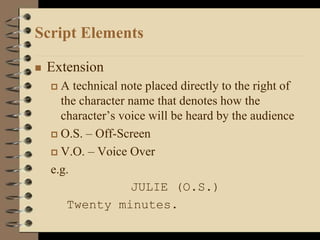
Script Elements
 Extension
 A technical note placed directly to the right of
the character name that denotes how the
character’s voice will be heard by the audience
 O.S. – Off-Screen
 V.O. – Voice Over
e.g.
JULIE (O.S.)
Twenty minutes.
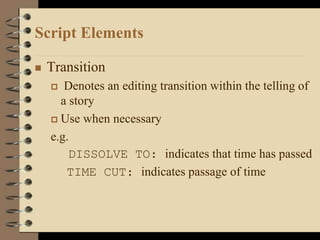
Script Elements
 Transition
 Denotes an editing transition within the telling of
a story
 Use when necessary
e.g.
DISSOLVE TO: indicates that time has passed
TIME CUT: indicates passage of time
Script Elements
 Transition
 Indented left at 6.5”
 Right margin of 1.0”
 ALL CAPS
 Follows an ACTION and precedes SCENE
HEADINGS
Script Elements
 Shot
 What the camera sees
 Allows the reader to see something not obvious
in the scene
 Allows the writer to achieve a particular emotion
or build to a climax
e.g.
ANGLE ON --
EXTREME CLOSE UP --
PAN TO –
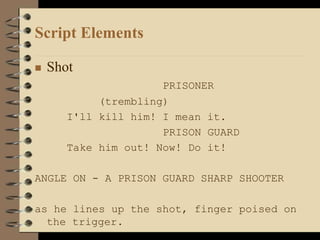
Script Elements
 Shot
PRISONER
(trembling)
I'll kill him! I mean it.
PRISON GUARD
Take him out! Now! Do it!
ANGLE ON - A PRISON GUARD SHARP SHOOTER
as he lines up the shot, finger poised on
the trigger.
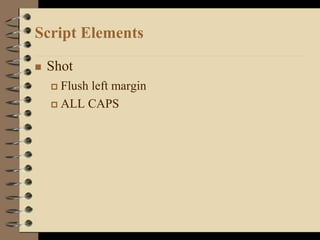
Script Elements
 Shot
 Flush left margin
 ALL CAPS

Screen writing

  • 1.
  • 2.
    Screen Writing  Theart of writing scripts for a visual medium
  • 3.
    What is ascript?  A document that outlines every aural, visual, behavioral, lingual element required to tell a story.  Must conform to standards that all involved parties understand  Intended to overview the typical elements
  • 4.
    Screen Writing Rules Written on 8.5” x 11” white 3-hole punched paper  A page number in the upper right corner  No page number on the first page  Font style: Courier  Font size: 12  Margins: between 0.5” – 1” (right, top & bottom) between 1.2” – 1.6” (left)
  • 5.
    Script Elements  SceneHeading  A short description of the location and time of day of a scene, also known as a "slugline” e.g. EXT. MOUNTAIN CABIN - DAY
  • 6.
    Script Elements  SceneHeading  Are we indoors or outdoors?  Name of the location  Time of the day  Continuous action  Stock shot
  • 7.
    Script Elements  SceneHeading  Aligned flush left  Written in ALL CAPS  Used a period after the INT. or EXT.  Used a hyphen between the other elements
  • 8.
    Script Elements  Action The moving pictures we see on screen  The direction given by a director indicating that filming e.g. FADE IN: EXT. KEY WEST MARINA - DAWN - ESTABLISHING Sailboats, yachts, and cabin cruisers all bob up and down in the warm blue water.
  • 9.
    Script Elements  Action Sets the scene  Describes the setting  Allows to introduce the characters
  • 10.
    Script Elements  Action Written in REAL TIME  Use active voice  Always write in PRESENT TENSE  From left to right margin  4-5 lines
  • 11.
    Script Elements  CharacterName  Can be an actual name or description or an occupation e.g. INT. MASTER SUITE – MORNING Sunlight filters through portholes over the figure of FRANKIE CAMPISI, 38. FRANKIE
  • 12.
    Script Elements  CharacterName  When introduced for the first time, write it in all caps.  Before a character can speak, the writer inserts a CHARACTER NAME to let the reader know this character's dialogue follows.  Formatted in ALL CAPS  Indented 3.5” from the left margin
  • 13.
    Script Elements  Dialogue The speeches between characters in a film or a play  A window into the soul of the character e.g. FRANKIE Rise and shine, Bluebird. Time to spread your wings and fly.
  • 14.
    Script Elements  Dialogue Indented 2.5” from the left margin  Indented 2.0” – 2.5” from the right margin  Can be 30 – 35 spaces long
  • 15.
    Script Elements  Parenthetical Also known as a “wryly” because of the inclination of amateur screenwriters to try to accent a character’s speech e.g. JULIE (sleepily) What? What time is it?
  • 16.
    Script Elements  Parenthetical Can be an attitude, verbal or action direction for the actor  Used as the continuing notation  Generally disfavored nowadays
  • 17.
    Script Elements  Parenthetical Left indented at 3.0”  Right indented at 3.5”  Not centered under the character name  Should be short, to the point, descriptive and used when necessary
  • 18.
    Script Elements  Extension A technical note placed directly to the right of the character name that denotes how the character’s voice will be heard by the audience  O.S. – Off-Screen  V.O. – Voice Over e.g. JULIE (O.S.) Twenty minutes.
  • 19.
    Script Elements  Transition Denotes an editing transition within the telling of a story  Use when necessary e.g. DISSOLVE TO: indicates that time has passed TIME CUT: indicates passage of time
  • 20.
    Script Elements  Transition Indented left at 6.5”  Right margin of 1.0”  ALL CAPS  Follows an ACTION and precedes SCENE HEADINGS
  • 21.
    Script Elements  Shot What the camera sees  Allows the reader to see something not obvious in the scene  Allows the writer to achieve a particular emotion or build to a climax e.g. ANGLE ON -- EXTREME CLOSE UP -- PAN TO –
  • 22.
    Script Elements  Shot PRISONER (trembling) I'llkill him! I mean it. PRISON GUARD Take him out! Now! Do it! ANGLE ON - A PRISON GUARD SHARP SHOOTER as he lines up the shot, finger poised on the trigger.
  • 23.
    Script Elements  Shot Flush left margin  ALL CAPS