Screenwriting  101 : How To Format A Script
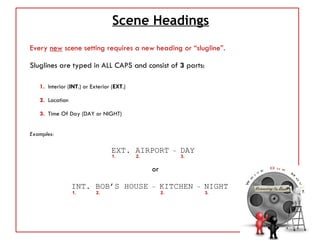
  Scene Headings Every  new  scene setting requires a new heading or “slugline”. Sluglines are typed in ALL CAPS and consist of  3  parts: 1.  Interior ( INT .) or Exterior ( EXT .)     2.   Location  3.   Time Of Day (DAY or NIGHT) Examples: EXT. AIRPORT  –  DAY   or   INT. BOB’S HOUSE  –  KITCHEN  –  NIGHT 1. 2. 3. 1. 2. 3. 2.
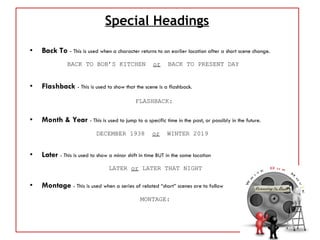
  Special Headings Back To   - This is used when a character returns to an earlier location after a short scene change.   BACK TO BOB’S KITCHEN  or   BACK TO PRESENT DAY Flashback   - This is used to show that the scene is a flashback.     FLASHBACK:   Month & Year   - This is used to jump to a specific time in the past, or possibly in the future.   DECEMBER 1938  or   WINTER 2019 Later  - This is used to show a minor shift in time BUT in the same location   LATER  or  LATER THAT NIGHT   Montage  - This is used when a series of related “short” scenes are to follow   MONTAGE:
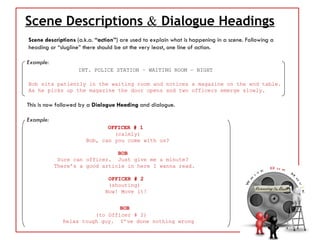
Scene Descriptions  &  Dialogue Headings Scene descriptions  (a.k.a.  “action” ) are used to explain what is happening in a scene. Following a  heading or “slugline” there should be at the very least, one line of action.  Example:    INT. POLICE STATION – WAITING ROOM – NIGHT Bob sits patiently in the waiting room and notices a magazine on the end table.  As he picks up the magazine the door opens and two officers emerge slowly. This is now followed by a  Dialogue Heading  and dialogue. Example:   OFFICER # 1   (calmly)   Bob, can you come with us?   BOB Sure can officer.  Just give me a minute?  There’s a good article in here I wanna read.   OFFICER # 2   (shouting)   Now! Move it!   BOB   (to Officer # 2)   Relax tough guy.  I’ve done nothing wrong
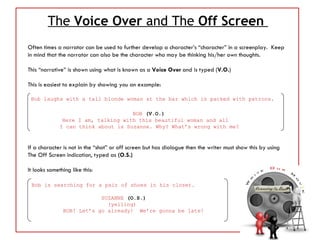
The  Voice Over  and   The  Off Screen  Often times a narrator can be used to further develop a character’s “character” in a screenplay.  Keep  in mind that the narrator can also be the character who may be thinking his/her own thoughts.  This “narrative” is shown using what is known as a  Voice Over  and is typed ( V.O. ) This is easiest to explain by showing you an example:  Bob laughs with a tall blonde woman at the bar which is packed with patrons.       BOB  (V.O.)   Here I am, talking with this beautiful woman and all  I can think about is Suzanne. Why? What’s wrong with me? If a character is not in the “shot” or off screen but has dialogue then the writer must show this by using The Off Screen indication, typed as  (O.S.) It looks something like this: Bob is searching for a pair of shoes in his closet.   SUZANNE  (O.S.)   (yelling)   BOB! Let’s go already!  We’re gonna be late!

Screenwriting 101

  • 1.
    Screenwriting 101: How To Format A Script
  • 2.
    SceneHeadings Every new scene setting requires a new heading or “slugline”. Sluglines are typed in ALL CAPS and consist of 3 parts: 1. Interior ( INT .) or Exterior ( EXT .) 2. Location 3. Time Of Day (DAY or NIGHT) Examples: EXT. AIRPORT – DAY or INT. BOB’S HOUSE – KITCHEN – NIGHT 1. 2. 3. 1. 2. 3. 2.
  • 3.
    SpecialHeadings Back To - This is used when a character returns to an earlier location after a short scene change. BACK TO BOB’S KITCHEN or BACK TO PRESENT DAY Flashback - This is used to show that the scene is a flashback. FLASHBACK: Month & Year - This is used to jump to a specific time in the past, or possibly in the future. DECEMBER 1938 or WINTER 2019 Later - This is used to show a minor shift in time BUT in the same location LATER or LATER THAT NIGHT Montage - This is used when a series of related “short” scenes are to follow MONTAGE:
  • 4.
    Scene Descriptions & Dialogue Headings Scene descriptions (a.k.a. “action” ) are used to explain what is happening in a scene. Following a heading or “slugline” there should be at the very least, one line of action. Example: INT. POLICE STATION – WAITING ROOM – NIGHT Bob sits patiently in the waiting room and notices a magazine on the end table. As he picks up the magazine the door opens and two officers emerge slowly. This is now followed by a Dialogue Heading and dialogue. Example: OFFICER # 1 (calmly) Bob, can you come with us? BOB Sure can officer. Just give me a minute? There’s a good article in here I wanna read. OFFICER # 2 (shouting) Now! Move it! BOB (to Officer # 2) Relax tough guy. I’ve done nothing wrong
  • 5.
    The VoiceOver and The Off Screen Often times a narrator can be used to further develop a character’s “character” in a screenplay. Keep in mind that the narrator can also be the character who may be thinking his/her own thoughts. This “narrative” is shown using what is known as a Voice Over and is typed ( V.O. ) This is easiest to explain by showing you an example: Bob laughs with a tall blonde woman at the bar which is packed with patrons. BOB (V.O.) Here I am, talking with this beautiful woman and all I can think about is Suzanne. Why? What’s wrong with me? If a character is not in the “shot” or off screen but has dialogue then the writer must show this by using The Off Screen indication, typed as (O.S.) It looks something like this: Bob is searching for a pair of shoes in his closet. SUZANNE (O.S.) (yelling) BOB! Let’s go already! We’re gonna be late!