SCREENING METHODS OF PARKINSON’S DISEASE
M. Pharm. (PTSM-1)
PRESENTED BY
NEERAJ RANA
NOIDA INSTITUTE OF ENGINEERING AND TECHNOLOGY
(PHARMACY INSTITUTE) GREATER NOIDA
Under Guidance:
Dr. Saumya Das
Associate Professor
OUTLINE
• Introduction
• Etiology
• Pathophysiology
• Classification
• In Vivo preclinical
• In Vitro preclinical Methods
• Gap of the study
• References
M. Pharm. (PTSM-1)
INTRODUCTION
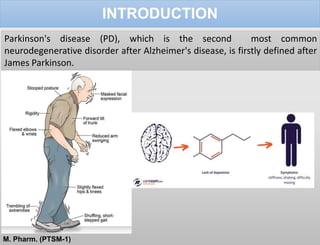
Parkinson's disease (PD), which is the second most common
neurodegenerative disorder after Alzheimer's disease, is firstly defined after
James Parkinson.
M. Pharm. (PTSM-1)
PATHOPHYSIOLOGY
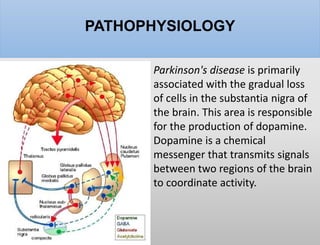
Parkinson's disease is primarily
associated with the gradual loss
of cells in the substantia nigra of
the brain. This area is responsible
for the production of dopamine.
Dopamine is a chemical
messenger that transmits signals
between two regions of the brain
to coordinate activity.
ETIOLOGY
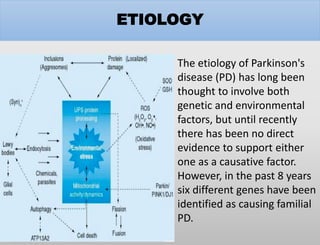
The etiology of Parkinson's
disease (PD) has long been
thought to involve both
genetic and environmental
factors, but until recently
there has been no direct
evidence to support either
one as a causative factor.
However, in the past 8 years
six different genes have been
identified as causing familial
PD.
CLASSIFICATION
• Dopamine analogues: Levodopa
• Peripheral deoxy decarboxylase inhibitor: carbidopa,
benserazide
• COMT- inhibitors: Tolcapone,Entacapone
• MAO-B inhibitor: Selegiline, Clogyline
• Dopamine agonists: Rosipirole, Pergoline
• Centre anti-cholinergic: Benzotropine, biperiden
• Antihistaminic: ophenadrine, promethazine
M. Pharm. (PTSM-1
IN VIVO METHOD
SCREENING MODELS
IN VIVO METHODS
• Tremorineand Oxotremorine Antagonism
• MPTP Model Of Parkinson’s Disease
• Reserpine Antagonism
• Circling Behavior In Nigrostriatal Lesioned Rats
• Elevated Body Swing Test
• Skilled Paw Reaching In Rats
• Stepping Test In Rats
• Gait Analysis
• Rotenone Induced Parkinson’s
M. Pharm. (PTSM-1
TREMORINE AND EXOTREMORINE
ANTAGONISM
• PURPOSE AND RATIONALE
• The muscranic agonists Tremaine and oxotremorine
induce parkinsonism-like signs such as tremor,
ataxia, spasticity, salivation, lacrimation and
hypothermia.
• These signs are antagonized by anticholinergic
drugs.
PROCEDURE
Groups of 6-10 male NMRI mice weighing 18-22g are used.
They are dosed orally with the test compound or the standard ( 5
mg/kg benzatropine mesilate) 1 h prior the administration of 0.5
mg/kg oxotremorine s.c.
• Rectal temperature is measured before
administration of the compound (Basal value) and
1,2and 3 h after oxotremorine injection.
Tremor is scored after oxotremorine dosage in 10 s
observation periods every 15 min for 1 h.
Tremor Score
Absent 0
Slight 1
Medium 2
Severe 3
M. Pharm. (PTSM-1
• Salivation and Lacrimation are scored 15 and 30 min
after oxotremorine injection.
Absent 0
Slight 1
Medium 2
Severe 3
EVALUATION
Hypothermia
The differences of the body temperature after 1,2 and 3
h versus basal values are summarized for each animals
in the control groups.
The average values are compared statistically.
• The scores for all animals in each group at the 3
observation periods are summarized.
The numbers in the treated groups are expressed as
percentage of the number of the control group.
Salivation and Lacrimation
The scores for the both symptoms for all animals in
each group are summarized at the 2 observation
periods.
The numbers in the treated groups are expressed as
percentage of the number of the control group
TREMOR
M. Pharm. (PTSM-1
MODIFICATIONS OF THE METHOD
• Johnson et al. (1986)
Developed a procedure for quantifying whole body tremors
in mice.
Displacement of a free floating platform by animal
movement created a change in resistance across a strain
gauge.
Administration of oxotremorine, 2.5 mg/kg i.p. produced
numerous high – frequency, high intensity peaks within 5
min.
M. Pharm. (PTSM-1
• Clement and Dyck (1989)
Constructed and tested a tremor monitor that quantitates
soma and oxotremorine induced tremors.
The device consisted of a force transducer, from which a
plastic beaker was suspended containing a mouse.
The signal from the force transducer was fed into a tremor
monitor and quantitated using the Applecounter from
Columus Instruments.
Coward et al. (1977)
Recommended N- carbamoyl-2- (2,6-dichlorophenyl)
acetamidine hypo chloride (LON-1954), a tremor genic
agent, as alternative to oxotremorine for the detection of
anti Parkinson drugs.
B. MPTP model in Monkeys
• PURPOSE AND RATIONALE
N- MPTP ( N-methyl-4-phenyl-1,2,3,6-
tetrahydopyridine) has been shown to cause
symptoms of Parkinson’s disease in exposed
individuals.
When administered to primates this compound
causes a partial destruction of basal ganglia and a
syndrome that resembles Parkinson’s diseases.
M. Pharm. (PTSM-1
PROCEDURE
• Burns et al. (1983) treated 8 adult rhesus monkeys
weighing 5-8 kg over a period of 5-8 days with cumulative
intravenous doses of N-methyl-4-phenyl-1,2,3,6-
tetrahydropyridine (N-MPTP) up to 10-18 mg/kg.
These animals showed a parkinsonism like disorder
(Drooling, rigidity, akinesia, postural tremors), which was
reversed by the administration of L-dopa.
The pathological and biochemical changes produced by N-
MPTP are similar to the well established changes in
patients in patients with Parkinsonism.
M. Pharm. (PTSM-1
EVALUATION
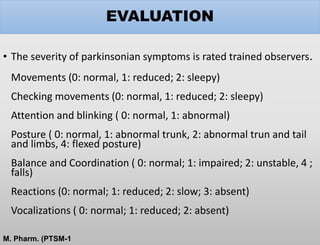
• The severity of parkinsonian symptoms is rated trained observers.
Movements (0: normal, 1: reduced; 2: sleepy)
Checking movements (0: normal, 1: reduced; 2: sleepy)
Attention and blinking ( 0: normal, 1: abnormal)
Posture ( 0: normal, 1: abnormal trunk, 2: abnormal trun and tail
and limbs, 4: flexed posture)
Balance and Coordination ( 0: normal; 1: impaired; 2: unstable, 4 ;
falls)
Reactions (0: normal; 1: reduced; 2: slow; 3: absent)
Vocalizations ( 0: normal; 1: reduced; 2: absent)
M. Pharm. (PTSM-1
MODIFICATIONS OF THE METHOD
• Kebanian et al. (1992) tested a selective D1 receptor agonist
with antiparkinsonian activity in MTPT treated marmosets.
Domino and Sheng (1993) studied the relative potency of some
dopamine agonists with varying selectivities for D1 and D2
receptors in MPTP induced hemiparkinsonian monkeys.
Asin et al. (1997) tested a selective D1 receptor agonist in rats
previously given unilateral 6 hydroxydopamine injections and in
macaques previously given unilateral, intracarotid infusions of
MPTP.
M. Pharm. (PTSM-1
IN VITRO METHOD
SCREENING MODELS
IN VITRO METHODS
• Experiment Using Rat Strial Slices
• Dopamine Stimulated Adenyl Cyclase Activity
• Culture Of Substantial Nigra
• Inhibition of Apoptosis In Neuroblastoma SH-SY5Y
Cells
• Radioligant Binding Studies For D1 And D2 Dopamine
Receptor
• In Vitro Neuroprotective Efficacy
M. Pharm. (PTSM-1
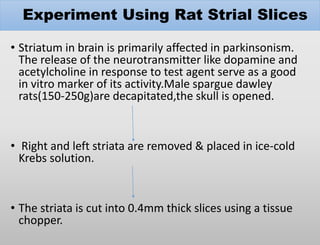
Experiment Using Rat Strial Slices
• Striatum in brain is primarily affected in parkinsonism.
The release of the neurotransmitter like dopamine and
acetylcholine in response to test agent serve as a good
in vitro marker of its activity.Male spargue dawley
rats(150-250g)are decapitated,the skull is opened.
• Right and left striata are removed & placed in ice-cold
Krebs solution.
• The striata is cut into 0.4mm thick slices using a tissue
chopper.
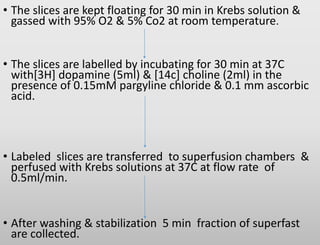
• The slices are kept floating for 30 min in Krebs solution &
gassed with 95% O2 & 5% Co2 at room temperature.
• The slices are labelled by incubating for 30 min at 37C
with[3H] dopamine (5ml) & [14c] choline (2ml) in the
presence of 0.15mM pargyline chloride & 0.1 mm ascorbic
acid.
• Labeled slices are transferred to superfusion chambers &
perfused with Krebs solutions at 37C at flow rate of
0.5ml/min.
• After washing & stabilization 5 min fraction of superfast
are collected.
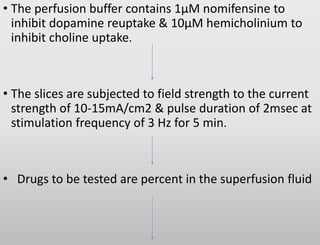
• The perfusion buffer contains 1µM nomifensine to
inhibit dopamine reuptake & 10µM hemicholinium to
inhibit choline uptake.
• The slices are subjected to field strength to the current
strength of 10-15mA/cm2 & pulse duration of 2msec at
stimulation frequency of 3 Hz for 5 min.
• Drugs to be tested are percent in the superfusion fluid
• The radioactivity in the superfast samples & in the
tissue is determined by liquid scintillation counting.
• The radiolabelled choline method makes it possible to
study Ach release in vitro without inhibiting
cholinesterase, thus minimizing auto inhibition of
transmitter release caused by accumulation of
unhydrolised of Ach.
M. Pharm. (PTSM-1
DOPAMINE STUMILATED ADENYLY CYCLASE
ACTIVITY
• Male sprege dawlety (150-250) are decapitated and left
striata are removed
• Striatal tissue homogenized in chilled buffer containing
10mm imidazole, 2mm EDTA and 10% source ph 7.3
• Homogenate is centrifuged at thousand g for 10min and
supernatant is recentifuged at 27000g for 20min
• The pellet obtained is washed twice and suspended in
10mM imidazole pH. 7.3 membrane prate is determine by
Bradford's method using bovine serum
• Adenylyl cycles activity is measured by calculating the
conversion rate of (32p) ATP to (32p) cAMP
• The assay is perform in 250microaL solution containing
imidazole ,mgcl2 papaverine dithiothretol
ATP,GTP,phosphokinase
• The reaction mixture is preincubate at 30c for 5min the
reaction is initiated by adding membrane proteins and
incubated for 10min
• The reaction is terminated by adding stopping solution
(ATP,SDS,cAMP). Formed (32p)cAMP is separated
from(32P)ATP by chromatography.
M. Pharm. (PTSM-1
GAP OF THE STUDY
The major gap of the studies is scientists could not have
found exact approaches to cure this disease.

M. Pharm. (PTSM-1)
REFERENCE
•A. Schrage, P. Barone, R. G. Brown et al., “Depression rating scales
in Parkinson’s disease: critique and recommendations,” Movement
Disorders, vol. 22, no. 8, pp. 1077–1092, 2007.
•A. F. G. Lenten's, K. Dujardin, L. Marsh et al., “Apathy and anhedonia
rating scales in Parkinson’s disease: critique and recommendations,”
Movement Disorders, vol. 23, no. 14, pp. 2004–2014, 2008.
•H. F. Kaiser, “An index of factorial simplicity,” Psychometrical, vol. 39,
no. 1, pp. 31–36, 1974.
•F. Raudino, “Non motor off in Parkinson’s disease,” Acta Neurological
Scandinavia, vol. 104, no. 5, pp. 312–315, 2001.
All creatures are deserving of a life free from fear and pain
M. Pharm. (PTSM-1)