PRECLINICAL
SCREENING OF
ANTIPSYCHOTIC AGENTS
SUBMITTED BY-
ANURAG CHOURASIA
M.PHARMA
CONTENTS
 INTRODUCTION
 DEFINITION
 CLASSIFICATION
 SCREENING MODELS
• IN VIVO
• IN VITRO
INTRODUCTION
The word psychosis was first used by Ernst in 1845 and stems from the Greek
words psyche (mind) and osis (abnormal condition).
It has been used as an alternative to mania. The etiopathology of psychosis is
complex and genetic basis has been understood to play a definitive role in its
genesis.
Antipsychotic or Neuroleptic drugs are those agents which are used to treat
severe psychiatric illness, psychosis and mania.
The prominent symptom's of psychosis include hallucinations, delusions and
thought disorder.
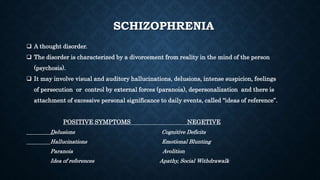
SCHIZOPHRENIA
 A thought disorder.
 The disorder is characterized by a divorcement from reality in the mind of the person
(psychosis).
 It may involve visual and auditory hallucinations, delusions, intense suspicion, feelings
of persecution or control by external forces (paranoia), depersonalization and there is
attachment of excessive personal significance to daily events, called “ideas of reference”.
POSITIVE SYMPTOMS NEGETIVE
Delusions Cognitive Deficits
Hallucinations Emotional Blunting
Paranoia Avolition
Idea of references Apathy, Social Withdrawalk
ANTI-PSYCHOTIC DRUGS
Antipsychotic drugs are also known as Neuroleptics, Ataractic,
Major Tranquilizer and Anti-Schizophrenic drugs.
A first generation of antipsychotics, known as typical
antipsychotics,was discovered in the 1950s.
Most of the drugs in the second generation, known as atypical
antipsychotics have been developed more recently.
CLASSIFICATIONS
1.Phenothiazines
a. Aliphatic side chain :Chlorpromazine
Triflupromazine
b. Piperidine side chain : Thioridazine
c. ‘Piperazine side chain : Trifluoperazine,Fluphenazine
2.Butyrophenones Haloperidol,Trifluperidol,Penfluridol
SCREENING MODELS
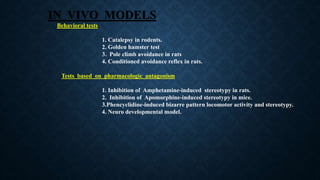
IN VIVO MODELS
Behavioral tests
1. Catalepsy in rodents.
2. Golden hamster test
3. Pole climb avoidance in rats
4. Conditioned avoidance reflex in rats.
Tests based on pharmacologic antagonism
1. Inhibition of Amphetamine-induced stereotypy in rats.
2. Inhibition of Apomorphine-induced stereotypy in mice.
3.Phencyclidine-induced bizarre pattern locomotor activity and stereotypy.
4. Neuro developmental model.
In vitro models
1. D₁ - receptor assay
2. D₂ - receptor assay
3. Binding to D₃ - receptor
4. Binding to D₄ - receptor
5. ⍺₁ - adrenergic receptor binding in brain
6. Measurement of neurotransmitters by intracranial micro
dialysis.
7. Binding to sigma receptors
IN VIVO MODELS
CATALEPSY IN RODENTS
Purpose and rationale
Catalepsy in rats is defined as a failure to correct an externally
imposed, unusual posture over a prolonged period of time.
This is a typical effect of all agents which inhibits dopaminergic
system in nigrostratum.
Procedure
 Groupings→ Group I - treated with test drug
Group II - treated with standard drug (Haloperidol 0.2
mg/kg I.P)
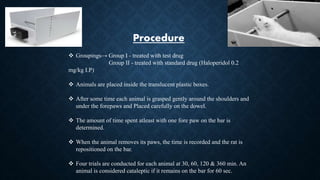
 Animals are placed inside the translucent plastic boxes.
 After some time each animal is grasped gently around the shoulders and
under the forepaws and Placed carefully on the dowel.
 The amount of time spent atleast with one fore paw on the bar is
determined.
 When the animal removes its paws, the time is recorded and the rat is
repositioned on the bar.
 Four trials are conducted for each animal at 30, 60, 120 & 360 min. An
animal is considered cataleptic if it remains on the bar for 60 sec.
Evaluation
The percentage of cataleptic animal is calculated for each group.
ED₅₀ values are calculated for comparison & elucidation of
potency.
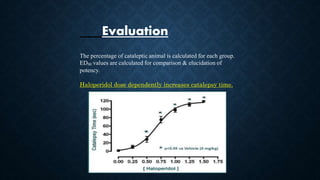
Haloperidol dose dependently increases catalepsy time.
INHIBITION OF
AMPHETAMINE INDUCED
STEREOTYPY IN RATS
PURPOSE AND RATIONALE
Amphetamine is an indirect acting sympathomimetic agent which releases
catacholamines from its neuronal storage pools. In rats the drug induces characteristic
stereotypic behavior and this can be prevented by neuroleptics
PROCEDURE Groupings;
Group I (control) - d-Amphetamine 10 mg/kg S.C.
Group II (treated) - Chlorpromazine 10 mg/kg S.C.+
d- Amphetamine 10 mg/kg S.C.
 The rats with a body weight between 120 - 200 g are selected and grouped into 6 each in
control and treated.
 They are injected simultaneously with d-Amphetamine and test compound and placed in
individual cages.
 After 60 min of drug administration the rats are observed.
 In the group I animals which have been administered d-Amphetamine shows stereotypic
behaviour which is characterized by continuous sniffing, licking or chewing and compulsive
gnawing.
 The stereotypic behaviour is reduced or abolished in drug treated group.
EVALUATION
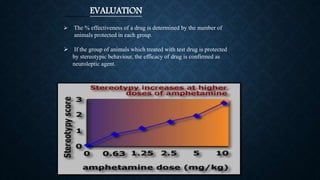
 The % effectiveness of a drug is determined by the number of
animals protected in each group.
 If the group of animals which treated with test drug is protected
by stereotypic behaviour, the efficacy of drug is confirmed as
neuroleptic agent.
INHIBITION OF
APOMORPHINE INDUCED
STEREOTYPY IN RATS
PURPOSE AND RATIONALE
Apomorphine (stimulate dopamine receptor in CTZ) induces a stereotyped
behavior in rats, characterized by licking, sniffing and gnawing in a
repetitive,compulsive manner, which is an indication of striatal dopaminergic
stimulation.
 Compounds which prevent apomorphine-induced stereotypy antagonize
dopamine receptors in the nigrostriatal system.
 Furthermore, antagonism of this behavior is predictive of propensity
(tendency to behave in certain way) for the development of extrapyramidal
side effects.
PROCEDURE
 For screening, group of 6 male Wistar rats with a body weight between
120 and 200 g are used.
 The test drug or the standard are administered I.P. 60 min prior to
Apomorphine dosage.
 Apomorphine HCl is injected S.C. at a dose of 1.5 mg/kg.
 The animals are placed in individual plastic cages.
 A 10 sec observation period is used to measure the presence of stereotypic activity such as
sniffing, licking and chewing 10 min after apomorphine administration.
 An animal is considered protected if this behavior is reduced or abolished.
EVALUATION
The percent effectiveness of a drug is determined by the number of
animals protected in each group.
 With a group size of 10 animals dose response curves are obtained
and ED₅₀ values calculated.
 ED₅₀ values were found to be 0.2 mg/kg S.C. for Haloperidol and 5.0
mg/kg for Chlorpromazine, whereas Clozapine was ineffective even
at high doses
GOLDEN HAMSTER
TEST
PURPOSE AND RATIONALE
This test uses the innate behavior of the species ( Mesocricetus auratus) for
differentiation between neuroleptics & sedative-hypnotic activity. The aggressive
behaviour of male Golden hamster is suppressed by neuroleptic in doses which do
not impair motor function.
PROCEDURE
 Control - vehicle treated (no.6)
 Treated - standard drug (no.6)
 The above grouped animals are placed together in crowded conditions in
specially designed cages for at least 14 days.
 The animals develop a characteristic fighting behavior during this period.
FOR SELECTION OF A TEST
GROUP
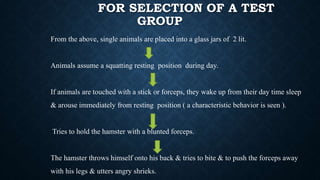
From the above, single animals are placed into a glass jars of 2 lit.
Animals assume a squatting resting position during day.
If animals are touched with a stick or forceps, they wake up from their day time sleep
& arouse immediately from resting position ( a characteristic behavior is seen ).
Tries to hold the hamster with a blunted forceps.
The hamster throws himself onto his back & tries to bite & to push the forceps away
with his legs & utters angry shrieks.
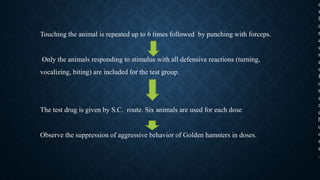
Touching the animal is repeated up to 6 times followed by punching with forceps.
Only the animals responding to stimulus with all defensive reactions (turning,
vocalizing, biting) are included for the test group.
The test drug is given by S.C. route. Six animals are used for each dose
Observe the suppression of aggressive behavior of Golden hamsters in doses.
a
s
l
a
r
e
u
s
e
d
f
o
r
e
a
c
h
d
o
s
e
.
EVALUATION
 The stimuli are applied every 20 min for 3 hr.
 The suppression of defense reaction is evaluated.
 If all defense reactions are suppressed even after punching with forceps at least once
during test period, an animal is regarded to be completely ‘tamed’.
IN-VITRO
MODELS
D2 RECEPTOR ASSAY: H-
SPIROPERIDOL
PURPOSE AND RATIONALE
 The neuroleptic compound Haloperidol has been used as binding ligand to study the activity
of other neuroleptics.
 The use of Haloperidol has been superseded by Spiroperidol.
 Dopamine receptor binding assays employing dopaminergic antagonists in mammalian
striatal tissue, a dopamine enriched area of the brain, have been shown to be predictive of in
vivo dopamine receptor antagonism and antipsychotic activity.
 Spiroperidol is considered to be an antagonist specific for D₂ receptors
PROCEDURE
TISSUE PREPRATION
Male Wistar rats are decapitated, their corpora striate removed,
weighed and homogenized in 50 ml of ice-cold 0.05 M Tris buffer
( pH 7.7 ).
 The homogenate is centrifuged at 40 000 rpm for 15 min.
 The pellet is rehomogenized in fresh buffer and recentrifuged at 40 000
rpm.
 The final pellet is then resuspended in Tris buffer.
ASSAY
The membrane preparations are incubated with ³H-Spiroperidol.
Various concentrations of the test drug at 37 °C for 20 min in a K/Na
phosphate buffer (50 mM, pH 7.2), followed by cooling in an ice bath for
45 min.
To determine non-specific binding, samples containing 2mM (+)-
Butaclamol are incubated under identical conditions without the test
compound.
Bound ligand is separated by rapid filtration through Whatman GF/B
glass fiber filters.
The filters are washed three times with ice-cold buffer, dried, and shaken thoroughly with 3.5 ml
scintillation fluid.
Radioactivity is determined in a liquid scintillation counter.
Specific binding is defined as the difference between total binding and the binding in the presence of
2.0 mM (+)-Butaclamol.
SCINTILLATION COUNTER
EVALUATION
The following parameters are determined:
• Total binding of ³H-spiroperidol
• Non-specific binding: binding of samples containing
2 mM Butaclamol
• Specific binding: total binding – non-specific
binding
• % inhibition: 100 – specific binding as percentage
of the control value.
Preclinical Screening of Antipsychotic Agents