seminar on
SCREENING METHODS OF ANTIDEPRESSANT DRUGS
Presented by
Mr. Lomate Krushna Anurath
[ 1st sem. M. Pharm ]
[pharmacology]
Under the guidance of
Dr.krishnamurty
Date:-
RAJGAD DNYANPEETH’S COLLEGE OF PHARMACY
Introduction
 Depression is considered as an affective disorder
characterized by change in mood, lack of interest
in surroundings and psychomotor retardation
 Women › men
 second most leading cause of premature death
or disability worldwide by the year 2020.
Types of depression
Major depression
Dysthymia
Bipolar depression
Seasonal depression
psychotic depression
Atypical depression
Pathophysiology of depression
Norepinephrine secreting neurons are located in
the brain stem
Serotonin producing neurons located in the
midline raphe nuclei of lowers pons and
medulla. The principle reason for depression
is the diminished activity of the mono
amines releasing neurons
depression due to the depletion of
monoamine level in the brain
especially NA, 5-HT, DA
depletion due to enzyme monoamine oxidase
depletion due to reuptake of monoamine
METHODS OF PRECLINICAL
EVALUATION OF ANTIDEPRESSANT
DRUGS
IN VIVO METHODS
1] Forced swim test
2] Tail suspension test
3] Muricide behavior in rats
4] Reserpine induced hypothermia
5] Compulsive gnawing in mice
Forced swim test
purpose and rationale
mice or rats forced to swim in a restricted space
from which they cannot escape are induced to a
characteristic behavior of immobility.
Procedure
rats of either sex individually forced to swim in open container
containing 19 cm of water 25 ± 1º C
rats are divided into the 5 groups
first group assigned as a control receiving only vehicle
other 3 group received acute dose of test drug
fifth group receive standard drug
total duration of immobility was recorded during the last 6 min of the
10 min period
judged immobile when remains floating motionless in water making
only those movement necessary to keep it head above water
decrease in duration of immobility its indicative of an antidepressant
effect
Evaluation
duration of immobility is measured in all
groups
antidepressants are decrease this
immobility period
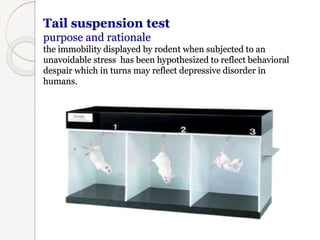
Tail suspension test
purpose and rationale
the immobility displayed by rodent when subjected to an
unavoidable stress has been hypothesized to reflect behavioral
despair which in turns may reflect depressive disorder in
humans.
Procedure
male balb/cj mice are used
housed in the plastic cage for 10 days
with food and water freely available
animal transport housing room to testing area
keep for 1 hour
group of 10 animal treated with test compound
mice are suspended on the edge of shelf 58 cm above a table
top by adhesive tape placed 1 on tip of tail
the duration of immobility is recorded for period of 5 min
Evaluation
mice are consider immobile when hang completely
motionless for 1 min,
the % of animal showing motionless behavior is counted
and compared with controls
Muricide behavior in rats
purpose and rationale
selective inhibition of mouse killing behavior in rats
by antidepressant
Procedure
male Sprague-dawley rats isolated for 6 weeks
access to food and water ad libitum
one mouse is placed in rat cage
10-30 % of rats kill the mouse
rats who consistently killing the mice within 5 min is used for test
mice are removed 15-45 sec after killing
drugs injected I.P to rats
mice are presented 30, 60 and 120 min after drug administration
evaluation
failure to kill a mouse within 5 min is considered inhibition of
muricide behavior
Reserpine induce hypothermia
purpose and rationale
hypothermic effect of reserpine is reversed by the
antidepressant drugs
procedure
5 mg/kg of reserpine I.P TO the groups of rats
after 18 hrs test drugs is given orally or I.P
rectal thermometer is lubricated with coconut oil
record the rectal temp.
Temp Recorded at o, 15, 30, 45, 60, 90 and 120 min in both group
evaluation
difference in temp. from both groups calculated and compared using t-test
Compulsive gnawing in mice
purpose and rationale
in rodent apomorhine produce compulsive gnawing due to
dopaminergic stimulation
tricyclic antidepressant enhance this compulsive gnawing
procedure
NMRI mice is used
10 mg/kg apomorphine injected S.C.
test drugs injected I.P. or S.C.
mice placed in to cage with wired grid
bottom of the cage covered with corrugated paper facing upward
mice bite the paper causing holes or tear the paper
this behavior is enhanced by antidepressant dugs
Evaluation
evaluate no. of bites
placing template on corrugated paper
template has 10 windows divided into 10 areas
in this 100 areas number of bites is checked
% of damage is checked
antidepressant increase the damaged
IN VITRO METHODS
1] Inhibition of 3[H]-norepinephrine uptake in rat
brain synaptosomes
2] Inhibition of 3[H]-serotonin uptake
3] MAO Inhibition: Inhibition of type A and B MAO
activity in rat brain synaptosomes
Inhibition of 3[H]-norepinephrine uptake in rat brain
synaptosome
purpose and rationale
reuptake of NE in neuron is imp process in synaptic cleft
antidepressants are inhibit this process
procedure
tissue preparation
male Wister rats are decapitated
remove brain rapidly
hypothalamic region is prepared, weigh and homogenized in 9 vol. of
ice cold sucrose solution
homogenate is centrifuged at 0-4ºC for 10 min.
Supernant is decanted and used for uptake
Assay
200 µl of tissue suspension + 800 µl NE
in kreb-henseleit bicarbonate buffer +20µl of drug
incubated at 37ºC under 95% O2 5% CO2 atm. For 5 min
3 tubes incubated with 20µl vehicle at 0ºC in ice bath
centrifuged for 10 min
supernant fluid is aspirated and the pellets dissolved by adding 1 ml
solubiliser
tubes are vigorously shaken
decanted in scintillation vials
counted in 10 ml of liquid scintillation cocktail
evaluation
percent inhibition is mean of 3 determinations
IC50 values are derived from log-probit analysis.
IC50 values for the standard drugs desipramine and
nortriptyline are
20 nM.
Inhibition of 3[H]-serotonin uptake
purpose and rationale
reuptake of 5-HT in neuron is imp process in synaptic cleft
antidepressants are inhibit this process
procedure
tissue preparation
same as above method
hypothalamic or whole brain is prepared
assay
200 µl of tissue suspension + 800 µl 5-HT
the remaining procedure is same as above
evaluation
% inhibition is mean of 3 determination
IC 50 calculated by log probit analysis
IC50 = chlorpromazine are 10 nM
MAO Inhibition: Inhibition of type A and B MAO
activity in rat brain synaptosomes
purpose and rationale
MOA enzyme metabolized the endogenous amine
also exogenous amine
antidepressant act by the inhibition of this enzyme
Two forms of MAO–type A & B
procedure [tissue preparation]
male Wister rat sacrificed
brain removed
brain is homogenized in 9 vol. of ice cold phosphate buffer
sucrose
homogenate is centrifuged for 10 min
supernant is decanted and recentrifused
the resulting pellets is resuspended in fresh sucrose solution and recentrifused
Washed pellets is resuspended in the original volume of 0.25
sucrose. It is Serve as tissue source
Assay
200µl tissue preparation + 450µl water
in 50µl of phosphate buffer
TT preincubated for 15 min at 37 º C
add 100 µl of 14C 5-HT
incubated for 30 min at 37 º C
add 0.3 ml of 2N HCL
tissue blank value determine
7 ml of diethyl ether added
tubes are capped and shaken vigorously
separate metabolite from aq. Phase by centrifugation
4 ml of ether layer is counted in 10 ml of liquid scintillation cocktail
Evaluation
% inhibition is mean of 3 determination
IC 50 calculated by log probit analysis
Research work done till now
Name of the
plant
Model used Author name &
Journal name
Embelica
officinalis
Forced swim test ,
Tail suspension test
Sudhakar pemminati,
H.N. Gopalkrishnan
A.K. Shenoy
IJABPT- OCT 2010
Ocium sanctum
Camellia sinesis
Forced swim test ,
Tail suspension test
Imrana Tabassum,
Z.N. Siddiqui
S.J.Rizvi
IJP-OCT-2010
Anacyclus
Pyrethrum
Forced swim test ,
Tail suspension test
Reserpine induce
hypothermia
S.R.Badhe, R.V. badhe,
M.M. Ghaisas,
V.V. chopade
A.D.deshapande
IJGP-2010
Conclusion
this study demonstrate that the various
models of screening of antidepressant is
proposed by different researcher but no
model is resembles with the actual condition
of the depression in human
forced swim test and tail suspension test are
very widely used by researcher for
antidepressant study
References
1. Vogel HG. “Drug Discovery and Evaluation Pharmacological
Assay” 3nd ed. (2007); Springer publication, New York, 2008.
Pg.no. 774-819
2. Goodman & Gilman’s, “The Pharmacological Basis of
Therapeutics” 11th ed. (2006); Mc Graw hill publication, New York
3. Barar FSK. “Essentials of Pharmacotherapeutics” 3rd ed. (1999)
S.Chand publication, New Delhi, Pg.no. 143-144
4. Rang HP, Dale MM, Ritter JM, Moore PK. “Pharmacology” 6th
ed, Churchill livingstone publication Pg.no. 477-478
5. Harrison T. R., “principle of internal medicine” 16 th ed. Mc
Graw hill publication, New York, Pg.no. 2552.
6. Kasture S. B., “A handbook of experiments in preclinical
pharmacology” first ed.2006, career publication, Nashik, Pg.no.45-
47,65
7. Guyton A .C., “textbook of medical physiology” 11 th ed. 2006,
Elsevier saunders publication, Pg.no. 745
8. Dr. Bodhankar, S.L., Vyawahare, N.S., “pathophysiology” fourth
edition (2007) Nirali Prakashan, Pune, pg.no.3.19
9.Sudhakar Pemminati, Gopalakrishna H.N, Ashok K Shenoy,
Sudhanshu Sekhar Sahu, Shishir Mishra, Vinayak Meti, Nair
Vinod, “Antidepressant Activity Of Aqueous Extract Of Fruits Of
Emblica Officinalis In Mice.” International Journal of Applied
Biology and Pharmaceutical Technology, Volume: I: (2): Aug-Oct
-2010, pg.no.449-454
10.Maribel Herrera-Ruiz a, Yolanda Garc´ıa-Beltr´an a, Sergio
Morab, Gabriela D´ıaz-V´eliz b, Glauce S.B. Viana c, Jaime
Tortoriello a, Guillermo Ram´ırez a, “Antidepressant and
anxiolytic effects of hydroalcoholic extract from Salvia elegans”
Journal of Ethnopharmacology Volume 107(1), 11 August 2006,
Pages 53-58
11. S.R.Badhe, R.V.Badhe, M.M.Ghaisas, V.V.Chopade,
A.D.Deshpande “evaluation of antidepressant activity of Anacyclus
Pyrethrum root extract” international journal of green pharmacy, vol-
72 (2),2010,pg.no. 79-82
12. Imrana Tabassum, zeba N. Siddiqui, Shamim J. Rizvi, “Effect of
ocium sanctum and camellia sinesis on stress induced anxiety and
depression in male albino rattusnorvegicus” Indian Journal of
Pharmacology, vol-42 (5) October 2010 pg no.283-288
13.Sudhakar Pemminati, Gopalakrishna H.N, Ashok K Shenoy,
Sudhanshu Sekhar Sahu, Shishir Mishra, Vinayak Meti, Nair Vinod,
“Antidepressant Activity Of Aqueous Extract Of Fruits Of Emblica
Officinalis In Mice.” International Journal of Applied Biology and
Pharmaceutical Technology, Volume: I: (2): Aug-Oct -2010,
pg.no.449-454
Antidepressant

Antidepressant

  • 1.
    seminar on SCREENING METHODSOF ANTIDEPRESSANT DRUGS Presented by Mr. Lomate Krushna Anurath [ 1st sem. M. Pharm ] [pharmacology] Under the guidance of Dr.krishnamurty Date:- RAJGAD DNYANPEETH’S COLLEGE OF PHARMACY
  • 2.
    Introduction  Depression isconsidered as an affective disorder characterized by change in mood, lack of interest in surroundings and psychomotor retardation  Women › men  second most leading cause of premature death or disability worldwide by the year 2020.
  • 3.
    Types of depression Majordepression Dysthymia Bipolar depression Seasonal depression psychotic depression Atypical depression
  • 4.
    Pathophysiology of depression Norepinephrinesecreting neurons are located in the brain stem Serotonin producing neurons located in the midline raphe nuclei of lowers pons and medulla. The principle reason for depression is the diminished activity of the mono amines releasing neurons depression due to the depletion of monoamine level in the brain
  • 5.
    especially NA, 5-HT,DA depletion due to enzyme monoamine oxidase depletion due to reuptake of monoamine
  • 6.
    METHODS OF PRECLINICAL EVALUATIONOF ANTIDEPRESSANT DRUGS IN VIVO METHODS 1] Forced swim test 2] Tail suspension test 3] Muricide behavior in rats 4] Reserpine induced hypothermia 5] Compulsive gnawing in mice
  • 7.
    Forced swim test purposeand rationale mice or rats forced to swim in a restricted space from which they cannot escape are induced to a characteristic behavior of immobility.
  • 8.
    Procedure rats of eithersex individually forced to swim in open container containing 19 cm of water 25 ± 1º C rats are divided into the 5 groups first group assigned as a control receiving only vehicle other 3 group received acute dose of test drug fifth group receive standard drug total duration of immobility was recorded during the last 6 min of the 10 min period judged immobile when remains floating motionless in water making only those movement necessary to keep it head above water decrease in duration of immobility its indicative of an antidepressant effect
  • 9.
    Evaluation duration of immobilityis measured in all groups antidepressants are decrease this immobility period
  • 10.
    Tail suspension test purposeand rationale the immobility displayed by rodent when subjected to an unavoidable stress has been hypothesized to reflect behavioral despair which in turns may reflect depressive disorder in humans.
  • 11.
    Procedure male balb/cj miceare used housed in the plastic cage for 10 days with food and water freely available animal transport housing room to testing area keep for 1 hour group of 10 animal treated with test compound mice are suspended on the edge of shelf 58 cm above a table top by adhesive tape placed 1 on tip of tail the duration of immobility is recorded for period of 5 min Evaluation mice are consider immobile when hang completely motionless for 1 min, the % of animal showing motionless behavior is counted and compared with controls
  • 12.
    Muricide behavior inrats purpose and rationale selective inhibition of mouse killing behavior in rats by antidepressant
  • 13.
    Procedure male Sprague-dawley ratsisolated for 6 weeks access to food and water ad libitum one mouse is placed in rat cage 10-30 % of rats kill the mouse rats who consistently killing the mice within 5 min is used for test mice are removed 15-45 sec after killing drugs injected I.P to rats mice are presented 30, 60 and 120 min after drug administration evaluation failure to kill a mouse within 5 min is considered inhibition of muricide behavior
  • 14.
    Reserpine induce hypothermia purposeand rationale hypothermic effect of reserpine is reversed by the antidepressant drugs procedure 5 mg/kg of reserpine I.P TO the groups of rats after 18 hrs test drugs is given orally or I.P rectal thermometer is lubricated with coconut oil record the rectal temp. Temp Recorded at o, 15, 30, 45, 60, 90 and 120 min in both group evaluation difference in temp. from both groups calculated and compared using t-test
  • 15.
    Compulsive gnawing inmice purpose and rationale in rodent apomorhine produce compulsive gnawing due to dopaminergic stimulation tricyclic antidepressant enhance this compulsive gnawing procedure NMRI mice is used 10 mg/kg apomorphine injected S.C. test drugs injected I.P. or S.C. mice placed in to cage with wired grid bottom of the cage covered with corrugated paper facing upward mice bite the paper causing holes or tear the paper this behavior is enhanced by antidepressant dugs
  • 16.
    Evaluation evaluate no. ofbites placing template on corrugated paper template has 10 windows divided into 10 areas in this 100 areas number of bites is checked % of damage is checked antidepressant increase the damaged
  • 17.
    IN VITRO METHODS 1]Inhibition of 3[H]-norepinephrine uptake in rat brain synaptosomes 2] Inhibition of 3[H]-serotonin uptake 3] MAO Inhibition: Inhibition of type A and B MAO activity in rat brain synaptosomes
  • 18.
    Inhibition of 3[H]-norepinephrineuptake in rat brain synaptosome purpose and rationale reuptake of NE in neuron is imp process in synaptic cleft antidepressants are inhibit this process procedure tissue preparation male Wister rats are decapitated remove brain rapidly hypothalamic region is prepared, weigh and homogenized in 9 vol. of ice cold sucrose solution homogenate is centrifuged at 0-4ºC for 10 min. Supernant is decanted and used for uptake
  • 19.
    Assay 200 µl oftissue suspension + 800 µl NE in kreb-henseleit bicarbonate buffer +20µl of drug incubated at 37ºC under 95% O2 5% CO2 atm. For 5 min 3 tubes incubated with 20µl vehicle at 0ºC in ice bath centrifuged for 10 min supernant fluid is aspirated and the pellets dissolved by adding 1 ml solubiliser tubes are vigorously shaken decanted in scintillation vials counted in 10 ml of liquid scintillation cocktail
  • 20.
    evaluation percent inhibition ismean of 3 determinations IC50 values are derived from log-probit analysis. IC50 values for the standard drugs desipramine and nortriptyline are 20 nM.
  • 21.
    Inhibition of 3[H]-serotoninuptake purpose and rationale reuptake of 5-HT in neuron is imp process in synaptic cleft antidepressants are inhibit this process procedure tissue preparation same as above method hypothalamic or whole brain is prepared assay 200 µl of tissue suspension + 800 µl 5-HT the remaining procedure is same as above evaluation % inhibition is mean of 3 determination IC 50 calculated by log probit analysis IC50 = chlorpromazine are 10 nM
  • 22.
    MAO Inhibition: Inhibitionof type A and B MAO activity in rat brain synaptosomes purpose and rationale MOA enzyme metabolized the endogenous amine also exogenous amine antidepressant act by the inhibition of this enzyme Two forms of MAO–type A & B procedure [tissue preparation] male Wister rat sacrificed brain removed brain is homogenized in 9 vol. of ice cold phosphate buffer sucrose homogenate is centrifuged for 10 min supernant is decanted and recentrifused the resulting pellets is resuspended in fresh sucrose solution and recentrifused
  • 23.
    Washed pellets isresuspended in the original volume of 0.25 sucrose. It is Serve as tissue source Assay 200µl tissue preparation + 450µl water in 50µl of phosphate buffer TT preincubated for 15 min at 37 º C add 100 µl of 14C 5-HT incubated for 30 min at 37 º C add 0.3 ml of 2N HCL tissue blank value determine 7 ml of diethyl ether added tubes are capped and shaken vigorously separate metabolite from aq. Phase by centrifugation 4 ml of ether layer is counted in 10 ml of liquid scintillation cocktail
  • 24.
    Evaluation % inhibition ismean of 3 determination IC 50 calculated by log probit analysis
  • 25.
    Research work donetill now Name of the plant Model used Author name & Journal name Embelica officinalis Forced swim test , Tail suspension test Sudhakar pemminati, H.N. Gopalkrishnan A.K. Shenoy IJABPT- OCT 2010 Ocium sanctum Camellia sinesis Forced swim test , Tail suspension test Imrana Tabassum, Z.N. Siddiqui S.J.Rizvi IJP-OCT-2010 Anacyclus Pyrethrum Forced swim test , Tail suspension test Reserpine induce hypothermia S.R.Badhe, R.V. badhe, M.M. Ghaisas, V.V. chopade A.D.deshapande IJGP-2010
  • 26.
    Conclusion this study demonstratethat the various models of screening of antidepressant is proposed by different researcher but no model is resembles with the actual condition of the depression in human forced swim test and tail suspension test are very widely used by researcher for antidepressant study
  • 27.
    References 1. Vogel HG.“Drug Discovery and Evaluation Pharmacological Assay” 3nd ed. (2007); Springer publication, New York, 2008. Pg.no. 774-819 2. Goodman & Gilman’s, “The Pharmacological Basis of Therapeutics” 11th ed. (2006); Mc Graw hill publication, New York 3. Barar FSK. “Essentials of Pharmacotherapeutics” 3rd ed. (1999) S.Chand publication, New Delhi, Pg.no. 143-144 4. Rang HP, Dale MM, Ritter JM, Moore PK. “Pharmacology” 6th ed, Churchill livingstone publication Pg.no. 477-478 5. Harrison T. R., “principle of internal medicine” 16 th ed. Mc Graw hill publication, New York, Pg.no. 2552. 6. Kasture S. B., “A handbook of experiments in preclinical pharmacology” first ed.2006, career publication, Nashik, Pg.no.45- 47,65
  • 28.
    7. Guyton A.C., “textbook of medical physiology” 11 th ed. 2006, Elsevier saunders publication, Pg.no. 745 8. Dr. Bodhankar, S.L., Vyawahare, N.S., “pathophysiology” fourth edition (2007) Nirali Prakashan, Pune, pg.no.3.19 9.Sudhakar Pemminati, Gopalakrishna H.N, Ashok K Shenoy, Sudhanshu Sekhar Sahu, Shishir Mishra, Vinayak Meti, Nair Vinod, “Antidepressant Activity Of Aqueous Extract Of Fruits Of Emblica Officinalis In Mice.” International Journal of Applied Biology and Pharmaceutical Technology, Volume: I: (2): Aug-Oct -2010, pg.no.449-454 10.Maribel Herrera-Ruiz a, Yolanda Garc´ıa-Beltr´an a, Sergio Morab, Gabriela D´ıaz-V´eliz b, Glauce S.B. Viana c, Jaime Tortoriello a, Guillermo Ram´ırez a, “Antidepressant and anxiolytic effects of hydroalcoholic extract from Salvia elegans” Journal of Ethnopharmacology Volume 107(1), 11 August 2006, Pages 53-58
  • 29.
    11. S.R.Badhe, R.V.Badhe,M.M.Ghaisas, V.V.Chopade, A.D.Deshpande “evaluation of antidepressant activity of Anacyclus Pyrethrum root extract” international journal of green pharmacy, vol- 72 (2),2010,pg.no. 79-82 12. Imrana Tabassum, zeba N. Siddiqui, Shamim J. Rizvi, “Effect of ocium sanctum and camellia sinesis on stress induced anxiety and depression in male albino rattusnorvegicus” Indian Journal of Pharmacology, vol-42 (5) October 2010 pg no.283-288 13.Sudhakar Pemminati, Gopalakrishna H.N, Ashok K Shenoy, Sudhanshu Sekhar Sahu, Shishir Mishra, Vinayak Meti, Nair Vinod, “Antidepressant Activity Of Aqueous Extract Of Fruits Of Emblica Officinalis In Mice.” International Journal of Applied Biology and Pharmaceutical Technology, Volume: I: (2): Aug-Oct -2010, pg.no.449-454