Mobile Roundup – Dec ‘14 
oKey themes 
oTech updates 
oAnd in other news…
Lies, damned lies, and… 
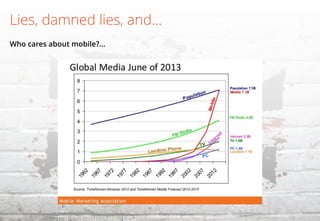
Who cares about mobile?...
Lies, damned lies, and… 
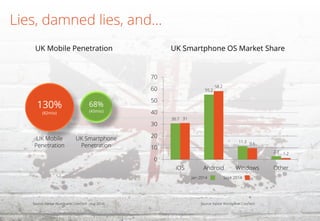
UK Mobile Penetration 
130% 
(82mio) 
68% (43mio) 
UK Mobile Penetration 
UK Smartphone Penetration 
30.7 
55.2 
11.3 
2.8 
31 
58.2 
9.6 
1.2 
0 
10 
20 
30 
40 
50 
60 
70 
iOS 
Android 
Windows 
Other 
Source: Kantar Worldpanel ComTech 
Jan 2014 
Sept 2014 
Source: Kantar Worldpanel ComTech (Aug 2014) 
UK Smartphone OS Market Share
Lies, damned lies, and… 
Sources: Kantar Worldpanel ComTech; Deloitte Mobile Consumer survey; IMRG Cap Gemini; Tecmark 
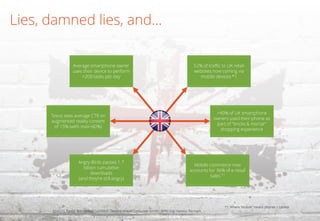
Average smartphone owner uses their device to perform >200 tasks per day 
Tesco sees average CTR on augmented reality content of 15% (with max=60%) 
Angry Birds passes 1.7 billion cumulative downloads 
(and they’re still angry) 
52% of traffic to UK retail websites now coming via mobile devices *1 
>40% of UK smartphone owners used their phone as part of “bricks & mortar” shopping experience 
Mobile commerce now accounts for 36% of e-retail sales *1 
*1: Where “mobile” means phones + tablets
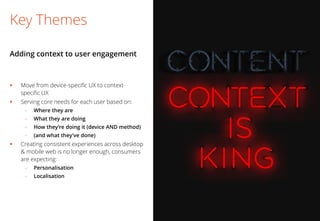
Move from device-specific UX to context- specific UX 
Serving core needs for each user based on: 
–Where they are 
–What they are doing 
–How they’re doing it (device AND method) 
–(and what they’ve done) 
Creating consistent experiences across desktop & mobile web is no longer enough, consumers are expecting: 
–Personalisation 
–Localisation 
Key Themes 
Adding context to user engagement
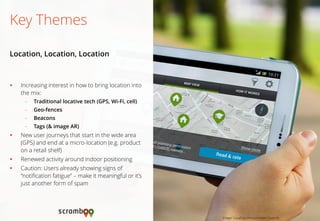
Increasing interest in how to bring location into the mix: 
–Traditional locative tech (GPS, Wi-Fi, cell) 
–Geo-fences 
–Beacons 
–Tags (& image AR) 
New user journeys that start in the wide area (GPS) and end at a micro-location (e.g. product on a retail shelf) 
Renewed activity around indoor positioning 
Caution: Users already showing signs of “notification fatigue” – make it meaningful or it’s just another form of spam 
Key Themes 
Location, Location, Location 
Image: LocalSay (Westminster Council)
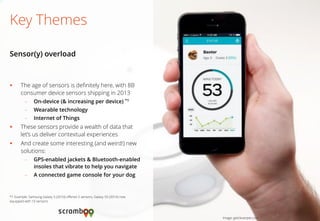
The age of sensors is definitely here, with 8B consumer device sensors shipping in 2013 
–On-device (& increasing per device) *1 
–Wearable technology 
–Internet of Things 
These sensors provide a wealth of data that let’s us deliver contextual experiences 
And create some interesting (and weird!) new solutions: 
–GPS-enabled jackets & Bluetooth-enabled insoles that vibrate to help you navigate 
–A connected game console for your dog 
Key Themes 
Sensor(y) overload 
Image: getcleverpet.com 
*1 Example: Samsung Galaxy S (2010) offered 3 sensors, Galaxy S5 (2014) now equipped with 10 sensors.
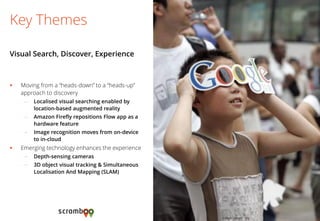
Moving from a “heads-down” to a “heads-up” approach to discovery 
–Localised visual searching enabled by location-based augmented reality 
–Amazon Firefly repositions Flow app as a hardware feature 
–Image recognition moves from on-device to in-cloud 
Emerging technology enhances the experience 
–Depth-sensing cameras 
–3D object visual tracking & Simultaneous Localisation And Mapping (SLAM) 
Key Themes 
Visual Search, Discover, Experience 
Image: yeeyan.org
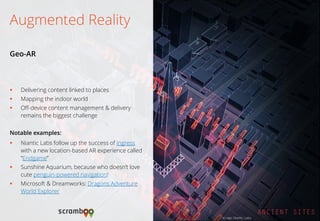
Delivering content linked to places 
Mapping the indoor world 
Off-device content management & delivery remains the biggest challenge 
Notable examples: 
Niantic Labs follow up the success of Ingress with a new location-based AR experience called “Endgame” 
Sunshine Aquarium, because who doesn’t love cute penguin-powered navigation! 
Microsoft & Dreamworks: Dragons Adventure World Explorer 
Augmented Reality 
Geo-AR 
Image: Niantic Labs
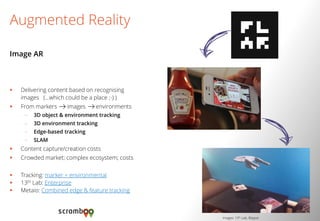
Delivering content based on recognising images (…which could be a place ;-) ) 
From markers images environments 
–3D object & environment tracking 
–3D environment tracking 
–Edge-based tracking 
–SLAM 
Content capture/creation costs 
Crowded market; complex ecosystem; costs 
Tracking: marker + environmental 
13th Lab: Enterprise 
Metaio: Combined edge & feature tracking 
Augmented Reality 
Image AR 
Images: 13th Lab, Blippar
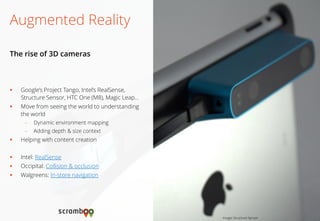
Google’s Project Tango, Intel’s RealSense, Structure Sensor, HTC One (M8), Magic Leap… 
Move from seeing the world to understanding the world 
–Dynamic environment mapping 
–Adding depth & size context 
Helping with content creation 
Intel: RealSense 
Occipital: Collision & occlusion 
Walgreens: In-store navigation 
Augmented Reality 
The rise of 3D cameras 
Image: Structure Sensor
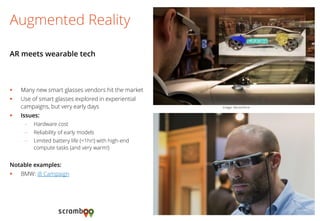
Many new smart glasses vendors hit the market 
Use of smart glasses explored in experiential campaigns, but very early days 
Issues: 
–Hardware cost 
–Reliability of early models 
–Limited battery life (<1hr!) with high-end compute tasks (and very warm!) 
Notable examples: 
BMW: i8 Campaign 
Augmented Reality 
AR meets wearable tech 
Image: Vectorform
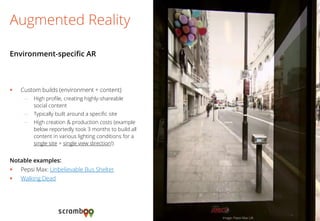
Custom builds (environment + content) 
–High profile, creating highly-shareable social content 
–Typically built around a specific site 
–High creation & production costs (example below reportedly took 3 months to build all content in various lighting conditions for a single site + single view direction!) 
Notable examples: 
Pepsi Max: Unbelievable Bus Shelter 
Walking Dead 
Augmented Reality 
Environment-specific AR 
Image: Pepsi Max UK
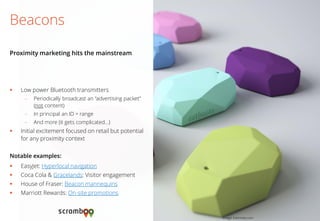
Low power Bluetooth transmitters 
–Periodically broadcast an “advertising packet” (not content) 
–In principal an ID + range 
–And more (it gets complicated…) 
Initial excitement focused on retail but potential for any proximity context 
Notable examples: 
EasyJet: Hyperlocal navigation 
Coca Cola & Gracelands: Visitor engagement 
House of Fraser: Beacon mannequins 
Marriott Rewards: On-site promotions 
Beacons 
Proximity marketing hits the mainstream 
Image: Estimote.com
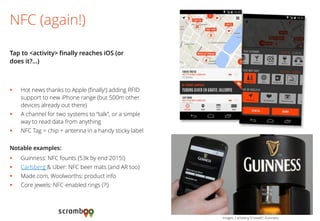
Hot news thanks to Apple (finally!) adding RFID support to new iPhone range (but 500m other devices already out there) 
A channel for two systems to “talk”, or a simple way to read data from anything 
NFC Tag = chip + antenna in a handy sticky label 
Notable examples: 
Guinness: NFC founts (53k by end 2015!) 
Carlsberg & Uber: NFC beer mats (and AR too) 
Made.com, Woolworths: product info 
Core jewels: NFC-enabled rings (?!) 
NFC (again!) 
Tap to <activity> finally reaches iOS (or does it?…) 
Images: Carlsberg “Crowdit”; Guinness
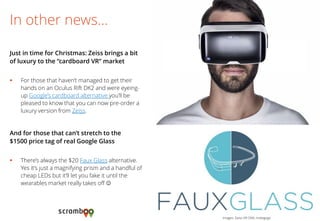
For those that haven’t managed to get their hands on an Oculus Rift DK2 and were eyeing- up Google’s cardboard alternative you’ll be pleased to know that you can now pre-order a luxury version from Zeiss. 
In other news… 
Just in time for Christmas: Zeiss brings a bit of luxury to the “cardboard VR” market 
Images: Zeiss VR ONE; Indiegogo 
There’s always the $20 Faux Glass alternative. Yes it’s just a magnifying prism and a handful of cheap LEDs but it’ll let you fake it until the wearables market really takes off  
And for those that can’t stretch to the $1500 price tag of real Google Glass
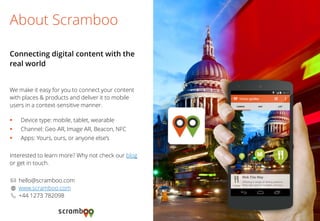
We make it easy for you to connect your content with places & products and deliver it to mobile users in a context-sensitive manner. 
Device type: mobile, tablet, wearable 
Channel: Geo-AR, Image AR, Beacon, NFC 
Apps: Yours, ours, or anyone else’s 
Interested to learn more? Why not check our blog or get in touch. 
hello@scramboo.com 
www.scramboo.com 
+44 1273 782098 
About Scramboo 
Connecting digital content with the real world

Scramboo mobile roundup - dec 2014

  • 1.
    Mobile Roundup –Dec ‘14 oKey themes oTech updates oAnd in other news…
  • 2.
    Lies, damned lies,and… Who cares about mobile?...
  • 3.
    Lies, damned lies,and… UK Mobile Penetration 130% (82mio) 68% (43mio) UK Mobile Penetration UK Smartphone Penetration 30.7 55.2 11.3 2.8 31 58.2 9.6 1.2 0 10 20 30 40 50 60 70 iOS Android Windows Other Source: Kantar Worldpanel ComTech Jan 2014 Sept 2014 Source: Kantar Worldpanel ComTech (Aug 2014) UK Smartphone OS Market Share
  • 4.
    Lies, damned lies,and… Sources: Kantar Worldpanel ComTech; Deloitte Mobile Consumer survey; IMRG Cap Gemini; Tecmark Average smartphone owner uses their device to perform >200 tasks per day Tesco sees average CTR on augmented reality content of 15% (with max=60%) Angry Birds passes 1.7 billion cumulative downloads (and they’re still angry) 52% of traffic to UK retail websites now coming via mobile devices *1 >40% of UK smartphone owners used their phone as part of “bricks & mortar” shopping experience Mobile commerce now accounts for 36% of e-retail sales *1 *1: Where “mobile” means phones + tablets
  • 5.
    Move from device-specificUX to context- specific UX Serving core needs for each user based on: –Where they are –What they are doing –How they’re doing it (device AND method) –(and what they’ve done) Creating consistent experiences across desktop & mobile web is no longer enough, consumers are expecting: –Personalisation –Localisation Key Themes Adding context to user engagement
  • 6.
    Increasing interest inhow to bring location into the mix: –Traditional locative tech (GPS, Wi-Fi, cell) –Geo-fences –Beacons –Tags (& image AR) New user journeys that start in the wide area (GPS) and end at a micro-location (e.g. product on a retail shelf) Renewed activity around indoor positioning Caution: Users already showing signs of “notification fatigue” – make it meaningful or it’s just another form of spam Key Themes Location, Location, Location Image: LocalSay (Westminster Council)
  • 7.
    The age ofsensors is definitely here, with 8B consumer device sensors shipping in 2013 –On-device (& increasing per device) *1 –Wearable technology –Internet of Things These sensors provide a wealth of data that let’s us deliver contextual experiences And create some interesting (and weird!) new solutions: –GPS-enabled jackets & Bluetooth-enabled insoles that vibrate to help you navigate –A connected game console for your dog Key Themes Sensor(y) overload Image: getcleverpet.com *1 Example: Samsung Galaxy S (2010) offered 3 sensors, Galaxy S5 (2014) now equipped with 10 sensors.
  • 8.
    Moving from a“heads-down” to a “heads-up” approach to discovery –Localised visual searching enabled by location-based augmented reality –Amazon Firefly repositions Flow app as a hardware feature –Image recognition moves from on-device to in-cloud Emerging technology enhances the experience –Depth-sensing cameras –3D object visual tracking & Simultaneous Localisation And Mapping (SLAM) Key Themes Visual Search, Discover, Experience Image: yeeyan.org
  • 9.
    Delivering content linkedto places Mapping the indoor world Off-device content management & delivery remains the biggest challenge Notable examples: Niantic Labs follow up the success of Ingress with a new location-based AR experience called “Endgame” Sunshine Aquarium, because who doesn’t love cute penguin-powered navigation! Microsoft & Dreamworks: Dragons Adventure World Explorer Augmented Reality Geo-AR Image: Niantic Labs
  • 10.
    Delivering content basedon recognising images (…which could be a place ;-) ) From markers images environments –3D object & environment tracking –3D environment tracking –Edge-based tracking –SLAM Content capture/creation costs Crowded market; complex ecosystem; costs Tracking: marker + environmental 13th Lab: Enterprise Metaio: Combined edge & feature tracking Augmented Reality Image AR Images: 13th Lab, Blippar
  • 11.
    Google’s Project Tango,Intel’s RealSense, Structure Sensor, HTC One (M8), Magic Leap… Move from seeing the world to understanding the world –Dynamic environment mapping –Adding depth & size context Helping with content creation Intel: RealSense Occipital: Collision & occlusion Walgreens: In-store navigation Augmented Reality The rise of 3D cameras Image: Structure Sensor
  • 12.
    Many new smartglasses vendors hit the market Use of smart glasses explored in experiential campaigns, but very early days Issues: –Hardware cost –Reliability of early models –Limited battery life (<1hr!) with high-end compute tasks (and very warm!) Notable examples: BMW: i8 Campaign Augmented Reality AR meets wearable tech Image: Vectorform
  • 13.
    Custom builds (environment+ content) –High profile, creating highly-shareable social content –Typically built around a specific site –High creation & production costs (example below reportedly took 3 months to build all content in various lighting conditions for a single site + single view direction!) Notable examples: Pepsi Max: Unbelievable Bus Shelter Walking Dead Augmented Reality Environment-specific AR Image: Pepsi Max UK
  • 14.
    Low power Bluetoothtransmitters –Periodically broadcast an “advertising packet” (not content) –In principal an ID + range –And more (it gets complicated…) Initial excitement focused on retail but potential for any proximity context Notable examples: EasyJet: Hyperlocal navigation Coca Cola & Gracelands: Visitor engagement House of Fraser: Beacon mannequins Marriott Rewards: On-site promotions Beacons Proximity marketing hits the mainstream Image: Estimote.com
  • 15.
    Hot news thanksto Apple (finally!) adding RFID support to new iPhone range (but 500m other devices already out there) A channel for two systems to “talk”, or a simple way to read data from anything NFC Tag = chip + antenna in a handy sticky label Notable examples: Guinness: NFC founts (53k by end 2015!) Carlsberg & Uber: NFC beer mats (and AR too) Made.com, Woolworths: product info Core jewels: NFC-enabled rings (?!) NFC (again!) Tap to <activity> finally reaches iOS (or does it?…) Images: Carlsberg “Crowdit”; Guinness
  • 16.
    For those thathaven’t managed to get their hands on an Oculus Rift DK2 and were eyeing- up Google’s cardboard alternative you’ll be pleased to know that you can now pre-order a luxury version from Zeiss. In other news… Just in time for Christmas: Zeiss brings a bit of luxury to the “cardboard VR” market Images: Zeiss VR ONE; Indiegogo There’s always the $20 Faux Glass alternative. Yes it’s just a magnifying prism and a handful of cheap LEDs but it’ll let you fake it until the wearables market really takes off  And for those that can’t stretch to the $1500 price tag of real Google Glass
  • 17.
    We make iteasy for you to connect your content with places & products and deliver it to mobile users in a context-sensitive manner. Device type: mobile, tablet, wearable Channel: Geo-AR, Image AR, Beacon, NFC Apps: Yours, ours, or anyone else’s Interested to learn more? Why not check our blog or get in touch. hello@scramboo.com www.scramboo.com +44 1273 782098 About Scramboo Connecting digital content with the real world