Augmented RealityA Simple Technical Introduction
Presented By: Diksha Bhargava
At : Core techies India Private Limited
What We’ll Look At..
● What is Augmented Reality (AR)?
● Types & Characteristics of AR
● Brief from the past
● Current uses of AR
● Future of AR
● Move up for first AR App
● Wrap up
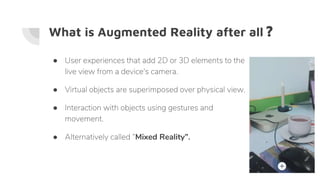
What is Augmented Reality after all❓
● User experiences that add 2D or 3D elements to the
live view from a device's camera.
● Virtual objects are superimposed over physical view.
● Interaction with objects using gestures and
movement.
● Alternatively called “Mixed Reality”.
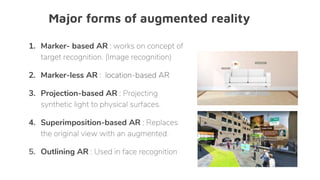
Major forms of augmented reality
1. Marker- based AR : works on concept of
target recognition. (Image recognition)
2. Marker-less AR : location-based AR
3. Projection-based AR : Projecting
synthetic light to physical surfaces.
4. Superimposition-based AR : Replaces
the original view with an augmented.
5. Outlining AR : Used in face recognition
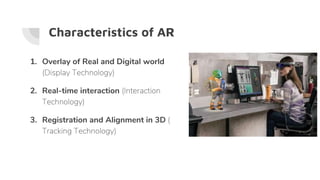
Characteristics of AR
1. Overlay of Real and Digital world
(Display Technology)
2. Real-time interaction (Interaction
Technology)
3. Registration and Alignment in 3D (
Tracking Technology)
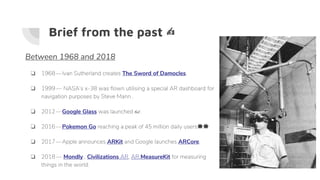
Brief from the past ✍
Between 1968 and 2018
❏ 1968 — Ivan Sutherland creates The Sword of Damocles.
❏ 1999 —  NASA’s x-38 was flown utilising a special AR dashboard for
navigation purposes by Steve Mann .
❏ 2012 —Google Glass was launched 👓.
❏ 2016 —Pokemon Go reaching a peak of 45 million daily users💥💥
❏ 2017 — Apple announces ARKit and Google launches ARCore.
❏ 2018 — Mondly , Civilizations AR, AR MeasureKit for measuring
things in the world.
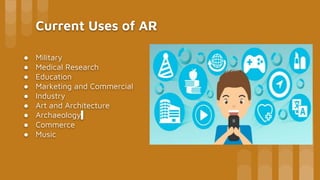
Current Uses of AR
● Military
● Medical Research
● Education
● Marketing and Commercial
● Industry
● Art and Architecture
● Archaeology
● Commerce
● Music
Future of AR 🔮
★ Major advancements in health care
(around $5 billion), tourism industries.
★ Effective and practical learning.
★ Featured Quote: “In a few years, we’re
not going to be able to imagine our
lives without [AR]. It’s that profound”
Tim Cook — CEO of Apple.
★ Games - grow to 216 million users
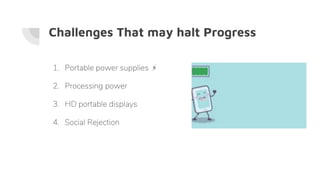
Challenges That may halt Progress
1. Portable power supplies ⚡
2. Processing power
3. HD portable displays
4. Social Rejection
Move Up For First AR App ?
>> Mobile AR SDKs
- ARKit (Apple)
- ARCore (Google)
- Vuforia
- Unity3D : cross-platform games engine
- RNDR, Umbra 3D,6D.AI - These are cloud-based
rendering services focused on AR
Requirements 🏷
For Apple’s ARKit:
● iOS 11.0 or later 📱
● XCode 9 or later ⚙
● Devices - iPhone 6s, 6s+,7,7+,SE,8,8+,X,iPad Pro (9.7, 10.5 or
12.9) – both first-gen and 2nd-gen, iPad (2017)
● mac OS Sierra 10.12.4 (or newer version) 🖥
For Google’s ARCore:
● Android 7.0 (Nougat) and later(API level 24 or higher)📱
● Android Studio version 3.1 or higher ⚙
Wrapping up… 🏁
>> Essential things behind the scenes of AR.
1. Tracking : device’s position and orientation
2. Scene understanding : includes Plane detection,
Hit-testing and Light estimation.
3. Rendering : placing 3D objects contextually
Tip—Keep in mind
1. Poor lighting or Contrast
2. Lack of texture
3. Fast Movement
4. Space & Charged batteries
THANKYOU

Augmented reality

  • 1.
    Augmented RealityA SimpleTechnical Introduction Presented By: Diksha Bhargava At : Core techies India Private Limited
  • 2.
    What We’ll LookAt.. ● What is Augmented Reality (AR)? ● Types & Characteristics of AR ● Brief from the past ● Current uses of AR ● Future of AR ● Move up for first AR App ● Wrap up
  • 3.
    What is AugmentedReality after all❓ ● User experiences that add 2D or 3D elements to the live view from a device's camera. ● Virtual objects are superimposed over physical view. ● Interaction with objects using gestures and movement. ● Alternatively called “Mixed Reality”.
  • 4.
    Major forms ofaugmented reality 1. Marker- based AR : works on concept of target recognition. (Image recognition) 2. Marker-less AR : location-based AR 3. Projection-based AR : Projecting synthetic light to physical surfaces. 4. Superimposition-based AR : Replaces the original view with an augmented. 5. Outlining AR : Used in face recognition
  • 5.
    Characteristics of AR 1.Overlay of Real and Digital world (Display Technology) 2. Real-time interaction (Interaction Technology) 3. Registration and Alignment in 3D ( Tracking Technology)
  • 6.
    Brief from thepast ✍ Between 1968 and 2018 ❏ 1968 — Ivan Sutherland creates The Sword of Damocles. ❏ 1999 —  NASA’s x-38 was flown utilising a special AR dashboard for navigation purposes by Steve Mann . ❏ 2012 —Google Glass was launched 👓. ❏ 2016 —Pokemon Go reaching a peak of 45 million daily users💥💥 ❏ 2017 — Apple announces ARKit and Google launches ARCore. ❏ 2018 — Mondly , Civilizations AR, AR MeasureKit for measuring things in the world.
  • 7.
    Current Uses ofAR ● Military ● Medical Research ● Education ● Marketing and Commercial ● Industry ● Art and Architecture ● Archaeology ● Commerce ● Music
  • 8.
    Future of AR🔮 ★ Major advancements in health care (around $5 billion), tourism industries. ★ Effective and practical learning. ★ Featured Quote: “In a few years, we’re not going to be able to imagine our lives without [AR]. It’s that profound” Tim Cook — CEO of Apple. ★ Games - grow to 216 million users
  • 9.
    Challenges That mayhalt Progress 1. Portable power supplies ⚡ 2. Processing power 3. HD portable displays 4. Social Rejection
  • 10.
    Move Up ForFirst AR App ? >> Mobile AR SDKs - ARKit (Apple) - ARCore (Google) - Vuforia - Unity3D : cross-platform games engine - RNDR, Umbra 3D,6D.AI - These are cloud-based rendering services focused on AR
  • 11.
    Requirements 🏷 For Apple’sARKit: ● iOS 11.0 or later 📱 ● XCode 9 or later ⚙ ● Devices - iPhone 6s, 6s+,7,7+,SE,8,8+,X,iPad Pro (9.7, 10.5 or 12.9) – both first-gen and 2nd-gen, iPad (2017) ● mac OS Sierra 10.12.4 (or newer version) 🖥 For Google’s ARCore: ● Android 7.0 (Nougat) and later(API level 24 or higher)📱 ● Android Studio version 3.1 or higher ⚙
  • 12.
    Wrapping up… 🏁 >>Essential things behind the scenes of AR. 1. Tracking : device’s position and orientation 2. Scene understanding : includes Plane detection, Hit-testing and Light estimation. 3. Rendering : placing 3D objects contextually
  • 13.
    Tip—Keep in mind 1.Poor lighting or Contrast 2. Lack of texture 3. Fast Movement 4. Space & Charged batteries
  • 14.