Rural Tourism Studio
Nature-based Tourism Development Workshop
               Travel Oregon


               9:00am to 4:00pm
          Tuesday, December 7, 2010
Isabel Edwards Hall, Wheeler County Fairgrounds,
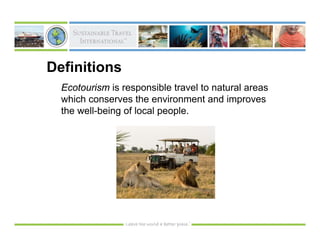
                 Fossil, Oregon
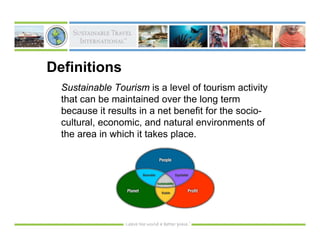
Agenda
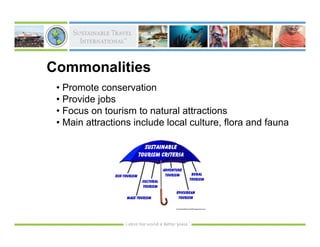
 9:00-10:00am  Overview of Nature-based Tourism
 10:00-10:15am Break
 10:15-11:10am Case Studies
 11:10-11:45pm Nature-based Tourism Potential
               Working with the Public Lands Agencies
 11:45-12:45pm Lunch
 12:45-1:45pm Gap Analysis and Nature-based Tourism Inventory
 1:45-2:15pm   Discuss Nature-based Tourism Potential based on
               Gap Analysis
 2:15-2:30pm   Break
 2:30-3:35pm   Information Analysis and Evaluation
 3:00-3:45pm   Ideas for Increasing Nature-based Tourism
 3:45-4:00pm   Evaluation and Wrap-up
Introductions
  1. Name
  2. Organization
  3. What you hope to get out of the Nature-based
     Tourism Workshop.
  4. Bonus: Favorite Nature-based Tourism
     experience and why?
Definitions
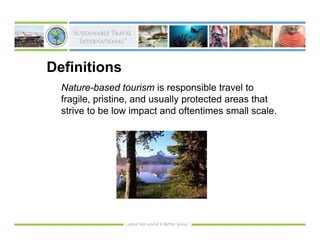
  Nature-based tourism is responsible travel to
  fragile, pristine, and usually protected areas that
  strive to be low impact and oftentimes small scale.
Definitions
  Adventure travel and may be any tourist activity,
  including two of the following three components:

  1.a physical activity,
  2.a cultural exchange, and / or
  3.interaction and engagement with nature.
Definitions
  Ecotourism is responsible travel to natural areas
  which conserves the environment and improves
  the well-being of local people.
Definitions
  Sustainable Tourism is a level of tourism activity
  that can be maintained over the long term
  because it results in a net benefit for the socio-
  cultural, economic, and natural environments of
  the area in which it takes place.
Commonalities
 • Promote conservation
 • Provide jobs
 • Focus on tourism to natural attractions
 • Main attractions include local culture, flora and fauna
Travel Oregon Principles of
Sustainable Tourism
 1.   Is integrated with respect of the culture, homeland, heritage, and
      people of a place
 2.   Provides a unique and authentic experience for the visitor
 3.   Generates localized economic development benefits
 4.   Generates development that has a balanced and beneficial impact on
      the environment
 5.   Generates revenue that is invested in conserving and enhancing the
      unique features of the community
 6.   Provides an educational experience for the visitor that leaves them
      enriched and inspired
 7.   Serves target markets that are profitable, with promising long term
      viability
 8.   Encourages diverse parties to work together to create new
      opportunities and to address common challenges
Market Segmentation and Trends
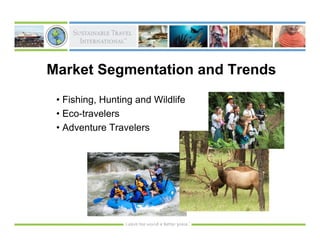
 • Fishing, Hunting and Wildlife
 • Eco-travelers
 • Adventure Travelers
Market Segmentation –
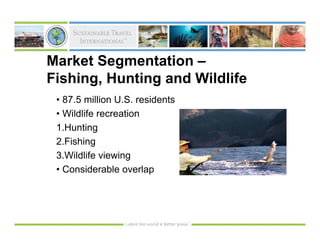
Fishing, Hunting and Wildlife
 • 87.5 million U.S. residents
 • Wildlife recreation
 1.Hunting
 2.Fishing
 3.Wildlife viewing
 • Considerable overlap
Market Segmentation –
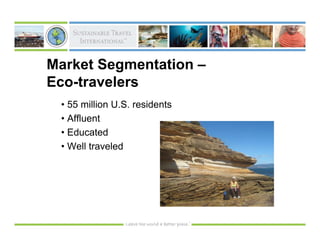
Eco-travelers
 • 55 million U.S. residents
 • Affluent
 • Educated
 • Well traveled
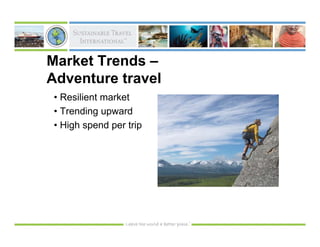
Market Trends –
Adventure travel
 • Resilient market
 • Trending upward
 • High spend per trip
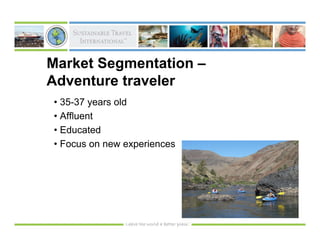
Market Segmentation –
Adventure traveler
• 35-37 years old
• Affluent
• Educated
• Focus on new experiences
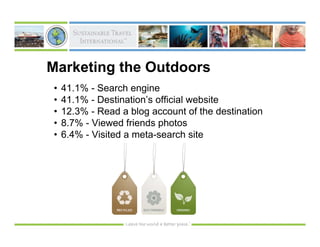
Marketing the Outdoors
•   41.1% - Search engine
•   41.1% - Destination’s official website
•   12.3% - Read a blog account of the destination
•   8.7% - Viewed friends photos
•   6.4% - Visited a meta-search site
The Opportunity
 • Benefits all citizens in participating communities
 • Job creation
 • Economic development
 • Few barriers to entry
 • Clean industry
 • Promotes conservation, preservation and pride
 • Increases local recreational opportunities
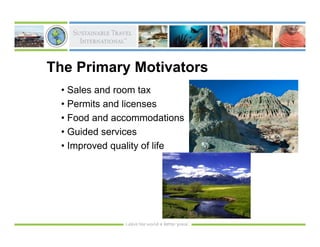
The Primary Motivators
 • Sales and room tax
 • Permits and licenses
 • Food and accommodations
 • Guided services
 • Improved quality of life
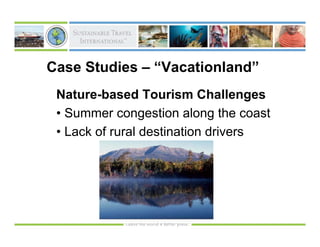
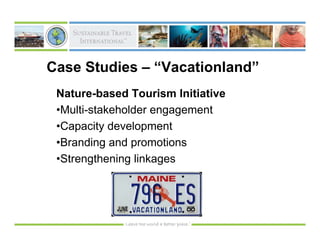
Case Studies – “Vacationland”
 Nature-based Tourism Challenges
 • Summer congestion along the coast
 • Lack of rural destination drivers
Case Studies – “Vacationland”
 Nature-based Tourism Opportunities
 • Spreading best management practices
 • Strengthening linkages to local industry
 • Improving transportation
 • Developing a regional brand
 • Building a world-class destination
 • Effectively promoting the destination
Case Studies – “Vacationland”
 Nature-based Tourism Initiative
 1. Recreational master plan
 2. Green lodging certification
 3. Integrating natural attractions
 4. Luring visitors with events
Case Studies – “Vacationland”
 Nature-based Tourism Initiative
 •Multi-stakeholder engagement
 •Capacity development
 •Branding and promotions
 •Strengthening linkages
Case Studies – Southeast Alaska
 Nature-based Tourism Key Findings
 • Focus is on Nature-based Tourism
 • Creates an economic ripple effect
 • High quality experiences attract a premium
 • Overnight trips generate more revenue and
 increase profitability
 • Independent travelers tend to stay longer and
 spend more
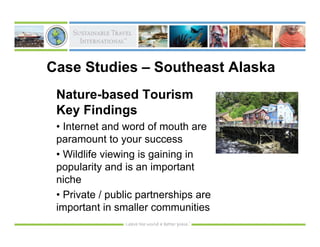
Case Studies – Southeast Alaska
 Nature-based Tourism
 Key Findings
 • Internet and word of mouth are
 paramount to your success
 • Wildlife viewing is gaining in
 popularity and is an important
 niche
 • Private / public partnerships are
 important in smaller communities
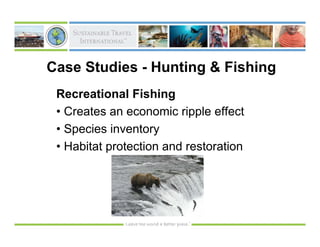
Case Studies - Hunting & Fishing
 Recreational Fishing
 • Creates an economic ripple effect
 • Species inventory
 • Habitat protection and restoration
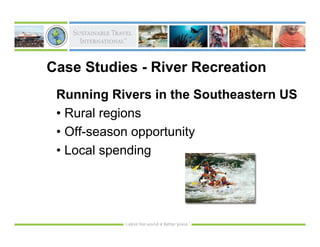
Case Studies - River Recreation
 Running Rivers in the Southeastern US
 • Rural regions
 • Off-season opportunity
 • Local spending
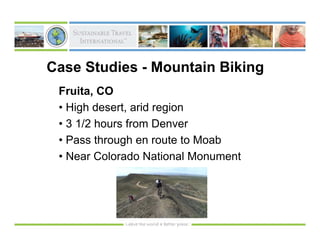
Case Studies - Mountain Biking
 Fruita, CO
 • High desert, arid region
 • 3 1/2 hours from Denver
 • Pass through en route to Moab
 • Near Colorado National Monument
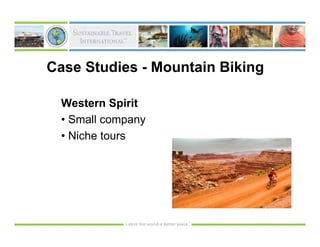
Case Studies - Mountain Biking

  Western Spirit
  • Small company
  • Niche tours
Questions & Answers
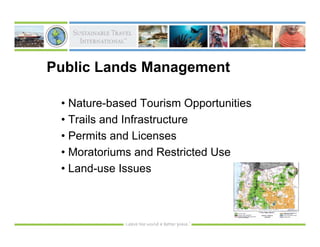
Public Lands Management

 • Nature-based Tourism Opportunities
 • Trails and Infrastructure
 • Permits and Licenses
 • Moratoriums and Restricted Use
 • Land-use Issues
Group Activity - Interactive Gap
Analysis
  1. What are the region’s natural features?
  2. What are the region’s manmade and
     enhanced natural attractions?
  3. What are the region’s main natural
     attractions?
  4. What nature-based tourism activities exist?
  5. What tourist services and amenities are
     available?
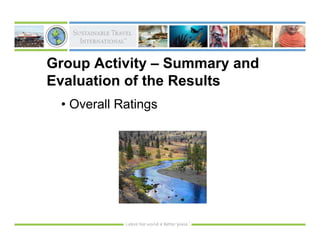
Group Activity – Summary and
Evaluation of the Results
 • Overall Ratings
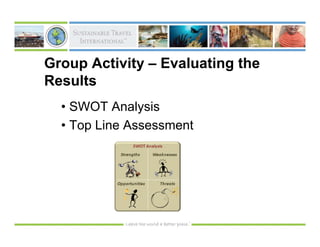
Group Activity – Evaluating the
Results
  • SWOT Analysis
  • Top Line Assessment
Group Activity – Evaluating the
Results
 • Mapping Attractions, Amenities, and Activities
 • Legend:
     • Blue/Purple Marker = highlight water-based attractions
     • Blue Stickers = label water activities
     • Green/Brown Marker = highlight land-based attractions
     • Green Stickers = label land-based activities
     • Orange Marker = highlight wildlife habitat
     • Yellow Stickers = label gas, food, lodging
     • Red Stickers = label outfitters/tour operators, shuttles
Developing Your Theme

 • Set the Region Apart
 • Increase Visibility
 • Improve Recognition
 • Establish a Brand Image
Development Strategies
 • Establish partnerships
     • Regional and local tour operators
     • State and federal agencies
     • Private businesses
 • Create a sense of welcome and belonging
 • Provide amenities
 • Create a must-see “destination”
Marketing Strategies
 • Establish partnerships
 • Maximize existing opportunities
 • Develop and disseminate information
 • Host outdoor recreation-oriented festivals and events
 • Information centers
 • Take a holistic approach
 • Expand market reach
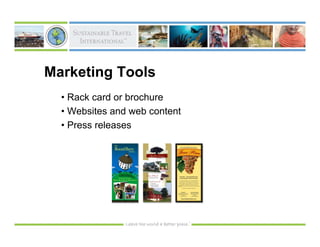
Marketing Tools
  • Rack card or brochure
  • Websites and web content
  • Press releases
Action Plan - Next Steps
  • Develop a committee
  • Identify members
  • Identify potential goals
  • Prioritize actions
Wrap up
 • Q&A
 • One impression about today
 • Evaluations
Credits and Sources
 • Adventure Tourism Market Report, 2010, The George Washington University, School
 of Business, The Adventure Travel Trade Association, and Xola Consulting
 • Community Nature-Based Tourism Development, Utah Recreation and Tourism
 Matters, Institute for Outdoor Recreation and Tourism, January 2010, Steven W. Burr
 and Jascha M. Zeitlin
 • Connecting People with America’s Great Outdoors: A Framework for Sustainable
 Recreation, United States Forest Service, USDA, Recreation, Heritage and Volunteer
 Resources, June 25, 2010
 • Developing Naturally: An Exploratory Process for Nature-based Community Tourism,
 Clemson University, Thomas D. Potts, Ph.D and Allan P.C. Marsinko, Ph.D.
 • National Survey of Fishing, Hunting, and Wildlife-Associated Recreation, 2006
 • Nature-based Tourism: Guidelines for Success, Clemson University, Thomas D.
 Potts, Ph.D., Thomas A. Rourke, and Strom Thurmond Institute
 • Planning and Developing a Nature Tourism Enterprise, Texas Parks and Wildlife,
 www.tpwd.state.tx.us/landwater/land/programs/tourism/your_business/planning/
 • Sustainable Tourism in Biosphere Reserves in Central and Eastern Europe,
 Sustainable Tourism: Training the Trainers Programme, Ecologicial Tourism in Europe

JDRT Nature Based Tourism

  • 1.
    Rural Tourism Studio Nature-basedTourism Development Workshop Travel Oregon 9:00am to 4:00pm Tuesday, December 7, 2010 Isabel Edwards Hall, Wheeler County Fairgrounds, Fossil, Oregon
  • 2.
    Agenda 9:00-10:00am Overview of Nature-based Tourism 10:00-10:15am Break 10:15-11:10am Case Studies 11:10-11:45pm Nature-based Tourism Potential Working with the Public Lands Agencies 11:45-12:45pm Lunch 12:45-1:45pm Gap Analysis and Nature-based Tourism Inventory 1:45-2:15pm Discuss Nature-based Tourism Potential based on Gap Analysis 2:15-2:30pm Break 2:30-3:35pm Information Analysis and Evaluation 3:00-3:45pm Ideas for Increasing Nature-based Tourism 3:45-4:00pm Evaluation and Wrap-up
  • 3.
    Introductions 1.Name 2. Organization 3. What you hope to get out of the Nature-based Tourism Workshop. 4. Bonus: Favorite Nature-based Tourism experience and why?
  • 4.
    Definitions Nature-basedtourism is responsible travel to fragile, pristine, and usually protected areas that strive to be low impact and oftentimes small scale.
  • 5.
    Definitions Adventuretravel and may be any tourist activity, including two of the following three components: 1.a physical activity, 2.a cultural exchange, and / or 3.interaction and engagement with nature.
  • 6.
    Definitions Ecotourismis responsible travel to natural areas which conserves the environment and improves the well-being of local people.
  • 7.
    Definitions SustainableTourism is a level of tourism activity that can be maintained over the long term because it results in a net benefit for the socio- cultural, economic, and natural environments of the area in which it takes place.
  • 8.
    Commonalities • Promoteconservation • Provide jobs • Focus on tourism to natural attractions • Main attractions include local culture, flora and fauna
  • 9.
    Travel Oregon Principlesof Sustainable Tourism 1. Is integrated with respect of the culture, homeland, heritage, and people of a place 2. Provides a unique and authentic experience for the visitor 3. Generates localized economic development benefits 4. Generates development that has a balanced and beneficial impact on the environment 5. Generates revenue that is invested in conserving and enhancing the unique features of the community 6. Provides an educational experience for the visitor that leaves them enriched and inspired 7. Serves target markets that are profitable, with promising long term viability 8. Encourages diverse parties to work together to create new opportunities and to address common challenges
  • 10.
    Market Segmentation andTrends • Fishing, Hunting and Wildlife • Eco-travelers • Adventure Travelers
  • 11.
    Market Segmentation – Fishing,Hunting and Wildlife • 87.5 million U.S. residents • Wildlife recreation 1.Hunting 2.Fishing 3.Wildlife viewing • Considerable overlap
  • 12.
    Market Segmentation – Eco-travelers • 55 million U.S. residents • Affluent • Educated • Well traveled
  • 13.
    Market Trends – Adventuretravel • Resilient market • Trending upward • High spend per trip
  • 14.
    Market Segmentation – Adventuretraveler • 35-37 years old • Affluent • Educated • Focus on new experiences
  • 15.
    Marketing the Outdoors • 41.1% - Search engine • 41.1% - Destination’s official website • 12.3% - Read a blog account of the destination • 8.7% - Viewed friends photos • 6.4% - Visited a meta-search site
  • 16.
    The Opportunity •Benefits all citizens in participating communities • Job creation • Economic development • Few barriers to entry • Clean industry • Promotes conservation, preservation and pride • Increases local recreational opportunities
  • 17.
    The Primary Motivators • Sales and room tax • Permits and licenses • Food and accommodations • Guided services • Improved quality of life
  • 18.
    Case Studies –“Vacationland” Nature-based Tourism Challenges • Summer congestion along the coast • Lack of rural destination drivers
  • 19.
    Case Studies –“Vacationland” Nature-based Tourism Opportunities • Spreading best management practices • Strengthening linkages to local industry • Improving transportation • Developing a regional brand • Building a world-class destination • Effectively promoting the destination
  • 20.
    Case Studies –“Vacationland” Nature-based Tourism Initiative 1. Recreational master plan 2. Green lodging certification 3. Integrating natural attractions 4. Luring visitors with events
  • 21.
    Case Studies –“Vacationland” Nature-based Tourism Initiative •Multi-stakeholder engagement •Capacity development •Branding and promotions •Strengthening linkages
  • 22.
    Case Studies –Southeast Alaska Nature-based Tourism Key Findings • Focus is on Nature-based Tourism • Creates an economic ripple effect • High quality experiences attract a premium • Overnight trips generate more revenue and increase profitability • Independent travelers tend to stay longer and spend more
  • 23.
    Case Studies –Southeast Alaska Nature-based Tourism Key Findings • Internet and word of mouth are paramount to your success • Wildlife viewing is gaining in popularity and is an important niche • Private / public partnerships are important in smaller communities
  • 24.
    Case Studies -Hunting & Fishing Recreational Fishing • Creates an economic ripple effect • Species inventory • Habitat protection and restoration
  • 25.
    Case Studies -River Recreation Running Rivers in the Southeastern US • Rural regions • Off-season opportunity • Local spending
  • 26.
    Case Studies -Mountain Biking Fruita, CO • High desert, arid region • 3 1/2 hours from Denver • Pass through en route to Moab • Near Colorado National Monument
  • 27.
    Case Studies -Mountain Biking Western Spirit • Small company • Niche tours
  • 28.
  • 29.
    Public Lands Management • Nature-based Tourism Opportunities • Trails and Infrastructure • Permits and Licenses • Moratoriums and Restricted Use • Land-use Issues
  • 30.
    Group Activity -Interactive Gap Analysis 1. What are the region’s natural features? 2. What are the region’s manmade and enhanced natural attractions? 3. What are the region’s main natural attractions? 4. What nature-based tourism activities exist? 5. What tourist services and amenities are available?
  • 31.
    Group Activity –Summary and Evaluation of the Results • Overall Ratings
  • 32.
    Group Activity –Evaluating the Results • SWOT Analysis • Top Line Assessment
  • 33.
    Group Activity –Evaluating the Results • Mapping Attractions, Amenities, and Activities • Legend: • Blue/Purple Marker = highlight water-based attractions • Blue Stickers = label water activities • Green/Brown Marker = highlight land-based attractions • Green Stickers = label land-based activities • Orange Marker = highlight wildlife habitat • Yellow Stickers = label gas, food, lodging • Red Stickers = label outfitters/tour operators, shuttles
  • 34.
    Developing Your Theme • Set the Region Apart • Increase Visibility • Improve Recognition • Establish a Brand Image
  • 35.
    Development Strategies •Establish partnerships • Regional and local tour operators • State and federal agencies • Private businesses • Create a sense of welcome and belonging • Provide amenities • Create a must-see “destination”
  • 36.
    Marketing Strategies •Establish partnerships • Maximize existing opportunities • Develop and disseminate information • Host outdoor recreation-oriented festivals and events • Information centers • Take a holistic approach • Expand market reach
  • 37.
    Marketing Tools • Rack card or brochure • Websites and web content • Press releases
  • 38.
    Action Plan -Next Steps • Develop a committee • Identify members • Identify potential goals • Prioritize actions
  • 39.
    Wrap up •Q&A • One impression about today • Evaluations
  • 40.
    Credits and Sources • Adventure Tourism Market Report, 2010, The George Washington University, School of Business, The Adventure Travel Trade Association, and Xola Consulting • Community Nature-Based Tourism Development, Utah Recreation and Tourism Matters, Institute for Outdoor Recreation and Tourism, January 2010, Steven W. Burr and Jascha M. Zeitlin • Connecting People with America’s Great Outdoors: A Framework for Sustainable Recreation, United States Forest Service, USDA, Recreation, Heritage and Volunteer Resources, June 25, 2010 • Developing Naturally: An Exploratory Process for Nature-based Community Tourism, Clemson University, Thomas D. Potts, Ph.D and Allan P.C. Marsinko, Ph.D. • National Survey of Fishing, Hunting, and Wildlife-Associated Recreation, 2006 • Nature-based Tourism: Guidelines for Success, Clemson University, Thomas D. Potts, Ph.D., Thomas A. Rourke, and Strom Thurmond Institute • Planning and Developing a Nature Tourism Enterprise, Texas Parks and Wildlife, www.tpwd.state.tx.us/landwater/land/programs/tourism/your_business/planning/ • Sustainable Tourism in Biosphere Reserves in Central and Eastern Europe, Sustainable Tourism: Training the Trainers Programme, Ecologicial Tourism in Europe