COMMUNITY-BASED TOURISM
PROF. DR. SYED RASHIDUL HASAN
DEPT. OF TOURISM & HOSPITALITY MANAGEMENT
UNIVERSITY OF DHAKA
BANGLADESH
A community is a social unit of any size that shares
common values.
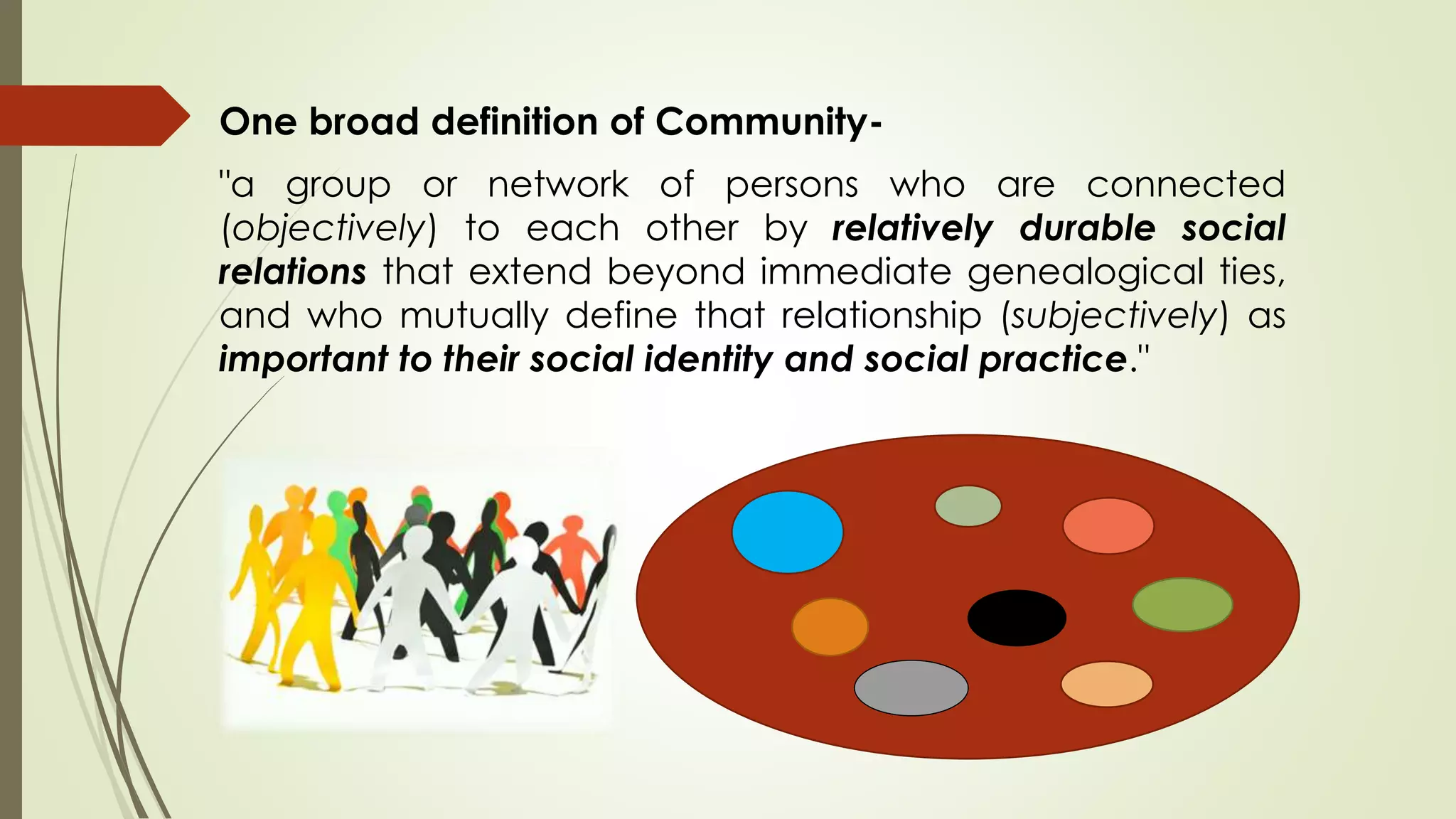
One broad definition of Community-
"a group or network of persons who are connected
(objectively) to each other by relatively durable social
relations that extend beyond immediate genealogical ties,
and who mutually define that relationship (subjectively) as
important to their social identity and social practice."
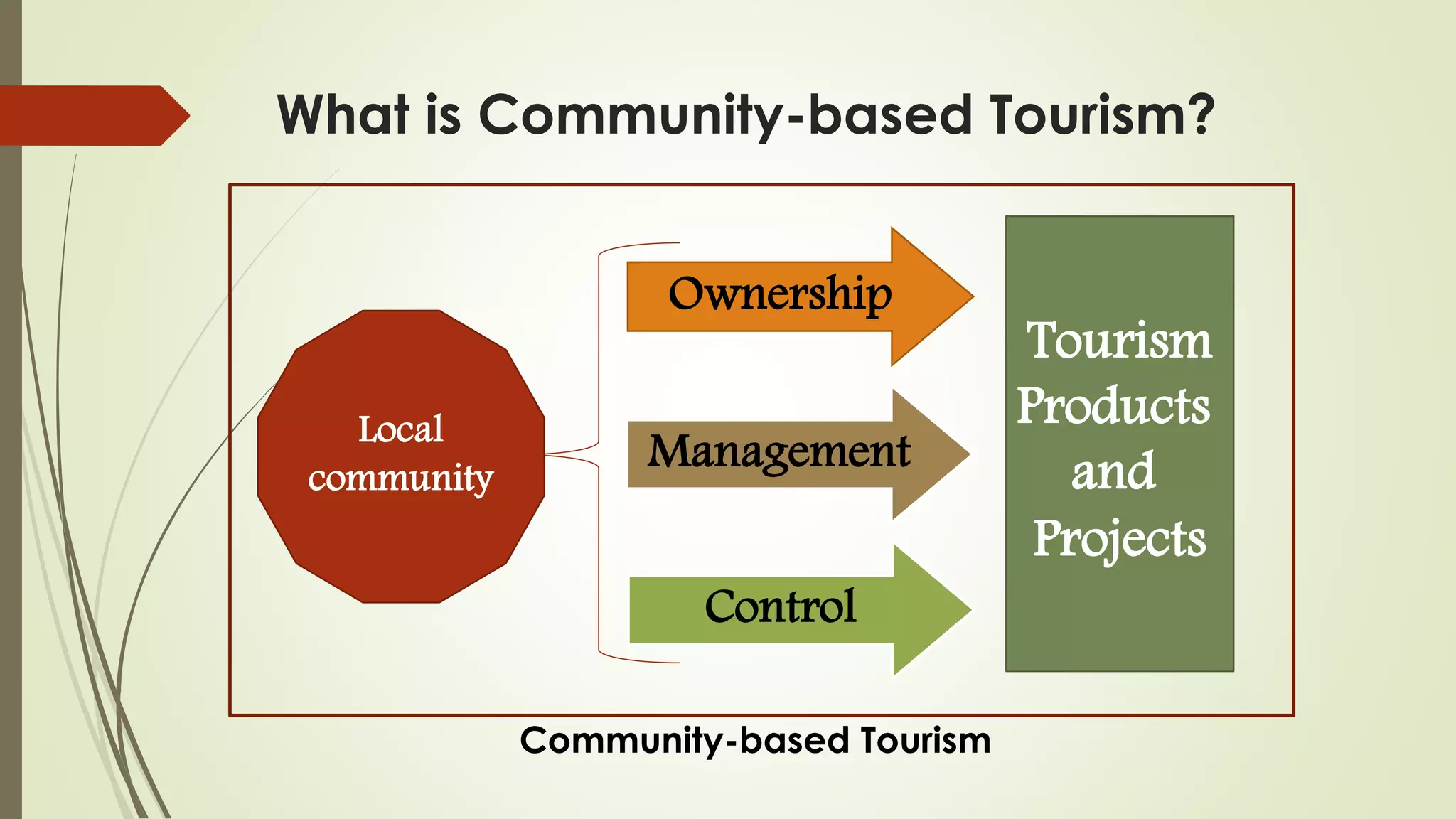
What is Community-based Tourism?
Ownership
Tourism
Products
and
Projects
Management
Control
Local
community
Community-based Tourism
More specifically…
are owned by local communities,
occur on their lands,
are based on their cultural and
natural/man-made assets and attractions,
are for community development and
environment conservation,
retain major portion of the earnings for local
communities.
CBT refers to
tourism
activities or
enterprises that
Community
-based
Tourism
extreme
growth
of
tourism
negative
effects
increased
an interest in
Why Community-based Tourism?
Sustainable
Development
Why Community-Based Tourism (CBT)?
Sustainability
Economic/Financial
sustainability
Environmental &
Ecological
Sustainability
Community
BasedTourism
Human beings destroy their own Tourism assets :
Threat to
man-made
assets
Human beings destroy their own Tourism assets :
Economic Sustainability :
Finding Alternative Tool for Poverty Alleviation
WHY Community People at
Grass root level cannot get
benefits of tourism ???
Have to Change our
Out look….
Tourism business is dominated
by rich and the elites. Rich
people own luxurious hotels,
theme parks, eating places,
cottages, motels, casinos and
others. Big tourism investments
are done in urban areas
mainly. The underprivileged
does not have entry to
ownership.
For the
underprivileged
poor
community
Public Private Partnership (PPP)
Benefit goes back to Top
Planning, policy, finance, implementation
done at the top
Community remains dried
Traditional TOP-DOWN APPPROACH (Investment Benefit flow)
BOTTOM-UP APPROACH (Investment Benefit Flow)
Planning, policy, finance, implementation done at the
bottom involving local community on PPCP
Both Top and community at the
bottom are benefitted Public Private Community Partnership (PPCP)
CBT : Success or Not ???
Almost since last four decades, CBT has been
thought as a tool by which the local community can
alleviate their economic condition. Many of the
countries namely Cambodia, Thailand, Nepal, India,
Indonesia, Peru, Uruguay, Bolivia, Chilie, Kenya,
Namibia, etc. claim to have successful CBT stories.
Success Failure
On the other side . . . . . . . .
Mitchell and Muckosy reported from a research by the
Rainforest Alliance and Conservation International which
reviewed 200 CBT projects across the Americas that
many CBT accommodation providers had only 5%
occupancy.
Harold Goodwin, along with Rosa Santilli (2009)
mentioned in their study, out of 116 CBT initiatives
nominated from all over the world, only 4 were
economically sustainable
Why not successful ???
Confused ???
For many of the CBT projects there have been no efforts
to assess if these are successful or not. Many of the
CBT projects funded by government/donor agencies in
developing countries, have not been monitored to
assess their success.
More Confusion ???
Many apparently recognized CBT initiatives capitalizing man-made resources
were not considered as CBT by many expert researchers. These so-called CBT
initiatives have demonstrated very considerable employment, local economic
development and collective community benefits, for example Manda Wilderness
(Mozambique), Aga Khan Development Network in Pakistan (Baltit and Shigar
Forts) and Chumbe Island (Tanzania).
Need a Compromise ???
In some other studies, understanding of a successful CBT has
emphasized on community’s Unique Selling Tourism Offers (USTO), and
available tourism assets around. In this approach, more emphasis has
been given on the inherited unique potential skill coupled with the
community services offered to explore natural/man-made tourism
resources.
Observation
Mere creation of eco-lodges without offering some unique services to
the tourists will not allure tourists to visit the area.
• CBT initiative in La Yunga in Bolivia is an example to support this
observation. Community-based tourism initiatives in Bolivia are based on
the development of community-owned and managed lodges or home-
stays. At La Yunga the lodge attracted only 60 visitors per year with a
bed occupancy of 2.7% only.
• The community subsequently developed a walking trail which in 2005
attracted 1000 people paying $1.80 trail fee, grossing $1800 plus guide
fees and other purchases from the community. The example
demonstrates that the common focus on accommodation only is
inappropriate – the community benefited far more when it provided an
activity, their initiative required a much smaller investment than the
investment in the lodge.
Example
Models for Assessing a Suitable Community for CBT
Different communities inherit unique artistic expertise from their
ancestors in various types of craftsmanship like hand weaving, pottery,
goldsmith, embroidery, snake charming, dancing etc. which could be
called as Unique Selling Tourism Offers (USTO). All communities may not
have the USTOs and may not be suitable for CBT.
To ensure which community is suitable, an assessment of community
tourism potential should be carried on. These models have been based
on the tripartite relationship among tourists, communities and touristic
attractions.
SUNLUST
WANDER
LUST
OTHERS
MODEL 1 : Transit travelers destined for natural/man-made attractions via
community settlements
Community &
Community activities
Tourists
Natural/man-
made
attractions
Community
Main attraction is natural/man-
made tourism assets; so less
benefit to the community
Tourists
Community
Community USTOs blended with natural/man-made
tourists attractions (community is the host)
Tourists
Natural/man-
made assets
Community
COMMUNITY
VILLAGE
Tourism : Bangladesh Perspective
• World Travel & Tourism Council (2014) claims :
• that the total contribution of Travel & Tourism to GDP of Bangladesh was
BDT460.3bn (4.4% of GDP) in 2013,
• to rise by 7.9% in 2014, and
• to rise by 6.5% pa to BDT935.5bn (4.7% of GDP) in 2024.
• In 2013, the total contribution of Travel & Tourism to employment, including jobs
indirectly supported by the industry, was 3.8% of total employment (2,846,500
jobs).
• This is expected to rise by 4.2% in 2014 to 2,965,000 jobs and
• rise by 3.0% pa to 3,974,000 jobs in 2024 (4.2% of total).
• All the indicators show a slow but steady growth in tourism and hospitality sector of
the country.
Why is Community Based Tourism
Important in Bangladesh?
Over Populated Country1
Conservation of tourism assets by involving the local community2
Economic vulnerability due to the instability of agriculture and the export of goods
and services
3
Existence of several unique Communities having separate tradition, culture and
craftsmanship
4
Concentration of tourist money in city based tourism establishments; thereby
uneven distribution of tourism earnings.
5
Locations of Various Tribal Ethnic Groups in Bangladesh.
Case:
Bandarban – potential jackpot of CBT
Let us watch a video on
Bandarban-
the hidden paradise
Ethnic Village:
1. Bawm Para
2. Marma Para
1
2
3
4
5
6
Ethnic Village:
1. Bawm Para
Ethnic Village:
1. Bawm Para
Ethnic Village:
1. Bawm Para
Ethnic Village:
1. Bawm Para
Accommodation
Food & Beverage
Facilities to Develop:
Chingri Jhiri
Keokradong
Zingsiam
Double Falls
Jadipai
Baklai Fall
Ethnic Village:
1. Murong Para
2. Bawm Para
Night 1: Boga Lake
Night 2: Rumana Para
Night 3: Keokradong
Night 4: Jadipai Para
Night 5: Thaikkiang
Night 6: Baklai Para
Areas of CBT where Local Community can be Involved
Community-
based tourism
beneficiaries
Home-stay/
community-
owned lodge/
campsite
Home-made
food/ Local
restaurants
Local
transports:
boats,
rickshaws etc.
Handicraft/
souvenir
shops/factory
Agriculture:
vegetable,
poultry
Tourism
Services like
Trekking,
Culture, Sight
seeing
Direct Tourism Proactive Sector
Indirect Tourism Proactive Sector
1. Tourism
Potential
Assessment
5. Market
Community
4. Develop
Products
2. Secure
Assistance
3. Develop an
Integrated
Approach
6. On-going
Support
1. Determine the USTOs and the potential
natural/man-made attractions nearby
through surveys
1. Hire local NGO or tourism consulting firm,
or other competent agencies
1. Hold community meetings
2. Formation of a local community tourism
committee
3. Identify entrepreneurs and opportunities
for community cooperatives
1. Develop training programs
2. Promote training programs
3. Implement programs
1. Develop marketing material for the
community, tourist attractions.
2. Promote community in the Internet and
travel books
1. Assess situation
2. Provide ongoing support as needed
1. A list of potential tourism products
1. Community approval on future
developments
2. Local tourism committee is responsible for
future tourism initiatives
3. Selection of most viable and suitable
products to develop
4. Development of a community brand
1. Assistance with the various stages of
tourism development (mainly creating
service offering structures)
1. Trained residents
2. Development of viable products
1. Arrival of first tourists
1. A successful and sustainable tourism
industry
2. A functioning tourism committee
STEPS ACTIVITIES RESULTS
CBT IS LIKE CHICK IN THE
HAND
Thank You

Some Proposed Models for Successful Community Based Tourism

  • 1.
    COMMUNITY-BASED TOURISM PROF. DR.SYED RASHIDUL HASAN DEPT. OF TOURISM & HOSPITALITY MANAGEMENT UNIVERSITY OF DHAKA BANGLADESH
  • 2.
    A community isa social unit of any size that shares common values.
  • 3.
    One broad definitionof Community- "a group or network of persons who are connected (objectively) to each other by relatively durable social relations that extend beyond immediate genealogical ties, and who mutually define that relationship (subjectively) as important to their social identity and social practice."
  • 4.
    What is Community-basedTourism? Ownership Tourism Products and Projects Management Control Local community Community-based Tourism
  • 5.
    More specifically… are ownedby local communities, occur on their lands, are based on their cultural and natural/man-made assets and attractions, are for community development and environment conservation, retain major portion of the earnings for local communities. CBT refers to tourism activities or enterprises that
  • 6.
  • 7.
    Why Community-Based Tourism(CBT)? Sustainability Economic/Financial sustainability Environmental & Ecological Sustainability Community BasedTourism
  • 8.
    Human beings destroytheir own Tourism assets : Threat to man-made assets
  • 9.
    Human beings destroytheir own Tourism assets :
  • 10.
    Economic Sustainability : FindingAlternative Tool for Poverty Alleviation
  • 11.
    WHY Community Peopleat Grass root level cannot get benefits of tourism ??? Have to Change our Out look…. Tourism business is dominated by rich and the elites. Rich people own luxurious hotels, theme parks, eating places, cottages, motels, casinos and others. Big tourism investments are done in urban areas mainly. The underprivileged does not have entry to ownership. For the underprivileged poor community
  • 12.
    Public Private Partnership(PPP) Benefit goes back to Top Planning, policy, finance, implementation done at the top Community remains dried Traditional TOP-DOWN APPPROACH (Investment Benefit flow)
  • 13.
    BOTTOM-UP APPROACH (InvestmentBenefit Flow) Planning, policy, finance, implementation done at the bottom involving local community on PPCP Both Top and community at the bottom are benefitted Public Private Community Partnership (PPCP)
  • 14.
    CBT : Successor Not ??? Almost since last four decades, CBT has been thought as a tool by which the local community can alleviate their economic condition. Many of the countries namely Cambodia, Thailand, Nepal, India, Indonesia, Peru, Uruguay, Bolivia, Chilie, Kenya, Namibia, etc. claim to have successful CBT stories. Success Failure
  • 15.
    On the otherside . . . . . . . . Mitchell and Muckosy reported from a research by the Rainforest Alliance and Conservation International which reviewed 200 CBT projects across the Americas that many CBT accommodation providers had only 5% occupancy. Harold Goodwin, along with Rosa Santilli (2009) mentioned in their study, out of 116 CBT initiatives nominated from all over the world, only 4 were economically sustainable Why not successful ???
  • 16.
    Confused ??? For manyof the CBT projects there have been no efforts to assess if these are successful or not. Many of the CBT projects funded by government/donor agencies in developing countries, have not been monitored to assess their success. More Confusion ??? Many apparently recognized CBT initiatives capitalizing man-made resources were not considered as CBT by many expert researchers. These so-called CBT initiatives have demonstrated very considerable employment, local economic development and collective community benefits, for example Manda Wilderness (Mozambique), Aga Khan Development Network in Pakistan (Baltit and Shigar Forts) and Chumbe Island (Tanzania).
  • 17.
    Need a Compromise??? In some other studies, understanding of a successful CBT has emphasized on community’s Unique Selling Tourism Offers (USTO), and available tourism assets around. In this approach, more emphasis has been given on the inherited unique potential skill coupled with the community services offered to explore natural/man-made tourism resources.
  • 18.
    Observation Mere creation ofeco-lodges without offering some unique services to the tourists will not allure tourists to visit the area. • CBT initiative in La Yunga in Bolivia is an example to support this observation. Community-based tourism initiatives in Bolivia are based on the development of community-owned and managed lodges or home- stays. At La Yunga the lodge attracted only 60 visitors per year with a bed occupancy of 2.7% only. • The community subsequently developed a walking trail which in 2005 attracted 1000 people paying $1.80 trail fee, grossing $1800 plus guide fees and other purchases from the community. The example demonstrates that the common focus on accommodation only is inappropriate – the community benefited far more when it provided an activity, their initiative required a much smaller investment than the investment in the lodge. Example
  • 19.
    Models for Assessinga Suitable Community for CBT Different communities inherit unique artistic expertise from their ancestors in various types of craftsmanship like hand weaving, pottery, goldsmith, embroidery, snake charming, dancing etc. which could be called as Unique Selling Tourism Offers (USTO). All communities may not have the USTOs and may not be suitable for CBT. To ensure which community is suitable, an assessment of community tourism potential should be carried on. These models have been based on the tripartite relationship among tourists, communities and touristic attractions.
  • 20.
    SUNLUST WANDER LUST OTHERS MODEL 1 :Transit travelers destined for natural/man-made attractions via community settlements Community & Community activities Tourists Natural/man- made attractions Community Main attraction is natural/man- made tourism assets; so less benefit to the community
  • 21.
  • 22.
    Community USTOs blendedwith natural/man-made tourists attractions (community is the host) Tourists Natural/man- made assets Community COMMUNITY VILLAGE
  • 23.
    Tourism : BangladeshPerspective • World Travel & Tourism Council (2014) claims : • that the total contribution of Travel & Tourism to GDP of Bangladesh was BDT460.3bn (4.4% of GDP) in 2013, • to rise by 7.9% in 2014, and • to rise by 6.5% pa to BDT935.5bn (4.7% of GDP) in 2024. • In 2013, the total contribution of Travel & Tourism to employment, including jobs indirectly supported by the industry, was 3.8% of total employment (2,846,500 jobs). • This is expected to rise by 4.2% in 2014 to 2,965,000 jobs and • rise by 3.0% pa to 3,974,000 jobs in 2024 (4.2% of total). • All the indicators show a slow but steady growth in tourism and hospitality sector of the country.
  • 24.
    Why is CommunityBased Tourism Important in Bangladesh? Over Populated Country1 Conservation of tourism assets by involving the local community2 Economic vulnerability due to the instability of agriculture and the export of goods and services 3 Existence of several unique Communities having separate tradition, culture and craftsmanship 4 Concentration of tourist money in city based tourism establishments; thereby uneven distribution of tourism earnings. 5
  • 25.
    Locations of VariousTribal Ethnic Groups in Bangladesh.
  • 26.
  • 27.
    Let us watcha video on Bandarban- the hidden paradise
  • 29.
    Ethnic Village: 1. BawmPara 2. Marma Para 1 2 3 4 5 6 Ethnic Village: 1. Bawm Para Ethnic Village: 1. Bawm Para Ethnic Village: 1. Bawm Para Ethnic Village: 1. Bawm Para Accommodation Food & Beverage Facilities to Develop: Chingri Jhiri Keokradong Zingsiam Double Falls Jadipai Baklai Fall Ethnic Village: 1. Murong Para 2. Bawm Para Night 1: Boga Lake Night 2: Rumana Para Night 3: Keokradong Night 4: Jadipai Para Night 5: Thaikkiang Night 6: Baklai Para
  • 30.
    Areas of CBTwhere Local Community can be Involved Community- based tourism beneficiaries Home-stay/ community- owned lodge/ campsite Home-made food/ Local restaurants Local transports: boats, rickshaws etc. Handicraft/ souvenir shops/factory Agriculture: vegetable, poultry Tourism Services like Trekking, Culture, Sight seeing Direct Tourism Proactive Sector Indirect Tourism Proactive Sector
  • 31.
    1. Tourism Potential Assessment 5. Market Community 4.Develop Products 2. Secure Assistance 3. Develop an Integrated Approach 6. On-going Support 1. Determine the USTOs and the potential natural/man-made attractions nearby through surveys 1. Hire local NGO or tourism consulting firm, or other competent agencies 1. Hold community meetings 2. Formation of a local community tourism committee 3. Identify entrepreneurs and opportunities for community cooperatives 1. Develop training programs 2. Promote training programs 3. Implement programs 1. Develop marketing material for the community, tourist attractions. 2. Promote community in the Internet and travel books 1. Assess situation 2. Provide ongoing support as needed 1. A list of potential tourism products 1. Community approval on future developments 2. Local tourism committee is responsible for future tourism initiatives 3. Selection of most viable and suitable products to develop 4. Development of a community brand 1. Assistance with the various stages of tourism development (mainly creating service offering structures) 1. Trained residents 2. Development of viable products 1. Arrival of first tourists 1. A successful and sustainable tourism industry 2. A functioning tourism committee STEPS ACTIVITIES RESULTS
  • 32.
    CBT IS LIKECHICK IN THE HAND
  • 33.