Sustainable Tourism
Development
Linda J. Cox, PhD
Community Economic Development Specialist
www.ctahr.hawaii.edu/CoxL
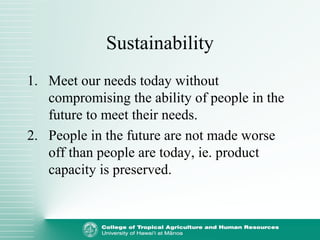
Sustainability
1. Meet our needs today without
compromising the ability of people in the
future to meet their needs.
2. People in the future are not made worse
off than people are today, ie. product
capacity is preserved.
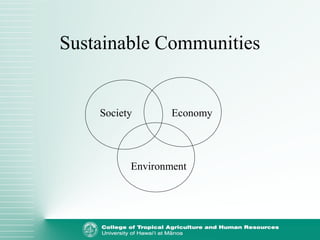
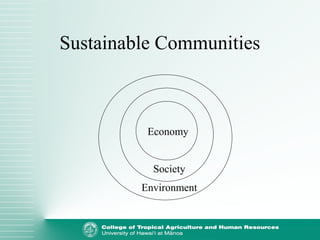
Sustainable Communities
Society Economy
Environment
Sustainable Communities
Economy
Society
Environment
Very Weak
Sustainability Position
• Anthropocentric and utilitarian
• Growth oriented and resource exploitative
• Natural resources utilized at economically optimal
rates with free markets satisfying individuals
• Infinite substitution between natural and human-
made capital
• Continued well-being from economic growth and
technical innovation
Weak Sustainability Position
• Anthropocentric and utilitarian
• Resource conservationist
• Managed growth
• Concern for intra- and intergenerational equity
• Rejection of infinite substitution between natural and
human-made capital with some aspects of natural world
being critical capital
• Human-made plus natural capital constant or rising
• Decouple of environmental impacts and economic
growth
Strong Sustainability Position
• (Eco)systems perspective
• Resource preservationist
• Recognizes value of maintaining ecosystems over
human resource utilization
• Interests of the collective given more weight than those
of the individual consumer
• Adherence to intra- and intergenerational equity
• Constant natural assets rule
• Zero economic and human population growth
Very Strong
Sustainability Position
• Bioethical and ecocentric
• Resource preservationist to the point where
natural resources use is minimized
• Nature’s rights include non-human living
organisms
• Anti-economic growth and reduced human
population
World Tourism Organization
(WTO)
Definition
Sustainable tourism is tourism that meets the
needs of present tourists and host regions
while protecting and enhancing
opportunities for the future.
WTO agreed that
Sustainable tourism development guidelines and
management practices are applicable to all forms
of tourism in all types of destinations.
Sustainability principles refer to the environmental,
economic and socio-cultural aspects of tourism
development, and a suitable balance must be
established between these three dimensions.
Carrying Capacity
• Central to sustainability and ecotourism
• Many types exist
– Cultural
– Social
– Ecological
• Limits of Acceptable Change - compromise
between resource protection and
recreational use stated as a ratio rather than
fixed number
Ecotourism
Term coined in the late 1970s when mass
tourism reached its peak.
A niche market that incorporates
environmentally friendly and culturally
protective techniques
Some feel it is rich people trying to see
something rare or companies trying to use a
trend to make money
Niche Market
• Narrowly defined group of potential
customers
• Businesses may be able to make more
money by targeting environmentalists
because they have higher incomes.
Ecotourism
“Responsible travel to natural areas that
conserves the environment and improves
the welfare of local people”
The International Ecotourism Society
Ecotourism should
• Involve travel to fragile, pristine and usually
protected areas while striving to be low impact
and small scale
• Educate the traveler
• Provide funds for conservation
• Benefit the economic development and political
empowerment of local communities
• Foster respect for different cultures and for human
rights
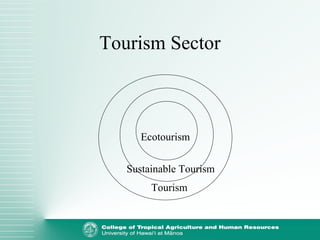
Tourism Sector
Ecotourism
Sustainable Tourism
Tourism
Restricted Supply
Restricted Supply
• Reduces amount supplied
• Increases price
• Customers need higher incomes to pay for
higher prices
• Rich people may cause issues in the
community
Visitor Satisfaction
• Quality
• Health, hygiene and safety conditions
• Sustainability
Rating systems exist for the first two.
Elements of Conformity
Assessment
• Standards
• Assessment
• Certification
• Accreditation
• Recognition
• Acceptance
• More than 100 ecological programs
worldwide certify or grant awards to tourism
operations
• Each program has its own standards
• Many sustainable tourism and ecotourism
initiatives focus exclusively on certification,
ignoring the other components
• Goal is a cost effective, credible sustainable
tourism conformity assessment system
Standards
• Prescriptive-how things will be done
• Performance-what will be achieved
• Management system- how things will be
done and overall what will be achieved
Assessment
• First-party assessment - supplier (self)
assessment
• Second-party assessment - purchaser
assessment
• Third-party assessment - done by an
organization not related to the supplier or
the purchaser
Certification
• First-party - supplier declaration is common
• Second-party - commonly used by large
purchasers
• Third-party -a technically competent
certifier is needed
• Supplier’s audit confirmation - third party
assesses the supplier’s internal audit system
• Certification programs mandated by
government regulation more rigorous and
expensive than voluntary private sectors
programs.
• Voluntary programs vary greatly
• Types include
– Conventional
– Sustainable
– Ecotourism
Accreditation
• Process to certify the certifiers
• Important element of third party systems
• No international accreditation program for
tourism
• Peer review process includes
– Self-evaluation
– On-site assessment by auditors
– Judgment by accreditation body
Acceptance
• Accreditation and recognition address
credibility, acceptance requires that
producers and customers be educated about
the benefits of certification
• A complementary marketing efforts is
needed to alert all stakeholders about issues
Certification Benefits
• Increased Producer Satisfaction
• More Sustainable Tourism Businesses
• More Competitive Local Tourism Markets
• Increased Profitability of Tourism Sector
• Improved Public Image of Tourism Sector
• Increased Community Dialogue
Certification Benefits
• Better Credit Opportunities
• Reduced Liability and Insurance Costs
• More Capable and Dedicated Workers
• Proactive and Participatory Tourism
Businesses
• More Efficient Technology Transfer
Keys to the Process of
Standard Development
• Openness - all persons who will be affected
must be allowed to participate
• Balance - no single interest category should
account for more than one third of group
deciding on the standards
• Consensus - all views and objections should
be considered and an effort be made to
resolve differences
Interest Categories
• Producer or suppliers
• Users
• Affected public
• General interest
Successful Systems
• Continue to be responsive to major
stakeholders who prefer a grading
mechanism to a pass/fail decision
• Are self-supporting and financially stable-
direct cost of assessment (certifier) and the
cost of implementing (supplier)
• In the long-run costs should be paid by the
tourism industry and its customers
Caveats
• An overall tourism policy and plan are needed first
with sustainable tourism as the goal
• Certification is a means to implement the plan
• Commitment to a political process that includes all
members of the local community is needed
• Limiting supplies will result in price increases and
then customers tend to have higher than average
incomes

Sustainable Tourism Development Presentation

  • 1.
    Sustainable Tourism Development Linda J.Cox, PhD Community Economic Development Specialist www.ctahr.hawaii.edu/CoxL
  • 2.
    Sustainability 1. Meet ourneeds today without compromising the ability of people in the future to meet their needs. 2. People in the future are not made worse off than people are today, ie. product capacity is preserved.
  • 3.
  • 4.
  • 5.
    Very Weak Sustainability Position •Anthropocentric and utilitarian • Growth oriented and resource exploitative • Natural resources utilized at economically optimal rates with free markets satisfying individuals • Infinite substitution between natural and human- made capital • Continued well-being from economic growth and technical innovation
  • 6.
    Weak Sustainability Position •Anthropocentric and utilitarian • Resource conservationist • Managed growth • Concern for intra- and intergenerational equity • Rejection of infinite substitution between natural and human-made capital with some aspects of natural world being critical capital • Human-made plus natural capital constant or rising • Decouple of environmental impacts and economic growth
  • 7.
    Strong Sustainability Position •(Eco)systems perspective • Resource preservationist • Recognizes value of maintaining ecosystems over human resource utilization • Interests of the collective given more weight than those of the individual consumer • Adherence to intra- and intergenerational equity • Constant natural assets rule • Zero economic and human population growth
  • 8.
    Very Strong Sustainability Position •Bioethical and ecocentric • Resource preservationist to the point where natural resources use is minimized • Nature’s rights include non-human living organisms • Anti-economic growth and reduced human population
  • 9.
    World Tourism Organization (WTO) Definition Sustainabletourism is tourism that meets the needs of present tourists and host regions while protecting and enhancing opportunities for the future.
  • 10.
    WTO agreed that Sustainabletourism development guidelines and management practices are applicable to all forms of tourism in all types of destinations. Sustainability principles refer to the environmental, economic and socio-cultural aspects of tourism development, and a suitable balance must be established between these three dimensions.
  • 11.
    Carrying Capacity • Centralto sustainability and ecotourism • Many types exist – Cultural – Social – Ecological • Limits of Acceptable Change - compromise between resource protection and recreational use stated as a ratio rather than fixed number
  • 12.
    Ecotourism Term coined inthe late 1970s when mass tourism reached its peak. A niche market that incorporates environmentally friendly and culturally protective techniques Some feel it is rich people trying to see something rare or companies trying to use a trend to make money
  • 13.
    Niche Market • Narrowlydefined group of potential customers • Businesses may be able to make more money by targeting environmentalists because they have higher incomes.
  • 14.
    Ecotourism “Responsible travel tonatural areas that conserves the environment and improves the welfare of local people” The International Ecotourism Society
  • 15.
    Ecotourism should • Involvetravel to fragile, pristine and usually protected areas while striving to be low impact and small scale • Educate the traveler • Provide funds for conservation • Benefit the economic development and political empowerment of local communities • Foster respect for different cultures and for human rights
  • 16.
  • 17.
  • 18.
    Restricted Supply • Reducesamount supplied • Increases price • Customers need higher incomes to pay for higher prices • Rich people may cause issues in the community
  • 19.
    Visitor Satisfaction • Quality •Health, hygiene and safety conditions • Sustainability Rating systems exist for the first two.
  • 20.
    Elements of Conformity Assessment •Standards • Assessment • Certification • Accreditation • Recognition • Acceptance
  • 21.
    • More than100 ecological programs worldwide certify or grant awards to tourism operations • Each program has its own standards • Many sustainable tourism and ecotourism initiatives focus exclusively on certification, ignoring the other components • Goal is a cost effective, credible sustainable tourism conformity assessment system
  • 22.
    Standards • Prescriptive-how thingswill be done • Performance-what will be achieved • Management system- how things will be done and overall what will be achieved
  • 23.
    Assessment • First-party assessment- supplier (self) assessment • Second-party assessment - purchaser assessment • Third-party assessment - done by an organization not related to the supplier or the purchaser
  • 24.
    Certification • First-party -supplier declaration is common • Second-party - commonly used by large purchasers • Third-party -a technically competent certifier is needed • Supplier’s audit confirmation - third party assesses the supplier’s internal audit system
  • 25.
    • Certification programsmandated by government regulation more rigorous and expensive than voluntary private sectors programs. • Voluntary programs vary greatly • Types include – Conventional – Sustainable – Ecotourism
  • 26.
    Accreditation • Process tocertify the certifiers • Important element of third party systems • No international accreditation program for tourism • Peer review process includes – Self-evaluation – On-site assessment by auditors – Judgment by accreditation body
  • 27.
    Acceptance • Accreditation andrecognition address credibility, acceptance requires that producers and customers be educated about the benefits of certification • A complementary marketing efforts is needed to alert all stakeholders about issues
  • 28.
    Certification Benefits • IncreasedProducer Satisfaction • More Sustainable Tourism Businesses • More Competitive Local Tourism Markets • Increased Profitability of Tourism Sector • Improved Public Image of Tourism Sector • Increased Community Dialogue
  • 29.
    Certification Benefits • BetterCredit Opportunities • Reduced Liability and Insurance Costs • More Capable and Dedicated Workers • Proactive and Participatory Tourism Businesses • More Efficient Technology Transfer
  • 30.
    Keys to theProcess of Standard Development • Openness - all persons who will be affected must be allowed to participate • Balance - no single interest category should account for more than one third of group deciding on the standards • Consensus - all views and objections should be considered and an effort be made to resolve differences
  • 31.
    Interest Categories • Produceror suppliers • Users • Affected public • General interest
  • 32.
    Successful Systems • Continueto be responsive to major stakeholders who prefer a grading mechanism to a pass/fail decision • Are self-supporting and financially stable- direct cost of assessment (certifier) and the cost of implementing (supplier) • In the long-run costs should be paid by the tourism industry and its customers
  • 33.
    Caveats • An overalltourism policy and plan are needed first with sustainable tourism as the goal • Certification is a means to implement the plan • Commitment to a political process that includes all members of the local community is needed • Limiting supplies will result in price increases and then customers tend to have higher than average incomes