By Marcel Caraciolo http://mobideia.blogspot.com Chapter 01 – Introduction to the Exam SCMAD Certification  45mm 61mm
Agenda Introduction Java ME Platform SCMAD Certification
Introduction Introduce the Java ME Platform Introduce the SCMAD Exam
What is Java ME Platform? Subset of Java Platform Execution environment  Resource – constrained devices Mobile Phones PDA’s  Set-top boxes
Implementations Specifications are defined by JSR’s Java Specification Requests Sun has a Windows/Unix development kit Device vendors pack VM’s implementation on  devices
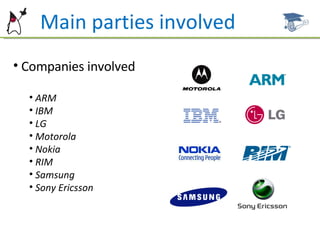
Main parties involved Companies involved ARM IBM LG Motorola Nokia RIM Samsung Sony Ericsson
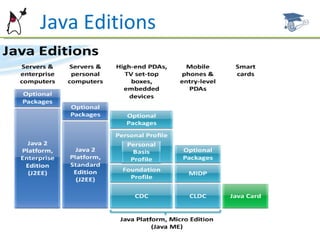
Java Editions
Java ME Platform Java SE defines a single VM and a single API At Java ME  VM’s are based on “Configurations  and “Profiles”. There are several VM types, to support devices with different capabilities,  from cheap cellphones to TV setup-boxes with  high-speed network and wired power supply.
Java ME Platform Configurations  define VM’s features (e.g.  floating point support, security model)  and  basic API’s (e.g. classes at  java.lang, java.util packages). They are composed by a subset of  features from a regular VM and by some new  API’s. Profiles  address “Horizontal” market segments.  They define specific API’s for device set (e.g.  user interface, application life cycle,  persistence, events, etc.)
CLDC: Connected Limited Configuration Most limited configuration Devices: Mobile phones and PDA’s with limited  power and connectivity Based on a subset of Java SE 1.3 API’s All other configurations are based on CLDC  ( to  avoid market fragmentation)
Simplified security model JNI is not allowed No finalization ( Object.finalize()) No file system No Reflection or Serialization No Collections Framework According to the version, floating support may  not be supported CLDC Restrictions
Closer to the Java SE  than CLDC Devices: Set-top boxes and PDA’s  No need for preverification Inherit additional API’s from Java SE CDC: Connected Device Configuration
MIDP  (Mobile Information Device Profile) Designed for mobile phones Provides GUI, persistence, networking, multimedia Depends on CLDC Personal Profile Designed for PDA’s and Set-top boxes Provides AWT for other Java SE API’s Runs on CDC Available Profiles
Provides: Application Life-Cycle User interface 2D games Multimedia Persistence Networking Notifications Security Internet Application distribution with digital signature MIDP: Mobile Information Device Profile
Defines supplementary API: WMA (JSR – 120) – Wireless  messaging API  (SMS messages) MMAPI (JSR-135) – Mobile Media API (support for audio,  video and media capture) PIM and File API (JSR-75) – Access to device’s file system  and contact list. Web Services (JSR-172) - SOAP calls and XML parsing Java API’s for Bluetooth (JSR-82) Scalable 2D  Vector Graphics for Java ME  (SVG Support)  Mobile 3D Graphics  API for Java ME (JSR-184) Mobile Internationalization API (JSR-238) Optional Packages
Define no new API’s What it defines?  Requirements over other API’s aiming to reduce platform  fragmentation Minimum hardware and performance requirements Examples: JTWI  – Java Technology for the Wireless Industry MSA  - Mobile Service Architecture  “ Umbrella” specifications
Specified API’s: CLDC 1.0 (1.1 may be used) MIDP 2.0 WMA 1.1 MMAPI 1.1 (conditional) Some aspects left as optional by the API’s are  required by JTWI Define device features requirements (e.g. screen  size, available memory). JTWI: Java Technology  for Wireless Industry
Splits in “MSA Subset” and “MSA” MSA Subset requires: CLDC 1.1 MIDP 2.1 MMAPI 1.1 WMA 2.0 PDA API (File and PIM) Java API’s for Bluetooth (Bluetooth and Obex) (conditional) Mobile 3D Graphics API Scalable 2D Vector Graphics API (SVG) MSA: Mobile Service Architecture
Besides Subset’s API’s, full MSA requires: J2ME Web Services  (Web Services and XML parsing) Security and Trust Services API (Encryption, smart card access  (conditional), PKI access (conditional)) Location API (conditional) SIP API (SIP protocol) Content Handler API Payment API Advanced Multimedia Supplements (MMAPI extensions) Mobile Internationalization  (i18n) MSA: Mobile Service Architecture
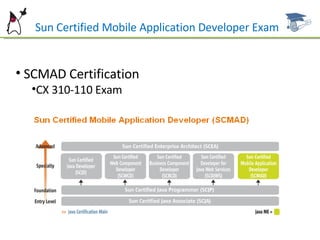
SCMAD Certification CX 310-110 Exam Sun Certified Mobile Application Developer Exam
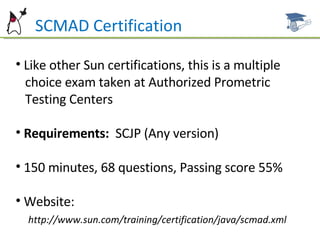
Like other Sun certifications, this is a multiple  choice exam taken at Authorized Prometric  Testing Centers Requirements:  SCJP (Any version) 150 minutes, 68 questions, Passing score 55% Website:  http://www.sun.com/training/certification/java/scmad.xml SCMAD Certification
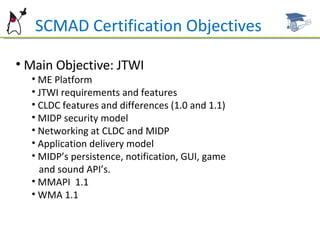
SCMAD Certification Objectives Main Objective: JTWI ME Platform JTWI requirements and features CLDC features and differences (1.0 and 1.1) MIDP security model Networking at CLDC and MIDP Application delivery model MIDP’s persistence, notification, GUI, game  and sound API’s.  MMAPI  1.1 WMA 1.1
Future Work Next Chapter: Tools and requirements for Java ME development  First Java ME mobile Application: Hello World MIDlet Configurations and Profiles – Differences
References ALVES F. Eduardo. SCMAD Study Guide,  27/04/2008.  JAKL Andreas, Java Platform, Micro Edition Part  01 slides, 12/2007. Sun Certification Mobile Application Developer  Website:  [http://www.sun.com/training/certification/java/scmad.xml].

Scmad Chapter 01

  • 1.
    By Marcel Caraciolohttp://mobideia.blogspot.com Chapter 01 – Introduction to the Exam SCMAD Certification 45mm 61mm
  • 2.
    Agenda Introduction JavaME Platform SCMAD Certification
  • 3.
    Introduction Introduce theJava ME Platform Introduce the SCMAD Exam
  • 4.
    What is JavaME Platform? Subset of Java Platform Execution environment Resource – constrained devices Mobile Phones PDA’s Set-top boxes
  • 5.
    Implementations Specifications aredefined by JSR’s Java Specification Requests Sun has a Windows/Unix development kit Device vendors pack VM’s implementation on devices
  • 6.
    Main parties involvedCompanies involved ARM IBM LG Motorola Nokia RIM Samsung Sony Ericsson
  • 7.
  • 8.
    Java ME PlatformJava SE defines a single VM and a single API At Java ME VM’s are based on “Configurations and “Profiles”. There are several VM types, to support devices with different capabilities, from cheap cellphones to TV setup-boxes with high-speed network and wired power supply.
  • 9.
    Java ME PlatformConfigurations define VM’s features (e.g. floating point support, security model) and basic API’s (e.g. classes at java.lang, java.util packages). They are composed by a subset of features from a regular VM and by some new API’s. Profiles address “Horizontal” market segments. They define specific API’s for device set (e.g. user interface, application life cycle, persistence, events, etc.)
  • 10.
    CLDC: Connected LimitedConfiguration Most limited configuration Devices: Mobile phones and PDA’s with limited power and connectivity Based on a subset of Java SE 1.3 API’s All other configurations are based on CLDC ( to avoid market fragmentation)
  • 11.
    Simplified security modelJNI is not allowed No finalization ( Object.finalize()) No file system No Reflection or Serialization No Collections Framework According to the version, floating support may not be supported CLDC Restrictions
  • 12.
    Closer to theJava SE than CLDC Devices: Set-top boxes and PDA’s No need for preverification Inherit additional API’s from Java SE CDC: Connected Device Configuration
  • 13.
    MIDP (MobileInformation Device Profile) Designed for mobile phones Provides GUI, persistence, networking, multimedia Depends on CLDC Personal Profile Designed for PDA’s and Set-top boxes Provides AWT for other Java SE API’s Runs on CDC Available Profiles
  • 14.
    Provides: Application Life-CycleUser interface 2D games Multimedia Persistence Networking Notifications Security Internet Application distribution with digital signature MIDP: Mobile Information Device Profile
  • 15.
    Defines supplementary API:WMA (JSR – 120) – Wireless messaging API (SMS messages) MMAPI (JSR-135) – Mobile Media API (support for audio, video and media capture) PIM and File API (JSR-75) – Access to device’s file system and contact list. Web Services (JSR-172) - SOAP calls and XML parsing Java API’s for Bluetooth (JSR-82) Scalable 2D Vector Graphics for Java ME (SVG Support) Mobile 3D Graphics API for Java ME (JSR-184) Mobile Internationalization API (JSR-238) Optional Packages
  • 16.
    Define no newAPI’s What it defines? Requirements over other API’s aiming to reduce platform fragmentation Minimum hardware and performance requirements Examples: JTWI – Java Technology for the Wireless Industry MSA - Mobile Service Architecture “ Umbrella” specifications
  • 17.
    Specified API’s: CLDC1.0 (1.1 may be used) MIDP 2.0 WMA 1.1 MMAPI 1.1 (conditional) Some aspects left as optional by the API’s are required by JTWI Define device features requirements (e.g. screen size, available memory). JTWI: Java Technology for Wireless Industry
  • 18.
    Splits in “MSASubset” and “MSA” MSA Subset requires: CLDC 1.1 MIDP 2.1 MMAPI 1.1 WMA 2.0 PDA API (File and PIM) Java API’s for Bluetooth (Bluetooth and Obex) (conditional) Mobile 3D Graphics API Scalable 2D Vector Graphics API (SVG) MSA: Mobile Service Architecture
  • 19.
    Besides Subset’s API’s,full MSA requires: J2ME Web Services (Web Services and XML parsing) Security and Trust Services API (Encryption, smart card access (conditional), PKI access (conditional)) Location API (conditional) SIP API (SIP protocol) Content Handler API Payment API Advanced Multimedia Supplements (MMAPI extensions) Mobile Internationalization (i18n) MSA: Mobile Service Architecture
  • 20.
    SCMAD Certification CX310-110 Exam Sun Certified Mobile Application Developer Exam
  • 21.
    Like other Suncertifications, this is a multiple choice exam taken at Authorized Prometric Testing Centers Requirements: SCJP (Any version) 150 minutes, 68 questions, Passing score 55% Website: http://www.sun.com/training/certification/java/scmad.xml SCMAD Certification
  • 22.
    SCMAD Certification ObjectivesMain Objective: JTWI ME Platform JTWI requirements and features CLDC features and differences (1.0 and 1.1) MIDP security model Networking at CLDC and MIDP Application delivery model MIDP’s persistence, notification, GUI, game and sound API’s. MMAPI 1.1 WMA 1.1
  • 23.
    Future Work NextChapter: Tools and requirements for Java ME development First Java ME mobile Application: Hello World MIDlet Configurations and Profiles – Differences
  • 24.
    References ALVES F.Eduardo. SCMAD Study Guide, 27/04/2008. JAKL Andreas, Java Platform, Micro Edition Part 01 slides, 12/2007. Sun Certification Mobile Application Developer Website: [http://www.sun.com/training/certification/java/scmad.xml].