Presented by Rauf Asadov
Contents
 Introduction
 History
 Basics
 MIDlets & Life Cycle
 Demonstration...
Introduction
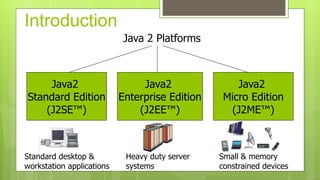
Java2
Standard Edition
(J2SE™)
Java2
Enterprise Edition
(J2EE™)
Java2
Micro Edition
(J2ME™)
Java 2 Platforms
Standard desktop &
workstation applications
Heavy duty server
systems
Small & memory
constrained devices
History
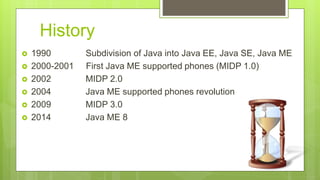
 1990 Subdivision of Java into Java EE, Java SE, Java ME
 2000-2001 First Java ME supported phones (MIDP 1.0)
 2002 MIDP 2.0
 2004 Java ME supported phones revolution
 2009 MIDP 3.0
 2014 Java ME 8
Basics
J2ME is based on 3 core concepts:
 Configurations
 Profiles
 Optional packages
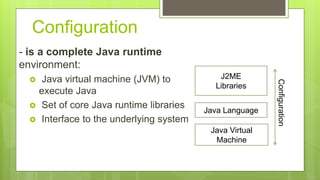
Configuration
- is a complete Java runtime
environment:
 Java virtual machine (JVM) to
execute Java
 Set of core Java runtime libraries
 Interface to the underlying system
J2ME
Libraries
Java Language
Java Virtual
Machine
Configuration
Configuration
CLDC CDC
Connected Limited
Device Configuration
Connected Device
Configuration
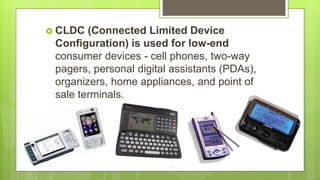
 CLDC (Connected Limited Device
Configuration) is used for low-end
consumer devices - cell phones, two-way
pagers, personal digital assistants (PDAs),
organizers, home appliances, and point of
sale terminals.
Connected Limited Device Configuration
 For very constrained devices, small screens
 160 - 512 KB of total memory
 16-bit or 32-bit processor
 Low power consumption and often operating with battery
power
 Connectivity with limited bandwidth
 May not have a user interface
 Use limited Virtual Machine ( called KVM)
 Selected classes are from: java.lang, java.io, java.util
 CDC (Connected Device Configuration) is
used for high-end consumer devices (TV
set-top boxes, Internet TV)
Connected Device Configuration
 2 MB or more memory for Java platform
 32-bit processor
 High bandwidth network connection, most often using
TCP/IP
 17 packages
 Full-featured Java2 virtual machine (called CVM)
Profile
- Adds features that are specific to a certain device
category such as cell phones or PDAs
- Based on specific configuration
Profile
MIDP PDAP PPPBPFP
Mobile
Information
Device
Profile
Personal
Digital
Assistant
Profile
Foundation
Profile
Personal
Basis
Profile
Personal
Profile
MIDP
 MIDP is targeted at a class of devices known
as mobile information devices (MIDs).
The MIDP, specifies the following APIs:
 application (MIDP application semantics and control)
 user interface
 persistent storage
 networking
 Timers
Optional Packages
- Implies additional functionality:
 Bluetooth
 Messaging
 Media
 3D
MIDlets
 MIDP applications are called MIDlets.
 javax.microedition.midlet.MIDlet
Life Cycle
MIDlet Suite
 MIDlets are bundled into a MIDletsuit
contained within a single package.
JAR JAD

Java J2ME

  • 1.
  • 2.
    Contents  Introduction  History Basics  MIDlets & Life Cycle  Demonstration...
  • 3.
    Introduction Java2 Standard Edition (J2SE™) Java2 Enterprise Edition (J2EE™) Java2 MicroEdition (J2ME™) Java 2 Platforms Standard desktop & workstation applications Heavy duty server systems Small & memory constrained devices
  • 4.
    History  1990 Subdivisionof Java into Java EE, Java SE, Java ME  2000-2001 First Java ME supported phones (MIDP 1.0)  2002 MIDP 2.0  2004 Java ME supported phones revolution  2009 MIDP 3.0  2014 Java ME 8
  • 5.
    Basics J2ME is basedon 3 core concepts:  Configurations  Profiles  Optional packages
  • 6.
    Configuration - is acomplete Java runtime environment:  Java virtual machine (JVM) to execute Java  Set of core Java runtime libraries  Interface to the underlying system J2ME Libraries Java Language Java Virtual Machine Configuration
  • 7.
    Configuration CLDC CDC Connected Limited DeviceConfiguration Connected Device Configuration
  • 8.
     CLDC (ConnectedLimited Device Configuration) is used for low-end consumer devices - cell phones, two-way pagers, personal digital assistants (PDAs), organizers, home appliances, and point of sale terminals.
  • 9.
    Connected Limited DeviceConfiguration  For very constrained devices, small screens  160 - 512 KB of total memory  16-bit or 32-bit processor  Low power consumption and often operating with battery power  Connectivity with limited bandwidth  May not have a user interface  Use limited Virtual Machine ( called KVM)  Selected classes are from: java.lang, java.io, java.util
  • 10.
     CDC (ConnectedDevice Configuration) is used for high-end consumer devices (TV set-top boxes, Internet TV)
  • 11.
    Connected Device Configuration 2 MB or more memory for Java platform  32-bit processor  High bandwidth network connection, most often using TCP/IP  17 packages  Full-featured Java2 virtual machine (called CVM)
  • 12.
    Profile - Adds featuresthat are specific to a certain device category such as cell phones or PDAs - Based on specific configuration Profile MIDP PDAP PPPBPFP Mobile Information Device Profile Personal Digital Assistant Profile Foundation Profile Personal Basis Profile Personal Profile
  • 13.
    MIDP  MIDP istargeted at a class of devices known as mobile information devices (MIDs). The MIDP, specifies the following APIs:  application (MIDP application semantics and control)  user interface  persistent storage  networking  Timers
  • 14.
    Optional Packages - Impliesadditional functionality:  Bluetooth  Messaging  Media  3D
  • 15.
    MIDlets  MIDP applicationsare called MIDlets.  javax.microedition.midlet.MIDlet Life Cycle
  • 16.
    MIDlet Suite  MIDletsare bundled into a MIDletsuit contained within a single package. JAR JAD