





Benchy
Lightweight performing benchmark framework for
Python scripts
Marcel Caraciolo
@marcelcaraciolo
Developer, Cientist, contributor to the Crab recsys project,
works with Python for 6 years, interested at mobile,
education, machine learning and dataaaaa!
Recife, Brazil - http://aimotion.blogspot.com
About me
Co-founder of Crab - Python recsys library
Cientist Chief at Atepassar, e-learning social network
Co-Founder and Instructor of PyCursos, teaching Python on-line
Co-Founder of Pingmind, on-line infrastructure for MOOC’s
Interested at Python, mobile, e-learning and machine learning!
Why do we test ?
Freedom from fear
Testing for
performance
What made my
code slower ?
me
Solutions ?
In	
  [1]:	
  def	
  f(x):


  ...:	


  return	
  x*x


  ...:	
  
In	
  [2]:	
  %timeit	
  for	
  x	
  in	
  range
(100):	
  f(x)
100000	
  loops,	
  best	
  of	
  3:	
  20.3	
  us	
  
per	
  loop
Stop. Help is near
Performance benchmarks to compare several python code
alternatives
Generates graphs using matplotlib
Memory consumption, Performance timing available
https://github.com/python-recsys/benchy
Performance
benchmarks
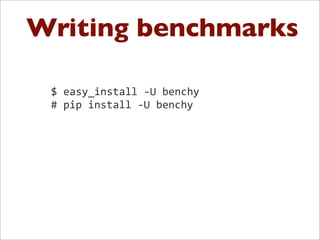
Writing benchmarks
$	
  easy_install	
  -­‐U	
  benchy	
  
#	
  pip	
  install	
  -­‐U	
  benchy
Writing benchmarks
from	
  benchy.api	
  import	
  Benchmark
common_setup	
  =	
  ""
statement	
  =	
  "lst	
  =	
  ['i'	
  for	
  x	
  in	
  range(100000)]"
benchmark1	
  =	
  Benchmark(statement,	
  common_setup,	
  name=	
  "range")
statement	
  =	
  "lst	
  =	
  ['i'	
  for	
  x	
  in	
  xrange(100000)]"
benchmark2	
  =	
  Benchmark(statement,	
  common_setup,	
  name=	
  "xrange")
statement	
  =	
  "lst	
  =	
  ['i']	
  *	
  100000"
benchmark3	
  =	
  Benchmark(statement,	
  common_setup,	
  name=	
  "range")
Use them in your
workflow
[1]:	
  print	
  benchmark1.run()
{'memory':	
  {'repeat':	
  3,


  'success':	
  True,


  'units':	
  'MB',


  'usage':	
  2.97265625},
	
  'runtime':	
  {'loops':	
  100,


  'repeat':	
  3,


  'success':	
  True,


  'timing':	
  7.5653696060180664,


  'units':	
  'ms'}}
Same code as %timeit
and %memit
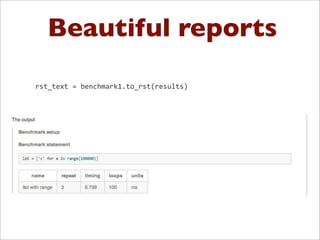
Beautiful reports
rst_text	
  =	
  benchmark1.to_rst(results)
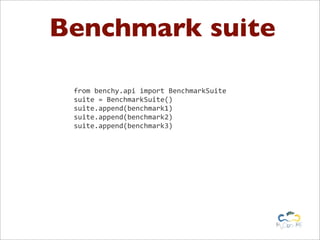
Benchmark suite
from	
  benchy.api	
  import	
  BenchmarkSuite
suite	
  =	
  BenchmarkSuite()
suite.append(benchmark1)
suite.append(benchmark2)
suite.append(benchmark3)
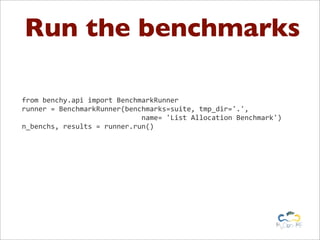
Run the benchmarks
from	
  benchy.api	
  import	
  BenchmarkRunner
runner	
  =	
  BenchmarkRunner(benchmarks=suite,	
  tmp_dir='.',	


  name=	
  'List	
  Allocation	
  Benchmark')
n_benchs,	
  results	
  =	
  runner.run()
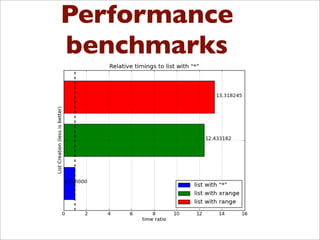
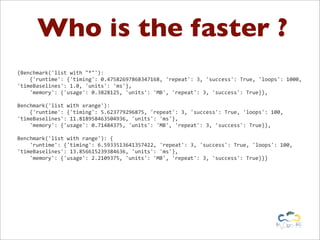
Who is the faster ?
{Benchmark('list	
  with	
  "*"'):


  {'runtime':	
  {'timing':	
  0.47582697868347168,	
  'repeat':	
  3,	
  'success':	
  True,	
  'loops':	
  1000,	
  
'timeBaselines':	
  1.0,	
  'units':	
  'ms'},


  'memory':	
  {'usage':	
  0.3828125,	
  'units':	
  'MB',	
  'repeat':	
  3,	
  'success':	
  True}},
Benchmark('list	
  with	
  xrange'):


  {'runtime':	
  {'timing':	
  5.623779296875,	
  'repeat':	
  3,	
  'success':	
  True,	
  'loops':	
  100,	
  
'timeBaselines':	
  11.818958463504936,	
  'units':	
  'ms'},


  'memory':	
  {'usage':	
  0.71484375,	
  'units':	
  'MB',	
  'repeat':	
  3,	
  'success':	
  True}},
Benchmark('list	
  with	
  range'):	
  {


  'runtime':	
  {'timing':	
  6.5933513641357422,	
  'repeat':	
  3,	
  'success':	
  True,	
  'loops':	
  100,	
  
'timeBaselines':	
  13.856615239384636,	
  'units':	
  'ms'},


  'memory':	
  {'usage':	
  2.2109375,	
  'units':	
  'MB',	
  'repeat':	
  3,	
  'success':	
  True}}}
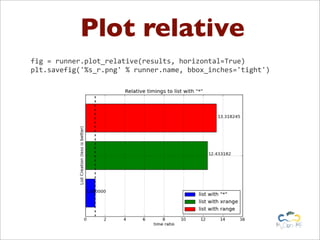
Plot relative
fig	
  =	
  runner.plot_relative(results,	
  horizontal=True)
plt.savefig('%s_r.png'	
  %	
  runner.name,	
  bbox_inches='tight')
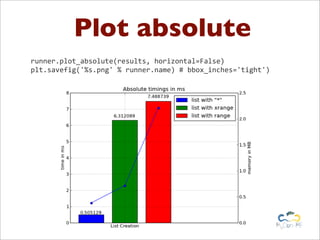
Plot absolute
runner.plot_absolute(results,	
  horizontal=False)
plt.savefig('%s.png'	
  %	
  runner.name)	
  #	
  bbox_inches='tight')
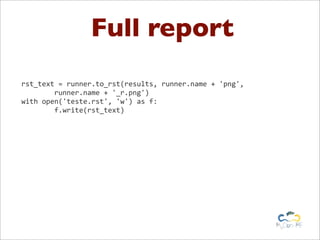
Full report
rst_text	
  =	
  runner.to_rst(results,	
  runner.name	
  +	
  'png',


  runner.name	
  +	
  '_r.png')
with	
  open('teste.rst',	
  'w')	
  as	
  f:


  f.write(rst_text)
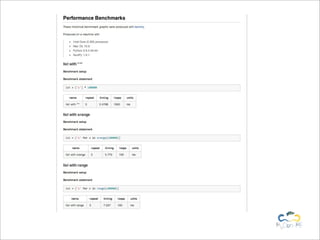
Full report
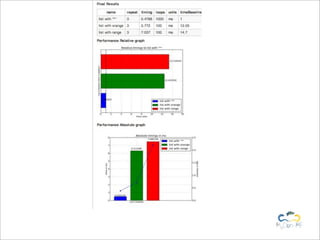
Full report
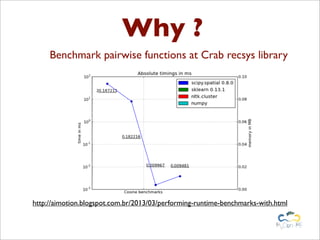
Why ?
Benchmark pairwise functions at Crab recsys library
http://aimotion.blogspot.com.br/2013/03/performing-runtime-benchmarks-with.html
Get involved
Create the benchmarks as TestCases
Check automatically for benchmark files and run like %nose.test()
More setup and teardown control
Group benchmarks at the same graph
Improvements
Added Database Handler
Added Git Support
Added New Runner
Run benchmarks
db.py
import	
  sqlite3


class	
  BenchmarkDb(object):


  """


  Persistence	
  handler	
  for	
  bechmark	
  results


  """


  def	
  _create_tables(self):


  self._cursor.execute("drop	
  table	
  if	
  exists	
  benchmarksuites")


  self._cursor.execute("drop	
  table	
  if	
  exists	
  benchmarks")


  self._cursor.execute("drop	
  table	
  if	
  exists	
  results")


  ...	


  self._cursor.execute('CREATE	
  TABLE	


  benchmarks(checksum	
  text	
  PRIMARY	
  KEY,	


  name	
  text,	
  description	
  text,	
  suite_id	
  integer,	


  FOREIGN	
  KEY(suite_id)	
  REFERENCES	
  benchmarksuites(id))')


  self._cursor.execute('CREATE	
  TABLE	
  results(id	
  integer	


  PRIMARY	
  KEY	
  AUTOINCREMENT,	
  checksum	
  text,	


  timestamp	
  timestamp,	
  ncalls	
  text,	
  timing	
  float,	
  traceback	
  text,


  FOREIGN	
  KEY(checksum)	
  REFERENCES	
  benchmarks(checksum))')


  self._con.commit()


  def	
  write_benchmark(self,	
  bm,	
  suite=None):


  if	
  suite	
  is	
  not	
  None:


  self._cursor.execute('SELECT	
  id	
  FROM	
  benchmarksuites	


  where	
  name	
  =	
  "%s"'	
  %	
  suite.name)


  row	
  =	
  self._cursor.fetchone()


  else:


  row	
  =	
  None


  if	
  row	
  ==	
  None:


  self._cursor.execute('INSERT	
  INTO	
  benchmarks	
  VALUES	
  (?,	
  ?,	
  ?,	
  ?)',


  (bm.checksum,	
  bm.name,	
  bm.description,	
  None))


  else:


  self._cursor.execute('INSERT	
  INTO	
  benchmarks	
  VALUES	
  (?,	
  ?,	
  ?,	
  ?)',


  (bm.checksum,	
  bm.name,	
  bm.description,	
  row[0]))
Improvements
Added Database Handler
Added Git Support
Added New Runner
Run benchmarks
Git Repo
class	
  GitRepository(Repository):


  """


  Read	
  some	
  basic	
  statistics	
  about	
  a	
  git	
  repository


  """


  def	
  __init__(self,	
  repo_path):


  self.repo_path	
  =	
  repo_path


  self.git	
  =	
  _git_command(self.repo_path)


  (self.shas,	
  self.messages,


  self.timestamps,	
  self.authors)	
  =	
  self._parse_commit_log()
[('d87fdf2', datetime.datetime(2013, 3, 22, 16, 55, 38)), ('a90a449', datetime.datetime(2013, 3, 22, 16, 54, 36)),
('fe66a86', datetime.datetime(2013, 3, 22, 16, 51, 2)), ('bea6b21', datetime.datetime(2013, 3, 22, 13, 14, 22)),
('bde5e63', datetime.datetime(2013, 3, 22, 5, 2, 56)), ('89634f6', datetime.datetime(2013, 3, 20, 4, 16, 19))]
Git Repo
class	
  BenchmarkRepository(object):


  """


  Manage	
  an	
  isolated	
  copy	
  of	
  a	
  repository	
  for	
  benchmarking


  """


  ...


  def	
  _copy_repo(self):


  if	
  os.path.exists(self.target_dir):


  print	
  'Deleting	
  %s	
  first'	
  %	
  self.target_dir


  #	
  response	
  =	
  raw_input('%s	
  exists,	
  delete?	
  y/n'	
  %	
  self.target_dir)


  #	
  if	
  response	
  ==	
  'n':


  #	


  raise	
  Exception('foo')


  cmd	
  =	
  'rm	
  -­‐rf	
  %s'	
  %	
  self.target_dir


  print	
  cmd


  os.system(cmd)


  self._clone(self.target_dir_tmp,	
  self.target_dir)


  self._prep()


  self._copy_benchmark_scripts_and_deps()


  def	
  _clone(self,	
  source,	
  target):


  cmd	
  =	
  'git	
  clone	
  %s	
  %s'	
  %	
  (source,	
  target)


  print	
  cmd


  os.system(cmd)


  def	
  _copy_benchmark_scripts_and_deps(self):


  pth,	
  _	
  =	
  os.path.split(os.path.abspath(__file__))


  deps	
  =	
  [os.path.join(pth,	
  'run_benchmarks.py')]


  if	
  self.dependencies	
  is	
  not	
  None:


  deps.extend(self.dependencies)


  for	
  dep	
  in	
  deps:


  cmd	
  =	
  'cp	
  %s	
  %s'	
  %	
  (dep,	
  self.target_dir)


  print	
  cmd


  proc	
  =	
  subprocess.Popen(cmd,	
  shell=True)


  proc.wait()
Improvements
Added Database Handler
Added Git Support
Added New Runner
Run benchmarks
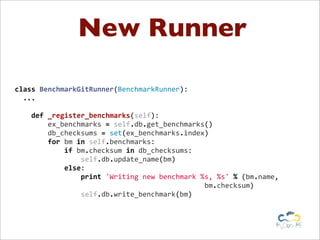
New Runner
	
  
class	
  BenchmarkGitRunner(BenchmarkRunner):
	
  	
  ...


  def	
  _register_benchmarks(self):


  ex_benchmarks	
  =	
  self.db.get_benchmarks()


  db_checksums	
  =	
  set(ex_benchmarks.index)


  for	
  bm	
  in	
  self.benchmarks:


  if	
  bm.checksum	
  in	
  db_checksums:


  self.db.update_name(bm)


  else:


  print	
  'Writing	
  new	
  benchmark	
  %s,	
  %s'	
  %	
  (bm.name,	


  bm.checksum)


  self.db.write_benchmark(bm)
	
  
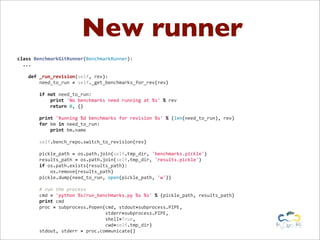
New runner
	
  
class	
  BenchmarkGitRunner(BenchmarkRunner):
	
  	
  ...


  def	
  _run_revision(self,	
  rev):


  need_to_run	
  =	
  self._get_benchmarks_for_rev(rev)


  if	
  not	
  need_to_run:


  print	
  'No	
  benchmarks	
  need	
  running	
  at	
  %s'	
  %	
  rev


  return	
  0,	
  {}


  print	
  'Running	
  %d	
  benchmarks	
  for	
  revision	
  %s'	
  %	
  (len(need_to_run),	
  rev)


  for	
  bm	
  in	
  need_to_run:


  print	
  bm.name


  self.bench_repo.switch_to_revision(rev)


  pickle_path	
  =	
  os.path.join(self.tmp_dir,	
  'benchmarks.pickle')


  results_path	
  =	
  os.path.join(self.tmp_dir,	
  'results.pickle')


  if	
  os.path.exists(results_path):


  os.remove(results_path)


  pickle.dump(need_to_run,	
  open(pickle_path,	
  'w'))


  #	
  run	
  the	
  process


  cmd	
  =	
  'python	
  %s/run_benchmarks.py	
  %s	
  %s'	
  %	
  (pickle_path,	
  results_path)


  print	
  cmd


  proc	
  =	
  subprocess.Popen(cmd,	
  stdout=subprocess.PIPE,


  stderr=subprocess.PIPE,


  shell=True,


  cwd=self.tmp_dir)


  stdout,	
  stderr	
  =	
  proc.communicate()
	
  
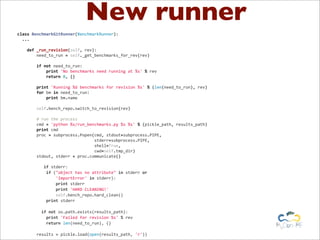
New runner	
  
class	
  BenchmarkGitRunner(BenchmarkRunner):
	
  	
  ...


  def	
  _run_revision(self,	
  rev):


  need_to_run	
  =	
  self._get_benchmarks_for_rev(rev)


  if	
  not	
  need_to_run:


  print	
  'No	
  benchmarks	
  need	
  running	
  at	
  %s'	
  %	
  rev


  return	
  0,	
  {}


  print	
  'Running	
  %d	
  benchmarks	
  for	
  revision	
  %s'	
  %	
  (len(need_to_run),	
  rev)


  for	
  bm	
  in	
  need_to_run:


  print	
  bm.name


  self.bench_repo.switch_to_revision(rev)


  #	
  run	
  the	
  process


  cmd	
  =	
  'python	
  %s/run_benchmarks.py	
  %s	
  %s'	
  %	
  (pickle_path,	
  results_path)


  print	
  cmd


  proc	
  =	
  subprocess.Popen(cmd,	
  stdout=subprocess.PIPE,


  stderr=subprocess.PIPE,


  shell=True,


  cwd=self.tmp_dir)


  stdout,	
  stderr	
  =	
  proc.communicate()


  if	
  stderr:


  if	
  ("object	
  has	
  no	
  attribute"	
  in	
  stderr	
  or


  'ImportError'	
  in	
  stderr):


  print	
  stderr


  print	
  'HARD	
  CLEANING!'


  self.bench_repo.hard_clean()


  print	
  stderr


  if	
  not	
  os.path.exists(results_path):


  print	
  'Failed	
  for	
  revision	
  %s'	
  %	
  rev


  return	
  len(need_to_run),	
  {}


  results	
  =	
  pickle.load(open(results_path,	
  'r'))
Improvements
Added Database Handler
Added Git Support
Added New Runner
Run benchmarks
Running
from	
  benchmark	
  import	
  Benchmark,	
  BenchmarkRepository,	
  BenchmarkGitRunner
try:


  REPO_PATH	
  =	
  config.get('setup',	
  'repo_path')


  REPO_URL	
  =	
  config.get('setup',	
  'repo_url')


  DB_PATH	
  =	
  config.get('setup',	
  'db_path')


  TMP_DIR	
  =	
  config.get('setup',	
  'tmp_dir')
except:


  REPO_PATH	
  =	
  os.path.abspath(os.path.join(os.path.dirname(__file__),	
  
"../"))


  REPO_URL	
  =	
  'git@github.com:python-­‐recsys/crab.git'


  DB_PATH	
  =	
  os.path.join(REPO_PATH,	
  'suite/benchmarks.db')


  TMP_DIR	
  =	
  os.path.join(HOME,	
  'tmp/base_benchy/')
PREPARE	
  =	
  """
python	
  setup.py	
  clean
"""
BUILD	
  =	
  """
python	
  setup.py	
  build_ext	
  -­‐-­‐inplace
"""
repo	
  =	
  BenchmarkRepository(REPO_PATH,	
  REPO_URL,	
  DB_PATH,	
  TMP_DIR)
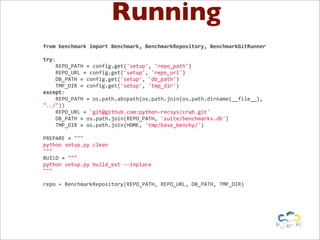
Running


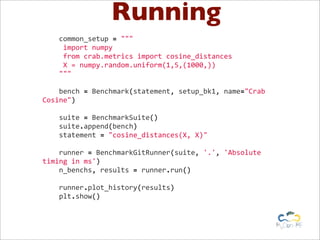
  common_setup	
  =	
  """


  import	
  numpy


  from	
  crab.metrics	
  import	
  cosine_distances


  X	
  =	
  numpy.random.uniform(1,5,(1000,))


  """


  bench	
  =	
  Benchmark(statement,	
  setup_bk1,	
  name="Crab	
  
Cosine")


  suite	
  =	
  BenchmarkSuite()


  suite.append(bench)	


  statement	
  =	
  "cosine_distances(X,	
  X)"


  runner	
  =	
  BenchmarkGitRunner(suite,	
  '.',	
  'Absolute	
  
timing	
  in	
  ms')


  n_benchs,	
  results	
  =	
  runner.run()


  runner.plot_history(results)


  plt.show()
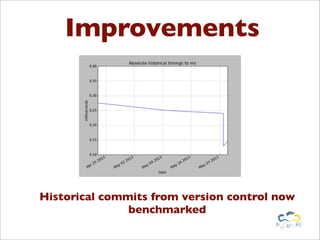
Improvements
Historical commits from version control now
benchmarked
Working now:
Module detection
by_module	
  =	
  {}
benchmarks	
  =	
  []
modules	
  =	
  ['metrics',


  'recommenders',


  'similarities']
for	
  modname	
  in	
  modules:


  ref	
  =	
  __import__(modname)


  by_module[modname]	
  =	
  [v	
  for	
  v	
  in	
  ref.__dict__.values()


  if	
  isinstance(v,	
  Benchmark)]


  benchmarks.extend(by_module[modname])
for	
  bm	
  in	
  benchmarks:


  assert(bm.name	
  is	
  not	
  None)
https://github.com/python-recsys/benchy
Forks and pull requests are welcomed!
Benchy
Lightweight performing benchmark framework for
Python scripts
Marcel Caraciolo
@marcelcaraciolo
Developer, Cientist, contributor to the Crab recsys project,
works with Python for 6 years, interested at mobile,
education, machine learning and dataaaaa!
Recife, Brazil - http://aimotion.blogspot.com

Benchy, python framework for performance benchmarking of Python Scripts

  • 1.
    Benchy Lightweight performing benchmarkframework for Python scripts Marcel Caraciolo @marcelcaraciolo Developer, Cientist, contributor to the Crab recsys project, works with Python for 6 years, interested at mobile, education, machine learning and dataaaaa! Recife, Brazil - http://aimotion.blogspot.com
  • 2.
    About me Co-founder ofCrab - Python recsys library Cientist Chief at Atepassar, e-learning social network Co-Founder and Instructor of PyCursos, teaching Python on-line Co-Founder of Pingmind, on-line infrastructure for MOOC’s Interested at Python, mobile, e-learning and machine learning!
  • 3.
    Why do wetest ?
  • 4.
  • 5.
  • 6.
  • 8.
  • 9.
    Solutions ? In  [1]:  def  f(x):      ...:          return  x*x      ...:   In  [2]:  %timeit  for  x  in  range (100):  f(x) 100000  loops,  best  of  3:  20.3  us   per  loop
  • 10.
    Stop. Help isnear Performance benchmarks to compare several python code alternatives Generates graphs using matplotlib Memory consumption, Performance timing available https://github.com/python-recsys/benchy
  • 11.
  • 12.
    Writing benchmarks $  easy_install  -­‐U  benchy   #  pip  install  -­‐U  benchy
  • 13.
    Writing benchmarks from  benchy.api  import  Benchmark common_setup  =  "" statement  =  "lst  =  ['i'  for  x  in  range(100000)]" benchmark1  =  Benchmark(statement,  common_setup,  name=  "range") statement  =  "lst  =  ['i'  for  x  in  xrange(100000)]" benchmark2  =  Benchmark(statement,  common_setup,  name=  "xrange") statement  =  "lst  =  ['i']  *  100000" benchmark3  =  Benchmark(statement,  common_setup,  name=  "range")
  • 14.
    Use them inyour workflow [1]:  print  benchmark1.run() {'memory':  {'repeat':  3,                        'success':  True,                        'units':  'MB',                        'usage':  2.97265625},  'runtime':  {'loops':  100,                          'repeat':  3,                          'success':  True,                          'timing':  7.5653696060180664,                          'units':  'ms'}} Same code as %timeit and %memit
  • 15.
    Beautiful reports rst_text  =  benchmark1.to_rst(results)
  • 16.
    Benchmark suite from  benchy.api  import  BenchmarkSuite suite  =  BenchmarkSuite() suite.append(benchmark1) suite.append(benchmark2) suite.append(benchmark3)
  • 17.
    Run the benchmarks from  benchy.api  import  BenchmarkRunner runner  =  BenchmarkRunner(benchmarks=suite,  tmp_dir='.',                                                            name=  'List  Allocation  Benchmark') n_benchs,  results  =  runner.run()
  • 18.
    Who is thefaster ? {Benchmark('list  with  "*"'):        {'runtime':  {'timing':  0.47582697868347168,  'repeat':  3,  'success':  True,  'loops':  1000,   'timeBaselines':  1.0,  'units':  'ms'},        'memory':  {'usage':  0.3828125,  'units':  'MB',  'repeat':  3,  'success':  True}}, Benchmark('list  with  xrange'):        {'runtime':  {'timing':  5.623779296875,  'repeat':  3,  'success':  True,  'loops':  100,   'timeBaselines':  11.818958463504936,  'units':  'ms'},        'memory':  {'usage':  0.71484375,  'units':  'MB',  'repeat':  3,  'success':  True}}, Benchmark('list  with  range'):  {        'runtime':  {'timing':  6.5933513641357422,  'repeat':  3,  'success':  True,  'loops':  100,   'timeBaselines':  13.856615239384636,  'units':  'ms'},        'memory':  {'usage':  2.2109375,  'units':  'MB',  'repeat':  3,  'success':  True}}}
  • 19.
    Plot relative fig  =  runner.plot_relative(results,  horizontal=True) plt.savefig('%s_r.png'  %  runner.name,  bbox_inches='tight')
  • 20.
  • 21.
    Full report rst_text  =  runner.to_rst(results,  runner.name  +  'png',                runner.name  +  '_r.png') with  open('teste.rst',  'w')  as  f:                f.write(rst_text)
  • 22.
  • 23.
  • 24.
    Why ? Benchmark pairwisefunctions at Crab recsys library http://aimotion.blogspot.com.br/2013/03/performing-runtime-benchmarks-with.html
  • 25.
    Get involved Create thebenchmarks as TestCases Check automatically for benchmark files and run like %nose.test() More setup and teardown control Group benchmarks at the same graph
  • 26.
    Improvements Added Database Handler AddedGit Support Added New Runner Run benchmarks
  • 27.
    db.py import  sqlite3     class  BenchmarkDb(object):        """        Persistence  handler  for  bechmark  results        """        def  _create_tables(self):                self._cursor.execute("drop  table  if  exists  benchmarksuites")                self._cursor.execute("drop  table  if  exists  benchmarks")                self._cursor.execute("drop  table  if  exists  results")                ...                    self._cursor.execute('CREATE  TABLE                              benchmarks(checksum  text  PRIMARY  KEY,                          name  text,  description  text,  suite_id  integer,                            FOREIGN  KEY(suite_id)  REFERENCES  benchmarksuites(id))')                  self._cursor.execute('CREATE  TABLE  results(id  integer                          PRIMARY  KEY  AUTOINCREMENT,  checksum  text,                          timestamp  timestamp,  ncalls  text,  timing  float,  traceback  text,                          FOREIGN  KEY(checksum)  REFERENCES  benchmarks(checksum))')                  self._con.commit()          def  write_benchmark(self,  bm,  suite=None):                if  suite  is  not  None:                        self._cursor.execute('SELECT  id  FROM  benchmarksuites                                  where  name  =  "%s"'  %  suite.name)                        row  =  self._cursor.fetchone()                else:                        row  =  None                  if  row  ==  None:                        self._cursor.execute('INSERT  INTO  benchmarks  VALUES  (?,  ?,  ?,  ?)',                                (bm.checksum,  bm.name,  bm.description,  None))                else:                        self._cursor.execute('INSERT  INTO  benchmarks  VALUES  (?,  ?,  ?,  ?)',                                (bm.checksum,  bm.name,  bm.description,  row[0]))
  • 28.
    Improvements Added Database Handler AddedGit Support Added New Runner Run benchmarks
  • 29.
    Git Repo class  GitRepository(Repository):        """        Read  some  basic  statistics  about  a  git  repository        """          def  __init__(self,  repo_path):                self.repo_path  =  repo_path                self.git  =  _git_command(self.repo_path)                (self.shas,  self.messages,                  self.timestamps,  self.authors)  =  self._parse_commit_log() [('d87fdf2', datetime.datetime(2013, 3, 22, 16, 55, 38)), ('a90a449', datetime.datetime(2013, 3, 22, 16, 54, 36)), ('fe66a86', datetime.datetime(2013, 3, 22, 16, 51, 2)), ('bea6b21', datetime.datetime(2013, 3, 22, 13, 14, 22)), ('bde5e63', datetime.datetime(2013, 3, 22, 5, 2, 56)), ('89634f6', datetime.datetime(2013, 3, 20, 4, 16, 19))]
  • 30.
    Git Repo class  BenchmarkRepository(object):        """        Manage  an  isolated  copy  of  a  repository  for  benchmarking        """        ...          def  _copy_repo(self):                if  os.path.exists(self.target_dir):                        print  'Deleting  %s  first'  %  self.target_dir                        #  response  =  raw_input('%s  exists,  delete?  y/n'  %  self.target_dir)                        #  if  response  ==  'n':                        #          raise  Exception('foo')                        cmd  =  'rm  -­‐rf  %s'  %  self.target_dir                        print  cmd                        os.system(cmd)                  self._clone(self.target_dir_tmp,  self.target_dir)                self._prep()                self._copy_benchmark_scripts_and_deps()          def  _clone(self,  source,  target):                cmd  =  'git  clone  %s  %s'  %  (source,  target)                print  cmd                os.system(cmd)          def  _copy_benchmark_scripts_and_deps(self):                pth,  _  =  os.path.split(os.path.abspath(__file__))                deps  =  [os.path.join(pth,  'run_benchmarks.py')]                if  self.dependencies  is  not  None:                        deps.extend(self.dependencies)                  for  dep  in  deps:                        cmd  =  'cp  %s  %s'  %  (dep,  self.target_dir)                        print  cmd                        proc  =  subprocess.Popen(cmd,  shell=True)                        proc.wait()
  • 31.
    Improvements Added Database Handler AddedGit Support Added New Runner Run benchmarks
  • 32.
    New Runner   class  BenchmarkGitRunner(BenchmarkRunner):    ...              def  _register_benchmarks(self):                ex_benchmarks  =  self.db.get_benchmarks()                db_checksums  =  set(ex_benchmarks.index)                for  bm  in  self.benchmarks:                        if  bm.checksum  in  db_checksums:                                self.db.update_name(bm)                        else:                                print  'Writing  new  benchmark  %s,  %s'  %  (bm.name,                                                                                              bm.checksum)                                self.db.write_benchmark(bm)  
  • 33.
    New runner   class  BenchmarkGitRunner(BenchmarkRunner):    ...              def  _run_revision(self,  rev):                need_to_run  =  self._get_benchmarks_for_rev(rev)                  if  not  need_to_run:                        print  'No  benchmarks  need  running  at  %s'  %  rev                        return  0,  {}                  print  'Running  %d  benchmarks  for  revision  %s'  %  (len(need_to_run),  rev)                for  bm  in  need_to_run:                        print  bm.name                  self.bench_repo.switch_to_revision(rev)                  pickle_path  =  os.path.join(self.tmp_dir,  'benchmarks.pickle')                results_path  =  os.path.join(self.tmp_dir,  'results.pickle')                if  os.path.exists(results_path):                        os.remove(results_path)                pickle.dump(need_to_run,  open(pickle_path,  'w'))                  #  run  the  process                cmd  =  'python  %s/run_benchmarks.py  %s  %s'  %  (pickle_path,  results_path)                print  cmd                proc  =  subprocess.Popen(cmd,  stdout=subprocess.PIPE,                                                                stderr=subprocess.PIPE,                                                                shell=True,                                                                cwd=self.tmp_dir)                stdout,  stderr  =  proc.communicate()  
  • 34.
    New runner   class  BenchmarkGitRunner(BenchmarkRunner):    ...              def  _run_revision(self,  rev):                need_to_run  =  self._get_benchmarks_for_rev(rev)                  if  not  need_to_run:                        print  'No  benchmarks  need  running  at  %s'  %  rev                        return  0,  {}                  print  'Running  %d  benchmarks  for  revision  %s'  %  (len(need_to_run),  rev)                for  bm  in  need_to_run:                        print  bm.name                  self.bench_repo.switch_to_revision(rev)                #  run  the  process                cmd  =  'python  %s/run_benchmarks.py  %s  %s'  %  (pickle_path,  results_path)                print  cmd                proc  =  subprocess.Popen(cmd,  stdout=subprocess.PIPE,                                                                stderr=subprocess.PIPE,                                                                shell=True,                                                                cwd=self.tmp_dir)                stdout,  stderr  =  proc.communicate()                      if  stderr:                        if  ("object  has  no  attribute"  in  stderr  or                                'ImportError'  in  stderr):                                print  stderr                                print  'HARD  CLEANING!'                                self.bench_repo.hard_clean()                        print  stderr                    if  not  os.path.exists(results_path):                        print  'Failed  for  revision  %s'  %  rev                        return  len(need_to_run),  {}                results  =  pickle.load(open(results_path,  'r'))
  • 35.
    Improvements Added Database Handler AddedGit Support Added New Runner Run benchmarks
  • 36.
    Running from  benchmark  import  Benchmark,  BenchmarkRepository,  BenchmarkGitRunner try:        REPO_PATH  =  config.get('setup',  'repo_path')        REPO_URL  =  config.get('setup',  'repo_url')        DB_PATH  =  config.get('setup',  'db_path')        TMP_DIR  =  config.get('setup',  'tmp_dir') except:        REPO_PATH  =  os.path.abspath(os.path.join(os.path.dirname(__file__),   "../"))        REPO_URL  =  'git@github.com:python-­‐recsys/crab.git'        DB_PATH  =  os.path.join(REPO_PATH,  'suite/benchmarks.db')        TMP_DIR  =  os.path.join(HOME,  'tmp/base_benchy/') PREPARE  =  """ python  setup.py  clean """ BUILD  =  """ python  setup.py  build_ext  -­‐-­‐inplace """ repo  =  BenchmarkRepository(REPO_PATH,  REPO_URL,  DB_PATH,  TMP_DIR)
  • 37.
    Running        common_setup  =  """          import  numpy          from  crab.metrics  import  cosine_distances          X  =  numpy.random.uniform(1,5,(1000,))        """          bench  =  Benchmark(statement,  setup_bk1,  name="Crab   Cosine")          suite  =  BenchmarkSuite()        suite.append(bench)                  statement  =  "cosine_distances(X,  X)"          runner  =  BenchmarkGitRunner(suite,  '.',  'Absolute   timing  in  ms')        n_benchs,  results  =  runner.run()          runner.plot_history(results)        plt.show()
  • 38.
    Improvements Historical commits fromversion control now benchmarked
  • 39.
    Working now: Module detection by_module  =  {} benchmarks  =  [] modules  =  ['metrics',                      'recommenders',                      'similarities'] for  modname  in  modules:        ref  =  __import__(modname)        by_module[modname]  =  [v  for  v  in  ref.__dict__.values()                                                    if  isinstance(v,  Benchmark)]        benchmarks.extend(by_module[modname]) for  bm  in  benchmarks:        assert(bm.name  is  not  None)
  • 40.
  • 43.
    Benchy Lightweight performing benchmarkframework for Python scripts Marcel Caraciolo @marcelcaraciolo Developer, Cientist, contributor to the Crab recsys project, works with Python for 6 years, interested at mobile, education, machine learning and dataaaaa! Recife, Brazil - http://aimotion.blogspot.com