MARWA ABO ALMAATY BESAR
LECTURER OF INTERNAL MEDICINE
(RHEUMATOLOGY&IMMUNOLOGY UNIT)
(PEDIATRIC RHEUMATOLOGY)
Scleroderma,S
S
38 year old woman presents with 3 months of progressive fatigue and
dyspnea that limits her ability to climb the steps in her two story house.
Her past medical history is remarkable for a ten year history of
Raynaud’s phenomenon which is treated with nifedipine.
Blood pressure – 130/75, Pulse 90, Respiratory Rate14, Pulse oximetry
92% on Room Air.
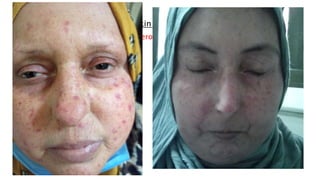
Physical exam reveals clear lungs bilaterally, and an S3. Skin is
remarkable for palmar and facial telangiectasias and thickening of the
skin overlying the fingers.
Chest radiograph, EKG, and CBC are normal
 What additional test would you order for the patient?
 Consider your Diagnosis
SCLERODERMA
Scleroderma = Systemic sclerosis = progressive systemic sclerosis.
SS = hard skin.
Multisystemic, autoimmune disease affecting small arteries, micro
vessels and fibroblast result in vascular obliteration, collagen
accumulation and scarring (fibrosis) of skin and internal organs.
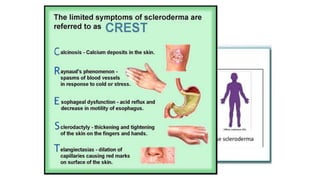
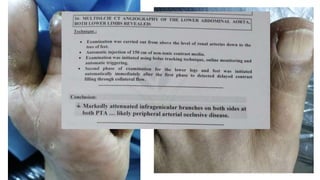
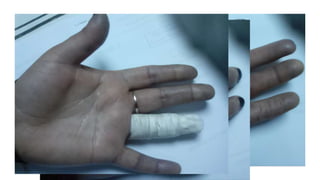
Vascular :
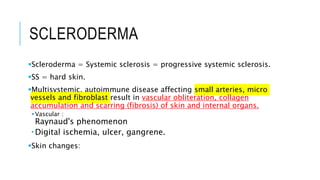
Raynaud's phenomenon
 Digital ischemia, ulcer, gangrene.
Skin changes:
EPIDEMIOLOGY:
Worldwide, all race.
Annual incidence 14.1/ million cases.
3rd and 5th decade.
Female: male= 5:1
Sever disease in young black women.
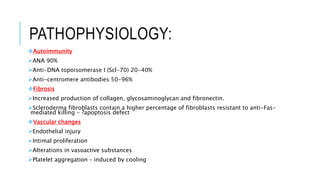
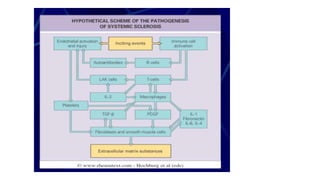
PATHOPHYSIOLOGY:
Autoimmunity
ANA 90%
Anti-DNA topoisomerase I (Scl-70) 20-40%
Anti-centromere antibodies 50-96%
Fibrosis
Increased production of collagen, glycosaminoglycan and fibronectin.
Scleroderma fibroblasts contain a higher percentage of fibroblasts resistant to anti-Fas-
mediated killing - ?apoptosis defect
Vascular changes
Endothelial injury
Intimal proliferation
Alterations in vasoactive substances
Platelet aggregation – induced by cooling
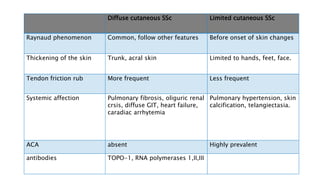
Diffuse cutaneous SSc Limited cutaneous SSc
Raynaud phenomenon Common, follow other features Before onset of skin changes
Thickening of the skin Trunk, acral skin Limited to hands, feet, face.
Tendon friction rub More frequent Less frequent
Systemic affection Pulmonary fibrosis, oliguric renal
crsis, diffuse GIT, heart failure,
caradiac arrhytemia
Pulmonary hypertension, skin
calcification, telangiectasia.
ACA absent Highly prevalent
antibodies TOPO-1, RNA polymerases 1,II,III
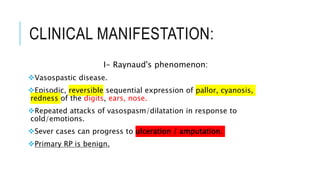
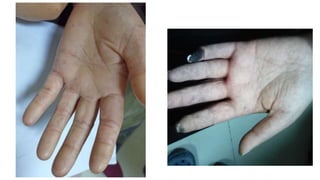
CLINICAL MANIFESTATION:
I- Raynaud's phenomenon:
Vasospastic disease.
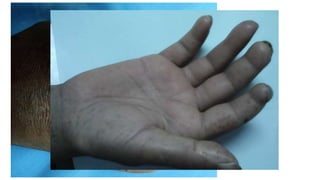
Episodic, reversible sequential expression of pallor, cyanosis,
redness of the digits, ears, nose.
Repeated attacks of vasospasm/dilatation in response to
cold/emotions.
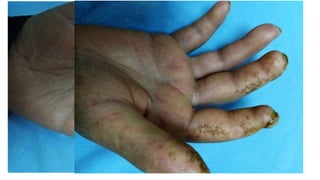
Sever cases can progress to ulceration / amputation.
Primary RP is benign.
II- Skin changes:
Initially swollen, puffy (pre-scleroderma) later become tight.
III- Musculoskeletal:
1/3 to ½ patients.
Symmetric polyarthritis resembling RA.
Carpel tunnel syndrome, tendon frication rub.
Muscle weakness: 5% LcSSc, 50% dcSSc.
3 pattern:
 Diffuse atrophy, arthralgia, morning stiffness; majority
 Scleroderma myopathy, not associated with elevated muscle enzyme.
 Full blown myositis, with elevated muscle enzyme undistinguished from
PM/DM (overlap SSc/PM, DM).
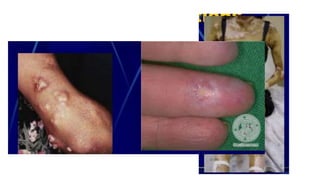
Calcinosis cutis:
Hypopigmentation:
IV- GIT:
>50% of SSc.
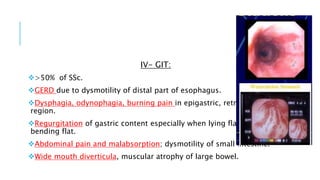
GERD due to dysmotility of distal part of esophagus.
Dysphagia, odynophagia, burning pain in epigastric, retrosternal
region.
Regurgitation of gastric content especially when lying flat or
bending flat.
Abdominal pain and malabsorption; dysmotility of small intestine.
Wide mouth diverticula, muscular atrophy of large bowel.
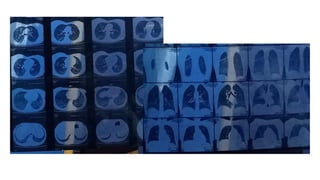
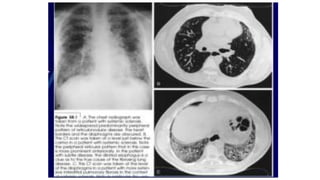
PULMONARY INVOLVEMENT:
25% of lcSSc, 50% dcSSc.
Exertional dyspnea, dry non productive cough.
On examination; bilateral basilar rales.
Three forms:
1. Pulmonary interstitial fibrosis (IPF); dcSS, anti-TOPI
2. Pulmonary hypertension; lcSSc, ACA.
3. Pulmonary alveolitis precede IPF.
Can detected by:
1. HRCT; increase reticular and nodular pattern (ground glass opacity).
2. BAL: increase alveolar macrophage, neutrophil, eosinophil, CD8 T
lymphocyte.
3. Spirometry: ↓FVC, TLC, ↓TLCO >> IPF.
↓TLC>>PH
Pulmonary symptoms can parallel progression of
skin disease
CARDIAC:
10% lcSSc, 20%dcSSc, both limited and diffuse scleroderma.
Most cases are subclinical.
Poor prognosis.
Either
• Primary (abnormalities of intra myocardial circulation/myocardial
fibrosis, cardiomyopathy) or
• Secondary(p HTN or systemic hypertension).
Affect all layer of the heart.
 Conduction abnormalities, arrythmia.
 Left side heart failure.
 Pericardial effusion, silent.
ECHO, Thallium scanning, electrophysiology studies.
RENAL, SRC:
2% lcssc, 6-30%dcssc.
 Risk factors for SRC:
I. male patients
II. prednisolone more than 25mg/day.
III. antibodies to RNA polymerase III
I. cardiac affection (pericarditis)
 Renal crisis:
I. Rise in DBP>10mmhg,
II. Decrease clearance during final week
III. Hematuria or proteinuria or
IV. Schistocyte or
V. Retinal hemorrhage or
VI. Microangiopathic hemolytic anemia or papilledema.
RENAL, SRC (CONT)
Poor outcome of SSc renal crisis:
1. Male.
2. Older age.
3. Creatine above 3 mg/dl.
 Crisis may occur with normal BP.
ACEI reduce rate of SRC.
MORTALITY:
1. Renal crisis.
2. Pulmonary hypertension.
3. Cardiac related mortality 15%.
MANAGEMENT:
I- Vascular therapy, RP:
Smoking is prohibited.
Drugs that aggravate VC are contraindicated.
CCBS; Nifedipine, Diltiazem, amlodipine.
ACEIS, ARBS: Losartan, effective in short term RP.
Nitro-glycerine; local or oral.
Phosphodiestrase type 5 inhibitors: Sildenafil.
Antiplatelet agents; Aspirin, dipyridamole.
Anticoagulant: heparin, oral warfarin.
Prostaglandins and their analogues;
 PGD2,PGI2, Prostacyclin, PGE2, PGF2a
 lead to smooth muscle relaxation, short half life.
 Analogues has longer half life.
Carboprostacyclin (illprost): synthetic analogues of prostacyclin
• Inpatients, slow infusion, 0.5 to 2ng/kg/min for 6 hour per day for 4
weeks.
Sever ischemia which can lead to digital gangrene.
Vasodilatation effect, alter platelet aggregation, decrease blood
viscosity, alter neutrophil functions.
Oral iliprost, same efficacy.
Sympathectomy
II-Immunomodulators
Cyclosporine:
 Inhibit cell mediated immunity, collagen synthesis by activated
fibroblast.
 HTN, hypertrichosis, deteriorate renal function.
Methotrexate:15mg/week.
 Reduce skin involvement. Less effect in dcSSc.
 May exacerbate cough, asthma, alveolitis.
Photopheresis (PUVA):
Inhibit activated T cell by extracorporeal photoactivated 8-
methoxypsoralen.
B cell depletion (Rituximab): improve skin and lung in most cases.
Anti-interleukin-6 receptor antibody: a promising target for the
treatment of SSc,
tocilizumab, a humanized monoclonal antibody against the human
IL-6 receptor, appeared to improve skin sclerosis and stabilize ILD in
case reports
Autologous stem cell transplantation:
 Reprogramming of the immune cell,
 eliminating autoreactive T cell and infusing their progenitor, CD34 positive stem cell.
 Skin score improved, but no lung, patient died.
III- Antifibrotics:
D-pencillamine
Interferon (α,β).
Pirfenidone
Imatinib mesylate
Rapamycin
ORGAN SPECIFIC MANAGEMENT:
Intersititial lung disease
Prednisolone, cyclophosphamide (oral or pulse therapy).
Mycofenalate mofetil (MMF), Cyclosporine, Azathioprine.
Pulmonary hypertension:
CCBs, ACEIs.
Anticoagulants; Warfarin.
Phosphodiesterase type 5 inhibitors: Sildenafil.
Endothelin receptors antagonist; Ambrisenten, sitaxsentan.
Carboprostacyclin (Illoprost); direct infusion, pulmonary artery or inhaled or
oral.
Home oxygen to reduce vascular resistant in pulmonary hypertension.
Follow up with HRCT, Spirometry, PIF score.
Renal disease:
Prevention,
 Dose of steroid less than 20 mg/ daily.
 Control of hypertension by ACEIS.
Treatment in SRC:
 Hospitalization
 High dose captopril or enalapril.
 Short term hemodialysis if necessary.
 Monitoring for development of microangiopathy hemolytic anemia.
GIT
H2 blockers or proton pump inhibitors; dysphagia, GERD.
Prokinetic, somatostatin analogues, metoclopramide, octreotide;
hypomotility of intestine.
Antibiotics, nutritional supplement, vitamins and low residue diets;
malabsorption.
Pseud obstruction of large bowel, treated carefully after
hospitalization, IV fluids.
Cardiac:
Empirical, depend on type
Scleroderma
Scleroderma

Scleroderma

  • 1.
    MARWA ABO ALMAATYBESAR LECTURER OF INTERNAL MEDICINE (RHEUMATOLOGY&IMMUNOLOGY UNIT) (PEDIATRIC RHEUMATOLOGY) Scleroderma,S S
  • 2.
    38 year oldwoman presents with 3 months of progressive fatigue and dyspnea that limits her ability to climb the steps in her two story house. Her past medical history is remarkable for a ten year history of Raynaud’s phenomenon which is treated with nifedipine. Blood pressure – 130/75, Pulse 90, Respiratory Rate14, Pulse oximetry 92% on Room Air. Physical exam reveals clear lungs bilaterally, and an S3. Skin is remarkable for palmar and facial telangiectasias and thickening of the skin overlying the fingers. Chest radiograph, EKG, and CBC are normal  What additional test would you order for the patient?  Consider your Diagnosis
  • 3.
    SCLERODERMA Scleroderma = Systemicsclerosis = progressive systemic sclerosis. SS = hard skin. Multisystemic, autoimmune disease affecting small arteries, micro vessels and fibroblast result in vascular obliteration, collagen accumulation and scarring (fibrosis) of skin and internal organs. Vascular : Raynaud's phenomenon  Digital ischemia, ulcer, gangrene. Skin changes:
  • 4.
    EPIDEMIOLOGY: Worldwide, all race. Annualincidence 14.1/ million cases. 3rd and 5th decade. Female: male= 5:1 Sever disease in young black women.
  • 5.
    PATHOPHYSIOLOGY: Autoimmunity ANA 90% Anti-DNA topoisomeraseI (Scl-70) 20-40% Anti-centromere antibodies 50-96% Fibrosis Increased production of collagen, glycosaminoglycan and fibronectin. Scleroderma fibroblasts contain a higher percentage of fibroblasts resistant to anti-Fas- mediated killing - ?apoptosis defect Vascular changes Endothelial injury Intimal proliferation Alterations in vasoactive substances Platelet aggregation – induced by cooling
  • 8.
    Diffuse cutaneous SScLimited cutaneous SSc Raynaud phenomenon Common, follow other features Before onset of skin changes Thickening of the skin Trunk, acral skin Limited to hands, feet, face. Tendon friction rub More frequent Less frequent Systemic affection Pulmonary fibrosis, oliguric renal crsis, diffuse GIT, heart failure, caradiac arrhytemia Pulmonary hypertension, skin calcification, telangiectasia. ACA absent Highly prevalent antibodies TOPO-1, RNA polymerases 1,II,III
  • 9.
    CLINICAL MANIFESTATION: I- Raynaud'sphenomenon: Vasospastic disease. Episodic, reversible sequential expression of pallor, cyanosis, redness of the digits, ears, nose. Repeated attacks of vasospasm/dilatation in response to cold/emotions. Sever cases can progress to ulceration / amputation. Primary RP is benign.
  • 14.
    II- Skin changes: Initiallyswollen, puffy (pre-scleroderma) later become tight.
  • 17.
    III- Musculoskeletal: 1/3 to½ patients. Symmetric polyarthritis resembling RA. Carpel tunnel syndrome, tendon frication rub. Muscle weakness: 5% LcSSc, 50% dcSSc. 3 pattern:  Diffuse atrophy, arthralgia, morning stiffness; majority  Scleroderma myopathy, not associated with elevated muscle enzyme.  Full blown myositis, with elevated muscle enzyme undistinguished from PM/DM (overlap SSc/PM, DM). Calcinosis cutis: Hypopigmentation:
  • 19.
    IV- GIT: >50% ofSSc. GERD due to dysmotility of distal part of esophagus. Dysphagia, odynophagia, burning pain in epigastric, retrosternal region. Regurgitation of gastric content especially when lying flat or bending flat. Abdominal pain and malabsorption; dysmotility of small intestine. Wide mouth diverticula, muscular atrophy of large bowel.
  • 20.
    PULMONARY INVOLVEMENT: 25% oflcSSc, 50% dcSSc. Exertional dyspnea, dry non productive cough. On examination; bilateral basilar rales. Three forms: 1. Pulmonary interstitial fibrosis (IPF); dcSS, anti-TOPI 2. Pulmonary hypertension; lcSSc, ACA. 3. Pulmonary alveolitis precede IPF. Can detected by: 1. HRCT; increase reticular and nodular pattern (ground glass opacity). 2. BAL: increase alveolar macrophage, neutrophil, eosinophil, CD8 T lymphocyte. 3. Spirometry: ↓FVC, TLC, ↓TLCO >> IPF. ↓TLC>>PH Pulmonary symptoms can parallel progression of skin disease
  • 23.
    CARDIAC: 10% lcSSc, 20%dcSSc,both limited and diffuse scleroderma. Most cases are subclinical. Poor prognosis. Either • Primary (abnormalities of intra myocardial circulation/myocardial fibrosis, cardiomyopathy) or • Secondary(p HTN or systemic hypertension). Affect all layer of the heart.  Conduction abnormalities, arrythmia.  Left side heart failure.  Pericardial effusion, silent. ECHO, Thallium scanning, electrophysiology studies.
  • 24.
    RENAL, SRC: 2% lcssc,6-30%dcssc.  Risk factors for SRC: I. male patients II. prednisolone more than 25mg/day. III. antibodies to RNA polymerase III I. cardiac affection (pericarditis)  Renal crisis: I. Rise in DBP>10mmhg, II. Decrease clearance during final week III. Hematuria or proteinuria or IV. Schistocyte or V. Retinal hemorrhage or VI. Microangiopathic hemolytic anemia or papilledema.
  • 25.
    RENAL, SRC (CONT) Pooroutcome of SSc renal crisis: 1. Male. 2. Older age. 3. Creatine above 3 mg/dl.  Crisis may occur with normal BP. ACEI reduce rate of SRC.
  • 30.
    MORTALITY: 1. Renal crisis. 2.Pulmonary hypertension. 3. Cardiac related mortality 15%.
  • 31.
    MANAGEMENT: I- Vascular therapy,RP: Smoking is prohibited. Drugs that aggravate VC are contraindicated. CCBS; Nifedipine, Diltiazem, amlodipine. ACEIS, ARBS: Losartan, effective in short term RP. Nitro-glycerine; local or oral. Phosphodiestrase type 5 inhibitors: Sildenafil. Antiplatelet agents; Aspirin, dipyridamole. Anticoagulant: heparin, oral warfarin.
  • 32.
    Prostaglandins and theiranalogues;  PGD2,PGI2, Prostacyclin, PGE2, PGF2a  lead to smooth muscle relaxation, short half life.  Analogues has longer half life. Carboprostacyclin (illprost): synthetic analogues of prostacyclin • Inpatients, slow infusion, 0.5 to 2ng/kg/min for 6 hour per day for 4 weeks. Sever ischemia which can lead to digital gangrene. Vasodilatation effect, alter platelet aggregation, decrease blood viscosity, alter neutrophil functions. Oral iliprost, same efficacy. Sympathectomy
  • 33.
    II-Immunomodulators Cyclosporine:  Inhibit cellmediated immunity, collagen synthesis by activated fibroblast.  HTN, hypertrichosis, deteriorate renal function. Methotrexate:15mg/week.  Reduce skin involvement. Less effect in dcSSc.  May exacerbate cough, asthma, alveolitis. Photopheresis (PUVA): Inhibit activated T cell by extracorporeal photoactivated 8- methoxypsoralen.
  • 34.
    B cell depletion(Rituximab): improve skin and lung in most cases. Anti-interleukin-6 receptor antibody: a promising target for the treatment of SSc, tocilizumab, a humanized monoclonal antibody against the human IL-6 receptor, appeared to improve skin sclerosis and stabilize ILD in case reports Autologous stem cell transplantation:  Reprogramming of the immune cell,  eliminating autoreactive T cell and infusing their progenitor, CD34 positive stem cell.  Skin score improved, but no lung, patient died.
  • 35.
  • 36.
    ORGAN SPECIFIC MANAGEMENT: Intersititiallung disease Prednisolone, cyclophosphamide (oral or pulse therapy). Mycofenalate mofetil (MMF), Cyclosporine, Azathioprine. Pulmonary hypertension: CCBs, ACEIs. Anticoagulants; Warfarin. Phosphodiesterase type 5 inhibitors: Sildenafil. Endothelin receptors antagonist; Ambrisenten, sitaxsentan. Carboprostacyclin (Illoprost); direct infusion, pulmonary artery or inhaled or oral. Home oxygen to reduce vascular resistant in pulmonary hypertension. Follow up with HRCT, Spirometry, PIF score.
  • 37.
    Renal disease: Prevention,  Doseof steroid less than 20 mg/ daily.  Control of hypertension by ACEIS. Treatment in SRC:  Hospitalization  High dose captopril or enalapril.  Short term hemodialysis if necessary.  Monitoring for development of microangiopathy hemolytic anemia.
  • 38.
    GIT H2 blockers orproton pump inhibitors; dysphagia, GERD. Prokinetic, somatostatin analogues, metoclopramide, octreotide; hypomotility of intestine. Antibiotics, nutritional supplement, vitamins and low residue diets; malabsorption. Pseud obstruction of large bowel, treated carefully after hospitalization, IV fluids. Cardiac: Empirical, depend on type